Content Menu
● What Is Mobile Air Conditioning in an Event Context?
>> Typical Mobile Systems Used for Events
>> Characteristics of Central HVAC Systems
● Deployment and Installation: Speed vs Stability
>> Time Constraints in Temporary Events
>> Structural and Site Requirements
● Comfort Performance and Experience for Attendees
>> Zone Cooling vs Whole-Building Coverage
>> Noise, Air Quality, and Perceived Quality
● Cost, Energy Use, and Event ROI
>> Short-Term Projects vs Long-Term Buildings
>> Energy Consumption Patterns
● Flexibility, Scalability, and Risk Management
>> Building a Customized Mobile Cooling Portfolio
● Practical Selection Framework for Event Cooling
● When Central HVAC Is Still the Primary Choice
>> Indoor Venues and Long-Term Operations
● Perspectives from Field Experience
>> Lessons from Temporary Event Projects
● Overall Direction for Temporary Event Cooling
● FAQs
>> 1. Can mobile air conditioning handle large crowds in tents or temporary halls?
>> 2. Is it possible to combine mobile systems with existing central air in one event?
>> 3. How early should cooling be planned for a temporary event?
>> 4. What factors most influence the choice between mobile and central systems?
>> 5. Are mobile systems suitable for repeated events at the same location?
Mobile air conditioning is generally better suited to short-term, flexible event cooling projects, while central HVAC systems are better for large permanent venues that require long-term whole-building climate control. For most temporary events, mobile solutions deliver faster deployment, more precise comfort in critical zones, and a more adaptable setup when layouts or attendance change at the last minute.
Temporary events operate under intense time pressure, variable attendance, and changing layouts. In this environment, cooling is not just a technical requirement; it is a critical part of the guest experience, equipment safety, and staff productivity. Mobile air conditioning and central HVAC systems can both create comfortable conditions, but they address fundamentally different use cases. From a practitioner’s standpoint, the most important distinction is that one system is designed to move with the event, while the other is designed to stay with the building.
What Is Mobile Air Conditioning in an Event Context?
Typical Mobile Systems Used for Events
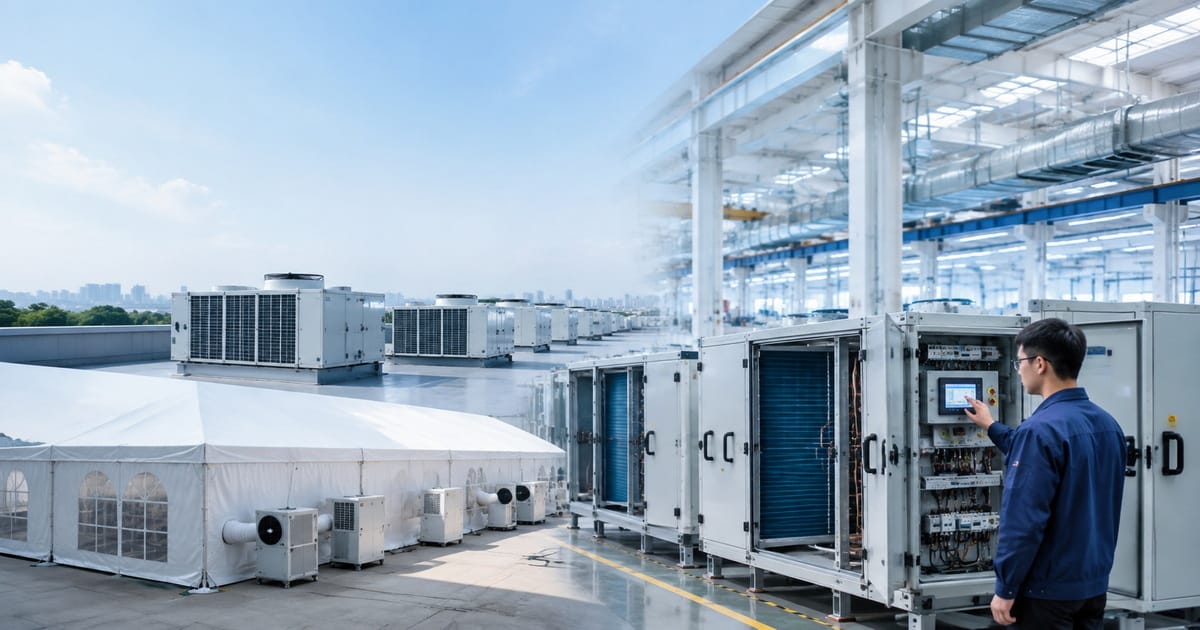
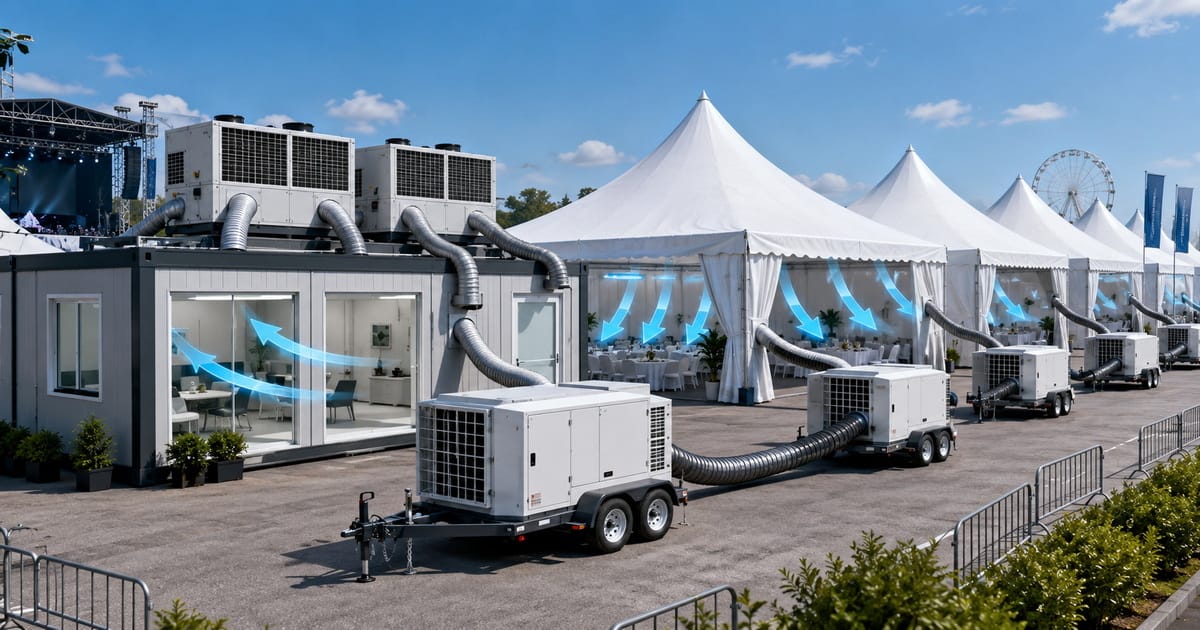
In the event world, mobile air conditioning refers to equipment that can be transported, installed, and removed without major construction work. Common solutions include:
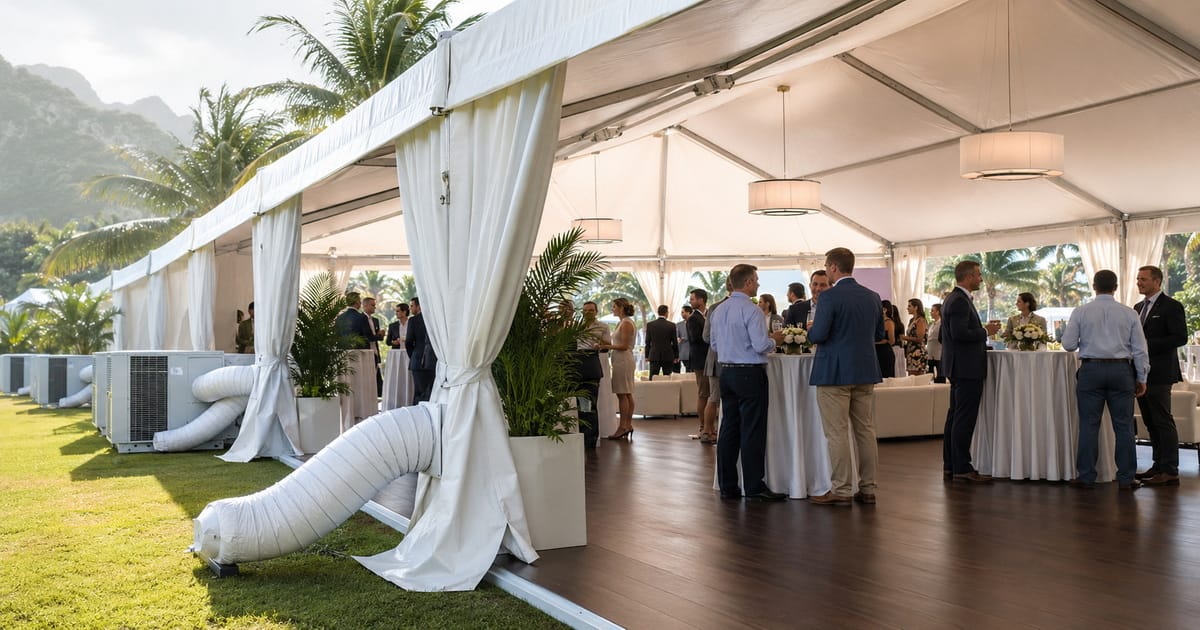
– Tent air conditioners feeding cooled air into enclosed or semi-enclosed structures.
– Rooftop units installed on modular buildings, hospitality suites, or large tents.
– Trailer-mounted systems delivered as complete cooling packages that connect to power and ducting on site.
– Fresh-air and ventilation units designed to handle CO₂ buildup, odors, and humidity in crowded spaces.
These systems are built specifically to be relocated between sites, scaled up or down depending on attendance, and adapted to different climates and event formats. For organizers, the key advantage is the ability to deploy cooling where it is needed most, without relying on existing building infrastructure.
Characteristics of Central HVAC Systems
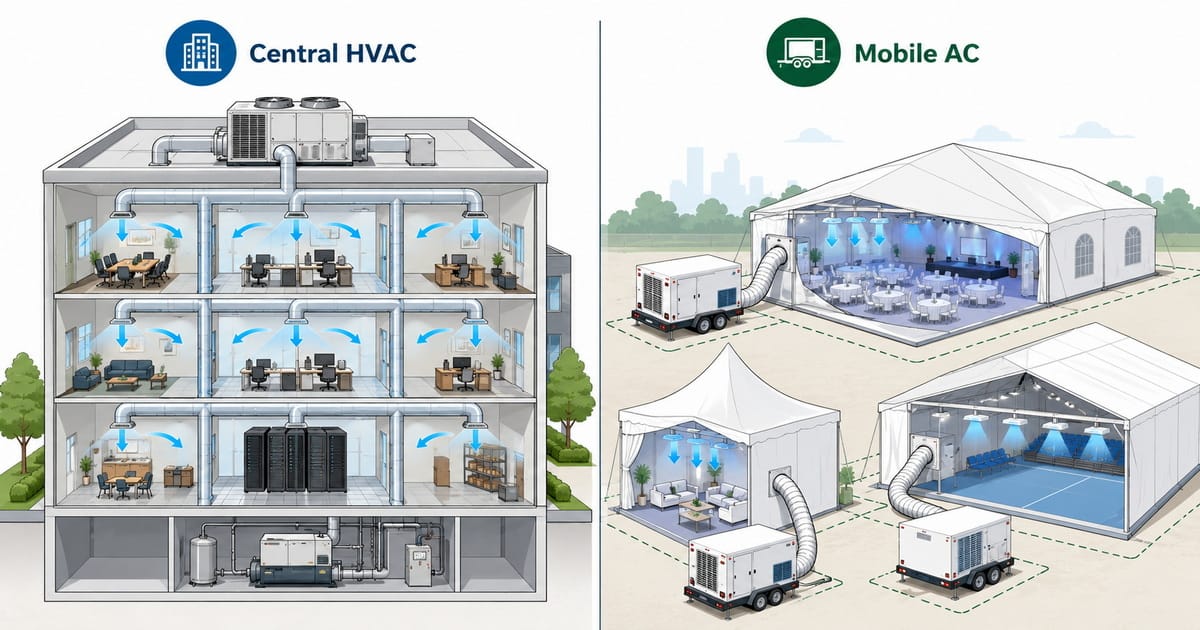
Central HVAC systems are permanent installations within a building. They typically include large chillers or rooftop units, extensive duct networks, and integrated control systems managed as part of the facility’s overall infrastructure. Their strengths lie in:
– Whole-building coverage, providing uniform temperature and airflow across many rooms and levels.
– Long-term efficiency, optimized around the building’s typical occupancy and usage patterns.
– Stable operation, with maintenance and performance managed by facility teams.
For large stadiums, convention centers, and exhibition halls, central systems offer reliable, continuous climate control. However, they are not designed to be moved or radically reconfigured when an event requires temporary tents, outdoor stages, or pop-up structures.
Deployment and Installation: Speed vs Stability
Time Constraints in Temporary Events
One of the most practical differences between mobile air conditioning and central HVAC is deployment speed. Temporary events often have only days—or even hours—between site access and doors opening. In this window, organizers must build structures, install electrical and communications systems, and set up all technical equipment.
Mobile air conditioning is designed for this reality. Units can be delivered on trailers or pallets, positioned around tents and modular buildings, and connected to flexible ducting in a short time frame. Electrical connections are planned to work with temporary power supply setups, including generators. Once the event ends, the same systems are removed and transported to the next site.
Central HVAC, by contrast, depends on infrastructure that must be designed and built long in advance. Ducts, structural supports, and plant rooms are part of the building itself. While central systems offer stability and long-term performance, they cannot be quickly introduced to a greenfield site or heavily modified for a unique event layout without substantial construction.
Structural and Site Requirements
Mobile AC systems require minimal permanent structural work. As long as there is space to position units and route ducts, cooling can be provided to tents, pavilions, temporary offices, backstage areas, and equipment rooms. This makes them ideal for:
– Outdoor festivals and fan zones built on open land.
– Traveling roadshows setting up in parking lots or temporary venues.
– Temporary camps and worksites with modular buildings.
Central HVAC systems, on the other hand, need a completed building with fixed walls, ceilings, and mechanical rooms. Their reach is defined by the duct network and the design conditions used when the building was constructed. This works well for long-term operations, but limits flexibility when the event footprint extends beyond the permanent envelope of the venue.
Comfort Performance and Experience for Attendees
Zone Cooling vs Whole-Building Coverage
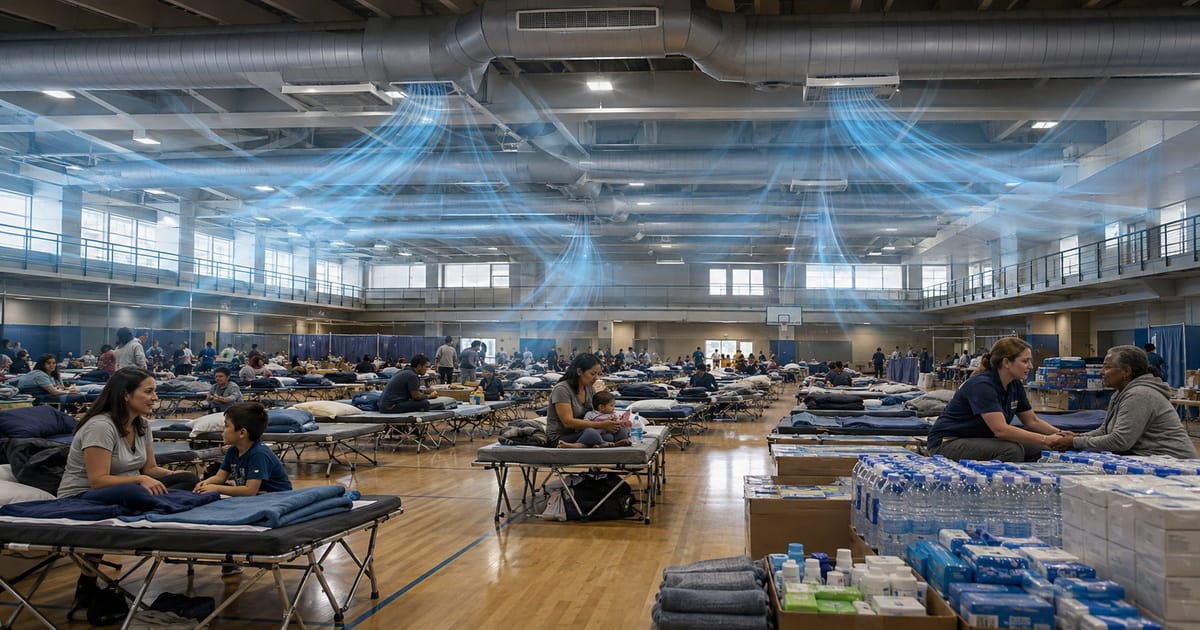
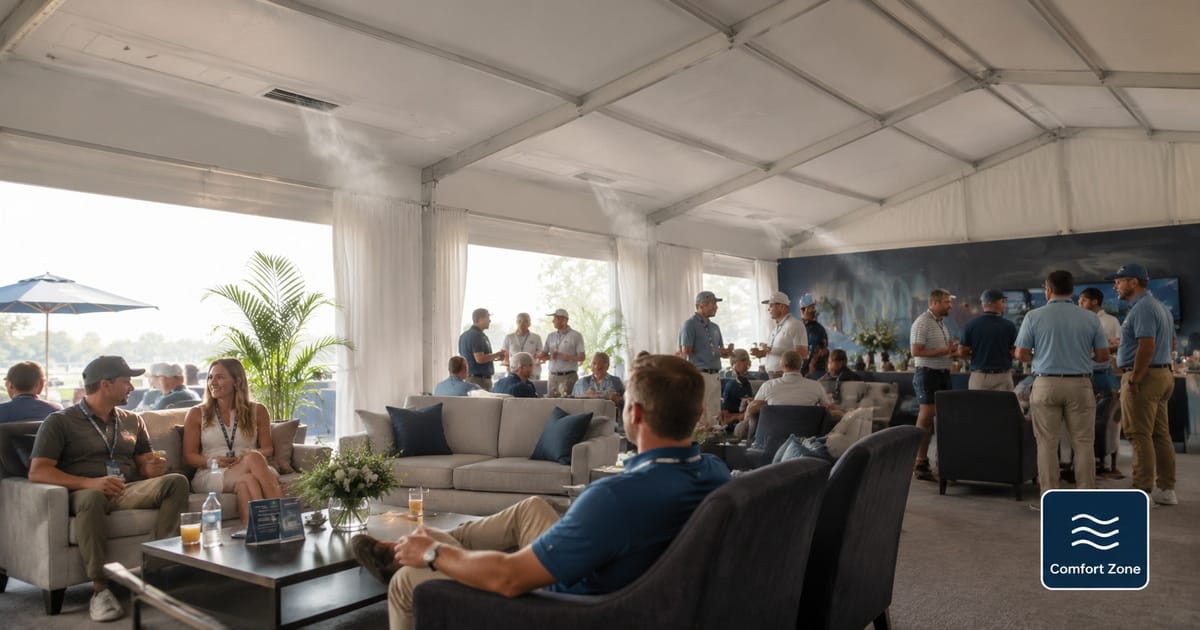
From an attendee perspective, comfort depends on temperature, airflow, humidity, and perceived freshness of the air. Central HVAC systems deliver a consistent environment across the entire building, provided they are well maintained and appropriately sized. This is ideal for indoor conventions, sports events in enclosed arenas, and conferences taking place in hotels or permanent exhibition centers.
Mobile air conditioning takes a different approach. Rather than cooling everything, it focuses on zone cooling. Organizers can prioritize locations where comfort has the greatest impact, such as:
– Audience seating or standing areas in tents or covered stages.
– VIP lounges, hospitality suites, and sponsor activations.
– Control rooms, broadcast facilities, and equipment zones.
By focusing cooling capacity on these areas, mobile systems can deliver strong thermal comfort where it matters most, while leaving less critical areas with lighter conditioning or natural ventilation. This targeted strategy often makes more sense for temporary projects than attempting full-site coverage.
Noise, Air Quality, and Perceived Quality
Another important dimension is the sensory experience. Central HVAC systems usually place noisy components, such as compressors, away from occupied spaces, while ducts quietly deliver air indoors. The result is low noise and steady airflow.
Mobile systems must be managed carefully to achieve similar results. Units are typically placed outside tents and structures, with ducting carrying cooled air inside. By positioning equipment at a distance and using properly designed ducts and diffusers, it is possible to maintain acceptable noise levels even at large events. Fresh-air and ventilation units are crucial as well, ensuring that CO₂ and humidity remain within comfortable ranges in crowded spaces. When these elements are planned correctly, guests experience a comfortable, fresh environment without being distracted by mechanical noise or drafts.
Cost, Energy Use, and Event ROI
Short-Term Projects vs Long-Term Buildings
Central HVAC is usually justified by long-term building operations. The capital investment covers equipment, installation, ducts, and integration with control systems. Over many years, this can result in efficient operation and predictable cost.
Temporary events face a different economic reality. They run for a limited period, in a specific location, and then move on. For these projects, the key cost questions are:
– How much does it cost to cool the event during the limited time it operates?
– How much structural work is required to introduce cooling?
– How quickly can cooling be reused at the next event or site?
Mobile air conditioning fits this model better. Organizers or service providers can deploy units as rentals or project-based assets, pay only for the duration of the event, and avoid long-term building investments. Because units can be reused across multiple events and locations, their cost can be spread across a portfolio of projects.
Energy Consumption Patterns
Energy performance depends heavily on how systems are used. Central HVAC systems often show strong efficiency for full-building, continuous operation. However, for short-term, highly localized cooling needs, mobile systems can be effective by focusing their output on specific areas and times.
If mobile units are correctly sized, installed, and operated with attention to tent insulation, internal heat gains, and climate conditions, they can deliver a good balance between comfort and energy use. In many events, nighttime temperatures, intermittent load profiles, and the ability to switch off some zones when not in use all contribute to keeping consumption under control. The key is careful planning and realistic expectations around which areas need high comfort, and when.
Flexibility, Scalability, and Risk Management
Adapting to Uncertainty
Events carry a high degree of uncertainty. Ticket sales may exceed expectations, weather can change, and sponsors might decide to expand activations at short notice. Central HVAC systems are relatively rigid; they provide a fixed amount of capacity across the building according to a pre-defined design. Major changes require engineering and construction.
Mobile air conditioning offers more adaptability. Additional units can be brought in if demand rises or specific zones require higher capacity. Units can be relocated between tents and structures as layouts evolve. Backup units can be included in the plan to handle extreme heat or unexpected occupancy. From a risk management perspective, this mobility is valuable, especially for outdoor and temporary projects where conditions are difficult to predict months in advance.
Building a Customized Mobile Cooling Portfolio
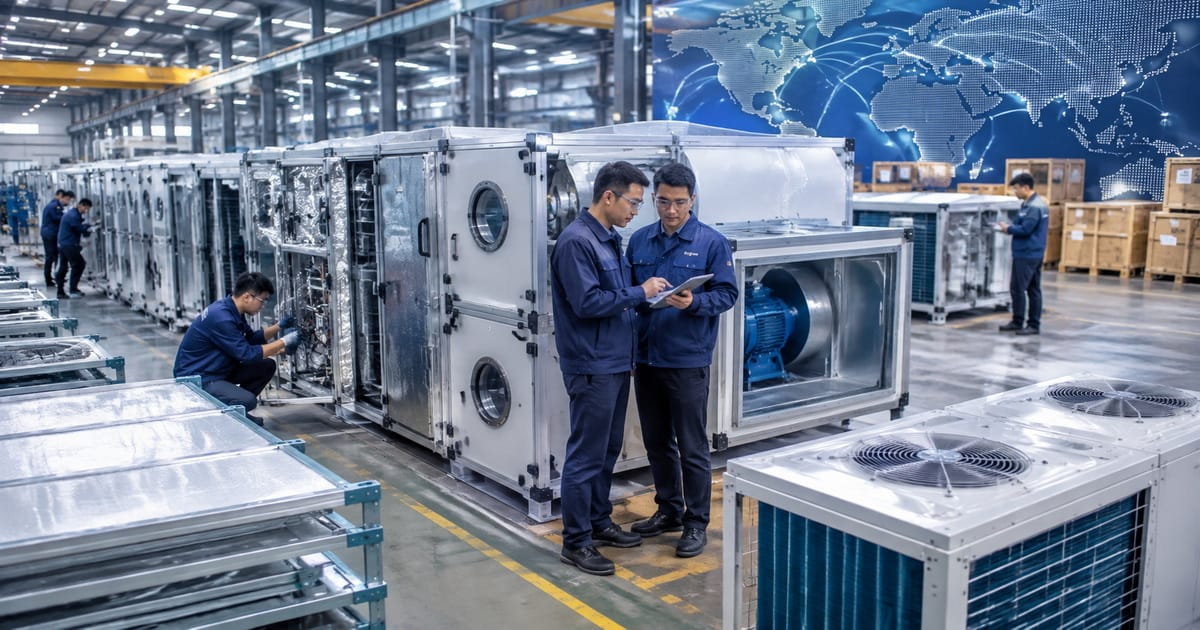
For companies that supply climate control equipment to event organizers, wholesalers, or brand owners, there is an opportunity to develop a tailored portfolio of mobile solutions. This can include:
– Standardized tent AC units for common structure sizes.
– Rooftop units designed for modular buildings and hospitality suites.
– Trailer-mounted systems that integrate cooling, controls, and power interfaces.
– Fresh-air and ventilation modules matching typical event occupancy profiles.
By standardizing capacities, connection interfaces, and control strategies across this portfolio, suppliers can deliver consistent performance while keeping deployment straightforward for their customers. This approach helps build recognizable product families that can be promoted to international markets and adapted to regional climate requirements.
Practical Selection Framework for Event Cooling
Step-by-Step Evaluation
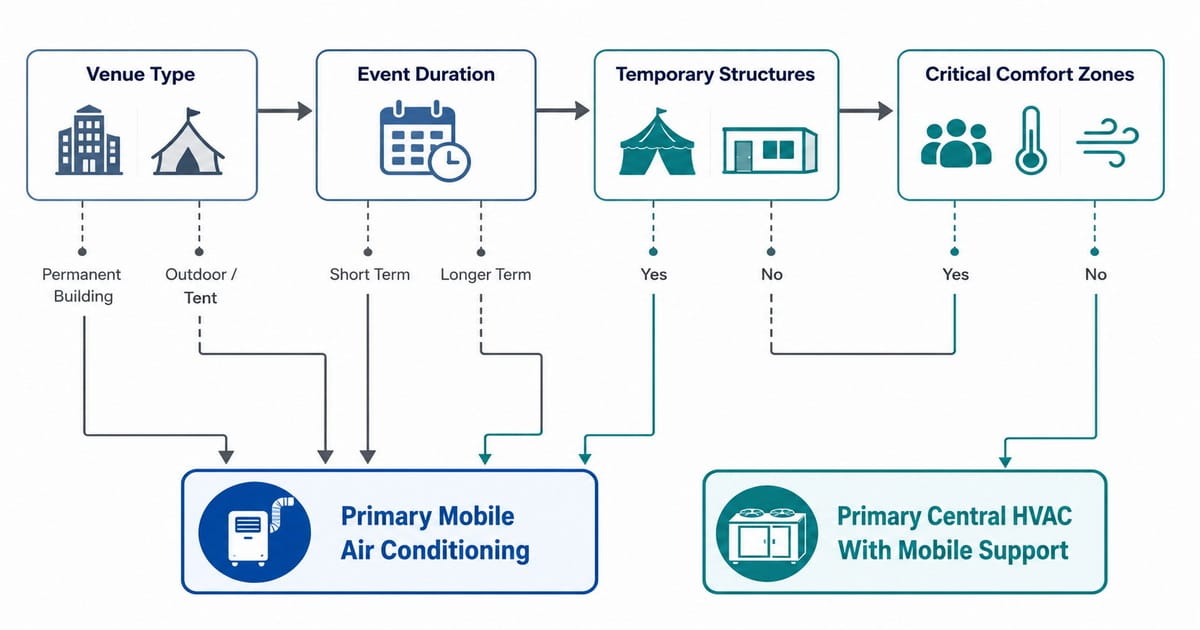
To decide whether mobile air conditioning or central HVAC should be the primary cooling strategy for a specific event, it is helpful to follow a structured evaluation:
1. Review the venue type
– If the event takes place entirely inside a permanent building with robust existing systems, using the central installation as the base solution makes sense.
– If significant portions of the event occur in tents, temporary halls, or outdoor zones, mobile systems should be considered essential.
2. Consider event duration and recurrence
– Short-term events, limited festivals, and touring projects benefit most from mobile solutions.
– Recurring events in the same permanent venue may justify investments in upgrades to central systems, with mobile units reserved for extensions or peak periods.
3. Identify critical comfort zones
– Focus on spaces where thermal comfort has direct impact on satisfaction, sales, or brand perception.
– Map out these areas and assign appropriate capacities, whether through mobile units or existing central air.
4. Check infrastructure and logistical constraints
– Confirm available power capacity, space for equipment placement, and routes for ducting.
– Evaluate site access for delivery vehicles and trailers.
5. Combine systems where appropriate
– In many cases, the best solution is a combination of central HVAC for permanent indoor spaces and mobile systems for temporary extensions and high-priority zones.
This structured evaluation helps avoid over-engineering while ensuring that cooling capacity is aligned with actual event needs.
When Central HVAC Is Still the Primary Choice
Indoor Venues and Long-Term Operations
There are many situations where central HVAC remains the natural primary solution. Large indoor exhibitions in convention centers, major sports events inside fully enclosed stadiums, and corporate conferences in hotels all rely on permanent systems that have been designed around typical occupancy.
In these cases, mobile air conditioning can play a supporting role rather than a dominant one. Extra units can be introduced to serve temporary structures attached to the building, respond to unusually high occupancy in specific rooms, or provide redundancy during periods of extreme climate stress or maintenance. This layered strategy respects the strengths of central HVAC while adding the versatility of mobile solutions where needed.
Perspectives from Field Experience
Lessons from Temporary Event Projects
Practical experience from temporary event cooling projects tends to highlight several recurring points:
– Early planning is crucial: Temperature and airflow targets must be defined when layouts are still flexible.
– Realistic expectations about outdoor comfort help avoid overpromising; in open or semi-open spaces, it is more effective to focus cooling on key areas rather than attempting to condition entire sites.
– Coordination between power, structures, and cooling equipment reduces last-minute issues.
Organizers who adopt mobile air conditioning as a strategic tool, rather than a last-minute addition, usually achieve better comfort and fewer operational surprises. When central HVAC is part of the picture, aligning building teams and event technical teams early in the process prevents conflicts over capacity and on-site responsibilities.
Overall Direction for Temporary Event Cooling
For temporary event cooling, mobile air conditioning typically offers more flexibility, faster deployment, and better alignment with project timelines than central HVAC systems. Central systems remain highly effective for permanent venues, but they are limited by their fixed nature and dependence on the building envelope. In many modern event projects, the most robust solution is neither purely mobile nor purely central, but a thoughtful combination of both, with mobile units concentrating on temporary areas and critical comfort zones.
By viewing climate control as an integral part of event design—rather than a purely technical afterthought—organizers and suppliers can create environments that are more comfortable, resilient, and adaptable. This mindset supports better guest experiences and more reliable operations across a wide variety of event formats and locations.
FAQs
1. Can mobile air conditioning handle large crowds in tents or temporary halls?
Yes, when capacities are correctly calculated and units are properly installed, mobile systems can handle high occupancy in tents and modular structures, provided airflow and fresh air delivery are addressed.
2. Is it possible to combine mobile systems with existing central air in one event?
It is common to combine both. Central systems serve permanent indoor spaces, while mobile units support temporary structures, high-density areas, and locations beyond the reach of the building’s ducts.
3. How early should cooling be planned for a temporary event?
Cooling should be considered when layouts, structures, and power plans are first defined. Early planning allows realistic sizing, placement of equipment, and coordination with other technical disciplines.
4. What factors most influence the choice between mobile and central systems?
Key factors include venue type, event duration, share of temporary structures, power availability, and the importance of comfort in specific zones such as VIP areas or critical equipment rooms.
5. Are mobile systems suitable for repeated events at the same location?
They are suitable for repeated events, especially when structures or layouts change between editions. Over time, a combination of permanent improvements and standardized mobile setups often delivers the best balance of performance and flexibility.
References
1. APGE. “Portable AC Units vs Central Air: Which Uses Less Electricity?”
<https://www.apge.com/blog/portable-ac-units-vs-central-air-which-uses-less-electricity>
2. Queen City HVAC. “How Do Portable AC Units Compare to Central Air?”
<https://queencityhvac.com/how-do-portable-ac-units-compare-to-central-air-conditioning/>
3. Home Comfort Inc. “Portable vs. Central Air Conditioners: Pros and Cons.”
<https://www.homecomfortinc.com/portable-vs-central-air-conditioners-pros-and-cons/>
4. Preferred Climate Solutions. “Best Portable Cooling Solutions for Any Events.”
<https://preferredclimatesolutions.com/best-portable-cooling-solutions-for-any-events/>
5. Dale’s AC. “Portable AC vs Central Air Systems: A Comparison.”
<https://dalesac.com/blog/portable-ac-vs-central-air-systems/>
6. Milani. “Central AC vs Portable AC.”
<https://www.milani.ca/blog/central-ac-vs-portable-ac/>
7. EquipmentShare. “The Best Event Cooling Solutions for Outdoor Spaces.”
<https://www.equipmentshare.com/articles/the-best-event-cooling-solutions-for-outdoor-spaces>
8. Vankool. “Best Portable Air Cooler for Outdoor Events & Large Spaces in 2026.”
<https://vankool.com/best-portable-air-cooler-for-outdoor-events-large-spaces/>
Hot Tags:Mobile Air Conditioning,Central HVAC System,Temporary Event Cooling,Industrial Tent Air Conditioner,Trailer Mounted AC Unit,Rooftop Packaged AC Unit,Temporary HVAC Rental Services,Event Climate Control Solutions,Mobile Air Conditioning OEM ODM,Portable Cooling Systems For Events