Content Menu
● What Makes Emergency Shelter Cooling Different?
● Fresh Air Conditioning vs. Standard HVAC
● How Standard HVAC Cooling Works
>> Where Standard HVAC Systems Can Fall Short
● What Fresh Air Conditioning Adds
>> 1. Controlled Outdoor Air Instead of Unmanaged Infiltration
>> 2. Better Humidity Control for Crowded Shelters
>> 3. Enhanced Filtration and Supplemental Air Cleaning
● Emergency Shelter HVAC Decision Framework
>> Step 1: Define the Shelter Scenario
>> Step 2: Separate Cooling Load From Ventilation Need
>> Step 3: Plan for Clean-Air Modes
>> Step 4: Verify Power Resilience
>> Step 5: Monitor, Maintain, and Document
● Avoid the “More Fresh Air Is Always Better” Myth
● When to Choose Each Solution
>> Choose Standard HVAC Cooling When
>> Choose Fresh Air Conditioning for Emergency Shelters When
● OEM and ODM Considerations for Shelter Projects
>> 1. What is fresh air conditioning for emergency shelters?
>> 2. Can a standard HVAC cooling system be used in an emergency shelter?
>> 3. Why is humidity control important in emergency shelters?
>> 4. Should emergency shelters bring in maximum outdoor air all the time?
>> 5. Is MERV 13 filtration always suitable for existing HVAC equipment?
>> 6. What monitoring equipment should an emergency shelter use?
>> 7. Can fresh air conditioning systems run on emergency generators?
Fresh air conditioning for emergency shelters is not simply “standard air conditioning with outside air added.” In high-occupancy, fast-changing, and often resource-constrained shelter environments, the HVAC strategy must manage cooling, humidity, ventilation, filtration, airflow distribution, resilience, and operational control at the same time.
For buyers, facility planners, relief organizations, and OEM/ODM brands, the central comparison is clear: standard HVAC cooling systems prioritize thermal comfort, while fresh air conditioning for emergency shelters prioritizes safe, breathable, and controllable indoor conditions under emergency occupancy and environmental stress. The right solution depends on shelter capacity, local climate, available power, outdoor air quality, deployment speed, and the vulnerability of occupants.
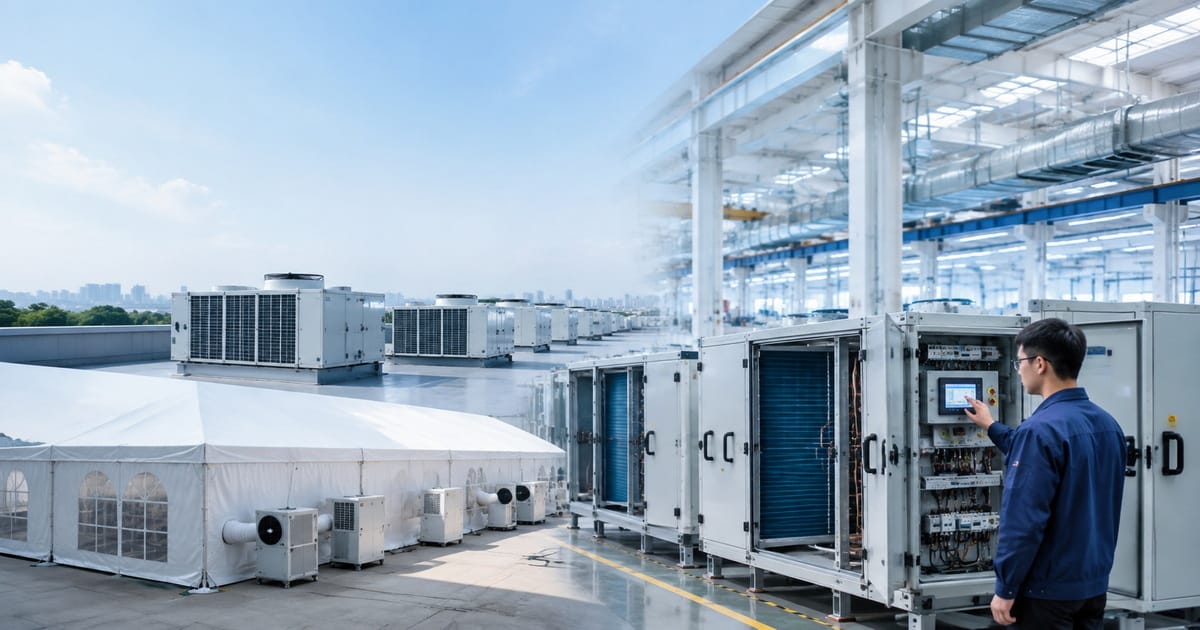
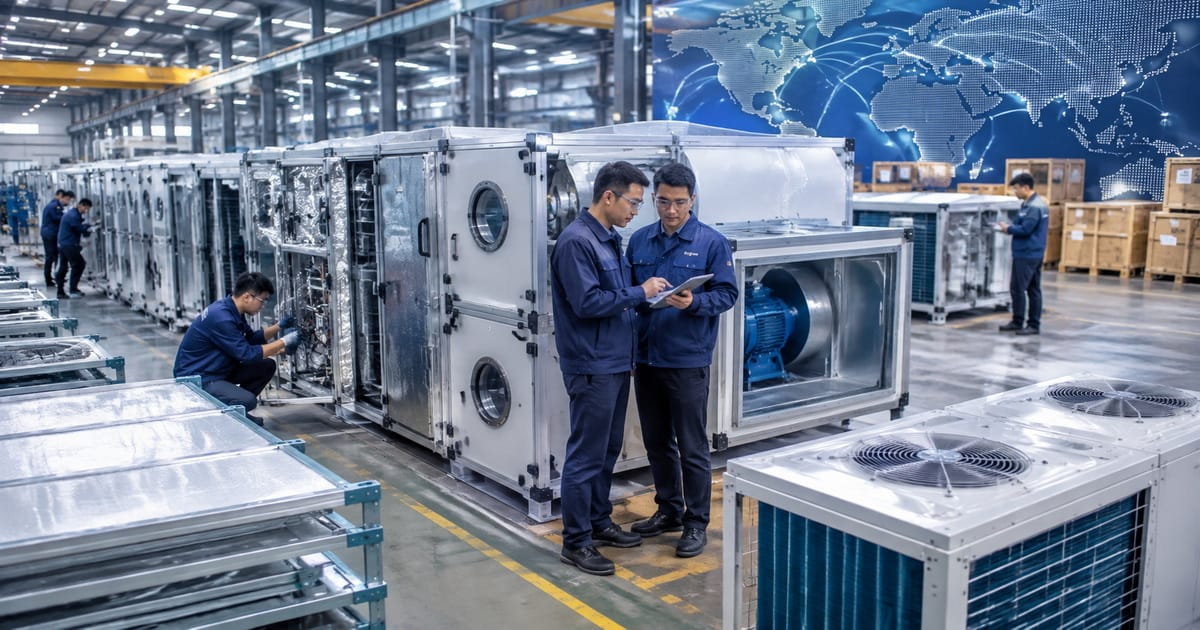
At DREZ (Guangzhou) Intelligent Technology Co., Ltd., we approach fresh air conditioning as an integrated climate-control solution. Through OEM, ODM, R&D, design, production, and customization capabilities, DREZ supports international brands, wholesalers, and manufacturers that need adaptable air-conditioning and ventilation products for demanding applications—including temporary shelters, cooling centers, medical-support areas, community halls, and disaster-response facilities.
What Makes Emergency Shelter Cooling Different?
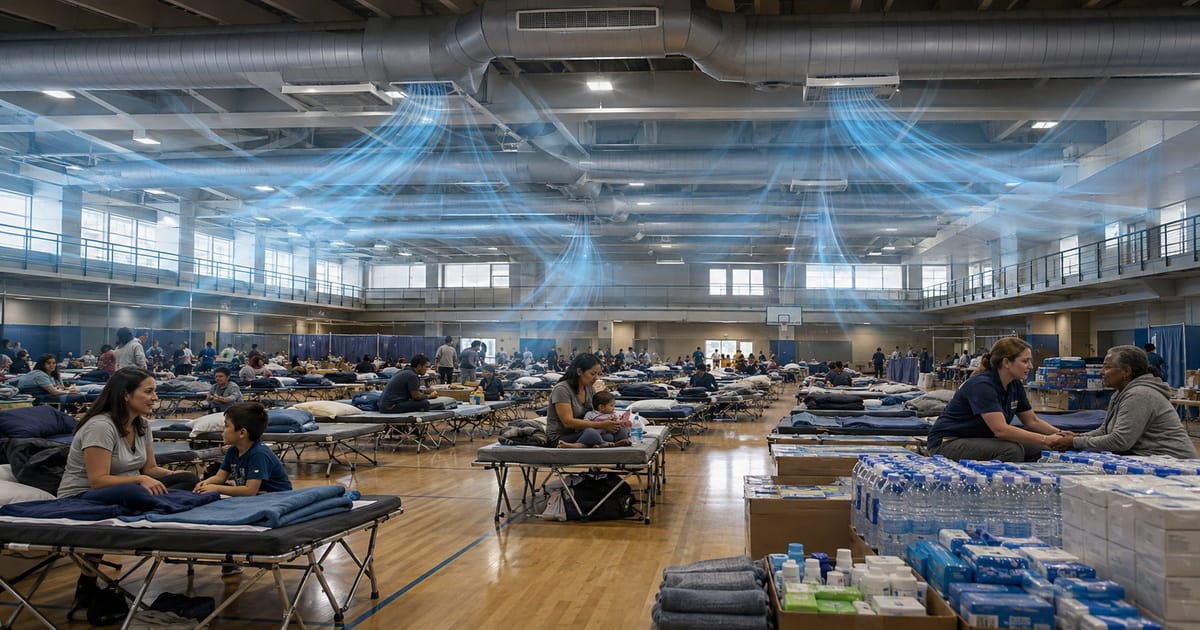
Emergency shelters can be opened with little notice. A school gymnasium, convention center, faith facility, warehouse, or temporary structure may suddenly accommodate many people for hours, days, or weeks. Unlike ordinary offices or retail spaces, occupancy can vary sharply, doors may open frequently, personal belongings accumulate, and some occupants may have elevated sensitivity to heat, humidity, smoke, allergens, or infectious aerosols.
A standard HVAC cooling system may perform well in a conventional building when it is correctly sized, maintained, and operated within its original design parameters. However, an emergency shelter can create operating conditions outside those assumptions:
– Higher-than-normal occupant density
– Longer operating hours
– More frequent door opening and infiltration
– High latent loads from people, wet clothing, showers, and food service
– Greater need for air-quality monitoring
– Potential wildfire smoke, dust, polluted outdoor air, or extreme heat
– Power interruptions or generator-based operation
– Need to separate general sleeping, isolation, medical, family, and pet areas
The U.S. Environmental Protection Agency notes that indoor environmental planning is particularly important during weather-related and human-caused emergencies. During smoke events, it recommends high-efficiency HVAC filtration where compatible, recirculation settings to reduce smoke entry, and reopening fresh-air pathways when outdoor conditions improve.
Fresh Air Conditioning vs. Standard HVAC
The following table compares the two approaches from the perspective of emergency shelter operation rather than normal commercial comfort cooling.
| Comparison Area | Fresh Air Conditioning for Emergency Shelters | Standard HVAC Cooling Systems |
|---|---|---|
| Primary objective | Maintain cooling, ventilation, humidity control, and indoor air quality for temporary high occupancy | Maintain indoor temperature comfort in a building’s expected operating conditions |
| Outdoor air strategy | Designed to introduce, treat, filter, or regulate outside air based on occupancy and outdoor-air conditions | May have limited or fixed outside-air capability, depending on the system design |
| Occupancy flexibility | Better suited for variable shelter populations and extended operating hours when properly engineered | Can struggle if actual occupancy substantially exceeds the original design load |
| Filtration focus | Can be configured around enhanced filtration, staged filtration, and supplemental air cleaning | Filtration may be selected mainly for equipment protection and ordinary building IAQ |
| Humidity management | A major operational priority, especially in hot-humid climates and crowded sleeping areas | Often secondary to sensible cooling capacity; performance may decline under unusual latent loads |
| Outdoor pollution response | Can support planned modes for smoke, dust, or pollution events, balancing fresh air and filtration | May rely on a simple recirculation mode without integrated IAQ response planning |
| Power-resilience planning | Can be customized for generator compatibility, staged operation, priority zones, and rapid deployment | Often depends on fixed building infrastructure and may be difficult to operate during outages |
| Monitoring potential | Can integrate temperature, relative humidity, CO₂, filter status, and system alarms | Monitoring may be limited to thermostat control and basic fault alerts |
| Typical best use | Emergency shelters, cooling centers, temporary clinics, evacuation hubs, disaster-response facilities | Offices, stores, residences, classrooms, and stable-occupancy commercial facilities |
| Procurement approach | Often requires project-specific sizing, airflow planning, and OEM/ODM customization | Frequently purchased as a conventional replacement or standard building system |
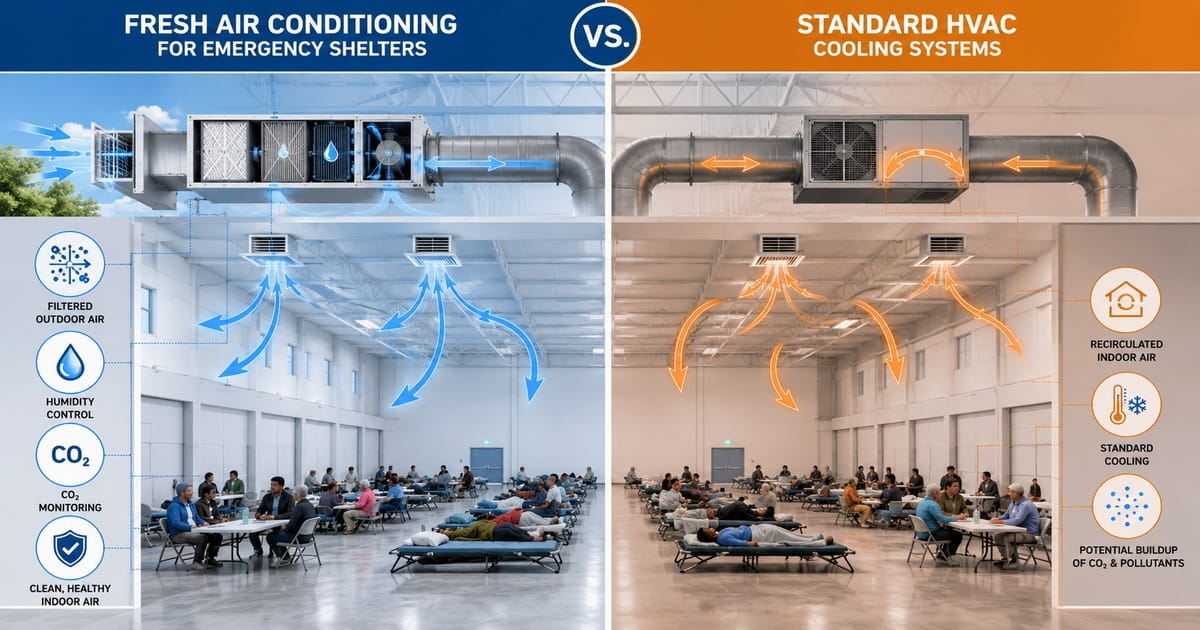
The key difference is not whether a system can produce cold air. It is whether the system can support a shelter’s total indoor environmental needs when the number of occupants, outdoor conditions, and operational constraints change quickly.
How Standard HVAC Cooling Works
A standard HVAC cooling system generally removes heat from indoor air using a refrigeration cycle. It circulates cooled air through a space and may introduce some outdoor air through a dedicated ventilation component, a rooftop unit, an air-handling unit, or building ventilation pathways.
For ordinary commercial applications, this approach can be effective. It can provide:
– Reliable temperature reduction
– Consistent air distribution
– Comfort for expected occupancy levels
– Efficient operation under stable conditions
– Straightforward service and replacement planning
However, cooling alone does not guarantee adequate indoor air quality. A system can maintain a comfortable thermostat reading while still underperforming in ventilation, filtration, humidity control, or airflow distribution.
For example, a crowded shelter may feel cool near supply registers but stuffy in sleeping zones, corners, or partitioned areas. That is a distribution and ventilation problem, not simply a cooling-capacity problem.
ASHRAE identifies Standards 62.1 and 62.2 as recognized standards for ventilation-system design and acceptable indoor air quality. These standards address minimum ventilation rates and related measures intended to reduce adverse health effects for occupants.
Where Standard HVAC Systems Can Fall Short
A conventional cooling system may be less suitable for emergency shelter use when it has one or more of the following limitations:
– Insufficient outdoor-air capacity for temporary high occupancy
– Inadequate fan pressure to accommodate upgraded filters without reducing airflow
– No practical zoning for medical, isolation, sleeping, food-service, or family areas
– Limited humidity removal during periods of heavy occupancy
– No integrated IAQ sensors or filter-condition monitoring
– No emergency operating mode for wildfire smoke, dust events, or power constraints
– Difficult access for rapid deployment, maintenance, or replacement
– A design basis that assumes normal business hours rather than 24/7 shelter operation
This does not mean standard HVAC systems are inherently unsuitable. In many existing shelters, the most practical solution is to upgrade and supplement the installed HVAC equipment rather than replace it entirely. The correct choice should follow a technical assessment of airflow, outdoor-air delivery, filtration capability, electrical supply, room layout, and occupant load.
What Fresh Air Conditioning Adds
Fresh air conditioning combines temperature control with managed ventilation. Depending on the product architecture, it can introduce outdoor air, filter it, cool or dehumidify it, and distribute it into occupied areas. It may also coordinate with recirculated air, exhaust systems, air-cleaning equipment, and sensors.
For emergency shelters, this can provide a more adaptable framework than cooling-only equipment.
1. Controlled Outdoor Air Instead of Unmanaged Infiltration
A well-designed fresh air conditioning solution gives operators more control over how outdoor air enters the shelter. This is important because outdoor air can be both beneficial and problematic.
When outdoor air is clean, ventilation helps dilute occupant-generated contaminants and odors. When outdoor air contains wildfire smoke, heavy dust, industrial pollution, or extreme humidity, unrestricted intake may worsen indoor conditions.
The operational goal is therefore not “maximum outdoor air at all times.” It is the right amount of appropriately treated outdoor air for the current risk condition.
CDC ventilation guidance emphasizes bringing in as much outdoor air as can be done safely, maximizing HVAC ventilation settings, increasing total airflow where practical, and improving filtration without causing a significant reduction in system airflow. It also advises ensuring systems are serviced and meet applicable code requirements.
2. Better Humidity Control for Crowded Shelters
Humidity is often underestimated in emergency cooling plans. In a densely occupied shelter, people add substantial moisture to the indoor environment through breathing, perspiration, bathing, wet clothing, and food preparation.
High humidity can make occupants feel hotter even when the thermostat appears acceptable. It can also contribute to condensation, odors, discomfort, and mold risk when conditions persist.
A fresh air conditioning system designed for hot-humid climates should consider:
– Sensible cooling capacity to reduce air temperature
– Latent capacity to remove moisture
– Fresh-air volume matched to occupancy and outdoor conditions
– Cooling-coil control to avoid short cycling
– Drainage and condensate management
– Relative-humidity monitoring
– Zoning for areas with different moisture loads
ASHRAE guidance for healthcare-related emergency conditions notes that unconditioned spaces can create thermal stress that may be life-threatening and may also lower resistance to infection. It also identifies 40% to 60% relative humidity as a range to consider in relevant indoor environments.
For an emergency shelter, exact operating targets should be determined by local code, climate, building conditions, and the needs of occupants. Still, the principle is universal: temperature and humidity must be managed together.
3. Enhanced Filtration and Supplemental Air Cleaning
Fresh air conditioning should not be treated as a replacement for filtration. In fact, emergency shelter performance improves when ventilation, filtration, and air cleaning are designed as one strategy.
Potential measures include:
– MERV-rated central filters, if the fan and duct system can safely support them
– Portable HEPA air cleaners near sleeping areas, health-support zones, or other higher-risk spaces
– Dedicated exhaust in restrooms, kitchens, and contamination-prone areas
– Upper-room UVGI or other validated supplemental technologies, where properly designed and maintained
– Filter pressure-drop monitoring to identify loading and replacement needs
EPA advises considering MERV 13 or better filters—or the highest efficiency the HVAC system can accommodate—during outdoor pollution events. ASHRAE also notes that its Standard 241 establishes requirements intended to reduce airborne disease transmission and uses the concept of equivalent clean airflow to quantify the delivery of pathogen-free air per occupant.
The practical lesson for shelter operators is important: adding a high-efficiency filter without checking fan capacity can reduce airflow and create a new problem. Filtration upgrades should be verified by a qualified HVAC professional.
Emergency Shelter HVAC Decision Framework
The most useful purchasing question is not, “Which system is better?” It is, “Which climate-control strategy is fit for our emergency use case?”
Use the following five-step evaluation framework before selecting fresh air conditioning equipment, packaged HVAC units, portable cooling systems, or OEM/ODM shelter solutions.
Step 1: Define the Shelter Scenario
Document the basic operating conditions:
– Maximum expected occupancy
– Normal and surge occupancy
– Hours or days of continuous operation
– Building type and usable floor area
– Sleeping, medical, food-service, family, pet, and isolation zones
– Local outdoor temperature and humidity extremes
– Seasonal wildfire smoke, dust, or pollution risks
– Available electrical capacity and generator backup
– Local code and public-health requirements
A gym used for 100 daytime cooling-center visitors is a different project from a 300-person overnight evacuation shelter. The cooling load, ventilation requirements, acoustic needs, filtration plan, and resilience requirements will all differ.
Step 2: Separate Cooling Load From Ventilation Need
Cooling capacity is usually expressed through units such as BTU/h, kW, or tons of refrigeration. Ventilation is commonly assessed through airflow, such as CFM or m³/h. They are connected, but they are not interchangeable.
A shelter may have enough cooling capacity but too little ventilation. It may also have adequate outdoor air but insufficient dehumidification. Both situations can lead to poor occupant experience.
A professional assessment should calculate or estimate:
– Sensible heat gain: People, lighting, equipment, solar load, and outdoor heat
– Latent moisture load: Occupants, showers, wet materials, and humid outside air
– Required outdoor airflow: Based on occupancy, space type, local regulations, and IAQ objectives
– Total supply airflow: Needed for air mixing, filtration cycles, and distribution
– Pressure relationships: Especially for toilets, kitchens, and designated isolation areas
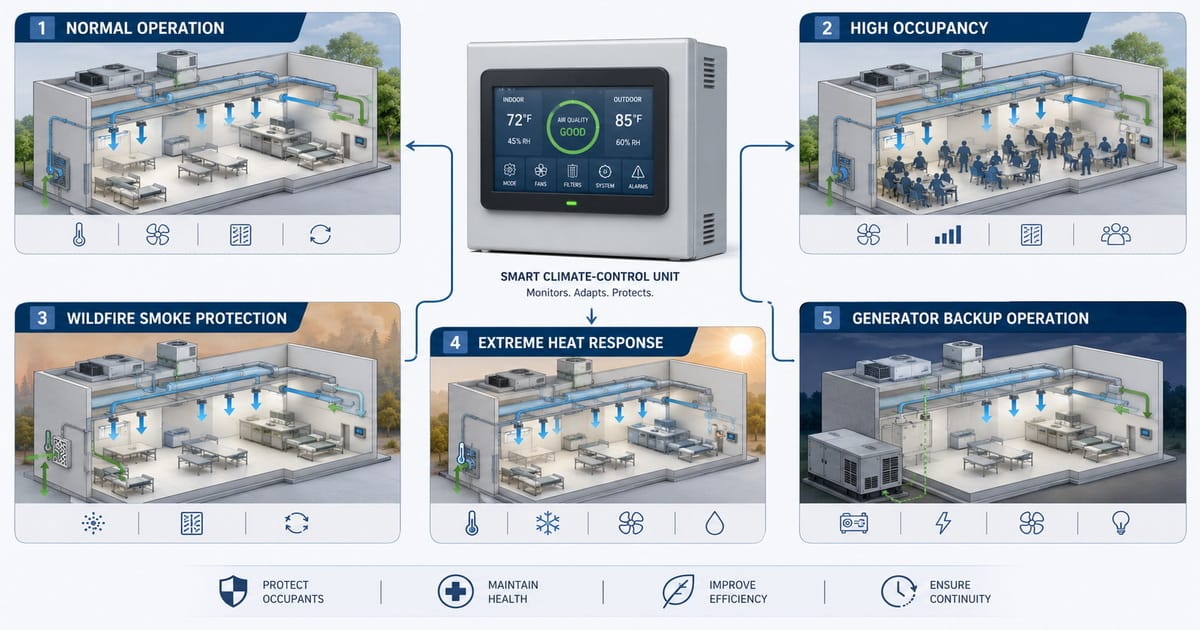
Step 3: Plan for Clean-Air Modes
Emergency shelter HVAC should include predefined operating modes rather than relying on improvised decisions during an incident.
A practical operating plan may include:
| Operating Mode | Typical Conditions | HVAC Priorities |
|---|---|---|
| Normal shelter mode | Outdoor air is acceptable; occupancy is stable | Provide comfort cooling, planned outdoor air, filtration, and normal exhaust |
| High occupancy mode | Occupancy rises quickly | Increase airflow, verify ventilation, operate portable air cleaners, monitor CO₂ and humidity |
| Smoke or dust mode | Outdoor pollution is elevated | Reduce untreated intake as planned, close building envelope, maximize compatible filtration and recirculation, monitor indoor conditions |
| Heat emergency mode | Extreme outdoor heat or vulnerable occupants | Prioritize cooling zones, manage humidity, protect generator capacity, monitor vulnerable areas |
| Power-limited mode | Generator or reduced electrical supply | Operate priority zones, stage equipment, maintain critical ventilation and cooling loads, communicate restrictions |
The EPA recommends adjusting HVAC systems to recirculate air during high outdoor pollution events and airing out spaces when conditions improve. This illustrates why shelters need a flexible operational strategy, not a permanently fixed fresh-air setting.
Step 4: Verify Power Resilience
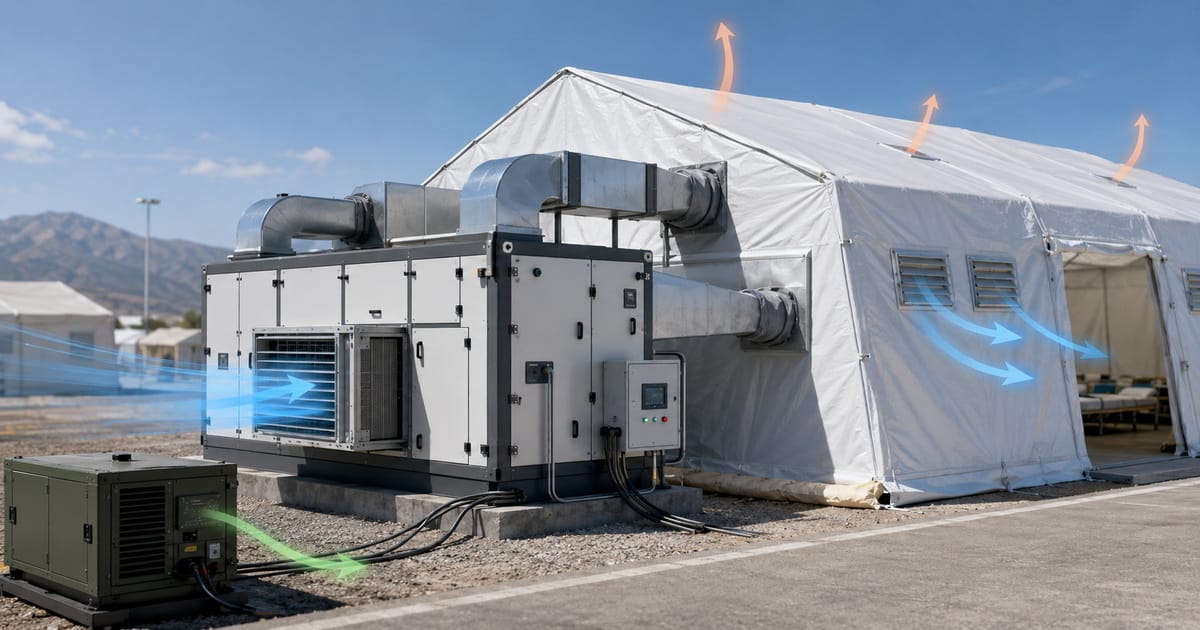
A cooling system that cannot run during an outage may not deliver the resilience an emergency shelter requires. Equipment selection should therefore consider generator capacity, startup current, staged compressor operation, priority circuits, and fuel logistics.
FEMA identifies generators as emergency equipment that provide a secondary power source. Ready.gov also warns that generators must be operated outdoors and at least 20 feet from windows, doors, and attached garages because of carbon monoxide hazards.
For system designers and OEM buyers, this translates into practical engineering decisions:
– Select equipment with known electrical demand
– Review startup and inrush current
– Consider variable-speed or staged-capacity designs
– Identify critical zones that must remain cooled first
– Avoid overloading backup power systems
– Keep generator exhaust away from outdoor-air intakes
– Include CO detection and emergency procedures
Step 5: Monitor, Maintain, and Document
The final step is operational discipline. Even an advanced fresh air conditioning system cannot protect occupants if filters are clogged, drains are blocked, ventilation dampers are closed, or staff cannot interpret alarms.
A shelter HVAC checklist should include:
1. Inspect filters before occupancy and keep replacement stock on site
2. Confirm condensate drainage and water-leak protection
3. Test supply fans, exhaust fans, dampers, and alarm functions
4. Verify outdoor-air intake condition and distance from possible contamination sources
5. Track indoor temperature and relative humidity
6. Use CO₂ as a practical ventilation indicator where appropriate, while recognizing it is not a direct measure of every pollutant
7. Check portable air cleaner placement, airflow direction, and filter status
8. Document generator capacity, fuel procedures, and equipment priority sequence
9. Train facility staff on normal, smoke, heat, and power-limited modes
10. Review performance after every shelter activation
EPA explains that ventilation reduces indoor carbon dioxide levels and cites an ASHRAE classroom guideline of 700 ppm above outdoor concentration as an upper limit intended to control body-odor concerns; however, CO₂ should be used as one operational indicator, not as a complete measure of indoor air quality or infection risk.
Avoid the “More Fresh Air Is Always Better” Myth
A common oversimplification in emergency shelter planning is that more outdoor air always means better air quality. This is not true in every condition.
During a severe heat wave, very humid weather, wildfire smoke, dust storms, or industrial pollution episodes, unrestricted outdoor-air intake can raise cooling loads, increase moisture, introduce particles, and overwhelm equipment. Conversely, sealing a crowded shelter and running only recirculated cooling can lead to odors, elevated CO₂, uneven conditions, and reduced air freshness.
The best strategy is controlled, measured, and condition-responsive ventilation.
That means:
– Bringing in outdoor air when it is sufficiently clean and practical
– Filtering outdoor air when necessary
– Reducing untreated intake during severe outdoor pollution events
– Maintaining central filtration and portable air cleaning
– Monitoring temperature, humidity, occupancy, and system performance
– Reverting to planned ventilation settings when outdoor conditions improve
This is precisely where a customized fresh air conditioning solution can offer strategic value. Instead of forcing one operating mode onto every project, OEM/ODM equipment can be designed around local climate, installation layout, airflow requirement, control logic, enclosure constraints, electrical standards, and brand-specific product positioning.
When to Choose Each Solution
Choose Standard HVAC Cooling When
Standard HVAC cooling may be the right option when:
– The building already has a properly sized, code-compliant central HVAC system
– Occupancy is predictable and close to the building’s normal design basis
– Outdoor air, filtration, and humidity control are already adequate
– The project focuses mainly on ordinary comfort cooling
– The site has stable utility power and conventional maintenance capability
– A shelter is only a limited, low-occupancy contingency use
In these cases, the best investment may be a system assessment, ventilation adjustment, filtration upgrade, portable HEPA support, monitoring equipment, and staff training rather than a complete replacement.
Choose Fresh Air Conditioning for Emergency Shelters When
A dedicated fresh air conditioning solution is often the stronger choice when:
– The site will support high-density temporary occupancy
– Outdoor temperature and humidity create a significant heat-stress risk
– The shelter may operate continuously for extended periods
– The building requires more controlled ventilation than its original HVAC design provides
– Air filtration and air-cleaning strategy are priorities
– The project needs modular, portable, packaged, rooftop, ducted, or customized equipment
– The buyer needs OEM or ODM development for a specific market, installation type, or product brand
– Resilience, generator compatibility, remote monitoring, or emergency operating modes are essential
For international brands and distributors, the opportunity is not limited to selling an air conditioner. It is to offer a shelter-ready climate-control package that combines cooling equipment, ventilation management, filtration options, controls, installation guidance, and lifecycle support.
OEM and ODM Considerations for Shelter Projects
For B2B buyers, product differentiation often comes from application engineering rather than basic cooling specifications. A shelter-focused fresh air conditioning product can be customized around the buyer’s market requirements.
DREZ can support OEM and ODM development considerations such as:
– Cooling and dehumidification capacity for target climate zones
– Fresh-air intake and filtration configurations
– MERV-compatible filter sections where fan design permits
– Portable, split, packaged, ducted, or modular product formats
– Low-noise design for sleeping environments
– Smart controls for temperature, humidity, timing, alarms, and fault diagnosis
– CO₂, PM, temperature, and humidity sensor integration
– Generator-compatible electrical design
– Localized voltage, frequency, plug, refrigerant, and certification requirements
– Private-label branding, housing design, manuals, cartons, and spare-parts plans
– Rapid installation and maintenance access
– Project-specific airflow and duct connection options
A strong OEM/ODM brief should include target shelter capacity, climate data, building type, desired product form, power supply, airflow requirements, filtration strategy, expected runtime, logistics constraints, and compliance expectations.
Final Recommendation
For emergency shelters, standard HVAC cooling should be viewed as a starting point—not automatically as a complete indoor-environment solution. It may be adequate for some facilities, especially after assessment and targeted upgrades. But shelters with dense occupancy, extreme weather exposure, variable outdoor air quality, and resilience requirements typically benefit from a more integrated fresh air conditioning strategy.
The best emergency shelter HVAC solution balances five priorities:
– Thermal comfort
– Humidity control
– Ventilation
– Filtration and air cleaning
– Operational resilience
If you are developing an emergency-shelter HVAC product line, sourcing a customized fresh air air-conditioning system, or evaluating OEM/ODM climate-control options for overseas markets, DREZ can help translate shelter operating requirements into a practical equipment specification.
Contact DREZ to discuss your target climate, shelter capacity, installation format, filtration needs, power requirements, and private-label goals. A well-defined project brief can lead to a more reliable, market-ready fresh air conditioning solution than selecting a standard cooling system based on tonnage alone.
Frequently Asked Questions
1. What is fresh air conditioning for emergency shelters?
Fresh air conditioning for emergency shelters is a climate-control approach that combines cooling with managed outdoor-air ventilation, filtration, humidity control, and airflow distribution. It is designed to help maintain acceptable indoor conditions for temporary, high-density occupancy rather than simply lowering room temperature.
2. Can a standard HVAC cooling system be used in an emergency shelter?
Yes. A standard HVAC system can serve an emergency shelter if its cooling capacity, outdoor-air delivery, filtration, airflow distribution, humidity removal, electrical supply, and maintenance condition are suitable for the expected shelter occupancy. Many systems need assessment and supplemental measures, such as portable HEPA units or upgraded filtration.
3. Why is humidity control important in emergency shelters?
High humidity makes people feel warmer, increases discomfort, and can contribute to condensation, odors, and mold risk. In crowded shelters, occupants and wet materials create substantial moisture loads, so cooling equipment must have adequate latent-capacity performance—not just sensible cooling capacity.
4. Should emergency shelters bring in maximum outdoor air all the time?
Not necessarily. More outdoor air can help dilute indoor contaminants when it is clean, but it can also introduce heat, humidity, smoke, dust, or pollutants. Emergency shelters should use an operational plan that adjusts ventilation and filtration according to outdoor-air quality, temperature, humidity, and occupancy.
5. Is MERV 13 filtration always suitable for existing HVAC equipment?
No. EPA recommends MERV 13 or better during certain pollution events when the system can accommodate it, but higher-efficiency filters can create more pressure drop. An HVAC professional should confirm that the fan, filter rack, and overall system can maintain adequate airflow after the upgrade.
6. What monitoring equipment should an emergency shelter use?
Useful monitoring can include indoor temperature, relative humidity, CO₂, filter pressure drop, equipment alarms, and—in relevant locations—outdoor PM or air-quality information. CO₂ can help indicate whether ventilation may be inadequate for occupancy, but it should not be treated as a complete measure of indoor air quality.
7. Can fresh air conditioning systems run on emergency generators?
They can be designed or selected for generator-backed operation, but the project must account for running power, compressor startup demand, equipment staging, priority zones, generator size, fuel supply, and electrical protection. Generator exhaust must also be kept away from building openings and air intakes.
References
2. ASHRAE. “Standards 62.1 & 62.2.” Overview of recognized standards for ventilation-system design and acceptable indoor air quality. [ASHRAE source]. [ashrae]
3. Centers for Disease Control and Prevention, National Institute for Occupational Safety and Health. “Ventilation in Schools and Childcare Programs.” Guidance on outdoor air, airflow, recirculation, maintenance, filtration, and portable HEPA air cleaners. [CDC/NIOSH source]. [cdc]
4. ASHRAE. “Healthcare.” Emergency-related recommendations addressing thermal stress, filtration, temperature, and humidity in critical occupied environments. [ASHRAE source]. [ashrae]
5. ASHRAE. “ASHRAE Publishes Standard 241, Control of Infectious Aerosols.” Overview of equivalent clean airflow requirements and infection-risk control. [ASHRAE source]. [ashrae]
6. ASHRAE. “ASHRAE Standard 241, Control of Infectious Aerosols.” Standard scope for reducing disease transmission from infectious aerosols in new and existing buildings. [ASHRAE source]. [ashrae]
7. U.S. Environmental Protection Agency. “Reference Guide for Indoor Air Quality in Schools.” Information on ventilation, carbon dioxide, and indoor-air quality management. [EPA source]. [epa]
8. Federal Emergency Management Agency. “Generator.” Information on generators as secondary emergency-power equipment. [FEMA source]. [fema]
9. Ready.gov. “Power Outages.” Generator safety guidance, including outdoor placement and carbon-monoxide precautions. [Ready.gov source]. [ready]
10. Citygate Network. “CDC Guidance Regarding Ventilation in Homeless Shelters.” Shelter-specific summary covering HVAC maintenance, HEPA filtration, exhaust ventilation, and UVGI considerations. [Citygate Network source]. [citygatenetwork]
Hot Tags: Fresh Air Conditioning, Emergency Shelter HVAC, Emergency Shelter Air Conditioning, Commercial HVAC Cooling Systems, Fresh Air Ventilation Systems, OEM HVAC Manufacturer, ODM Air Conditioning Solutions, Temporary Shelter Cooling Solutions, Indoor Air Quality HVAC, Disaster Relief HVAC Systems