Content Menu
● Why Exhibition Halls Create a Ventilation Challenge
>> Common Indoor-Air Problems at Trade Shows
● Fresh Air Conditioning vs. Fresh Air Exchange Systems
>> What Fresh Air Conditioning Actually Does
>> What a Fresh Air Exchange System Does
>> The Key Difference: Conditioning vs. Exchanging
● Do Exhibition Halls Really Need Fresh Air Exchange Systems?
>> When Recirculated Air Conditioning Is Not Enough
● How to Size Fresh Air for an Exhibition Hall
>> Start With Occupancy and Volume
>> Use Air Changes Per Hour Carefully
>> Example: A Preliminary Airflow Exercise
● The Best System Strategy: Integrated, Zoned, and Demand-Controlled
>> Why Demand-Controlled Ventilation Fits Exhibition Venues
● Energy Recovery: A Strong Option for Large Venues
● A Buyer’s Checklist for Fresh Air Conditioning Systems
● Expert Recommendation for Exhibition Hall Projects
● Request a Fresh Air Solution
● FAQ
>> 1. What is the difference between fresh air conditioning and normal air conditioning?
>> 2. Does an exhibition hall need a separate fresh air exchange system?
>> 3. How can exhibition halls reduce ventilation energy costs?
>> 4. Is a CO₂ sensor enough to measure exhibition hall air quality?
>> 5. What information should I give an OEM fresh air conditioning supplier?
>> 6. Can fresh air systems help protect exhibits and booth materials?
>> 7. What does 5 ACH mean for an exhibition hall?
Most exhibition halls need a dedicated fresh air exchange strategy, not air conditioning alone. A conventional air-conditioning system can cool or heat recirculated air, but it does not necessarily introduce enough outdoor air, remove pollutants, control humidity, or respond effectively when visitor density changes throughout an event.
For exhibition centers, trade-show venues, convention halls, product-launch spaces, and temporary display areas, the question is not simply whether to install Fresh Air Conditioning. The practical question is: How can the venue maintain thermal comfort, indoor air quality, and operating efficiency when occupancy, outdoor weather, booth materials, and event schedules change by the hour?
For overseas brands, wholesalers, HVAC contractors, and venue-project buyers, this distinction matters. A properly engineered fresh air exchange system for exhibition halls can improve guest comfort, support healthier indoor environments, protect exhibits from humidity-related damage, and help operators avoid wasting energy during low-occupancy periods.
Why Exhibition Halls Create a Ventilation Challenge
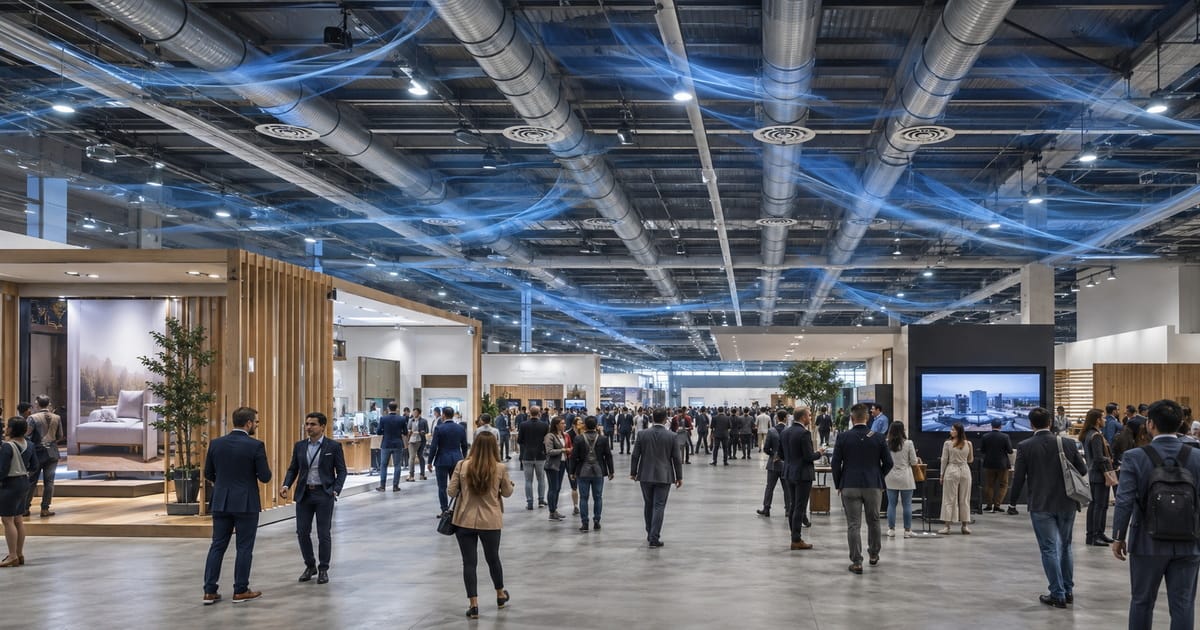
Exhibition halls are among the most demanding commercial HVAC environments. Their floor areas are large, ceiling heights are substantial, occupancy can rise sharply during opening hours, and indoor pollutant loads vary by event type.
A technology exhibition, furniture fair, machinery show, food expo, or automotive display may involve thousands of visitors, densely packed booths, demonstration equipment, printed graphics, new carpeting, packaging materials, and frequent loading-door openings. These factors can affect temperature, humidity, carbon dioxide (CO₂), particulate levels, odors, and perceived freshness.
The U.S. Environmental Protection Agency explains that inadequate ventilation can raise indoor pollutant concentrations because insufficient outdoor air is introduced to dilute indoor emissions and pollutants are not effectively removed.
Common Indoor-Air Problems at Trade Shows
When a venue relies only on recirculating cooling equipment, operators may encounter:
– Stuffy air during peak visitor periods.
– Rising CO₂ levels caused by high human occupancy.
– Persistent odors from food service, carpets, adhesives, paints, packaging, and product demonstrations.
– Uneven temperatures between crowded aisles, booths, entrances, and upper areas.
– High humidity that can affect printed displays, textiles, electronics, wood products, and visitor comfort.
– Poor visitor perception, even when thermostat readings appear normal.
– Energy waste when full ventilation runs at maximum volume during setup, teardown, or low-attendance hours.
This is why fresh air conditioning for exhibition halls must be designed as a complete air-management solution. Cooling capacity alone is not an indoor-air-quality strategy.
Fresh Air Conditioning vs. Fresh Air Exchange Systems
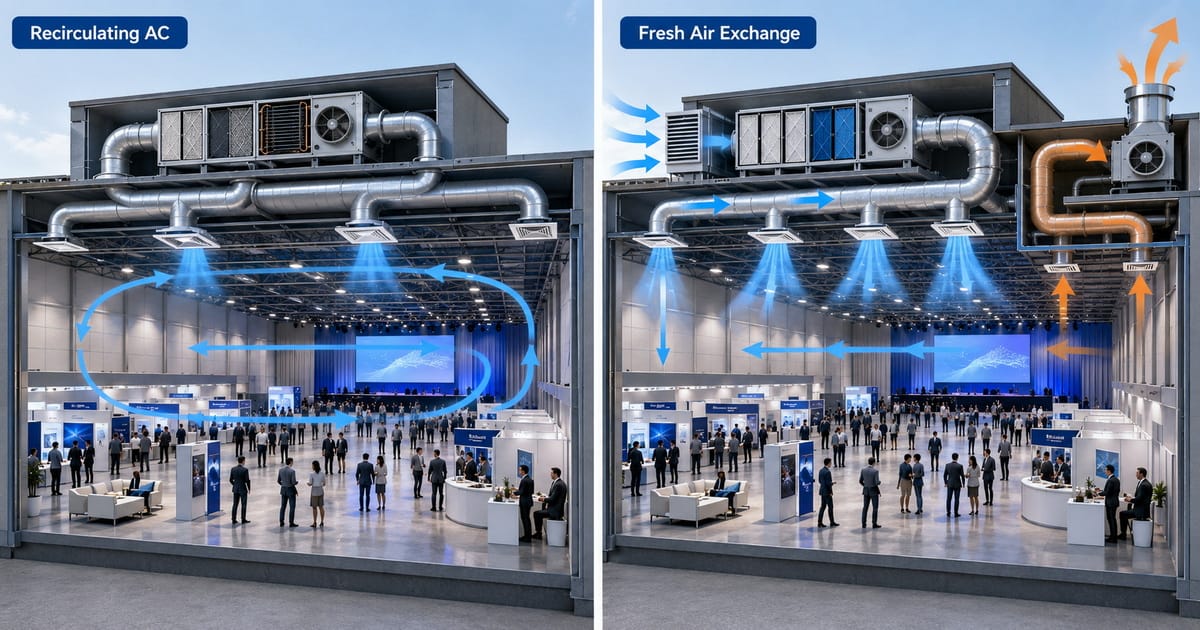
Although the two terms are often used interchangeably, they describe different functions. In many projects, the best solution combines both.
| Feature | Fresh Air Conditioning | Fresh Air Exchange System |
|---|---|---|
| Primary purpose | Conditions incoming outdoor air by cooling, heating, dehumidifying, or sometimes filtering it | Replaces stale indoor air with outdoor air and exhausts polluted indoor air |
| Outdoor-air supply | Usually includes controlled outdoor-air intake | Core function is outdoor-air intake and stale-air exhaust |
| Temperature control | Strong capability when specified with cooling/heating components | May have limited or no active temperature conditioning unless integrated with an energy-recovery or air-conditioning module |
| Humidity control | Can provide dehumidification and humidity stabilization | Depends on system configuration and climate conditions |
| Pollutant removal | Helps dilute contaminants when fresh air is supplied | Directly supports pollutant removal through exhaust and air exchange |
| Best use in exhibition halls | Maintaining comfort while handling outside-air loads | Managing high occupancy, odors, CO₂, and stale-air removal |
| Ideal project approach | Integrated with return-air, exhaust-air, filtration, controls, and zoning | Integrated with cooling/heating and smart controls for year-round comfort |
What Fresh Air Conditioning Actually Does
A fresh air conditioning system treats outdoor air before it enters the exhibition space. Depending on the product design and project requirements, it can cool hot outdoor air, heat cold outdoor air, remove moisture in humid climates, filter particles, and distribute conditioned fresh air into occupied zones.
This approach is especially valuable in venues where untreated outdoor air would create a major cooling, heating, or humidity burden.
For example, a subtropical exhibition center may require large volumes of outdoor air during a summer event. If that outdoor air enters without sufficient dehumidification, indoor humidity can rise quickly. Visitors may feel sticky even when the room temperature seems acceptable. Booth materials, brochures, electronics, and display products may also be affected.
What a Fresh Air Exchange System Does
A fresh air exchange system focuses on ventilation. It brings outdoor air into the building while exhausting indoor air that contains CO₂, odors, moisture, and airborne contaminants.
A well-designed system may include:
– Outdoor-air intake louvers.
– Supply fans and exhaust fans.
– Ductwork and air-distribution terminals.
– Pre-filtration and high-efficiency filtration options.
– Heat-recovery or energy-recovery components.
– CO₂, temperature, humidity, PM, and VOC monitoring.
– Variable-speed drives and demand-controlled ventilation logic.
– Building automation system integration.
The U.S. Centers for Disease Control and Prevention notes that improving ventilation can increase clean-air delivery, dilute contaminants, and reduce occupants’ exposure to airborne hazards.
The Key Difference: Conditioning vs. Exchanging
The simplest way to understand the comparison is this:
– Fresh air conditioning makes incoming outdoor air comfortable.
– Fresh air exchange makes sure stale indoor air is removed and replaced.
An exhibition hall typically needs both functions. Without proper exchange, a cooling system may repeatedly circulate air that has accumulated odors and CO₂. Without conditioning, an outdoor-air system may introduce heat or moisture that overwhelms the comfort system.
Do Exhibition Halls Really Need Fresh Air Exchange Systems?
In most commercial cases, the answer is yes. The exact configuration depends on local codes, climate, building design, event type, maximum occupancy, and existing HVAC capacity. However, venues with large crowds and changing activity profiles should not depend solely on recirculated air-conditioning equipment.
ASHRAE Standard 62.1 establishes minimum ventilation requirements intended to support acceptable indoor air quality in many nonresidential buildings. It also addresses outdoor-air and air-cleaning system design, installation, commissioning, operation, and maintenance.
A dedicated fresh air exchange system is particularly important when an exhibition hall has one or more of the following conditions:
– High visitor density during limited peak hours.
– Long-duration indoor events.
– Enclosed spaces with few operable windows.
– Food, fragrance, printing, craft, automotive, or chemical-product exhibitions.
– High ceilings and difficult air-distribution patterns.
– Humid or hot outdoor climates.
– Multiple halls with different occupancy schedules.
– Requirements for international visitor comfort and premium venue positioning.
– A need to monitor and document indoor-air performance.
When Recirculated Air Conditioning Is Not Enough
A traditional split system, rooftop unit, VRF system, fan-coil unit, or central air-conditioning system may provide reliable temperature control. Yet if the system mainly recirculates indoor air, it can fall short in three critical areas:
1. Dilution of occupant-generated pollutants
Visitors exhale CO₂ and emit bioeffluents. Higher occupancy can make air feel stale rapidly, even when cooling remains stable.
2. Removal of event-generated contaminants
Exhibitor activities can produce odors, particles, and volatile organic compounds. These may come from displays, installation materials, product demonstrations, cleaning agents, or food service.
3. Humidity stability
In humid climates, outdoor-air ventilation without effective dehumidification can create condensation risks and an uncomfortable indoor environment. Conversely, insufficient outdoor-air control can allow moisture and odors to linger.
How to Size Fresh Air for an Exhibition Hall
There is no responsible “one-size-fits-all” airflow number for every exhibition hall. System capacity should be engineered from real project conditions—not selected from floor area alone.
ASHRAE’s ventilation framework considers both people-related and area-related outdoor-air requirements. In other words, outdoor airflow should reflect expected occupancy as well as the size and use of the space.
Start With Occupancy and Volume
The first practical step is to calculate the hall’s air volume:
Room volume=Length×Width×Ceiling height
Then assess expected peak occupancy, not only average attendance.
A 10,000 m² exhibition hall may be lightly occupied during booth setup but densely occupied for several hours during a major opening day. Designing only around average traffic can result in inadequate ventilation precisely when visitors need it most.
Use Air Changes Per Hour Carefully
Air changes per hour, or ACH, indicate how often the equivalent volume of air in a space is replaced in one hour.
ACH=Airflow (m³/h)/Room volume (m³)
For workplace respiratory-virus risk reduction, the CDC says that, where possible, facilities should aim for 5 or more ACH of clean air. This clean-air total may combine mechanical ventilation, natural ventilation, and equivalent clean-air delivery from filtration or air-cleaning devices.
However, this is not a substitute for code compliance or project engineering. An exhibition hall’s actual design should consider local regulations, fire and smoke-control requirements, pressure relationships, climate, filtration resistance, noise limits, and equipment performance.
Example: A Preliminary Airflow Exercise
Assume an exhibition hall measures:
– Length: 100 m.
– Width: 50 m.
– Ceiling height: 12 m.
The volume is:
100×50×12=60,000 m3
If an engineer targets a preliminary total clean-air benchmark of 5 ACH, the equivalent clean-air requirement would be:
60,000×5=300,000 m3/h
That total does not automatically mean 300,000 m³/h of untreated outside air. It may include outdoor-air ventilation plus verified filtration or air-cleaning contributions, subject to local regulations and an engineer’s system design. This calculation illustrates why large venues need a coordinated HVAC and ventilation strategy rather than small standalone equipment.
The Best System Strategy: Integrated, Zoned, and Demand-Controlled
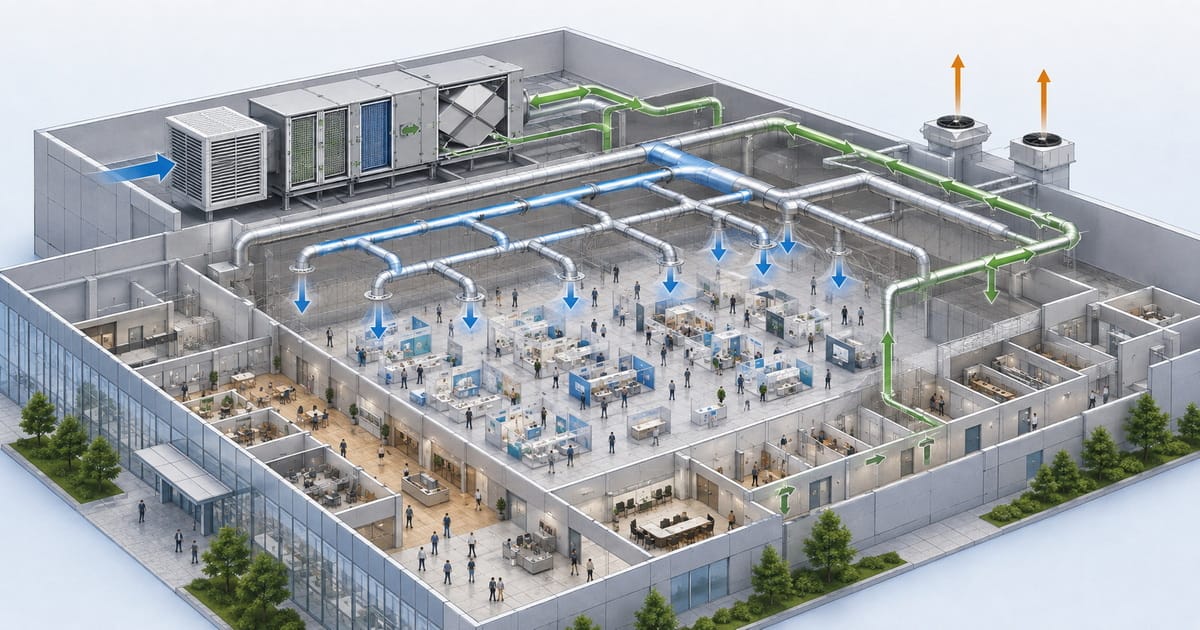
For many exhibition projects, an integrated system is more effective than choosing between “air conditioning” and “fresh air exchange” as separate categories.
A practical design may combine:
– A central fresh air conditioning unit.
– Dedicated exhaust-air paths.
– Energy or heat recovery where appropriate.
– Zoned air distribution for halls, lobbies, meeting rooms, and back-of-house areas.
– Variable-speed fans.
– CO₂-based demand-controlled ventilation.
– Temperature and humidity sensors.
– Multi-stage filtration.
– Integration with a building management system.
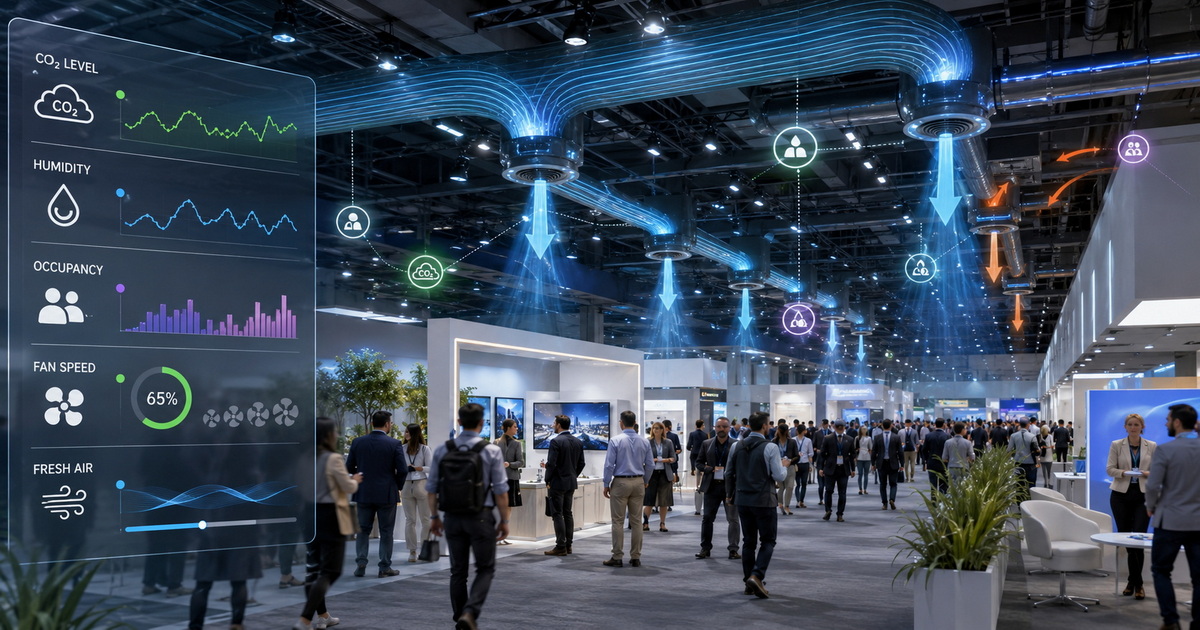
The U.S. Department of Energy states that demand-controlled ventilation uses occupancy or CO₂ sensors to automatically adjust ventilation based on changing occupancy. This can maintain air quality while saving energy during low-occupancy periods.
Why Demand-Controlled Ventilation Fits Exhibition Venues
Exhibitions rarely maintain the same crowd level all day. Visitor volume may change sharply between setup, opening, lunch breaks, keynote sessions, closing periods, and teardown.
Instead of permanently operating at maximum outside-air volume, smart controls can increase ventilation when occupancy rises and reduce unnecessary conditioning loads when the hall is nearly empty.
This can support three business goals:
– Visitor comfort: More fresh air is delivered when crowds and pollutant loads increase.
– Energy efficiency: The system avoids over-ventilating empty spaces.
– Operational visibility: Facility teams receive real-time data rather than relying only on guest complaints.
CO₂ monitoring can help indicate whether ventilation is responding to occupancy, but it should not be treated as a complete indoor-air-quality measurement. EPA guidance specifically notes that indoor CO₂ concentrations can provide ventilation information but must be interpreted carefully.
Energy Recovery: A Strong Option for Large Venues
Introducing outdoor air has an energy cost. In hot climates, incoming air may carry significant heat and moisture. In cold climates, it can increase heating demand. This is where heat-recovery or energy-recovery technology can improve project economics.
An energy-recovery ventilation approach transfers part of the energy between exhaust and incoming outdoor air streams. In suitable applications, it can precondition incoming air before it reaches the cooling or heating section.
For exhibition halls, potential benefits include:
– Lower cooling loads during hot weather.
– Reduced dehumidification burden in humid regions.
– Lower heating demand in colder climates.
– Better control of supply-air conditions.
– A more balanced approach to ventilation and operating cost.
Still, energy recovery should be selected carefully. Engineers need to evaluate cross-contamination risk, cleaning access, pressure drop, exhaust-air quality, climate, maintenance plans, and local code requirements.
A Buyer’s Checklist for Fresh Air Conditioning Systems
For international buyers sourcing OEM or ODM fresh air conditioning products, price and nominal airflow are not enough. The product must fit the building’s actual use case.
Ask potential suppliers these questions:
1. What is the verified fresh-air volume range?
Confirm airflow under the intended external static pressure, not only under laboratory no-load conditions.
2. How does the unit manage humidity?
Ask for dehumidification capacity, operating conditions, condensate management, and climate suitability.
3. What filtration options are available?
Clarify filter grades, replacement access, pressure-drop impact, and monitoring requirements.
4. Can the system integrate with CO₂ and occupancy sensors?
Demand control is valuable when exhibition attendance changes significantly.
5. Is heat or energy recovery available?
Evaluate whether it is appropriate for your climate and exhaust-air conditions.
6. How flexible is the unit for OEM and ODM projects?
Review casing dimensions, air-supply direction, control logic, branding, electrical standards, and integration options.
7. What after-sales documentation is supplied?
Request selection data, wiring diagrams, installation guidance, maintenance manuals, spare-parts lists, and commissioning support.
8. How will the system be commissioned?
A high-quality unit can still underperform if airflow balancing, damper settings, sensors, and controls are not verified after installation.
Expert Recommendation for Exhibition Hall Projects
The best question is not, “Do we need air conditioning or ventilation?” It is, “How do we deliver the right amount of clean, conditioned outdoor air at every stage of the event?”
For small, lightly occupied spaces with frequent natural ventilation, a simple solution may be adequate. For large enclosed exhibition halls, however, dedicated and controllable fresh-air exchange is usually essential.
A robust design should prioritize:
– Sufficient outdoor-air ventilation based on code and actual occupancy.
– Reliable temperature and humidity control.
– Effective filtration matched to local air conditions and system capability.
– Zoning for different hall uses and operating schedules.
– Demand-based control to balance indoor-air quality and energy cost.
– Commissioning and ongoing maintenance to protect real-world performance.
DREZ (Guangzhou) Intelligent Technology Co., Ltd. can support overseas brands, wholesalers, project contractors, and manufacturers with OEM and ODM Fresh Air Conditioning solutions tailored to exhibition halls and other high-occupancy commercial applications. The right solution should be built around your airflow target, climate, hall volume, occupancy pattern, installation constraints, control requirements, and brand standards.
Request a Fresh Air Solution
If you are planning an exhibition hall, convention venue, showroom, conference center, or large commercial project, do not select HVAC equipment based on cooling capacity alone.
Contact DREZ to discuss a customized Fresh Air Conditioning and air-exchange solution for your market. Provide your hall dimensions, ceiling height, expected occupancy, climate zone, operating hours, existing HVAC system, and target certifications. A project-specific assessment can help define the appropriate airflow, dehumidification, filtration, control, and OEM/ODM configuration.
FAQ
1. What is the difference between fresh air conditioning and normal air conditioning?
Normal air conditioning often recirculates indoor air to provide cooling or heating. Fresh air conditioning introduces outdoor air and conditions it through cooling, heating, dehumidification, and filtration before supplying it indoors. It is designed to support both comfort and ventilation.
2. Does an exhibition hall need a separate fresh air exchange system?
In most large or enclosed exhibition halls, yes. A separate or integrated fresh air exchange function is important because cooling equipment alone may not supply enough outdoor air or remove enough stale air, odors, and occupant-generated pollutants during crowded events.
3. How can exhibition halls reduce ventilation energy costs?
Use zoning, variable-speed fans, energy-recovery technology where suitable, efficient filtration design, and demand-controlled ventilation. CO₂ or occupancy sensors can help increase ventilation during peak attendance and reduce it during setup or low-occupancy periods.
4. Is a CO₂ sensor enough to measure exhibition hall air quality?
No. CO₂ is useful as a ventilation and occupancy indicator, but it does not measure every indoor-air-quality factor. A complete strategy may also consider temperature, relative humidity, particulate matter, VOCs, odors, filter condition, and airflow performance. EPA advises that CO₂ readings must be interpreted carefully.
5. What information should I give an OEM fresh air conditioning supplier?
Share the project location, hall dimensions, ceiling height, expected visitor load, event type, operating schedule, local electrical requirements, duct arrangement, external static pressure, desired controls, filtration requirements, and branding or customization needs.
6. Can fresh air systems help protect exhibits and booth materials?
Yes. Properly designed fresh air conditioning can help stabilize temperature and humidity while diluting odors and contaminants. This is valuable for electronics, printed materials, wood, textiles, food displays, luxury goods, and other products sensitive to uncomfortable or humid indoor conditions.
7. What does 5 ACH mean for an exhibition hall?
Five ACH means that airflow equal to five times the room’s volume is supplied, exhausted, or delivered as equivalent clean air in one hour. The CDC identifies a goal of 5 or more ACH of clean air, where possible, to help reduce airborne viral particles in workplaces.
References
1. [ASHRAE — Relevant Standards and Guidelines] — Overview of ASHRAE ventilation, air-cleaning, commissioning, operation, and maintenance requirements related to indoor air quality and infectious-aerosol exposure. [ashrae]
2. [U.S. Environmental Protection Agency — Introduction to Indoor Air Quality] — Explains how inadequate ventilation can increase indoor pollutant levels and defines air-exchange concepts. [epa]
3. [CDC/NIOSH — How Much Ventilation Is Enough?] — Provides the 5 ACH clean-air target, explains equivalent ACH, and outlines ACH calculation steps. [cdc]
4. [CDC/NIOSH — Ventilation and Respiratory Viruses] — Discusses clean-air delivery, outdoor-air introduction, and dilution of airborne contaminants in workplaces. [cdc]
5. [U.S. Department of Energy — HVAC Retrofit] — Describes demand-controlled ventilation using CO₂ or occupancy sensors to adjust ventilation rates and reduce energy use during low occupancy. [energy]
6. [U.S. Environmental Protection Agency — Can I Measure Carbon Dioxide Indoors?] — Explains why CO₂ can inform ventilation assessment but needs careful interpretation. [epa]
7. [ASHRAE — Updated Standard 62.1] — Notes ventilation-rate resources and the Standard 62.1 framework for commercial building ventilation design. [ashrae]
Hot Tags: Fresh Air Conditioning, Fresh Air Exchange System, Exhibition Hall Ventilation, Commercial HVAC Solutions, Energy Recovery Ventilation, Demand Controlled Ventilation, Industrial Fresh Air System, Commercial Air Handling Unit, OEM HVAC Manufacturer, ODM Fresh Air Conditioning