
Content Menu
● What Makes Tent Cooling Different?
● Fresh Air Conditioning for Temporary Tents
>> How It Works in a Tent Setup
● Standard Portable Cooling Units Explained
>> Where Portable Units Perform Well
● Fresh Air Conditioning vs Portable Units
● The Ventilation Issue Buyers Often Miss
● Sizing Fresh Air Conditioning for a Temporary Tent
>> 3. Review the Local Climate
>> 4. Plan Airflow Paths Before Installation
>> 5. Design for Real Operating Conditions
● Expert Installation Practices for Better Results
>> Keep Hot Exhaust Away From the Tent
>> Temporary Event and Exhibition Tents
>> Temporary Warehouses and Production Shelters
>> Medical, Emergency, and Relief Tents
>> Outdoor Construction and Maintenance Projects
● Choose the Right Solution With DREZ
● FAQ
>> 1. Is fresh air conditioning necessary for every temporary tent?
>> 2. Can portable cooling units cool a large event tent?
>> 3. Does a fresh air conditioning system reduce humidity?
>> 4. Where should tent air conditioning equipment be installed?
>> 5. How do I calculate the cooling capacity for a temporary tent?
>> 6. Can fresh air conditioning and portable cooling units be used together?
>> 7. What should OEM buyers ask a tent air conditioning supplier?
Temporary tents create a difficult cooling environment. High solar gain, fabric walls, frequent door openings, crowded occupancy, and limited air exchange can quickly turn a tent into a hot, humid, and uncomfortable workspace or event area.
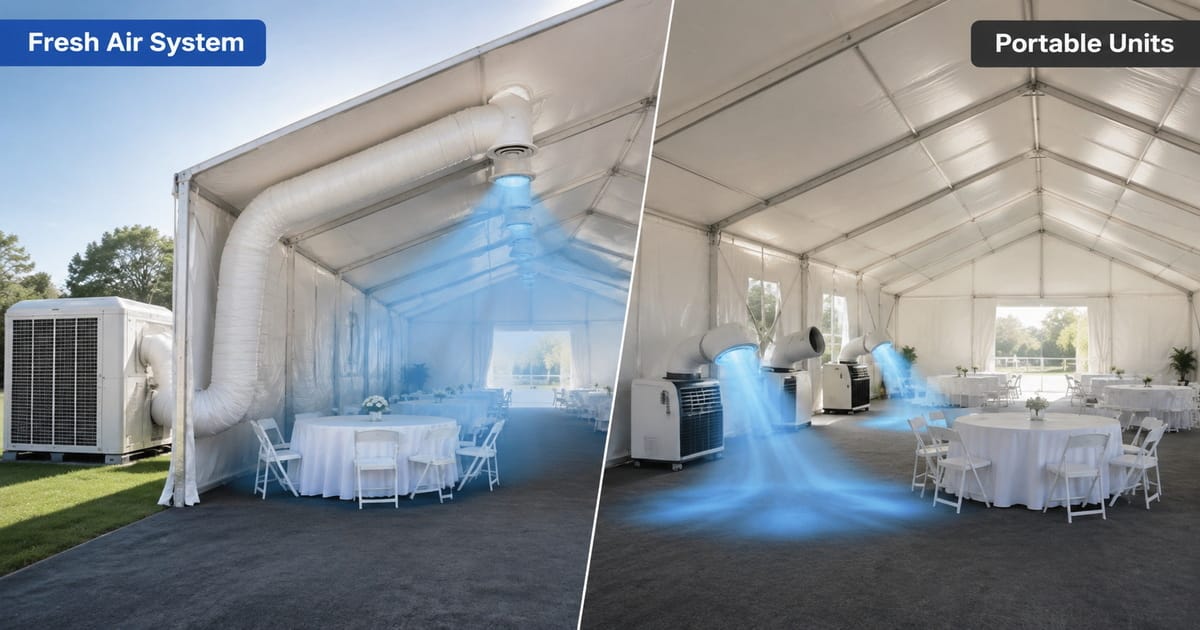
When comparing fresh air conditioning in temporary tents with standard portable cooling units, the key difference is simple: a fresh air system is designed to manage cooling, humidity, airflow, and outdoor-air introduction as part of a planned solution. A standard portable unit mainly provides localized recirculated cooling. For demanding tent applications, that distinction can determine whether occupants feel consistently comfortable or merely stand near a cold-air outlet.
What Makes Tent Cooling Different?
A tent is not a conventional building. Its enclosure is lightweight, often poorly insulated, and constantly affected by external weather.
In my experience working with climate-control requirements for temporary spaces, the most common procurement mistake is treating a tent like a small indoor room. A portable unit may work for a guarded booth or a low-occupancy shelter. But a large event tent, temporary warehouse, field workshop, medical tent, or military support tent needs a more complete air-management approach.
Key tent cooling challenges include:
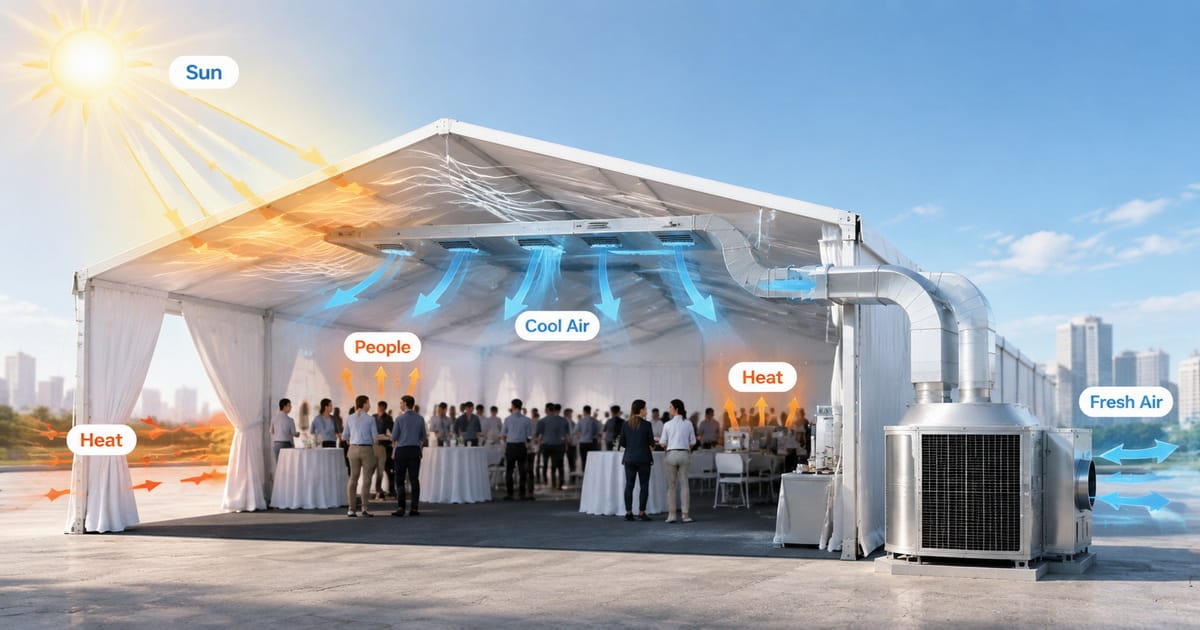
– Direct solar radiation through the roof and sidewalls
– High infiltration, especially when entrances remain open
– Uneven interior temperatures from weak air distribution
– Moisture buildup caused by humidity, people, and outdoor air
– Dust, odors, fumes, or airborne particles in outdoor settings
– Rapidly changing occupancy levels during shifts or events
– Limited electrical infrastructure at remote sites
Cooling capacity alone does not solve these issues. The system must also move conditioned air to where people work, rest, dine, or wait.
Fresh Air Conditioning for Temporary Tents
Fresh air conditioning typically combines cooling with a controlled supply of outdoor air. Depending on the configuration, it may also include filtration, dehumidification, ducted supply air, return-air management, and intelligent controls.
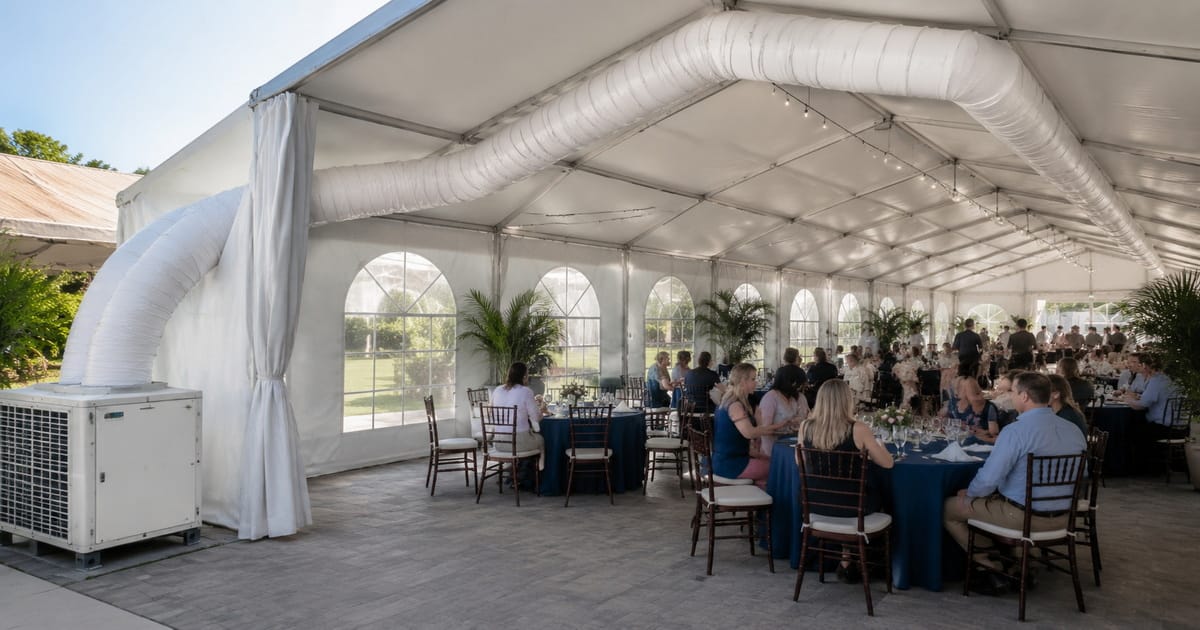
For temporary tents, the equipment is commonly installed outside the structure. Conditioned air enters through flexible ducts, while return air or exhaust air is routed away from the occupied zone.
This layout keeps bulky equipment outside the tent, reduces indoor noise, and preserves valuable floor space.
How It Works in a Tent Setup
A practical fresh air conditioning system for temporary tents usually follows this process:
1. Outdoor air enters the system through a protected intake.
2. Air passes through filtration and cooling components.
3. The unit removes sensible heat and, when designed for it, moisture.
4. Conditioned air is delivered through ducts to multiple areas in the tent.
5. Return air, exhaust air, or a controlled relief path prevents pressure imbalance.
6. Controls adjust fan speed, temperature, and operating conditions as the load changes.
The result is not only cooler air. It is a more manageable indoor environment.
Core Benefits
Better air distribution. Ducts can deliver cool air across a long tent, not only around one machine.
Improved comfort at high occupancy. Fresh-air supply helps reduce stuffiness when many people occupy the enclosure.
More effective humidity control. In warm and humid climates, lower temperature without moisture control can still feel uncomfortable.
Lower risk of short cycling. Proper return-air design helps prevent the system from immediately pulling in its own cooled supply air.
Cleaner tent layout. Locating major equipment outdoors avoids cable congestion, trip hazards, and blocked walkways.
Scalable configuration. Multiple units can serve separate tent zones, allowing flexible expansion for different event sizes or work areas.
Standard Portable Cooling Units Explained
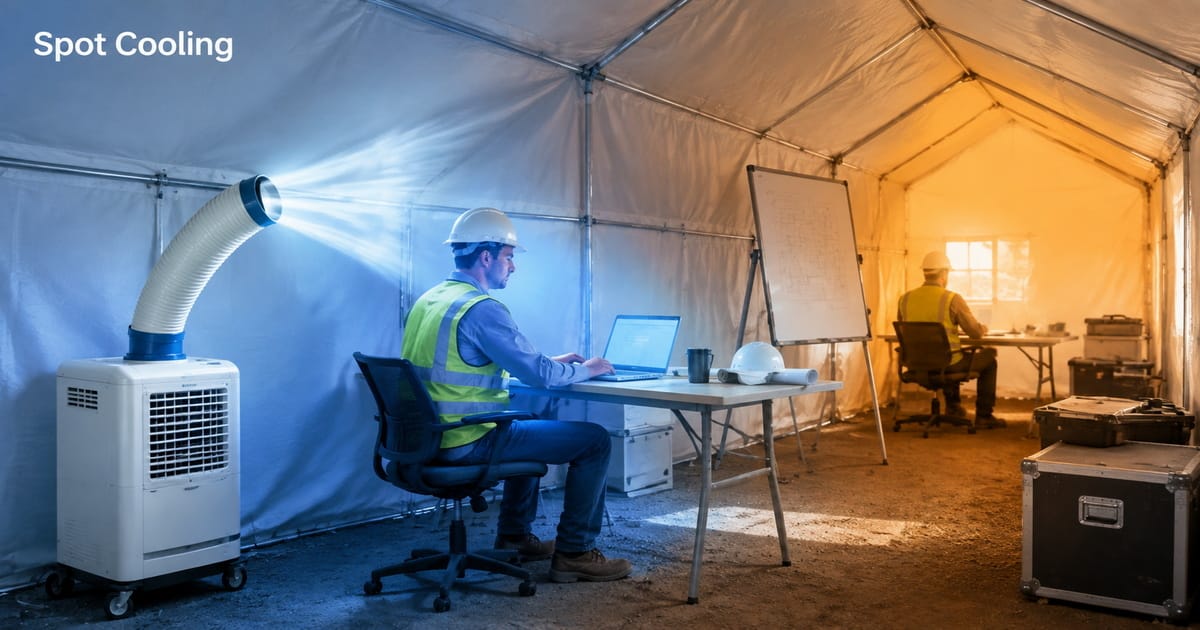
Standard portable cooling units are usually self-contained systems placed inside or close to the temporary space. They may use spot-cooling outlets, directional air hoses, or direct discharge into the room.
These units can be useful. They are often fast to deploy, easy to move, and suitable for focused cooling tasks.
However, they are not always the best primary solution for a large temporary tent.
Where Portable Units Perform Well
Standard portable cooling units are a practical choice when the project has:
– A small enclosed tent
– Low occupant density
– A short operating period
– One heat-sensitive workstation
– A temporary emergency need
– Limited duct-routing options
– A requirement for localized spot cooling
For example, a portable unit can help cool a technician working beside sensitive test equipment. It can also create a short-term cooling zone near an operator station.
The limitation is that the unit usually treats the nearby air first. In a large or open tent, much of that cooling can be lost before it benefits the full occupied area.
Fresh Air Conditioning vs Portable Units
The following table highlights the most important differences for tent cooling projects.
| Comparison Factor | Fresh Air Conditioning in Temporary Tents | Standard Portable Cooling Units |
|---|---|---|
| Primary function | Cooling plus managed outdoor-air supply and circulation | Localized or short-range cooling |
| Best application | Large, crowded, long-duration, or high-specification tents | Small tents, spot cooling, short-term needs |
| Air distribution | Ducted delivery can cover multiple zones | Cooling is strongest near the unit |
| Humidity management | Often more capable when correctly designed | Varies by model; may be limited in large spaces |
| Indoor floor space | Main equipment can remain outdoors | Unit often occupies indoor space |
| Noise in occupied zone | Lower when the main system is outside | Higher because equipment may operate inside |
| Fresh-air capability | Can be purpose-designed for outdoor-air introduction | Often recirculates indoor air primarily |
| Installation complexity | Requires planning for ducts, intake, return, and power | Faster, simpler deployment |
| Upfront project cost | Usually higher | Usually lower |
| Whole-tent comfort | Stronger potential when properly sized | Often inconsistent in larger tents |
The right choice depends on the job. Portable cooling is an equipment decision. Fresh air conditioning is an environmental-control strategy.
The Ventilation Issue Buyers Often Miss
Cooling and ventilation are related, but they are not the same.
Cooling removes heat. Ventilation introduces outdoor air, removes stale air, and supports air quality management. The Occupational Safety and Health Administration distinguishes air treatment from ventilation, while noting that general ventilation dilutes hot air with cooler air. It also recognizes local cooling as useful for specific work areas.
This distinction matters in temporary tents because tents can become stale quickly. High occupancy increases carbon dioxide, body heat, and moisture. Certain applications may also involve odors, dust, vehicle exhaust exposure, or process-related contaminants.
A fresh-air configuration can provide a more controlled answer when the project requires both cooling and airflow management. Standard portable units may still be useful, but they should not be assumed to replace a designed ventilation strategy.
For occupied spaces, public-health guidance commonly emphasizes bringing in cleaner outdoor air, improving filtration when feasible, and using multiple methods to improve air quality.
A Practical Rule
Choose a fresh air conditioning approach when your project needs:
– Even comfort across the full tent
– Airflow for a large number of occupants
– Humidity control in hot, wet conditions
– Ducted supply to divided or long spaces
– A cleaner, less cluttered indoor layout
– Extended operating hours
– A professional environment for customers, employees, patients, or guests
Choose portable cooling units when you need:
– Rapid spot cooling
– Short-term emergency capacity
– Cooling for a single enclosed zone
– A supplement to an existing central solution
– Lower initial deployment cost
Sizing Fresh Air Conditioning for a Temporary Tent
Do not select a unit based only on tent square footage. The required capacity can change dramatically based on sunlight, fabric type, tent color, occupancy, internal loads, and local climate.
A good project assessment should consider the following variables.
1. Measure the Tent Volume
Record:
– Length
– Width
– Peak height
– Sidewall height
– Interior partitions
– Number and size of entrances
Volume matters because a high-roof tent contains much more air than a low canopy of the same floor area.
2. Identify Heat Sources
Heat load may come from:
– People
– Lighting
– Cooking equipment
– Screens and electronics
– Machinery
– Refrigeration equipment
– Open doors
– Direct sunlight
– Warm outdoor air entering the tent
A crowded exhibition tent and a temporary storage tent may have the same dimensions but completely different cooling demands.
3. Review the Local Climate
Temperature alone is not enough. Humidity changes comfort, latent cooling demand, and equipment performance.
In hot-humid regions, a unit that only blows cooler air may fail to create the desired comfort level. In hot-dry areas, airflow and evaporative effects may play a larger role, but dust control becomes more important.
4. Plan Airflow Paths Before Installation
Supply ducts should not terminate at one end of a long tent while return air is collected at the same location. That setup creates a cold zone near the unit and warm stagnant areas elsewhere.
A better arrangement is to distribute supply air across occupied zones and locate return or relief points to encourage air movement through the tent.
5. Design for Real Operating Conditions
Ask the buyer these questions before recommending equipment:
1. How many people will be inside at peak occupancy?
2. Will doors remain open during operation?
3. Is the tent exposed to direct afternoon sun?
4. Are there interior walls, booths, or storage racks?
5. Does the site have stable electrical power?
6. Is low noise important?
7. Is the system expected to run for hours, days, or months?
8. Are filtration, fresh-air intake, or moisture reduction required?
Expert Installation Practices for Better Results
The performance gap between a good system and a disappointing one is often caused by installation details.
Use Ducts Strategically
Place supply ducts to reach areas where people stay the longest. Avoid directing cold air only at entrances, which can waste capacity.
For larger structures, create separate cooling zones for:
– Reception or waiting areas
– Dining zones
– Workstations
– Equipment areas
– Sleeping quarters
– High-occupancy gathering zones
Keep Hot Exhaust Away From the Tent
Any condenser-side heat rejection must be managed carefully. Do not place the heat-producing side of the equipment where it can be drawn back into the tent’s fresh-air intake.
Protect Fresh-Air Intakes
Position intakes away from:
– Generator exhaust
– Vehicle traffic
– Dusty loading areas
– Cooking smoke
– Waste collection points
– Chemical storage
Check Tent Sealing
Perfect sealing is unrealistic for most temporary structures. But reducing unnecessary gaps, using door curtains, and controlling entrances can reduce cooling loss substantially.
Monitor Conditions
Use temperature and humidity monitors at several points in the tent. A single thermostat near the equipment does not represent the experience of occupants at the far end.
For high-occupancy spaces, portable carbon dioxide monitors can provide an additional indication of whether outdoor-air delivery may need improvement. Guidance cited by public-health organizations has used readings above 800 ppm as a prompt to evaluate fresh-air ventilation.
Application Examples
Temporary Event and Exhibition Tents
A premium event tent needs stable comfort, low noise, and a clean interior appearance. A ducted fresh air conditioning system is usually better suited because it keeps major equipment outside and distributes air across guest areas.
Temporary Warehouses and Production Shelters
These sites may require cooling for workers, electronics, packaging materials, or process equipment. A hybrid solution can work well: fresh air conditioning for broad coverage, plus portable cooling units for high-heat stations.
Medical, Emergency, and Relief Tents
These projects require careful planning. Cooling, airflow, occupant comfort, filtration needs, power redundancy, and clean-air pathways should be evaluated together. A portable unit may provide support, but the broader air-management design is usually more important.
Outdoor Construction and Maintenance Projects
For a small rest tent, portable cooling can offer a fast and cost-effective solution. For larger crew shelters operating through long hot shifts, a fresh-air system can better support recovery areas. Workplace heat guidance recommends limiting time in heat and increasing recovery time in cool areas.
Choose the Right Solution With DREZ
The best temporary tent cooling project starts with a complete site assessment, not a generic capacity estimate.
DREZ (Guangzhou) Intelligent Technology Co., Ltd. supports overseas brands, wholesalers, and manufacturers with OEM and ODM fresh air conditioning solutions for temporary tents and other demanding climate-control applications. We can help evaluate tent dimensions, climate conditions, occupancy, airflow paths, ducting needs, noise expectations, power availability, and private-label requirements.
If your customers need more than a cold-air outlet, a customized fresh air conditioning solution can create a more reliable, professional, and scalable tent environment.
Contact DREZ to discuss your OEM or ODM temporary tent cooling project and receive a solution tailored to your market, installation scenario, and brand requirements.
FAQ
1. Is fresh air conditioning necessary for every temporary tent?
No. Small tents with low occupancy may only need a portable cooling unit. However, fresh air conditioning becomes more valuable when the tent is large, crowded, humid, used for long hours, or divided into multiple zones.
2. Can portable cooling units cool a large event tent?
They can provide relief near the units, but they may not cool the full space evenly. Multiple units can help, yet ducted fresh air conditioning is often more effective for large tents that require consistent comfort.
3. Does a fresh air conditioning system reduce humidity?
It can, depending on the unit design, operating conditions, airflow rate, and moisture load. Correct system sizing is important because excessive outdoor-air intake without suitable dehumidification can increase the latent cooling demand.
4. Where should tent air conditioning equipment be installed?
For many projects, the main equipment should be placed outside the tent. Conditioned air can then enter through insulated ducts. This protects indoor floor space, lowers equipment noise near occupants, and improves layout flexibility.
5. How do I calculate the cooling capacity for a temporary tent?
Start with tent size, but also assess location, solar exposure, fabric insulation, occupancy, door use, lighting, equipment heat, outside temperature, and humidity. A professional supplier should evaluate the complete heat load before final selection.
6. Can fresh air conditioning and portable cooling units be used together?
Yes. This is often an effective approach. A fresh air system can provide whole-tent cooling and ventilation, while portable units support localized hot spots, equipment zones, or temporary demand peaks.
7. What should OEM buyers ask a tent air conditioning supplier?
Ask about cooling capacity, fresh-air volume, humidity performance, duct options, filtration, noise level, electrical specifications, control method, operating temperature range, service access, branding options, packaging, compliance needs, and lead time.
References
1. [Occupational Safety and Health Administration: Heat Stress Guide]
2. [CDC/NIOSH: Workplace Recommendations for Heat Stress]
3. [ASHRAE: Indoor Air Quality Resources and Ventilation Standards]
4. [U.S. Environmental Protection Agency: Indoor Air Quality Reference Guide]
5. [CDC Ventilation Guidance Overview via AJMC]
6. [John Snow Project: Air Hygiene and Clean Air Changes Guidance]
7. [Heat Safety in the Workplace: Modified Delphi Consensus Recommendations]
Hot Tags: Fresh Air Conditioning, Temporary Tent Air Conditioning, Portable Cooling Units, Tent Cooling System, Ducted Air Conditioning For Tents, Commercial Tent Cooling Solutions, Industrial Portable Air Conditioners, Outdoor Event Tent Cooling, Temporary Structure Climate Control, OEM Air Conditioning Manufacturer