Content Menu
● Why Humid Outdoor Events Create a Different HVAC Challenge
● Fresh Air Conditioning: What It Does for Event Spaces
>> Core Functions of Fresh Air Conditioning
>> The Strength of Fresh Air Conditioning
>> Limitations of Fresh Air Conditioning
● Dehumidification Systems: Why Moisture Control Matters
>> When Dehumidification Should Be the Priority
>> Dehumidifier Types for Temporary Events
● Fresh Air Conditioning vs. Dehumidification Systems
● What Matters More? The Decision Framework
>> Choose Fresh Air Conditioning First When
>> Choose Dehumidification First When
>> Use an Integrated System When
● Expert Checklist for Sizing Event Climate Control
>> 1. Evaluate the Event Envelope
>> 2. Estimate Sensible Heat Load
>> 3. Estimate Latent Moisture Load
>> 4. Define the Performance Target
>> 5. Validate With Real-Time Monitoring
● Common Mistakes That Reduce Event Comfort
>> Oversizing Cooling but Ignoring Humidity
>> Adding Untreated Outdoor Air
>> Placing Equipment Without Airflow Planning
>> Ignoring Condensate Management
>> Treating Humidity as a Secondary Detail
● OEM and ODM Opportunities for Climate-Control Brands
● FAQ
>> 1. Is fresh air conditioning the same as a regular portable air conditioner?
>> 2. Can air conditioning remove enough humidity for an outdoor event tent?
>> 3. What relative humidity is appropriate for an event tent?
>> 4. Why does an event tent feel sticky even when the air conditioner is running?
>> 5. Should I open the tent walls to improve ventilation in humid weather?
>> 6. What information should I provide when requesting an event HVAC quote?
>> 7. Can DREZ support private-label fresh air conditioning and dehumidification products?
For humid outdoor events, fresh air conditioning and dehumidification systems solve different but connected problems. Fresh air conditioning brings in, filters, cools, and conditions outdoor air, while a dehumidification system removes excess water vapor. In a hot, moisture-heavy event environment, neither should be viewed as a universal substitute for the other.
In many humid climates, the strongest solution is an integrated one: properly treated outdoor air combined with sufficient latent-load control. This article explains how decision-makers can compare fresh air conditioning vs. dehumidification systems for outdoor events—and how OEM/ODM buyers can specify the right mobile climate-control solution.
Why Humid Outdoor Events Create a Different HVAC Challenge
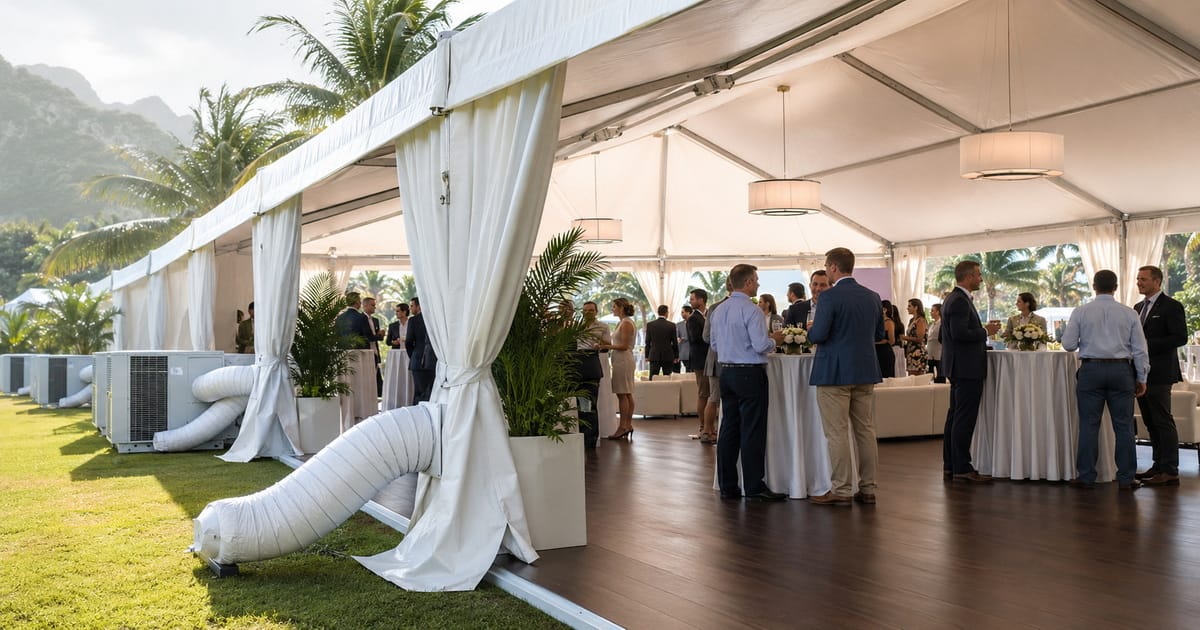
Outdoor events are rarely fully outdoors from an HVAC perspective. Weddings, product launches, trade exhibitions, sports hospitality areas, military shelters, temporary warehouses, outdoor dining zones, and festival VIP tents often rely on partially enclosed or fully enclosed fabric structures.
Once walls, roofs, side curtains, flooring, lighting, people, catering equipment, and temporary partitions are added, the event space begins to behave like a temporary building. It gains heat. It gains moisture. It also needs ventilation.
The challenge becomes more severe in tropical, coastal, rainy, and monsoon-prone regions. Hot outdoor air can carry a large amount of moisture. When that air enters a tent or semi-enclosed venue, it can make guests feel sticky even if the measured temperature appears acceptable.
This is why event planners often make a costly mistake: they select cooling capacity only by square meters or BTU output. They overlook latent heat, which is the energy associated with moisture in the air.
A system may lower dry-bulb temperature but still leave the space uncomfortable if relative humidity remains too high. Conversely, a powerful dehumidifier may reduce moisture but may not supply enough cooled, filtered outdoor air for a densely occupied event.
The U.S. Environmental Protection Agency generally recommends maintaining indoor relative humidity between 30% and 50% where feasible, and below 60% to reduce moisture-related problems such as condensation and mold growth. Temporary event structures are more difficult to control than permanent buildings, but these thresholds remain useful operational reference points.
Fresh Air Conditioning: What It Does for Event Spaces
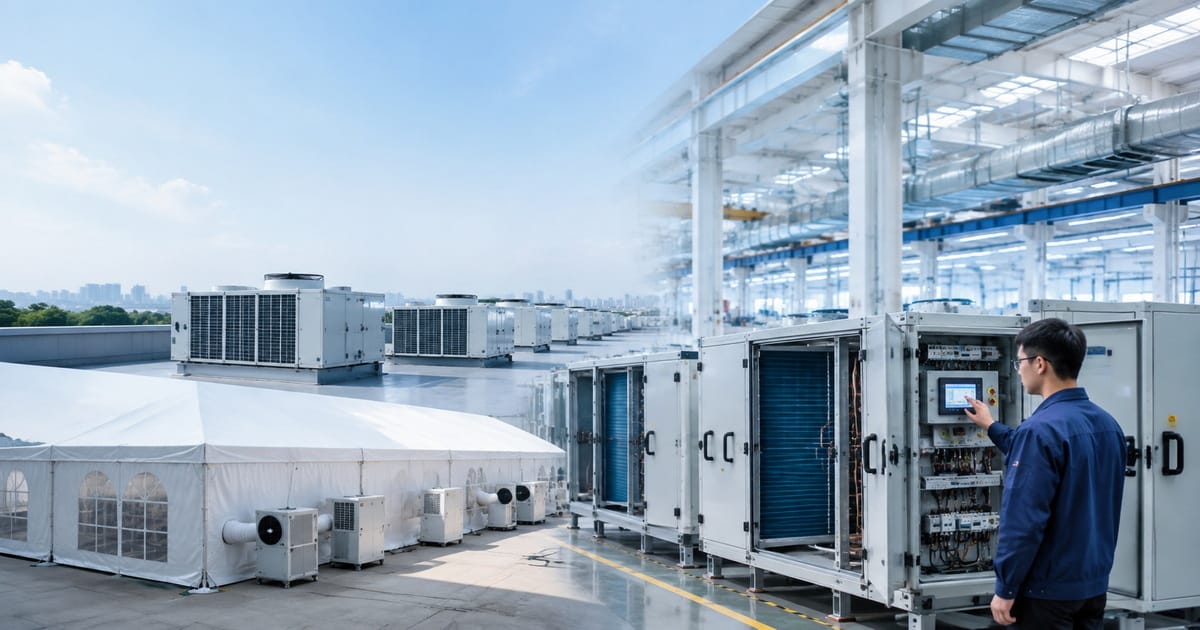
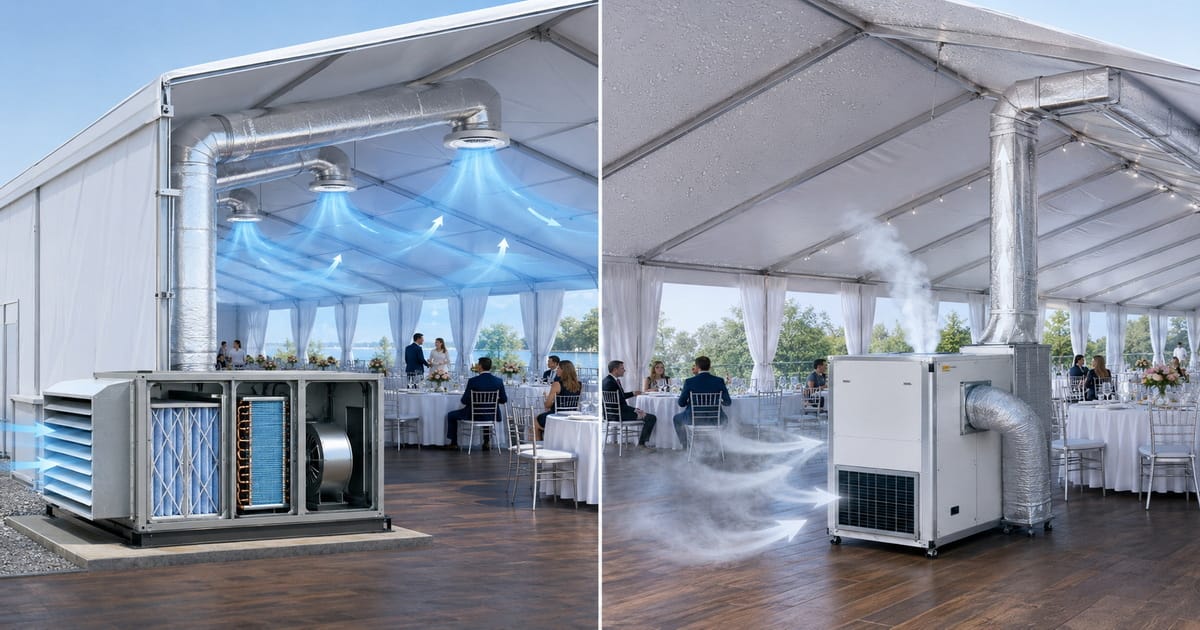
Fresh air conditioning is designed to manage more than temperature. In a properly engineered system, it can introduce outdoor air, filter it, cool it, and—in certain configurations—remove moisture before supplying the treated air to the occupied area.
For an outdoor event tent or temporary structure, a fresh air conditioning unit is particularly valuable when organizers need to manage thermal comfort, ventilation quality, air movement, and crowd-related stuffiness at the same time.
Core Functions of Fresh Air Conditioning
A fresh air air-conditioning system can support several event requirements:
– Introduces controlled outdoor air into a semi-enclosed or enclosed event area.
– Cools incoming hot air before it reaches guests.
– Filters dust, pollen, smoke particles, and other airborne contaminants, depending on filter configuration.
– Creates more consistent airflow across large temporary spaces.
– Helps dilute indoor pollutants and odors generated by crowds, food service, decorations, equipment, and cleaning products.
– Can provide some moisture removal during active cooling operation.
– Supports positive-pressure or balanced-pressure strategies where appropriate.
Fresh air is especially important in venues with high occupancy density. A packed exhibition tent, temporary showroom, dining pavilion, or wedding marquee can become uncomfortable not only because of heat, but also because of body heat, carbon dioxide accumulation, odors, and reduced perceived freshness.
The EPA notes that increasing the amount of fresh air brought indoors can help reduce indoor pollutant concentrations. However, humid outdoor conditions require caution: bringing in untreated outdoor air can increase the moisture load rather than solve it.
The Strength of Fresh Air Conditioning
The major advantage of fresh air conditioning is that it addresses the guest experience holistically. Guests do not evaluate comfort by humidity alone. They notice whether the air feels cool, clean, moving, fresh, and breathable.
For example, imagine a 500-person outdoor product-launch event held in a large enclosed tent near a humid coastline. Guests arrive wearing formal clothing. Catering stations add heat and steam. Doors open repeatedly. In this case, simply placing portable dehumidifiers around the tent may reduce moisture levels, but it may not deliver enough cooled and fresh air to maintain a premium experience.
A ducted fresh air conditioning solution can distribute conditioned air more evenly into the occupied zone. When paired with humidity management, it creates a more professional and comfortable result.
Limitations of Fresh Air Conditioning
Fresh air conditioning is not automatically a complete answer to high humidity.
Traditional air conditioning removes moisture mainly when the cooling coil operates below the air’s dew point. In other words, it dehumidifies as a secondary effect of cooling. ASHRAE explains that conventional air conditioners do remove moisture while cooling, but dehumidification is generally incidental to their primary temperature-control function.
This creates several limitations:
– A system sized mainly for sensible cooling may not remove enough moisture.
– If the unit cycles off frequently, moisture removal can drop sharply.
– Large volumes of humid outside air can overwhelm a unit that lacks sufficient latent capacity.
– Opening tent entrances, service doors, or sidewalls introduces repeated moisture loads.
– Cooler but humid air can still feel uncomfortable and cause condensation on equipment, floors, and décor.
For humid outdoor events, fresh air conditioning must therefore be selected based on both sensible cooling load and latent moisture load.
Dehumidification Systems: Why Moisture Control Matters
A dehumidification system removes water vapor from the air. In humid outdoor events, its primary purpose is to reduce relative humidity, lower dew point, limit condensation risk, and improve perceived comfort.
This is not a minor issue. High humidity changes how the human body experiences temperature. Sweat evaporates less effectively in moisture-heavy air, so people can feel hotter, stickier, and more fatigued even when air temperature is moderately controlled.
For event operators, moisture also affects the venue itself:
– Condensation can form on cold surfaces, ducts, windows, flooring, and equipment.
– Wet or slippery floors can increase safety risks.
– AV equipment, LED displays, cameras, and electrical connections may face higher moisture exposure.
– Paper signage, packaging, product samples, and display materials can warp or soften.
– Fabric décor and tent liners may feel damp.
– Musty odors can undermine a premium-brand environment.
ASHRAE defines dehumidification as the removal of water vapor from air, gases, or other fluids.
When Dehumidification Should Be the Priority
Dehumidification becomes the leading priority when the event has one or more of the following conditions:
– Outdoor relative humidity is consistently high.
– The venue is a closed or highly enclosed tent with limited natural drying.
– The event includes cold surfaces, chilled products, ice displays, refrigeration, or glass installations.
– The venue has frequent door openings or service access.
– Cooling demand is low or moderate, but moisture levels remain high.
– The event operates during rainy weather, evenings, early mornings, or shoulder seasons.
– Equipment, displays, textiles, food products, or packaging are sensitive to moisture.
– The site is located in a tropical, coastal, or monsoon-influenced market.
A portable dehumidification system can be particularly effective for temporary structures because it targets the hidden problem: excess water vapor. It can maintain moisture removal even when a cooling system is not running enough to provide adequate latent control.
Dehumidifier Types for Temporary Events
OEM buyers and event-equipment brands should distinguish among several common system approaches:
| System Type | Primary Benefit | Best Use Case | Key Limitation |
|---|---|---|---|
| Refrigerant dehumidifier | Efficient moisture removal in warm conditions | Tents, event halls, temporary warehouses | Performance can vary at lower temperatures |
| Desiccant dehumidifier | Effective at low temperatures and low dew points | Sensitive equipment, specialty applications, cold conditions | May require regeneration heat and more energy |
| Portable spot dehumidifier | Flexible and fast to deploy | Smaller zones, backstage areas, storage rooms | Limited for large open venues |
| Ducted industrial dehumidifier | More even distribution and higher capacity | Large tents, exhibition halls, temporary structures | Requires layout planning and duct management |
| AC-integrated moisture control | Combines cooling and latent control | Premium event climate systems | Must be correctly sized for outdoor-air load |
The right choice depends on air volume, outdoor dew point, occupancy, enclosure quality, infiltration, internal moisture sources, and target conditions.
Fresh Air Conditioning vs. Dehumidification Systems
The following comparison helps event planners and B2B buyers understand the practical difference.
| Evaluation Factor | Fresh Air Conditioning | Dehumidification System | Best Choice in Humid Events |
|---|---|---|---|
| Main purpose | Cools and introduces treated outdoor air | Removes water vapor from air | Use both when possible |
| Temperature control | Strong | Limited or indirect | Fresh air conditioning |
| Humidity control | Moderate to strong, depending on coil design and runtime | Strong when properly sized | Dehumidification |
| Ventilation support | Strong | Usually limited unless integrated with ventilation | Fresh air conditioning |
| Odor and pollutant dilution | Stronger when outdoor air is filtered and supplied | Limited | Fresh air conditioning |
| Condensation prevention | Partial | Strong | Dehumidification |
| Crowd comfort in enclosed tents | Strong if capacity is adequate | Helpful but incomplete alone | Integrated solution |
| Sensitive equipment protection | Helpful through air cooling and circulation | Critical where moisture is the main risk | Dehumidification-led design |
| Door-opening resilience | Can be overwhelmed by humid air intake | Helps recover moisture load | Both systems together |
| Event setup flexibility | Available in portable and ducted forms | Available in portable and ducted forms | Depends on venue layout |
What Matters More? The Decision Framework
For humid outdoor events, dehumidification often matters more than planners initially expect. But it does not necessarily matter more than fresh air conditioning in every situation.
The decision should be based on the event’s actual failure risk.
Choose Fresh Air Conditioning First When
Fresh air conditioning should be the priority when:
– Guests are concentrated in a closed or semi-closed tent.
– Heat load from people, lighting, cooking, and equipment is high.
– The event needs a visible premium-comfort experience.
– Ventilation and odor dilution are major concerns.
– The venue feels hot, stale, or poorly circulated.
– The event occurs during peak daytime heat.
– The client expects cooling, not only moisture reduction.
In these cases, fresh air conditioning creates the foundation for thermal comfort and air movement.
Choose Dehumidification First When
Dehumidification should be the priority when:
– The temperature is acceptable, but the air feels damp and sticky.
– Condensation is visible on surfaces or equipment.
– The event is in a rainy, tropical, or coastal location.
– Cooling systems run intermittently and cannot remove enough moisture.
– The space contains moisture-sensitive displays, products, electronics, or materials.
– The event happens in the evening or during wet weather.
– A tent is closed for long periods with repeated entrance traffic.
The EPA specifically advises using dehumidification when outdoor air is warm and humid, rather than relying on ventilation alone to reduce indoor moisture.
Use an Integrated System When
For premium, high-capacity, or mission-critical events, the best strategy is usually an integrated system:
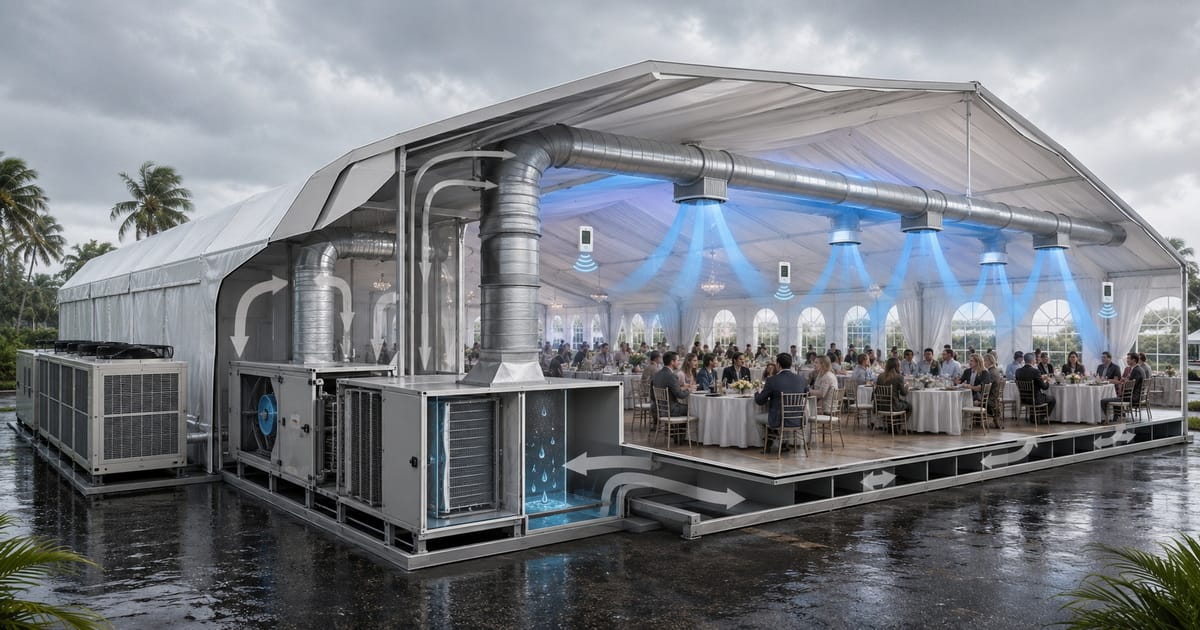
1. Bring in controlled and filtered fresh air.
2. Cool the air to manage sensible heat.
3. Remove sufficient moisture to control dew point and relative humidity.
4. Distribute air evenly through ducts or strategically positioned supply points.
5. Monitor conditions continuously with temperature and humidity sensors.
6. Adjust equipment operation as occupancy and outdoor weather change.
This approach is especially relevant for DREZ’s OEM and ODM partners. Instead of treating a portable air conditioner and a dehumidifier as unrelated products, brands can develop a coordinated temporary climate-control solution tailored to their market.
Expert Checklist for Sizing Event Climate Control
The most reliable way to avoid under-sizing is to assess the complete load—not only the floor area.
1. Evaluate the Event Envelope
Start with the temporary structure:
– Tent length, width, and ceiling height.
– Whether the tent is fully enclosed, partially open, or frequently opened.
– Roof and wall material.
– Insulation level, if any.
– Number and size of entrances.
– Air leakage around tent seams, flooring, and service openings.
– Duct-routing options and equipment placement zones.
A large tent with open sidewalls behaves very differently from a sealed exhibition pavilion. If humid outdoor air can enter continuously, the dehumidification load rises substantially.
2. Estimate Sensible Heat Load
Sensible load is the heat that raises air temperature. Key sources include:
– Occupants.
– Solar radiation through tent fabric.
– Lighting.
– Cooking and catering equipment.
– LED screens and AV equipment.
– Refrigeration equipment.
– Nearby generators or equipment exhaust.
For a daytime event, solar gain can be a major driver. For an evening event, crowd density and humidity may become more significant than sunlight.
3. Estimate Latent Moisture Load
Latent load is the moisture introduced into the space. Consider:
– Outdoor air humidity and dew point.
– Guest perspiration and respiration.
– Infiltration through open doors and tent gaps.
– Catering steam and food preparation.
– Wet flooring, rainwater, or damp materials.
– Floral displays, water features, or ice stations.
– Fresh-air ventilation volume.
A high-occupancy event in a humid region can generate a meaningful internal moisture load even before outdoor-air infiltration is considered.
4. Define the Performance Target
Avoid vague objectives such as “make the tent comfortable.” Define measurable conditions:
– Target indoor temperature.
– Target relative humidity.
– Maximum acceptable dew point.
– Desired air movement.
– Operating hours.
– Recovery time after doors open.
– Noise limit near guests or speakers.
– Power supply and backup requirements.
For many comfort-oriented event spaces, a practical target may be a moderate temperature combined with controlled relative humidity. Exact targets should be adjusted for local climate, clothing, activity level, and event type.
5. Validate With Real-Time Monitoring
Use multiple temperature and humidity sensors. Do not place all sensors beside the equipment.
Install them at representative guest-zone locations, including:
– Near entrances.
– In the center of the occupied zone.
– Near high-density seating or exhibition areas.
– Near catering zones.
– Near sensitive electronics or product displays.
This gives operators a clearer picture of whether the system is controlling the entire space—not only the area closest to the supply outlet.
Common Mistakes That Reduce Event Comfort
Oversizing Cooling but Ignoring Humidity
A powerful portable air conditioner may create cold air near the discharge point while leaving the broader event area damp. Guests can feel chilly and clammy at the same time.
Adding Untreated Outdoor Air
Ventilation is important, but humid outdoor air must be treated. Simply opening tent sides or doors may improve airflow while dramatically increasing the latent moisture load.
The CDC notes that increasing outside air can be difficult in hot or humid weather because it can affect thermal comfort and indoor humidity.
Placing Equipment Without Airflow Planning
Equipment location matters. If supply air short-circuits directly back to return air, guests may receive little benefit. Ducted delivery and coordinated supply-return placement often improve performance in large temporary structures.
Ignoring Condensate Management
Both air conditioners and dehumidifiers generate condensate. Event plans should include drainage, pumps, hoses, collection methods, and safe routing away from walkways and electrical equipment.
Treating Humidity as a Secondary Detail
In humid markets, moisture control should be part of the original equipment specification. It should not become an emergency add-on after guests complain about sticky air or condensation appears on the first day.
OEM and ODM Opportunities for Climate-Control Brands
For distributors, wholesalers, equipment-rental companies, and private-label HVAC brands, humid outdoor events represent an opportunity to offer more than a single machine.
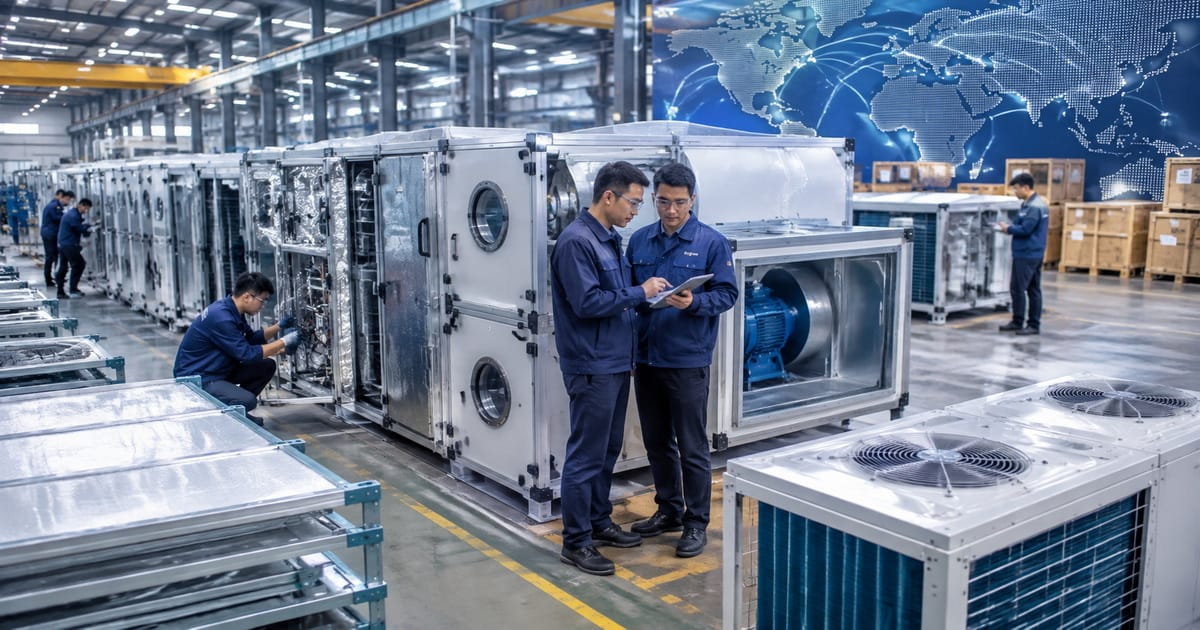
DREZ (Guangzhou) Intelligent Technology Co., Ltd. can support OEM and ODM partners by helping configure climate-control solutions that fit regional event conditions, installation practices, branding requirements, and commercial channel needs.
Potential customization priorities include:
– Cooling and dehumidification capacity matched to local climate.
– Portable, wheeled, ducted, or modular product configurations.
– Flexible fresh-air intake and supply-air duct options.
– High-efficiency filtration options.
– Integrated humidity and temperature control.
– Smart control panels, remote monitoring, and sensor integration.
– Low-noise designs for hospitality, weddings, exhibitions, and corporate events.
– Private-label housings, colors, packaging, manuals, and certification support.
– Condensate pump and drainage configurations.
– Equipment designed for rental fleets and repeated transport.
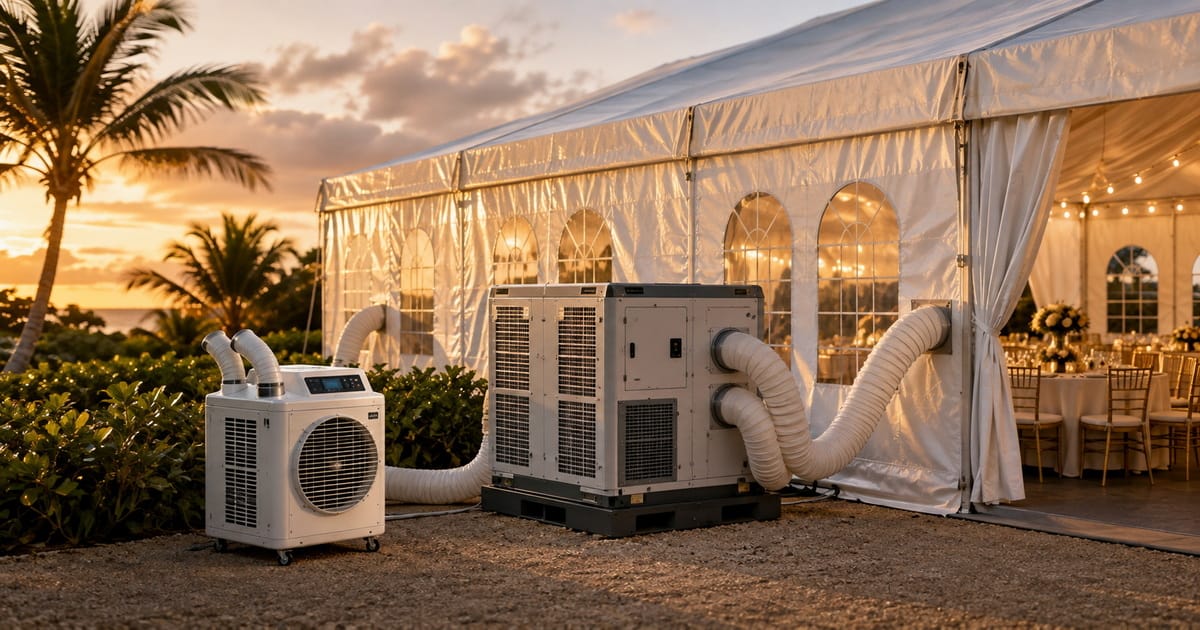
For brands serving tropical or coastal markets, a strong product portfolio may include both mobile fresh air conditioners and industrial dehumidifiers. The commercial advantage comes from helping customers solve the entire event-comfort problem—not merely selling cooling capacity.
Final Verdict
For humid outdoor events, fresh air conditioning is essential for cooling, ventilation, and overall guest experience, while dehumidification is essential for moisture control, condensation prevention, and true comfort in humid conditions.
If the venue is hot, crowded, enclosed, and stale, prioritize fresh air conditioning. If it is damp, sticky, condensation-prone, or exposed to humid outdoor air, prioritize dehumidification. For high-value events, large tents, tropical climates, and equipment-sensitive installations, combine both systems into one coordinated temporary climate-control plan.
The best system is not the one with the highest cooling number on a brochure. It is the system that controls temperature, humidity, airflow, ventilation, noise, drainage, and operational stability under real event conditions.
Looking for an OEM or ODM fresh air conditioning solution for humid outdoor events? Contact DREZ to discuss portable fresh air air-conditioning units, commercial dehumidification systems, ducted configurations, private-label development, and climate-control solutions engineered for your target market.
FAQ
1. Is fresh air conditioning the same as a regular portable air conditioner?
No. A regular portable air conditioner often focuses mainly on recirculated-air cooling. Fresh air conditioning is designed to introduce and treat outdoor air, often adding filtration, cooling, controlled airflow, and ventilation benefits. The exact capabilities depend on the equipment design.
2. Can air conditioning remove enough humidity for an outdoor event tent?
Sometimes, but not always. Air conditioning removes moisture while cooling, yet high outdoor humidity, large air leakage, frequent door opening, and dense occupancy can create more moisture than the cooling system can remove. Dedicated dehumidification may be required.
3. What relative humidity is appropriate for an event tent?
A practical comfort target often falls around 40% to 60% RH, depending on temperature, climate, and enclosure quality. EPA guidance for indoor environments recommends 30% to 50% where feasible and keeping humidity below 60% to reduce moisture-related problems.
4. Why does an event tent feel sticky even when the air conditioner is running?
The likely cause is excessive moisture in the air. The cooling unit may lower temperature without removing enough water vapor. Poor airflow, humid outside-air infiltration, insufficient runtime, and inadequate system sizing can all contribute.
5. Should I open the tent walls to improve ventilation in humid weather?
It depends on conditions. Opening the tent can increase airflow, but it can also bring in large volumes of humid air, increasing the dehumidification burden. In hot and humid weather, controlled mechanical fresh-air treatment is often more reliable than uncontrolled opening.
6. What information should I provide when requesting an event HVAC quote?
Provide tent dimensions, enclosure type, guest count, location, date, operating hours, expected weather, local temperature and humidity, door-opening frequency, heat-generating equipment, power availability, target comfort conditions, noise restrictions, and whether ducts can be used.
7. Can DREZ support private-label fresh air conditioning and dehumidification products?
Yes. DREZ (Guangzhou) Intelligent Technology Co., Ltd. can support international brands, wholesalers, and manufacturers with OEM and ODM climate-control solutions, including product customization, branding, specifications, configurations, and commercial development support.
References
1. U.S. Environmental Protection Agency. “[Care for Your Air: A Guide to Indoor Air Quality].” Guidance on ventilation, moisture control, and maintaining indoor humidity between 30% and 50%. [epa]
2. U.S. Environmental Protection Agency. “[Mold Course Chapter 2].” Guidance that indoor relative humidity should remain below 60%, ideally between 30% and 50%, to help limit moisture problems. [epa]
3. U.S. Environmental Protection Agency. “[Mold Course Chapter 9].” Discussion of condensation prevention and the need to dehumidify when outdoor air is warm and humid. [epa]
4. U.S. Environmental Protection Agency. “[Moisture Control: Indoor Air Quality Design Tools for Schools].” Guidance linking controlled humidity with protection of occupants, buildings, and contents. [epa]
5. ASHRAE. “[Top Ten Things Consumers Should Know About Air Conditioning].” Explanation that standard air conditioning dehumidifies as it cools, but moisture control can require dedicated attention. [ashrae]
6. ASHRAE. “[ASHRAE Journal Podcast Episode 39].” Definition of dehumidification as the removal of water vapor from air. [ashrae]
7. U.S. Centers for Disease Control and Prevention. “[Ventilation in Buildings].” Guidance on increasing outdoor air, air changes, and the challenges of ventilation during hot and humid weather. [archive.cdc]
Hot Tags: Fresh Air Conditioning, Dehumidification Systems, Outdoor Event HVAC, Temporary Event Cooling, Event Tent Air Conditioning, Commercial Dehumidifiers, Portable HVAC Systems, Humidity Control Solutions, Industrial Climate Control, OEM HVAC Manufacturer