Content Menu
● Why Ventilation Matters at Large Events
● What Is Fresh Air Conditioning?
>> Fresh Air Conditioning Benefits for Event Venues
● What Is an Exhaust Ventilation System?
● Fresh Air Conditioning vs. Exhaust Ventilation Systems
● Which System Performs Better in Real Event Conditions?
>> High-Density Conferences and Exhibitions
>> Concerts, Performances, and High-Activity Gatherings
>> Food, Odor, and Back-of-House Areas
>> Outdoor, Semi-Outdoor, and Temporary Events
● The Hidden Issue: Air Balance
● How to Select the Right System for a Large Event
>> 1. Define Occupancy and Event Behavior
>> 2. Identify Heat and Moisture Loads
>> 3. Separate Whole-Space and Source-Control Needs
>> 4. Specify Monitoring and Controls
>> 5. Verify Installation and Commissioning
● Expert Recommendation for Event Buyers
● Final Answer: Which Is Better?
>> 1. Can exhaust fans replace fresh air conditioning for a large event?
>> 2. Is fresh air conditioning more energy-intensive than exhaust ventilation?
>> 3. How can event venues avoid stuffy air during peak attendance?
>> 4. Where should exhaust ventilation be used at an event venue?
>> 5. Can a fresh air conditioning system work in humid climates?
>> 6. What should an OEM buyer ask a fresh air conditioning manufacturer?
>> 7. Is CO₂ monitoring enough to measure event indoor air quality?
For large events, fresh air conditioning is usually the stronger primary solution because it combines outdoor-air introduction, temperature control, humidity management, air distribution, and—when specified correctly—filtration. Exhaust ventilation systems remain essential, but they are generally best used as a complementary strategy for removing heat, odors, moisture, and pollutants from targeted areas rather than as the only ventilation method for a crowded venue.
For event organizers, venue operators, HVAC contractors, and equipment buyers, the practical question is not simply “fresh air conditioning vs. exhaust ventilation systems.” It is: How can the venue maintain safe, comfortable, balanced, and energy-efficient indoor conditions while occupancy changes rapidly? The best answer for most large indoor events is an engineered combination, with fresh air conditioning at the center and properly designed exhaust ventilation supporting it.
Why Ventilation Matters at Large Events
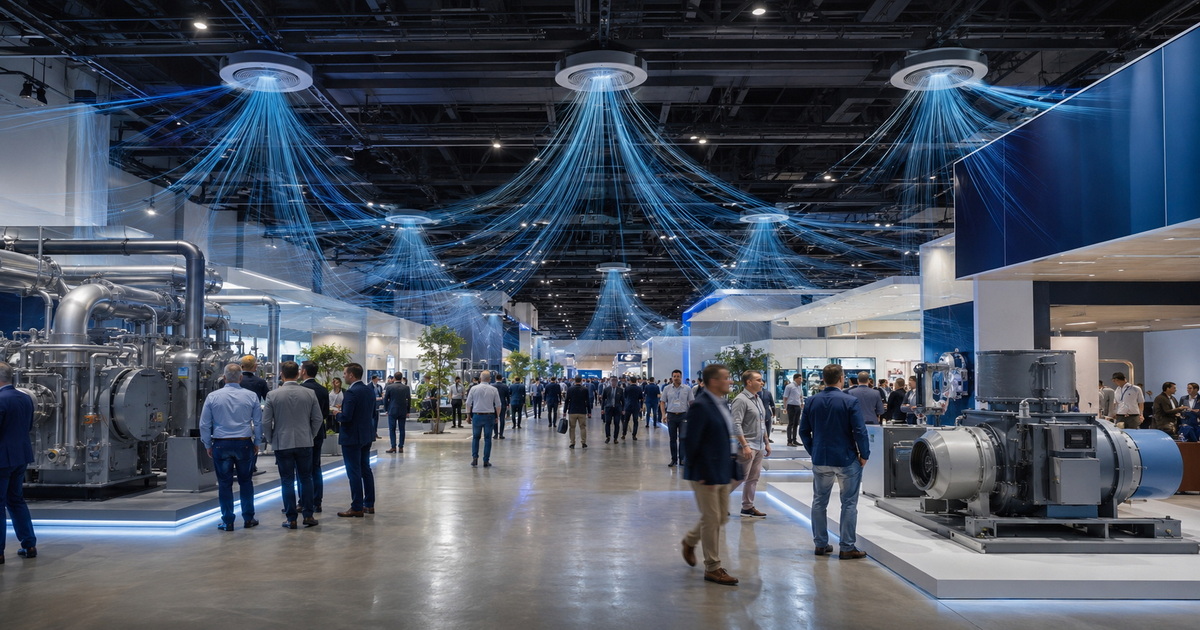
Large events create an unusually demanding indoor-air environment. Conferences, concerts, exhibitions, sports gatherings, product launches, factory open days, wedding receptions, and temporary event structures can bring hundreds or thousands of people into one enclosed area for several hours.
Every attendee adds heat, moisture, carbon dioxide, and bioeffluents to the space. Food service, stage effects, cleaning products, display materials, temporary partitions, and high sound levels can further affect air quality and comfort.
A ventilation strategy for a large event must therefore solve several problems at once:
– Supply enough outdoor air for a changing number of occupants.
– Remove stale air, odors, humidity, and internally generated pollutants.
– Control room temperature during crowd-related heat gains.
– Avoid uncomfortable drafts, stagnant zones, and uneven temperatures.
– Maintain building-pressure balance.
– Manage energy use, especially in hot, humid, cold, or polluted climates.
– Support the venue’s applicable local codes and ventilation design requirements.
ASHRAE identifies Standards 62.1 and 62.2 as recognized standards for ventilation-system design and acceptable indoor air quality. For commercial and institutional event venues, ANSI/ASHRAE Standard 62.1 addresses minimum ventilation rates along with filtration, controls, air-cleaning systems, and building operations and maintenance.
The core point is simple: air movement alone is not the same as effective ventilation. A fan may make occupants feel cooler, but it does not necessarily provide outdoor-air dilution, temperature control, humidity control, or pollutant removal.
What Is Fresh Air Conditioning?
Fresh air conditioning is an HVAC approach that introduces conditioned outdoor air into an occupied space. Unlike a conventional recirculating air-conditioning unit that primarily cools or heats indoor air, a fresh air conditioning system is designed to bring in external air, process it, and distribute it to occupants.
Depending on the application, the system may include:
– Outdoor-air intake and intake-air filtration.
– Cooling and heating capacity.
– Dehumidification or humidification functions.
– Supply fans and ductwork.
– Air diffusers designed for even airflow distribution.
– Energy-recovery components.
– Sensors for temperature, humidity, carbon dioxide, or particulate matter.
– Demand-controlled ventilation logic.
For a large event, the key advantage is that the equipment can deliver conditioned, usable outdoor air. This matters because raw outdoor air may be too hot, humid, cold, dusty, or polluted to introduce directly at the volumes needed for a packed venue.
A well-designed fresh air conditioning solution can help a venue achieve three goals simultaneously:
1. Ventilation: Dilute indoor contaminants by replacing a portion of indoor air with outdoor air.
2. Thermal comfort: Offset heat from people, lighting, displays, equipment, and outdoor conditions.
3. Humidity control: Reduce the sticky, damp, or stuffy conditions that can develop when many people occupy a space.
This is especially relevant for exhibitions and conferences in warm or humid regions. Increasing outdoor airflow without sufficient cooling and dehumidification can make the space less comfortable, increase latent cooling loads, and potentially create condensation risks.
Fresh Air Conditioning Benefits for Event Venues
A fresh air conditioning system is particularly useful when event operators need consistent comfort across a large hall, ballroom, convention center, temporary venue, or modular event structure.
Key benefits include:
– Better perceived air freshness: Outdoor-air dilution can reduce the “stuffy room” experience associated with high occupancy.
– Temperature stability: The system can manage both external weather and crowd-generated heat.
– Humidity management: This is vital for guest comfort, protecting event equipment, and reducing condensation concerns.
– Improved air distribution: Properly selected diffusers and duct layouts can reduce dead zones.
– Better integration with IAQ controls: CO₂, humidity, and occupancy signals can support responsive operation.
– More professional venue experience: Comfortable air conditions influence attendee dwell time, exhibitor satisfaction, and repeat bookings.
For OEM and ODM buyers, the value is not only the equipment itself. It is the ability to configure airflow capacity, cabinet dimensions, heat-exchanger options, filtration stages, controls, and installation format for the venue, regional climate, and brand requirements.
What Is an Exhaust Ventilation System?
An exhaust ventilation system removes indoor air from a building or specific zone and discharges it outdoors. Its basic role is to pull contaminated, humid, hot, odorous, or stale air away from the occupied environment.
In event settings, exhaust ventilation may serve:
– Toilets and washrooms.
– Commercial kitchens and food-preparation zones.
– Smoking rooms where permitted.
– Backstage spaces.
– Waste-storage areas.
– Generator or technical rooms.
– Areas with strong odors, aerosols, or heat loads.
– Temporary event areas with localized pollutants.
Exhaust systems can be very effective when the pollutant source is concentrated. For example, a kitchen hood removes grease-laden vapors at the source. A restroom exhaust fan removes odors and moisture before they spread into corridors or public halls.
The U.S. Consumer Product Safety Commission notes that inadequate ventilation can raise indoor pollutant levels when there is insufficient outdoor air to dilute indoor emissions or insufficient removal of air from the space. It also notes that exhaust fans vented outdoors remove contaminants directly from the room where they are generated.
However, exhaust ventilation has an important limitation: it removes air, but it does not automatically provide conditioned replacement air.
When an exhaust fan pulls indoor air outdoors, replacement air must enter from somewhere. If there is no planned make-up-air path, the venue may draw unconditioned air through doors, cracks, loading docks, ceiling voids, or other unintended routes. This can create negative pressure, hot or humid infiltration, door-opening difficulty, uneven comfort, and higher HVAC loads.
Fresh Air Conditioning vs. Exhaust Ventilation Systems
The table below compares the two systems from the perspective of a large-event application.
| Evaluation factor | Fresh air conditioning | Exhaust ventilation systems |
|---|---|---|
| Main function | Supplies and conditions outdoor air while managing indoor comfort | Removes air, moisture, odors, heat, and pollutants from a space |
| Outdoor-air delivery | Direct and controlled | Indirect; replacement air enters through planned or unplanned paths |
| Temperature control | Strong; cooling or heating can be integrated | Limited; generally does not cool or heat supply air |
| Humidity control | Strong when equipped for dehumidification or humidification | Removes moisture but may introduce humid replacement air if make-up air is uncontrolled |
| Best application | Occupied halls, exhibition areas, ballrooms, conference rooms, arenas | Kitchens, toilets, backstage rooms, waste areas, pollutant-source zones |
| Comfort during high occupancy | High potential when airflow is properly sized and distributed | Often inadequate alone for overall occupant comfort |
| Indoor air quality role | Dilutes pollutants and can integrate filtration and monitoring | Removes pollutants at the source or from the room |
| Pressure impact | Can be designed to maintain balanced or slightly positive pressure | Can create negative pressure if make-up air is not properly designed |
| Energy use | Can be higher due to conditioning outdoor air, but energy recovery and controls can reduce waste | Fan energy may be lower, but uncontrolled infiltration can increase whole-building cooling or heating loads |
| Event suitability | Best as the primary whole-space solution | Best as a supporting or localized solution |
Quick Verdict
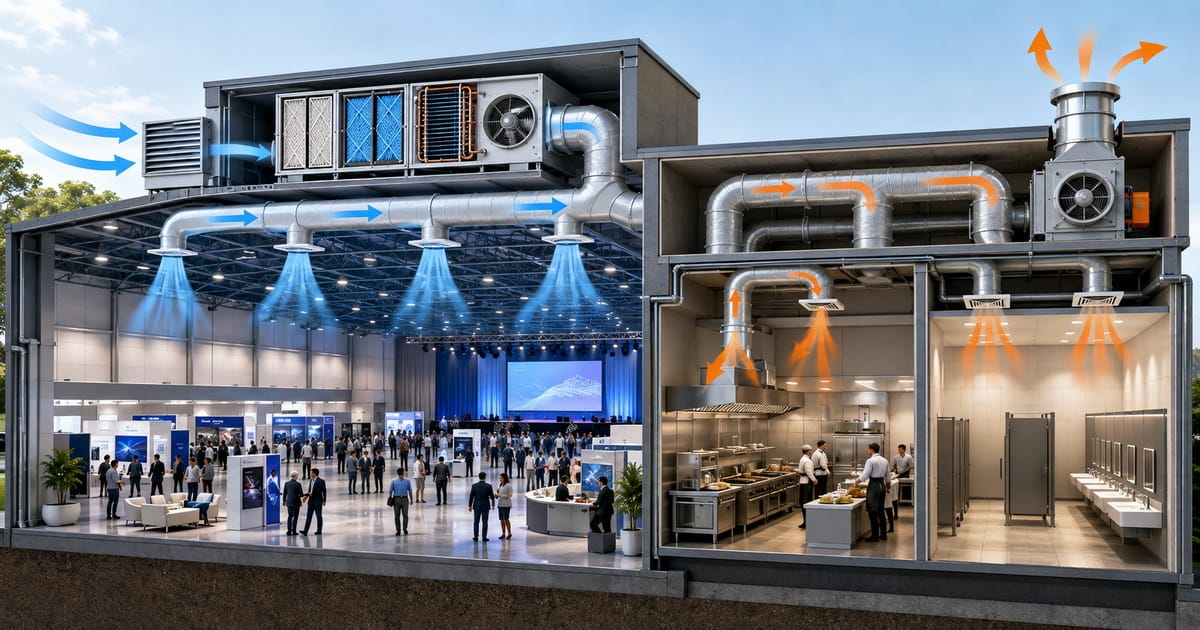
For a large occupied event space, fresh air conditioning is better as the main system.
For local pollutant removal, exhaust ventilation is indispensable.
For high-performance venue design, the winning approach is usually not a choice between the two. It is a balanced ventilation strategy that combines conditioned outdoor air supply with correctly sized, purpose-built exhaust.
Which System Performs Better in Real Event Conditions?
The answer changes based on event type, occupancy, local climate, venue layout, and event duration. Still, several real-world operating conditions strongly favor fresh air conditioning.
High-Density Conferences and Exhibitions
Trade shows and conferences often involve fluctuating occupancy. Morning registration, keynote sessions, lunch periods, breakout meetings, and peak exhibition hours can create major changes in cooling and ventilation demand.
An exhaust-only approach may pull out warm, stale air, but it cannot reliably maintain comfort across the full hall. It also cannot ensure that the incoming replacement air is filtered, cooled, dehumidified, or evenly distributed.
Fresh air conditioning performs better because it can:
– Deliver ventilation air where attendees actually sit or stand.
– Handle people-related sensible and latent heat.
– Maintain a more stable temperature across large zones.
– Respond to occupancy changes through controls and sensors.
– Improve comfort for exhibitors who remain in the space all day.
Concerts, Performances, and High-Activity Gatherings
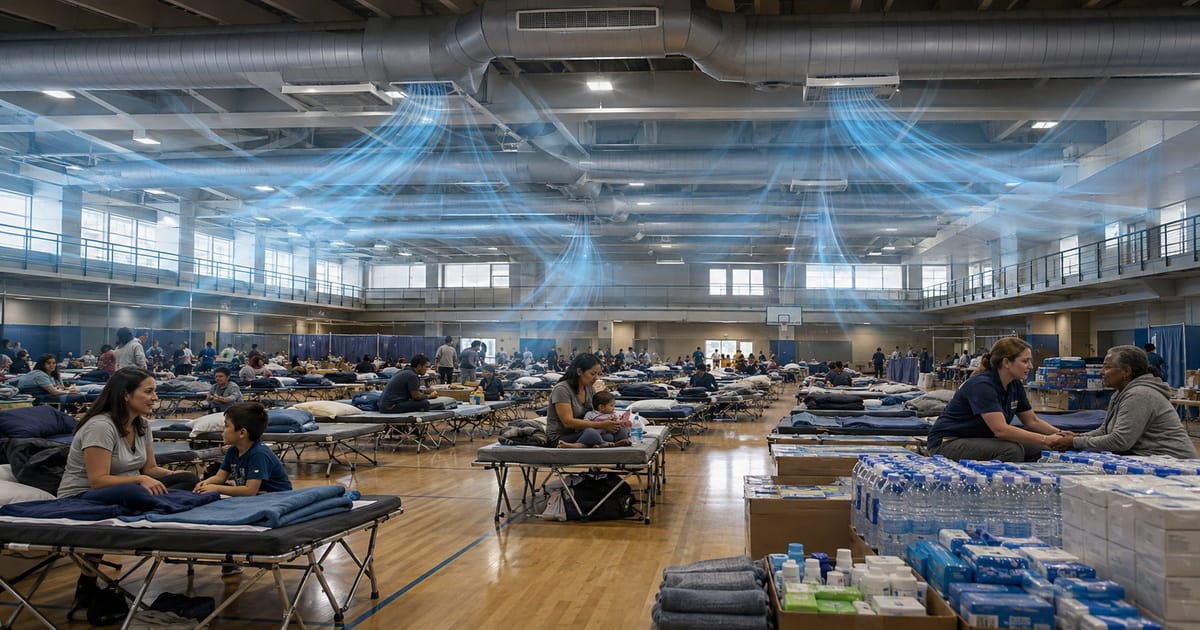
Crowds at concerts, fan events, fitness exhibitions, and active entertainment programs generate more heat and moisture than a quiet seated meeting. Loud speaking, singing, dancing, and physical movement can further increase the need for effective air exchange and distribution.
A peer-reviewed review of ventilation recommendations reports that guidance for ordinary public spaces has used a minimum outdoor-air rate of 10 L/s per person, while spaces involving more aerosol-generating activity such as singing, loud speaking, or aerobic exercise may need higher ventilation rates. The same review emphasizes that CO₂ should be interpreted as a ventilation indicator, not as a direct measure of infection risk.
For venue managers, that means the system should not rely on a fixed fan setting throughout the event. Monitoring, adjustment, and verification matter.
Food, Odor, and Back-of-House Areas
Exhaust ventilation can outperform fresh air conditioning in localized areas with a clear pollutant source.
Examples include:
– Food-court cooking stations.
– Temporary commercial kitchens.
– Restrooms.
– Floral storage or waste areas.
– Printing, fabrication, or display-preparation rooms.
– Equipment rooms with high heat loads.
In these cases, source capture is the priority. The fresh air conditioning system should support the occupied venue, while exhaust systems remove contaminants at or near their origin.
Outdoor, Semi-Outdoor, and Temporary Events
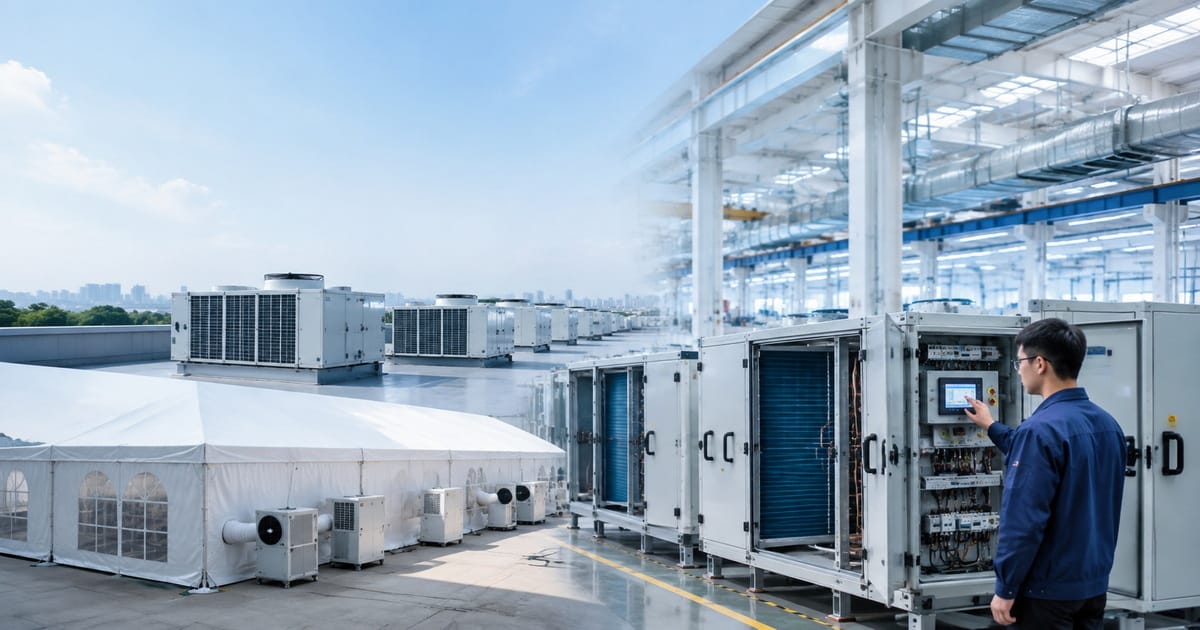
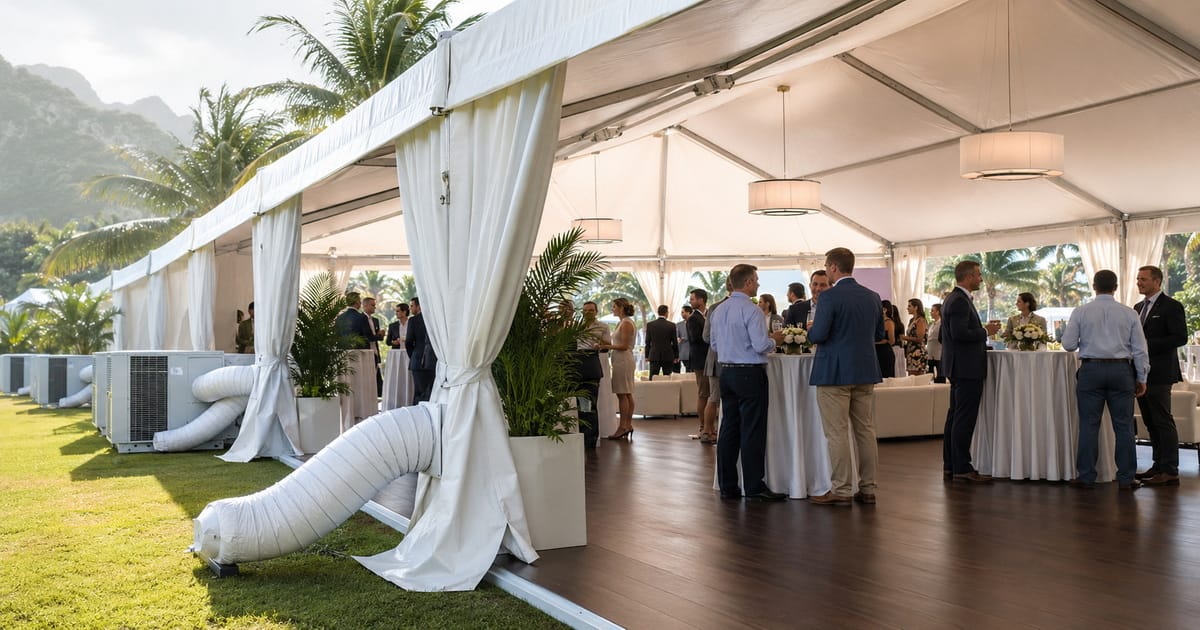
For open-sided tents or partially enclosed event structures, traditional ducted fresh air conditioning may be less efficient because of large infiltration loads and unrestricted air exchange with the outdoors.
However, fresh air cooling solutions can still be valuable in targeted zones, such as:
– VIP lounges.
– Registration areas.
– Enclosed meeting rooms.
– Broadcast or control rooms.
– Temporary hospitality suites.
– Medical, security, or staff areas.
The correct solution may include localized fresh air conditioning, spot cooling, air curtains, shade planning, and targeted exhaust—not a one-size-fits-all central system.
The Hidden Issue: Air Balance
One of the most overlooked parts of large-event HVAC planning is air balance.
If a venue exhausts significantly more air than it supplies, it becomes negatively pressurized. This can pull warm, humid, dusty, or unfiltered air into the space through any available opening. In a hot and humid climate, this may increase the cooling and dehumidification burden dramatically.
If a venue supplies too much air without sufficient exhaust or return-air capacity, pressure can build up and push conditioned air out through doors and leakage paths.
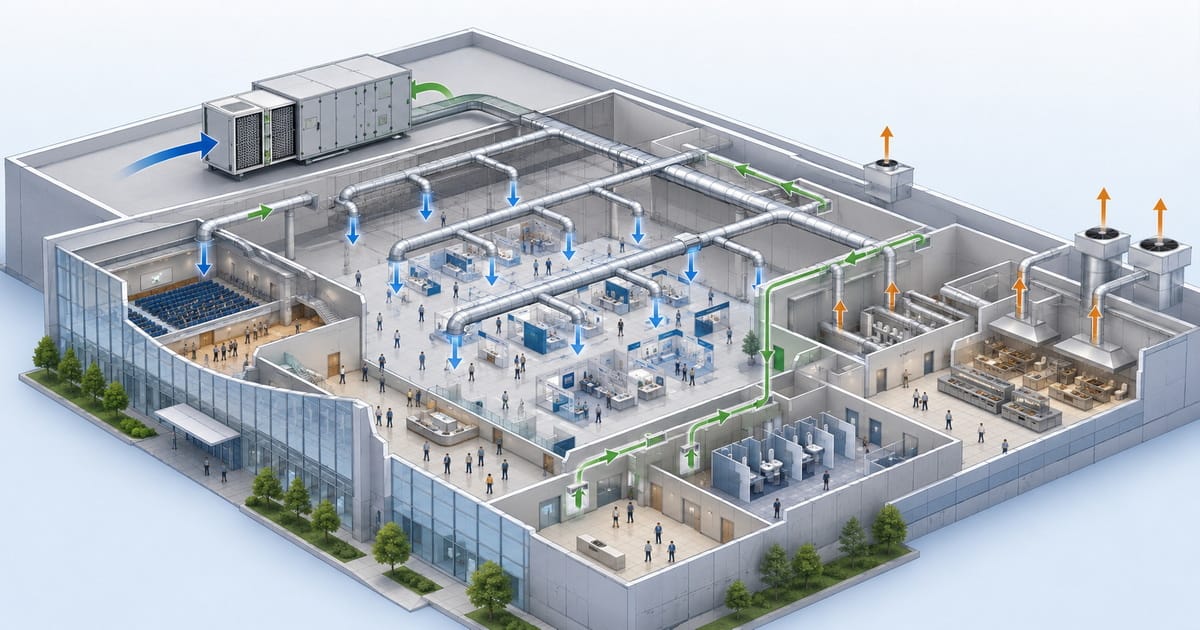
A balanced design considers:
– Outdoor supply airflow.
– Return airflow.
– General exhaust airflow.
– Local exhaust airflow.
– Make-up-air requirements.
– Door usage and loading-dock openings.
– Pressure relationships between occupied and service areas.
– Airflow paths between clean and less-clean zones.
ASHRAE Standard 62.1-2025 includes requirements related to mechanical and natural ventilation, filtration, controls, air cleaning, operations, maintenance, humidity control, demand-controlled ventilation sequences, exhaust airflow rates, and separation distances between intakes and exhausts.
For event projects, this reinforces an important purchasing principle: do not select a fresh air unit or exhaust fan based only on nominal airflow. The design must consider where air enters, where it travels, where it leaves, and whether the venue maintains comfortable and intentional pressure relationships.
How to Select the Right System for a Large Event
Use the following process when comparing fresh air conditioning equipment and exhaust ventilation systems.
1. Define Occupancy and Event Behavior
Start with the realistic peak attendance, not only the venue’s nominal capacity.
Ask:
– How many people will be present at the busiest time?
– Will they sit, stand, eat, dance, speak loudly, or exercise?
– How long will the event last?
– Are occupancy peaks predictable?
– Are there separate enclosed rooms within the event site?
A conference hall with 800 seated attendees has different needs from an exhibition hall with 800 moving attendees and active demonstration booths.
2. Identify Heat and Moisture Loads
People are only one part of the load. Consider:
– Lighting and LED walls.
– Audio-visual equipment.
– Booth lighting.
– Cooking equipment.
– Doors opening frequently.
– Outdoor solar gain.
– Outdoor temperature and humidity.
– Temporary partitions that block airflow.
In warm, humid markets, latent load can be as important as sensible cooling load. A system that appears large enough for cooling may still leave the room uncomfortable if it cannot adequately remove moisture.
3. Separate Whole-Space and Source-Control Needs
Use fresh air conditioning for the main occupied event area.
Use exhaust ventilation for source zones such as kitchens, toilets, waste rooms, and technical spaces.
This separation helps prevent odors, moisture, and contaminants from spreading into guest areas.
4. Specify Monitoring and Controls
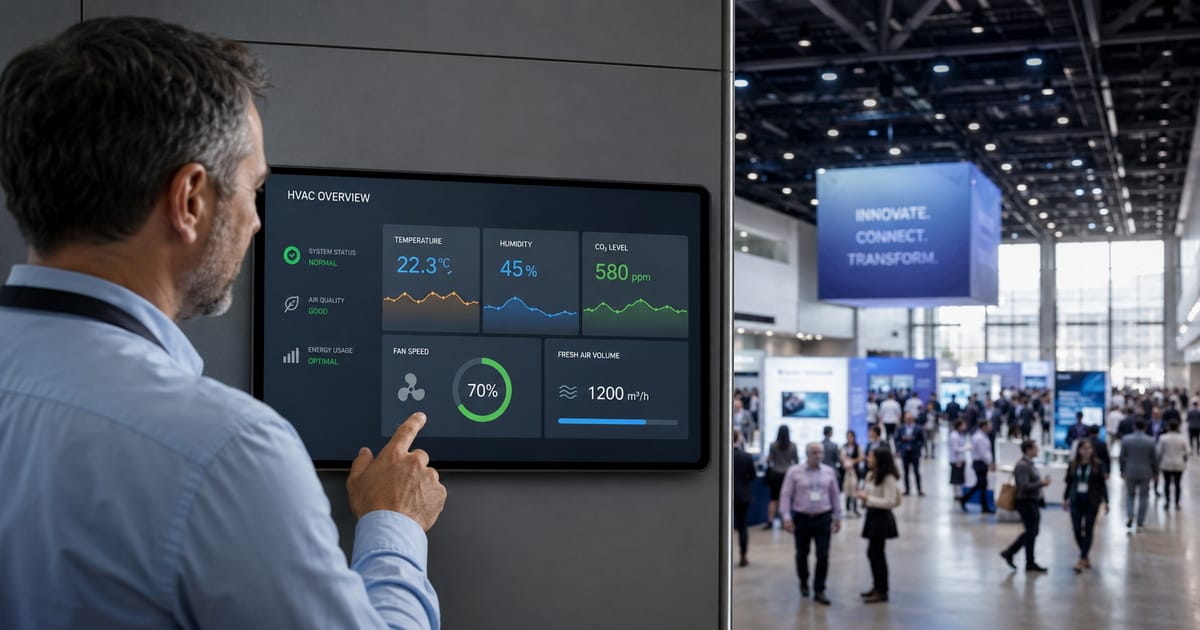
For variable-occupancy venues, sensors can improve both comfort and energy performance.
Useful controls may include:
– CO₂ sensors for ventilation-demand indication.
– Temperature sensors in different zones.
– Relative-humidity sensors.
– Variable-speed fans.
– Demand-controlled ventilation.
– Building-management-system integration.
– Filter-status alerts.
– Remote monitoring and fault alarms.
CO₂ monitoring is useful for identifying whether a crowded space may need more ventilation, but it should not be treated as a complete indoor-air-quality assessment or as a direct measure of airborne infection risk.
5. Verify Installation and Commissioning
Even excellent HVAC equipment can underperform if installed incorrectly.
Before the event, verify:
– Actual supply and exhaust airflow.
– Filter installation and condition.
– Intake and exhaust locations.
– Supply-air temperature and humidity.
– Air distribution in crowded zones.
– Pressure differences between key spaces.
– Controls and sensor operation.
– Noise levels during full fan operation.
Expert Recommendation for Event Buyers
From an HVAC specification perspective, the wrong question is often: “Should we install fresh air conditioning or exhaust ventilation?”
The better question is: “What combination of conditioned outdoor air, filtration, air distribution, local exhaust, and controls will deliver stable comfort at peak occupancy?”
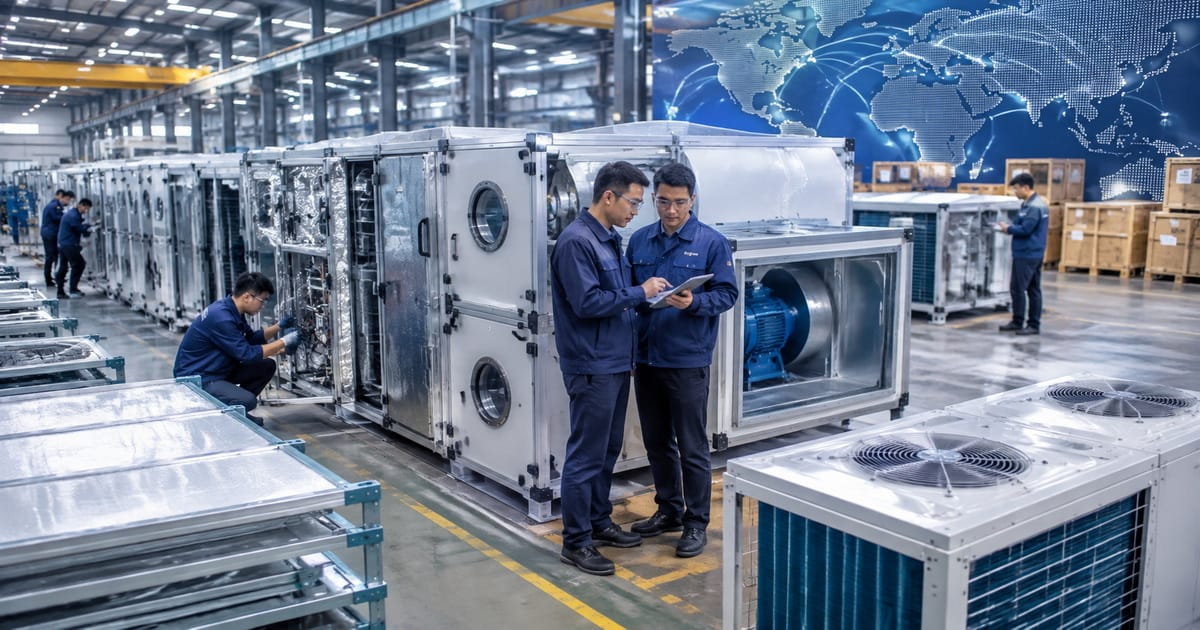
For large event halls, DREZ-style fresh air conditioning solutions can be positioned as the primary climate-control layer because they address comfort and ventilation together. For overseas brands, wholesalers, and manufacturers seeking OEM or ODM partnerships, customization may include:
– Airflow range and external static-pressure configuration.
– Cabinet size and service-access layout.
– Cooling, heating, and dehumidification capacity.
– Filtration options for local air-quality conditions.
– Energy-recovery integration.
– Control interfaces and branding requirements.
– Ducted, packaged, rooftop, ceiling-mounted, or modular configurations.
– Compliance-oriented component selection for the target market.
The most credible supplier conversation should focus on application engineering, not generic product claims. Buyers should request airflow data, fan curves, ESP capability, cooling and dehumidification performance, filtration specifications, sound data, controls options, electrical requirements, test documentation, and quality-control processes.
Final Answer: Which Is Better?
For most large indoor events, fresh air conditioning is better than an exhaust-only ventilation system because it brings in outdoor air while actively controlling temperature, humidity, distribution, and, where specified, filtration.
However, exhaust ventilation is not optional. It is the right solution for localized contaminant, odor, moisture, and heat removal. A high-performing venue normally uses both systems in a coordinated design:
– Fresh air conditioning for the main event environment.
– Exhaust ventilation for restrooms, kitchens, technical rooms, and pollutant-source areas.
– Air balancing and make-up air to protect comfort and energy efficiency.
– Monitoring and commissioning to confirm real-world performance.
Planning a large-event HVAC project or developing a private-label fresh air conditioning product line? Contact DREZ (Guangzhou) Intelligent Technology Co., Ltd. to discuss OEM and ODM fresh air conditioning solutions tailored to your climate, venue type, airflow target, branding requirements, and international market needs.
Frequently Asked Questions
1. Can exhaust fans replace fresh air conditioning for a large event?
Usually, no. Exhaust fans remove indoor air, but they do not reliably provide filtered, cooled, heated, or dehumidified replacement air. For a crowded event hall, fresh air conditioning is generally needed to maintain both indoor air quality and thermal comfort.
2. Is fresh air conditioning more energy-intensive than exhaust ventilation?
Conditioning outdoor air requires energy, especially in very hot, cold, humid, or polluted locations. However, systems with demand controls, variable-speed fans, efficient heat exchangers, and energy recovery can reduce unnecessary energy use. Exhaust-only designs can also create hidden energy costs if they cause uncontrolled outdoor-air infiltration.
3. How can event venues avoid stuffy air during peak attendance?
Venues should assess peak occupancy, provide sufficient outdoor air, distribute supply air evenly, remove polluted air from source zones, and monitor conditions such as temperature, humidity, and CO₂. Equipment should be commissioned before the event rather than adjusted only after complaints arise.
4. Where should exhaust ventilation be used at an event venue?
Exhaust is especially important in toilets, kitchens, food-preparation zones, waste rooms, smoking areas where permitted, technical rooms, and other spaces that generate odors, moisture, fumes, or excess heat.
5. Can a fresh air conditioning system work in humid climates?
Yes. It is often particularly valuable in humid climates when engineered with sufficient dehumidification capacity. Simply bringing in untreated outdoor air can make an event hall feel damp and uncomfortable, so the system should be selected based on local outdoor design conditions and indoor humidity targets.
6. What should an OEM buyer ask a fresh air conditioning manufacturer?
Ask for airflow performance, external static pressure, cooling and heating capacity, dehumidification performance, filtration options, fan data, noise levels, control features, energy-recovery choices, material specifications, certifications needed for the destination market, customization scope, quality-control documentation, lead time, and after-sales support.
7. Is CO₂ monitoring enough to measure event indoor air quality?
No. CO₂ is a useful indicator of occupancy-related ventilation adequacy, but it does not measure all pollutants, filtration effectiveness, humidity, thermal comfort, or infection risk. It should be used alongside system design, commissioning, and practical indoor-air-quality management.
References
1. American Society of Heating, Refrigerating and Air-Conditioning Engineers (ASHRAE). “[Standards 62.1 & 62.2].” This source outlines the role of ANSI/ASHRAE Standards 62.1 and 62.2 in ventilation-system design and acceptable indoor air quality, including the 2025 updates for Standard 62.1. [ashrae]
2. Luo, K. et al. “[Recommendations for ventilation of indoor spaces to reduce the transmission of respiratory infection].” *Indoor Air*, 2021. This peer-reviewed review discusses ventilation-rate guidance, activity-related ventilation considerations, and the appropriate interpretation of CO₂ measurements. [pmc.ncbi.nlm.nih]
3. U.S. Consumer Product Safety Commission. “[The Inside Story: A Guide to Indoor Air Quality].” This guide explains how inadequate ventilation can increase indoor pollutants and how outdoor-vented exhaust can remove pollutants at their source. [cpsc]
4. Professional Convention Management Association (PCMA). “[New Indoor Air Quality Standards: What Event Planners and Suppliers Should Know].” This event-industry resource highlights the importance of ventilation verification for event spaces and references ASHRAE Standard 62.1. [pcma]
5. American Lung Association. “[Ventilation].” This resource explains air exchange and the role of outdoor air and exhaust ventilation in improving indoor conditions. [lung]
6. Kaiterra. “[Ensuring ASHRAE 62.1 Compliance for CO₂ Sensors in Demand Controlled Ventilation].” This technical explainer summarizes ASHRAE requirements relevant to CO₂ sensors used in demand-controlled ventilation systems. [learn.kaiterra]
Hot Tags: Fresh Air Conditioning, Exhaust Ventilation Systems, Large Event Ventilation, Commercial HVAC Systems, Event Venue Air Conditioning, Indoor Air Quality Solutions, Fresh Air Handling Units, Commercial Ventilation Equipment, OEM HVAC Manufacturer, ODM Air Conditioning Solutions