Content Menu
● What Is the Difference Between Fresh Air and Recirculating Air Conditioning?
>> Recirculating Air Conditioning
● Why Crowded Events Create Higher Air-Quality Risks
>> 1. Higher Carbon Dioxide Levels
>> 2. More Respiratory Aerosols
>> 3. Heat and Humidity Spikes
● Is Fresh Air Conditioning Safer for Crowded Events?
>> Fresh Air’s Safety Advantage
>> When Recirculation Can Be the Safer Choice
● Fresh Air Conditioning vs. Recirculation: Event Safety Comparison
● The Best Answer: A Hybrid Clean-Air Strategy
● A Practical Event Ventilation Checklist
● Do Not Use CO₂ as a Standalone Safety Score
● How DREZ Supports Smarter Fresh Air Conditioning Solutions
● Conclusion: Choose Clean Air, Not a False Either-Or
● FAQ
>> 1. Is fresh air conditioning better than normal air conditioning for crowded events?
>> 2. Can recirculating air conditioning spread contaminants?
>> 3. What filter should be used for an event venue HVAC system?
>> 4. What CO₂ level is good for a crowded indoor event?
>> 5. Should a venue bring in fresh air during wildfire smoke?
>> 6. Does fresh air conditioning increase energy costs?
>> 7. What is the best HVAC setup for a temporary event space?
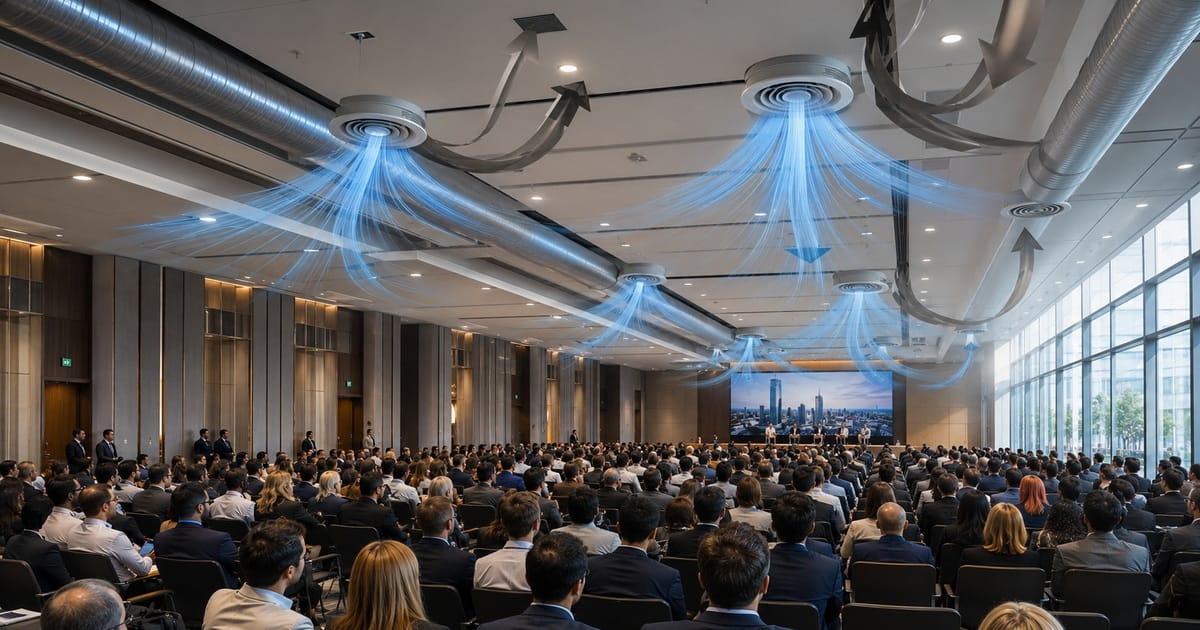
For crowded indoor events, fresh air conditioning is generally safer than recirculating air conditioning because it introduces outdoor air that dilutes carbon dioxide, occupant-generated pollutants, and potentially infectious aerosols. However, the safest real-world solution is usually not “fresh air only”: it is a properly engineered system that combines filtered outdoor air, effective recirculation, high-efficiency filtration, air-quality monitoring, and event-specific control strategies.
For venue operators, event planners, HVAC brands, and OEM/ODM buyers, the question is not simply whether to use fresh air or recirculated air. The key question is: How can an HVAC system deliver enough verified clean air to the breathing zone when occupancy, heat loads, humidity, outdoor pollution, and energy use all change rapidly?
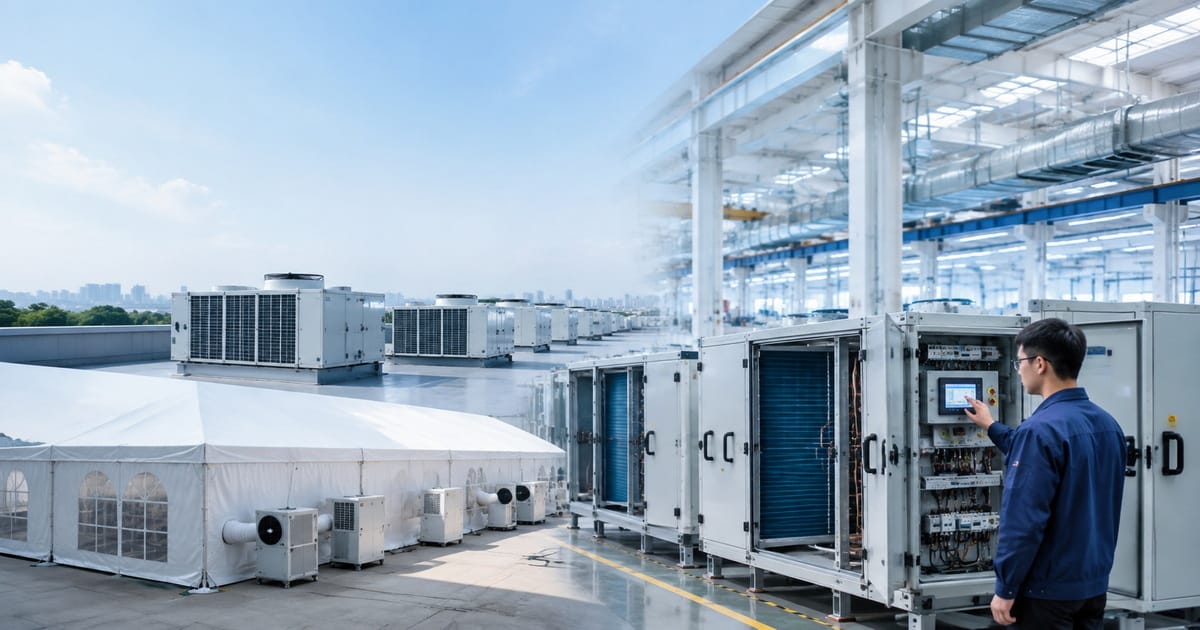
At DREZ (Guangzhou) Intelligent Technology Co., Ltd., we view fresh air conditioning as part of an integrated climate-control strategy. For crowded venues, an intelligently designed fresh air air-conditioning solution can improve comfort, reduce stuffiness, support indoor-air-quality (IAQ) management, and give operators more control than a conventional recirculation-only system.
What Is the Difference Between Fresh Air and Recirculating Air Conditioning?
Before comparing safety, it is important to define the two systems accurately.
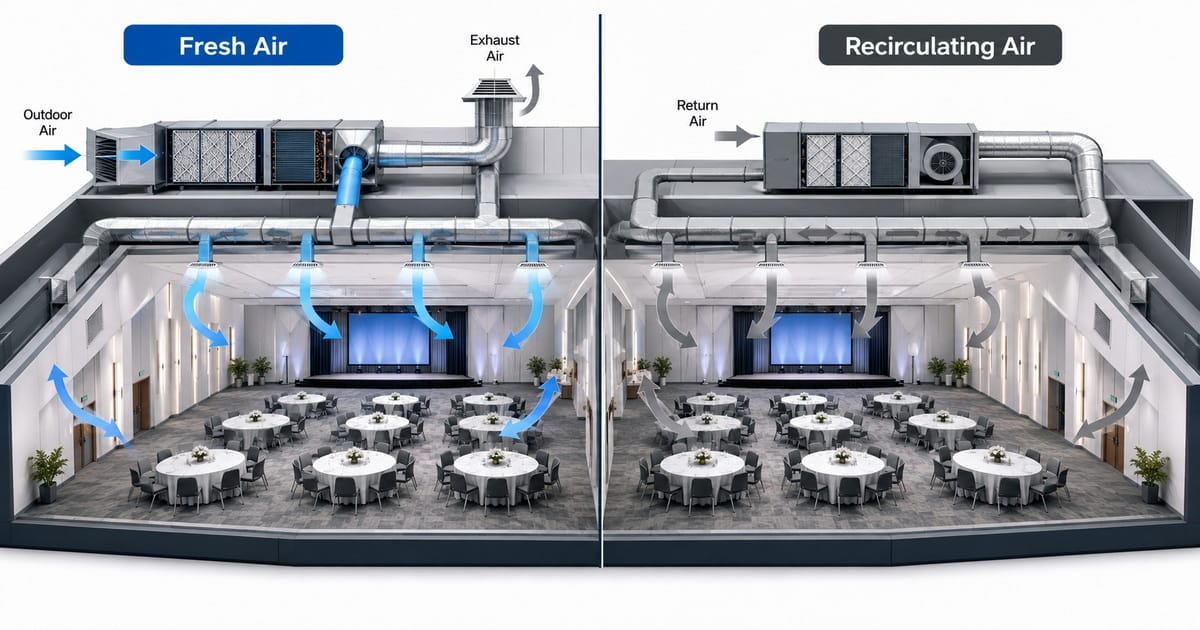
Fresh Air Conditioning
A fresh air conditioning system brings outdoor air into a building, filters and conditions it, then supplies it to occupied spaces. Depending on the system design, it may cool, heat, dehumidify, humidify, filter, and ventilate the incoming outdoor air.
Its primary IAQ function is dilution. When clean outdoor air enters a crowded room and stale indoor air is exhausted or displaced, the concentration of internally generated contaminants can decrease.
In a busy exhibition hall, banquet room, classroom, gym, worship space, or temporary event venue, people continuously release:
– Carbon dioxide through breathing
– Water vapor
– Body odors
– Fine particles from clothing, movement, and activities
– Volatile organic compounds (VOCs) from materials, cleaning products, décor, and furnishings
– Respiratory aerosols that may contain infectious particles when someone is ill
Outdoor air does not “sterilize” a space. But when it is clean and properly delivered, it can reduce the accumulation of pollutants that become more concentrated as occupancy rises.
Recirculating Air Conditioning
A recirculating air conditioning system returns indoor air to the HVAC unit, conditions it, and sends much of it back into the same occupied area. Its main value is efficiency: recirculated air is already closer to the desired indoor temperature and humidity than hot, cold, humid, or dry outdoor air.
Recirculation can provide several practical benefits:
– Faster temperature stabilization
– Lower cooling and heating loads
– Lower equipment capacity requirements in some climates
– Better humidity control when designed correctly
– Reduced entry of outdoor particles, smoke, pollen, and pollutants during poor outdoor-air conditions
However, recirculation alone does not remove all pollutants. A system that mostly cycles indoor air without sufficient outdoor-air replacement, filtration, or air cleaning may allow carbon dioxide, odors, and airborne particles to build up.
The Simple Comparison
| Factor | Fresh Air Conditioning | Recirculating Air Conditioning |
|---|---|---|
| Primary air source | Outdoor air | Indoor return air |
| Main IAQ benefit | Dilutes indoor contaminants | Can filter and mix indoor air |
| Carbon dioxide control | Strong when outdoor air is clean and sufficient | Limited without outdoor-air intake |
| Temperature efficiency | Can increase cooling/heating energy demand | Usually more energy-efficient |
| Outdoor pollution exposure | Requires good filtration and control | Can reduce intake during smoke or pollution episodes |
| Best use at crowded events | Essential component of a healthy-air strategy | Valuable as a complementary, filtered component |
| Main risk if poorly designed | Humidity, energy use, or outdoor pollutant entry | Stale air and contaminant accumulation |
Why Crowded Events Create Higher Air-Quality Risks
Crowded events are challenging because the number of occupants can change quickly while each person adds heat, moisture, and exhaled air to the room.
A ballroom designed for a small meeting can behave very differently when it hosts a 500-person product launch. Likewise, a temporary exhibition booth, indoor sports event, school auditorium, or wedding venue may experience sharp peaks in occupancy and activity.
From a building-operations perspective, crowded events create four overlapping challenges.
1. Higher Carbon Dioxide Levels
Carbon dioxide, or CO₂, is not usually the main health hazard at typical indoor concentrations. Yet it is widely used as a practical indicator of how much exhaled air may be accumulating in a space.
The U.S. National Institute for Occupational Safety and Health (NIOSH) notes that CO₂ readings below 800 ppm can be one potential indicator of good ventilation, while also emphasizing that a single target does not fit every building, occupancy level, or activity type. It should be interpreted alongside room use, outdoor CO₂ levels, system design, and other IAQ information.
For event operators, the practical lesson is clear: watch trends, not just one number. If CO₂ rises steadily as guests arrive, the venue may need more outdoor air, more equivalent clean airflow, fewer occupants, or longer breaks between sessions.
2. More Respiratory Aerosols
In crowded indoor environments, people speak, laugh, sing, exercise, cough, and breathe in close proximity. Those activities can increase the amount of respiratory aerosol released into shared air.
The U.S. Centers for Disease Control and Prevention explains that bringing fresh outdoor air indoors helps prevent virus particles from accumulating, while higher-rated HVAC filters, air cleaners, and increased air circulation can further reduce airborne exposures.
This does not mean ventilation replaces other public-health measures when they are needed. It means that cleaner air is a core layer of risk reduction, especially where crowds gather for extended periods.
3. Heat and Humidity Spikes
More people means more sensible heat and moisture. A poorly designed fresh-air system can struggle if it introduces large volumes of hot and humid outdoor air without enough latent-capacity control. A poorly managed recirculation system can also struggle, especially if it does not remove moisture effectively.
Comfort matters because uncomfortable guests open doors, leave windows open without control, crowd around supply vents, complain about odors, or reduce the time they remain at the event. Good IAQ and good thermal comfort must be engineered together.
4. Uneven Air Distribution
A venue may technically have adequate airflow on paper but still suffer from stagnant zones. Air can short-circuit from a supply diffuser to a return grille without effectively reaching occupants. Corners, enclosed booths, stage areas, VIP rooms, and low-ceiling spaces often need special attention.
This is why airflow design, diffuser placement, return-air pathways, and commissioning are just as important as the nominal airflow rating of the equipment.
Is Fresh Air Conditioning Safer for Crowded Events?
Yes—when outdoor air is reasonably clean, filtered, conditioned, and supplied in sufficient volume. Fresh air conditioning is usually safer than relying primarily on recirculation because it directly lowers the concentration of pollutants generated indoors.
But it is important not to present the comparison as a simplistic “fresh air good, recirculation bad” argument.
Fresh Air’s Safety Advantage
Fresh outdoor air supports safety by:
– Diluting exhaled air and indoor pollutants
– Reducing the buildup of CO₂ in densely occupied areas
– Supporting removal of moisture and odors
– Reducing the concentration of airborne contaminants over time
– Improving perceived freshness and occupant comfort
– Supporting ventilation requirements in commercial and public spaces
ASHRAE Standard 62.1 establishes minimum ventilation requirements intended to support acceptable indoor air quality and limit adverse health effects. For infection-risk management, ASHRAE Standard 241 adds a useful modern concept: equivalent clean airflow.
Equivalent clean airflow recognizes that outdoor air is not the only source of cleaner air. Proper filtration, in-room air cleaning, and technologies such as germicidal ultraviolet treatment can contribute to the total clean-air delivery rate in an occupied space.
That distinction is important for event venues. The goal should not be to maximize outdoor airflow blindly. The goal should be to provide enough clean air per person, with appropriate protection against outdoor-air contaminants and without sacrificing temperature or humidity control.
When Recirculation Can Be the Safer Choice
Recirculation can become necessary—and sometimes preferable—when outdoor air quality is poor.
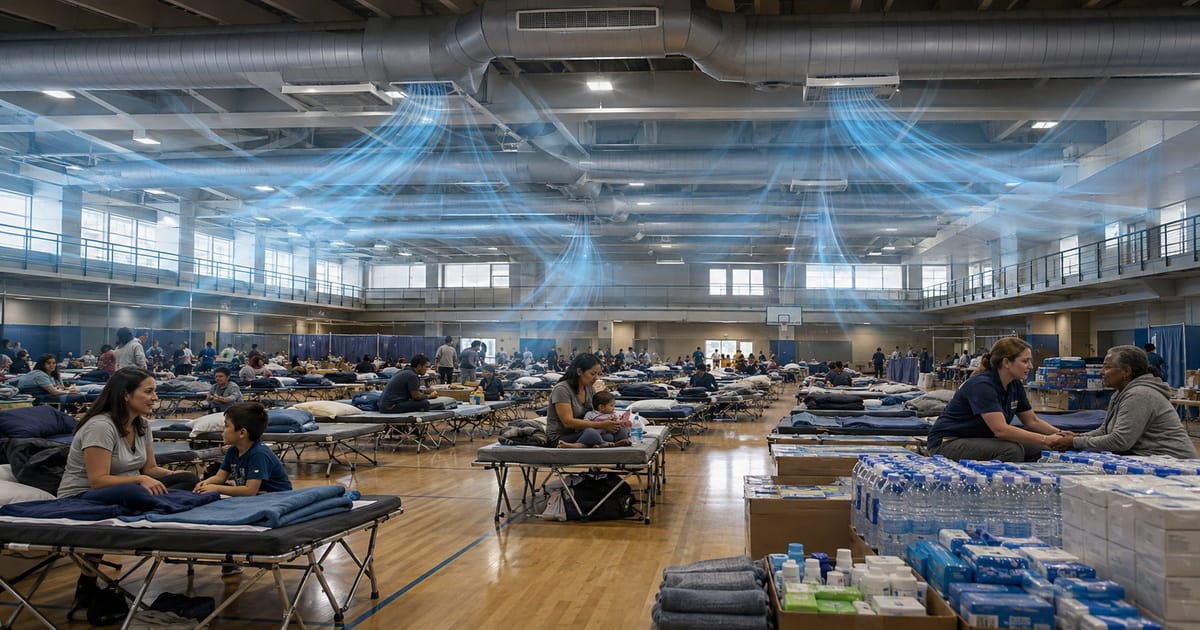
During wildfire smoke, dust storms, severe urban pollution, or high pollen events, bringing in large amounts of untreated outdoor air can worsen indoor conditions. Health Canada’s guidance for cleaner-air spaces advises switching HVAC systems to recirculation during poor outdoor-air-quality events, then restoring fresh-air intake when the smoke plume subsides so pollutants do not remain trapped indoors.
This is especially relevant for venues in regions affected by seasonal wildfire smoke, industrial emissions, dust, or traffic pollution.
The correct strategy is therefore conditional:
| Outdoor Condition | Preferred HVAC Approach |
|---|---|
| Clean outdoor air and high occupancy | Increase filtered fresh-air ventilation and exhaust stale air |
| Moderate outdoor pollution | Use controlled outdoor-air intake with suitable filtration |
| Wildfire smoke or severe particulate pollution | Reduce outside-air intake temporarily; use filtered recirculation and supplemental air cleaning |
| High indoor humidity | Balance outdoor-air intake with dedicated dehumidification capacity |
| High infection-risk event | Increase equivalent clean airflow using outdoor air, filtration, and air cleaning |
Fresh Air Conditioning vs. Recirculation: Event Safety Comparison
The following comparison is useful for venue owners, HVAC engineers, event-management companies, and procurement teams evaluating commercial fresh air conditioning systems.
| Evaluation Area | Fresh Air Conditioning | Recirculating Air Conditioning | Best Practice for Events |
|---|---|---|---|
| Ventilation | Introduces outdoor air and dilutes indoor contaminants | Reuses indoor air, with limited dilution by itself | Use outdoor air as the ventilation foundation |
| Airborne particle control | Depends on outdoor-air filtration and exhaust design | Depends heavily on filter efficiency and maintenance | Combine outdoor air with MERV-rated filtration where compatible |
| CO₂ management | Reduces indoor CO₂ accumulation | Does not meaningfully lower CO₂ without outside air | Use CO₂ monitoring and demand-controlled ventilation carefully |
| Odor control | Generally effective because stale air is replaced | Can redistribute odors if air is not adequately exhausted | Provide fresh air plus targeted exhaust |
| Humidity management | Requires sufficient cooling/dehumidification capacity | May reduce outside moisture load | Use dedicated fresh-air treatment in humid climates |
| Energy consumption | Higher if untreated outdoor air is extreme | Often lower due to energy recovery from indoor air | Add energy recovery and intelligent controls |
| Outdoor smoke/pollution | Can introduce contaminants if filtration is inadequate | Can protect indoor air temporarily when outside air is poor | Switch operating mode based on outdoor-air-quality data |
| Installation flexibility | Can require ductwork, air handling, and controls | Often compatible with conventional split or packaged HVAC systems | Use modular, scalable, OEM-configured solutions |
The Best Answer: A Hybrid Clean-Air Strategy
For most crowded events, the safest option is a hybrid ventilation strategy, not a single-mode system.
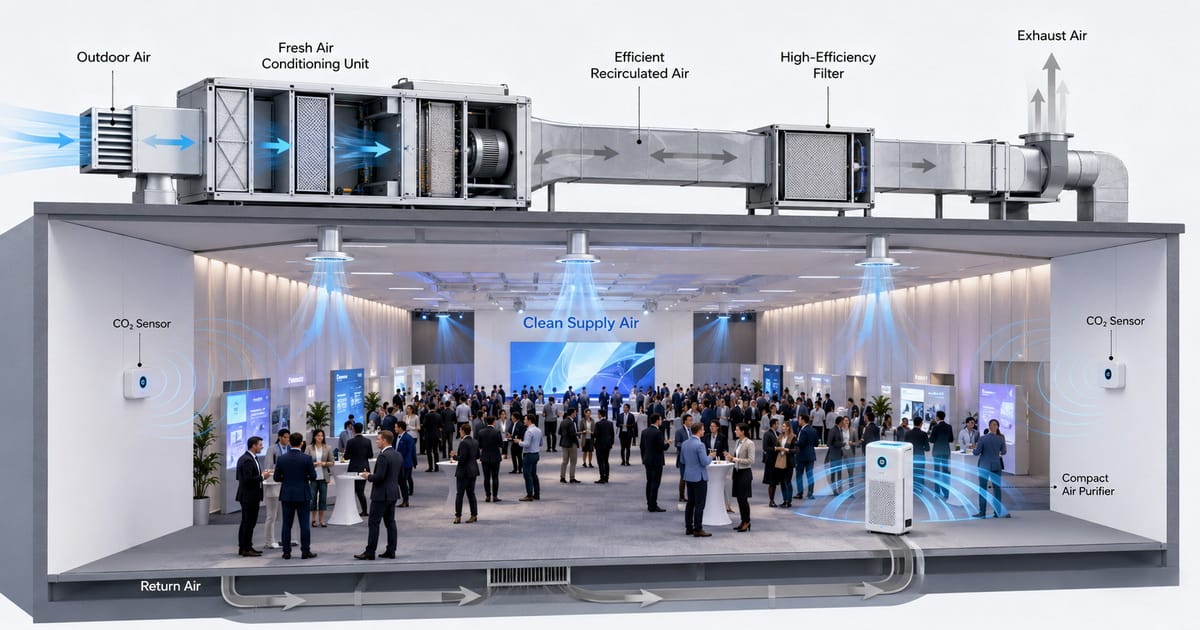
A well-designed solution may include:
1. Filtered outdoor air to dilute indoor pollutants and manage CO₂.
2. High-efficiency central filtration to reduce particles in recirculated air.
3. Supplemental portable or integrated air cleaners for rooms with dense crowds, variable layouts, or poor airflow.
4. Demand-based controls that respond to occupancy, CO₂, temperature, humidity, and outdoor-air conditions.
5. Targeted exhaust from restrooms, kitchens, backstage spaces, smoking-adjacent zones, and high-odor areas.
6. Balanced air distribution so clean air reaches actual occupied zones rather than bypassing guests.
The CDC recommends actions such as bringing in outdoor air when conditions allow, using MERV-13 or higher filters when possible, increasing circulation during occupancy, using appropriately sized air cleaners, and checking ventilation performance with tools such as portable CO₂ monitors.
For OEM and ODM buyers, this points to a major product-development opportunity: air-conditioning equipment should not be evaluated only by cooling capacity, sound level, or energy efficiency. It should also be evaluated by how easily it can support healthy-air operating modes during high-occupancy conditions.
A Practical Event Ventilation Checklist
Event safety is often won or lost before guests arrive. Facility managers should use a practical pre-event plan rather than relying on normal HVAC settings.
Before the Event
– Confirm the expected occupancy, event duration, and activity level.
– Review the room’s outdoor-air capacity and airflow design.
– Inspect and replace filters according to the equipment specification.
– Verify that outside-air dampers, exhaust fans, and controls operate correctly.
– Check local outdoor-air quality, including smoke and particulate conditions.
– Pre-flush the venue with clean air before guests arrive when conditions permit.
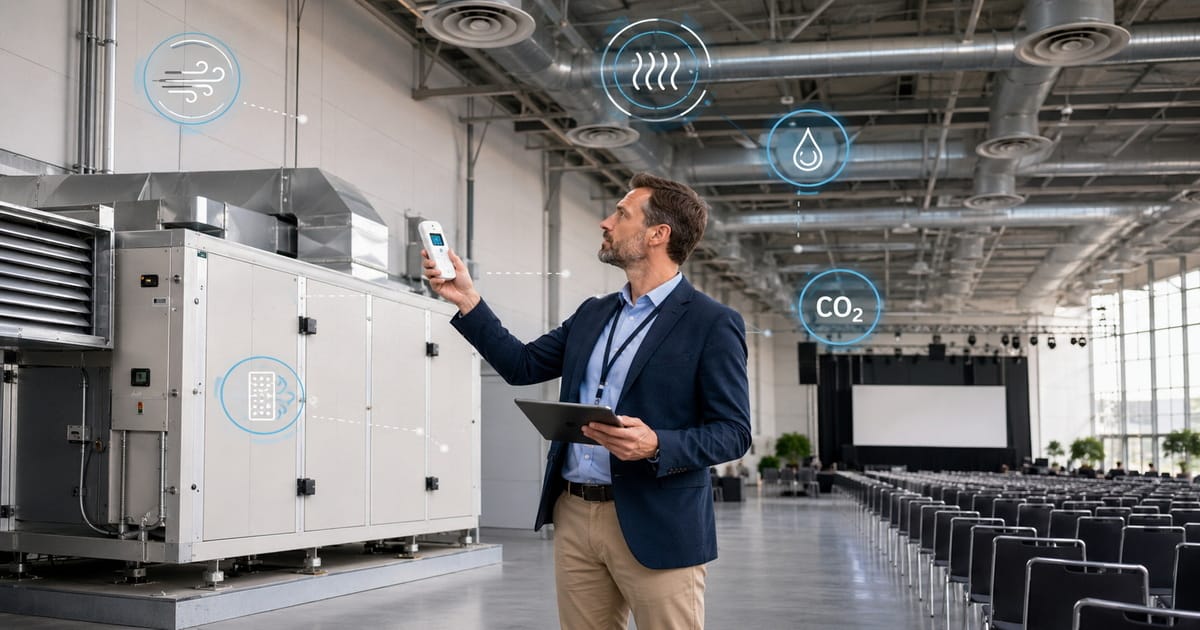
– Place CO₂ monitors in representative occupied zones, away from supply vents and doors.
– Add portable HEPA air cleaners where the room layout creates stagnant areas.
During the Event
– Run the system continuously rather than cycling the fan only when cooling is needed.
– Increase fresh-air intake during peak occupancy if outdoor conditions allow.
– Monitor temperature, humidity, CO₂ trends, and guest comfort feedback.
– Keep doors, windows, and exhaust strategies coordinated to avoid uncontrolled airflow problems.
– Use breaks to increase ventilation or briefly reduce room occupancy.
– Reassess when activity changes—for example, from seated presentations to networking, dancing, or exercise.
After the Event
– Continue ventilation and filtration for a suitable post-event period.
– Inspect filters if the event involved high occupancy, smoke exposure, construction dust, or unusual pollutants.
– Record CO₂, humidity, temperature, and maintenance observations.
– Use the data to improve the ventilation plan for future events.
Do Not Use CO₂ as a Standalone Safety Score
One common mistake is treating a CO₂ monitor as a complete indoor-air-quality or infection-risk meter. It is not.
CO₂ can indicate whether outdoor-air ventilation may be insufficient relative to occupancy, but it does not directly measure viruses, fine particles, VOCs, humidity, filtration effectiveness, or airflow distribution. NIOSH specifically cautions that a single CO₂ value is not appropriate as a universal ventilation target for all spaces and occupancy conditions.
A stronger event-management approach combines:
– CO₂ trend monitoring
– Outdoor AQI and smoke awareness
– HVAC airflow verification
– Filter condition checks
– Relative humidity monitoring
– Occupancy management
– Supplemental filtration where needed
– Professional commissioning for high-risk or large venues
For example, a conference room may show an acceptable CO₂ reading near a supply vent while the far side of the room remains poorly mixed. A multi-point monitoring approach and an airflow assessment are more reliable than a single sensor placed in a convenient location.
How DREZ Supports Smarter Fresh Air Conditioning Solutions
DREZ (Guangzhou) Intelligent Technology Co., Ltd. develops climate-control solutions that integrate research, design, manufacturing, sales, and customization. For international brands, wholesalers, and equipment manufacturers, a fresh air conditioning product should be more than an add-on ventilation device.
It should be a scalable platform that supports real customer needs, including:
– Customized airflow and cooling-capacity configurations
– Heat recovery or energy-saving design options
– Filtration integration appropriate to target-market requirements
– Humidity-control capability for tropical, coastal, and high-occupancy environments
– Intelligent sensors and control logic
– OEM private-label manufacturing
– ODM product-development support
– Flexible housing, control-panel, ducting, and installation configurations
For a brand serving commercial venues, hospitality projects, schools, fitness centers, retail spaces, and event facilities, an intelligently controlled fresh-air solution can create a clearer market position: comfort plus cleaner-air capability, rather than cooling alone.
Conclusion: Choose Clean Air, Not a False Either-Or
Fresh air conditioning is usually the safer choice for crowded events because it helps dilute indoor pollutants and reduces the buildup of exhaled air. Yet the safest and most resilient event HVAC strategy combines filtered outdoor air with efficient recirculation, high-quality filtration, verified airflow, and responsive controls.
When outdoor air is clean, increase fresh-air ventilation. When smoke or severe pollution affects the outdoor environment, temporarily reduce intake, strengthen filtration, and maintain sufficient clean-air delivery through controlled recirculation and supplemental air cleaning.
For HVAC brands and project buyers, this creates a clear product requirement: choose a fresh air conditioning supplier that understands ventilation, filtration, humidity, energy performance, controls, and customization as one integrated system.
Looking for an OEM or ODM fresh air conditioning solution for crowded commercial spaces? Contact DREZ to discuss customized airflow, filtration, heat-recovery, humidity-control, and intelligent-control configurations for your market and project requirements.
FAQ
1. Is fresh air conditioning better than normal air conditioning for crowded events?
Yes. Fresh air conditioning is generally better for crowded events because it brings in outdoor air to dilute CO₂, odors, moisture, and other indoor contaminants. Conventional recirculating air conditioning can maintain temperature effectively but needs sufficient ventilation and filtration to manage indoor-air quality.
2. Can recirculating air conditioning spread contaminants?
Recirculating air can move particles within a space if the system has inadequate filtration, poor airflow design, or insufficient outdoor-air exchange. However, properly filtered recirculation is still valuable and can contribute to equivalent clean airflow. It should complement—not replace—appropriate ventilation when outdoor conditions are safe.
3. What filter should be used for an event venue HVAC system?
Where the system can support it, the CDC recommends MERV-13 or higher HVAC filters to capture more airborne particles than lower-rated filters. Filter selection must also consider fan capacity, pressure drop, sealing quality, maintenance practices, and the equipment manufacturer’s specifications.
4. What CO₂ level is good for a crowded indoor event?
There is no universal “safe” CO₂ number for every venue. NIOSH identifies readings below 800 ppm as one potential indicator of good ventilation but emphasizes that ventilation assessment must account for the space, occupancy, activity, outdoor CO₂ level, and system operation. Monitor trends and investigate persistent increases.
5. Should a venue bring in fresh air during wildfire smoke?
Usually not at high volumes. During poor outdoor-air-quality events such as wildfire smoke, reduce outdoor-air intake temporarily, use high-efficiency filtration and recirculation, and add portable air cleaners where appropriate. Restore fresh-air ventilation after outdoor conditions improve to prevent indoor pollutants from accumulating.
6. Does fresh air conditioning increase energy costs?
It can increase cooling, heating, and dehumidification loads because outdoor air must be conditioned. Energy recovery, demand-controlled ventilation, variable-speed fans, efficient compressors, appropriate fresh-air sizing, and intelligent controls can help reduce the energy penalty without compromising indoor-air quality.
7. What is the best HVAC setup for a temporary event space?
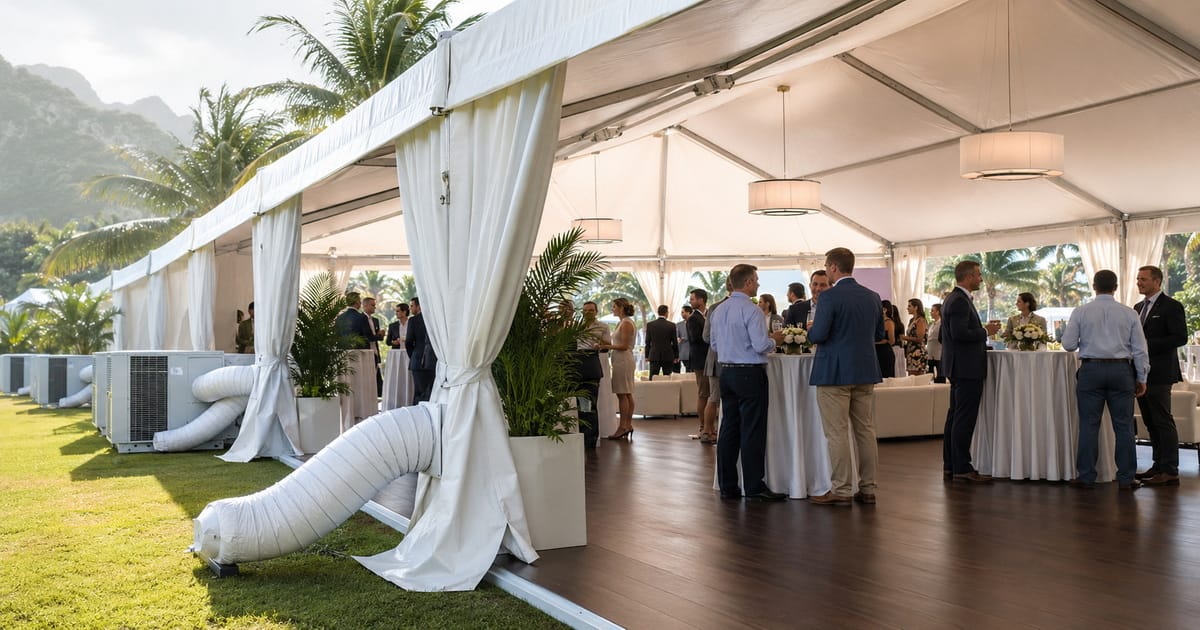
For temporary or highly variable venues, use a modular strategy: conditioned fresh air, portable HEPA filtration, CO₂ monitoring, zoned fans, targeted exhaust, and flexible controls. This approach can adapt to changing occupancy and room layouts better than a fixed recirculation-only setup.
References
1. [U.S. Centers for Disease Control and Prevention — Ventilation Can Reduce Exposure to Respiratory Viruses in Indoor Spaces]. Guidance on outdoor air, MERV-13 filtration, air cleaners, fan operation, exhaust ventilation, and CO₂ monitoring. [restoredcdc]
2. [CDC/NIOSH — Ventilation FAQs]. Information on interpreting CO₂ readings and the role of ASHRAE Standard 241 and equivalent clean airflow per person. [cdc]
3. [ASHRAE — Standard 241, Control of Infectious Aerosols]. Overview of requirements intended to reduce disease-transmission risk from infectious aerosols. [ashrae]
4. [ASHRAE — Standard 241 Announcement]. Explanation of equivalent clean airflow as a combination of outdoor air, filtration, and air-disinfection approaches. [ashrae]
5. [ASHRAE — Relevant Standards and Guidelines]. Summary of ASHRAE Standard 62.1 and its purpose in establishing minimum ventilation rates for acceptable indoor-air quality. [ashrae]
6. [Health Canada — Guidance for Cleaner Air Spaces During Wildfire Smoke Events]. Guidance on switching to recirculation during poor outdoor-air conditions and returning to outdoor-air ventilation after smoke conditions improve. [canada]
7. [U.S. Consumer Product Safety Commission — The Inside Story: A Guide to Indoor Air Quality]. Background on how inadequate ventilation can increase indoor pollutant levels. [cpsc]
Hot Tags: Fresh Air Conditioning, Recirculating Air Conditioning, Commercial Fresh Air System, HVAC Ventilation Solutions, Indoor Air Quality Systems, Event Venue HVAC, Commercial Air Conditioning Manufacturer, OEM Fresh Air Conditioning, ODM HVAC Solutions, Energy Recovery Ventilation