
Content Menu
● What Is Fresh Air Conditioning?
● What Is Traditional Air Conditioning?
● Fresh Air AC vs Traditional AC
● Air Quality: The Main Fresh-Air Advantage
>> Why Recirculated Air Can Be a Problem
>> Filtration Must Match the Application
● Cooling Efficiency: The Traditional AC Strength
● The Hidden Trade-Off: Outdoor Air Creates Cooling Load
>> Expert Perspective: Design for Total Comfort
● How Energy Recovery Changes the Equation
>> When Energy Recovery Is Valuable
● Choosing the Right System by Application
>> Residential Bedrooms and Apartments
>> Offices, Classrooms, and Meeting Rooms
>> Hotels and Hospitality Projects
● OEM and ODM Product Development Opportunities
● FAQs
>> 1. Does fresh air conditioning cool a room as effectively as traditional air conditioning?
>> 2. Is fresh air conditioning more energy-efficient?
>> 3. Can a traditional air conditioner improve indoor air quality?
>> 4. Is a fresh air AC system suitable for humid climates?
>> 5. Does fresh air conditioning require more maintenance?
>> 6. What is the best application for a fresh air air conditioner?
>> 7. Can DREZ support private-label fresh air conditioning products?
Choosing between fresh air conditioning and traditional air conditioning is no longer only about making a room cooler. For brand owners, wholesalers, project contractors, and HVAC equipment manufacturers, the decision affects indoor air quality (IAQ), occupant comfort, energy consumption, system design, and long-term product positioning.
Traditional air conditioning is highly effective at lowering indoor temperature through mostly recirculated air. A fresh air conditioning system, by contrast, introduces treated outdoor air while helping manage temperature, humidity, filtration, and airflow balance. The real question is not “Which system is better?” It is: Which air-conditioning solution best matches the building’s climate, occupancy, air-quality requirements, and energy targets?
DREZ (Guangzhou) Intelligent Technology Co., Ltd. develops fresh air conditioning solutions and supports overseas brands, wholesalers, and manufacturers with flexible OEM and ODM capabilities. From a product-development perspective, the strongest HVAC solution is usually one that combines reliable cooling performance with controlled, measurable fresh-air delivery.
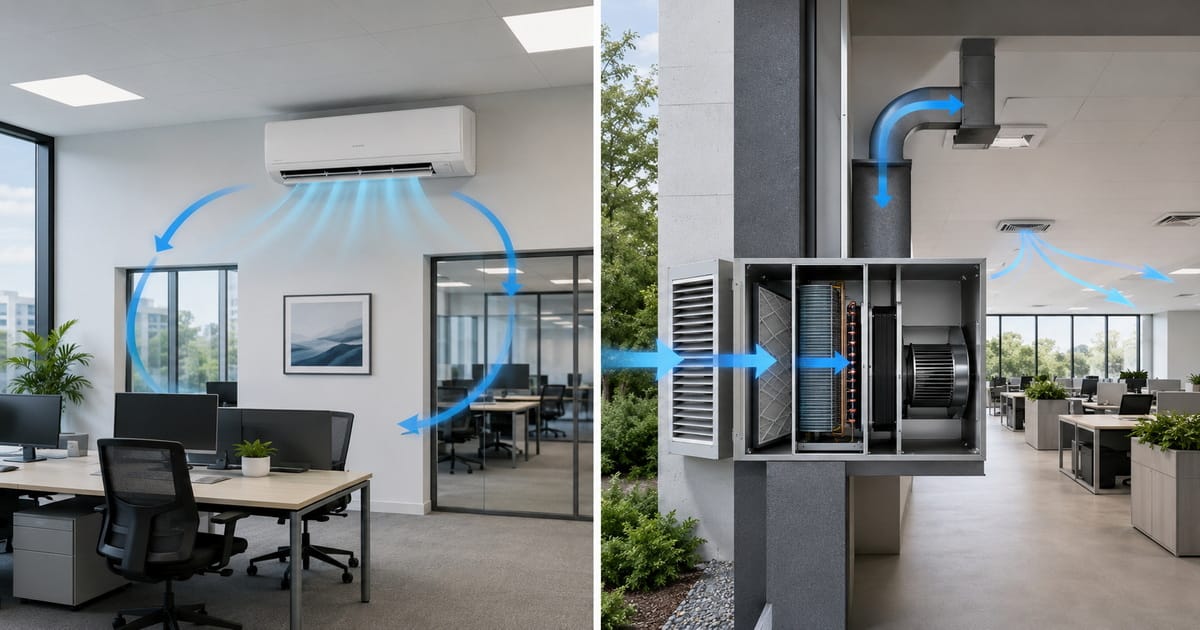
What Is Fresh Air Conditioning?
Fresh air conditioning is an HVAC approach that delivers a controlled amount of outdoor air into an indoor space after it has been filtered and, depending on the system design, cooled, heated, dehumidified, or otherwise conditioned.
Unlike a standard room air conditioner that often recirculates the same indoor air, a fresh air AC system is designed to improve ventilation while maintaining thermal comfort.
In practical product terms, fresh air conditioning can include:
– Fresh-air integrated split or packaged air conditioners
– Fresh-air ventilators combined with cooling equipment
– Energy-recovery ventilation systems
– Dedicated outdoor-air systems
– Centralized or decentralized ventilation and cooling solutions
– Smart HVAC systems with sensors, fan-speed control, and demand-based ventilation
The purpose is not simply to “bring in outside air.” Outdoor air may contain dust, pollen, PM2.5, odors, moisture, or other pollutants. A capable fresh air conditioning system must therefore manage air intake, filtration, temperature, humidity, pressure, and exhaust pathways as one coordinated process.
The U.S. Environmental Protection Agency identifies source control, improved ventilation, and air cleaning/filtration as three core strategies for improving indoor air quality. Ventilation can dilute pollutants generated indoors, but incoming outdoor air should be suitable for the space and properly treated when necessary.
What Is Traditional Air Conditioning?
Traditional air conditioning primarily controls indoor temperature. Most conventional systems cool and dehumidify indoor air, then circulate that air back into the room.
Typical examples include:
– Wall-mounted split air conditioners
– Window air conditioners
– Portable air conditioners
– Multi-split systems
– Fan coil units
– Central air-conditioning systems with limited outdoor-air intake
Traditional AC remains popular because it is familiar, cost-effective, compact, and fast to install. It can deliver quick cooling in homes, hotel rooms, shops, offices, and light-commercial applications.
However, cooling alone does not automatically provide adequate ventilation. A room can feel cool while carbon dioxide, odors, moisture, volatile organic compounds (VOCs), or fine particles remain insufficiently controlled. This is particularly relevant in airtight buildings, occupied meeting rooms, classrooms, bedrooms, clinics, and hospitality spaces.
ASHRAE identifies Standards 62.1 and 62.2 as recognized references for ventilation system design and acceptable indoor air quality. The standards address ventilation, filtration, controls, air-cleaning systems, and operation and maintenance—not merely temperature control.
Fresh Air AC vs Traditional AC
| Comparison factor | Fresh air conditioning | Traditional air conditioning |
|---|---|---|
| Primary function | Cooling plus controlled outdoor-air ventilation | Primarily cooling and recirculation |
| Indoor air quality | Can dilute indoor pollutants and manage incoming-air filtration | Depends heavily on existing ventilation and filter maintenance |
| Cooling speed | May require more capacity because outdoor air carries heat and moisture | Often cools a closed room quickly |
| Energy demand | Can be higher without energy recovery or smart control | Often lower for simple closed-space cooling |
| Humidity management | Requires careful latent-load design, especially in humid climates | Usually dehumidifies during cooling, but may not address ventilation moisture |
| Installation complexity | Higher; requires intake, filtration, drainage, airflow balancing, and controls | Lower for standard split or window AC installations |
| Best applications | Bedrooms, offices, schools, hotels, clinics, apartments, premium residential and commercial projects | Small rooms, seasonal cooling, budget-led applications, areas with adequate natural ventilation |
| Product differentiation | Strong for health-oriented, smart-home, and premium HVAC brands | Strong for entry-level cooling and replacement markets |
The key trade-off is clear: fresh air conditioning improves the quality and freshness of indoor air, while traditional air conditioning often delivers simpler and more direct cooling efficiency.
But this should not be viewed as a fixed either-or choice. Well-engineered fresh-air systems can reduce the efficiency gap through variable-speed compressors, EC fans, demand-controlled ventilation, heat recovery, appropriate filtration, and intelligent humidity control.
Air Quality: The Main Fresh-Air Advantage
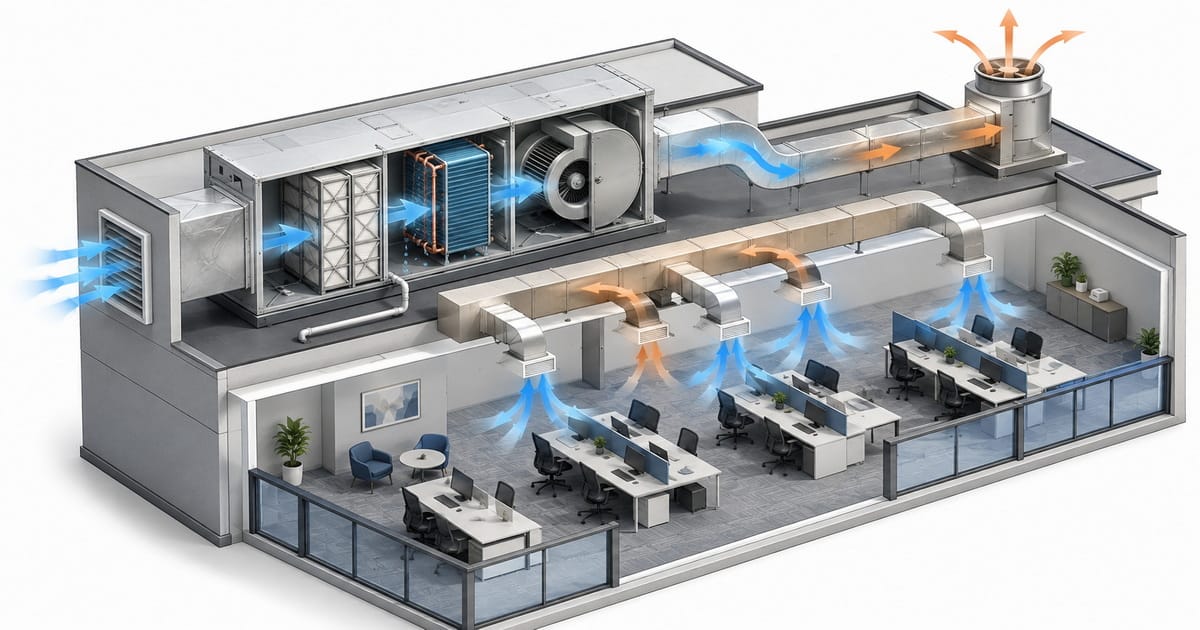
The most important benefit of fresh air conditioning is its potential to improve indoor air quality. This is especially valuable when people spend long hours inside enclosed, mechanically cooled spaces.
Why Recirculated Air Can Be a Problem
Traditional AC can repeatedly circulate indoor air. If the room has limited outdoor-air exchange, pollutants from occupants, furnishings, cleaning products, cooking, printing equipment, or nearby traffic can build up over time.
Common indoor-air concerns include:
– Elevated carbon dioxide in densely occupied rooms
– Odors from people, food, chemicals, or pets
– Fine particles, including PM2.5
– High humidity and condensation risk
– VOCs emitted by furniture, finishes, and consumer products
– Allergens such as pollen and dust
– Biological contaminants associated with damp conditions
Cooling does not eliminate all of these issues. A cold room may still have stale air.
Fresh-air ventilation helps by diluting internally generated pollutants with outdoor air. However, this only works well when the outdoor-air source is appropriate and the system provides correct filtration and treatment. In locations with polluted, hot, humid, or cold outdoor conditions, unfiltered fresh air can create new problems rather than solve existing ones.
Filtration Must Match the Application
For OEM and ODM HVAC product development, filtration should be treated as a system-level decision. Higher-efficiency filters may capture more particles, but they can also increase pressure drop, fan energy use, and maintenance requirements.
A practical fresh-air product strategy may include:
– Washable pre-filters for larger dust particles
– Higher-efficiency particulate filters for finer particles
– Optional activated-carbon filters for odors and gases
– Filter-change reminders based on operating time or pressure sensors
– Easy-access filter compartments for end-user maintenance
– Sealed airflow channels to reduce bypass leakage
Research published in *Environmental Science & Technology* found that MERV 13 or higher filtration can reduce modeled airborne influenza infection risk compared with an environment without filtration. Actual results vary by system configuration, airflow, occupancy, maintenance, and contaminant source.
Cooling Efficiency: The Traditional AC Strength
Traditional air conditioning systems are often highly attractive because they focus their capacity on the indoor air already in the room. In a closed space, the equipment does not need to continuously cool and dehumidify a large volume of hot, humid outdoor air.
This can create several advantages:
– Faster pull-down cooling after a room becomes hot
– Lower equipment cost for basic installations
– Simpler ducting or ductless installation
– Lower initial design complexity
– Easier replacement of existing split AC equipment
– Familiar operation for distributors and end users
For high-volume, budget-sensitive markets, traditional air conditioning remains commercially important. It is especially suitable where outdoor-air ventilation is already provided by other systems, where occupancy is low, or where users only need periodic cooling.
However, its apparent efficiency should be assessed carefully. If occupants respond to stuffy indoor air by opening windows while the AC is running, energy use can increase sharply. Similarly, poor maintenance, blocked filters, refrigerant issues, oversized systems, or incorrect installation can reduce real-world performance.
The International Energy Agency notes that growing cooling demand is becoming a major driver of electricity use. In its Efficient Cooling Scenario, stronger efficiency measures could reduce cooling energy demand by 45% compared with a baseline pathway while doubling average air-conditioner efficiency.
The Hidden Trade-Off: Outdoor Air Creates Cooling Load
Fresh air is beneficial for ventilation, but it is not “free.” Outdoor air brings sensible heat and latent heat into the building.
In hot climates, incoming air may be both warm and humid. The HVAC system must remove heat and moisture before the air reaches a comfortable indoor condition. In cold climates, outdoor air may need heating and humidification management.
This means a fresh air conditioning system needs correct engineering around:
– Outdoor temperature and humidity
– Required ventilation airflow
– Number of occupants
– Indoor setpoint temperature
– Indoor relative humidity target
– Building airtightness
– Filter resistance
– Fan static pressure
– Duct design
– Energy-recovery effectiveness
A system that introduces fresh air without sufficient dehumidification may make a tropical or subtropical room feel sticky, even when the thermostat shows a low temperature. Conversely, a system that over-ventilates can waste energy and make it difficult to maintain comfort.
Expert Perspective: Design for Total Comfort
In HVAC product planning, temperature is only one comfort variable. A high-performing solution should balance:
Comfort=Temperature+Humidity+Air Cleanliness+Air Movement+Noise Control
For many overseas HVAC buyers, the market opportunity lies in selling this broader value proposition rather than competing only on BTU rating or unit price.
How Energy Recovery Changes the Equation
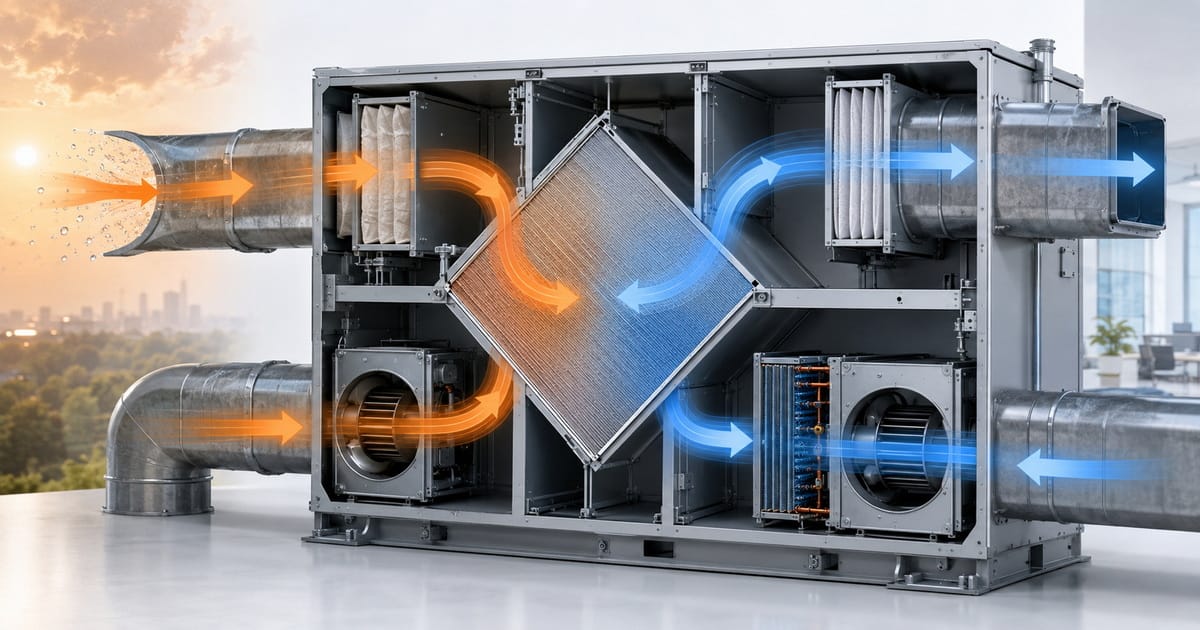
Energy recovery is one of the most important ways to make fresh air conditioning more energy-efficient.
An energy-recovery ventilator can transfer part of the heat—and, depending on the technology, moisture—between outgoing exhaust air and incoming outdoor air. This reduces the conditioning load placed on the cooling or heating equipment.
For example, in a hot, humid climate, cooler and drier exhaust air can help pre-condition incoming fresh air before it reaches the cooling coil. In a cold climate, warmer exhaust air can help temper incoming air.
When Energy Recovery Is Valuable
Energy recovery is particularly relevant for:
– Hotels and serviced apartments
– Schools and training centers
– Offices with long operating hours
– Clinics and healthcare-adjacent spaces
– Premium residential developments
– Meeting rooms and co-working spaces
– Buildings in hot-humid, hot-dry, or cold climates
– Projects with high ventilation requirements
The product decision should still be application-specific. Energy-recovery modules add cost, space requirements, and maintenance considerations. But for projects with long operating hours or significant outdoor-air loads, they can improve lifecycle economics.
Choosing the Right System by Application
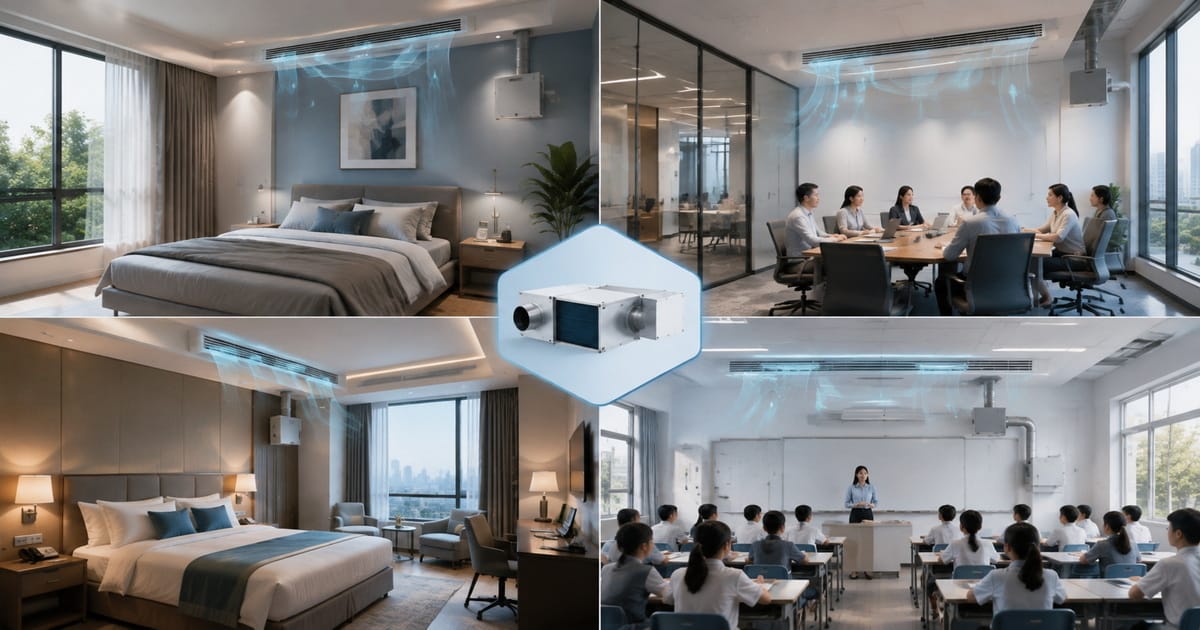
Residential Bedrooms and Apartments
For bedrooms, the strongest pain point is often stale air during nighttime operation. Users may close windows for noise, security, weather, or pollution reasons, then run a conventional split AC for many hours.
A fresh air AC solution can support:
– More stable air freshness during sleep
– Reduced dependence on open windows
– Filtered outdoor-air intake
– Better humidity control in humid regions
– Smart modes linked to occupancy or air-quality sensors
Traditional AC may still be suitable for lower-cost apartments, mild climates, or homes with dependable natural ventilation. For premium residential brands, however, fresh-air integration can be a meaningful differentiator.
Offices, Classrooms, and Meeting Rooms
High occupant density makes ventilation especially important. A meeting room can become stuffy quickly even when cooling capacity is adequate.
For these spaces, prioritize:
1. Sufficient outdoor-air delivery
2. Demand-based control using occupancy or CO₂ indicators
3. Proper air distribution to avoid drafts
4. Accessible filter maintenance
5. Low noise at part-load operation
6. Humidity control based on the local climate
A traditional AC system can cool a meeting room, but it may not adequately manage the ventilation requirement unless supported by a separate outdoor-air system.
Hotels and Hospitality Projects
Hotels need quiet operation, room-by-room controllability, attractive aesthetics, reliable humidity management, and guest comfort. A fresh air conditioning solution can add value when it prevents guests from feeling that the room is “cold but stuffy.”
For hospitality OEM projects, product teams should consider:
– Ultra-low-noise fan design
– Guest-room occupancy logic
– Centralized or decentralized fresh-air architecture
– Optional heat recovery
– Condensate management
– Easy filter-service access for maintenance staff
– Smart controls compatible with hotel management systems
A Practical Buyer Checklist
Before selecting fresh air conditioning or traditional air conditioning, ask these questions:
1. What is the outdoor climate, including summer humidity and winter temperature?
2. How many people will typically occupy the room?
3. Does the building already have a separate ventilation system?
4. What indoor-air issues matter most: CO₂, odor, particles, humidity, or all of them?
5. Is outdoor air clean enough to introduce directly, or does it require advanced filtration?
6. Is there enough installation space for ducts, intake paths, drains, and service access?
7. What is the expected operating schedule: occasional, daily, or nearly continuous?
8. Are energy recovery and demand-controlled ventilation justified by the project’s operating profile?
9. What maintenance capability does the end user or property manager have?
10. Which certifications, electrical specifications, refrigerants, and regional standards apply in the target market?
This checklist is especially useful for distributors and private-label HVAC brands evaluating OEM or ODM system specifications.
OEM and ODM Product Development Opportunities
For HVAC brands seeking a more differentiated product portfolio, fresh air conditioning offers a path beyond price-based competition. The product can be designed around localized market needs rather than a generic “one-size-fits-all” air conditioner.
Potential customization areas include:
– Airflow capacity and external static pressure
– Fresh-air volume and recirculation ratio
– Filter configuration and replacement design
– Heat-recovery option
– Humidity-control logic
– Smart sensors and connectivity
– Indoor unit appearance and dimensions
– Noise optimization
– Refrigerant options based on local compliance needs
– Voltage, plug, packaging, branding, and user interface localization
DREZ provides integrated R&D, design, manufacturing, sales, and customized climate-control solutions. For overseas brand owners, wholesalers, and equipment manufacturers, a well-specified OEM or ODM fresh-air AC system can help create a clearer premium position in residential and light-commercial markets.
Final Recommendation
Fresh air conditioning is usually the better choice when indoor air quality, ventilation, humidity control, and long-term occupant comfort are priorities. Traditional air conditioning remains an efficient and practical choice when the main requirement is quick, cost-effective cooling and the building already has adequate ventilation.
The most competitive HVAC strategy is not to position fresh air and cooling efficiency as enemies. It is to engineer the right balance through efficient compressors, sensible airflow design, filtration, humidity control, heat recovery, and intelligent controls.
Looking for a customized fresh air conditioning solution for your brand or project? Contact DREZ to discuss OEM/ODM specifications, target-market requirements, airflow design, filtration options, energy-efficiency targets, and customized product development.
FAQs
1. Does fresh air conditioning cool a room as effectively as traditional air conditioning?
Yes, when correctly sized and designed. However, fresh-air systems must handle the additional heat and humidity brought in by outdoor air, so equipment selection and dehumidification capacity are especially important.
2. Is fresh air conditioning more energy-efficient?
Not automatically. Bringing in outdoor air adds cooling or heating load. However, variable-speed technology, demand-controlled ventilation, energy recovery, efficient fans, and appropriate controls can improve overall performance.
3. Can a traditional air conditioner improve indoor air quality?
It can improve air cleanliness to a limited extent through its filter and by reducing humidity during cooling. However, it generally does not provide sufficient outdoor-air ventilation by itself.
4. Is a fresh air AC system suitable for humid climates?
Yes, but humidity control is essential. In hot-humid regions, the system should be designed to remove moisture from incoming outdoor air, prevent condensation, and maintain comfortable indoor conditions.
5. Does fresh air conditioning require more maintenance?
Usually, yes. Fresh-air systems may require regular filter inspection, cleaning or replacement, intake-path checks, drainage inspection, and periodic verification of airflow performance.
6. What is the best application for a fresh air air conditioner?
Fresh air air conditioners are especially useful in bedrooms, apartments, offices, meeting rooms, classrooms, hotels, clinics, and other enclosed spaces where occupants spend extended periods indoors.
7. Can DREZ support private-label fresh air conditioning products?
Yes. DREZ can support OEM and ODM projects involving product design, performance specifications, branding, customization, manufacturing, and climate-control solution development for overseas customers.
References
1. U.S. Environmental Protection Agency. “Improving Indoor Air Quality.” Explains source control, ventilation, and air cleaning as core indoor-air-quality strategies. [EPA: Improving Indoor Air Quality]. [epa]
2. ASHRAE. “Standards 62.1 & 62.2.” Provides recognized frameworks for ventilation-system design and acceptable indoor air quality. [ASHRAE Standards 62.1 & 62.2]. [ashrae]
3. International Energy Agency. “The Future of Cooling.” Discusses global cooling demand and the potential impact of improved air-conditioner efficiency. [IEA: The Future of Cooling]. [iea]
4. U.S. Environmental Protection Agency. “Heating, Ventilation and Air-Conditioning Systems, Part of Indoor Air Quality Design Tools for Schools.” Describes HVAC systems’ role in maintaining IAQ through adequate ventilation. [EPA HVAC and IAQ Design Tools]. [epa]
5. Azimi, P. and Stephens, B. “HVAC Filtration for Controlling Infectious Airborne Disease Transmission in Indoor Environments.” *Environmental Science & Technology*. Reviews modeled effects of higher-efficiency HVAC filtration, including MERV 13. [PubMed Central article]. [pmc.ncbi.nlm.nih]
6. ANSI Blog. “ANSI/ASHRAE 62.1-2025: Ventilation for Indoor Air Quality.” Summarizes the standard’s purpose, including minimum ventilation rates and acceptable IAQ. [ANSI/ASHRAE 62.1 overview]. [blog.ansi]
Hot Tags: Fresh Air Conditioning System, Traditional Air Conditioning System, OEM Air Conditioner Manufacturer, ODM HVAC Solutions, Indoor Air Quality Solutions, Commercial HVAC Systems, Energy Efficient Air Conditioning, Fresh Air Ventilation System, HVAC Air Filtration Solutions, Humidity Control Air Conditioner