Content Menu
● 1. Define What Your Commercial Mobile Air Conditioner Must Achieve
● 2. Size a Mobile Air Conditioning System for Commercial Use Correctly
>> Calculate heat load instead of relying on floor area
>> Separate sensible cooling from moisture removal
>> Compare ratings on the same basis
● 3. Choose the Right Commercial Mobile Cooling Configuration
● 4. Check Ductwork, Return Air, and Ventilation Together
>> Ask for airflow at the required external static pressure
>> Prevent supply-to-return short-circuiting
>> Distinguish cooling from fresh-air ventilation
● 5. Verify Power, Drainage, and Noise Before Ordering
● 6. Use a Scenario-Based Acceptance Test
● 7. Compare Total Ownership Cost, Not Just Unit Price
● 8. Evaluate OEM and ODM Capability Beyond Branding
● 9. Build a Quote-Ready Purchasing Brief
● Discuss Your Commercial Cooling Requirements With DREZ
>> 1.What size mobile air conditioner do I need for a commercial space?
>> 2.Can a commercial portable air conditioner work without an exhaust hose?
>> 3.Is a larger commercial mobile air conditioner always better?
>> 4.Can commercial mobile cooling equipment run on a generator?
>> 5.What should overseas buyers verify before approving an OEM order?
>> 6.How can buyers compare suppliers offering different capacity figures?
Choosing a mobile air conditioning system for commercial use starts with understanding your site—not comparing the largest capacity numbers on a quotation. A unit that performs well in a small retail space may struggle inside a sun-exposed event tent, a busy workshop, or a temporary warehouse.
My recommendation is to treat commercial mobile cooling as a complete system: equipment, airflow, electrical supply, drainage, and operating conditions.
1. Define What Your Commercial Mobile Air Conditioner Must Achieve
Before requesting prices, decide whether you need whole-space cooling, targeted cooling, or temporary backup.
These applications require different selection priorities.
| Commercial application | Main cooling challenge | Selection priority |
|---|---|---|
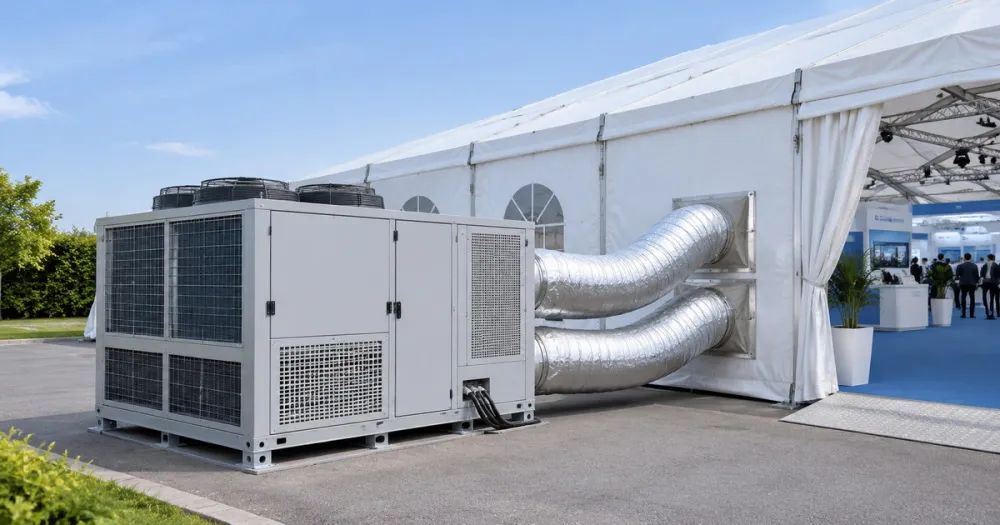
| Exhibition tents | Solar gain, crowds, and air leakage | Calculated capacity and distributed airflow |
| Workshops | Concentrated machinery heat | Targeted delivery and suitable filtration |
| Retail spaces | Customer comfort and open doors | Noise, humidity control, and air distribution |
| Temporary warehouses | Large volumes and loading activity | Defined cooling zones and infiltration control |
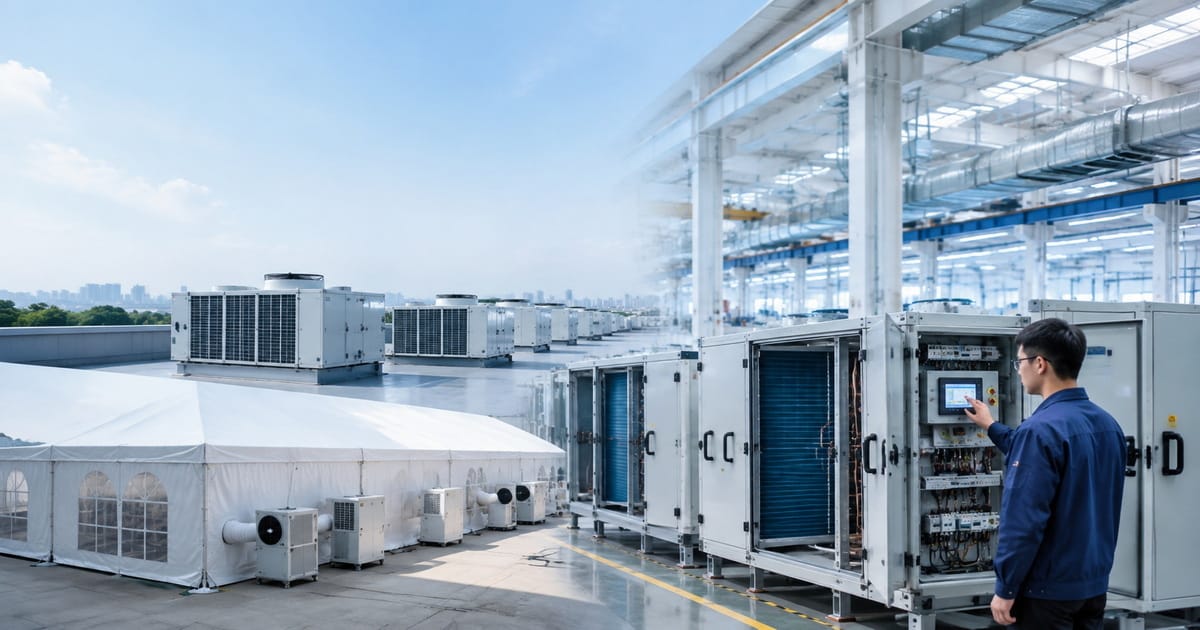
| Equipment rooms | Continuous heat generation | Sensible capacity, monitoring, and redundancy |
| Rental operations | Repeated transport and changing sites | Durability, handling, and installation flexibility |
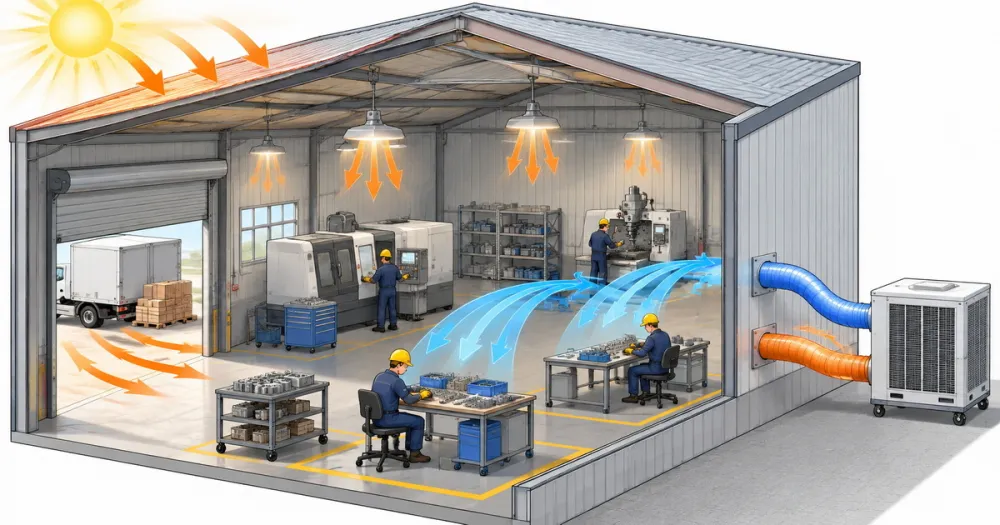
A warehouse may not require uniform cooling throughout its entire volume. Cooling selected workstations could be more practical. Conversely, an event venue needs a distribution strategy that avoids hot corners and uncomfortable cold drafts.
2. Size a Mobile Air Conditioning System for Commercial Use Correctly
Calculate heat load instead of relying on floor area
Floor area provides a starting point, but it does not describe the complete cooling requirement.
A commercial cooling-load assessment should consider:
– Building dimensions and ceiling height.
– Roof, wall, and window construction.
– Solar exposure and shading.
– Occupancy and activity levels.
– Lighting, machinery, and electrical equipment.
– Outdoor ventilation air.
– Door openings and uncontrolled air leakage.
– Required indoor temperature and humidity.
Two spaces with identical floor areas can need substantially different systems.
An insulated showroom and an uninsulated temporary structure should not receive the same recommendation simply because both measure 200 square meters.
Separate sensible cooling from moisture removal
Sensible cooling reduces air temperature. Latent cooling removes moisture.
This distinction matters in humid climates, crowded venues, and applications with substantial outdoor-air intake. A machine selected only by total cooling capacity may not provide the required balance of temperature reduction and moisture removal.
Ask suppliers for total and sensible cooling capacities at the proposed operating conditions.
Compare ratings on the same basis
Confirm the indoor temperature, outdoor temperature, humidity, airflow, and test method behind every quoted capacity.
For portable air conditioners covered by the relevant U.S. Department of Energy procedure, Seasonally Adjusted Cooling Capacity accounts for specified effects such as duct heat transfer and infiltration.
However, that framework is not a universal comparison method for every industrial packaged system. Larger commercial equipment may use different applicable standards.
Request comparable test conditions rather than assuming every advertised BTU/h figure means the same thing.
3. Choose the Right Commercial Mobile Cooling Configuration
Different equipment layouts solve different installation problems.
| Configuration | Potential fit | What to verify |
|---|---|---|
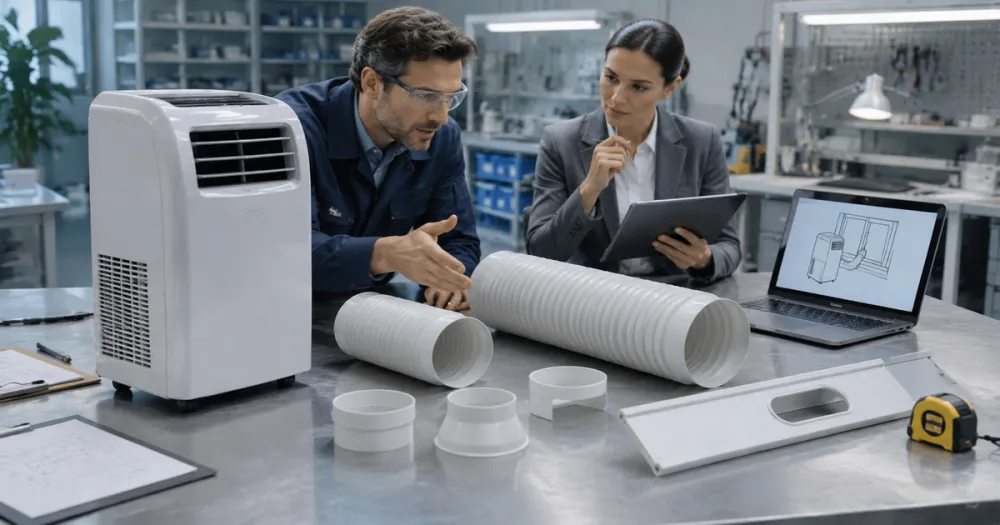
| Indoor spot cooler | Targeted workstation or equipment cooling | Condenser heat discharge and replacement air |
| Dual-duct portable unit | Enclosed spaces with suitable openings | Intake/exhaust separation and sealing |
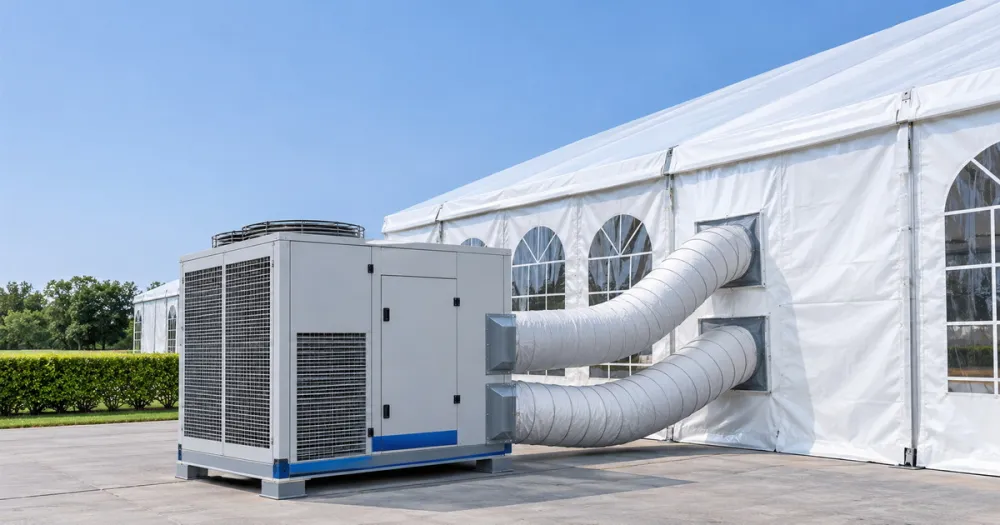
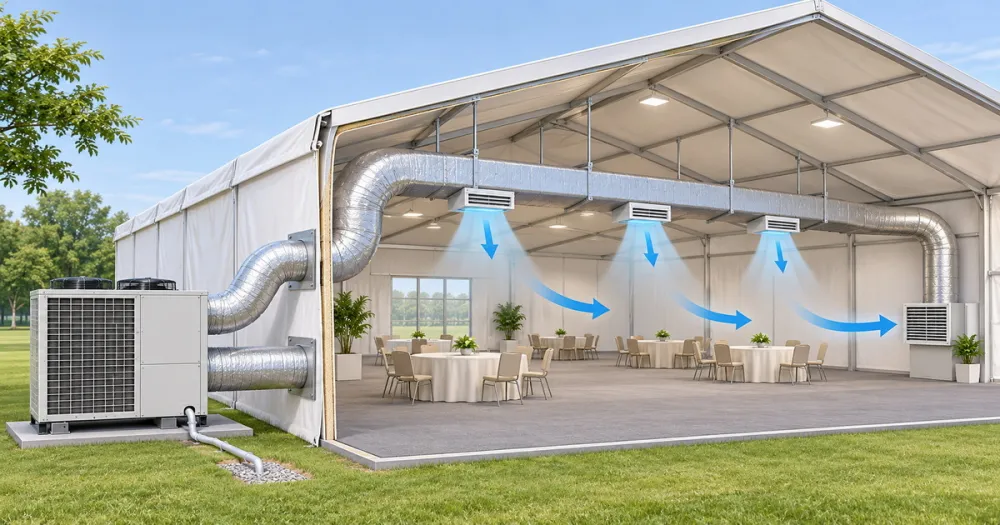
| Outdoor packaged ducted system | Tents, temporary buildings, and events | Supply/return layout and available static pressure |
| Mobile split system | Applications needing separated components | Connection limits and installation procedures |
| Trailer-mounted system | Larger temporary projects and rental fleets | Transport, positioning, power, and duct handling |
The central question is simple: where does the removed heat go?
An air conditioner must reject the heat it extracts, together with heat associated with its electrical input. If its condenser discharges into the same enclosed space being cooled, it cannot deliver net whole-room cooling.
An indoor spot cooler can still provide useful localized cooling, but its heat-rejection arrangement must suit the project.
Single-duct designs that exhaust indoor air can also create negative pressure and draw replacement air into the building. That additional outdoor air may increase the cooling load.
Evaluate the complete air path—not just the cold-air outlet.
4. Check Ductwork, Return Air, and Ventilation Together
Ask for airflow at the required external static pressure
A commercial portable air conditioner needs enough fan capability to overcome resistance from its installation.
Flexible ducts, bends, filters, grilles, and distribution accessories all affect airflow.
Ask the supplier:
1. What airflow is available at the proposed external static pressure?
2. What duct diameter and maximum configuration are permitted?
3. Are the figures based on connected ductwork or unrestricted discharge?
4. Which bends and accessories were included in testing?
5. What return-air arrangement is required?
Avoid accepting a universal maximum duct length without understanding the installation behind it.
A short, sharply bent duct may create more difficulty than a longer, correctly sized route.
Prevent supply-to-return short-circuiting
Cold air should pass through the intended occupied or equipment zone before returning to the unit.
If supply and return openings sit too close together, the system may recirculate cooled air without adequately treating the wider space.
A practical layout drawing should show outlets, return paths, partitions, doorways, and major heat sources.
Distinguish cooling from fresh-air ventilation
Recirculating cooling does not automatically meet ventilation requirements.
Determine how outdoor air will enter, how exhaust air will leave, and who will calculate the associated cooling and moisture loads.
For commercial buildings, ventilation requirements must follow the applicable project standards and local regulations.
5. Verify Power, Drainage, and Noise Before Ordering
Electrical compatibility
Specify voltage, frequency, phase, available supply capacity, and connection requirements.
Also request operating current, starting characteristics, protective-device requirements, and installation instructions.
For generator-powered sites, have the equipment supplier and a qualified electrical professional assess compatibility. Running power alone may not describe starting demands or interactions with other loads.
A lower equipment price offers little value if the site needs unexpected electrical modifications.
Condensate management
Moisture removed from the air must be collected or discharged safely.
Verify:
– Gravity-drain requirements and routing.
– Condensate-pump availability and lift limits.
– Tank capacity, if applicable.
– Overflow protection and shutdown behavior.
– Access for cleaning and maintenance.
Do not assume a self-evaporating feature eliminates drainage requirements under all humidity conditions.
Meaningful acoustic data
Request sound data with the measurement distance, operating mode, and test conditions.
Sound pressure and sound power are different quantities, so do not compare them as interchangeable figures.
For customer-facing spaces, assess the installed arrangement—including fans, duct outlets, vibration, and nearby reflective surfaces—not just a brochure number.
6. Use a Scenario-Based Acceptance Test
One valuable procurement improvement is to test the proposed installation rather than approving equipment from an unrestricted factory demonstration.
Consider an illustrative temporary-event project with high occupancy, flexible supply ducts, and frequent door opening. This is a planning example, not a reported customer case.
The buyer and manufacturer should agree on:
1. Outdoor and indoor starting conditions.
2. Simulated occupancy and equipment loads.
3. Supply and return duct configurations.
4. Measurement locations across the occupied area.
5. Stabilization and operating periods.
6. Temperature, humidity, airflow, and power criteria.
7. Alarm and condensate-protection checks.
Place sensors away from direct cold-air discharge. A reading immediately beside the outlet does not establish comfort throughout the space.
Record the setup with photographs and an installation diagram. If the actual site differs substantially, the acceptance result may no longer represent real operation.
This approach turns “strong cooling performance” into a verifiable requirement.
7. Compare Total Ownership Cost, Not Just Unit Price
For commercial buyers, purchase price is only one part of the decision.
A practical ownership-cost model includes:
For example, assume two systems deliver equivalent cooling under the same specified conditions:
| Illustrative input | System A | System B |
|---|---|---|
| Electrical input | 12 kW | 10 kW |
| Annual operation | 2,000 hours | 2,000 hours |
| Electricity tariff | $0.15/kWh | $0.15/kWh |
| Calculated annual electricity cost | $3,600 | $3,000 |
The illustrative difference is $600 annually.
These are assumed figures, not DREZ product data. Actual consumption depends on load, controls, ambient conditions, maintenance, and operating hours.
8. Evaluate OEM and ODM Capability Beyond Branding
DREZ (Guangzhou) Intelligent Technology Co., Ltd. integrates research and development, design, production, sales, and customized climate-control solutions. For overseas brands, wholesalers, and manufacturers, the useful next step is translating market requirements into a documented specification.
Discuss:
– Capacity and climate requirements.
– Voltage, frequency, and phase options.
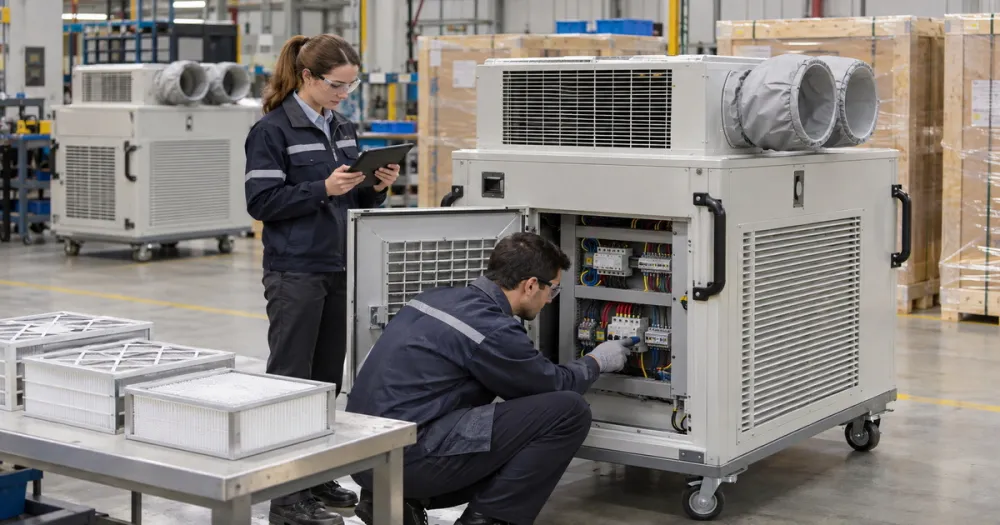
– Cabinet dimensions and handling features.
– Duct connections and installation interfaces.
– Controls, alarms, and monitoring.
– Service access and replacement components.
– Packaging, manuals, and labeling.
– Destination-market compliance documentation.
For an existing product platform, confirm which changes require additional validation. A different fan, controller, refrigerant, or electrical configuration can affect performance, safety, and documentation.
Request certificates and test reports that identify the exact model and applicable scope. Do not assume one document covers an entire product family or every customized variant.
9. Build a Quote-Ready Purchasing Brief
A detailed request makes supplier comparisons more useful.
Include the following information in your inquiry:
| Category | Information to provide |
|---|---|
| Application | Building type, cooling zones, and operating schedule |
| Environment | Outdoor design conditions, dust, rain exposure, and humidity |
| Space | Dimensions, insulation, windows, and door activity |
| Loads | People, lighting, machinery, and ventilation |
| Installation | Unit position, duct routes, return air, and drainage |
| Power | Voltage, frequency, phase, and supply limitations |
| Commercial scope | Quantity, destination, customization, and service expectations |
Ask each supplier to list assumptions, exclusions, and required site work.
The strongest proposal is not necessarily the one promising the lowest temperature. It is the one explaining what the system can achieve, under which conditions, and how that performance will be verified.
Discuss Your Commercial Cooling Requirements With DREZ
Send DREZ your site dimensions, location, occupancy, heat sources, power supply, duct layout, and target indoor conditions.
For brand owners, wholesalers, and manufacturers, also include expected order quantities and OEM or ODM requirements. Ask for a project-specific proposal covering equipment configuration, performance assumptions, installation needs, and validation criteria before approving production.
Frequently Asked Questions
1.What size mobile air conditioner do I need for a commercial space?
Use a cooling-load assessment covering construction, occupancy, equipment, ventilation, and outdoor conditions. Floor area alone is insufficient. Request capacity at your project’s actual design conditions.
2.Can a commercial portable air conditioner work without an exhaust hose?
Some configurations use outdoor condenser sections or outdoor packaged equipment instead of an indoor exhaust hose. Nevertheless, every refrigeration system needs an appropriate heat-rejection path. “Hose-free” does not mean heat-rejection-free.
3.Is a larger commercial mobile air conditioner always better?
No. Oversizing can create control and cycling problems, while inadequate airflow or moisture removal may remain unresolved. Match the equipment’s operating range and sensible/latent performance to the load.
4.Can commercial mobile cooling equipment run on a generator?
Potentially, provided voltage, frequency, phase, starting requirements, and supply quality are compatible. Obtain written equipment requirements and have the complete generator installation assessed by qualified professionals.
5.What should overseas buyers verify before approving an OEM order?
Verify the exact configuration, agreed performance conditions, model-specific documentation, acceptance tests, warranty terms, spare-parts availability, and production change-control procedures.
6.How can buyers compare suppliers offering different capacity figures?
Request the test standard, rating conditions, power input, sensible capacity, airflow, and connected static pressure. Compare equivalent conditions rather than headline capacity alone.
References
1. ASHRAE. “[Chapter 18: Nonresidential Cooling and Heating Load Calculations].” Technical basis for cooling loads, indoor design conditions, sensible and latent heat, and ventilation-related loads. [handbook.ashrae]
2. ASHRAE. “[Chapter 2: Retail Facilities].” Guidance concerning commercial load assessment, air distribution, humidity, and ventilation. [handbook.ashrae]
3. U.S. Department of Energy. “[Test Procedure for Portable Air Conditioners—Notice of Proposed Rulemaking],” 2022. Technical background on portable-air-conditioner testing, adjusted capacity, duct heat transfer, and infiltration. This proposal is cited for technical explanation, not as confirmation of current legal requirements. [energy]
4. U.S. Department of Energy. “[Energy Conservation Standards for Portable Air Conditioners—Notice of Proposed Rulemaking],” 2016. Background on single-duct systems, negative pressure, and infiltration effects. [energy]
5. DREZ. “[Custom Industrial Air Conditioner Manufacturer & Factory].” Manufacturer-provided information on commercial and industrial applications and OEM/ODM cooperation. Company descriptions are manufacturer statements, not independent certification. [drezaircon]
Hot Tags: Commercial Portable Air Conditioner, Commercial Mobile Air Conditioning System, Industrial Portable Air Conditioner, Commercial Spot Cooler, Portable Air Conditioner Manufacturer, Industrial Air Conditioning System, Trailer Mounted Air Conditioner, Portable Air Conditioner OEM, Custom Air Conditioning Solutions, Commercial Air Conditioner Supplier