Content Menu
● What Is Mobile Air Conditioning for Tents?
>> Definition and Typical Use Cases
>> Key Features of Mobile Tent AC
● What Is a Fixed HVAC Installation in Tent Environments?
>> Definition and Integration into Structures
>> Characteristics of Fixed HVAC in Tents
● Cost Comparison: Upfront and Operating Costs
>> Initial Investment and Installation
>> Energy Consumption and Monthly Operating Cost
● Efficiency and Comfort Performance
>> Challenges of Cooling Tents
>> Comfort Stability: Mobile vs Fixed
● Deployment Speed, Flexibility, and Scalability
>> Mobility and Network Growth
● Maintenance, Durability, and Lifecycle Cost
>> Lifecycle Cost Considerations
● OEM/ODM Perspective: Custom Climate‑Control Solutions
>> Branding and Product Differentiation
>> Solution Design for International Markets
● Practical Decision Framework for Tent Cooling
>> Where Mobile Tent AC Wins and Where Fixed HVAC Wins
● Summary and Strategic Outlook
● FAQs
>> 1. Is mobile air conditioning for tents more expensive to operate than fixed HVAC?
>> 2. Can fixed HVAC be effectively integrated into semi‑permanent tents?
>> 3. What type of tent applications benefit most from mobile air conditioning?
>> 4. How should equipment buyers decide between mobile and fixed systems?
>> 5. Can mobile tent AC systems support advanced features and energy‑saving strategies?
Mobile air conditioning for tents and fixed HVAC installations serve very different types of spaces, and the most cost‑efficient choice depends on how long, how often, and where cooling is required. For DREZ (Guangzhou) Intelligent Technology Co., Ltd., an integrated climate‑control supplier offering OEM and ODM solutions, understanding this balance is essential to helping international brand owners, wholesalers, and producers design reliable outdoor cooling portfolios.
Temporary structures and semi‑permanent tents are now widely used for events, logistics, industrial production, emergency shelters, and military operations. In these scenarios, climate control is no longer a “nice to have” feature; it directly affects worker safety, equipment performance, and visitor comfort. Mobile air conditioning for tents and fixed HVAC installations represent two distinct approaches, each with clear strengths and limitations in terms of cost, efficiency, flexibility, and long‑term value.
DREZ (Guangzhou) Intelligent Technology Co., Ltd. operates as an innovation‑driven climate‑control supplier, integrating research, design, manufacturing, sales, and customized solution development. Through OEM and ODM cooperation, the company helps overseas partners bring tailored tent‑cooling solutions to market, matching local regulations, brand positioning, and real‑world deployment needs.
What Is Mobile Air Conditioning for Tents?
Definition and Typical Use Cases
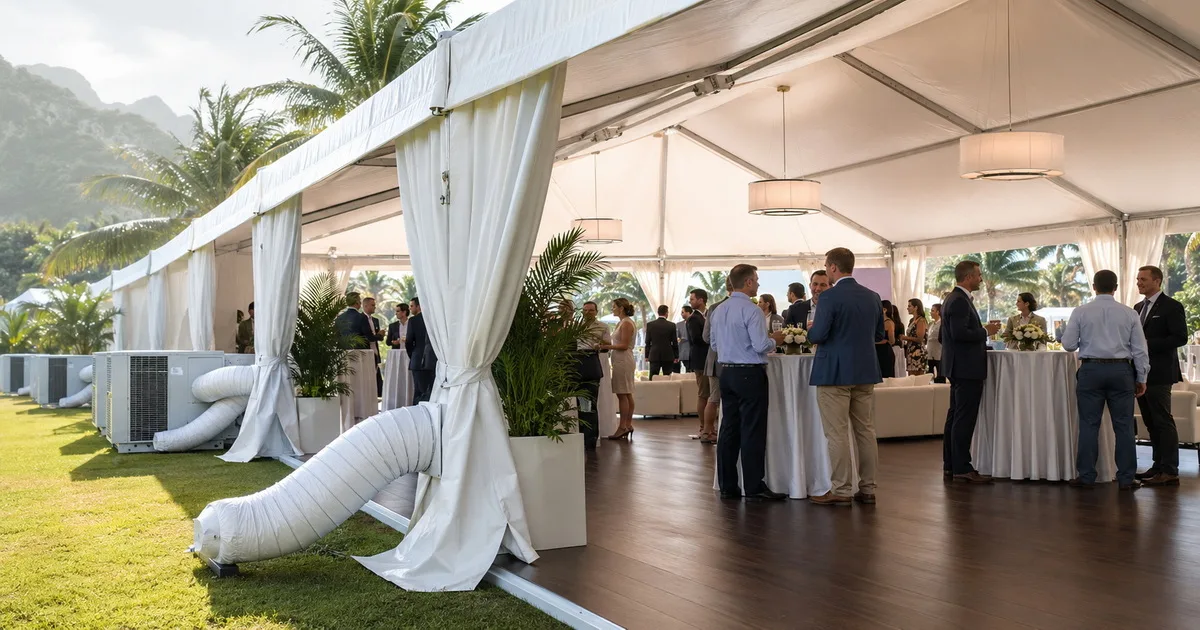
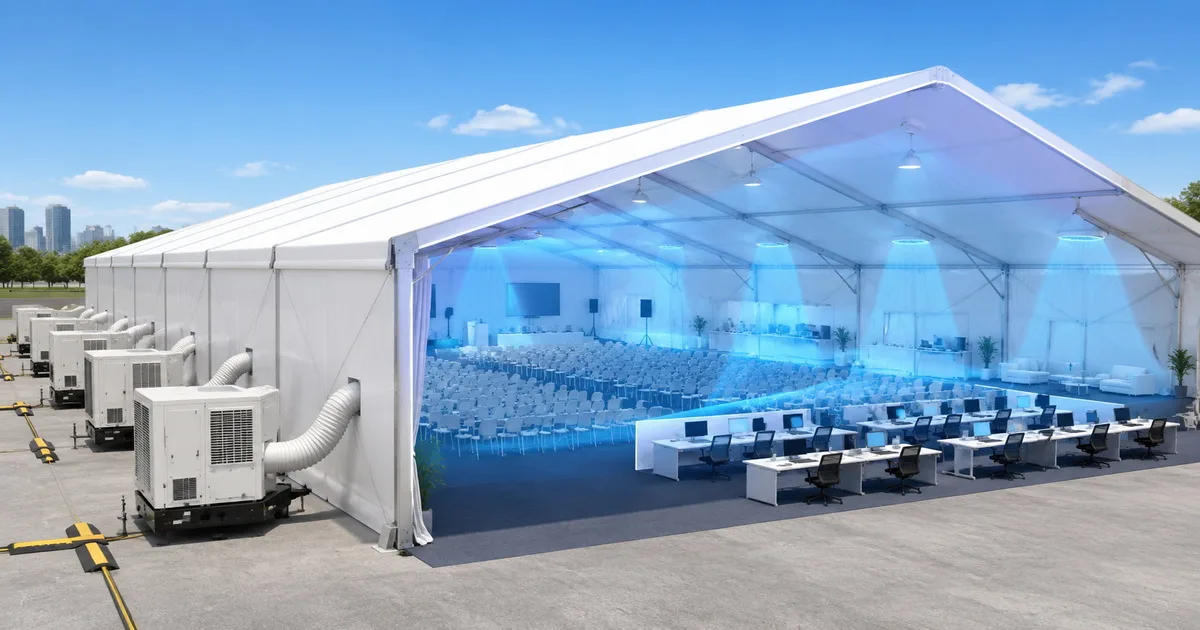
Mobile air conditioning for tents refers to portable or semi‑portable cooling systems engineered specifically for temporary structures. These systems usually feature robust casings, mobile frames or wheels, flexible air ducts, and quick‑connect power interfaces. They are designed to withstand outdoor and semi‑industrial environments where tent layouts, occupancy, and operating times change frequently.
Common applications include:
– Large event tents and exhibition marquees
– Construction sites and field engineering camps
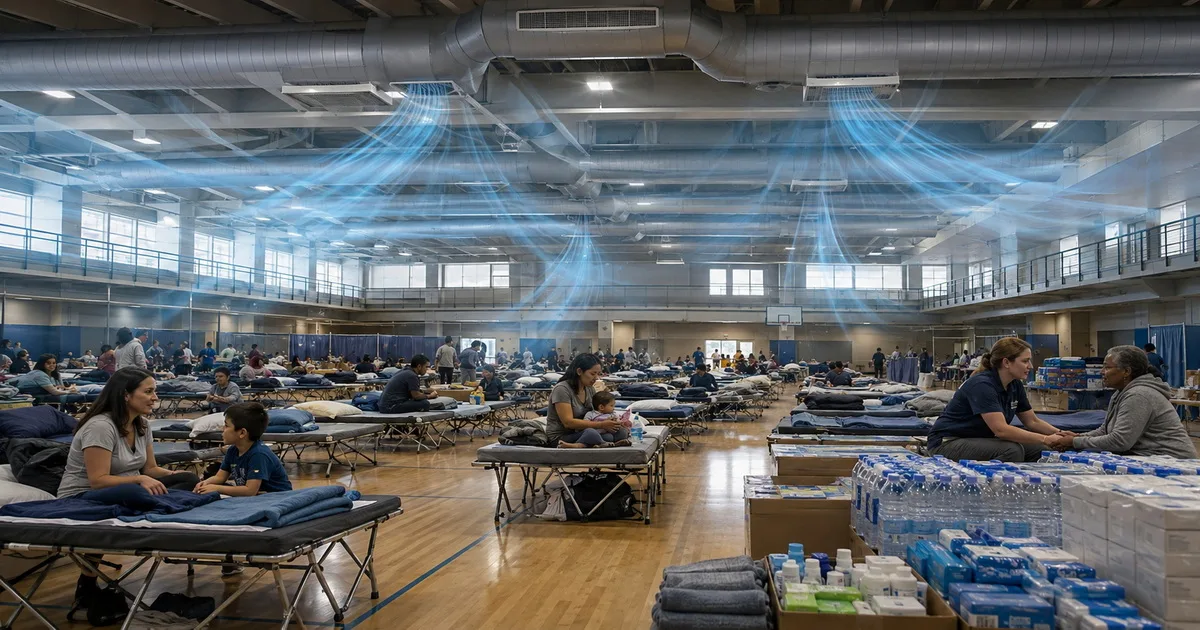
– Disaster‑relief shelters and medical field units
– Military camps and training facilities
– Temporary industrial workshops and storage tents
In these scenarios, fast deployment, easy relocation, and modular capacity are more valuable than purely theoretical maximum efficiency. Mobile tent AC systems can be rolled into place, connected to power, attached to air ducts, and brought online in a very short timeframe. Multiple units can be combined to match different tent sizes, internal layouts, and cooling requirements.
Key Features of Mobile Tent AC
Well‑designed mobile air conditioning for tents typically offers:
– Fast setup with minimal structural requirements
– Flexible air distribution using ducts to target occupied zones
– Modular scalability, allowing additional units as the tent network grows
– Rugged construction to handle frequent transport and outdoor exposure
– Straightforward routine maintenance, such as filter cleaning and inspection
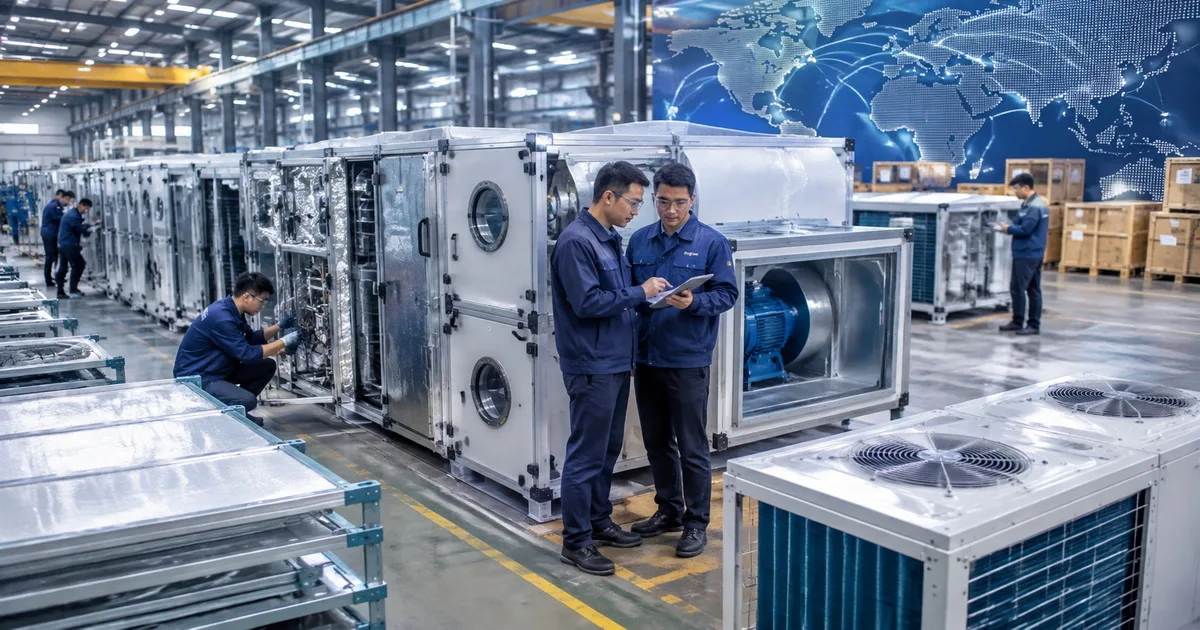
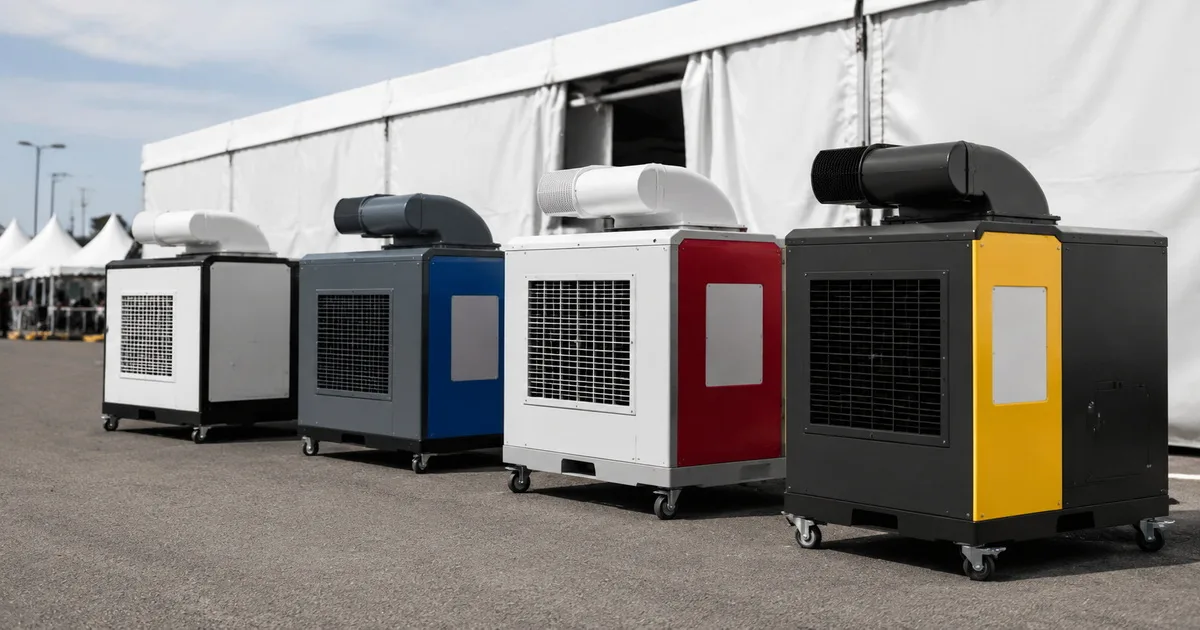
For OEM and ODM partners, mobile tent AC units can be customized in terms of housing design, color, control panels, electrical standards, and branded details, making them suitable as flagship products in international climate‑control portfolios.
What Is a Fixed HVAC Installation in Tent Environments?
Definition and Integration into Structures
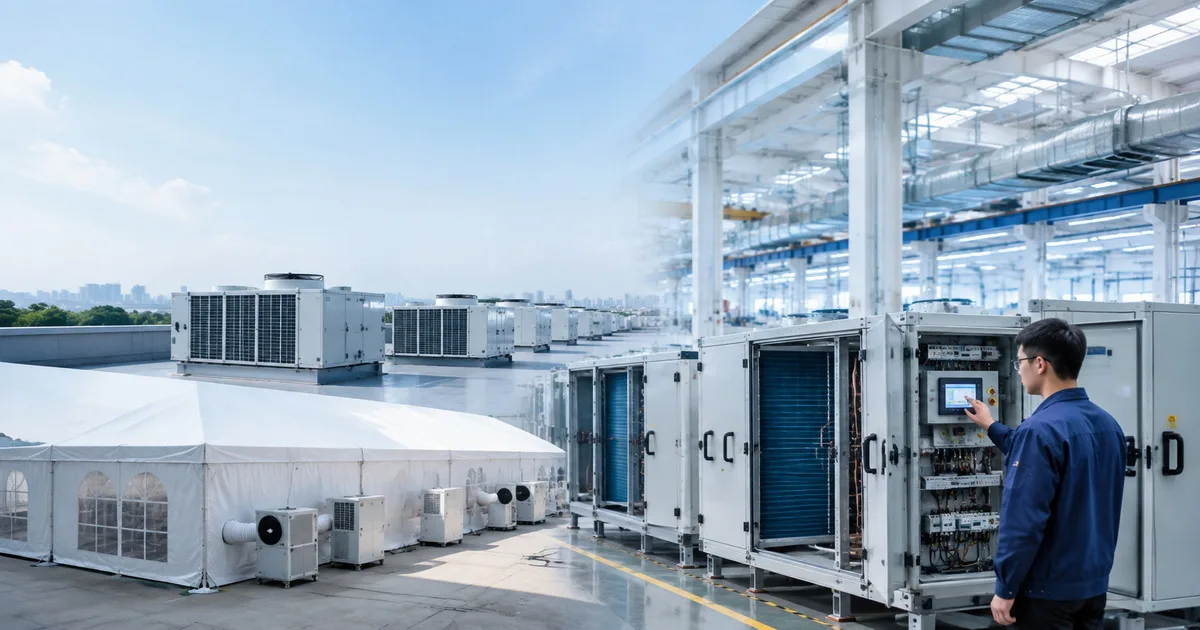
Fixed HVAC installations are permanently mounted cooling systems, typically split units, multi‑split configurations, central ducted systems, or rooftop package units. They are designed for long‑term use and integrated into the structure’s envelope through ducts, supports, and control networks. While most people associate fixed HVAC with conventional buildings, similar systems can be engineered for semi‑permanent tents, industrial shelters, and warehouse‑style fabric structures.
When used in tent environments, fixed HVAC normally involves:
– Structural mounting of indoor and outdoor units or rooftop packages
– Designed duct layouts for consistent air distribution
– Integration with the tent’s power infrastructure and safety systems
– Professional installation, commissioning, and periodic servicing
This approach makes sense when the tent or fabric structure behaves more like a building: it remains in place for years, has controlled entrances, and uses insulated panels or reinforced membranes.
Characteristics of Fixed HVAC in Tents
In tent‑type structures, fixed HVAC installation provides:
– High comfort stability with steady temperature and humidity control
– Optimized ducted air distribution for clear zones inside the tent
– Strong long‑term efficiency, especially in well‑insulated setups
– Integrated controls for centralized management across multiple zones
However, fixed HVAC systems are tied to a single structure. Relocating or upsizing them can be complex and costly, particularly when the tent layout or location changes frequently.
Cost Comparison: Upfront and Operating Costs
Initial Investment and Installation
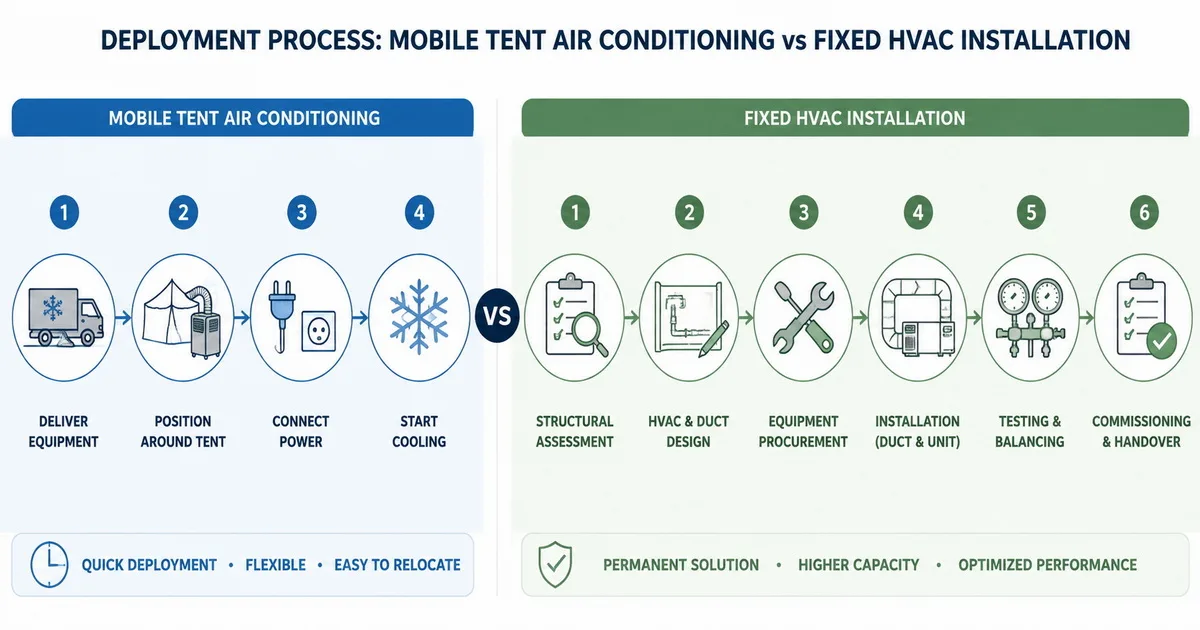
From a cost perspective, mobile air conditioning for tents generally requires lower upfront investment. Equipment can be purchased as standalone units without heavy structural modification. Setup involves:
– Positioning units around the tent
– Connecting to available power
– Installing flexible ducts or air outlets
Fixed HVAC installations, by contrast, require:
– Engineering design for load and ducting
– Structural assessments and mounting work
– Refrigerant piping, duct installation, and insulation
– Professional commissioning and testing
This raises the initial capital cost significantly. For short‑term or seasonal tent usage, that cost may never be fully recovered. For long‑term semi‑permanent operations, it can be justified by superior efficiency and consistent comfort.
Energy Consumption and Monthly Operating Cost
Energy consumption data from typical single‑split systems and mobile units shows a clear pattern: fixed installations tend to use less electricity per hour of cooling, while mobile units use somewhat more. This difference appears both in residential comparisons and in industrial or event contexts.
Important nuances include:
– Mobile tent AC can be used only when needed, avoiding energy waste on idle spaces.
– Units can be relocated between events or projects, allowing better utilization.
– Fixed systems run in a structure that remains in place, often with more stable loads and better insulation.
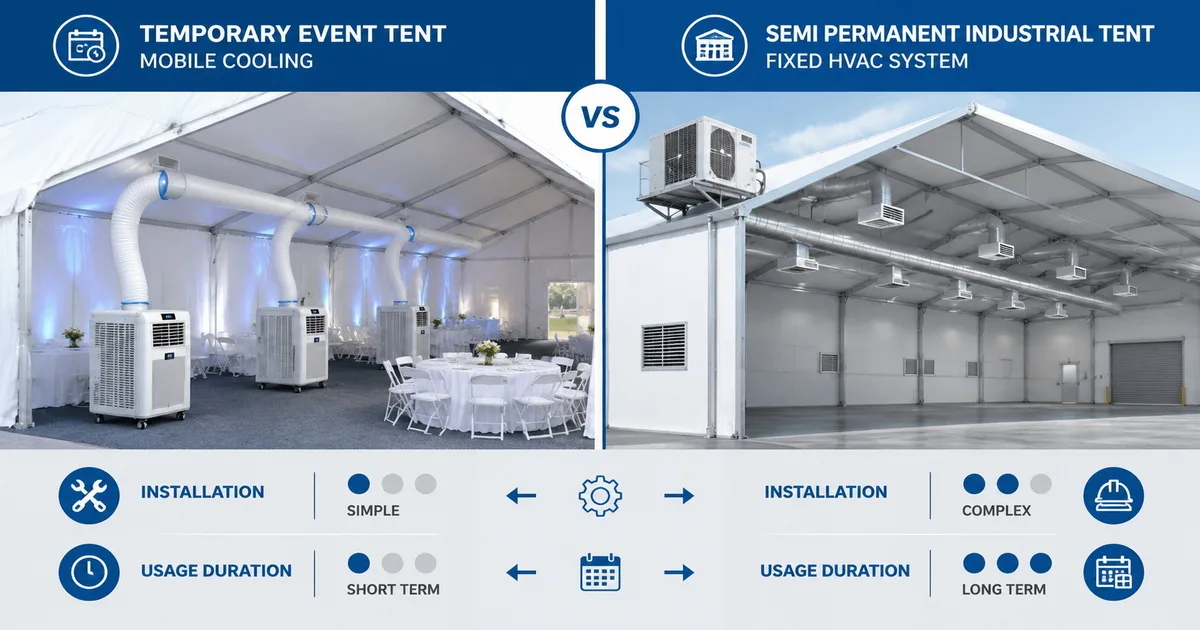
In practice, short‑term event or seasonal tent applications often achieve lower total cost of ownership with mobile tent AC, even if per‑hour consumption is higher. Multi‑year industrial or logistics tents, where cooling is needed for large portions of the day, tend to favor fixed HVAC in the long run.
Efficiency and Comfort Performance
Challenges of Cooling Tents
Tents and fabric structures pose specific challenges:
– Thin walls and membranes allow heat gain and loss quickly.
– Doors and openings are used frequently, increasing air infiltration.
– Solar radiation and wind conditions change rapidly.
Mobile air conditioning systems for tents are engineered to handle these difficulties by supplying high airflow and adapting to fluctuating loads. They often use flexible ducts to direct cool air into occupied zones rather than attempting to perfectly condition every cubic meter of air inside the structure.
Comfort Stability: Mobile vs Fixed
Fixed HVAC installations offer excellent comfort stability when tents behave like buildings. With insulated walls, controlled doors, and defined zones, fixed systems can keep temperature and humidity tightly within target ranges. This is especially important where sensitive goods, equipment, or production processes are involved.
Mobile tent AC, on the other hand, shines in dynamic situations where occupancy patterns and internal layouts shift daily. Its advantages include:
– Rapid ramp‑up of cooling before events or work shifts
– Targeting of specific areas where people work or gather
– Easy addition or removal of units as tent usage changes
In many real‑world tent applications, practical comfort—cooling where it matters most—is more important than uniform temperature everywhere, which favors mobile solutions.
Deployment Speed, Flexibility, and Scalability
Speed of Deployment
Deployment speed is critical in temporary tent scenarios. Mobile tent AC solutions can be delivered, positioned, and activated very quickly, which is vital for:
– Event organizers facing tight schedules
– Relief teams responding to emergencies
– Military units setting up or relocating camps
– Contractors starting short‑term outdoor projects
Fixed HVAC systems require a longer planning and installation period. This includes duct design, structural adjustments, wiring, and commissioning. In time‑sensitive situations, that delay can be a significant limitation.
Mobility and Network Growth
Mobile tent AC adds distinct strategic value through its mobility:
– Units can follow event calendars across regions.
– Camps and temporary sites can be cooled without building new infrastructure.
– Equipment fleets can be resized based on actual demand, not just forecasts.
Fixed HVAC installations are ideal for single sites with stable operations. They work well when a tented structure is used as a long‑term warehouse, workshop, or logistics hub. However, they are not inherently suited to networks of rotating or short‑term sites.
Maintenance, Durability, and Lifecycle Cost
Maintenance Complexity
Mobile tent AC systems are built with robust casings and accessible components, simplifying routine maintenance. Filters, coils, and ducts can be inspected and cleaned without major disruption. This is important for operators who move equipment frequently or lack specialized technical staff at every site.
Fixed HVAC systems often demand more structured maintenance:
– Regular visits from certified technicians
– Detailed checks of refrigerant circuits and duct integrity
– Integration with building‑level monitoring systems
While this yields excellent reliability in permanent installations, it adds overhead in contexts where tents or fabric structures are temporary.
Lifecycle Cost Considerations
Lifecycle cost depends heavily on usage duration, load profile, and mobility requirements. Broadly:
– Mobile tent AC is economically favorable when usage is seasonal, intermittent, or distributed across multiple locations.
– Fixed HVAC becomes more attractive when cooling needs are continuous, long‑term, and concentrated in one semi‑permanent tent structure.
For international partners working with DREZ, these lifecycle considerations can be embedded into product planning. By segmenting applications—events, camps, industrial shelters, logistics hubs—partners can match mobile or fixed solutions to each segment’s economic reality.
OEM/ODM Perspective: Custom Climate‑Control Solutions
Branding and Product Differentiation
From an OEM/ODM standpoint, mobile air conditioning for tents opens a wide space for customization and differentiation:
– Tailored housing designs and colors aligned with client branding
– Custom control interfaces (touch panels, remote controls, smart connectivity)
– Compatibility with regional electrical and safety standards
– Optional features such as low‑noise operation or enhanced filtration
Because mobile tent AC units are visible in event and industrial environments, they can function as branded assets rather than purely functional equipment. This creates opportunities for climate‑control brands to stand out while providing high‑performance cooling.
Solution Design for International Markets
DREZ, as an integrated climate‑control supplier, supports overseas brand owners, wholesalers, and producers in co‑developing:
– Modular product portfolios for different tent sizes and applications
– Mobile solutions aimed at event organizers and rotating projects
– Fixed or semi‑fixed solutions tailored to long‑term tented facilities
– Comprehensive deployment frameworks and technical guidance
This cooperation shortens development cycles and reduces risk. Partners can enter or expand within tent‑cooling markets using mature technologies and optimized designs rather than building solutions entirely from scratch.
Practical Decision Framework for Tent Cooling
Evaluation Dimensions
To choose between mobile air conditioning for tents and fixed HVAC installations, decision makers can evaluate the following dimensions:
1. Usage duration – How many days per year and how many years will the tent be used?
2. Mobility requirements – Does the tent stay in one place or move between sites?
3. Envelope quality – Is the structure a thin fabric tent or a semi‑insulated shelter?
4. Comfort expectations – Are precise, stable conditions required, or is targeted cooling sufficient?
5. Available infrastructure – Is there capacity for structural mounting, ductwork, and permanent power integration?
Where Mobile Tent AC Wins and Where Fixed HVAC Wins
In general:
– Mobile air conditioning for tents is the better option when tents are truly temporary, move regularly, or host short‑term events and projects. It delivers agility, modular capacity, and acceptable efficiency for intermittent use.
– Fixed HVAC installation becomes the preferred option when tent structures function like buildings for long periods, with relatively stable internal layouts and clear comfort targets. It offers superior seasonal efficiency and more consistent conditions.
For many organizations, the most resilient strategy is not to choose one approach exclusively but to combine both according to application segments. Mobile fleets serve events, relief operations, and flexible projects, while fixed systems support long‑term industrial or logistics tents.
Summary and Strategic Outlook
Mobile air conditioning for tents and fixed HVAC installations are not direct competitors in every situation; they are complementary solutions tailored to different usage patterns. Mobile tent AC excels in agility, modularity, and economic performance for short‑term or distributed applications. Fixed HVAC provides superior long‑term efficiency and comfort stability when tent structures behave like permanent buildings.
For international brand owners, wholesalers, and producers working with a climate‑control partner such as DREZ, the key is to align product portfolios with real‑world tent usage. By segmenting applications, evaluating lifecycle costs, and leveraging OEM/ODM customization capabilities, organizations can build tent‑cooling solutions that deliver both commercial value and reliable comfort in outdoor and semi‑industrial environments.
FAQs
1. Is mobile air conditioning for tents more expensive to operate than fixed HVAC?
Mobile air conditioning for tents usually consumes more energy per hour than comparable fixed systems. However, because it is used flexibly and can be shut down or relocated when not needed, total operating costs can be lower for short‑term or seasonal applications.
2. Can fixed HVAC be effectively integrated into semi‑permanent tents?
Yes. When tents or fabric structures are designed as long‑term facilities with sufficient structural support and controlled envelopes, fixed HVAC systems can be installed and deliver building‑like comfort and efficient performance over multiple years.
3. What type of tent applications benefit most from mobile air conditioning?
Mobile solutions are ideal for events, field camps, construction projects, and other situations where tents move frequently or are used intermittently. They provide quick deployment, easy relocation, and modular cooling capacity suited to changing layouts.
4. How should equipment buyers decide between mobile and fixed systems?
Equipment buyers should analyze usage duration, mobility requirements, comfort expectations, and available infrastructure. Short‑term, mobile, and unpredictable usage patterns point toward mobile tent AC. Long‑term, stable operations in semi‑permanent structures favor fixed HVAC.
5. Can mobile tent AC systems support advanced features and energy‑saving strategies?
Yes. Modern mobile tent AC solutions can integrate high‑efficiency compressors, smart controls, remote monitoring, and zoning. With thoughtful operation schedules and tent layouts, they can provide strong practical efficiency in temporary environments.
References
1. Innova Energie – “Stroomverbruik airco: verbruik en kosten per type airco” (Energy consumption and cost of fixed vs mobile air conditioners).
<https://www.innovaenergie.nl/kennisbank/stroomverbruik-airco/>
2. ClimExpert – “Climatiseur mobile ou fixe : que choisir en 2026 ?” (Comparison of mobile and fixed air conditioning, installation and performance).
<https://climexpert.fr/guide-climatisation/climatiseur-mobile-ou-fixe>
3. Teknicool Air Conditioning – “Portable vs. Fixed Air Conditioners: Which is Right for You?” (Cost and suitability of portable vs fixed units).
<https://www.teknicoolairconditioning.com.au/portable-vs-fixed-air-conditioners-whats-best-for-you/>
4. Energy One – “Portable Air Conditioners Sacrifice Cost for Ease of Use” (Efficiency comparison and cooling performance of portable units).
<https://energy-one.com/portable-air-conditioner-vs-window-unit-efficiency-comparison/>
5. Drez Air Conditioner Manufacturer – “Mobile Air Conditioning vs Central HVAC System: Which Is Better for Temporary Event Cooling?” (Framework and system comparison for temporary event cooling).
6. IGSD – “Life cycle costs and benefits of mobile air conditioning systems” (Lifecycle economic analysis for mobile cooling solutions).
<https://igsd.org/wp-content/uploads/2019/01/Life-cycle-costs-and-benefits-of-MACs-.pdf>
7. MCC – “HVAC Solutions for Off‑Road Vehicles” (Rugged climate‑control systems and OEM/ODM perspective).
Hot Tags: Mobile Tent Air Conditioning, Industrial Tent Cooling Systems, Temporary Event Climate Control, Fixed HVAC For Fabric Structures, OEM Tent Air Conditioner Solutions, ODM Climate Control Manufacturer, Commercial Outdoor Cooling Equipment, Semi Permanent Tent HVAC Design, Industrial Marquee Air Conditioning, Temporary Warehouse Cooling Systems