Content Menu
● What Is Mobile Air Conditioning for Industrial Sites?
● What Are Fixed HVAC Systems?
● Mobile Air Conditioning vs. Fixed HVAC: Comparison Table
● When Industrial Mobile Air Conditioning Makes Sense
>> Temporary Production and Changing Layouts
>> Localized Hotspots and Worker Recovery Areas
>> Emergency Cooling During Maintenance
● When Fixed HVAC Systems Are the Better Investment
>> Continuous, Facility-Wide Operation
>> Tight Temperature or Humidity Requirements
>> Integrated Ventilation and Airflow Management
● The Overlooked Issue: Heat Rejection and Air Balance
>> Exhausting Heat Is Not Optional
>> Exhaust Can Create Additional Cooling Load
● How to Size Industrial Air Conditioning Correctly
>> Step 1: Define the Cooling Boundary
>> Step 2: Calculate Sensible and Latent Loads
>> Step 3: Check Actual Operating Conditions
● Compare Total Cost, Not Just Purchase Price
>> Use a Like-for-Like Cost Worksheet
● A Hybrid Strategy: Permanent Base Cooling with Mobile Support
● A Practical Site Acceptance Test
● What Overseas OEM and ODM Buyers Should Specify
● Discuss Your Industrial Cooling Requirements with DREZ
>> 1.Can mobile air conditioning replace fixed HVAC in a factory?
>> 2.Is mobile air conditioning cheaper to operate?
>> 3.Do industrial portable air conditioners provide fresh air?
>> 4.Can mobile units cool an open warehouse?
>> 5.Are standard mobile air conditioners suitable for hazardous areas?
>> 6.What information should buyers provide when requesting a quotation?
Choosing between mobile air conditioning and fixed HVAC systems starts with one question: does your industrial site need cooling that moves with production, or permanent environmental control across a defined space?
Mobile systems generally suit temporary work areas, changing layouts, seasonal hotspots, and emergency backup. Fixed HVAC systems usually make more sense for permanent facilities requiring coordinated temperature, humidity, and ventilation control.
What Is Mobile Air Conditioning for Industrial Sites?
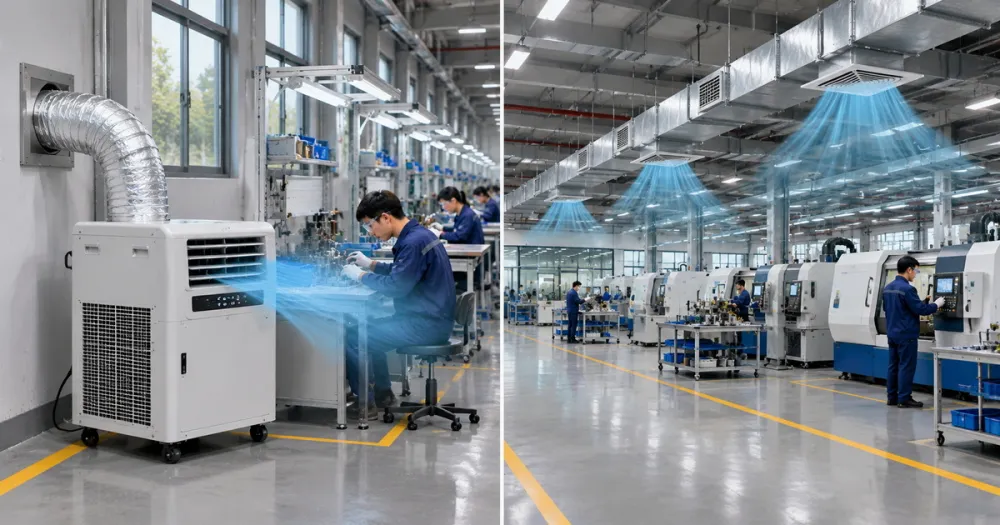
Industrial mobile air conditioning provides relocatable cooling through equipment such as portable spot coolers, transportable packaged units, mobile split systems, and trailer-mounted air conditioners.
These products differ substantially in capacity and configuration. A compact spot cooler serving an operator station is not equivalent to a ducted packaged unit conditioning a temporary production enclosure.
Unlike evaporative coolers, refrigeration-based air conditioners remove heat through a refrigerant circuit. They can also remove moisture when their cooling coils operate below the incoming air’s dew point.
However, portability does not eliminate installation requirements. Depending on the configuration, mobile equipment still needs:
– A suitable electrical supply.
– A properly designed heat-rejection route.
– Supply and return airflow clearance.
– Condensate drainage or collection.
– Safe positioning and equipment access.
My starting point for evaluating any mobile unit is simple: identify where the extracted heat will go before comparing its advertised cooling capacity.
What Are Fixed HVAC Systems?
Fixed HVAC systems are permanently installed heating, ventilation, and air-conditioning arrangements. Industrial examples include rooftop packaged units, split systems, variable refrigerant flow systems, and chilled-water installations serving air-handling units.
A properly designed installation can coordinate cooling, heating, outdoor air, filtration, and humidity management. Its capabilities depend on the selected components and controls; they are not guaranteed by the term “HVAC.”
Permanent systems are especially relevant when production requires consistent conditions across multiple rooms or shifts. However, industrial contaminant control may still require dedicated local exhaust rather than relying on comfort-conditioning equipment.
Mobile Air Conditioning vs. Fixed HVAC: Comparison Table
| Decision factor | Mobile air conditioning | Fixed HVAC systems |
|---|---|---|
| Primary application | Temporary, localized, changing, or backup cooling | Permanent, coordinated building or zone conditioning |
| Installation | Usually less structural work, but utilities and duct routes still matter | May require permanent electrical, ductwork, piping, and structural work |
| Relocation | Designed for redeployment, subject to handling requirements | Relocation generally involves substantial modification |
| Initial expenditure | Often lower for limited cooling scope | Usually higher where extensive infrastructure is required |
| Running costs | Depend on configuration, duty, airflow, and conditioned area | Depend on efficiency, sizing, controls, and distribution |
| Humidity control | Varies; moisture removal does not guarantee precise control | Can incorporate dedicated humidity-control functions |
| Outdoor air | Must be checked for the specific model and arrangement | Can be integrated into the engineered system |
| Expansion | Additional units can serve new zones if utilities allow | Expansion depends on installed capacity and distribution |
| Maintenance | Distributed units need individual inspection and servicing | Centralized equipment still requires planned maintenance |
| Best fit | Flexible industrial operations and contingency planning | Stable layouts and sustained environmental requirements |
Compare equivalent outcomes. Cooling three occupied workstations is a different assignment from maintaining an entire manufacturing hall at a specified temperature.
When Industrial Mobile Air Conditioning Makes Sense
Temporary Production and Changing Layouts
Mobile cooling suits facilities where production cells move, contracts change, or temporary enclosures support additional capacity.
It can reduce commitment to permanent infrastructure before the final layout is established. Nevertheless, each relocation requires another check of airflow, drainage, electrical protection, and access.
Localized Hotspots and Worker Recovery Areas
A warehouse may have acceptable conditions overall but excessive heat around a packing line or enclosed workstation.
Targeted cooling can address that limited zone without attempting to condition the whole building. Air-conditioned recovery rooms can also form part of a broader heat-management program.
Cooling equipment alone does not establish safe working conditions. Workload, radiant heat, humidity, clothing, acclimatization, and work practices must also be assessed.
Emergency Cooling During Maintenance
Mobile equipment can provide temporary support during planned shutdowns or unexpected failures.
The important distinction is between owning backup equipment and having deployable backup. A useful contingency plan identifies power connections, duct openings, drainage, equipment locations, and responsible personnel before an outage occurs.
When Fixed HVAC Systems Are the Better Investment
Continuous, Facility-Wide Operation
Permanent installations often become more attractive when stable production areas require cooling throughout long operating schedules.
Their distribution systems and controls can be designed around established zones. Whether they deliver lower lifetime costs still depends on the load, equipment selection, installation quality, and operating practices.
Tight Temperature or Humidity Requirements
Printing, packaging, electronics assembly, and other processes may require defined environmental tolerances.
A portable unit’s ability to collect condensate should not be mistaken for precise humidity regulation. Where moisture control is critical, specify the allowable humidity range, monitoring method, and required control response.
Integrated Ventilation and Airflow Management
Facilities with substantial exhaust systems need coordinated replacement air. Adding cooling without understanding that balance can create pressure problems or pull hot, humid air through uncontrolled openings.
Fixed HVAC can support this coordination, but process extraction and hazardous-contaminant controls still require specialist design.
The Overlooked Issue: Heat Rejection and Air Balance
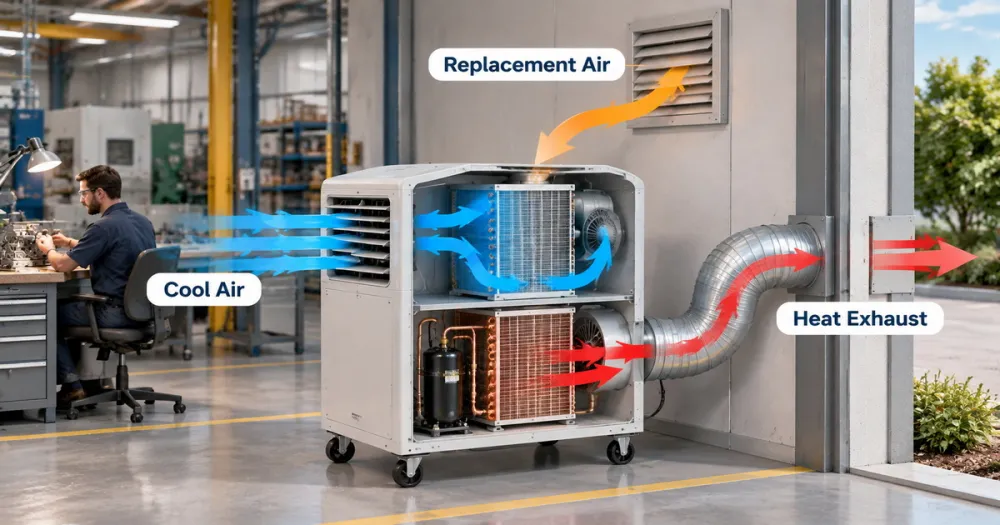
Exhausting Heat Is Not Optional
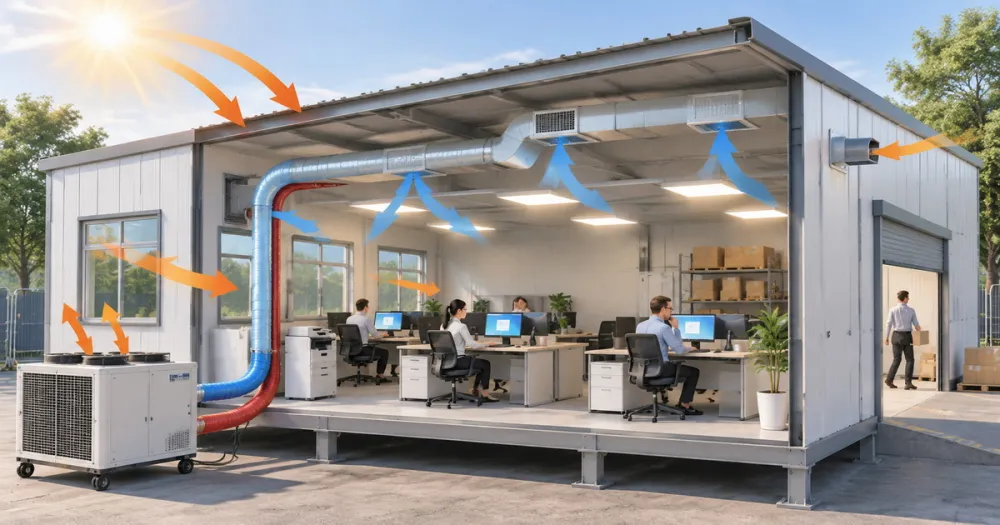
An air conditioner transfers heat rather than destroying it. Its condenser must reject the extracted heat plus the energy associated with operating the refrigeration system.
If a self-contained unit rejects condenser heat into the same enclosed space it is intended to cool, it will not provide net cooling to that entire space.
For indoor air-cooled equipment, verify:
– Where condenser discharge terminates.
– Whether condenser intake air comes from indoors or outdoors.
– Permitted duct lengths and restrictions.
– Separation between hot discharge and air intakes.
– Performance at the expected condenser-air temperature.
Exhaust Can Create Additional Cooling Load
When a unit draws condenser air from a room and exhausts it outdoors, replacement air must enter somewhere.
That replacement air may be hot, humid, or contaminated. The resulting load can undermine performance and interfere with existing ventilation.
Depending on the application, an engineered condenser-air arrangement, outdoor packaged unit, or mobile split configuration may be preferable. Selection should follow the site’s pressure and airflow requirements, not convenience alone.
How to Size Industrial Air Conditioning Correctly
Floor area is useful background information, but it is not a reliable standalone sizing method for industrial sites.
Two equally sized workshops can have very different cooling requirements because their machinery, roof exposure, door-opening patterns, and exhaust rates differ.
Step 1: Define the Cooling Boundary
Decide whether the objective is to cool:
1. An occupied workstation.
2. An enclosed production cell.
3. A temporary structure.
4. A complete building.
5. Temperature-sensitive equipment.
A spot-cooling arrangement should not be evaluated against a whole-room temperature target unless it was designed to meet that target.
Step 2: Calculate Sensible and Latent Loads
Include machinery, lighting, occupants, solar gain, building-envelope heat transfer, ventilation, and infiltration.
Distinguish sensible load, which raises temperature, from latent load, which involves moisture removal. Humid outdoor air can materially increase the required total capacity.
Step 3: Check Actual Operating Conditions
Request capacity and electrical-input data at the expected conditions, not just a nominal rating.
Also confirm airflow at the proposed duct resistance, maximum operating temperature, and available sensible capacity.
Avoid selecting equipment simply by adding an arbitrary safety margin. Excess capacity can introduce control problems, particularly where equipment cannot modulate effectively.
Compare Total Cost, Not Just Purchase Price
A fair total cost comparison includes installation, electricity, maintenance, redeployment, and operational risk.
Mobile equipment may avoid permanent building modifications. However, multiple units can introduce additional drainage checks, filter servicing, cables, and handling requirements.
Fixed systems may offer coordinated controls and distribution, but their economics weaken if substantial installed capacity serves areas that rarely need cooling.
Use a Like-for-Like Cost Worksheet
For each proposal, document:
| Cost category | Include in the assessment |
|---|---|
| Equipment | Units, controls, accessories, and spare parts |
| Installation | Electrical work, ducts, piping, drainage, lifting, and permits |
| Energy | Expected input across realistic operating conditions |
| Maintenance | Filters, cleaning, inspections, servicing, and access |
| Operational exposure | Production interruption and recovery arrangements |
| Flexibility | Relocation, expansion, removal, and building reinstatement |
Do not compare nameplate input power alone. Ask suppliers to explain expected operating hours, loading assumptions, and control sequences. Treat any savings percentage without a defined baseline as an unverified estimate.
A Hybrid Strategy: Permanent Base Cooling with Mobile Support
The strongest solution may combine both approaches.
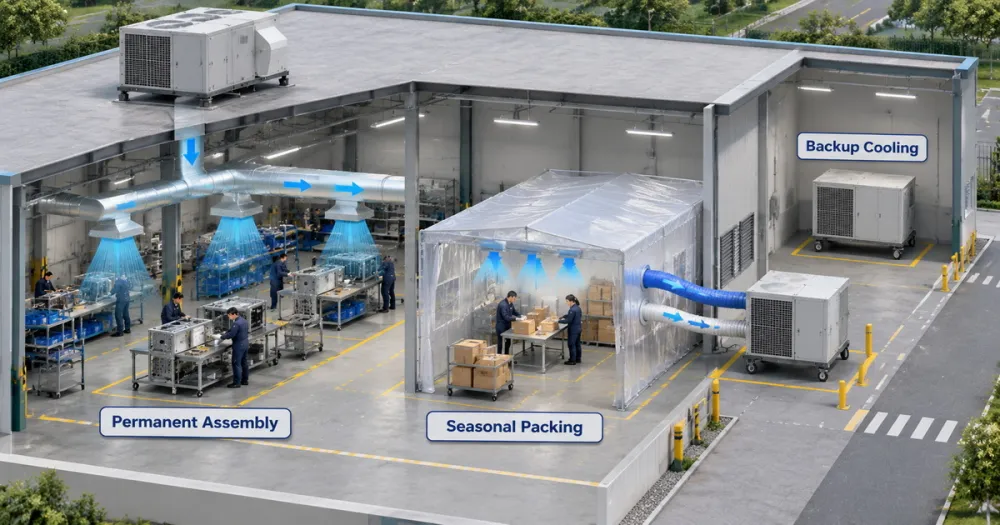
Consider an illustrative factory with a stable assembly area, a seasonal packing zone, and occasional maintenance shutdowns. Fixed HVAC could serve the assembly area, while mobile units support seasonal work and planned outages.
This is a planning example, not a documented customer result.
Its value lies in separating persistent demand from temporary demand. However, backup capacity must be available when needed: equipment already committed to seasonal production cannot simultaneously provide full emergency coverage.
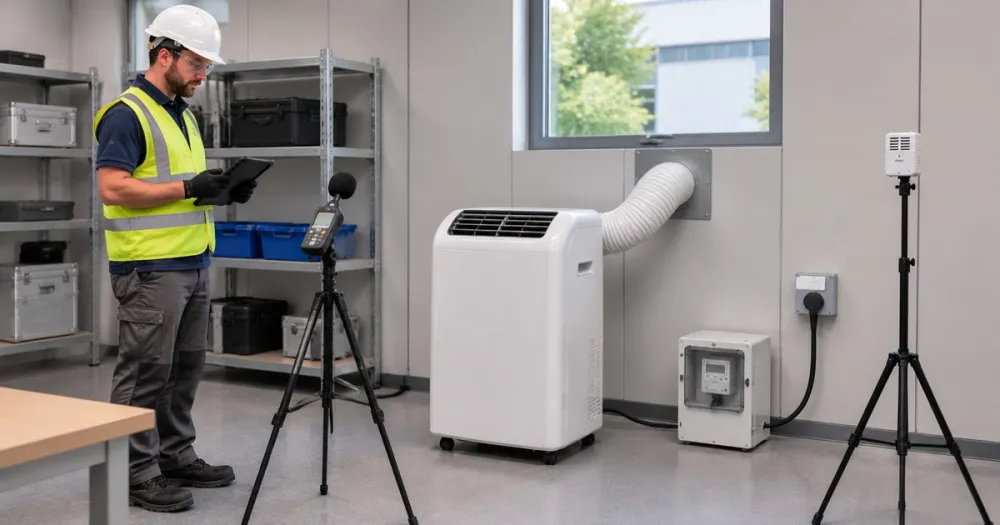
A Practical Site Acceptance Test
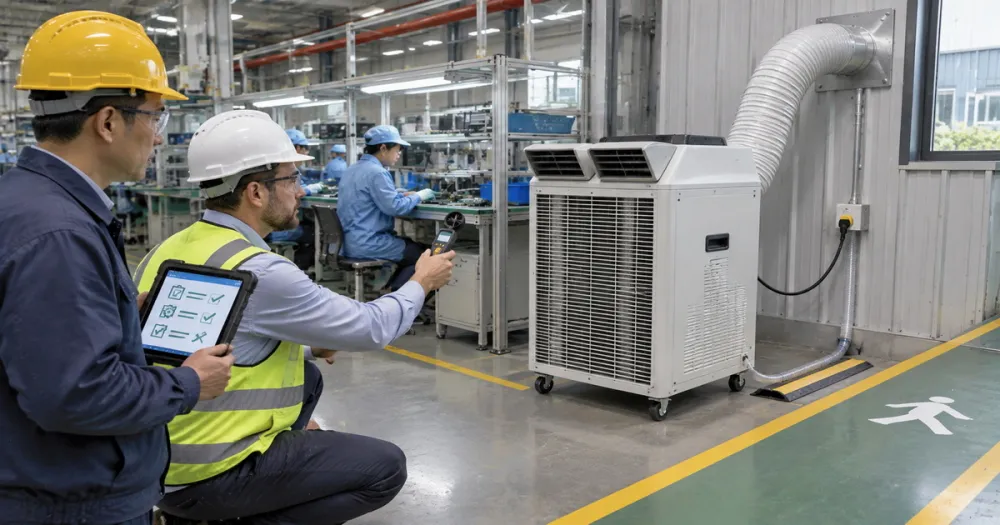
A structured acceptance test helps buyers determine whether the installed arrangement meets the agreed requirement.
Before ordering, define the test conditions and pass criteria:
1. Record outdoor and indoor temperature and humidity.
2. Confirm the agreed production load and occupancy.
3. Verify electrical conditions, airflow routes, and drainage.
4. Measure conditions at occupied or process-critical locations.
5. Check for hot-air recirculation and unwanted pressure effects.
6. Record running current, alarms, condensate handling, and noise.
7. Repeat checks under representative operating conditions.
Measure the outcome where it matters. A cold supply-air reading alone does not prove adequate cooling at a workstation or across a production zone.
What Overseas OEM and ODM Buyers Should Specify
Brand owners, wholesalers, and manufacturers need a repeatable product specification, not merely a suitable demonstration unit.
For OEM and ODM projects, establish:
– Destination-market voltage, frequency, and electrical requirements.
– Capacity at stated temperature and humidity conditions.
– Airflow and available external static pressure.
– Refrigerant selection and applicable market restrictions.
– Ambient operating limits and enclosure suitability.
– Noise measurement conditions.
– Drainage, transport, lifting, and service-access arrangements.
– Controls, branding, documentation, and spare-parts support.
– Model-specific conformity evidence and sample approval criteria.
DREZ (Guangzhou) Intelligent Technology Co., Ltd. integrates research, design, production, sales, and customized climate-control solutions. Its published portfolio includes packaged tent air conditioners, rooftop units, trailer-mounted systems, and fresh-air ventilation equipment.
For overseas partners, the practical next step is to translate the intended application into a jointly approved technical brief before finalizing customization or production.
Discuss Your Industrial Cooling Requirements with DREZ
Send DREZ your site layout, cooling boundary, production heat sources, operating schedule, available power, destination market, and temperature or humidity targets.
Request a proposal that explains equipment selection, heat rejection, airflow, drainage, and acceptance testing. This creates a stronger basis for comparing mobile, fixed, and hybrid solutions—and for developing an OEM or ODM product matched to real operating conditions.
Frequently Asked Questions
1.Can mobile air conditioning replace fixed HVAC in a factory?
Sometimes, particularly for temporary spaces or localized cooling. It is not automatically equivalent to a permanent system providing coordinated ventilation, humidity control, and building-wide distribution.
2.Is mobile air conditioning cheaper to operate?
Not inherently. It may reduce expenditure when only limited zones need cooling. Compare equivalent cooling outcomes, operating hours, installation costs, and maintenance requirements before deciding.
3.Do industrial portable air conditioners provide fresh air?
Not necessarily. Many primarily recirculate indoor air. Confirm whether the selected configuration supplies outdoor air and whether additional ventilation or replacement air is required.
4.Can mobile units cool an open warehouse?
They may provide useful localized cooling, but maintaining a uniform warehouse temperature can be difficult with open doors and uncontrolled infiltration. Define whether the target is personal relief or whole-space conditioning.
5.Are standard mobile air conditioners suitable for hazardous areas?
Do not assume so. Areas involving combustible dust, flammable gases, or vapors require a specialist assessment and equipment appropriate to the applicable hazardous-area classification.
6.What information should buyers provide when requesting a quotation?
Provide dimensions, layout, climate conditions, machinery heat loads, occupancy, operating hours, ventilation rates, electrical supply, and required environmental limits. Include duct routes and drainage constraints where known.
References
1. [Occupational Safety and Health Administration — Heat: Engineering Controls, Work Practices, and Personal Protective Equipment]. Guidance on air conditioning, ventilation, radiant-heat controls, and complementary measures for reducing occupational heat exposure. [osha]
2. [Occupational Safety and Health Administration — Technical Manual, Section III, Chapter 3: Ventilation Investigation]. Technical background on industrial ventilation, replacement air, local exhaust, system design, inspection, and maintenance. [osha]
3. [Occupational Safety and Health Administration — Technical Manual, Section III, Chapter 4: Heat Stress]. Background on occupational heat assessment and the relationship between engineering controls, work practices, and personal protection. [osha]
4. [Aggreko — Sizing an Air Conditioner for Commercial and Industrial Applications]. Published July 4, 2025. Industry guidance covering building conditions, internal heat sources, ventilation loads, operating requirements, and professional sizing verification. [aggreko]
5. [Occupational Safety and Health Administration — Indoor Air Quality in Commercial and Institutional Buildings]. Publication 3430. Supporting guidance on outdoor-air distribution, HVAC inspection, preventive maintenance, moisture management, and system rebalancing. [osha]
6. [DREZ (Guangzhou) Intelligent Technology Co., Ltd. — About Us]. Company-published information supporting the description of DREZ’s business scope and product portfolio. The comparison framework, illustrative hybrid scenario, and purchasing checklists are editorial analysis, not independently verified customer performance results. [drezaircon]
Hot Tags: Mobile Air Conditioning, Industrial Air Conditioning, Industrial Portable Air Conditioner, Fixed HVAC Systems, Industrial Spot Cooling, Warehouse Cooling Solutions, Factory Cooling Systems, Temporary Industrial Cooling, OEM Air Conditioner Manufacturer, ODM Air Conditioning Solutions