Content Menu
● Outside Air Intake vs Indoor Air Recirculation: The Essential Difference
>> What Is Outside Air Intake?
>> What Is Indoor Air Recirculation?
● How Single-Hose and Dual-Hose Portable Air Conditioners Work
>> Single-Hose Portable Air Conditioners
>> Dual-Hose Portable Air Conditioners
● Outside Air Intake vs Indoor Air Recirculation: Comparison Table
● Which Airflow Arrangement Delivers Better Cooling Efficiency?
>> Indoor Recirculation Limits Repeated Outdoor-Air Conditioning
>> Outdoor Condenser Intake Can Reduce Replacement-Air Penalties
>> Compare Ratings on the Same Basis
● Humidity and Air Quality: Where the Trade-Off Changes
>> Outdoor Temperature Alone Is Not Enough
>> Recirculation Does Not Replace Ventilation
>> Outdoor Air Is Not Always Cleaner
● A Practical Engineering Example: The Hidden Replacement-Air Load
● A Five-Step Airflow Audit Before Buying or Installing
>> 1. Identify Every Air Connection
>> 2. Confirm Whether Fresh Air Reaches the Room
>> 3. Inspect the Window or Wall Interface
>> 4. Separate Intake and Exhaust
>> 5. Verify Performance After Installation
● Which Configuration Should You Choose?
>> For Offices and Temporary Commercial Spaces
>> For OEM and ODM Product Development
>> 1.Does a Portable Air Conditioner Bring in Fresh Air?
>> 2.Is Outside Air Intake Better Than Indoor Air Recirculation?
>> 3.Do Dual-Hose Portable Air Conditioners Cause Negative Pressure?
>> 4.Can I Run a Portable Air Conditioner Without an Exhaust Hose?
>> 5.Does Recirculation Remove Humidity?
>> 6.Can a Portable Air Conditioner Replace a Ventilation System?
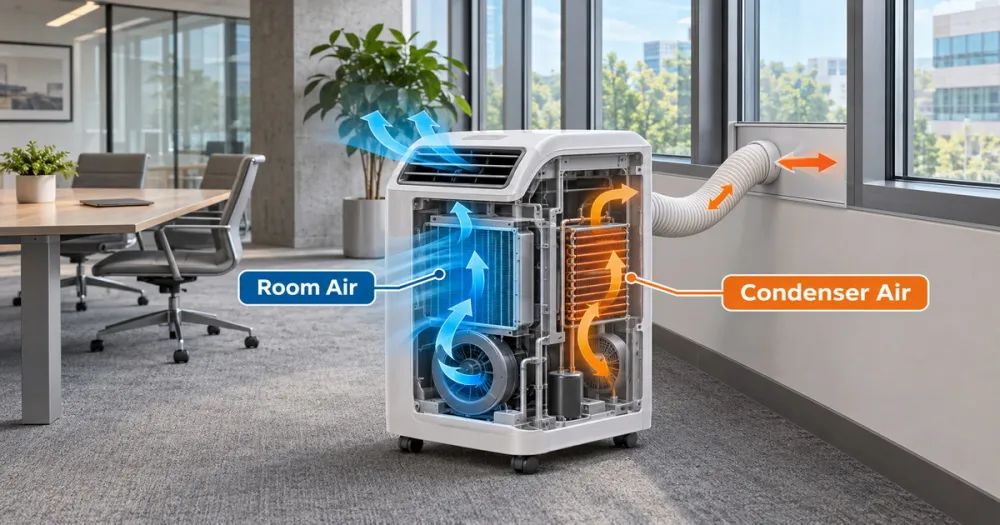
Outside air intake vs indoor air recirculation for portable air conditioners is not simply a choice between fresh air and recycled air. The real issue is which airflow circuit you are discussing: the air being cooled for occupants or the air removing heat from the condenser.
My starting point when evaluating a portable air conditioner is therefore straightforward: trace every intake and outlet before comparing cooling capacity. A dual-hose unit can use outdoor air for heat rejection while still recirculating indoor air for cooling. These functions can operate together rather than compete.
Outside Air Intake vs Indoor Air Recirculation: The Essential Difference
What Is Outside Air Intake?
Outside air intake means drawing air from outdoors into an appliance or ventilation system. However, its purpose depends on where that air goes.
In portable air conditioning, outdoor air can serve two different functions:
– Condenser cooling: Outdoor air absorbs heat at the condenser and is exhausted outdoors.
– Occupied-space ventilation: Outdoor air enters the room, directly or after treatment, to replace indoor air.
These functions are not interchangeable. An outdoor intake connected to a condenser does not automatically provide fresh air to occupants.
What Is Indoor Air Recirculation?
Indoor air recirculation means drawing room air into the unit, cooling it across the evaporator, and returning it to the room.
The main airflow path is:
Room air → filter → evaporator → cooled supply air → room.
This process repeatedly cools the same indoor air. Moisture may also condense on the evaporator when operating conditions support dehumidification.
Most conventional portable air conditioners use this recirculating room-cooling process, including many models with outdoor condenser intakes.
How Single-Hose and Dual-Hose Portable Air Conditioners Work
Single-Hose Portable Air Conditioners
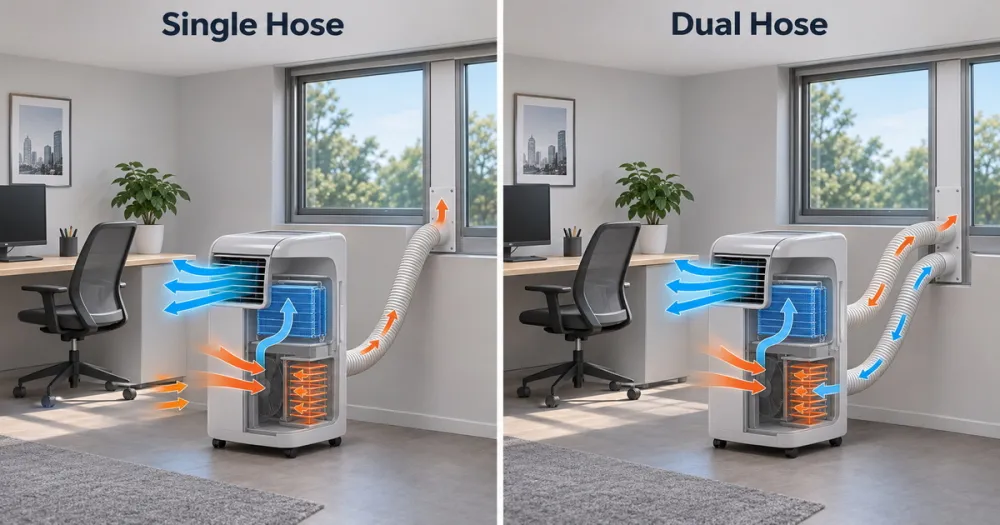
A typical single-hose portable air conditioner draws indoor air across its evaporator to cool the room. It also uses indoor air to remove condenser heat, then discharges that heated air through an exhaust hose.
Because some room air leaves the building, replacement air must enter through openings or leakage paths.
This can create negative indoor pressure. If replacement air is warmer or more humid, it adds to the cooling load.
The important distinction is that the exhaust hose removes heat; it is not a fresh-air supply.
Dual-Hose Portable Air Conditioners
A typical dual-hose design uses one outdoor connection to draw air through the condenser and another to discharge heated air outdoors.
Meanwhile, a separate room-side circuit recirculates indoor air across the evaporator.
This arrangement reduces reliance on conditioned room air for heat rejection. However, leakage and airflow imbalance can still occur, so “dual hose” should not be interpreted as a guarantee of perfectly balanced pressure.
Some products package intake and exhaust passages within a combined duct assembly. Count the separate airflow paths, not just the visible hoses.
Outside Air Intake vs Indoor Air Recirculation: Comparison Table
Because these terms describe different functions, the most useful comparison separates condenser intake from actual ventilation.
| Comparison point | Outdoor air for condenser cooling | Indoor air recirculation | Outdoor air supplied to occupants |
|---|---|---|---|
| Primary purpose | Remove refrigeration-system heat | Cool room air | Provide ventilation |
| Typical airflow destination | Back outdoors after heat absorption | Back into the room | Into the occupied space |
| Common configuration | Dual-hose portable AC | Single- and dual-hose portable ACs | Dedicated ventilation equipment or explicitly designed AC feature |
| Direct fresh-air benefit | Normally none | None by itself | Yes, when properly designed |
| Main design concern | Intake/exhaust balance and separation | Cooling delivery and filtration | Outdoor-air quality, conditioning, and airflow |
| Humidity consideration | Normally outside the room-air circuit | Can remove indoor moisture during cooling | May add or reduce moisture |
| Buyer verification | Condenser airflow diagram | Room-side airflow diagram | Measured ventilation airflow |
Which Airflow Arrangement Delivers Better Cooling Efficiency?
Indoor Recirculation Limits Repeated Outdoor-Air Conditioning
Recirculation allows the unit to cool air that has already been partially conditioned.
By contrast, introducing hot outdoor air into the occupied space adds a new cooling load. In humid conditions, the system must also remove additional water vapor.
However, recirculation alone does not determine whole-unit efficiency. A single-hose unit can recirculate room air through its evaporator while simultaneously exhausting conditioned air through its condenser circuit.
Evaluate the complete airflow system rather than one feature in isolation.
Outdoor Condenser Intake Can Reduce Replacement-Air Penalties
A well-designed dual-hose arrangement reduces the need to exhaust conditioned indoor air.
That can reduce the replacement-air load associated with a single-hose system, particularly when outdoor conditions differ substantially from indoor conditions.
Nevertheless, compressor performance, fan power, duct heat transfer, controls, and installation quality also affect results. A hose configuration is not an efficiency rating.
Compare Ratings on the Same Basis
For products sold in the United States, seasonally adjusted cooling capacity, or SACC, is particularly relevant.
The Department of Energy’s portable-air-conditioner test framework accounts for effects including duct heat transfer and infiltration when determining adjusted cooling performance.
When comparing models, request:
– Cooling capacity under the same test procedure.
– The applicable test-procedure version.
– Electrical input and the corresponding efficiency metric.
– Tested hose configuration.
– Relevant operating-temperature limits.
Do not compare an unadjusted capacity figure on one product with an adjusted figure on another.
Humidity and Air Quality: Where the Trade-Off Changes
Outdoor Temperature Alone Is Not Enough
Cooler outdoor air is not necessarily suitable for unrestricted ventilation.
If it contains substantial moisture, introducing it indoors may increase dehumidification demand even when its temperature seems comfortable.
Conversely, dry outdoor air may help reduce indoor moisture under suitable conditions.
For product selection, consider outdoor temperature and moisture together. Relative humidity alone can be misleading because it changes with temperature.
Recirculation Does Not Replace Ventilation
Cooling the same air repeatedly does not provide a controlled outdoor-air supply.
Standard particle filters also should not be assumed to remove carbon dioxide or all gaseous contaminants. A cooler room is not proof that ventilation is adequate.
For occupied offices, meeting rooms, and temporary facilities, assess ventilation separately from portable cooling.
Outdoor Air Is Not Always Cleaner
Smoke, traffic pollution, dust, and excessive outdoor humidity can make additional outdoor-air intake undesirable.
The right strategy depends on outdoor conditions and building needs. During poor outdoor-air events, follow local public-health guidance and use an appropriate indoor-air-quality plan rather than assuming more outdoor air is always better.
A Practical Engineering Example: The Hidden Replacement-Air Load
Consider a hypothetical single-hose installation exhausting 200 cubic meters of room air per hour. Assume all replacement air comes from outdoors, where the temperature is 10°C above the room temperature.
Using approximate air properties:
Qs=ρcpV˙ΔT
With air density of approximately 1.2 kilograms per cubic meter and specific heat of approximately 1.0 kilojoule per kilogram-kelvin, the additional sensible cooling load is approximately 0.67 kW.
This is an illustrative calculation, not a measured product result. It excludes moisture removal, duct heat, and building-specific leakage behavior.
Its practical lesson is important: air exhausted from a room must be replaced. If that replacement air is hot and humid, some cooling output is spent conditioning the incoming air rather than reducing the existing room load.
It does not mean every dual-hose model saves 0.67 kW of electricity. Cooling load and electrical consumption are different quantities.
A Five-Step Airflow Audit Before Buying or Installing
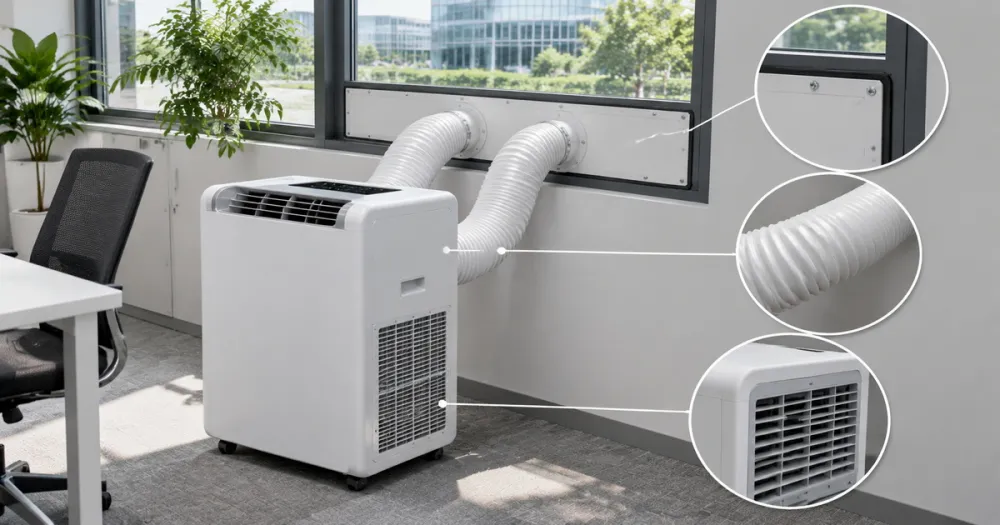
1. Identify Every Air Connection
Locate the room-air return, cooled-air outlet, condenser intake, and condenser exhaust.
Ask for a diagram if the connections are unclear. A grille labeled “air intake” does not explain its function.
2. Confirm Whether Fresh Air Reaches the Room
Check the manual for an explicit ventilation function and rated outdoor-air delivery.
Do not treat “outdoor intake,” “air circulation,” or “fan mode” as evidence of fresh-air ventilation.
3. Inspect the Window or Wall Interface
Follow the manufacturer’s installation instructions. Seal unintended gaps around the approved installation kit.
Keep ducts within the specified length and bending limits. Unauthorized extensions can change airflow resistance and operating performance.
4. Separate Intake and Exhaust
Position outdoor connections according to the installation requirements so the intake does not readily draw in hot exhaust air.
Avoid obstructed locations and confirm that exterior openings remain clear.
5. Verify Performance After Installation
Record room temperature, humidity, operating mode, and relevant outdoor conditions.
Check for unusual drafts, overheating warnings, and condensate-management problems. Where pressure effects or ventilation rates matter, use qualified technicians and appropriate instruments rather than informal airflow impressions.
OEM and ODM Procurement
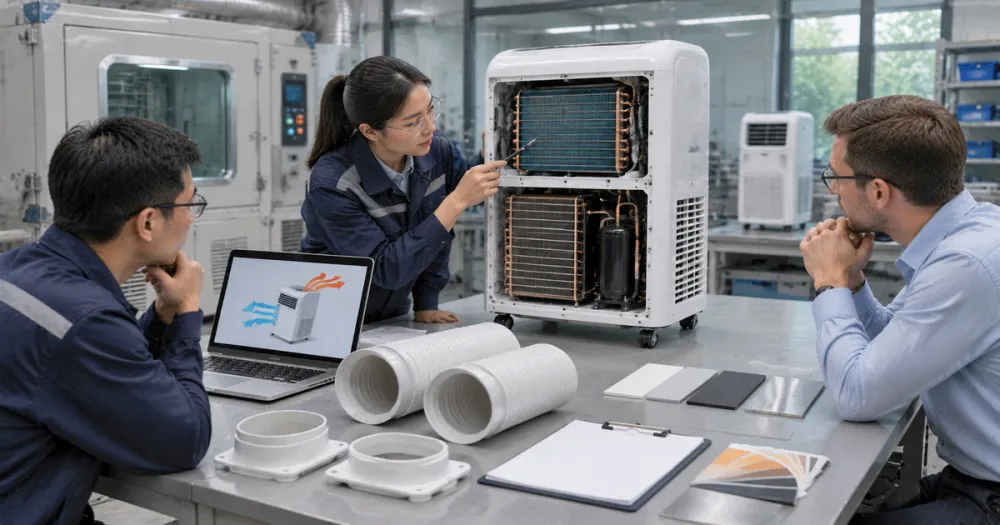
For overseas brands, wholesalers, and manufacturers, the most valuable specification is not “fresh-air design.” It is a verifiable description of airflow and performance.
DREZ (Guangzhou) Intelligent Technology Co., Ltd. combines research, design, production, sales, and customized climate-control solutions. Within that development context, buyers should establish the following requirements before approving a portable air conditioner project.
| Procurement requirement | Evidence to request |
|---|---|
| Airflow architecture | Diagram distinguishing evaporator, condenser, and ventilation paths |
| Cooling performance | Report identifying test conditions and methodology |
| Efficiency | Electrical input and efficiency results on a consistent basis |
| Fresh-air capability | Measured outdoor-air delivery, if offered |
| Installation compatibility | Approved ducts, adapters, window kits, and dimensional limits |
| Moisture management | Drainage instructions and operating limitations |
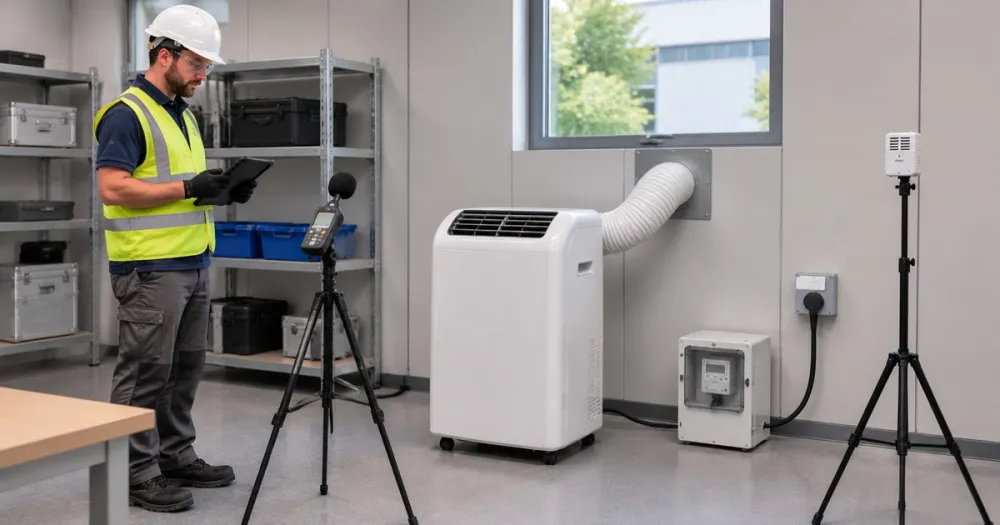
| Acoustic performance | Test method, operating mode, and measurement conditions |
| Market suitability | Applicable electrical, refrigerant, safety, and labeling documentation |
Which Configuration Should You Choose?
For Residential Rooms
Prioritize suitable adjusted cooling capacity, practical installation, noise performance, and condensate handling.
A dual-hose design can reduce the replacement-air disadvantage associated with single-hose operation. Actual model performance and installation requirements should still guide the purchase.
For Offices and Temporary Commercial Spaces
Treat cooling and ventilation as separate design responsibilities.
Portable cooling may address local heat loads, but occupancy-related outdoor-air requirements need an independently verified solution.
For OEM and ODM Product Development
Define the application first: destination climate, room conditions, operating hours, installation constraints, and target market requirements.
Then choose the airflow architecture. Starting with a preferred marketing phrase risks building a product specification around an unclear promise.
For a project discussion with DREZ, prepare your target market, required cooling capacity, installation dimensions, ambient conditions, and ventilation expectations. Request an airflow proposal and validation plan before finalizing the configuration.
Frequently Asked Questions
1.Does a Portable Air Conditioner Bring in Fresh Air?
Not necessarily. Most conventional models recirculate room air for cooling. A dual-hose outdoor intake usually serves the condenser rather than supplying fresh air to occupants. Verify the airflow diagram and any stated ventilation rating.
2.Is Outside Air Intake Better Than Indoor Air Recirculation?
They serve different purposes and can operate together. Outdoor condenser intake supports heat rejection, while indoor recirculation cools the room. Supplying outdoor air to occupants is a separate ventilation function.
3.Do Dual-Hose Portable Air Conditioners Cause Negative Pressure?
They generally reduce the room-air exhaust imbalance associated with single-hose designs. However, leakage and unequal airflow can still affect room pressure. Avoid assuming that every dual-hose installation is pressure-neutral.
4.Can I Run a Portable Air Conditioner Without an Exhaust Hose?
A conventional air-cooled portable AC installed entirely inside the room needs its specified heat-rejection arrangement for effective room cooling. Removing the exhaust connection returns rejected heat indoors. Fan-only operation is different from refrigeration cooling.
5.Does Recirculation Remove Humidity?
It can when the evaporator is cold enough for moisture to condense. Actual moisture removal depends on indoor conditions, operating time, controls, and drainage. Recirculation by itself does not guarantee dehumidification.
6.Can a Portable Air Conditioner Replace a Ventilation System?
Not unless it is explicitly designed and verified to deliver the required outdoor airflow. Cooling capacity, fan airflow, and condenser intake airflow are not substitutes for a measured ventilation rate.
References
1. U.S. Department of Energy. “Energy Conservation Program: Test Procedure for Portable Air Conditioners.” Federal Register, May 15, 2023. Covers single- and dual-duct configurations, infiltration, duct heat transfer, and adjusted capacity calculations. [federalregister]
2. U.S. Environmental Protection Agency. “Ventilation and Respiratory Viruses.” Explains outdoor-air ventilation and cautions concerning outdoor pollution, humidity, and extreme conditions. [epa]
3. ASHRAE. “Fundamentals of Heating and Cooling Loads.” Identifies infiltration, ventilation, and moisture control as components of building-load analysis. [ashrae]
4. ASHRAE Journal, hosted by Trane. “The ABCs of DOAS—Dedicated Outdoor Air Systems.” Explains separate treatment of outdoor air and the relationship between sensible cooling, latent loads, and ventilation. [trane]
5. ASHRAE technical paper, hosted by GTI Energy. “Dehumidification and Cooling Loads from Ventilation Air.” Explains why outdoor-air temperature and moisture create distinct conditioning loads. [gti]
Hot Tags: Portable Air Conditioner Manufacturer, Portable Air Conditioner Supplier, Wholesale Portable Air Conditioners, OEM Portable Air Conditioner, ODM Portable Air Conditioner, Commercial Portable Air Conditioner, Industrial Portable Air Conditioner, Dual Hose Portable Air Conditioner, Single Hose Portable Air Conditioner, Custom Portable Air Conditioner