Content Menu
● Portable Air Conditioner with Long Exhaust Hose: What Does It Actually Mean?
● Long Exhaust Hose vs Short Exhaust Hose: Comparison Table
● How Exhaust Hose Length Affects Cooling Performance
>> Airflow Resistance Can Limit Heat Rejection
>> A Longer Warm Hose Can Return More Heat Indoors
>> Single-Hose and Dual-Hose Designs Are Separate Variables
● Cooling Capacity and Energy Use: Compare the Right Numbers
● Installation, Comfort, and Ownership Costs
>> Placement Flexibility Has Practical Value
>> Noise Requires a Whole-System Assessment
>> Purchase Price Is Only Part of the Cost
● Three Practical Tools for Better Product Selection
>> 1. Measure the Complete Exhaust Route Before Ordering
>> 2. Use a Controlled Comparison Instead of a Hose-Length Guess
>> 3. Turn the Installation Limits into Customer-Facing Information
● Which Configuration Fits Your Application?
>> Choose a Standard Short-Hose Model When
>> Consider an Approved Longer-Hose System When
● What OEM and ODM Buyers Should Ask DREZ
● Choose the Configuration, Not Just the Hose
>> 1. Can I Extend My Portable Air Conditioner Exhaust Hose?
>> 2. What Is the Maximum Portable Air Conditioner Exhaust Hose Length?
>> 3. Is a Shorter Exhaust Hose Always Better?
>> 4. Will Insulating a Long Exhaust Hose Improve Cooling?
>> 5. Does a Long Exhaust Hose Use More Electricity?
>> 6. Can the Exhaust Hose Discharge into Another Room?
A portable air conditioner with long exhaust hose can offer greater placement flexibility, while standard short-hose models usually make installation simpler and exhaust routing easier. However, a longer hose is not automatically an upgrade. The important distinction is whether the air conditioner is designed and approved for that hose configuration.
For overseas brands, wholesalers, and equipment manufacturers, this comparison affects more than convenience. Hose selection influences cooling performance, installation requirements, customer support, and product positioning.
Portable Air Conditioner with Long Exhaust Hose: What Does It Actually Mean?
“Long exhaust hose” is a descriptive phrase, not a universal product classification. Buyers should distinguish between two configurations:
– A manufacturer-approved system supplied or validated with a longer exhaust hose.
– A standard portable air conditioner modified with an aftermarket extension.
These configurations are not equivalent. An approved design can account for duct resistance, connection geometry, and operating temperatures. An aftermarket extension may exceed the appliance’s installation limits.
Likewise, “standard short-hose model” does not describe one fixed length. De’Longhi, for example, describes the supplied hose for certain products as approximately four feet long. Other products may have different specifications.
The most useful purchasing rule is compatibility: verify the permitted hose length, diameter, adapters, and routing instructions for the specific model.
Long Exhaust Hose vs Short Exhaust Hose: Comparison Table
| Comparison factor | Manufacturer-approved longer hose | Standard short-hose configuration |
|---|---|---|
| Placement flexibility | Can accommodate a more distant permitted exhaust opening | Usually requires positioning closer to the opening |
| Airflow resistance | Requires evaluation of the complete duct path | Generally easier to keep resistance low |
| Indoor hose exposure | More exposed surface can transfer heat into the room | Less exposed surface, other conditions equal |
| Installation complexity | May require additional support and routing controls | Usually fewer routing decisions |
| Cooling performance | Depends on system design and installation | More straightforward to reproduce the intended setup |
| Appearance and space use | May cross more visible or usable floor space | Usually easier to contain near the window |
| OEM and ODM development | Requires validation of the specified configuration | Offers a simpler installation baseline |
| Best application | Sites where additional approved reach solves a genuine constraint | Sites with a suitable nearby exhaust opening |
Neither configuration wins every application. The better choice is the shortest practical, manufacturer-approved route that satisfies the installation requirement.
How Exhaust Hose Length Affects Cooling Performance
Airflow Resistance Can Limit Heat Rejection
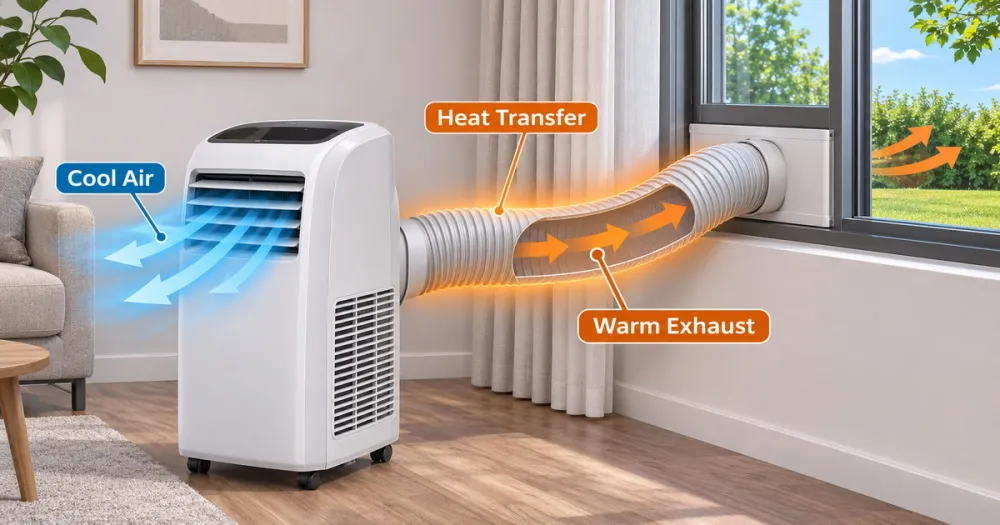
A portable air conditioner must reject heat outside the conditioned space. Its condenser fan moves air through the exhaust assembly, including the hose, adapters, and outlet.
Additional hose length adds resistance. Tight bends, crushed sections, and restrictive fittings can add further resistance.
If the fan cannot maintain the required airflow, condenser operating conditions can deteriorate. Depending on the appliance and severity of the restriction, cooling may decline or protective controls may interrupt operation.
This does not mean that every longer hose produces poor results. It means the acceptable length depends on the equipment’s design, not simply on whether an extension is available.
A Longer Warm Hose Can Return More Heat Indoors
The exhaust hose carries warm air through the room. Heat passing through its wall adds to the load the air conditioner must remove.
A longer exposed hose generally provides more heat-transfer surface when diameter, material, and operating conditions remain comparable. Manufacturer-approved insulation can reduce this heat transfer, but it cannot eliminate airflow resistance.
This is why a hose cover and a hose extension solve different problems. Insulation addresses heat transfer; it does not establish that a longer exhaust route is acceptable.
Single-Hose and Dual-Hose Designs Are Separate Variables
Hose length should not be confused with hose architecture.
A single-hose portable air conditioner typically uses room air for condenser cooling and exhausts that air outdoors. Replacement air must then enter the conditioned space, potentially bringing additional heat and moisture.
A dual-hose design provides a separate outdoor-air intake path for the condenser. Actual performance still depends on leakage, airflow balance, equipment efficiency, and installation.
When comparing products, assess hose architecture and hose length separately. Neither label alone establishes which model will cool a particular room better.
Cooling Capacity and Energy Use: Compare the Right Numbers
A larger headline cooling figure does not necessarily mean better installed performance.
For products sold in the United States, seasonally adjusted cooling capacity, or SACC, provides a useful comparison because the underlying methodology accounts for factors including duct heat transfer and infiltration effects.
Buyers should:
1. Compare cooling capacities measured under the same rating method.
2. Review efficiency figures using the same measurement basis.
3. Confirm the hose configuration associated with the product documentation.
4. Request additional evidence for any proposed nonstandard installation.
Avoid treating different rating methods as interchangeable.
There is also no defensible universal statement that doubling the hose length reduces cooling by a fixed percentage. The outcome depends on diameter, bends, airflow characteristics, ambient conditions, and appliance controls.
For procurement teams, a documented configuration is more valuable than an unsupported efficiency promise.
Installation, Comfort, and Ownership Costs
Placement Flexibility Has Practical Value
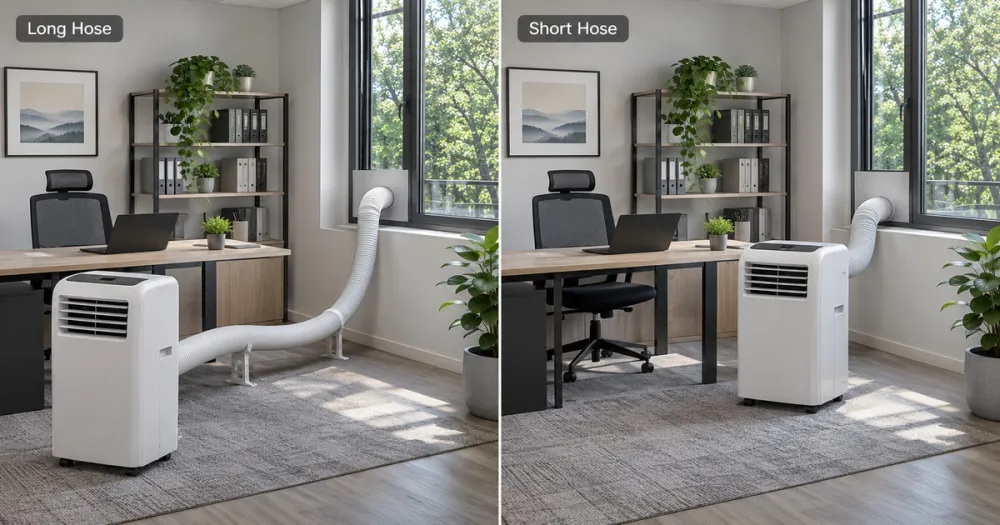
A longer approved hose may help when furniture, equipment, or room layout prevents placing the unit directly beside a suitable window.
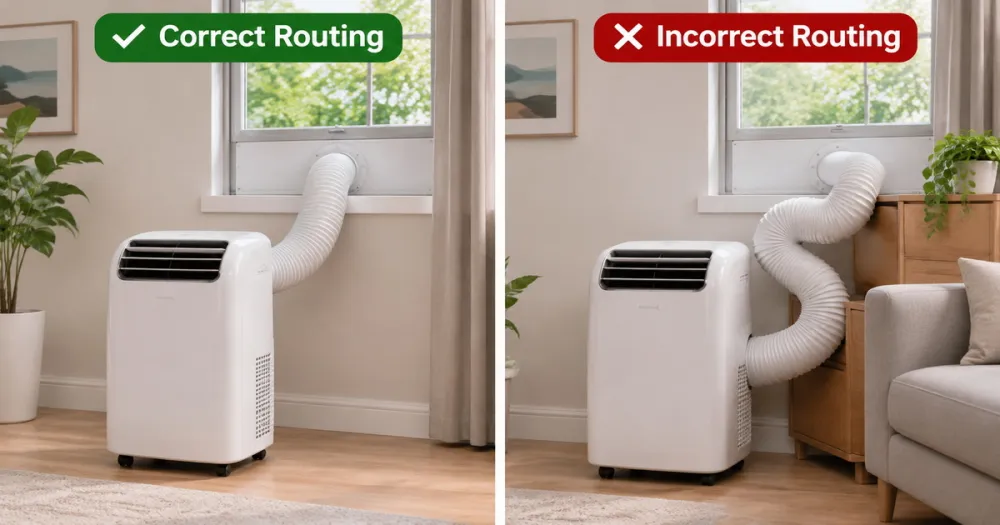
However, moving the appliance farther into the room can create new problems. The hose may cross a walkway, become vulnerable to crushing, or occupy valuable floor space.
Before choosing a longer route, consider whether repositioning furniture or using another approved outlet location would solve the problem more simply.
Noise Requires a Whole-System Assessment
A longer hose does not guarantee quieter operation. It may allow the appliance to sit farther from a desk, but airflow turbulence, loose connections, and operating changes can affect perceived sound.
Compare published noise figures under equivalent conditions. For commercial purchasing, evaluate sound in the proposed layout rather than assuming distance alone will provide the desired result.
Purchase Price Is Only Part of the Cost
A longer-hose configuration may require additional accessories, packaging, installation instructions, and validation work.
For a brand or wholesaler, ownership cost also includes customer questions, replacement parts, installation complaints, and returns.
A short-hose model can be the better commercial choice when it provides predictable installation. A validated longer-hose option can justify its complexity when additional reach solves a clearly defined customer problem.
Three Practical Tools for Better Product Selection
1. Measure the Complete Exhaust Route Before Ordering
Straight-line distance from the appliance to the window is not enough.
Use this installation checklist:
1. Identify an outdoor discharge location permitted by the manufacturer.
2. Measure the actual routing path.
3. Account for required appliance clearances and connector positions.
4. Identify bends, pinch points, and areas needing support.
5. Check the specified hose diameter and permitted length.
6. Confirm that the window panel and adapters fit securely.
7. Verify that the installation does not obstruct access or walkways.
Keep the hose as short and free of unnecessary curves as the instructions permit. Avoid unapproved reductions or extensions.
This process helps buyers resolve installation constraints before equipment arrives.
2. Use a Controlled Comparison Instead of a Hose-Length Guess
For an OEM or ODM project, compare the proposed configuration against a defined baseline.
Record:
– Indoor and outdoor temperature and humidity.
– Room load and appliance operating settings.
– Hose length, diameter, bends, and adapter details.
– Cooling performance and electrical input.
– Relevant operating temperatures and protective interruptions.
– Noise measurement position and test conditions.
Change one installation variable at a time wherever practical. Otherwise, a difference attributed to hose length may actually result from a tighter bend, altered outlet, or changing ambient conditions.
This is a proposed evaluation framework, not a claim that every supplier already performs these tests. Buyers should request the actual method and results.
3. Turn the Installation Limits into Customer-Facing Information
A technically suitable product can still disappoint users if its instructions are unclear.
For a longer-hose portable air conditioner, product documentation should clearly state:
– Supplied and maximum permitted hose length.
– Required diameter and compatible connectors.
– Approved routing and outlet arrangements.
– Whether insulation is permitted.
– Configurations that are not supported.
– Troubleshooting steps for poor cooling or restricted exhaust.
Illustrated acceptable and unacceptable installations can make these requirements easier to understand.
For international brands, this information should remain consistent across packaging, manuals, distributor listings, and customer-support materials.
Which Configuration Fits Your Application?
Choose a Standard Short-Hose Model When
– A suitable exhaust opening is close to the planned appliance location.
– Simple setup is a priority.
– The installation will change frequently.
– Customers are likely to install the product without technical assistance.
– There is no genuine need for additional reach.
For many ordinary room layouts, this is the more straightforward starting point.
Consider an Approved Longer-Hose System When
– The available opening cannot be reached with the standard configuration.
– The proposed route remains within documented installation limits.
– The hose can be supported without crushing or excessive bends.
– The supplier can provide relevant performance evidence.
– Added placement flexibility delivers a clear operational benefit.
For heavily constrained sites, another cooling-system format may be more appropriate than extending a portable unit beyond its approved limits.
What OEM and ODM Buyers Should Ask DREZ
DREZ (Guangzhou) Intelligent Technology Co., Ltd. integrates research and development, design, production, sales, and customized climate-control solutions, including portable air conditioners and OEM and ODM services.
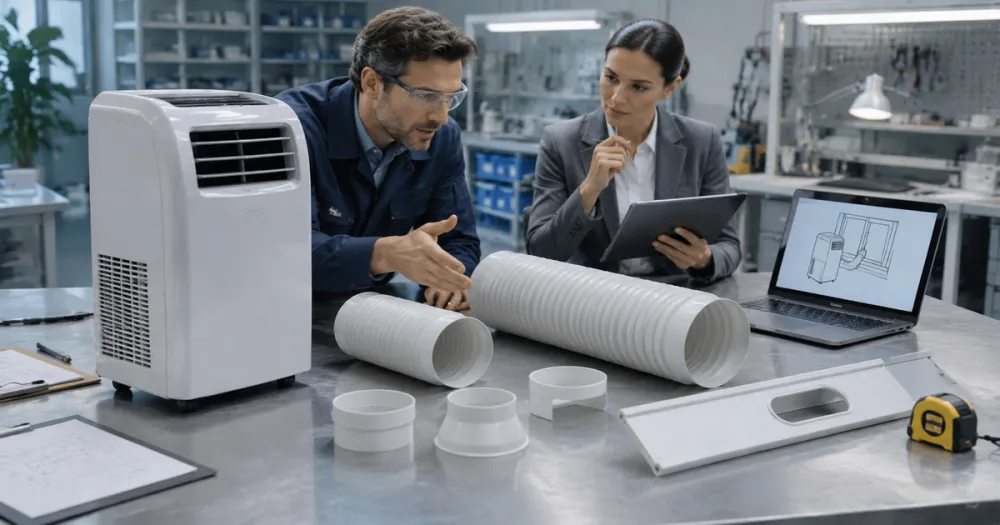
For a hose-related customization project, begin with the installation requirements rather than a requested hose length alone.
Provide the intended market, cooling requirement, ambient conditions, electrical supply, room layout, and exhaust-route drawing. Then define the questions the project must resolve:
| Procurement question | Evidence to request |
|---|---|
| Is the proposed hose configuration supported? | Model-specific installation limits |
| Will it deliver the required cooling? | Performance results under stated conditions |
| Are connectors and outlets suitable? | Drawings, dimensions, and assembly checks |
| Can customers install it correctly? | Draft instructions and installation illustrations |
| What happens if routing is restricted? | Relevant protection and operating-limit information |
| Can the configuration be maintained? | Replacement-part and service documentation |
Do not assume that customization automatically includes approval for extended ducting. The final specification should identify exactly what has been evaluated.
Choose the Configuration, Not Just the Hose
A portable air conditioner with long exhaust hose makes sense when additional reach is necessary and the complete configuration is supported. A standard short-hose model is often the simpler choice when a suitable opening is nearby.
For brands, wholesalers, and manufacturers planning a customized product, send DREZ your installation drawing, target cooling requirement, market, and proposed exhaust route. Request a configuration review and a clearly defined validation scope before finalizing the product specification.
Frequently Asked Questions
1. Can I Extend My Portable Air Conditioner Exhaust Hose?
Only when the manufacturer permits the proposed configuration. Some manufacturers explicitly advise against extensions because performance and safe operation can be affected. A matching connector does not establish compatibility.
2. What Is the Maximum Portable Air Conditioner Exhaust Hose Length?
There is no universal maximum. Check the specific model’s manual or obtain written confirmation from the supplier. Do not apply one brand’s hose limit to another appliance.
3. Is a Shorter Exhaust Hose Always Better?
A shorter, less restrictive route is generally preferable within the installation instructions. However, do not shorten, cut, or otherwise modify supplied components unless permitted. Required clearances and correct connections still matter.
4. Will Insulating a Long Exhaust Hose Improve Cooling?
Approved insulation can reduce heat passing from the warm hose into the room. It does not remove resistance caused by extra length, bends, or restrictive fittings, and it does not authorize an otherwise unsupported extension.
5. Does a Long Exhaust Hose Use More Electricity?
It can affect energy use if the installation reduces cooling effectiveness or changes operation. However, there is no universal increase that applies to every product. Compare measured performance under equivalent conditions.
6. Can the Exhaust Hose Discharge into Another Room?
Discharging into another occupied room transfers heat there rather than rejecting it outdoors. Use the manufacturer’s approved discharge arrangement. Do not assume a ceiling void, corridor, or chimney is a suitable substitute.
References
1. De’Longhi. “Can I extend the hose on my portable air conditioner?” Manufacturer guidance stating that hose extensions are not recommended and describing the supplied hose for the referenced products as approximately four feet long. [delonghi]
2. De’Longhi. “Can my Portable Air conditioner be exhausted through the chimney flue?” Manufacturer explanation of performance reduction, overheating risks, and restrictions on extending the supplied exhaust path. [delonghi]
3. De’Longhi. “PAC CN120E — Instructions for Use.” Installation guidance covering unobstructed exhaust, appliance positioning, and keeping the hose short and free of unnecessary curves. [delonghi]
4. U.S. Department of Energy. “Energy Conservation Standards for Portable Air Conditioners: Notice of Proposed Rulemaking,” 2016. Technical background on infiltration, duct heat transfer, SACC, and differences between portable and room air conditioners. Used for engineering context, not as a statement of current regulatory requirements. [energy]
5. U.S. Department of Energy. “Test Procedure for Portable Air Conditioners: Notice of Proposed Rulemaking,” 2022. Technical discussion of duct setup, infiltration heat transfer, and seasonally adjusted cooling capacity. Used to explain measurement principles, not to assert the currently applicable compliance procedure. [energy]
6. De’Longhi. “Insulated Hose Cover for Portable Air Conditioners (Universal) — DLSA003.” Manufacturer explanation of reducing heat transferred from the exhaust hose back into the room. [delonghi]
Hot Tags: Portable Air Conditioner, Portable Air Conditioner Manufacturer, Portable Air Conditioner Supplier, OEM Portable Air Conditioner, ODM Portable Air Conditioner, Wholesale Portable Air Conditioner, Portable Air Conditioner with Long Exhaust Hose, Portable Air Conditioner Exhaust Hose, Dual Hose Portable Air Conditioner, Custom Portable Air Conditioner