Content Menu
● What Is a Portable Air Conditioner with Outdoor Unit?
>> An Outdoor Unit Does Not Always Mean an Outdoor Compressor
● What Is a Self-Contained Portable Air Conditioner?
>> Single-Hose vs Dual-Hose Portable AC
● Portable Split AC vs Self-Contained Portable AC: Quick Comparison
● Which Design Delivers Better Cooling Performance?
>> Compare Capacity on the Same Basis
>> Match Cooling to the Actual Heat Load
● Noise and Comfort: Look Beyond the Lowest Decibel Figure
● Installation Requirements That Can Change the Decision
>> Outdoor Placement and Connection Limits
>> Exhaust Routing for Self-Contained Units
>> Condensate and Electrical Supply
● A Practical Selection Example for Commercial Buyers
● Total Ownership Cost: Evaluate More Than Purchase Price
● A Five-Step Acceptance Test Before Bulk Purchasing
>> 1. Define the Test Conditions
>> 2. Install the Complete System
>> 3. Log Room Conditions and Power
>> 4. Check Noise and Water Management
>> 5. Document Acceptance Criteria
● What OEM and ODM Buyers Should Specify
● Discuss Your Portable Cooling Project with DREZ
>> 1.Is a portable air conditioner with outdoor unit always more efficient?
>> 2.Can a self-contained portable AC cool without an exhaust hose?
>> 3.Is a dual-hose portable AC the same as a portable split AC?
>> 4.Are portable split air conditioners always quieter?
>> 5.Which design is easier to move?
>> 6.Which design should a distributor stock?
Choosing a portable air conditioner with outdoor unit vs self-contained portable AC starts with one practical question: how will the system remove heat from your space?
A portable split system separates its indoor and outdoor heat exchangers. A self-contained portable air conditioner keeps its main refrigeration components inside one cabinet and typically uses ducting to discharge heat elsewhere.
Neither design is automatically better for every application. Installation access, operating hours, noise requirements, and maintenance support all affect the decision.
For overseas brands, wholesalers, and manufacturers, my recommendation is to compare installed performance, not cabinet appearance or advertised cooling capacity alone. The right product must work reliably in the customer’s actual environment—and remain practical to transport, install, and service.
What Is a Portable Air Conditioner with Outdoor Unit?
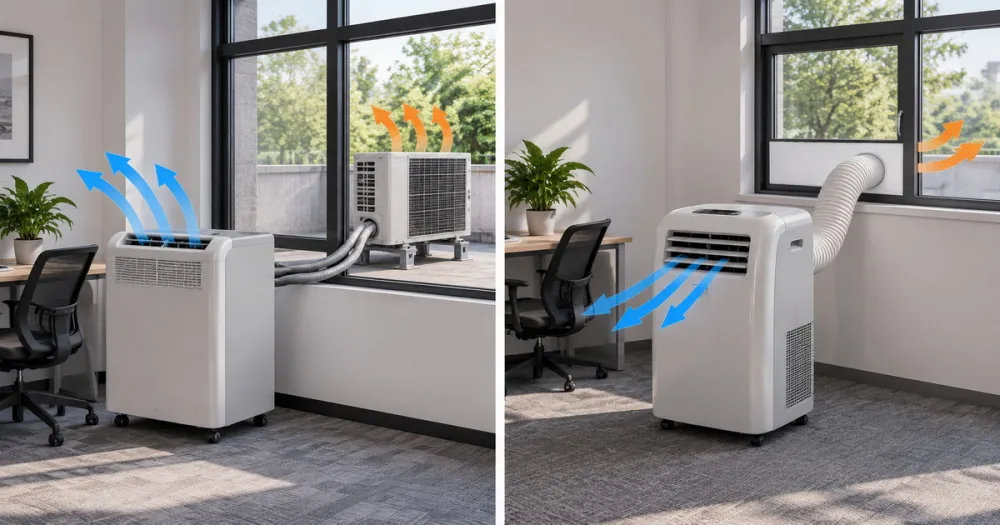
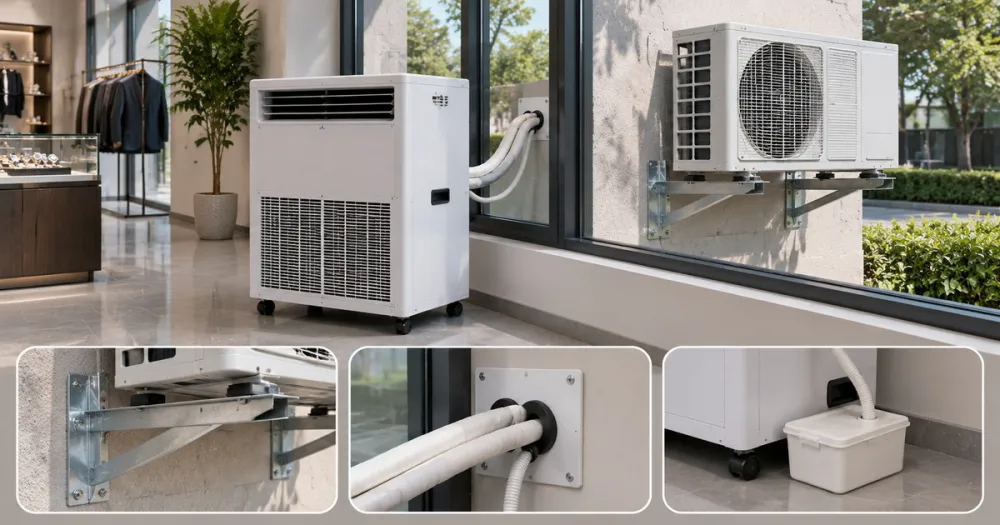
A portable air conditioner with an outdoor unit is a movable split-type cooling system. An indoor section absorbs heat from the room, while an outdoor section releases that heat outside.
The sections connect through a manufacturer-designed assembly. Depending on the model, this may carry refrigerant, electrical wiring, and condensate.
Unlike a conventional permanently installed split system, some portable split AC products arrive with factory-connected lines and installation accessories. However, connection arrangements differ, so buyers should never assume every model allows user disconnection or installation without professional support.
An Outdoor Unit Does Not Always Mean an Outdoor Compressor
A separate outdoor section does not prove that the compressor sits outdoors. Component placement varies between products.
This distinction matters because an outdoor heat exchanger alone does not guarantee exceptionally quiet indoor operation. Ask where the compressor is located and request indoor noise data at the operating mode customers will actually use.
What Is a Self-Contained Portable Air Conditioner?
A self-contained portable AC places its refrigeration components in one cabinet.
In common indoor models, the evaporator cools room air while the condenser rejects heat through an exhaust hose. The cabinet may be movable, but cooling still requires a suitable heat-discharge route.
“Self-contained” therefore does not mean “no ventilation required.”
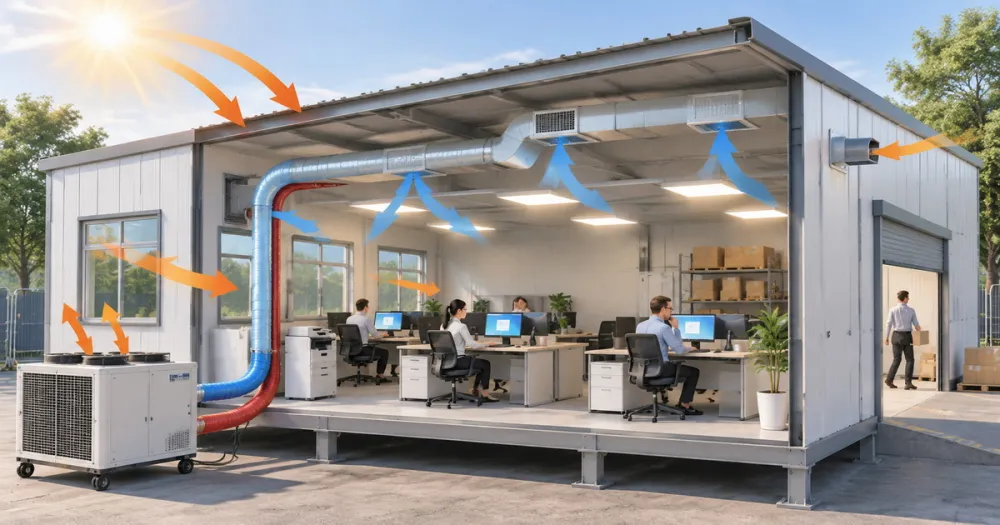
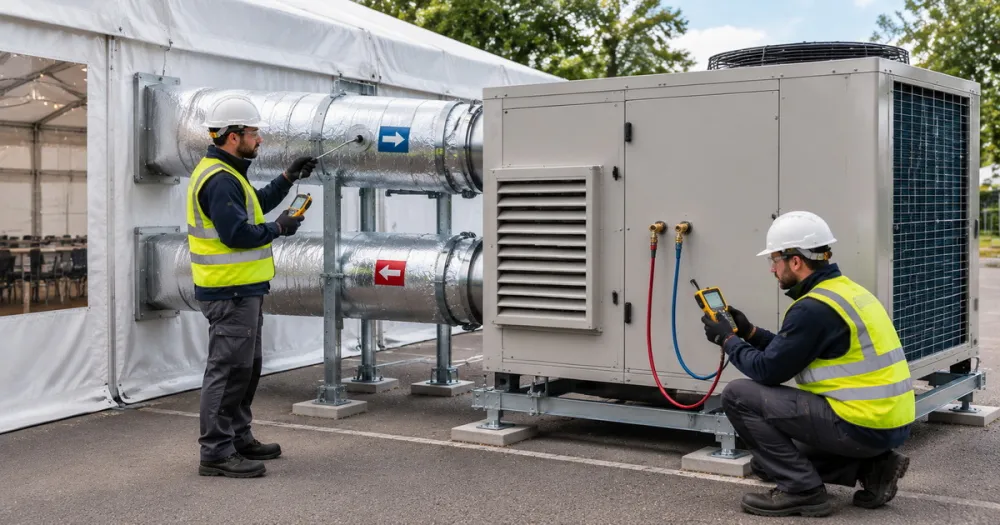
Commercial packaged equipment adds another variation: the entire cabinet may stand outdoors and deliver conditioned air through supply ducting, sometimes with a separate return duct. That arrangement should not be confused with an indoor single-hose portable unit.
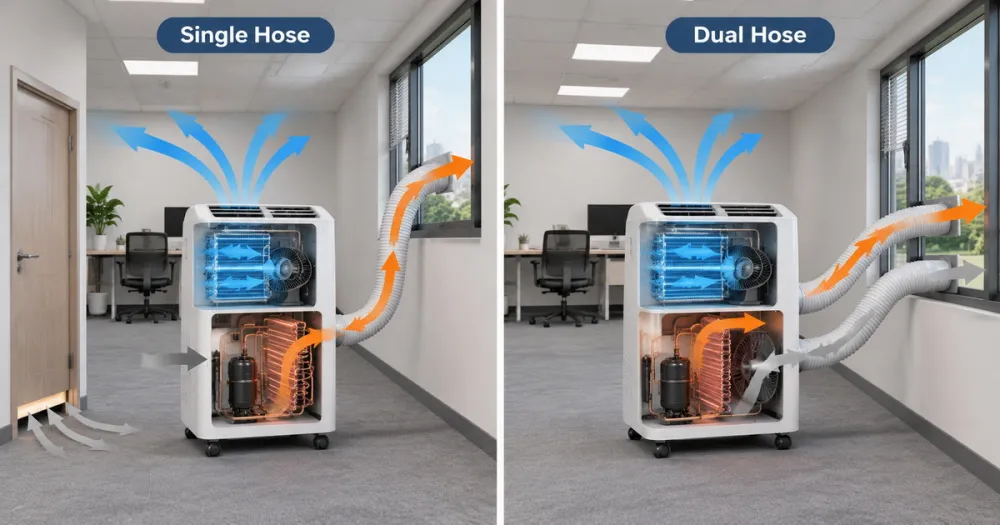
Single-Hose vs Dual-Hose Portable AC
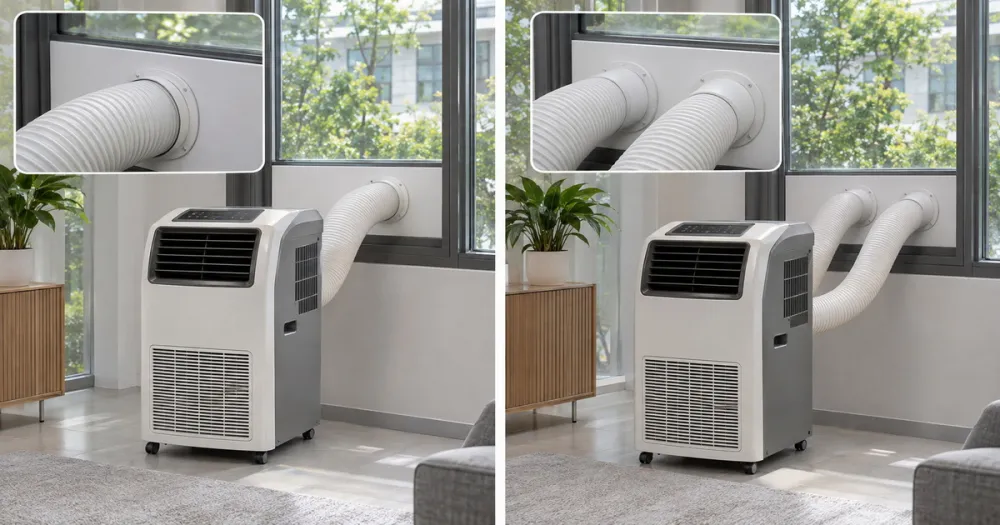
Single-hose models typically draw room air across the condenser and exhaust it outside. Replacement air must enter the room, potentially bringing additional heat and moisture.
Dual-hose models provide separate condenser intake and exhaust paths. This can reduce the pressure imbalance associated with single-hose operation, although actual results depend on airflow balance, sealing, and equipment design.
A dual-hose portable AC is still self-contained. Two hoses do not make it a split system.
Portable Split AC vs Self-Contained Portable AC: Quick Comparison
| Selection factor | Portable AC with outdoor unit | Indoor self-contained portable AC |
|---|---|---|
| Main arrangement | Separate indoor and outdoor sections | Main refrigeration components in one cabinet |
| Heat rejection | Outdoor heat exchanger | Exhaust duct to an appropriate discharge location |
| Placement requirement | Safe outdoor location and connection route | Suitable exhaust opening and indoor floor space |
| Room pressure | Generally avoids condenser exhaust drawn from room air | Depends strongly on single-hose or dual-hose design |
| Indoor noise | Depends on compressor location and fan operation | Compressor and fans are usually indoors |
| Relocation | Requires moving two sections and protecting connections | One cabinet, plus hoses and installation accessories |
| Main buying check | Outdoor access and connection limitations | Exhaust routing, pressure effects, and drainage |
Which Design Delivers Better Cooling Performance?
Compare Capacity on the Same Basis
Two products advertised with identical BTU/h figures may not provide equivalent cooling in use.
For covered portable air conditioners in the United States, seasonally adjusted cooling capacity, or SACC, accounts for effects including duct heat transfer and infiltration. It is not interchangeable with every other advertised capacity figure.
A portable split product may fall under a different classification or rating framework. Ask suppliers to identify:
– The applicable product category and test standard.
– Indoor and outdoor test conditions.
– Rated cooling capacity and electrical input.
– Whether reported performance includes installation-related losses.
– Available capacity at the intended outdoor temperature.
Do not compare SACC, EER, CEER, and seasonal ratings as though they measure the same thing.
Match Cooling to the Actual Heat Load
Floor area alone cannot describe the cooling demand of a busy workshop, glazed showroom, or temporary structure.
A useful assessment includes:
– Solar exposure and insulation.
– Ceiling height and building materials.
– Occupancy and door-opening frequency.
– Lighting, machinery, and other internal heat sources.
– Outdoor temperature and humidity.
– Required indoor conditions.
Cooling selection should address both sensible load, which affects temperature, and latent load, which concerns moisture removal.
My starting point would be a documented load assessment—not the largest capacity available within the purchasing budget.
Noise and Comfort: Look Beyond the Lowest Decibel Figure
Noise can become a decisive issue in offices, accommodation, showrooms, and customer-facing spaces.
A split arrangement may reduce indoor noise when significant noise-producing components are outdoors. However, compressor location, fan speed, vibration isolation, and operating mode still matter.
A low figure measured in a reduced-output mode does not establish noise performance at maximum cooling.
Ask suppliers to distinguish sound pressure from sound power and provide the measurement conditions. For sound-pressure figures, distance and surroundings affect the result.
During evaluation, also listen for rattles, tonal noise, and cycling behavior. A single decibel value cannot describe every aspect of acoustic comfort.
Installation Requirements That Can Change the Decision
Outdoor Placement and Connection Limits
A portable split AC requires a secure, permitted location for its outdoor section.
Before ordering, verify:
1. The outdoor section’s weight and support requirements.
2. Compatibility with the window, balcony, or installation opening.
3. Maximum connection length and permitted elevation difference.
4. Required airflow clearances.
5. Weather exposure and drainage provisions.
6. Restrictions on bending, disconnecting, or extending connections.
A factory-connected product can simplify installation, but it does not eliminate the need to follow its instructions.
Exhaust Routing for Self-Contained Units
An indoor self-contained unit needs a suitable exhaust route that prevents discharged heat from returning to the conditioned space.
Keep the duct arrangement within the manufacturer’s limits. Unapproved extensions, crushing, or excessive bends can restrict airflow and undermine performance.
Seal the installation opening appropriately. Discharging heat into an unsuitable enclosed ceiling void or neighboring room merely relocates the problem.
Condensate and Electrical Supply
Both designs require a clear condensate-management plan.
Do not interpret “self-evaporating” as a universal promise of maintenance-free drainage. Confirm the model’s requirements for the expected humidity and operating mode.
Also verify voltage, frequency, circuit requirements, earthing, and any manufacturer restrictions on extension leads.
A Practical Selection Example for Commercial Buyers
Consider two hypothetical customers.
The first operates a showroom for long daily periods and has a suitable outdoor placement area. Indoor comfort and predictable operation matter more than frequent relocation.
A portable split system deserves close evaluation, provided its noise, capacity, and installation requirements meet the brief.
The second operates a rental business serving temporary rooms with varied layouts. Staff must deliver, install, retrieve, and redeploy equipment regularly.
A self-contained unit may offer a practical handling advantage, but only where customers have suitable exhaust access.
These are selection scenarios, not measured case studies. Their lesson is straightforward: the operating workflow can matter as much as the refrigeration layout.
Total Ownership Cost: Evaluate More Than Purchase Price
The lowest quotation does not necessarily produce the lowest operating cost.
Compare:
– Product and installation-accessory costs.
– Delivery volume, weight, and handling requirements.
– Electricity consumption at representative loads.
– Cleaning and drainage work.
– Spare-parts availability and service time.
– Warranty logistics and replacement procedures.
For a basic energy estimate:
Annual electricity cost = average electrical input in kW × operating hours × electricity tariff.
Use representative average input where possible. Rated maximum input is not necessarily the average consumption of a variable-speed product.
A credible payback comparison also needs equivalent cooling duty and operating assumptions. Without those, a claimed percentage saving is difficult to defend.
A Five-Step Acceptance Test Before Bulk Purchasing
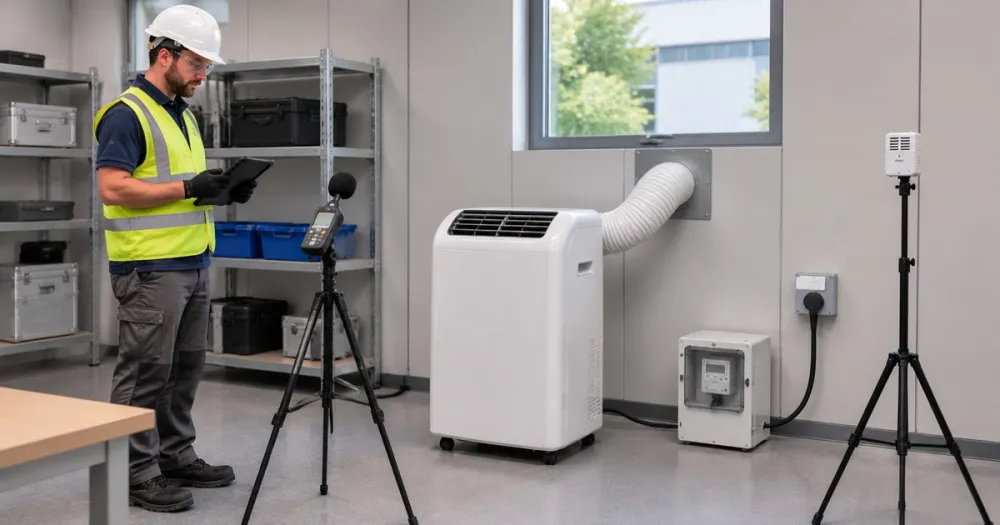
For brands and distributors, a sample evaluation should reproduce the intended installation rather than demonstrate cold air at the outlet.
1. Define the Test Conditions
Record room dimensions, outdoor conditions, starting temperature and humidity, occupancy, and internal heat sources.
2. Install the Complete System
Use the proposed brackets, sealing kits, ducts, and drainage accessories. Check access for cleaning and service.
3. Log Room Conditions and Power
Measure occupied-zone temperature and humidity over time, alongside electrical consumption where suitable instruments are available.
4. Check Noise and Water Management
Evaluate representative operating modes. Inspect for vibration, condensate leakage, and drainage interruptions.
5. Document Acceptance Criteria
Agree in advance on acceptable room conditions, installation time, noise, and operating stability.
A cold outlet reading alone does not demonstrate that the system can maintain the required conditions throughout the space.
What OEM and ODM Buyers Should Specify
A portable AC development brief should describe the application before selecting enclosure styling.
Include:
– Target market and applicable compliance requirements.
– Cooling duty and expected climate.
– Voltage, frequency, plug, and control requirements.
– Refrigerant choice and associated safety considerations.
– Indoor and outdoor acoustic expectations.
– Exhaust, mounting, or connection accessories.
– Drainage arrangements.
– Packaging, handling, and spare-parts requirements.
– Branding, documentation, and service support.
For ODM projects, establish which changes require additional testing. Alterations to airflow paths, controls, components, or refrigerant systems can affect performance and compliance.
Request reports matching the proposed model and configuration rather than relying on documents for a related product family.
Discuss Your Portable Cooling Project with DREZ
DREZ (Guangzhou) Intelligent Technology Co., Ltd. integrates research and development, design, production, sales, and customized climate-control solutions, with OEM and ODM services for overseas brands, wholesalers, and manufacturers.
To begin a focused discussion, send your target market, application, room conditions, preferred installation arrangement, electrical requirements, and estimated order volume.
Ask DREZ to confirm feasible configurations, supporting technical documentation, and a sample-validation plan before finalizing specifications.
Frequently Asked Questions
1.Is a portable air conditioner with outdoor unit always more efficient?
No. It can avoid some losses associated with indoor exhaust arrangements, but efficiency still depends on equipment design, installation, operating conditions, and the rating method used.
2.Can a self-contained portable AC cool without an exhaust hose?
A typical indoor air-cooled model needs to discharge condenser heat outside the cooled space. Removing its exhaust arrangement does not turn it into effective whole-room cooling equipment.
3.Is a dual-hose portable AC the same as a portable split AC?
No. A dual-hose unit keeps its refrigeration components in one cabinet. A portable split system has separate indoor and outdoor sections.
4.Are portable split air conditioners always quieter?
No. Confirm compressor location and compare noise at equivalent operating conditions. An outdoor section alone does not establish indoor acoustic performance.
5.Which design is easier to move?
A self-contained cabinet may simplify handling, but its hoses and window kit still require installation. A portable split system adds a second section and connections that need protection.
6.Which design should a distributor stock?
Base the decision on customer installations and service capability. Outdoor access, exhaust availability, daily operating hours, noise expectations, and relocation frequency should guide the product mix.
References
1. U.S. Department of Energy / Electronic Code of Federal Regulations, “10 CFR Part 430, Subpart B, Appendix CC—Uniform Test Method for Measuring the Energy Consumption of Portable Air Conditioners.” Supports the discussion of single-duct and dual-duct testing, duct heat transfer, infiltration, and SACC. Its scope should not be assumed to cover every portable split configuration. [ecfr]
2. U.S. Department of Energy, “Strategy Guideline: HVAC Equipment Sizing.” Supports load-based equipment selection, sensible and latent cooling requirements, and the relationship between equipment and airflow design. Residential sizing procedures are not presented here as commercial sizing rules. [www1.eere.energy]
3. Midea, “PortaSplit Installation.” Provides a manufacturer-specific example of separate indoor/outdoor portable equipment, outdoor support brackets, and window sealing. These installation features are not universal specifications for portable split products. [midea]
4. Midea, “Portasplit 12000 BTU Mobile Air Conditioner.” Supports the distinction between outdoor heat rejection, indoor compressor-noise management, operating modes, and separately reported acoustic figures. Its product claims are not attributed to DREZ. [midea]
5. U.S. Department of Energy, “Minimum Efficiency Requirements Tables for Heating and Cooling Product Categories.” Provides definitions distinguishing EER and seasonal efficiency metrics. Historical purchasing thresholds on that page are not used here as current product-compliance requirements. [energy]
6. BLACK+DECKER, “Portable Air Conditioner Instruction Manual,” reproduced by Manuals+. Provides model-specific examples of exhaust installation, electrical supply, airflow clearance, and stable positioning requirements. Buyers should follow the manual supplied with their own equipment. [manuals]
Hot Tags: Portable Air Conditioner, Commercial Portable Air Conditioner, Industrial Portable Air Conditioner, Portable Air Conditioner With Outdoor Unit, Portable Split Air Conditioner, Self-Contained Portable Air Conditioner, Dual-Hose Portable Air Conditioner, OEM Portable Air Conditioner, ODM Portable Air Conditioner, Commercial Portable Cooling Solutions