Content Menu
● Two Hoses vs One Hose: The Main Differences
● How a Single-Hose Portable Air Conditioner Works
>> One Hose Removes Heat but Also Removes Indoor Air
>> When a Single-Hose Model Still Makes Sense
● How a Dual-Hose Portable Air Conditioner Works
>> Separate Air Paths Reduce Room-Air Loss
>> Outdoor Heat Still Affects Performance
● Single-Hose vs Dual-Hose Cooling in Different Hot Climates
>> Extreme Heat Above Published Operating Limits
● Compare SACC and Efficiency, Not Just Advertised BTU
>> Why Adjusted Cooling Capacity Matters
>> What CEER Adds to the Comparison
● An Illustrative Example: Why Air Leakage Matters
● A Practical Sample-Testing Protocol for Importers
>> Step 1: Define the Target Environment
>> Step 2: Standardize Installation
>> Step 3: Record Comfort and Energy Together
>> Step 4: Repeat Before Drawing Conclusions
● Installation and Maintenance Can Change the Outcome
>> Keep Ducts Within the Approved Configuration
>> Plan Drainage Before Peak Summer
>> Maintain Airflow and Electrical Safety
● Choosing an OEM or ODM Platform for Hot-Climate Markets
>> Separate Design Preferences from Verified Capabilities
>> Build the Offer Around the User’s Situation
● Final Recommendation and Project Enquiry
>> 1. Is a two-hose portable air conditioner always better?
>> 2. Does a single-hose portable air conditioner bring hot air inside?
>> 3. Can I convert a single-hose portable AC into a dual-hose unit?
>> 4. Do dual-hose portable air conditioners use less electricity?
>> 5. Which portable AC is better for humid climates?
>> 6. Can a portable air conditioner work without outdoor venting?
When comparing a portable air conditioner with two hoses vs one hose in hot climates, I would generally shortlist a dual-hose model first. Its separate condenser intake and exhaust pathways reduce the room-air loss associated with single-hose designs. However, hose count alone cannot guarantee better cooling, lower electricity bills, or reliable operation during extreme heat.
The right choice depends on adjusted cooling capacity, operating temperature limits, humidity, installation quality, and daily usage. For homeowners, these differences affect comfort. For brands, wholesalers, and manufacturers, they also influence product positioning, customer expectations, and after-sales support.
Two Hoses vs One Hose: The Main Differences
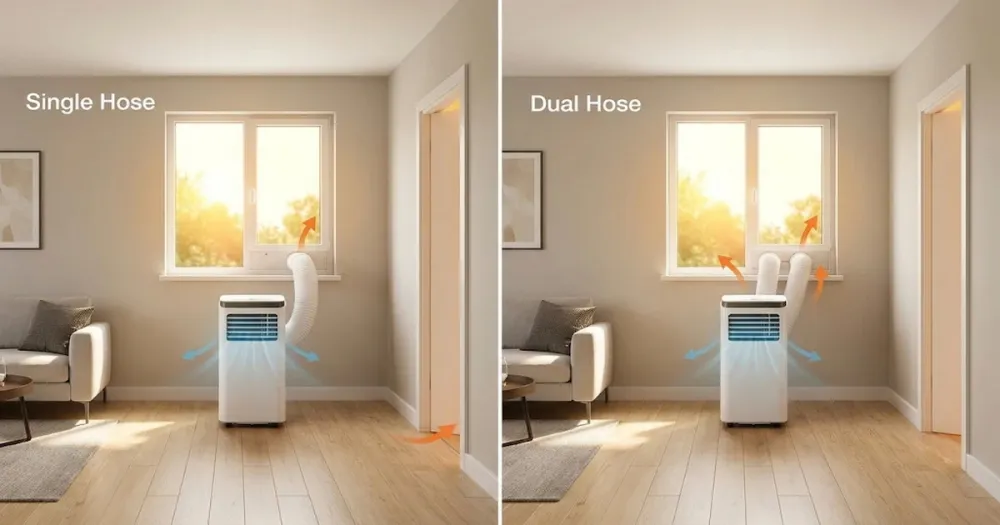
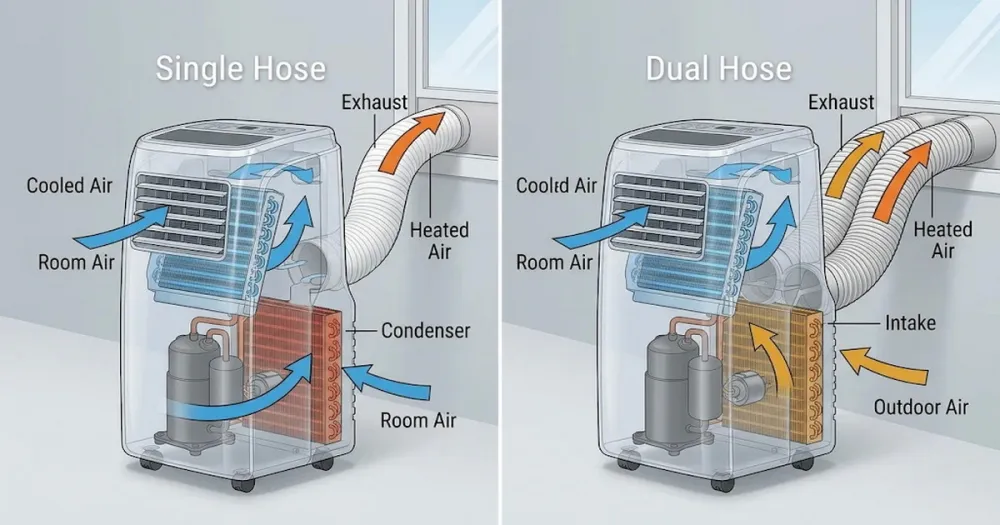
A single-hose portable air conditioner exhausts indoor air after using it to cool the condenser. A dual-hose model brings some or all condenser cooling air from outside through a separate intake.
That difference changes how each system interacts with the room.
| Comparison point | Single-hose portable AC | Dual-hose portable AC |
|---|---|---|
| Condenser intake | Draws air from the room | Draws some or all air from outside |
| Exhaust arrangement | One exhaust hose | Separate intake and exhaust pathways |
| Room pressure | Creates net airflow out of the room | Reduces that imbalance, depending on design |
| Hot-air infiltration | Greater potential penalty | Usually a smaller penalty |
| Window installation | One duct connection | Two airflow connections |
| Best starting application | Occasional cooling with simpler installation | Extended cooling in demanding conditions |
| Main buying check | Adjusted capacity after installation-related losses | Adjusted capacity and high-temperature performance |
How a Single-Hose Portable Air Conditioner Works
One Hose Removes Heat but Also Removes Indoor Air
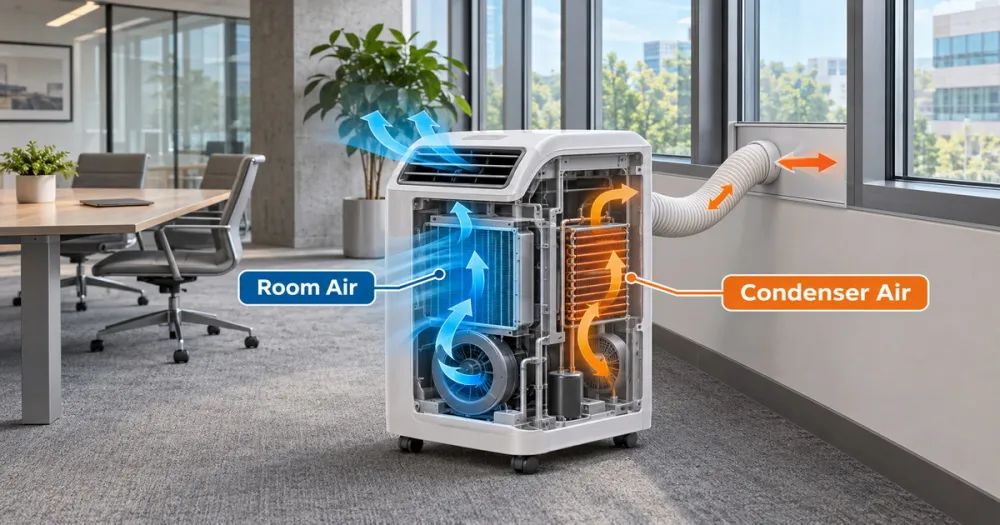
Both designs use a refrigeration cycle to absorb heat at the evaporator and release it at the condenser.
A single-hose unit uses room air to carry condenser heat outdoors. This creates net airflow out of the conditioned space. Replacement air then enters through available leakage paths, potentially including windows, doors, or adjacent rooms.
If that replacement air is warmer or more humid, it adds another cooling load.
Consequently, the appliance may deliver cold supply air while the room cools more slowly than expected. The relevant question is not simply how cold the outlet feels, but how much useful cooling remains after these effects.
When a Single-Hose Model Still Makes Sense
A single-hose portable air conditioner can remain a reasonable option when:
– Cooling is occasional rather than continuous.
– The installation needs a simple window connection.
– The room has a manageable cooling load.
– The specific model provides sufficient adjusted capacity.
– Purchase price outweighs potential operating-cost differences.
I would not reject a well-documented single-hose product simply because another appliance has two hoses.
How a Dual-Hose Portable Air Conditioner Works
Separate Air Paths Reduce Room-Air Loss
A dual-hose portable air conditioner uses one pathway to bring outdoor air toward the condenser and another to discharge heated air outside.
Meanwhile, room air circulates across the evaporator to receive cooling.
This arrangement reduces dependence on conditioned room air for heat rejection. It therefore addresses an important weakness of single-hose construction.
However, “dual hose” does not automatically mean perfectly balanced airflow. Some designs also draw indoor air into the condenser circuit. Internal leakage and differences between intake and exhaust airflow can still create infiltration.
Outdoor Heat Still Affects Performance
A dual-hose unit must reject heat into its condenser air stream. When that incoming air becomes hotter, operating conditions become more demanding.
Two hoses therefore do not make an appliance immune to extreme temperatures.
Before selecting a portable air conditioner for a hot climate, check its declared operating range and request performance information at the intended outdoor conditions.
Single-Hose vs Dual-Hose Cooling in Different Hot Climates
Hot, Dry Conditions
In a hot, dry climate, replacement air can impose a substantial temperature-related load on a single-hose system.
Dual-hose construction helps reduce this penalty. Nevertheless, strong sunlight, roof exposure, glazing, and internal heat sources still influence the capacity required.
A west-facing office and a shaded bedroom of identical floor area should not automatically receive the same recommendation.
Hot, Humid Conditions
Humidity adds a second challenge.
An air conditioner must remove both sensible heat, which affects temperature, and latent heat, which is associated with moisture removal.
When humid replacement air enters a room, a single-hose appliance may face additional moisture load alongside the temperature load.
Dual-hose construction can reduce that burden, but buyers should still examine:
– Condensate collection and drainage.
– High-humidity operating instructions.
– Moisture-removal test conditions.
– Full-tank shutdown behavior.
– Continuous-drain requirements.
An auto-evaporation feature should not be interpreted as a guarantee that drainage will never be necessary.
Extreme Heat Above Published Operating Limits
The thermostat’s lowest setting is not the appliance’s maximum operating temperature.
For example, a selectable cooling setpoint says little about whether the machine can operate reliably in a severely overheated space.
If expected temperatures exceed the published range, request a suitable alternative or documented validation. Do not assume that a larger advertised cooling number resolves the limitation.
Compare SACC and Efficiency, Not Just Advertised BTU
Why Adjusted Cooling Capacity Matters
Two portable air conditioners can display the same headline BTU figure while providing different useful cooling.
SACC, or seasonally adjusted cooling capacity, incorporates standardized adjustments for effects including infiltration and duct heat transfer.
For procurement, compare SACC values obtained under the same applicable testing framework. Avoid comparing one product’s headline capacity directly with another product’s adjusted capacity.
Also remember that a seasonal rating is not a guarantee of performance at every extreme outdoor temperature.
What CEER Adds to the Comparison
CEER, or combined energy efficiency ratio, provides an efficiency measure that incorporates relevant operating and non-active energy consumption under the prescribed procedure.
A higher comparable CEER indicates better standardized efficiency. It does not, by itself, predict the electricity bill in a particular building.
For a balanced comparison, request:
1. SACC and the applicable test procedure.
2. CEER on a comparable basis.
3. Rated electrical input.
4. Declared operating limits.
5. Available high-temperature performance results.
Neither hose count nor compressor type should replace these checks.
An Illustrative Example: Why Air Leakage Matters
Consider a simplified single-hose installation exhausting 150 cubic feet of room air per minute. Assume all replacement air arrives from outdoors at 100°F while the room is 80°F.
Using the common approximate sensible-air-load relationship:
Q≈1.08×CFM×ΔT
The estimated temperature-related replacement-air load is:
1.08×150×20=3,240 Btu/h
This is an illustrative engineering calculation, not a measured product result. The coefficient assumes typical near-sea-level air properties. The example also excludes moisture load and other heat gains.
Actual results depend on exhaust airflow, air density, and where replacement air originates.
The practical lesson is that a meaningful share of cooling can be offset by replacement-air heat. This helps explain why advertised capacity alone is insufficient.
A Practical Sample-Testing Protocol for Importers
For brands and distributors, I would evaluate competing samples under controlled, repeatable conditions rather than relying only on catalogue claims.
Step 1: Define the Target Environment
Specify the intended room size, ceiling height, outdoor temperature, humidity, occupancy, and equipment load.
For hot-climate markets, include demanding conditions within each product’s declared operating range.
Step 2: Standardize Installation
Use the supplied hoses and window accessories. Keep installation conditions comparable and follow each manual’s permitted arrangement.
Seal window-panel gaps and avoid obstructing intake or exhaust airflow.
An installation advantage should not be confused with an appliance advantage.
Step 3: Record Comfort and Energy Together
Measure:
– Room temperature at consistent locations.
– Relative humidity.
– Time to reach the target condition.
– Electricity consumption during the same test period.
– Noise under comparable operating conditions.
– Drainage requirements and interruptions.
Outlet temperature alone is not a room-cooling performance test.
Step 4: Repeat Before Drawing Conclusions
Repeat trials with comparable starting conditions.
These checks support product selection and troubleshooting. They do not replace accredited testing or establish universal savings claims.
Installation and Maintenance Can Change the Outcome
Seal the Window Interface
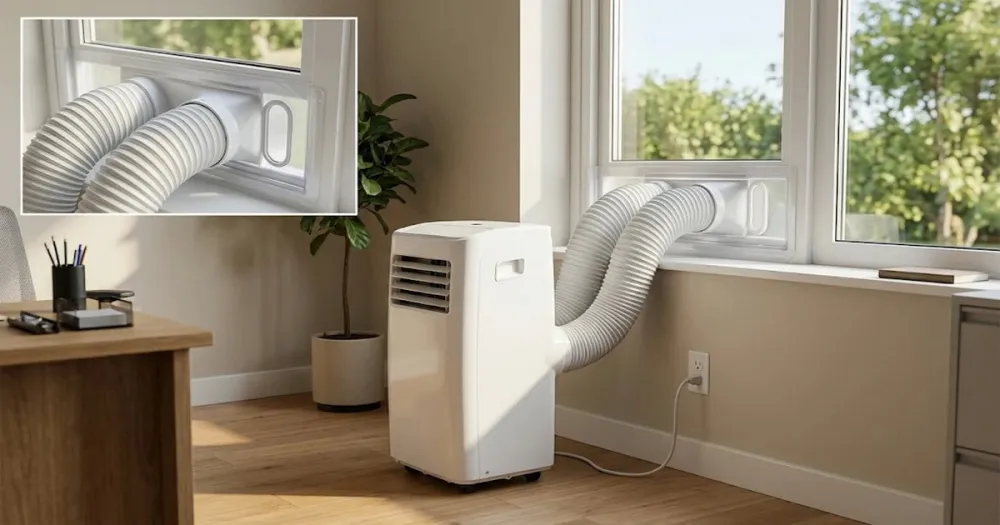
Gaps around a window kit create unwanted leakage paths.
Use compatible sealing materials and confirm that the panel fits the intended window type. For dual-hose installations, follow the specified intake and exhaust arrangement to limit hot exhaust recirculation.
Keep Ducts Within the Approved Configuration
Avoid unnecessary bends, crushing, or unapproved extensions.
Longer or more restrictive duct arrangements can change airflow and performance. Use manufacturer-approved accessories rather than assuming any similarly sized hose will work.
Plan Drainage Before Peak Summer
Confirm whether cooling or dehumidifying operation requires a drain connection.
Where gravity drainage is specified, maintain the required downward route and prevent kinks. Ensure users understand how to empty retained water safely.
Maintain Airflow and Electrical Safety
Clean filters according to the manual and preserve required clearances.
Use the specified electrical supply and connection method. Do not improvise extensions or bypass protective plugs.
These requirements apply to both single-hose and dual-hose portable air conditioners.
Choosing an OEM or ODM Platform for Hot-Climate Markets
For commercial buyers, the better product is the one that matches the target application and can support defensible claims.

Separate Design Preferences from Verified Capabilities
Ask prospective suppliers to clarify:
– Which hose configurations are available.
– Which capacities have supporting test reports.
– Which operating conditions have been validated.
– Which window kits suit the destination market.
– Which drainage arrangements are supported.
– Which electrical, refrigerant, and labeling requirements apply.
Documentation should identify the actual model and configuration being purchased.
Avoid applying one platform’s test results to another product without an appropriate technical basis.
Build the Offer Around the User’s Situation
A straightforward single-hose platform may suit occasional-use customers who prioritize installation simplicity.
A validated dual-hose platform may better suit customers expecting sustained summer cooling.
For either approach, clear manuals, usable accessories, and realistic room recommendations help align expectations with performance.
Final Recommendation and Project Enquiry
For sustained cooling in hot climates, I would generally begin with a dual-hose shortlist. Its airflow arrangement addresses an important source of single-hose performance loss.
Then compare adjusted capacity, efficiency, temperature limits, drainage, noise, and installation requirements. A suitable, documented product matters more than the hose count alone.
DREZ (Guangzhou) Intelligent Technology Co., Ltd. integrates research, design, production, sales, and customized climate-control solutions for overseas brands, wholesalers, and manufacturers.
Send DREZ your target market, expected temperature and humidity, room application, capacity requirements, and customization brief. Request a model-specific proposal identifying the available hose configuration, supporting performance documentation, and OEM or ODM scope.
Frequently Asked Questions
1. Is a two-hose portable air conditioner always better?
No. Dual-hose construction generally reduces the room-air-loss penalty, but capacity, efficiency, operating limits, and installation still determine suitability.
2. Does a single-hose portable air conditioner bring hot air inside?
It exhausts room air outdoors. Replacement air enters through available leakage paths and may be hotter or more humid than the conditioned room.
3. Can I convert a single-hose portable AC into a dual-hose unit?
Only use a manufacturer-approved conversion. An improvised intake attachment can alter airflow or interfere with the intended design.
4. Do dual-hose portable air conditioners use less electricity?
They can provide an efficiency advantage, but savings are model- and application-dependent. Compare compatible ratings and measured energy use at equivalent comfort conditions.
5. Which portable AC is better for humid climates?
A suitable dual-hose model is often a strong starting point. Also verify moisture handling, drainage instructions, and sufficient adjusted cooling capacity.
6. Can a portable air conditioner work without outdoor venting?
For conventional hose-based refrigerated models, cooling requires rejecting condenser heat outside the conditioned space. Discharging that heat into the same room does not provide net room cooling.
References
1. – U.S. Department of Energy. [Test Procedure for Portable Air Conditioners: Request for Information, 2021]. Technical basis for single-duct and dual-duct airflow, infiltration, duct heat transfer, and outdoor-temperature effects. [energy]
2. – U.S. Department of Energy. [Certification Requirements, Labeling Requirements, and Enforcement Provisions: Final Rule, 2024]. Supports configuration definitions and reporting of SACC, CEER, and condensate-removal features. [energy]
3. – U.S. Department of Energy. [Portable Air Conditioners: Test Procedure Calculation Workbook, Version 2.1]. Supports the treatment of infiltration heat, airflow measurements, duct temperatures, and configuration-specific capacity calculations. The numerical example above is independently constructed, not a reported test result. [energy]
4. – Whynter. [ARC-1030WN, ARC-1230WN, and ARC-1230WNH User Manual]. Model-specific examples of operating limits, exhaust requirements, and drainage instructions; these limits should not be generalized to other products. [whynter]
5. – Whynter. [ARC-1280MX and ARC-1280WX User Manual]. Supports model-specific guidance on high-humidity drainage, gravity-drain routing, and electrical connections. [whynter]
Hot Tags: Dual Hose Portable Air Conditioner, Single Hose Portable Air Conditioner, Portable Air Conditioner Manufacturer, Portable Air Conditioner Supplier, Wholesale Portable Air Conditioners, OEM Portable Air Conditioner, ODM Portable Air Conditioner, Commercial Portable Air Conditioner, Portable Air Conditioner for Hot Climates, Custom Portable Air Conditioner