Content Menu
● How Single-Hose and Dual-Hose Portable Air Conditioners Work
>> Single-Hose Portable Air Conditioners: One Exhaust Path
>> Dual-Hose Portable Air Conditioners: Separate Intake and Exhaust Paths
● Single-Hose vs Dual-Hose Portable Air Conditioners: Comparison Table
● Cooling Performance: Why Rated Capacity Needs Context
>> Compare SACC on the Same Test Basis
>> Account for the Actual Commercial Load
● Energy Efficiency and Operating Costs
>> Use a Transparent Cost Calculation
● Installation, Noise, and Daily Operation
>> Evaluate Noise Under Comparable Conditions
>> Verify Condensate Management
● Which Configuration Fits Different Commercial Spaces?
>> Small Offices and Temporary Meeting Rooms
>> Retail Stores and Showrooms
>> Equipment Rooms and Heat-Intensive Areas
● A Commercial Insight: Follow the Replacement Air
● A Practical Acceptance Test Before a Bulk Purchase
● What OEM and ODM Buyers Should Specify
● Specify the Application Before Choosing the Product
>> 1.Are dual-hose portable air conditioners always more efficient?
>> 2.Can a single-hose portable air conditioner cool a commercial room?
>> 3.Does a dual-hose unit provide fresh air for occupants?
>> 4.Can I convert a single-hose model into a dual-hose model?
>> 5.Which cooling-capacity figure should buyers compare?
>> 6.Which configuration should an overseas distributor stock?
Choosing between single-hose vs dual-hose portable air conditioners for commercial spaces starts with understanding airflow—not simply comparing cooling-capacity labels. Single-hose systems offer a straightforward installation, while dual-hose systems can reduce the loss of conditioned indoor air. However, two hoses alone do not guarantee better efficiency or lower operating costs.
For offices, retail stores, temporary showrooms, and other commercial environments, the right choice depends on operating hours, heat sources, installation restrictions, and verified performance.
How Single-Hose and Dual-Hose Portable Air Conditioners Work
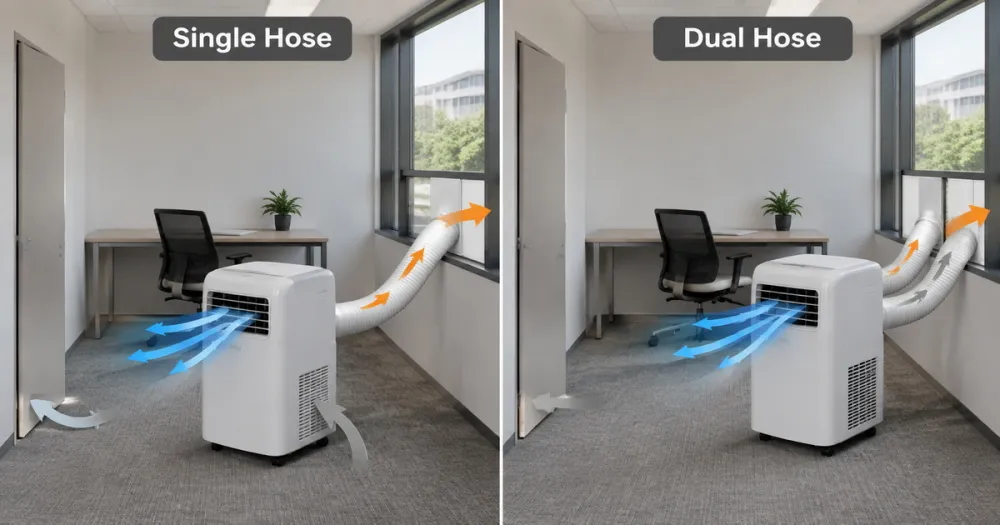
Both configurations move heat from the occupied space to another location. The difference lies primarily in how they supply air to the condenser, which releases the collected heat.
Single-Hose Portable Air Conditioners: One Exhaust Path
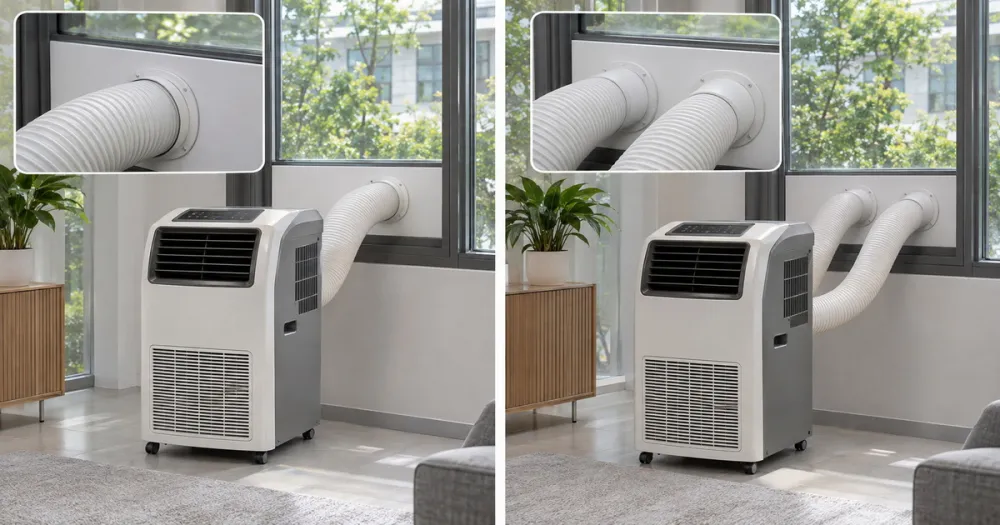
A single-hose portable air conditioner draws condenser air from the room and discharges it outside through an exhaust hose.
This removes indoor air as well as heat. Replacement air must enter through door gaps, building leakage, adjacent rooms, or other openings.
When replacement air is warmer or more humid than the conditioned space, it adds to the cooling load. The effect depends on the building and the source of that replacement air.
A single-hose unit therefore cannot be evaluated solely by the cold air leaving its front grille.
Dual-Hose Portable Air Conditioners: Separate Intake and Exhaust Paths
A dual-hose portable air conditioner uses one air path to bring condenser air from outside the conditioned space and another to discharge heated air.
This arrangement can reduce reliance on already-cooled room air for heat rejection.
However, “dual-hose” does not necessarily mean perfectly balanced airflow. Some designs also draw condenser air from indoors, and leakage or differences between intake and exhaust airflow can still create an imbalance.
Buyers should examine the actual design and test results rather than assuming every dual-hose system performs identically.
Single-Hose vs Dual-Hose Portable Air Conditioners: Comparison Table
| Selection factor | Single-hose configuration | Dual-hose configuration |
|---|---|---|
| Condenser air supply | Drawn from the conditioned room | Drawn partly or entirely from outside the conditioned space |
| Room-air replacement | Exhausted room air requires replacement | Can reduce the amount of room air requiring replacement |
| Installation | One exhaust connection to accommodate | Intake and exhaust connections require planning |
| Pressure effects | Can depressurize the room | Can reduce depressurization, depending on design |
| Capacity evaluation | Check adjusted capacity and test conditions | Check the same metrics; hose count is insufficient |
| Practical application | Consider when installation simplicity is important and load is manageable | Consider when reducing room-air loss is important |
| Main buying risk | Ignoring replacement-air heat and moisture | Assuming two hoses guarantee superior performance |
Cooling Performance: Why Rated Capacity Needs Context
A commercial buyer needs to know how much useful cooling remains after installation effects—not just the equipment’s headline capacity.
Compare SACC on the Same Test Basis
For portable air conditioners covered by the relevant U.S. Department of Energy procedures, seasonally adjusted cooling capacity, or SACC, accounts for effects including duct heat transfer and replacement-air loads.
A conventional cooling-capacity figure and a SACC figure describe different measurement bases. Comparing them directly can produce a misleading purchasing decision.
Ask suppliers for:
– Cooling capacity and its stated test method.
– SACC, where applicable.
– Combined energy efficiency ratio, or CEER, where applicable.
– Rated electrical input and operating conditions.
– The exact duct configuration used during testing.
For equipment outside this product category or sold into other markets, request the applicable local test documentation. Installing a portable unit in commercial premises does not, by itself, establish its regulatory classification.
Account for the Actual Commercial Load
Floor area is only one input. A small shop with strong solar exposure, frequent door openings, and heat-producing equipment may need more cooling than a larger, quieter office.
Build the assessment around:
– Occupancy and operating schedules.
– Windows, solar exposure, and insulation.
– Lighting and equipment heat.
– Outdoor temperature and humidity.
– Required ventilation and door-opening patterns.
Avoid selecting a unit from a generic room-size claim without checking these conditions.
Energy Efficiency and Operating Costs
Dual-hose airflow can reduce an important source of cooling loss, but configuration alone does not determine overall efficiency.
Compressor performance, controls, fan power, heat exchangers, duct heat transfer, and operating conditions also matter. A well-performing single-hose model should not automatically be rejected in favor of an inadequately documented dual-hose alternative.
Use a Transparent Cost Calculation
For procurement screening:
Electricity cost=average input power in kW×operating hours×electricity tariff
For example, an assumed average input of 1.2 kW over 1,000 hours consumes 1,200 kWh. At an assumed tariff of $0.20 per kWh, the electricity cost is $240.
This is an illustrative calculation, not a product-performance claim. Actual consumption changes with load, controls, and compressor cycling.
Compare costs while achieving the same temperature and humidity targets. A unit that consumes less electricity but leaves the room uncomfortable is not necessarily the better investment.
Installation, Noise, and Daily Operation
Installation quality can undermine either configuration.
Plan the Complete Air Path
A single-hose system requires an exhaust route. A dual-hose system requires both an intake and an exhaust route, whether these use separate hoses or a manufacturer-designed combined assembly.
Before ordering, confirm:
1. The available opening and approved mounting arrangement.
2. Permitted hose lengths, bends, and accessories.
3. Sealing requirements around the installation panel.
4. Intake and exhaust positioning to limit recirculation.
5. Access for cleaning, drainage, and service.
Do not extend or modify ductwork without manufacturer approval. A physically compatible hose is not proof that the fan can operate correctly with it.
Evaluate Noise Under Comparable Conditions
Hose count does not establish how quiet a unit will be.
Ask for the sound metric, test distance, fan setting, and compressor operating condition. A low-speed sound figure should not be compared with another unit’s maximum-output figure.
For offices and customer-facing spaces, include a site listening assessment during representative operation.
Verify Condensate Management
“Self-evaporating” should not be interpreted as a guarantee of drain-free operation in every environment.
Confirm the available condensate-removal method, tank-full response, drainage instructions, and maintenance access. These details matter particularly where unattended operation or potential water damage affects business continuity.
Which Configuration Fits Different Commercial Spaces?
The following are selection scenarios, not documented customer case studies.
Small Offices and Temporary Meeting Rooms
Single-hose models deserve consideration when cooling demand is limited and installation simplicity is the main constraint.
For longer daily use, compare adjusted capacity and efficiency carefully. Also consider whether replacement air comes from a hot corridor, outdoors, or another conditioned zone.
Retail Stores and Showrooms
Frequent door openings and solar gain may dominate the cooling load.
A dual-hose configuration can reduce room-air loss through the condenser circuit, but it cannot eliminate heat entering through an open entrance. Door management and appropriate sizing remain essential.
Temporary Commercial Areas
For pop-up displays and short-term offices, assess relocation requirements alongside performance.
One connection may simplify setup, while a well-designed dual-path installation may better support repeated, longer operating periods. The practical choice depends on the mounting kit and site restrictions.
Equipment Rooms and Heat-Intensive Areas
Do not assume a comfort-cooling portable unit is suitable for continuous equipment protection.
Check continuous-duty suitability, operating limits, alarm functions, drainage, and restart behavior. Critical applications also require a failure-response plan.
A Commercial Insight: Follow the Replacement Air
The most useful question is often not “How many hoses does it have?” but “Where will replacement air come from?”
A single-hose unit exhausting room air might draw replacement air from:
– A warm warehouse.
– An outdoor entrance.
– An air-conditioned corridor.
– Another space served by the central system.
These situations create different consequences.
If replacement air comes from another cooled zone, the portable unit may shift part of the cooling burden to the building’s existing system. Looking only at the portable unit’s electricity consumption can miss that interaction.
Likewise, a dual-hose condenser intake is not automatically a fresh-air supply for occupants. Its airflow may remain separate from the occupied-room air circuit.
Cooling, ventilation, and building-pressure requirements should therefore be evaluated separately.
A Practical Acceptance Test Before a Bulk Purchase
For overseas brands and wholesalers, a representative installation trial can reveal problems that a specification sheet cannot.
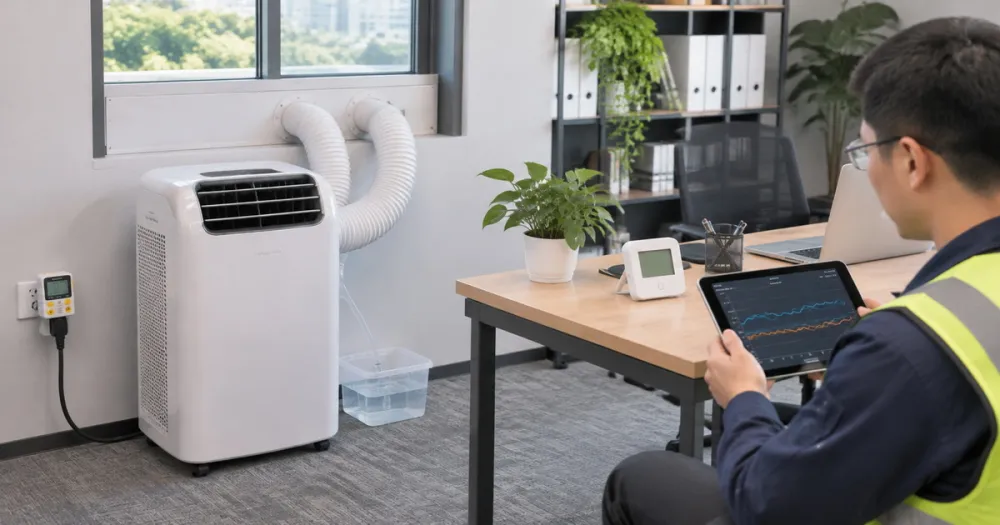
Use this six-step checklist:
1. Define the room’s temperature, humidity, occupancy, and operating-hour targets.
2. Record the installation, including hose routing and panel seals.
3. Log room conditions at representative occupied locations, away from the cold-air outlet.
4. Measure electricity use over a representative operating period.
5. Observe noise, drainage, alarms, and restart behavior.
6. Repeat under reasonably comparable loads before drawing conclusions.
Record outdoor conditions and door activity as well. Comparing one unit on a mild day with another during hotter, busier conditions is not a fair test.
This proposed acceptance process supports purchasing decisions; it does not replace standardized laboratory testing.
What OEM and ODM Buyers Should Specify
For brand owners, wholesalers, and manufacturers, the product specification should cover the complete installation and service experience.
| Specification area | Questions to resolve |
|---|---|
| Performance | Which test method supports capacity and efficiency claims? |
| Airflow | Where does condenser intake air originate? |
| Installation kit | Which openings, hose arrangements, and accessories are supported? |
| Electrical requirements | What voltage, frequency, plug, and circuit requirements apply? |
| Water management | Which drainage options and protective responses are available? |
| Serviceability | How are filters, components, and spare parts accessed? |
| Documentation | Which manuals, labels, and market-specific reports are required? |
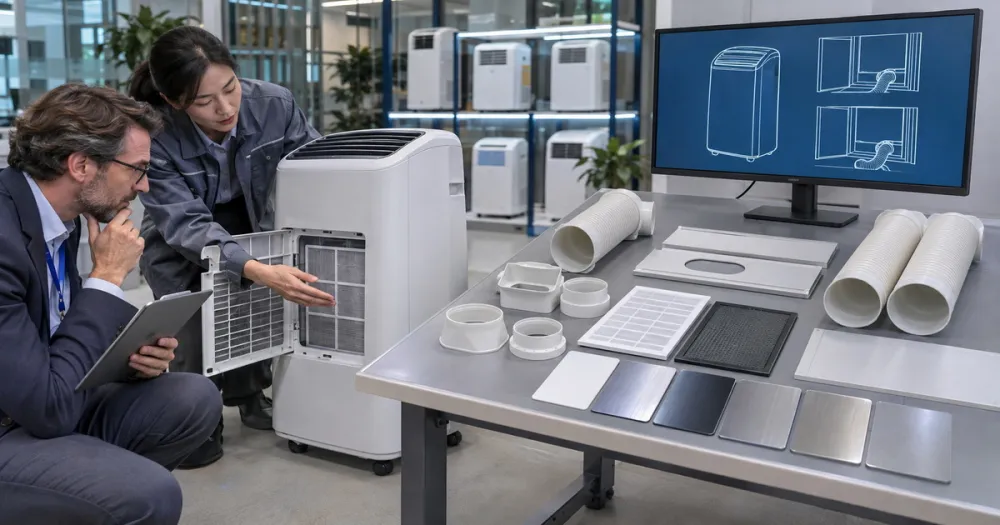
DREZ (Guangzhou) Intelligent Technology Co., Ltd. integrates research and development, design, production, sales, and customized climate-control solutions. Its OEM and ODM services support overseas brands, wholesalers, and manufacturers.
However, company-level capabilities should remain separate from model-level claims. Request evidence for the proposed configuration, performance, and destination-market requirements before approving a specification.
Specify the Application Before Choosing the Product
Single-hose systems offer a simpler connection arrangement. Dual-hose systems can reduce reliance on conditioned room air. Neither advantage removes the need for verified performance and a workable installation.
Send DREZ your target market, room conditions, heat sources, operating hours, power supply, and installation drawings. Request an OEM or ODM proposal addressing capacity, airflow, drainage, accessories, and supporting documentation—not simply a choice between one hose and two.
Frequently Asked Questions
1.Are dual-hose portable air conditioners always more efficient?
No. They can reduce room-air loss, but overall efficiency also depends on components, controls, leakage, and operating conditions. Compare verified results on the same test basis.
2.Can a single-hose portable air conditioner cool a commercial room?
Yes, provided its useful capacity matches the load and the installation is appropriate. Consider replacement-air effects, occupancy, equipment heat, and operating hours rather than relying only on floor area.
3.Does a dual-hose unit provide fresh air for occupants?
Not necessarily. Its intake may serve only the condenser circuit. Verify the air paths and assess occupied-space ventilation separately.
4.Can I convert a single-hose model into a dual-hose model?
Do not assume an aftermarket conversion is suitable. Use only a configuration supported by the manufacturer, with appropriate performance documentation and installation instructions.
5.Which cooling-capacity figure should buyers compare?
Use figures measured under the same procedure and configuration. Where applicable, SACC helps account for portable-system effects that a conventional capacity figure may not capture.
6.Which configuration should an overseas distributor stock?
Base the decision on customer applications and installation constraints. A range may serve both simpler temporary installations and applications where reducing conditioned-air loss is a priority.
References
1. U.S. Department of Energy. [“Energy Conservation Program for Appliance Standards: Certification, Compliance, Labeling, and Enforcement for Electric Motors and Air Conditioners and Heat Pumps” — Final Rule, September 2024]. Supports the single-duct and dual-duct definitions and discussion of reported capacity, efficiency, configuration, and condensate-removal information. [energy]
2. U.S. Department of Energy. [“Test Procedure for Portable Air Conditioners” — Notice of Data Availability, May 2014]. Technical background on replacement-air infiltration, pressure effects, and differences between rated and net cooling performance. Historical findings are not presented here as current market-wide performance averages. [energy]
3. U.S. Department of Energy. [“Energy Conservation Standards for Portable Air Conditioners” — Notice of Proposed Rulemaking, April 2016]. Supports discussion of airflow imbalance, duct heat transfer, and why configuration alone does not establish overall efficiency. Used as technical background, not as a statement of current requirements. [energy]
4. U.S. Department of Energy. [“Test Procedure for Portable Air Conditioners” — Notice of Proposed Rulemaking, May 2022]. Background on SACC, operating conditions, and single-speed versus variable-speed measurement considerations. Proposed provisions are not represented as universally applicable current rules. [energy]
Hot Tags: Portable Air Conditioner, Commercial Portable Air Conditioner, Single Hose Portable Air Conditioner, Dual Hose Portable Air Conditioner, Portable Air Conditioner Manufacturer, Portable Air Conditioner Supplier, Wholesale Portable Air Conditioner, OEM Portable Air Conditioner, ODM Portable Air Conditioner, Custom Portable Air Conditioner