Content Menu
● What Does “Air Conditioner With Long Hose” Actually Mean?
● Why Source These Systems From China?
>> Established Manufacturing Networks
>> A Large Market, but No Separate Long-Hose Market Category
● Selection Criteria: How to Evaluate These Ten Manufacturers
● Manufacturer Comparison: Capacity, MOQ, and Certification Transparency
● The Top 10 Manufacturers to Evaluate
>> 1. DREZ (Guangzhou) Intelligent Technology Co., Ltd.
>> 3. Gree Electric Appliances, Inc. of Zhuhai
>> 5. Hisense
>> 7. AUX Group
>> 8. Dongguan JHS Electrical Co., Ltd.
>> 9. CHIGO
>> 10. Dorosin
● Technical Buyer’s Guide: What to Specify Before Comparing Prices
>> 1. Require Performance at the Actual Duct Configuration
>> 2. Write a Material Specification for the Hose
>> 3. Separate CE Marking, RoHS, and Factory Certification
>> 4. Compare Cooling Ratings on the Same Basis
● The Less-Discussed Procurement Trap: The “Easy Air Path” Demonstration
● How to Verify the Factory, Approve Samples, and Control Delivery
● Conclusion: Choose the Manufacturer Around the Installation
● FAQ
>> 2. Can I extend a portable air conditioner’s exhaust hose from two meters to eight meters?
>> 3. Does CE marking on the compressor mean the complete air conditioner complies?
>> 4. What happens if the production factory substitutes a fan or hose material after sample approval?
>> 5. How can I verify capacity if the factory will not disclose a trustworthy annual-output figure?
Choosing an air conditioner with long hose capability requires more than comparing cooling capacity and factory prices. For professional buyers, the central question is whether a manufacturer can deliver reliable cooling through the specified duct arrangement while maintaining consistent quality, compliant documentation, and dependable production schedules.
China offers a substantial manufacturing base for this category, ranging from residential portable air conditioners to industrial spot coolers and externally installed tent cooling systems. Its export scale is significant: a July 2025 report citing the General Administration of Customs stated that China exported 36.46 million air conditioners during January–May 2025, up 12.9% year on year. These figures cover the broader air-conditioning category, not specifically long-hose equipment.
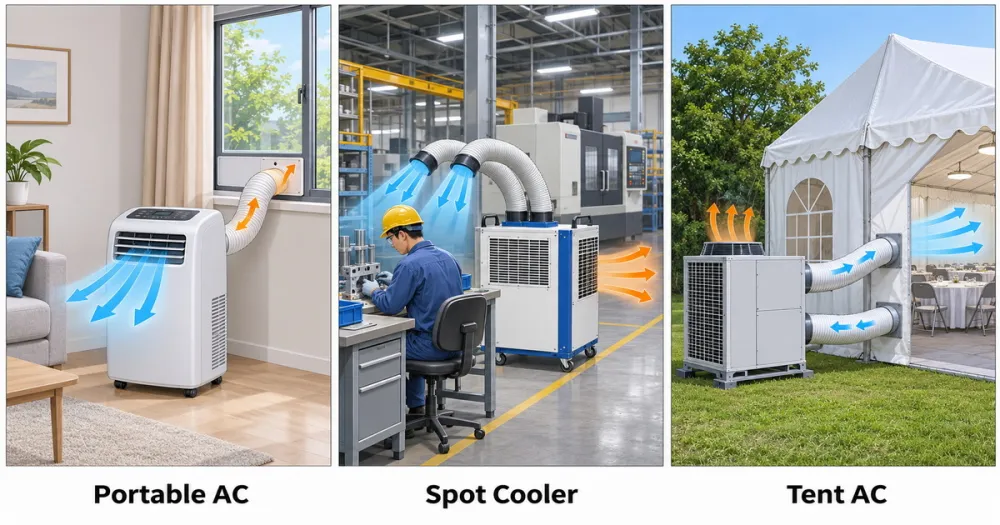
What Does “Air Conditioner With Long Hose” Actually Mean?
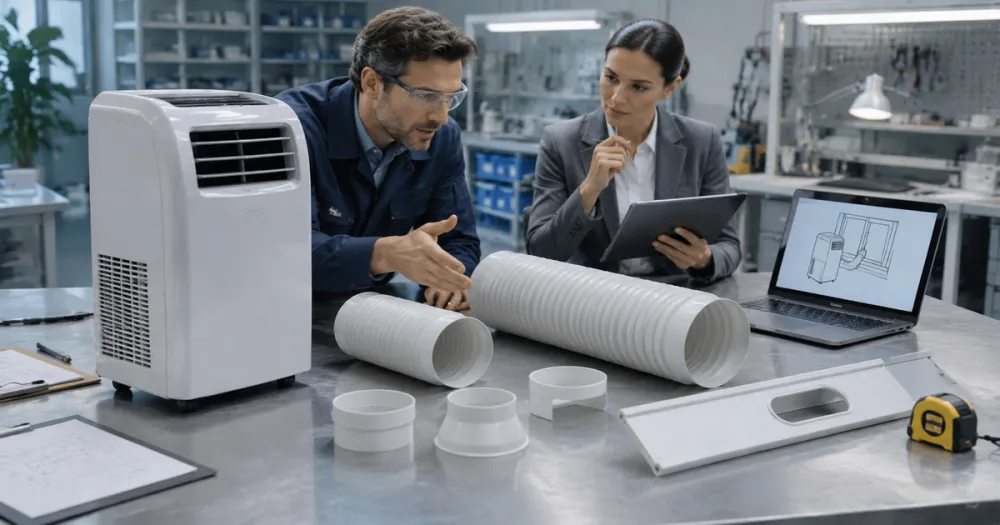
Before requesting quotations, define which hose or duct your application requires.
| Product configuration | Function of the hose or duct | Typical purchasing application | Main technical question |
|---|---|---|---|
| Residential portable air conditioner | Discharges condenser heat outdoors | Retail distribution, residential cooling, small offices | Does the manufacturer permit the required exhaust length? |
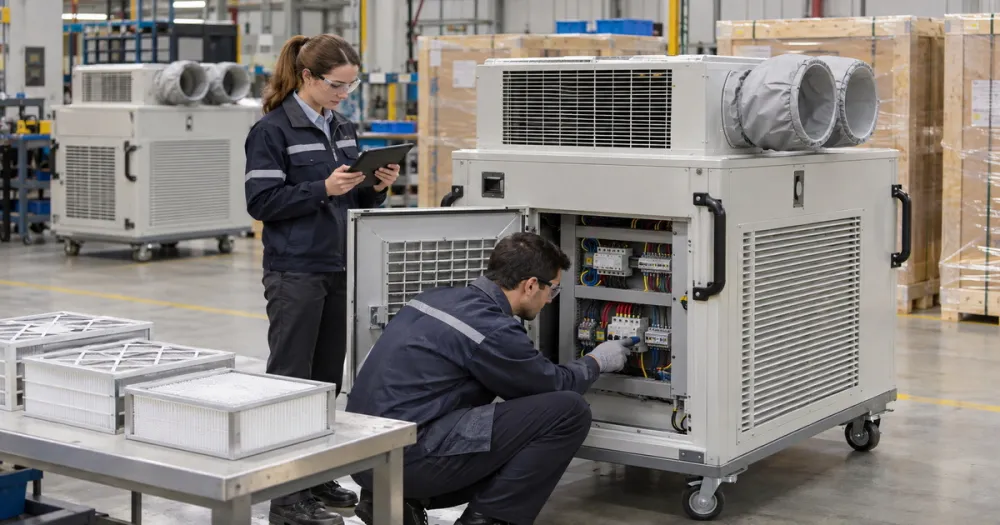
| Industrial spot cooler | Directs cooled air toward a work area; some installations also duct away condenser heat | Workshops, production lines, maintenance operations | What airflow remains with the proposed duct configuration? |
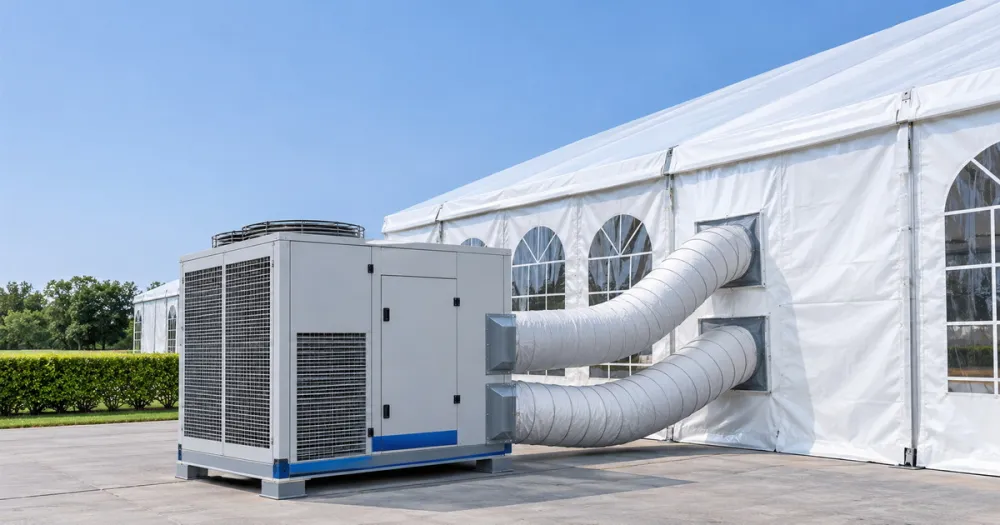
| Outdoor packaged tent air conditioner | Delivers conditioned air into a tent or temporary building, sometimes with a return duct | Events, exhibitions, temporary facilities | Can the blower overcome the complete supply-and-return resistance? |
| Portable air conditioner with drainage hose | Removes condensate | Humid environments or continuous drainage applications | Is gravity drainage sufficient, or is a pump required? |
These configurations are not interchangeable. A drainage hose has no bearing on the allowable exhaust length, and a residential exhaust-hose appliance should not automatically be treated as a long-distance cold-air delivery system.
Why Source These Systems From China?
Established Manufacturing Networks
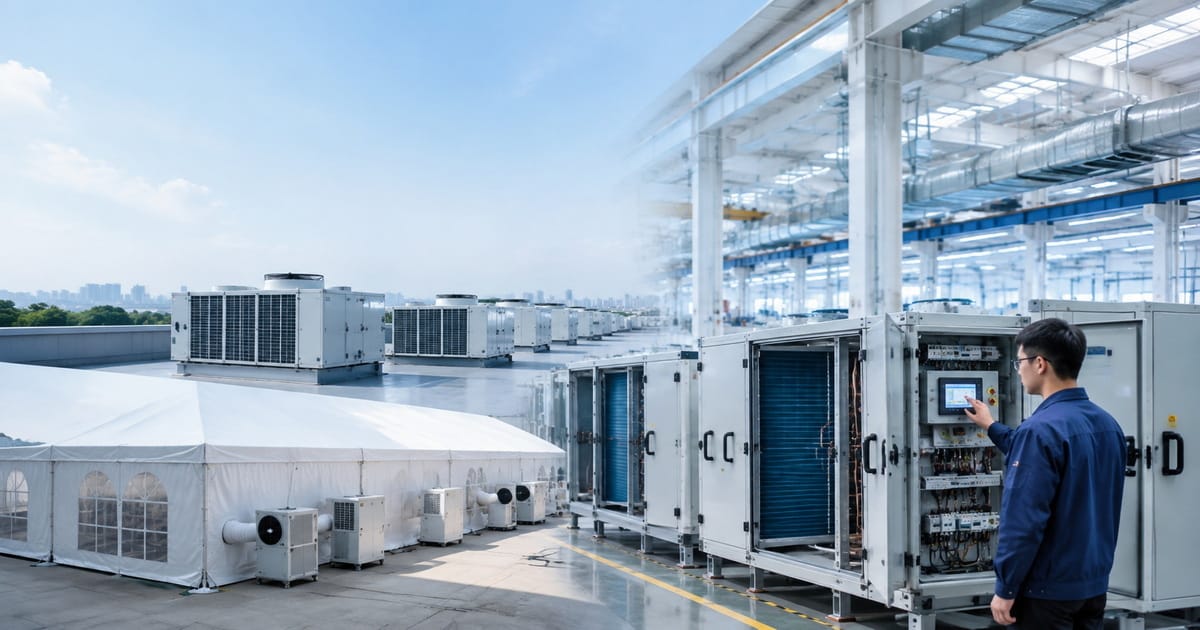
The manufacturer locations represented in this guide illustrate several useful sourcing concentrations:
– Guangzhou and the wider Pearl River Delta offer access to commercial HVAC and temporary-structure cooling suppliers, including DREZ.
– Foshan and Zhuhai host established air-conditioning manufacturers such as CHIGO and Gree.
– Dongguan supports portable-air-conditioner manufacturing, including JHS.
– Qingdao has a substantial appliance and HVAC presence associated with Haier and Hisense.
For buyers, geographic concentration can make multi-factory visits and supplier comparisons more practical. However, location alone does not establish production quality or customization capability.
A Large Market, but No Separate Long-Hose Market Category
The Japan Refrigeration and Air Conditioning Industry Association’s 2025 presentation reported global air-conditioner demand of approximately 131.638 million units in 2024, representing 106.2% of the preceding year’s level. Its figures distinguish residential and commercial equipment, rather than identifying “air conditioners with long hoses” as a separate market.
This distinction matters when evaluating supplier presentations. Broad market growth can support investment in manufacturing, but it does not prove that a particular model can operate successfully through extended ductwork.
Selection Criteria: How to Evaluate These Ten Manufacturers
This shortlist combines specialist duct-connected cooling suppliers with larger portable-air-conditioner manufacturers. Inclusion reflects product relevance and available company information; it does not imply that every manufacturer offers a standard long-hose model or accepts every private-label project.
| Evaluation area | Suggested weighting | Evidence to request |
|---|---|---|
| Application and duct compatibility | 30% | Approved duct layouts, airflow data, operating limits, performance tests |
| Manufacturing and quality control | 25% | Factory audit, process controls, inspection records, traceability |
| Destination-market compliance | 20% | Model-specific declarations, reports, labels, certification records where applicable |
| OEM/ODM engineering support | 15% | Drawing control, sample procedures, customization boundaries, change management |
| Delivery and after-sales support | 10% | Production schedule, spare-parts policy, warranty procedures, service documentation |
Manufacturer Comparison: Capacity, MOQ, and Certification Transparency
| Manufacturer | Most relevant sourcing focus | Public capacity information | MOQ position | Certification evidence to obtain |
|---|---|---|---|---|
| DREZ | Tent cooling, packaged commercial systems, project customization | Company states more than 10,000 units annually; not a long-hose-only figure | RFQ required | Exact-model compliance package and applicable factory certificates |
| Midea | Residential portable AC platforms | No comparable portable-only figure used here | RFQ required | Destination-specific model documentation |
| Gree | Portable AC and broader HVAC platforms | No comparable portable-only figure used here | RFQ required | Exact model and production-site documentation |
| Haier | Branded portable cooling and appliance channels | No comparable portable-only figure used here | Confirm sourcing route | Model documentation and authorization arrangements |
| Hisense | Single- and dual-hose residential portable AC | No comparable portable-only figure used here | Confirm sourcing route | Exact-model documentation and approved hose arrangement |
| TCL | Residential portable AC | Historical 2023 statement reported over 30 million units across its AC network; not portable-only capacity | RFQ required | Current model-specific compliance package |
| AUX | Portable AC and ODM platforms | No comparable portable-only figure used here | RFQ required | Exact-model compliance documents |
| JHS | Specialist portable AC and dehumidifier production | July 2025 report cited expected annual orders above 2.3 million portable AC units; forecast, not audited output | RFQ required | Model reports and relevant factory certificates |
| CHIGO | Residential and commercial AC platform sourcing | No current comparable figure verified here | RFQ required | Current entity, factory, and model documentation |
| Dorosin | Industrial spot cooling and humidity control | No comparable figure verified here | RFQ required | Current legal-entity certificates and exact-model reports |
The Top 10 Manufacturers to Evaluate
1. DREZ (Guangzhou) Intelligent Technology Co., Ltd.
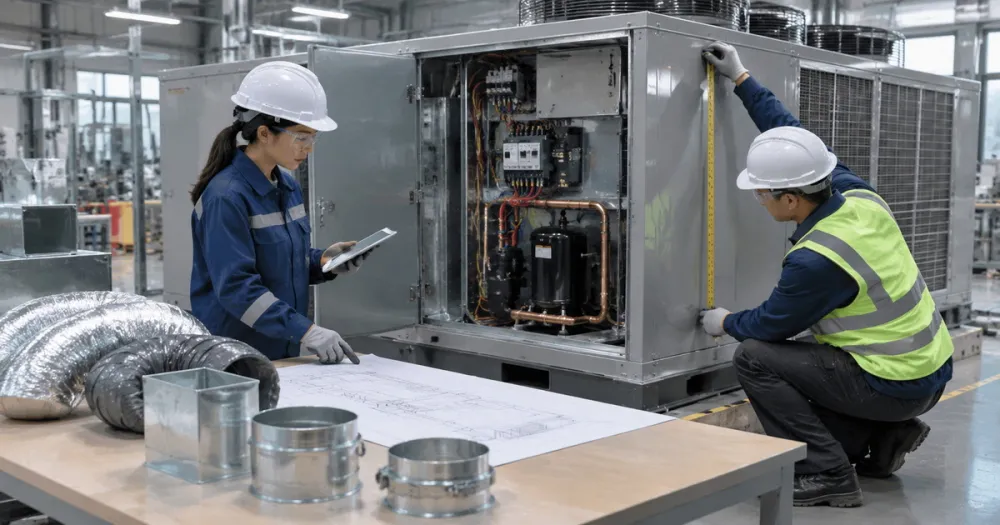
DREZ is particularly relevant for buyers sourcing cooling systems for tents, exhibitions, temporary structures, industrial spaces, and outdoor events rather than conventional residential window-exhaust installations.
Its company profile identifies DREZ Intel Tech as a subsidiary of DREZ Group, which was established in 2001. Buyers should distinguish that group-history date from the incorporation date of the specific contracting entity. The same profile states that its Guangzhou factory occupies more than 6,000 square meters and has annual production capacity exceeding 10,000 units.
– Establishment reference: DREZ Group established in 2001; confirm the subsidiary’s legal incorporation date during onboarding.
– Market coverage: The company describes established activity in mainland China, Hong Kong, and Macao, with overseas expansion beginning in 2015. Its current website states exports to more than 60 countries.
– Core strengths: Commercial and industrial packaged cooling, integrated duct arrangements, and application-specific system selection.
– OEM/ODM scope: The company advertises customization for structural designs, installation requirements, and project specifications.
For smaller overseas brands, DREZ is worth evaluating as a value-oriented alternative to large appliance groups, particularly where standard catalog equipment does not fit the installation. That value proposition should be tested through total project cost, engineering response quality, sample performance, and after-sales commitments—not assumed from factory size.
Its customization positioning makes communication efficiency especially important. Ask for a named engineering contact, a written drawing-approval process, and response-time expectations. These measures provide an objective way to assess flexibility and depth of OEM support.
Procurement checkpoint: Request performance evidence for the complete proposed duct layout, including supply and return arrangements where applicable. Do not infer an approved maximum duct length from the fact that a system uses flexible ducts.
2. Midea Group
Midea traces its origins to 1968 and is headquartered in Foshan, Guangdong. Its portfolio spans residential and commercial air conditioning, and portable air conditioners form part of its consumer cooling offering.
– Founded: 1968.
– Market coverage: China and international appliance markets.
– Core strengths: Broad appliance manufacturing experience and established residential cooling platforms.
– OEM/ODM sourcing scope: Midea has a documented OEM manufacturing history, but the availability of a specific portable AC platform, branding arrangement, or engineering modification requires confirmation with the relevant business unit.
Midea is a logical candidate when the purchasing brief centers on a residential portable air conditioner, standard accessories, and repeatable volume procurement.
It is less appropriate to assume that an existing residential platform can be converted into a long-distance ducted system merely by ordering a different hose.
Procurement checkpoint: Obtain written approval for the required hose length and diameter. If the proposed installation exceeds the original manual, request engineering validation rather than distributor assurances.
3. Gree Electric Appliances, Inc. of Zhuhai
Gree was founded in 1991. Its official residential catalog includes portable-air-conditioner families such as the SHINY and MONA series, establishing product-category relevance beyond its better-known fixed air-conditioning systems.
– Founded: 1991.
– Market coverage: China and international markets; company information describes sales across more than 160 countries and regions.
– Core strengths: Air-conditioning specialization and a broad HVAC manufacturing portfolio.
– OEM/ODM sourcing scope: Portable platform sourcing, approved accessory packages, and private-label opportunities should be discussed with the authorized export organization; acceptance is not established by catalog availability alone.
Gree merits consideration for buyers prioritizing an established air-conditioning supplier and a structured product platform.
However, production scale does not establish suitability for extended exhaust ducting or small-batch modifications.
Procurement checkpoint: Identify the actual manufacturing subsidiary and factory address on the contract, test reports, and product labels. Confirm whether any proposed accessory change affects the approved configuration.
4. Haier Group
Haier was established in 1984 and expanded from refrigeration into a diversified appliance business, including air conditioning. Its corporate history emphasizes international brand development rather than treating every overseas relationship as contract manufacturing.
– Founded: 1984.
– Market coverage: China and international appliance markets.
– Core strengths: Broad appliance experience and established branded distribution.
– OEM/ODM sourcing scope: Confirm whether the relevant business unit offers private-label production, authorized distribution, or another commercial arrangement. These routes should not be treated as equivalent.
Haier belongs on a broader portable-cooling sourcing shortlist, particularly for buyers considering branded distribution alongside factory-direct manufacturing.
For a dedicated long-hose project, the first qualification step is product selection: establish the exact current portable model and verify its permitted installation before discussing customization.
Procurement checkpoint: Obtain confirmation of model availability, manufacturing origin, territorial sales rights, and warranty responsibility. Do not assume that access to a branded product includes permission to rebrand it.
5. Hisense
Hisense traces its origins to 1969, while its air-conditioning company was established in 1996. Its portable cooling portfolio includes single- and dual-hose configurations, with current examples of inverter dual-hose products.
– Founded: Group origins in 1969; air-conditioning company established in 1996.
– Market coverage: China and international appliance markets, including a documented U.S. portable AC offering.
– Core strengths: Residential portable cooling and multiple duct configurations.
– OEM/ODM sourcing scope: Any private-label, control-system, or accessory customization requires confirmation with the responsible manufacturing or commercial entity. Public retail availability does not prove open ODM access.
Hisense is also a useful example of why installation manuals should influence supplier selection. Its instructions explicitly prohibit modifying or extending the exhaust hose on specified models.
Procurement checkpoint: Distinguish airflow throw from duct length. A statement that a unit projects air across a room does not mean its exhaust hose can be extended by the same distance.
6. TCL Air Conditioner
TCL’s corporate history dates to 1981. A 2023 company announcement described more than twenty years of air-conditioning manufacturing and a global network with overall AC capacity exceeding 30 million units. That historical figure covers the broader air-conditioning operation, not portable units alone.
– Founded: TCL corporate origins in 1981; confirm the relevant AC subsidiary’s incorporation date separately.
– Market coverage: International markets, with portable AC documentation available for regions including Thailand and Australia.
– Core strengths: Residential cooling platforms and established product documentation.
– OEM/ODM sourcing scope: Discuss regional electrical configurations, approved accessories, packaging, and private-label availability with the relevant business unit.
TCL is relevant when buyers want to assess standardized residential portable equipment rather than industrial long-duct cooling.
Procurement checkpoint: Match the quotation to the destination-market model. A manual or report for a similarly named unit in another country may describe a different electrical configuration, refrigerant, or accessory package.
7. AUX Group
AUX Group was established in 1986 and entered the air-conditioning industry in 1994. Its official website includes both a portable-air-conditioner range and a manufacturer/ODM offering for global business partners.
– Founded: Group established in 1986; air-conditioning business began in 1994.
– Market coverage: China and overseas HVAC markets.
– Core strengths: Established AC manufacturing and an expressly advertised portable ODM offering.
– OEM/ODM scope: Portable AC platform development and business-partner supply, with detailed modification boundaries subject to quotation.
AUX is worth considering when private-label portable cooling is central to the sourcing brief.
The key distinction is between cosmetic customization and changes to the airflow system. A revised logo or carton is not equivalent to engineering a longer exhaust path.
Procurement checkpoint: Ask which requested changes remain within an existing tested platform and which trigger additional testing, tooling, or documentation updates.
8. Dongguan JHS Electrical Co., Ltd.
JHS was established in 2004 and specializes in portable air conditioners and dehumidifiers. Its company information describes dedicated manufacturing operations and international business coverage.
A July 2025 industry news report stated that a new 80,000-square-meter factory had become operational earlier that year and that the company expected annual portable-air-conditioner orders to exceed 2.3 million units. These were reported expectations, not independently verified completed production.
– Founded: 2004.
– Market coverage: International portable cooling markets; the 2025 report specifically documented shipments to Mexico.
– Core strengths: Product-category concentration and dedicated portable AC manufacturing.
– OEM/ODM sourcing scope: A relevant candidate for portable platform sourcing, although branding terms, tooling ownership, and engineering responsibilities require direct confirmation.
JHS may be especially relevant to importers seeking repeatable residential portable AC supply.
Procurement checkpoint: Separate factory capacity, booked orders, and your allocated production slot. Ask for a dated schedule covering component readiness, production, testing, inspection, and shipment release.
9. CHIGO
CHIGO was established in 1994 and is headquartered in Nanhai, Foshan. Its official profile describes residential and commercial air-conditioning manufacturing, while supplier records also document portable-air-conditioner products.
– Founded: 1994.
– Market coverage: Domestic and export-oriented HVAC supply.
– Core strengths: A broad air-conditioning manufacturing background within the Foshan industrial base.
– OEM/ODM sourcing scope: Evaluate current portable platforms, export configurations, branding, and accessories directly with the contracting entity.
CHIGO merits consideration as an established AC manufacturer, but buyers should exercise particular care with older online listings. Some publicly accessible portable AC records show legacy refrigerant configurations and therefore should not be treated as current purchasing specifications.
Procurement checkpoint: Require a current dated specification sheet, current refrigerant information, and identification of the factory that will produce the order. Historical brand recognition is not a substitute for current factory verification.
10. Dorosin
Dorosin is relevant to industrial spot cooling and temperature-and-humidity control rather than only residential portable cooling. An industry exhibition profile identifies its temperature-and-humidity-control R&D and manufacturing focus, while supplier information lists portable AC equipment and mobile spot coolers.
– Establishment information: Public profiles conflict. One lists 2010 for Guangzhou Dorosin Electrical Appliance Co., Ltd.; another cites 2003 for Guangdong Dorosin. Confirm the exact legal entity and its incorporation date.
– Market coverage: China-based industrial equipment supply with international supplier listings; a reliable regional sales breakdown was not established from the reviewed material.
– Core strengths: Industrial temperature and humidity control.
– OEM/ODM sourcing scope: Discuss spot-cooler outlet arrangements, electrical specifications, branding, and project accessories directly; do not assume deep ODM capability without engineering evidence.
Dorosin is worth evaluating when the installation requires targeted worker or equipment cooling.
Procurement checkpoint: Distinguish the allowable cold-air delivery arrangement from condenser exhaust requirements. Approval for one side of the system does not automatically approve the other.
Technical Buyer’s Guide: What to Specify Before Comparing Prices
1. Require Performance at the Actual Duct Configuration
For genuinely long-duct applications, request:
– Required airflow at the operating point.
– Available external static pressure.
– Supply and return duct lengths.
– Internal duct diameter.
– Number and geometry of bends.
– Adapter and grille dimensions.
– Filter condition during testing.
– Ambient and indoor test conditions.
– Cooling output and electrical input under the agreed setup.
The importance of purpose-designed blowers is illustrated by high-static commercial equipment: KwiKool explicitly pairs extended duct capability with high-static blower design and publishes model-specific duct limits. That is a different engineering proposition from simply extending a residential exhaust hose.
Do not copy another manufacturer’s published duct length into your own specification without confirming equivalent airflow, resistance, and operating conditions.
2. Write a Material Specification for the Hose
Avoid purchase descriptions such as “durable flexible hose.” Instead, define the material and construction for the intended duty.
For residential exhaust hoses, request the polymer specification, temperature rating, reinforcement construction, connector details, and agreed aging or durability tests.
For industrial flexible ducts, specify the fabric or polymer construction, reinforcement, abrasion resistance, insulation where required, and applicable flame-performance evidence.
These are proposed specification fields, not universal material requirements. The appropriate construction depends on whether the duct carries hot exhaust, conditioned supply air, or return air.
3. Separate CE Marking, RoHS, and Factory Certification
CE marking is not a general quality award or a certificate issued by a central EU approval office. The manufacturer must identify applicable requirements, perform the required conformity assessment, compile technical documentation, and sign the EU Declaration of Conformity.
For in-scope electrical and electronic equipment, RoHS addresses restricted substances. It does not establish cooling performance, energy efficiency, or long-duct capability.
A useful compliance request should identify:
– Exact product model and electrical version.
– Applicable legislation and standards.
– Signed declaration.
– Supporting test reports.
– Critical-component identification.
– Product label and user instructions.
– Manufacturing-site details.
– Change-control responsibilities.
A blanket statement that a factory “has CE and RoHS” is insufficient for approving a specific shipment.
4. Compare Cooling Ratings on the Same Basis
Do not compare two portable AC units solely by the largest BTU figure in their marketing materials.
U.S. portable AC reporting includes seasonally adjusted cooling capacity, or SACC, combined energy efficiency ratio, duct configuration, and condensate-removal characteristics. These fields help distinguish products that appear similar in a simplified sales listing.
Require the rating basis and test configuration on every comparison sheet. A nominal capacity figure without test conditions is a weak basis for procurement.
The Less-Discussed Procurement Trap: The “Easy Air Path” Demonstration
One particularly useful risk to guard against is a sample demonstration performed with an easier air path than the final installation.
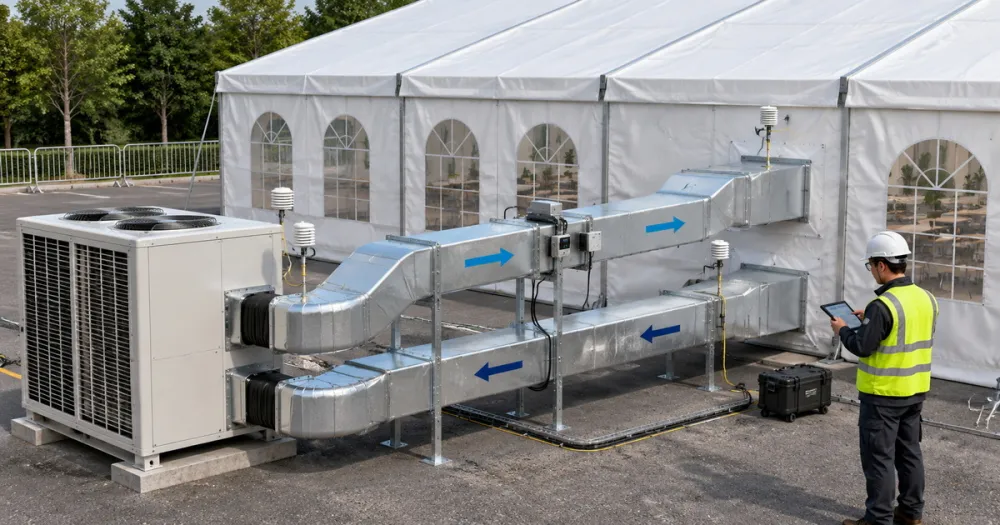
For example, a demonstration might use a short, straight duct with no return connection, while the actual project includes longer ducts, several bends, filters, and restricted adapters. A convincing temperature reading at the outlet does not, by itself, establish useful cooling delivery across that installed system.
The underlying engineering issue is why purpose-built long-duct products specify high-static blowers and explicit configuration limits, while some residential manuals prohibit hose extensions entirely.
Use the following acceptance procedure:
1. Approve a drawing of the complete duct arrangement before testing.
2. Specify the exact hose construction and connectors.
3. Include the proposed return path where applicable.
4. Record airflow, temperature, humidity, power input, and operating conditions.
5. Test continuous operation and condensate handling.
6. Photograph the configuration and record the unit’s serial number.
7. Repeat critical checks on a production unit selected during inspection.
Treat this as a preventive qualification method, not an allegation about any supplier listed here.
How to Verify the Factory, Approve Samples, and Control Delivery
Factory Verification
Ask for the business license, legal company name, factory address, contracting entity, and payment beneficiary details.
Then verify that the production site shown during an audit is the site covered by the relevant documentation. For management-system certificates, check status and scope through IAF CertSearch and resolve discrepancies with the issuing body.
A remote tour can support initial screening, but a larger or more customized program should have a documented audit plan and independent verification where appropriate.
Sample Approval
Use a staged process:
1. Technical feasibility review.
2. Written specification and duct-layout approval.
3. Engineering sample evaluation.
4. Compliance-document review.
5. Pre-production sample approval.
6. Pilot-order inspection.
7. Controlled release to repeat production.
For ODM work, define ownership and access rights for drawings, software, tooling, test data, and replacement parts before development starts.
Freeze the approved bill of materials. Require written authorization before changes to the compressor, fan, motor, controller, heat exchanger, refrigerant specification, duct material, or connectors. EU guidance specifically recognizes product and component changes as reasons to review conformity documentation.
Logistics and Landed Cost
Request a shipping plan based on the exact model, refrigerant information, packed dimensions, weight, and destination.
Ask your freight forwarder to confirm classification, carrier acceptance, and documentation requirements rather than assuming that all air conditioners can follow the same booking procedure.
Also compare:
– Units per container.
– Separate duct and accessory packing volume.
– Loading orientation and handling instructions.
– Spare-parts inclusion.
– Packaging protection.
– Destination electrical compatibility.
– Responsibility for transit damage.
– Warranty labor and parts arrangements.
The lowest unit price may not produce the lowest delivered project cost.
Conclusion: Choose the Manufacturer Around the Installation
The strongest shortlist depends on the application.
DREZ deserves early consideration for tent cooling, temporary structures, and project-specific packaged systems. JHS and AUX are particularly relevant to portable AC sourcing discussions, while larger appliance manufacturers provide additional platform and distribution options. Industrial spot-cooling projects require a different technical review from residential exhaust-hose products.
For a productive quotation, send the supplier your destination market, electrical supply, ambient conditions, required cooling duty, duct layout, annual purchasing forecast, and customization requirements.
For buyers evaluating DREZ, request a documented application review and an itemized OEM/ODM proposal covering the unit, ducts, controls, compliance evidence, testing, spare parts, and delivery schedule. A technically complete proposal provides a stronger foundation for long-term cooperation than a price-only quotation.
FAQ
1. How can I check whether a manufacturer’s ISO certificate is expired, suspended, or unrelated to its factory?
Search IAF CertSearch using the certificate number or company name. Review the status, scope, locations, standard, issuing certification body, and accreditation information. Compare those details with the factory that will manufacture your order.
If information is missing or inconsistent, contact the issuer directly before drawing a conclusion. A certificate for a different legal entity, address, or activity should not automatically qualify your supplier.
2. Can I extend a portable air conditioner’s exhaust hose from two meters to eight meters?
Not without written manufacturer approval for that model and installation.
Some Hisense manuals expressly prohibit replacing, extending, or otherwise modifying the exhaust hose. Where the application genuinely requires a longer run, source a system engineered and validated for that duty rather than assuming an accessory extension is acceptable.
Ask for approved diameter, layout limits, operating conditions, and performance evidence—not just a verbal maximum-length claim.
3. Does CE marking on the compressor mean the complete air conditioner complies?
No. EU guidance states that the party placing the final product on the market must address conformity of the complete product, even when individual components already carry CE marking.
Request the declaration and supporting documentation for the finished air conditioner, including its actual model, electrical configuration, and supplied accessories.
4. What happens if the production factory substitutes a fan or hose material after sample approval?
Make substitutions subject to written engineering approval before shipment.
Your purchasing agreement should require a change request identifying the affected part, reason, performance implications, compliance implications, and validation plan. Product modifications can require updates to the EU Declaration of Conformity and supporting technical documentation.
An approved sample is useful only if production remains traceable to its agreed specification.
5. How can I verify capacity if the factory will not disclose a trustworthy annual-output figure?
Evaluate delivery capability against your actual order rather than relying on a headline factory number.
Request a dated production allocation, component-readiness plan, inspection schedule, and evidence from a pilot batch. Separate installed capacity from current available capacity and from forecast orders.
This distinction is important because published figures may describe different things: DREZ states annual production capacity, TCL’s historical announcement describes overall network capacity, and the cited JHS report describes expected orders.
Reference
1. – General Administration of Customs: “China’s Major Exports by Quantity and Value, September 2025,” providing official broader export context. [english.customs.gov]
2. – China Daily, July 17, 2025: “Meeting global demand for cool products,” reporting Customs air-conditioner export figures and JHS manufacturing developments. [chinadailyhk]
3. – Japan Refrigeration and Air Conditioning Industry Association: 2025 presentation reporting global 2024 air-conditioner demand. [jraia.or]
4. – European Union, Your Europe: CE marking requirements and manufacturer responsibilities. [europa]
5. – European Union, Your Europe: Signing an EU Declaration of Conformity. [europa]
6. – European Commission: RoHS guidance for electrical and electronic equipment. [environment.ec.europa]
7. – IAF CertSearch: Accredited management-system certificate verification. [iafcertsearch]
8. – U.S. Department of Energy: Portable air-conditioner certification and reporting requirements. [energy]
9. – DREZ: Company profile and published manufacturing information. [drezaircon]
10. – Manufacturer publications from Gree, AUX, TCL, JHS, Haier, and Hisense, supplemented by identified supplier and exhibition profiles where primary information was incomplete. [assets.hisense-usa]
Hot Tags: Portable Air Conditioner Manufacturers, Portable Air Conditioner OEM, Portable Air Conditioner ODM, Wholesale Portable Air Conditioners, Air Conditioner Manufacturers In China, Air Conditioner With Long Hose, Tent Air Conditioner Manufacturers, Industrial Spot Cooler Manufacturers, Commercial Portable Air Conditioner Suppliers, Ducted Tent Air Conditioner