Content Menu
● What Does “Air Conditioner With Outdoor Unit” Mean?
● Why Source Air Conditioners From China?
>> A Large Manufacturing and Export Ecosystem
>> Established Regional Manufacturing Clusters
● How These Manufacturers Were Selected
● The Top 10 Manufacturers to Consider
>> 1. DREZ (Guangzhou) Intelligent Technology Co., Ltd.
>>> Suitable for: Customized Tent, Event, and Project-Based Climate Control
>>> Suitable for: Large-Volume Residential and Commercial Programs
>> 3. Gree Electric Appliances
>>> Suitable for: Established Split-System and Commercial HVAC Platforms
>> 4. Haier
>>> Suitable for: Residential and Light-Commercial Programs With Regional Support Requirements
>> 5. Hisense
>>> Suitable for: Inverter Air Conditioning and Export-Oriented Platform Discussions
>>> Suitable for: Residential Split-System Sourcing
>>> Suitable for: Volume Residential and Light-Commercial Programs
>> 8. Chigo
>>> Suitable for: Alternative Residential and Commercial Supply Programs
>> 9. TICA
>>> Suitable for: Commercial, Industrial, and Engineered HVAC Projects
>>> Suitable for: Commercial and Industrial HVAC Procurement
● Manufacturer Comparison: Capacity, MOQ, and Certification Checks
>> 1. Compare Performance Under the Same Conditions
>> 2. Specify Materials Without Oversimplifying Quality
>> 3. Review Manufacturing Processes, Not Just Finished Samples
>> 4. Separate CE Marking From Factory Certification
>> 5. Check Refrigerant Rules Against the Expected Market-Entry Date
● An Overlooked Procurement Trap: Approving a Sample Without Freezing Its Configuration
● How to Verify a Factory Before Placing an Order
>> Step 1: Confirm the Legal and Manufacturing Entities
>> Step 2: Audit the Proposed Production Site
>> Step 3: Approve an Engineering Sample
>> Step 5: Control Delivery and Logistics
● Common Sourcing Problems and How to Avoid Them
● Conclusion: Select the Supplier Around the Application
● FAQ
>> 2. Can One Report Cover Multiple Indoor and Outdoor Unit Combinations?
>> 3. What Should Happen if the Supplier Wants to Change a Compressor After Sample Approval?
>> 4. Is CE Marking Enough to Import a Pre-Charged Air Conditioner Into the EU?
>> 5. How Should a Buyer Protect Spare-Parts Availability for a Long-Term OEM Program?
China offers overseas buyers a broad choice of air conditioner manufacturers, from high-volume residential split-system producers to engineering-led suppliers serving commercial buildings, industrial facilities, and temporary structures. For procurement managers, however, manufacturing scale alone does not identify the right long-term partner.
A dependable supplier must demonstrate consistent cooling performance, traceable components, destination-market compliance, realistic production scheduling, and the engineering resources to support product changes.
What Does “Air Conditioner With Outdoor Unit” Mean?
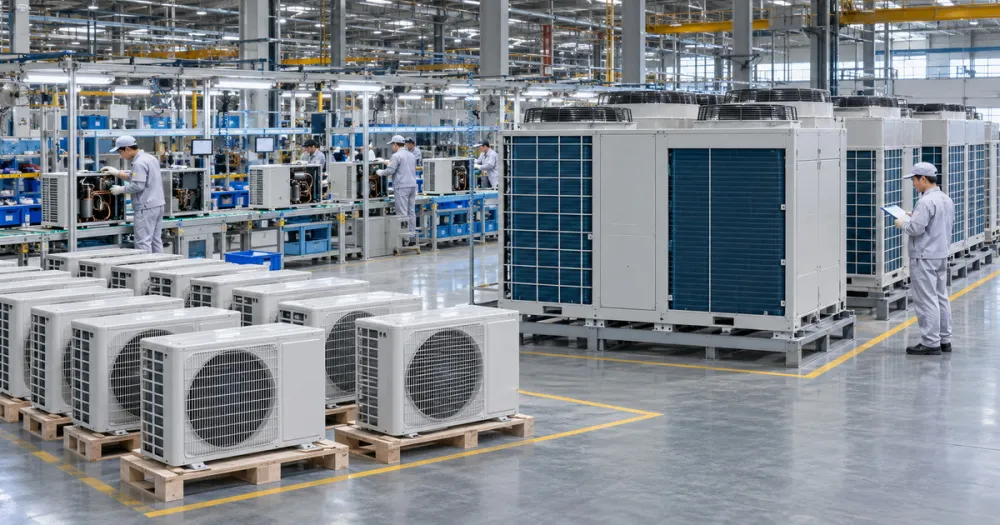
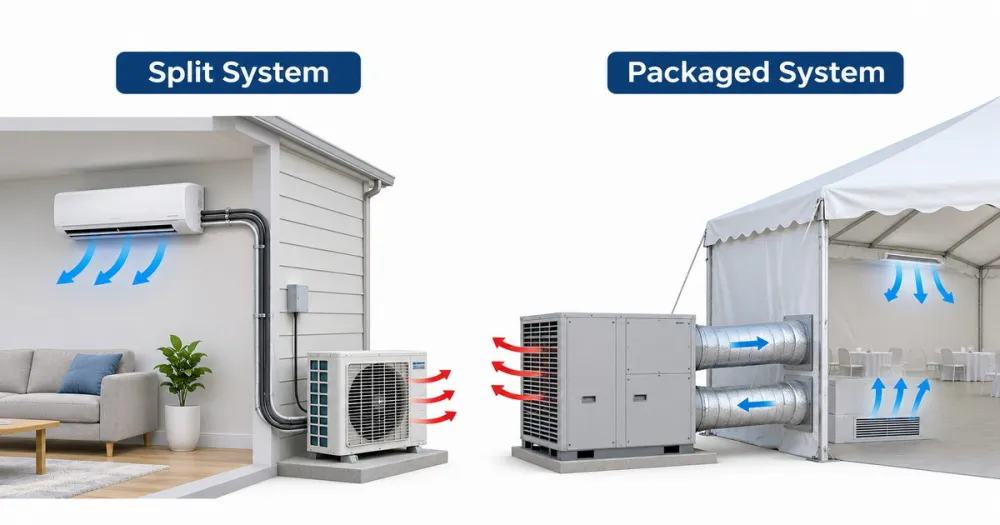
An air conditioner with outdoor unit generally refers to a split system: an indoor unit connects to an outdoor compressor-condensing unit through refrigerant piping and electrical connections. The category includes residential mini-splits, commercial ducted split systems, and variable refrigerant flow systems.
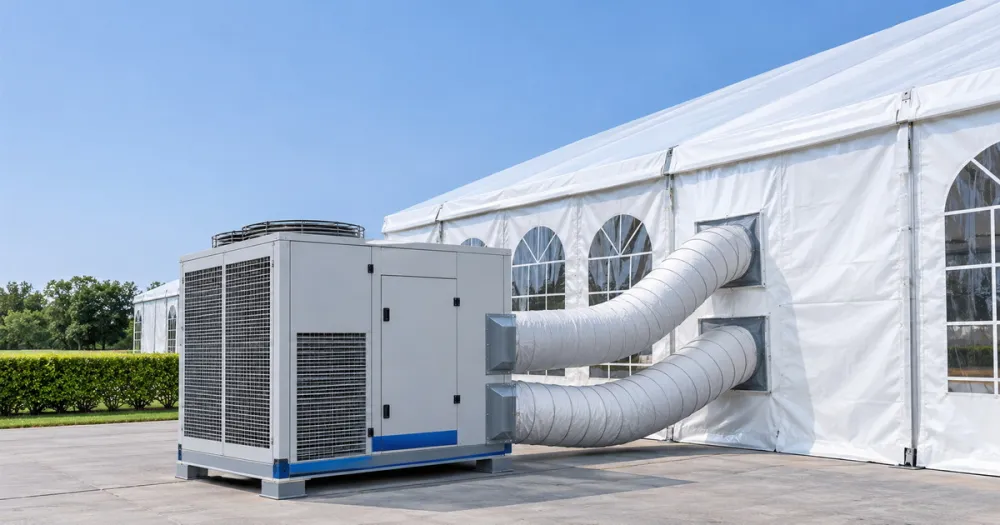
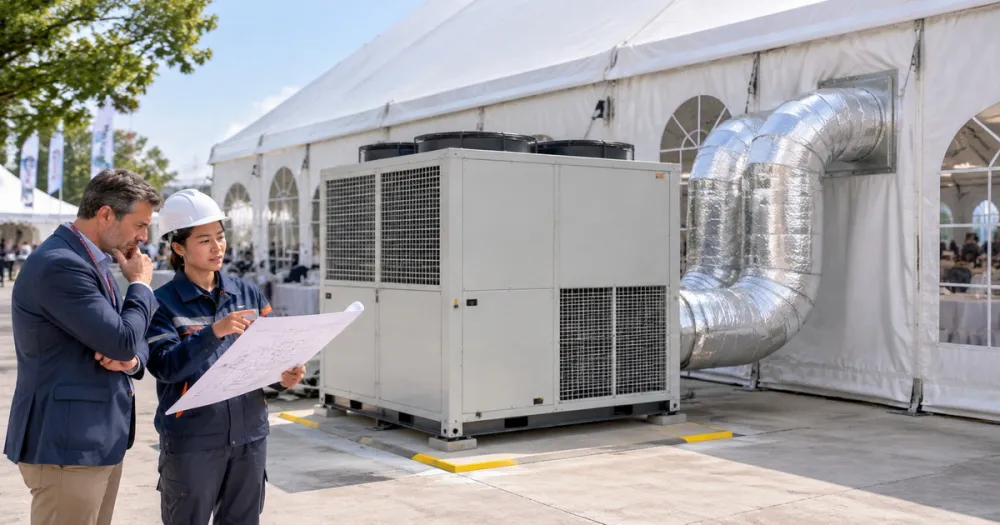
An outdoor-installed packaged air conditioner is different. It combines the refrigeration components within one enclosure and normally delivers conditioned air through ducts rather than connecting to a separate indoor evaporator. DREZ’s published portfolio emphasizes these packaged, rooftop, trailer-mounted, and temporary-structure applications. Buyers seeking a separate indoor/outdoor configuration should request confirmation of the exact available design.
This distinction matters because a strong tent-cooling manufacturer is not automatically the most suitable supplier for a standard residential mini-split program—and the reverse is equally true.
Why Source Air Conditioners From China?
A Large Manufacturing and Export Ecosystem
The China Household Electrical Appliances Association reported that China’s home air conditioner shipments exceeded 210 million units during the 2025 cooling year, covering August 2024 through July 2025. Its review, drawing on ChinaIoL shipment data, recorded exports of 99.29 million units, an increase of 16.7% year over year. These are cooling-year figures, not calendar-year customs totals.
The same report placed domestic home air conditioner production capacity above 300 million units. That figure describes industry capacity—not actual output, available production slots, or the commercial cooling capacity of individual machines.
For overseas buyers, this scale creates a substantial supplier base. It does not eliminate the need to examine financial stability, component consistency, and production allocation.
Established Regional Manufacturing Clusters
Guangdong provides a particularly useful sourcing corridor. Midea’s manufacturing presence in Shunde, Gree’s headquarters in Zhuhai, Chigo’s operations in Foshan, and DREZ’s Guangzhou factory illustrate the concentration of HVAC businesses across the Pearl River Delta.
Other sourcing centers include Qingdao for Haier and Hisense-related operations, Nanjing for TICA, and Yantai for Dunham-Bush’s China manufacturing facility. These locations give buyers access to different product specializations rather than one uniform manufacturing market.
How These Manufacturers Were Selected
The central selection principle is traceability: buyers should be able to connect every important claim to a specific company, factory, product configuration, and supporting document.
The following framework provides a practical way to compare candidates. The weights are proposed purchasing priorities, not scores assigned to the manufacturers below.
| Evaluation area | Suggested weight | Evidence to request |
|---|---|---|
| Application and engineering fit | 25% | Product drawings, operating envelope, selection calculations, matched-system data |
| Quality-control capability | 20% | Inspection plans, test procedures, calibration records, serial-number records |
| Destination-market compliance | 20% | Model-specific declarations, reports, listings, labels, and installation instructions |
| Production and delivery reliability | 15% | Line allocation, component availability, order milestones, capacity assumptions |
| OEM/ODM execution | 10% | Customization scope, sample process, tooling ownership, engineering-change procedure |
| Lifecycle support | 10% | Spare-parts policy, service manuals, warranty process, technical response commitments |
A professional supplier evaluation should examine research and development capability alongside routine manufacturing discipline. Ask how engineering changes move from drawings into purchasing, assembly, testing, and service documentation.
For smaller brands, communication efficiency should also become a measurable purchasing condition: appoint one technical contact, agree on response times, and require consolidated answers to specification questions.
The Top 10 Manufacturers to Consider
1. DREZ (Guangzhou) Intelligent Technology Co., Ltd.
Suitable for: Customized Tent, Event, and Project-Based Climate Control
DREZ describes itself as an integrated HVAC supplier covering research and development, manufacturing, sales, and leasing. Its published applications include large tents, steel structures, exhibitions, festivals, industrial spaces, emergency response, and temporary outdoor activities.
– Establishment background: DREZ’s About Us page dates the parent DREZ Group to 2001. It does not clearly establish the incorporation year of the Guangzhou subsidiary.
– Manufacturing location: Shawan, Panyu, Guangzhou.
– Published scale: More than 6,000 square meters of factory space and annual production capacity exceeding 10,000 units.
– Market coverage: Mainland China, Hong Kong, and Macao are identified in its background information; its current website reports exports to more than 60 countries.
– OEM/ODM scope: Customized climate-control equipment adapted to structural layouts, installation requirements, and project specifications.
DREZ merits consideration when a small or medium-sized brand needs more engineering involvement than a standard catalog purchase provides. Its published OEM/ODM offering supports discussion of equipment configuration and application-specific design rather than branding alone.
Its potential value proposition is therefore project flexibility and cost-to-specification alignment—not an unverified claim that it always offers the lowest price. Procurement teams should test this proposition through a detailed quotation, drawing review, sample evaluation, and agreed communication milestones.
An important qualification: the publicly documented range emphasizes packaged equipment. For an air conditioner with outdoor unit requiring a physically separate indoor section, request a configuration drawing and written confirmation before placing an order.
2. Midea Group
Suitable for: Large-Volume Residential and Commercial Programs
Midea was founded in 1968 and reports operations across more than 200 countries and regions. Its product portfolio includes residential and commercial air conditioning, supported by an extensive international research network.
– Establishment year: 1968 for the group; Midea Building Technologies dates its establishment to 1999.
– Manufacturing background: A multinational production network rather than a single China-only factory.
– Published scale: A 2024 company release reported air conditioner production capacity exceeding 67 million units annually across 11 facilities.
– Market coverage: Global.
– OEM/ODM relevance: Midea’s published production disclosures explicitly include OEM-brand air conditioners; the commercial and technical scope of a new program must be negotiated with the relevant division.
Midea is a logical candidate for buyers seeking standardized product platforms and substantial volume capability. Its commercial portfolio also includes VRF, light-commercial air conditioners, and compressor-condensing units.
Buyers should identify the contracting entity and manufacturing site early. Group-level capacity does not establish the capacity available for a particular voltage, refrigerant, or private-label program.
3. Gree Electric Appliances
Suitable for: Established Split-System and Commercial HVAC Platforms
Founded in 1991 and based in Zhuhai, Gree specializes in residential and commercial air conditioning. Its published range includes mini-split and central air conditioning systems.
– Establishment year: 1991.
– Core strength: Broad HVAC specialization and substantial research infrastructure.
– Market coverage: International; its official materials describe extensive worldwide distribution.
– OEM/ODM scope to discuss: Approved platform selection, private-label eligibility, controller options, and documentation for the intended destination. New OEM availability should not be assumed from manufacturing scale alone.
Gree belongs on the shortlist when buyers prioritize an established air conditioning platform and a broad product family.
The key purchasing question is not simply whether Gree manufactures the required capacity. It is whether the relevant business unit will support the buyer’s brand, territory, order volume, customization requirements, and service responsibilities.
4. Haier
Suitable for: Residential and Light-Commercial Programs With Regional Support Requirements
Haier Group was founded in 1984. Its air conditioning business serves residential and commercial applications, while its European HVAC operation emphasizes regional technical assistance and after-sales support.
– Establishment year: 1984 for Haier Group.
– Core strength: International operations combining local research, manufacturing, marketing, and service.
– Market coverage: North America, Europe, Asia, and other international regions.
– OEM/ODM scope to discuss: Destination-specific platform adaptation, controls, labeling, and service documentation; private-label access requires direct confirmation.
Haier is relevant for buyers who place significant weight on regional market adaptation and an established product-support structure.
However, a branded distribution relationship and a private-label manufacturing agreement are different arrangements. Confirm which model the relevant subsidiary offers before investing in product qualification.
5. Hisense
Suitable for: Inverter Air Conditioning and Export-Oriented Platform Discussions
Hisense’s published history dates the establishment of its air conditioning company to 1996. The same history describes an international expansion strategy that used OEM business to develop overseas channels and operating experience.
– Establishment year: 1996 for the air conditioning company; the wider group predates it.
– Core strength: Inverter air conditioning experience.
– Market coverage: China and international markets through the group’s overseas development.
– OEM/ODM scope to discuss: Platform-based branding, electrical configurations, controls, and market-specific documentation, subject to the relevant entity’s current offering.
Hisense is worth evaluating when buyers want an established appliance group with documented OEM experience.
For commercial projects, clarify the exact manufacturer. Hisense-branded equipment and equipment supplied by related joint ventures should not be treated as interchangeable products with identical approvals or contractual support.
6. AUX Air Conditioning
Suitable for: Residential Split-System Sourcing
AUX entered the air conditioning industry in 1994. Its published company introduction describes an integrated business covering design, research and development, production, sales, and service.
– Establishment year: 1994 for the air conditioning business; AUX Group was founded in 1986.
– Core strength: Dedicated residential air conditioning manufacturing.
– Market coverage: Its commercial air conditioning website reports sales across more than 150 countries and regions.
– OEM/ODM scope to discuss: Standard-platform branding, packaging, electrical variants, and approved control options; exact customization rights and minimum orders require a quotation.
AUX is a relevant candidate for importers comparing residential split-system platforms.
Procurement teams should distinguish modifications supported by existing production and test documentation from changes that require additional engineering work. A different refrigerant, major control change, or revised heat exchanger should not be treated as a simple cosmetic option.
7. TCL Air Conditioner
Suitable for: Volume Residential and Light-Commercial Programs
TCL dates its air conditioning business to 1999. Its current global profile reports 12 global bases and annual capacity exceeding 38 million units.
– Establishment year: 1999 for the air conditioning business.
– Core strength: Large-scale manufacturing across residential, commercial, and specialized air conditioning.
– Market coverage: TCL reports exports to more than 160 markets.
– OEM/ODM scope to discuss: Platform selection, branding, user-interface options, packaging, and destination-specific configurations, subject to program approval.
TCL also publishes light-commercial technical catalogs that identify nominal test conditions. This makes it possible for buyers to compare quoted cooling performance on a defined basis rather than relying only on headline capacity.
Ask which production base will manufacture the order and whether the quoted delivery date includes customized labels, manuals, accessories, and inspection.
8. Chigo
Suitable for: Alternative Residential and Commercial Supply Programs
Chigo was founded in 1994 and identifies Nanhai, Foshan, as its headquarters location. Its published product range includes residential and commercial air conditioning, heat pumps, and refrigeration equipment.
– Establishment year: 1994.
– Core strength: Air conditioning manufacturing within Guangdong’s established industrial base.
– Published scale: More than six million sets of annual production capacity across its stated southern and eastern China bases.
– Market focus: China-based manufacturing with export-oriented supplier activity; request current destination references rather than relying on historical reach.
– OEM/ODM scope to discuss: Private-label standard models and export configurations; verify the current contracting and manufacturing entities.
Chigo provides an additional option for buyers seeking a second-source manufacturer.
Its evaluation should emphasize present-day operations: inspect the proposed factory, verify certificate ownership, review recent shipments where available, and confirm who supplies replacement electronics and compressors.
9. TICA
Suitable for: Commercial, Industrial, and Engineered HVAC Projects
Established in 1991, TICA describes itself as a provider of HVAC and thermal-utilization solutions. Its published materials document international operations and VRF manufacturing experience.
– Establishment year: 1991.
– Core strength: Engineered commercial HVAC rather than only household appliance production.
– Market coverage: China and international project markets, supported by overseas operations and branches.
– OEM/ODM scope to discuss: Project-specific equipment selection, controls integration, and engineering adaptations; private-label manufacturing is not established by the reviewed material.
TICA is relevant when the purchasing requirement involves a building system rather than a standalone retail product.
For a project requiring an outdoor condensing unit, obtain a complete equipment schedule identifying indoor equipment, outdoor equipment, controls, piping limits, and commissioning responsibilities.
10. Dunham-Bush
Suitable for: Commercial and Industrial HVAC Procurement
Dunham-Bush traces its origins to the United States in 1894 and opened its Yantai manufacturing plant in China in 1995. It is included here as a manufacturer operating in China, not as a Chinese-origin brand.
– Establishment year: 1894 globally; China manufacturing established in 1995.
– Core strength: Commercial and industrial air conditioning.
– Manufacturing footprint: Published facilities include Yantai, China; Kajang, Malaysia; and Miami, United States.
– Market coverage: International commercial and industrial projects.
– OEM/ODM scope to discuss: Engineered configurations and project adaptations; private-label availability requires direct confirmation.
Dunham-Bush is more relevant to technically specified commercial projects than to a small residential private-label launch.
Buyers should verify that the proposed product is manufactured at the expected facility and that local commissioning, documentation, and service arrangements meet the project specification.
Manufacturer Comparison: Capacity, MOQ, and Certification Checks
Published manufacturing capacity is not directly comparable across these businesses. Residential units, large packaged systems, and engineered commercial equipment require different production resources.
No independently verified, universally applicable MOQ was established for these ten suppliers. Minimum orders may change with model, destination, branding, tooling, and electrical configuration.
| Manufacturer | Published capacity or manufacturing indicator | MOQ status | Certification evidence to obtain |
|---|---|---|---|
| DREZ | More than 10,000 units/year; supplier-stated | Request configuration-specific MOQ | Current factory certificates and exact-model destination documents |
| Midea | More than 67 million AC units/year reported in 2024; global network | Request by platform and customization level | Factory identity, matched-system reports, applicable market listings |
| Gree | Large international HVAC organization; no comparable current unit figure used here | Confirm program eligibility and MOQ | Exact indoor/outdoor combination and relevant compliance records |
| Haier | International manufacturing network; no comparable AC-only figure used here | Confirm by entity and product family | Manufacturing-site records and destination-specific documents |
| Hisense | Established AC manufacturing business; no comparable capacity figure used here | Request by contracting entity | Exact manufacturer, model scope, and current approvals |
| AUX | Integrated AC design and manufacturing business | Request by configuration | Product-specific reports, declarations, and labels |
| TCL | More than 38 million units/year; global capacity | Request by factory and platform | Exact electrical version, system pairing, and market documents |
| Chigo | More than six million sets/year; supplier-stated | Request current factory quotation | Current legal entity, factory scope, and exact-model documents |
| TICA | Multiple factories and international operations | Project-specific quotation | Equipment schedule, performance evidence, and applicable approvals |
| Dunham-Bush | Published manufacturing facilities in China, Malaysia, and the US | Project-specific quotation | Production origin, project compliance, and performance documentation |
The final column is a purchasing checklist, not a claim that every listed supplier holds every possible certificate.
Technical Buyer’s Guide
1. Compare Performance Under the Same Conditions
A nominal cooling-capacity figure is incomplete without its rating conditions.
For example, TCL’s 2025 light-commercial catalog specifies indoor and outdoor temperatures and equivalent refrigerant-piping length for nominal cooling ratings. Buyers should request equivalent information from every candidate so that quotations describe comparable operating conditions.
Include the following in the request for quotation:
– Design outdoor temperature and indoor temperature/humidity.
– Required total and sensible cooling capacity.
– Electrical supply, frequency, and phase.
– Refrigerant-piping length and elevation difference.
– Airflow and external static pressure for ducted equipment.
– Required operating envelope and protective controls.
– Noise measurement conditions.
– Installation, maintenance, and service clearances.
For temporary structures, also define occupancy, fresh-air requirements, door-opening frequency, solar exposure, and duct routing. Require the supplier to document the assumptions behind its equipment selection.
2. Specify Materials Without Oversimplifying Quality
A phrase such as “premium copper” is not a measurable specification.
Instead, require a controlled material schedule covering:
| Component | Information to define |
|---|---|
| Refrigerant tubing | Material specification, dimensions, approved construction, joining requirements |
| Heat exchanger | Tube and fin construction, coating, performance requirements |
| Outdoor cabinet | Base material, thickness, coating system, corrosion-test acceptance criteria |
| Fasteners | Material or coating appropriate to the installation environment |
| Electrical enclosure | Protection level, cable entries, grounding, environmental exposure |
| Controls | PCB revision, firmware version, sensor specifications, approved replacements |
Do not assume that one material choice automatically makes every product better. Evaluate the complete design, corrosion protection, serviceability, and verified performance.
The practical safeguard against material substitution is a signed bill of materials supported by inspection rights and written approval requirements for changes.
3. Review Manufacturing Processes, Not Just Finished Samples
Ask prospective suppliers to show how they control:
1. Incoming compressors, motors, tubing, and electronics.
2. Refrigeration-circuit joining and cleanliness.
3. Pressure and leak testing.
4. Evacuation and refrigerant charging.
5. Electrical safety checks.
6. Functional and performance testing.
7. Calibration and test-equipment maintenance.
8. Serial-number records and nonconforming-product handling.
Agree which tests apply to every unit and which apply to sampled units. The inspection plan should identify acceptance limits, records to retain, and responsibility for corrective action.
4. Separate CE Marking From Factory Certification
CE marking is the manufacturer’s declaration that a product meets applicable European requirements. It is not a general quality award or an approval issued by the European Union. The manufacturer must establish the relevant conformity assessment, technical documentation, and EU Declaration of Conformity.
For an EU-bound product, request a compliance matrix identifying applicable electrical safety, electromagnetic compatibility, restricted-substance, energy-performance, and other product-specific obligations. Do not accept a document package merely because it contains familiar logos.
Also establish the private-label brand’s responsibilities. EU guidance explains that a business having products made and selling them under its own name or trademark can be treated as the manufacturer. Outsourcing production does not automatically outsource every legal obligation.
5. Check Refrigerant Rules Against the Expected Market-Entry Date
Refrigerant selection affects the commercial life of a product platform.
The European Commission states that, from January 1, 2025, single-split air conditioning systems containing less than 3 kg of fluorinated greenhouse gases with a global warming potential of 750 or more are prohibited from being placed on the EU market. It also identifies additional restrictions beginning in 2027 for specified self-contained equipment.
Do not apply the same rule indiscriminately to split and packaged systems. Check the equipment category, capacity, refrigerant, applicable exceptions, and expected placing-on-the-market date with a qualified compliance adviser.
For relevant pre-charged equipment, EU importers must also address HFC quota accounting and associated documentation.
An Overlooked Procurement Trap: Approving a Sample Without Freezing Its Configuration
A less-discussed risk is configuration drift between the approved sample and mass production.
The sample may perform satisfactorily, yet the purchasing agreement may leave room to change the compressor model, fan motor, heat exchanger, PCB, firmware, or indoor/outdoor pairing. A familiar cabinet and unchanged sales model number do not give the buyer enough information to control those changes.
This guide does not claim that any listed manufacturer follows such practices. It identifies a contractual risk worth addressing with every supplier.
Use the following safeguards:
– Record the approved indoor and outdoor model combination.
– Attach the critical-component bill of materials.
– Record controller and firmware revisions.
– Define which alternatives are already approved.
– Require written notification before substitutions.
– Specify when a change triggers retesting or renewed approval.
– Retain an approved reference sample where practical.
– Link production serial numbers to the accepted configuration.
This approach also supports compliance review: EU guidance requires technical documentation and declarations to remain up to date, making product changes more than a purchasing-detail issue.
How to Verify a Factory Before Placing an Order
Step 1: Confirm the Legal and Manufacturing Entities
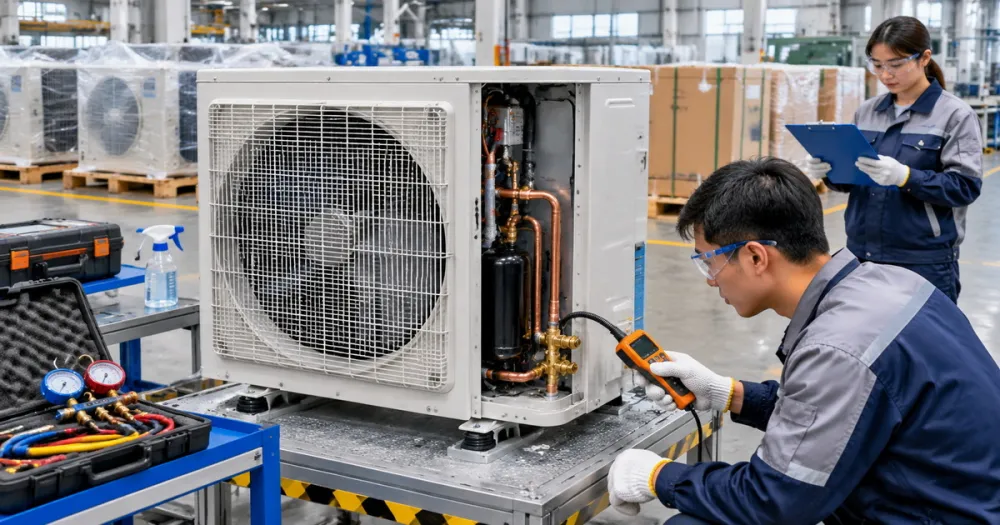
Request the business license, legal company name, registration identifier, factory address, contracting entity, and export entity.
If these differ, ask for a clear explanation of the relationship. Align the contract, payment instructions, inspection location, certificate scope, and warranty responsibilities.
Step 2: Audit the Proposed Production Site
Use an on-site inspection or independent audit to examine the actual line intended for the order.
Review component storage, production control, test stations, calibration records, traceability, rework procedures, and finished-goods handling. Ask to see records from representative production rather than only a demonstration unit.
Step 3: Approve an Engineering Sample
Evaluate the sample against a signed specification.
For a split system, record both indoor and outdoor identifiers. Check installation instructions, piping requirements, operating behavior, drainage, controls, noise, packaging, labels, and access for maintenance.
Avoid approving a sample solely from photographs or a short video showing cold discharge air.
Step 4: Run a Pilot Order
A pilot order tests repeatability, packaging, documentation, and communication—not only equipment performance.
Define the inspection scope and corrective-action process before production starts. Close significant deviations before authorizing a larger release.
Step 5: Control Delivery and Logistics
Require a schedule covering component procurement, production, testing, inspection, and shipment readiness.
For shipping, confirm:
– Dimensions, weights, lifting points, and stacking limits.
– Export packaging and moisture protection.
– Refrigerant details and carrier acceptance requirements.
– Protection for service valves, coils, and controls.
– Document requirements for the destination.
– Responsibility for freight, insurance, clearance, and damage claims.
Ask the freight forwarder to confirm the treatment of the actual charged equipment. Do not assume that every refrigerant-filled product can move under the same transport arrangements.
Common Sourcing Problems and How to Avoid Them
| Procurement problem | Why it creates risk | Practical control |
|---|---|---|
| Comparing headline cooling capacities | Rating conditions may differ | Require the same test basis |
| Accepting a generic compliance document | It may not cover the ordered configuration | Match models, electrical versions, manufacturer, and scope |
| Treating group capacity as order allocation | Production may already be committed | Obtain a dated production plan |
| Approving appearance instead of construction | Internal substitutions may remain uncontrolled | Freeze the critical bill of materials |
| Assuming customization means unlimited redesign | Changes may affect testing, cost, and lead time | Define engineering scope before deposit |
| Ignoring replacement electronics | Service may depend on specific PCB and firmware versions | Agree a spare-parts and compatibility policy |
| Ordering packaged equipment for a split-system requirement | Installation architecture differs | Approve a system diagram before purchase |
Conclusion: Select the Supplier Around the Application
For standard residential split-system programs, Midea, Gree, Haier, Hisense, AUX, TCL, and Chigo provide relevant starting points. For engineered commercial or industrial projects, TICA and Dunham-Bush warrant consideration. DREZ is particularly relevant to customized tent, event, temporary-structure, and project-based cooling, with the exact split or packaged configuration requiring confirmation.
The strongest sourcing decision comes from comparing an approved technical specification, documented compliance, production repeatability, and lifecycle support—not from the lowest initial quotation.
For a DREZ project review, submit the application, destination country, design temperatures, electrical supply, required capacity, preferred system architecture, order quantity, and branding requirements. Request a configuration drawing, itemized quotation, sample plan, compliance-document list, and delivery schedule before committing to production.
FAQ
1. How Can I Verify Whether a Factory’s ISO Certificate Has Expired, Been Suspended, or Covers the Wrong Site?
Obtain the complete certificate and check the legal name, factory address, standard, scope, certificate number, issuing body, and validity dates.
Search the certificate through IAF CertSearch and, where necessary, contact the certification body directly. IAF CertSearch is an official database for validating accredited management-system certifications and their accreditation chain.
An apparently valid expiry date does not resolve every question. Confirm current status and whether the manufacturing site and activity relevant to the order fall within scope.
2. Can One Report Cover Multiple Indoor and Outdoor Unit Combinations?
Do not assume so.
Request the report’s model schedule and the supplier’s documented explanation of which combinations it covers. Check electrical supply, refrigerant, controls, and critical components against the order.
For EU conformity, the manufacturer remains responsible for the complete product and must maintain supporting documentation appropriate to that product. A report for a related model is not, by itself, sufficient evidence for every variation.
3. What Should Happen if the Supplier Wants to Change a Compressor After Sample Approval?
Require a written engineering-change request before accepting the substitution.
The request should identify the old and proposed components, explain the reason, assess performance and compliance effects, and state the required verification work.
The contract should define who pays for retesting and whether shipment must pause pending approval. Relevant declarations and technical documentation must remain current when product changes affect conformity.
4. Is CE Marking Enough to Import a Pre-Charged Air Conditioner Into the EU?
No. CE conformity is only part of the review.
Buyers must also consider the equipment’s refrigerant category, applicable placing-on-the-market restrictions, HFC quota accounting where relevant, and importer documentation. The European Commission identifies separate obligations for pre-charged refrigeration, air conditioning, and heat-pump equipment.
Complete this review before purchase, particularly when stock may arrive near a regulatory transition date.
5. How Should a Buyer Protect Spare-Parts Availability for a Long-Term OEM Program?
Make spare-parts support a contractual deliverable.
Define the support period, parts list, identification system, pricing method, lead times, firmware compatibility, and notification period before component discontinuation.
For critical electronics, agree how replacement boards will be configured and whether later revisions remain compatible with installed units. Include service manuals, wiring diagrams, fault-code documentation, and a technical escalation process in the handover package.
Reference Notes
1. – China Household Electrical Appliances Association, “Total Shipments Surpass 200 Million Units: A Review of China’s Air Conditioner Industry in the 2025 Cooling Year.” This is the source for the cooling-year shipment and export figures used above. [en.cheaa]
2. – European Union, Your Europe, guidance on CE marking and manufacturer responsibilities. [europa]
3. – European Commission, guidance on air conditioning alternatives and F-gas restrictions. [climate.ec.europa]
4. – European Commission, guidance on F-gases in equipment and products. [climate.ec.europa]
5. – IAF CertSearch, accredited management-system certification validation. [iafcertsearch]
Hot Tags: Air Conditioner With Outdoor Unit, Air Conditioner Manufacturers In China, OEM Air Conditioner Manufacturer, ODM Air Conditioner Manufacturer, Split Air Conditioner Manufacturer, Commercial Air Conditioner Manufacturer, Industrial Air Conditioner Supplier, Wholesale Air Conditioners, Tent Air Conditioner Manufacturer, Custom Air Conditioning Solutions