Content Menu
● Understand the Product Before Comparing Manufacturers
● Why Source Outside-Air Conditioning Equipment From China?
>> Established Manufacturing Networks
>> Substantial Export Activity, With Important Statistical Limits
● Selection Criteria: How This Shortlist Was Built
● The Top 10 Manufacturers to Evaluate
>> 1. DREZ (Guangzhou) Intelligent Technology Co., Ltd.
>> 3. Gree Electric Appliances, Inc. of Zhuhai
>> 4. Haier Group / Haier HVAC
>> 6. TICA
>> 7. Guangdong Shenling Environmental Systems Co., Ltd.
>> 8. AUX
>> 9. Chigo
>> 10. Guangdong Euroklimat Air-Conditioning & Refrigeration Co., Ltd.
● Manufacturer Comparison: Capacity, MOQ, and Certification
>> Specify Outside Air as a Measurable Requirement
>> Compare Materials Through a Written Specification
>> Treat CE and RoHS Correctly
>> Verify the Factory, Then Approve the Sample
>> Plan Logistics Around Installation and Service
● An Overlooked Procurement Trap: “Fresh Air” at Zero Useful Pressure
● FAQ
>> 1. How Can I Verify Whether a Manufacturer’s ISO Certificate Has Expired?
>> 2. Can an Outdoor-Installed Tent Air Conditioner Supply 100% Outside Air?
>> 3. What Should Happen if the Supplier Changes the Compressor or Coil After Sample Approval?
>> 4. Is a CE-Marked Sample Enough to Approve a Customized Production Order?
>> 5. How Can Buyers Compare Two Units With the Same Nominal Cooling Capacity?
China offers a broad supplier base for buyers sourcing an air conditioner with outside air capability, from manufacturers of portable tent cooling equipment to large producers of commercial ventilation and air-handling systems. However, identifying a suitable long-term manufacturing partner requires more than comparing cooling capacity and unit prices.
Understand the Product Before Comparing Manufacturers
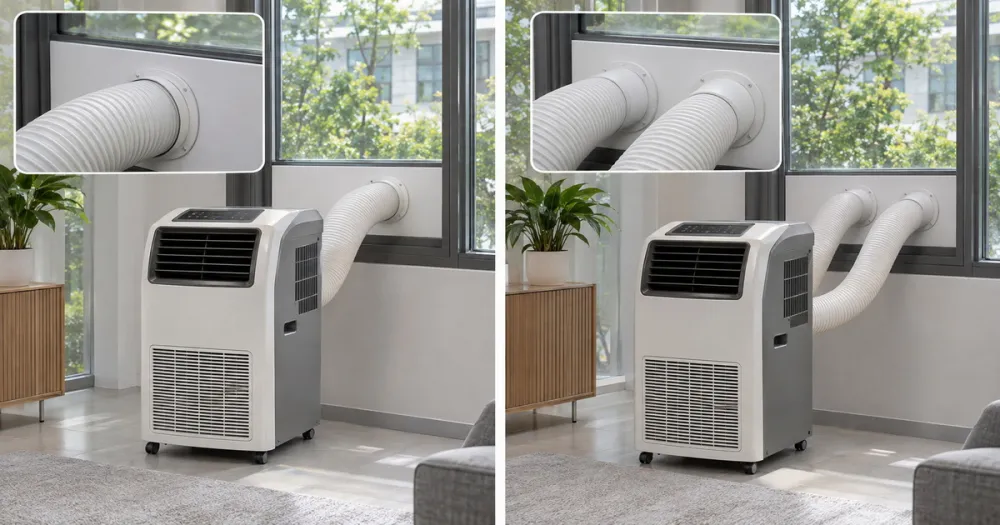
The phrase “Air Conditioner With Outside” can describe several different configurations. These configurations are not technically interchangeable.
| Configuration | What it does | What buyers must verify |
|---|---|---|
| Split air conditioner with an outdoor unit | Transfers heat between indoor and outdoor sections through a refrigerant circuit | An outdoor condenser does not automatically provide outdoor ventilation air |
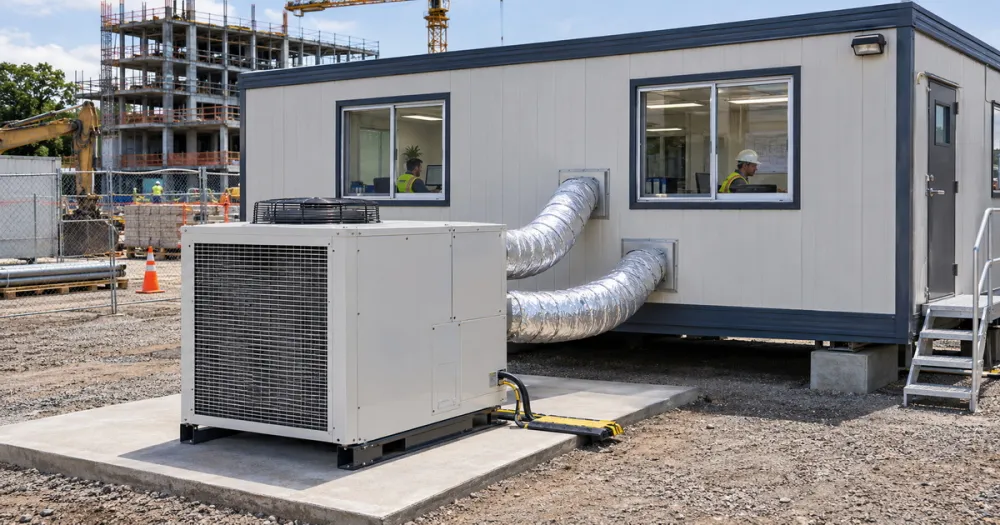
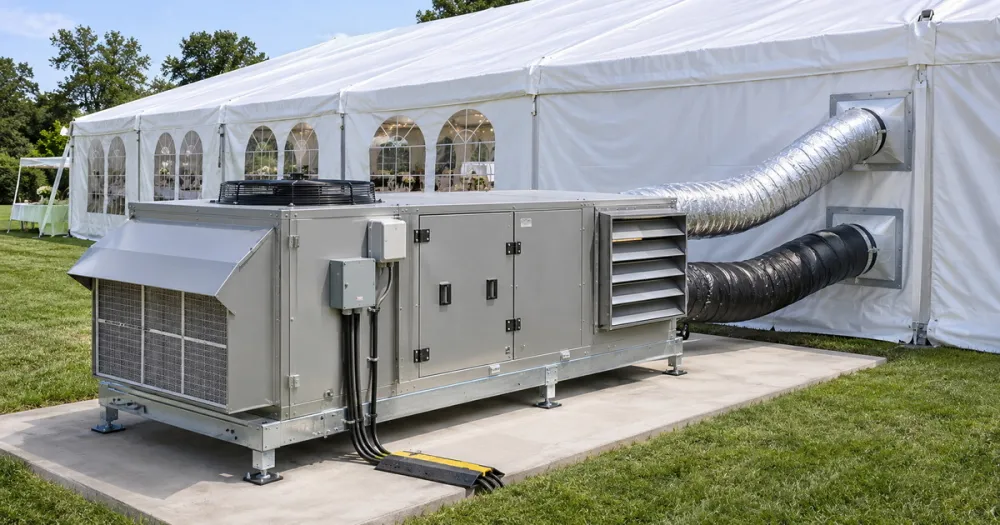
| Outdoor-installed packaged air conditioner | Places the refrigeration equipment outside and delivers conditioned air through ducts | Whether the supply circuit uses return air, outdoor air, or a controlled mixture |
| Air conditioner with a fresh-air connection | Introduces a specified quantity of outdoor air | Measured outdoor airflow and cooling performance at that airflow |
| Dedicated outdoor air system, or DOAS | Conditions ventilation air separately from the main space-cooling system | Moisture removal, supply-air conditions, controls, and integration requirements |
| Air-handling unit with cooling | Filters, mixes, and conditions air using a selected cooling source | Coil selection, casing construction, fan pressure, filtration, and system compatibility |
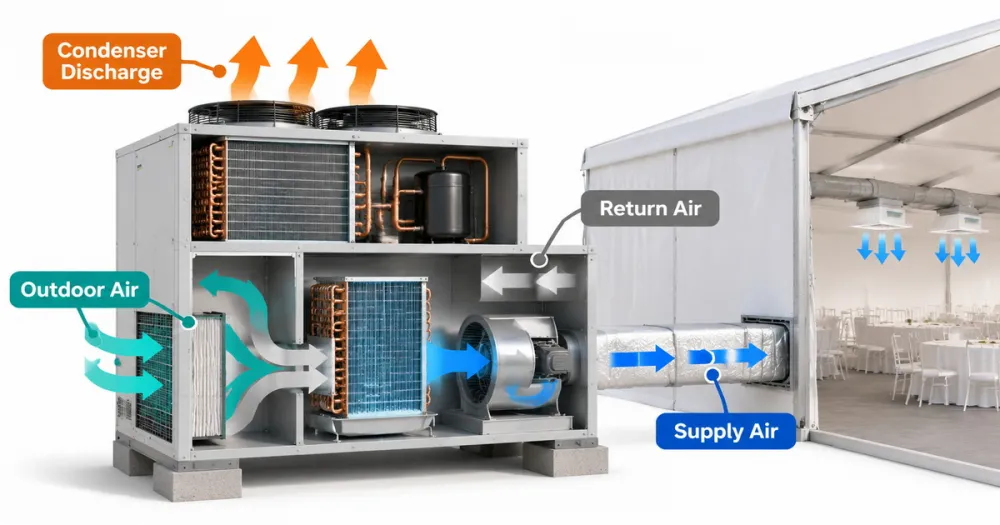
A unit standing outside a tent may recirculate indoor air almost entirely. Conversely, equipment designed to condition substantial outdoor airflow must handle the temperature and moisture entering with that air. ASHRAE distinguishes dedicated outdoor-air treatment from the equipment responsible for maintaining space temperature.
Why Source Outside-Air Conditioning Equipment From China?
Established Manufacturing Networks
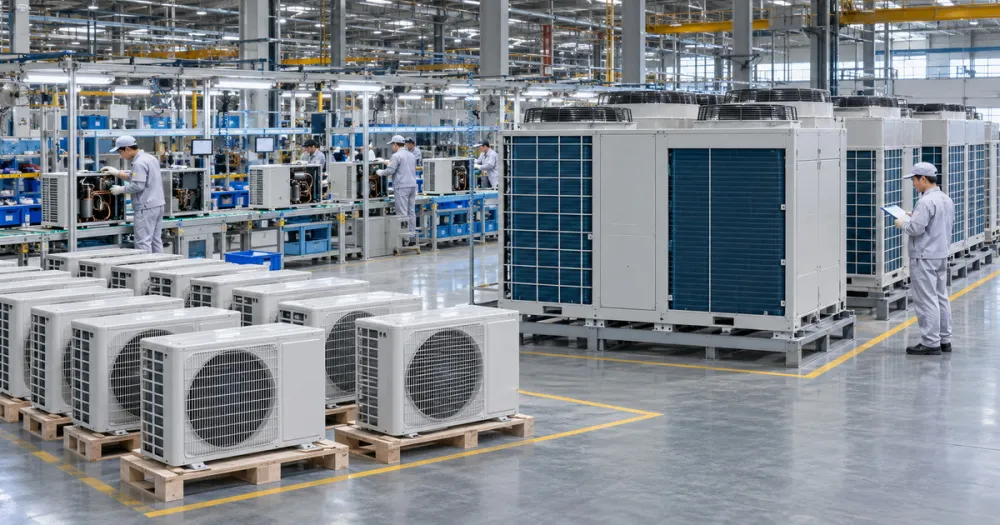
China’s supplier base includes large appliance manufacturers, commercial HVAC specialists, component producers, sheet-metal fabricators, and controls suppliers.
Guangdong is particularly relevant to this shortlist. DREZ operates in Guangzhou; Midea is associated with Shunde, Foshan; Gree is based in Zhuhai; and Shenling and Chigo also have operations in the Foshan area. DREZ specifically identifies its location near Southern China’s HVAC manufacturing and development cluster. This geographic concentration provides buyers with several supplier categories within one regional sourcing itinerary.
Substantial Export Activity, With Important Statistical Limits
A September 2025 review published by the China Household Electrical Appliances Association reported that China’s home air-conditioner shipments exceeded 210 million units in the 2025 cooling year. It also cited ChinaIoL export shipments of 99.29 million units, up 16.7% year on year. These are home-air-conditioner industry figures, not production figures for fresh-air systems or tent air conditioners specifically.
A later China Refrigeration and Air-Conditioning Industry Association review, published in August 2026, reported that calendar-year 2025 customs export value for the broader air-conditioner category declined slightly. Its reporting-enterprise data showed different trends across commercial equipment categories. These findings are not directly contradictory: reporting periods, product coverage, shipment quantities, and export values differ.
For procurement managers, the practical implication is straightforward: China offers considerable manufacturing depth, but national shipment figures cannot establish a particular factory’s available capacity or product suitability.
Selection Criteria: How This Shortlist Was Built
The following criteria provide a transparent basis for initial supplier screening.
| Evaluation area | Evidence buyers should request |
|---|---|
| Manufacturing identity | Business license, production-site address, factory ownership or operating relationship |
| Application fit | Relevant product drawings, selection sheets, and comparable project references |
| Engineering capability | Documented ability to select fans, coils, controls, refrigeration components, and electrical configurations |
| Quality assurance | Incoming inspection records, refrigerant-circuit testing, electrical checks, and final inspection procedures |
| Compliance | Model-specific declarations, reports, registrations, and applicable certificates |
| Production reliability | Current line loading, critical-component availability, and written production milestones |
| OEM/ODM suitability | Confirmed customization scope, development charges, design ownership, and change-control procedures |
| Lifecycle support | Spare-parts policy, service documentation, warranty responsibilities, and troubleshooting support |
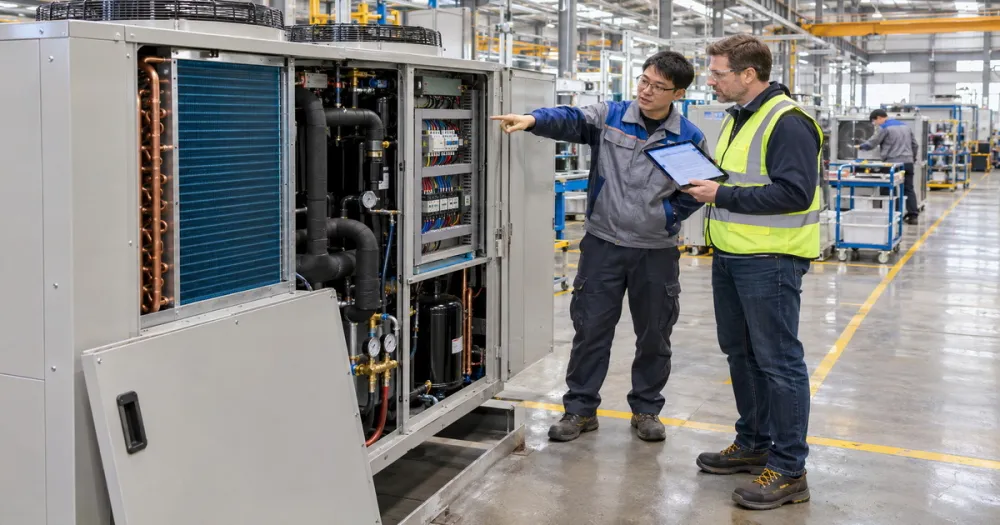
The Top 10 Manufacturers to Evaluate
1. DREZ (Guangzhou) Intelligent Technology Co., Ltd.
DREZ is a specialist candidate for buyers whose applications involve temporary structures, events, industrial spaces, and project-based cooling rather than conventional residential installations.
– Establishment: DREZ’s website dates DREZ Group to 2001. It does not establish the incorporation year of DREZ (Guangzhou) Intelligent Technology Co., Ltd.; buyers should verify that separately.
– Location: Shawan, Panyu, Guangzhou, Guangdong.
– Published manufacturing scale: A factory exceeding 6,000 square meters and stated annual production capacity exceeding 10,000 units.
– Documented market background: Mainland China, Hong Kong, and Macao project activity; the company states that overseas expansion began in 2015.
– Application strengths: Large tents, steel structures, exhibitions, festivals, emergency-response settings, and industrial cooling. These are company-published statements rather than independently audited performance findings.
For smaller overseas brands, DREZ is worth evaluating as a specialist alternative to high-volume appliance groups. Its integrated research, manufacturing, and service positioning is relevant where procurement requires discussion of duct layouts, equipment placement, electrical supply, and site-specific operating requirements.
The commissioning brief identifies OEM/ODM services as part of DREZ’s offering. Buyers should ask the company to define the available scope for branding, cabinet changes, controls, electrical configurations, and air-path modifications in writing.
Flexibility, communication efficiency, and value for money should be evaluated through a structured quotation and sample project—not treated as established advantages without comparison. A useful first test is whether DREZ returns a coordinated technical response covering the requested configuration, exclusions, development costs, and acceptance criteria.
For outside-air applications specifically, request confirmation of the outdoor-air intake arrangement and performance at the required fresh-air percentage. A tent-cooling background alone does not prove DOAS capability.
2. Midea Group
Midea is an appropriate large-scale candidate for buyers seeking a broad residential and commercial air-conditioning portfolio.
– Established: 1968.
– Manufacturing base: Associated with Shunde, Foshan, Guangdong.
– Market coverage: Global.
– Core strengths: Broad air-treatment product coverage, including residential and commercial air-conditioning solutions.
– OEM/ODM relevance: Midea has an established history of supplying other brands through OEM and ODM arrangements. Availability remains dependent on product division, territory, order scale, and commercial agreement.
Midea deserves consideration when a buyer needs multiple product families rather than one specialized tent unit.
For an air conditioner with outside air requirement, the inquiry should identify whether the project needs a packaged product, ventilation equipment, or a commercial system assembled from compatible components. Avoid sending a generic request for “fresh air AC” without airflow and humidity specifications.
3. Gree Electric Appliances, Inc. of Zhuhai
Gree is a candidate for buyers prioritizing an established air-conditioning manufacturer with residential and commercial product coverage.
– Established: 1991.
– Location: Zhuhai, Guangdong.
– Market coverage: Gree’s published export catalog describes distribution across more than 160 countries and regions.
– Core strengths: Extensive air-conditioning manufacturing background and a broad residential and commercial business.
– OEM/ODM relevance: Buyers must obtain written confirmation of private-label eligibility, available platforms, and territorial restrictions; a global branded sales network does not establish unrestricted OEM availability.
Gree is particularly relevant when the procurement requirement emphasizes a standardized equipment platform and an established overseas support route.
The technical screening should still establish the exact ventilation arrangement. Product names containing “fresh” should not substitute for a measured outside-air specification.
4. Haier Group / Haier HVAC
Haier is suitable for buyers comparing residential, light-commercial, and larger building-system options.
– Established: Haier Group was founded in 1984. Its corporate history records expansion into air conditioning through a 1991 merger.
– Base: Qingdao, Shandong.
– Market coverage: Global, with regional HVAC operations including Europe and Australia/New Zealand.
– Core strengths: Broad appliance and climate-control operations; regional offerings include heating, cooling, and ventilation solutions.
– OEM/ODM relevance: Confirm whether the proposed cooperation is private-label manufacturing, distribution, or project supply. These arrangements involve different rights and responsibilities.
Haier is worth assessing where regional product support and compatibility with a broader building-services package are important.
For outside-air procurement, request a system schematic showing which component supplies ventilation, which controls humidity, and which maintains room temperature.
5. Hisense HVAC
Hisense HVAC is relevant to commercial buyers considering VRF, light-commercial equipment, and integrated building applications.
– Establishment: Hisense Group dates to 1969; the commercial HVAC business associated with Hisense-Hitachi dates to 2003.
– Base: Qingdao, Shandong.
– Documented markets: International operations, including commercial HVAC offerings in North America and Singapore.
– Core strengths: Commercial VRF systems, controls, and light-commercial air-conditioning coverage.
– OEM/ODM relevance: Availability must be confirmed with the responsible manufacturing and sales entity rather than inferred from the parent group’s scale.
Hisense is more naturally evaluated for permanent commercial systems than automatically treated as a specialist portable tent-equipment supplier.
Buyers should establish whether outdoor air is conditioned through a dedicated product, an approved air-handling interface, or a separate ventilation system.
6. TICA
TICA is a strong application-fit candidate for engineered air handling and controlled indoor environments.
– Established: 1991.
– Manufacturing footprint: Its international profile lists factories in Nanjing, Tianjin, Guangzhou, Chengdu, and Kuala Lumpur.
– Market coverage: China and international project markets.
– Core strengths: Clean-air solutions, central air conditioning, refrigeration, and thermal-energy systems.
– OEM/ODM relevance: Engineered project customization is relevant, but private-label manufacturing rights and standard-platform availability require direct confirmation.
TICA should be considered when the requirement extends beyond a self-contained cooling appliance into filtration, air handling, and coordinated environmental control.
A useful inquiry includes the required outdoor airflow, filter specification, external static pressure, access requirements, and operating schedule—not merely the cooling capacity.
7. Guangdong Shenling Environmental Systems Co., Ltd.
Shenling is an appropriate candidate for technically demanding industrial and specialized climate-control applications.
– Established: The corporation was founded in 2000; its historical materials trace the Shenling brand to 1988.
– Location: Shunde, Foshan, Guangdong.
– Market coverage: Domestic and overseas industrial, public-building, and data-center applications.
– Core strengths: Customized environmental-control solutions, precision cooling, industrial applications, and specialized air-conditioning equipment.
– OEM/ODM relevance: Its international website invites distributor and OEM/ODM partnership inquiries; the exact scope remains subject to agreement.
Shenling’s product information includes fresh-air equipment for data-center applications and other specialized systems. This makes it relevant where outside-air conditioning requires more engineering than a standard comfort-cooling product.
Buyers should distinguish between a configurable established platform and a new development project, because testing obligations, engineering fees, and delivery schedules may differ.
8. AUX
AUX is relevant to buyers investigating residential and light-commercial ODM sourcing.
– Established: AUX Group was founded in 1986; this is the group date, not a verified incorporation date for every air-conditioning subsidiary.
– Market coverage: China and international air-conditioning markets.
– Core strengths: Residential and commercial air-conditioning product coverage.
– OEM/ODM relevance: Its official global site provides a dedicated ODM product page covering wall-mounted, floor-standing, and portable air conditioners.
AUX deserves consideration where the commercial objective is a repeatable product platform for brand distribution.
However, portable air-conditioning availability does not establish that a product can condition a controlled outdoor-air stream. Buyers should request a clear airflow diagram and model-specific technical confirmation before discussing labels or packaging.
9. Chigo
Chigo provides another established manufacturing option for residential and light-commercial sourcing.
– Established: 1994.
– Location: Headquarters in Nanhai, Foshan, Guangdong.
– Market coverage: The company reports business in more than 180 countries and regions.
– Core strengths: Household and central air conditioning, supported by multiple manufacturing locations.
– Published capacity indicator: Its corporate profile states annual capacity of two million sets for the first phase of its Sihui manufacturing base. This is a site-level statement, not outside-air-system capacity or currently available OEM allocation.
– OEM/ODM relevance: Confirm the contracting entity, proposed factory, branding rights, and engineering scope directly.
Chigo’s corporate profile lists management-system and international product-compliance credentials. Buyers should treat these as a starting point for document requests, not proof that every current model holds every listed approval.
For fresh-air applications, obtain exact model specifications rather than relying on the breadth of the company’s product range.
10. Guangdong Euroklimat Air-Conditioning & Refrigeration Co., Ltd.
Guangdong Euroklimat is relevant to engineered commercial and industrial environmental-control projects.
– Established: The Chinese business dates to 2009; the European Euroklimat brand traces its history to 1963.
– Manufacturing locations: Guangdong and Tianjin are identified in corporate transaction information.
– Market focus: Industrial heating and cooling, process applications, and commercial environmental-control systems.
– Core strengths: Chillers, air handling, dehumidification, and temperature-control products.
– OEM/ODM relevance: Its published positioning emphasizes customized solutions. Buyers should separately confirm private-label rights and whether the requested equipment uses an existing platform.
The company publishes a fresh-air heat-recovery product, making it relevant to ventilation-oriented projects. However, heat recovery is not automatically equivalent to active refrigeration or guaranteed dehumidification; the complete selected system must meet the design conditions.
For current contracts, confirm the legal entity and warranty structure. Atlas Copco announced an agreement to acquire the Chinese business in July 2026, while Euroklimat’s current website identifies EK China as part of the group.
Manufacturer Comparison: Capacity, MOQ, and Certification
| Manufacturer | Published capacity information relevant to this review | MOQ | Certification and compliance status |
|---|---|---|---|
| DREZ | Company states more than 10,000 units annually; product mix unspecified | Request by model and customization scope | Exact-model documents not established in reviewed material |
| Midea | Comparable outside-air-system capacity not established | Request from responsible division | Verify factory and exact-model documentation |
| Gree | Comparable outside-air-system capacity not established | Request; private-label eligibility also requires confirmation | Verify proposed model and destination-market requirements |
| Haier | Comparable outside-air-system capacity not established | Request by product and agreement type | Verify exact indoor/outdoor combination and ventilation components |
| Hisense HVAC | Comparable outside-air-system capacity not established | Request from responsible entity | Verify selected commercial system and accessories |
| TICA | Published multi-factory footprint; no comparable product-specific figure established | Project quotation required | Verify relevant factory scope and selected equipment |
| Shenling | Comparable outside-air-system capacity not established | Project quotation required | Verify exact customized configuration |
| AUX | Comparable outside-air-system capacity not established | Request for selected ODM platform | Verify approvals for the export configuration |
| Chigo | Sihui first-phase capacity stated at two million sets annually; not outside-air-specific | Request by factory and model | Corporate profile lists credentials; validity and model coverage require checking |
| Guangdong Euroklimat | Comparable outside-air-system capacity not established | Project quotation required | Verify contracting entity and selected equipment documentation |
Technical Buyer’s Guide
Specify Outside Air as a Measurable Requirement
An effective request for quotation should include:
– Total supply airflow and required outdoor airflow.
– Design outdoor dry-bulb temperature and humidity condition.
– Target room temperature and relative humidity.
– Occupancy, operating hours, and door-opening frequency.
– Supply- and return-duct arrangement.
– Required external static pressure.
– Available voltage, phase, and frequency.
– Filtration and monitoring requirements.
– Maximum equipment dimensions, weight, and noise criteria.
Outside air affects both temperature and moisture loads. ASHRAE’s guidance explains why outdoor-air treatment often requires deliberate dehumidification rather than simply increasing nominal cooling capacity.
Compare Materials Through a Written Specification
| Component | Procurement specification to establish |
|---|---|
| Cabinet | Base material, thickness, coating system, and required corrosion evidence |
| Coil | Tube and fin materials, construction details, and corrosion-treatment specification |
| Fasteners | Material grade appropriate to the installation environment |
| Insulation | Material, thickness, moisture resistance, and applicable fire-performance evidence |
| Drain assembly | Material, slope, access, trapping requirements, and leakage acceptance criteria |
| Refrigerant circuit | Approved components, joining procedures, leak-test method, and traceability |
| Electrical assembly | Component ratings, protection arrangement, wiring identification, and test records |
Treat CE and RoHS Correctly
CE marking is not an environmental-quality award, and there is no central EU authority issuing a universal “CE certificate.” The manufacturer must identify applicable rules, assemble technical evidence, complete the conformity process, and issue the appropriate EU Declaration of Conformity.
For an EU-bound order, ask for:
1. The declaration covering the exact supplied model.
2. Applicable safety and electromagnetic-compatibility evidence.
3. RoHS compliance evidence where the equipment falls within scope.
4. Refrigerant and environmental-regulation review for the intended market.
5. Applicable energy-performance documentation and registrations.
Do not assume one energy-label rule covers every system. The European Commission’s room-air-conditioner guidance covers equipment up to 12 kW within its defined scope, while larger cooling equipment and ventilation units can fall under different measures.
Verify the Factory, Then Approve the Sample
Use a staged purchasing process:
1. Check the legal entity, factory address, and bank beneficiary.
2. Review production operations through an independent visit or a structured live video inspection.
3. Approve drawings, wiring diagrams, component lists, and performance conditions.
4. Test a representative sample or pilot unit.
5. Record the approved configuration as the production baseline.
6. Conduct pre-shipment inspection against that baseline.
7. Agree commissioning support and warranty procedures before shipment.
For delivery planning, request a dated schedule covering design approval, critical-component procurement, assembly, testing, packing, and dispatch. A promise of “30-day delivery” is incomplete without a defined starting event and approved configuration.
Plan Logistics Around Installation and Service
The shipping review should cover packed dimensions, gross weight, lifting points, loading method, center of gravity, moisture protection, and handling restrictions.
Ask the freight forwarder to assess the selected equipment’s refrigerant, charge quantity, transport configuration, and carrier requirements. Do not assume the shipping treatment of one model applies to every other model.
Also agree which commissioning consumables and spare parts will travel with the first shipment. A low purchase price offers limited value if a minor component failure prevents deployment during a scheduled event.
An Overlooked Procurement Trap: “Fresh Air” at Zero Useful Pressure
One easily missed problem is a fresh-air claim that does not describe actual installed performance.
A quotation may show a substantial airflow figure without stating whether it represents total supply airflow, outdoor airflow, or a fan operating without the intended ducts and filters. A mixing damper may also be described by its opening position rather than verified outdoor-air volume.
The commercial risk is an acceptance disagreement: the supplier demonstrates that the fan runs, while the buyer expected a specified amount of conditioned outdoor air.
Prevent this by writing the acceptance requirement as a combined operating point:
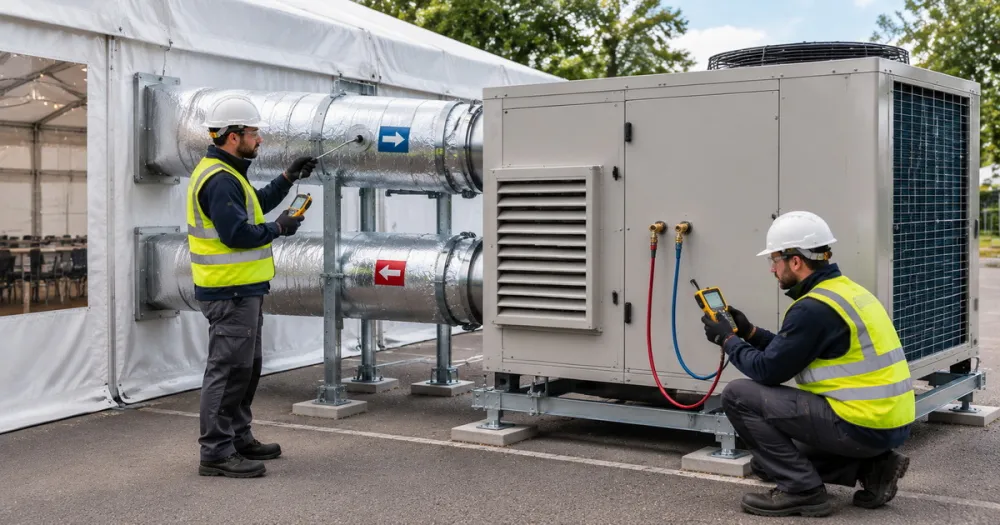
Require the supplier to state the measurement method and instrument accuracy before testing. This recommendation follows the distinction between total supply air, outdoor-air fraction, and the thermal load associated with ventilation.
For tent projects, inspect the complete air path as well: intake position, return path, duct restrictions, and discharge separation. The unit should be accepted as part of its intended installation, not solely as an isolated machine.
Conclusion
The appropriate supplier depends on the application and partnership model.
DREZ is a relevant first discussion for temporary structures and project-based cooling. Midea and AUX merit investigation for platform-based brand sourcing. TICA, Shenling, and Guangdong Euroklimat are relevant to engineered environmental-control requirements. Gree, Haier, Hisense, and Chigo provide additional options for buyers comparing established air-conditioning portfolios. Their suitability must still be established for the specific configuration and commercial agreement.
For a DREZ project inquiry, submit the site location, application, cooling conditions, required outdoor airflow, electrical supply, quantity, destination country, and customization scope. Request a coordinated technical proposal, compliance-document list, sample-validation plan, and itemized quotation before approving production.
FAQ
1. How Can I Verify Whether a Manufacturer’s ISO Certificate Has Expired?
Check the certificate number, legal company name, factory address, standard, scope, issuing body, and validity dates.
Search the certificate through the issuing certification body and the IAF CertSearch service where applicable. Review the live status rather than relying only on the expiry date printed on a PDF: a certificate can be suspended or withdrawn before that date.
If the record is missing or inconsistent, ask the issuing body for confirmation. Do not assume that a certificate for a sales office covers the manufacturing site supplying your order.
2. Can an Outdoor-Installed Tent Air Conditioner Supply 100% Outside Air?
Only if the selected system is designed and demonstrated for that duty.
Outdoor installation does not establish an outdoor-air treatment capability. The supplier must confirm fan performance, cooling and moisture-removal performance, controls, and supply-air conditions at the required entering-air conditions.
For high outdoor-air requirements, compare a suitable packaged design with a dedicated outdoor-air approach rather than assuming a recirculating tent unit can be converted without performance consequences.
3. What Should Happen if the Supplier Changes the Compressor or Coil After Sample Approval?
The purchasing contract should require written engineering-change approval before substitution.
The supplier should identify the affected serial numbers, explain the change, and provide evidence of its effect on performance, electrical characteristics, servicing, and compliance documentation. Where the change affects the agreed acceptance basis, require renewed testing.
Maintain an approved component list and production revision record. This is a recommended contractual control, not an assurance that a supplier’s standard warranty already provides it.
4. Is a CE-Marked Sample Enough to Approve a Customized Production Order?
No. Approval should cover the equipment actually being supplied.
Changes to electrical configuration, controls, components, or product combinations can require a fresh compliance assessment. Ask the responsible manufacturer to confirm that the declaration and supporting technical documentation cover the final configuration.
For systems assembled from several components, establish who is responsible for the conformity of the completed equipment rather than collecting unrelated certificates.
5. How Can Buyers Compare Two Units With the Same Nominal Cooling Capacity?
Compare them at the same operating conditions.
Require matching outdoor and return-air conditions, outdoor-air quantities, external static pressure, filtration, electrical supply, and performance boundaries. Then compare total and sensible cooling, moisture removal or supply-air humidity condition, power input, noise, and service access.
Two units with identical nominal capacity can represent different operating duties. The relevant comparison is the performance each supplier guarantees at the buyer’s required conditions.
Reference
1. – DREZ, “About Us.” Company-published background, group history, factory area, stated capacity, application focus, and overseas expansion. [drezaircon]
2. – China Household Electrical Appliances Association, “Total Shipments Surpass 200 Million Units: A Review of China’s Air Conditioner Industry in the 2025 Cooling Year,” September 2025. Industry shipment and export context. [en.cheaa]
3. – China Refrigeration and Air-Conditioning Industry Association, “2025 Refrigeration and Air-Conditioning Industry Annual Report Highlights—Exports,” August 2026. Calendar-year export trends and statistical limitations. [chinacraa.org]
4. – Midea, “Company Intro”; supplementary corporate background on OEM/ODM operations. [en.wikipedia]
5. – Gree, published residential air-conditioning catalog and overseas sales information. Founding date, company background, and international coverage. [global.gree]
6. – Haier, corporate introduction, company history, and regional HVAC information. [haier]
7. – Hisense, commercial HVAC and regional system information; Hisense HVAC establishment background. [hisense]
8. – TICA, corporate profile and international manufacturing information. [global.tica]
9. – Shenling, corporate profile, product information, and international company history. [shenling]
10. – AUX, global company information and ODM product portfolio. [auxair]
11. – Chigo, corporate overview. Establishment, international coverage, published manufacturing capacity, and listed credentials. [china-chigo]
12. – Euroklimat, corporate history, current product portfolio, and fresh-air heat-recovery product information; Atlas Copco transaction announcement. [atlascopcogroup]
13. – ASHRAE Handbook, “Dedicated Outdoor Air Systems” and “Ventilation and Infiltration.” Outdoor-air treatment, humidity loads, and airflow distinctions. [handbook.ashrae]
14. – European Union, “CE Marking”; European Commission, air-conditioner requirements and product-regulation listing. [europa]
15. – IAF CertSearch, certificate validation and certificate-search guidance. [iafcertsearch]
Hot Tags: Air Conditioner With Outside Air, Fresh Air Air Conditioner, Outdoor Air Conditioning Unit, China Air Conditioner Manufacturers, OEM Air Conditioner Manufacturer, ODM Air Conditioning Solutions, Commercial Fresh Air Conditioning System, Industrial Air Conditioning Equipment, Tent Air Conditioner Manufacturer, Dedicated Outdoor Air System