Content Menu
● What Does “Air Conditioner With Two Hoses” Actually Mean?
● How These Manufacturers Were Selected
● The Top 10 Manufacturer Shortlist
>> 1. DREZ (Guangzhou) Intelligent Technology Co., Ltd.
>> 3. Hisense
>> 5. Gree Electric Appliances, Inc. of Zhuhai
>> 6. Dongguan JHS Electrical Co., Ltd.
>> 9. Ningbo Hicon Industry Technology Co., Ltd.
>> 10. Ningbo Fuda Intelligent Technology Co., Ltd.
● Manufacturer Comparison: Capacity, MOQ, and Certification
● Why China’s Manufacturing Clusters Matter
● Technical Buying Guide for an Air Conditioner With Two Hoses
>> Compare Cooling Performance on the Same Basis
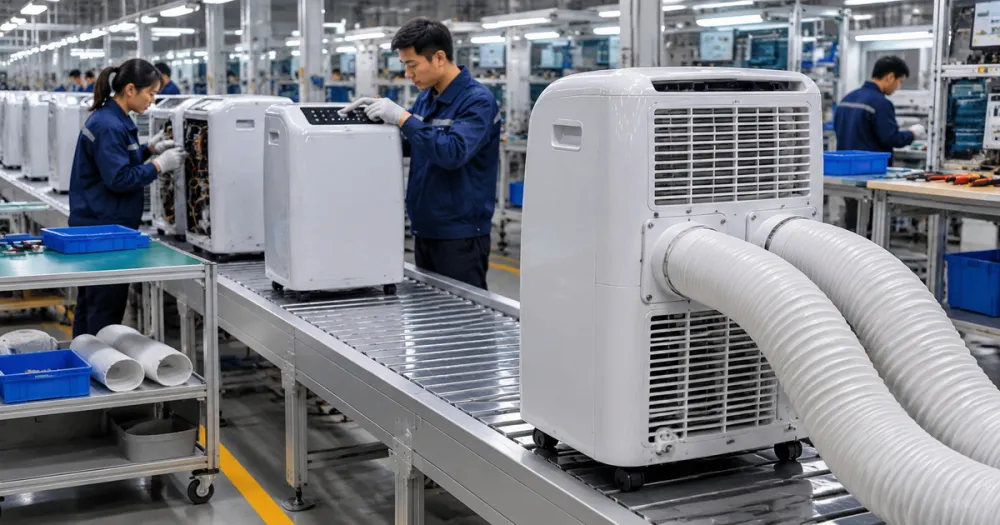
>> Specify Materials and Manufacturing Controls
>> Separate Factory Certification From Product Compliance
● The Overlooked Procurement Trap: Buying a Different Air Path From the One Tested
● Factory Verification, Sampling, and Logistics
>> Verify the Actual Manufacturer
>> Use a Controlled Sample Process
>> Confirm Logistics Before Final Pricing
● Conclusion: Match the Manufacturer to the Actual Cooling System
● FAQ
>> 3. Can I extend the hoses without changing the declared cooling performance?
>> 4. Does CE marking mean the product has an independent European quality certificate?
>> 5. How can we stop the factory from replacing approved components after sample approval?
An air conditioner with two hoses can look straightforward in a catalog. For a professional buyer, however, the purchasing decision involves more than cooling capacity and unit price. Airflow design, installation accessories, production consistency, certification coverage, and engineering support all influence whether a product becomes a reliable commercial line.
China offers a substantial manufacturing base for portable and duct-connected air-conditioning equipment. Its suppliers range from large appliance groups to specialist factories serving private-label brands, equipment distributors, and temporary-building projects.
The China Household Electrical Appliances Association reported that China’s residential air-conditioner exports reached 99.29 million units during the 2025 cooling year, up 16.7% year on year. Its newer 2026 cooling-year review reported exports of 89.41 million units, down 10.0%. These figures cover residential air conditioning broadly—not the two-hose portable segment—and show why buyers should evaluate current factory conditions rather than assume uninterrupted market growth.
What Does “Air Conditioner With Two Hoses” Actually Mean?
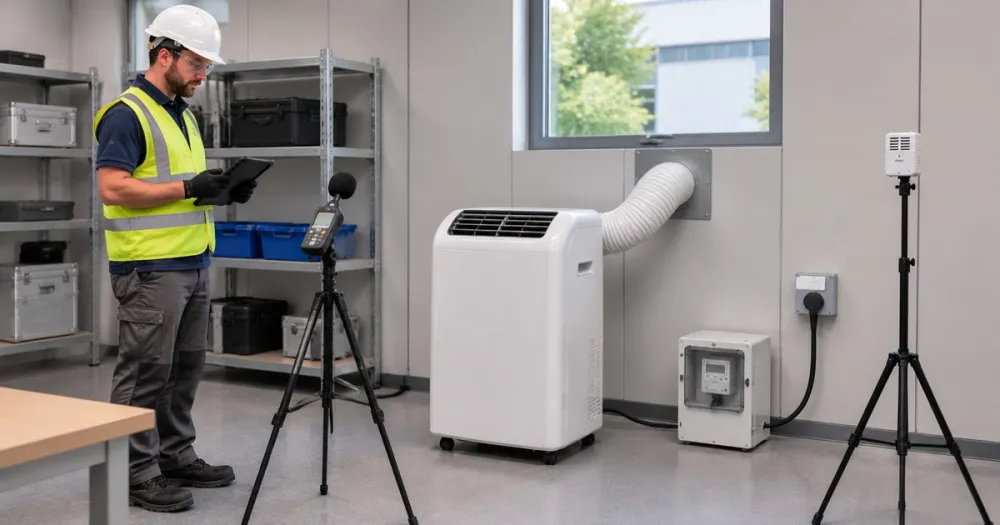
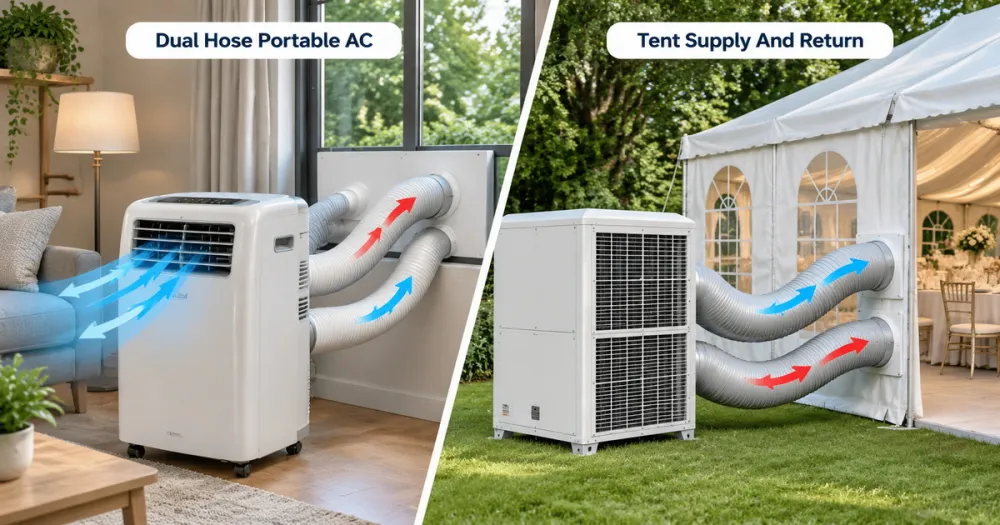
A residential dual-hose portable air conditioner generally draws condenser cooling air from outdoors through one air path and discharges heated air outdoors through another. Compared with a single-hose design, this arrangement can reduce the need to replace exhausted indoor air with warm infiltration air. Actual performance still depends on airflow balance, leakage, duct heat transfer, and operating conditions.
Two related configurations require separate consideration:
| Configuration | What the air paths do | Typical sourcing application |
|---|---|---|
| Two separate condenser hoses | Bring outdoor air to the condenser and discharge heated air outdoors | Residential portable AC |
| Concentric hose-in-hose assembly | Provides separate intake and exhaust passages within one visible assembly | Compact dual-air-path portable AC |
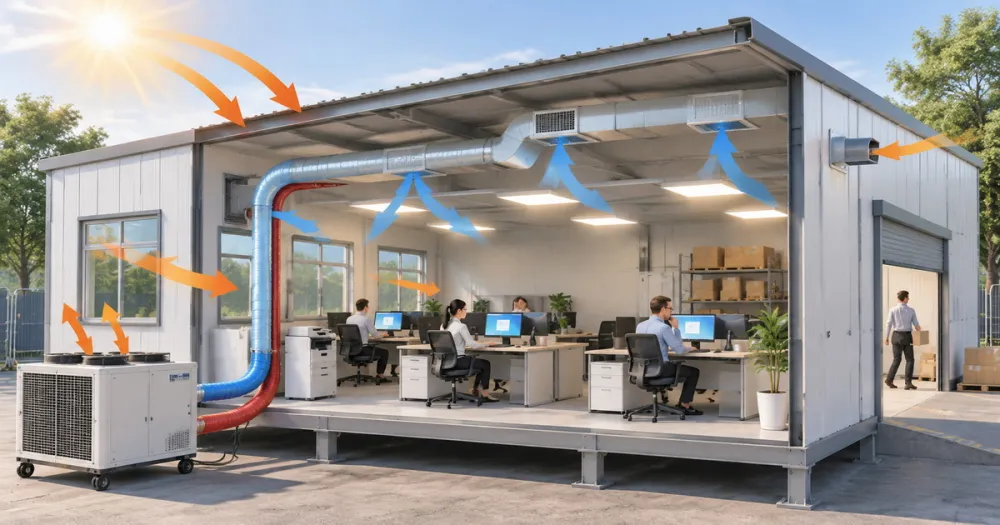
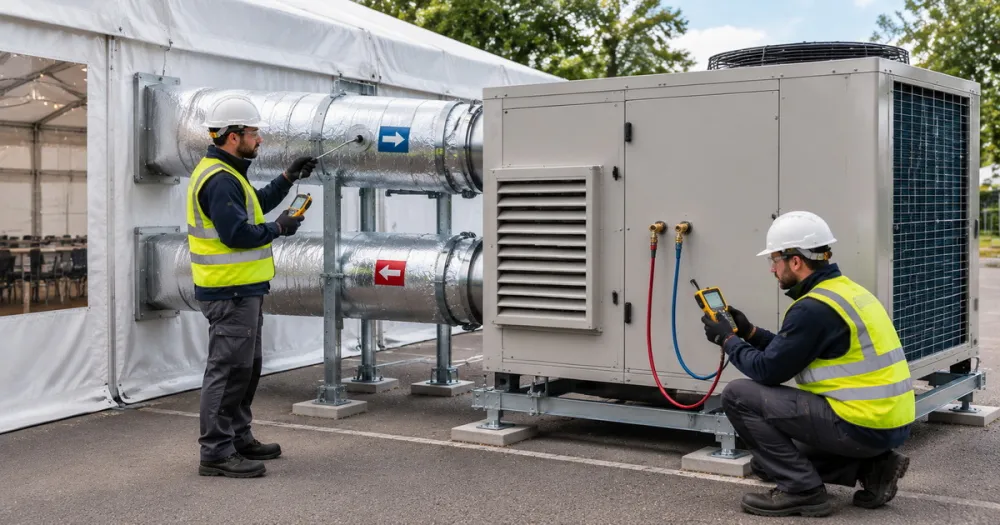
| Supply-and-return flexible ducts | Deliver conditioned air to a space and return air to an externally positioned unit | Tent, event, and temporary-building cooling |
Midea’s Duo range illustrates the hose-in-hose approach. DREZ’s packaged tent-cooling business belongs to a different application category and should be evaluated against project-specific supply-and-return requirements, not automatically treated as equivalent to a household dual-hose portable unit.
A drain tube does not qualify as a second air hose. Likewise, two cold-air outlets on an industrial spot cooler do not, by themselves, establish a dual-hose condenser system.
How These Manufacturers Were Selected
This is an application-based sourcing shortlist, not an audited market-share ranking. DREZ appears first because this guide is prepared for DREZ and its international customers; its placement is not evidence that it leads every product category.
The assessment uses five procurement dimensions:
1. Product relevance: confirmed dual-hose equipment, portable refrigeration products, or a relevant duct-connected cooling platform.
2. Engineering capability: product development, component integration, testing resources, and customization support.
3. Manufacturing transparency: identifiable facilities, disclosed production information, and a clear contracting entity.
4. Compliance evidence: documentation that can be matched to the factory, model, configuration, and destination market.
5. Partnership suitability: development communication, sample control, delivery planning, spare parts, and change management.
Public disclosures do not establish a verified two-hose product, current certification package, MOQ, or private-label program for every company below. Where evidence is incomplete, that limitation is stated rather than replaced with an estimate.
The Top 10 Manufacturer Shortlist
1. DREZ (Guangzhou) Intelligent Technology Co., Ltd.
DREZ is a Guangzhou-based climate-control supplier integrating research, design, manufacturing, sales, and tailored solutions. Its published applications include large tents, exhibitions, festivals, industrial spaces, emergency response, and temporary structures.
– Establishment: DREZ states that its parent group was established in 2001; the reviewed page does not separately establish the incorporation year of the current contracting entity.
– Manufacturing base: Shawan, Panyu, Guangzhou.
– Disclosed scale: more than 6,000 square meters of factory space and annual capacity exceeding 10,000 units.
– Documented market background: mainland China, Hong Kong, and Macao; overseas market development began in 2015.
– Development evidence: the company reports more than 20 patents and national high-tech enterprise recognition in 2020.
DREZ is particularly relevant to buyers seeking project-oriented cooling rather than a standard residential appliance. Its published range includes packaged tent air conditioners, rooftop units, trailer-mounted systems, and fresh-air ventilation equipment.
For small and medium-sized brands, the potential value proposition is a more direct engineering discussion around installation, controls, duct interfaces, branding, and service requirements. Buyers should test that flexibility through a written development brief and a sample project rather than assume low MOQs or rapid modifications.
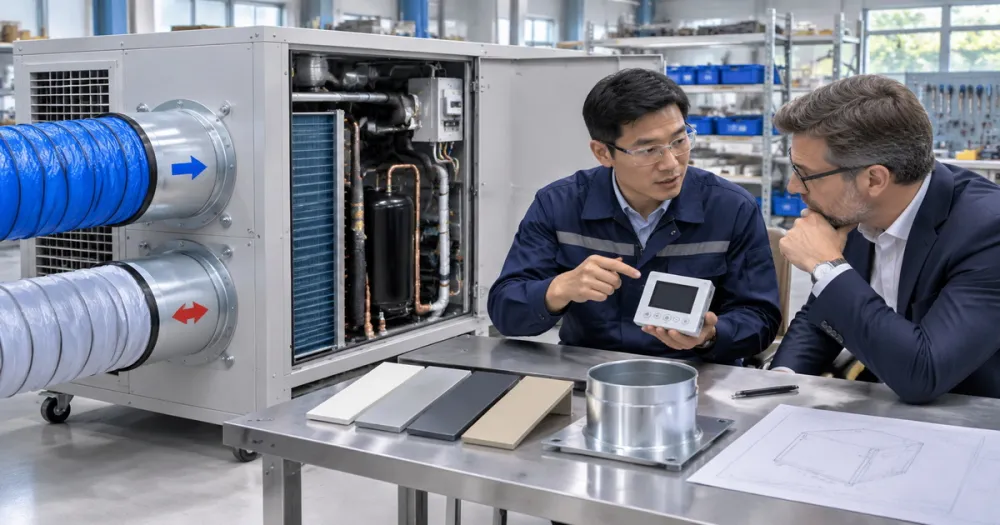
OEM/ODM discussion should focus on the required cooling architecture, electrical supply, operating environment, control functions, duct connections, and documentation responsibilities. Exact customization scope, tooling charges, and minimum order quantities require confirmation.
DREZ lists ISO 9001, CE, and SASO on its company page. These references are starting points for document review, not proof that every model carries every approval. Its disclosed capacity also covers its broader business, not a verified two-hose-only production line.
2. Midea Group
Midea is one of the clearest product matches for buyers researching residential dual-air-path portable air conditioners. Its official Duo range uses a hose-in-hose design intended to provide separate outdoor intake and exhaust paths.
– Establishment: obtain the current corporate profile and contracting-entity registration during qualification.
– Relevant market: the United States is directly evidenced by official Duo product listings.
– Core strength: a publicly documented portable platform combining dual-air-path ducting and variable-speed compressor technology.
– OEM/ODM scope: private-label access, platform licensing, territory restrictions, and tooling arrangements require direct commercial confirmation.
One official listing identifies the MAP12S1TGR-S as a 10,000 Btu/h DOE-rated portable model. This provides a useful example of why buyers should request an exact model number and rating basis, rather than compare headline cooling figures alone.
Midea is a strong technical benchmark. However, a product’s retail availability does not establish that the same platform is available to an independent brand.
3. Hisense
Hisense is another relevant candidate for residential portable cooling. Its history dates to 1969, and its official US website maintains a portable-air-conditioner category. US retail evidence also identifies Hisense dual-hose products.
– Established: 1969 at group level.
– Evidenced market: United States.
– Core strength: an established portable-appliance offering and market presence.
– OEM/ODM scope: confirm whether the opportunity involves authorized distribution, private-label production, or a separate development agreement.
Buyers should request the current dual-hose model’s manual, airflow diagram, rating documentation, and production-site details. A historic dual-hose listing should not be treated as proof that every current portable model uses the same architecture.
Hisense is most relevant when evaluating standardized residential equipment. Tent-cooling requirements should be treated as a separate engineering inquiry.
4. TCL Air Conditioner
TCL’s official international and US websites document a residential portable-air-conditioner business. A TCL storefront listing also identifies a Q-Series dual-hose inverter product, although buyers should obtain the corresponding factory documentation before approving a platform.
– Establishment: confirm the air-conditioning manufacturing entity’s registration date; it should not be substituted with the founding date of a wider corporate group.
– Evidenced markets: international residential channels, including the United States.
– Core strength: standardized portable cooling within a broader consumer-appliance portfolio.
– OEM/ODM scope: branding, controls, packaging, connectivity, and territory availability must be negotiated.
For procurement managers, TCL is a candidate for comparing feature packages and channel positioning. The decisive evidence should be the exact proposed model—not a general brand brochure.
5. Gree Electric Appliances, Inc. of Zhuhai
Gree was founded in 1991. Its official residential catalogs include portable air conditioners, including SHINY and MONA product families. This establishes portable-category relevance, but the reviewed catalogs do not establish that every listed model is dual-hose.
– Established: 1991.
– Manufacturing base: Zhuhai, Guangdong.
– Evidenced markets: international channels, including European and Australasian product catalogs.
– Core strength: established HVAC manufacturing and a documented portable product category.
– OEM/ODM scope: confirm platform availability, branding authorization, engineering changes, and model-specific commercial conditions.
Gree belongs on a broader qualification list, particularly when the buyer values HVAC platform depth. A current dual-hose model and its associated documentation remain prerequisites for inclusion in a final residential two-hose tender.
6. Dongguan JHS Electrical Co., Ltd.
JHS is a specialist candidate with a substantial portable-air-conditioner focus. Its official website lists portable models and describes annual production and sales of nearly two million units across a business selling into approximately 50 countries. These are company-reported figures, not independently audited dual-hose capacity.
– Establishment: not verified in the reviewed primary-source profile.
– Manufacturing base: Dongguan, Guangdong.
– Market reach: approximately 50 countries, according to the company.
– Core strength: category specialization in portable environmental appliances.
– OEM/ODM scope: request written confirmation of private-label development, tooling ownership, controls, packaging, and compliance responsibilities.
An important caution: JHS’s A029B page specifies a 1.5-meter exhaust hose but does not, by itself, establish a dual-hose configuration. Buyers should not infer two-hose availability from general portable-AC manufacturing capability.
7. New Widetech Industries
New Widetech, also known as NWT, was established in 1979 and has manufacturing facilities and an R&D center across Guangdong Province and Tainan. It should therefore be understood as a cross-strait manufacturing organization, not described simply as a mainland-headquartered company.
– Established: 1979.
– Mainland manufacturing relevance: Guangdong operations.
– Market reach: more than 150 countries, according to the company.
– Disclosed capacity: 2.7 million units annually across its manufacturing business; not a verified dual-hose-only figure.
– OEM/ODM strength: published turnkey support from design and development through assembly and logistics.
NWT also describes in-house capabilities covering plastic injection parts, sheet metal, heat exchangers, motors, and compressors. This makes it relevant to buyers evaluating component integration and deeper development support.
Before proceeding, confirm which legal entity owns the proposed platform, which facility will manufacture it, and whether a documented dual-hose configuration is available.
8. Ningbo Deye Technology
Deye’s official website traces its business to 1990 and lists a portable-air-conditioner category, including the DYP-A12A. Its broader portfolio also includes humidity-control and energy-related products.
– Established: 1990 at group level.
– Manufacturing location: Ningbo, Zhejiang.
– Core strength: a relevant portable product category within a broader technology business.
– Main markets: request an AC-specific destination breakdown; the reviewed portable page does not establish its leading export markets.
– OEM/ODM scope: confirm whether customization covers portable AC hardware, controls, appearance, branding, or only selected established platforms.
Deye is an adjacent-platform candidate rather than a verified dual-hose selection on the evidence reviewed here. Require an airflow schematic, exact configuration, sample, and applicable test reports before comparing its quotation with confirmed dual-hose models.
9. Ningbo Hicon Industry Technology Co., Ltd.
Hicon’s official profile distinguishes the operating company, established in September 2001, from Hicon Group, established in 1972. Keeping those dates separate helps buyers avoid confusing group history with the history of the contracting manufacturer.
– Established: 2001 for the operating company; 1972 for the parent group.
– Manufacturing location: Ningbo, Zhejiang.
– Documented markets: the United States, Japan, Canada, Spain, France, and Italy, among others.
– Core strength: refrigeration manufacturing, portable-air-conditioner products, testing facilities, and stated custom development from customer drawings or samples.
Hicon reports annual air-conditioner production of 1.2 million sets, but the same profile contains other capacity statements with unclear scope. Buyers should obtain a current, plant-specific capacity breakdown rather than treating historical website figures as available production slots.
The company also lists management-system certifications and product approvals. Their current validity and exact model coverage must be independently checked.
10. Ningbo Fuda Intelligent Technology Co., Ltd.
Fuda is a portable-air-conditioner and dehumidifier sourcing candidate in Ningbo. A supplier-platform record lists its establishment date as November 16, 2016 and identifies OEM/ODM and sample availability.
– Established: 2016 according to the supplier-platform record; verify against the business license.
– Manufacturing location: Ningbo, Zhejiang.
– Core strength: a focused portable-cooling and humidity-control product range.
– Main markets: international sales are indicated, but leading destinations require confirmation.
– OEM/ODM scope: platform records indicate availability; exact engineering depth and commercial terms remain subject to qualification.
Fuda’s listings include substantial capacity and certification claims. Because these are supplier-provided disclosures and not verified two-hose-specific figures, buyers should request a factory audit, current certificates, and an exact-model sample before relying on them.
Manufacturer Comparison: Capacity, MOQ, and Certification
| Manufacturer | Two-hose relevance | Public production information | MOQ | Certification evidence to obtain |
|---|---|---|---|---|
| DREZ | Project-oriented ducted cooling; confirm supply/return configuration | Over 10,000 units annually across its business | RFQ | Current factory certificates and exact-model destination documents |
| Midea | Confirmed Duo hose-in-hose products | No comparable dual-hose-only figure used here | RFQ; confirm private-label access | Proposed model’s safety, performance, and market-access documents |
| Hisense | Dual-hose products evidenced in US retail channels | Not verified for this segment | RFQ | Current model, factory, and duct-configuration records |
| TCL | Dual-hose product listing identified; obtain factory evidence | Not verified for this segment | RFQ | Exact-model reports and listing coverage |
| Gree | Portable range confirmed; dual-hose model requires verification | Not verified for this segment | RFQ | Current model-specific compliance package |
| JHS | Portable specialist; exact two-hose platform unverified | Company reports nearly 2 million annual production/sales | RFQ | Factory certificates and selected model’s complete reports |
| NWT | Relevant development/manufacturing platform; confirm dual-hose model | Company reports 2.7 million annual units across its business | RFQ | Production-site, platform, and model-specific records |
| Deye | Portable category confirmed; dual-hose status unverified | Not verified for this segment | RFQ | Configuration drawing and destination-specific reports |
| Hicon | Portable category confirmed; dual-hose status unverified | Profile reports 1.2 million AC sets annually; scope/date require confirmation | RFQ | Current certificates, factory scope, and exact-model approvals |
| Fuda | Portable category confirmed; dual-hose status unverified | Supplier listing claims 1.5 million portable AC units annually | RFQ | Independently verified certificates and model reports |
Why China’s Manufacturing Clusters Matter
The shortlist spans several established manufacturing locations: Guangzhou for DREZ, Zhuhai for Gree, Dongguan for JHS, Guangdong operations for NWT, and Ningbo for Deye, Hicon, and Fuda.
For buyers, this creates practical opportunities to organize regional factory visits and compare different supplier types within one sourcing program.
However, proximity is not proof of shared capability. A factory experienced in household portable appliances may not have the engineering resources needed for long external ducts, temporary structures, or project-specific electrical systems. Conversely, a tent-cooling specialist may not be the right partner for a compact retail appliance.
The useful question is not simply, “Which cluster is cheapest?” It is, “Which factory has already solved the installation and compliance problems associated with our intended product?”
Technical Buying Guide for an Air Conditioner With Two Hoses
Compare Cooling Performance on the Same Basis
Do not compare headline Btu/h figures without checking the test method.
For US portable-air-conditioner comparisons, request the applicable seasonally adjusted cooling capacity, or SACC, and combined energy efficiency ratio, or CEER. DOE procedures account for factors including duct heat transfer and infiltration effects, which explains why adjusted ratings can differ from other advertised capacities.
Ask each supplier to identify:
– Exact model and compressor type.
– Duct configuration used during testing.
– Applicable test procedure and edition.
– Voltage and frequency.
– Included hose and window-kit arrangement.
– Cooling capacity and power input under stated conditions.
Current US regulatory obligations should be checked at the time of import. DOE’s product page includes both established standards information and a later proposal concerning product coverage; a proposal should not be treated as an effective rule.
Specify Materials and Manufacturing Controls
Turn quality expectations into measurable purchase specifications.
| Component or process | Procurement specification to define |
|---|---|
| Hose assembly | Material, temperature rating, wall construction, length, diameter, and collapse resistance |
| Plastic housing | Resin grade, permitted recycled content, color tolerance, and relevant safety requirements |
| Metal enclosure | Material grade, thickness, coating system, and application-specific corrosion resistance |
| Electrical system | Approved component list, wire specification, terminal control, and traceability |
| Refrigerant circuit | Approved compressor, refrigerant, charge specification, and leak-test procedure |
| Final inspection | Electrical safety checks, functional testing, accessory checks, and serial-number records |
Separate Factory Certification From Product Compliance
ISO 9001 concerns a management system. It does not certify the cooling capacity or destination-market compliance of a particular air conditioner.
Likewise, CE marking is not a general factory quality award. The European Commission explains that it represents conformity with applicable requirements and the completion of the relevant conformity-assessment procedures. For equipment within RoHS scope, the declaration and technical evidence must also address the applicable substance restrictions.
Ask for documents that identify the actual model, responsible manufacturer, relevant legislation, and supporting evidence. A logo printed on a brochure is not enough.
The Overlooked Procurement Trap: Buying a Different Air Path From the One Tested
A less obvious risk is approving the cabinet while allowing changes to the hose assembly.
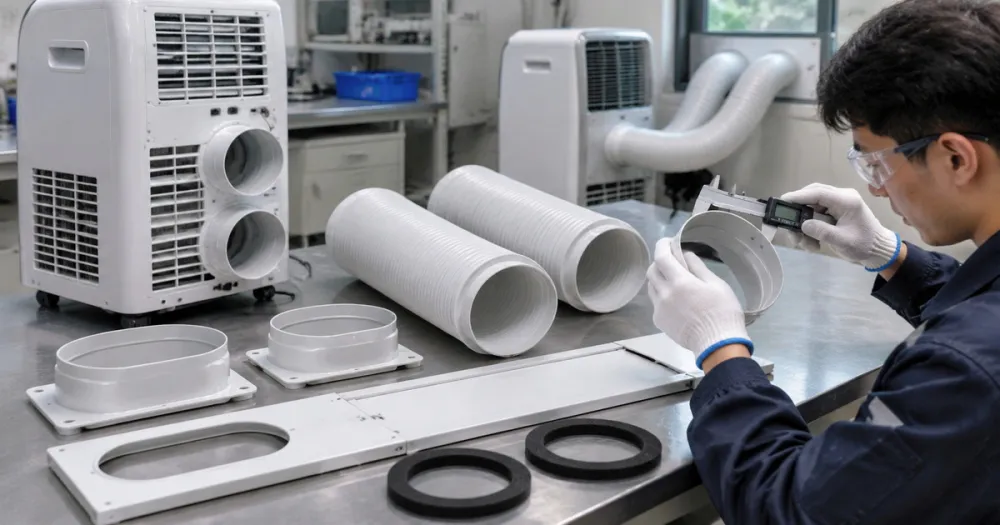
DOE’s portable-AC testing materials specify the use of manufacturer-provided ducts, connectors, seals, insulation where supplied, and window fixtures. The ducting is part of the tested system—not merely an accessory.
That distinction has commercial consequences. A lower-cost replacement hose, altered adapter, or revised window insert may change the installation that supported the original performance claim.
Use configuration control to prevent this:
1. Approve the complete installation kit with the sample.
2. Record hose dimensions, part numbers, seals, and adapters.
3. Include those components in the controlled bill of materials.
4. Require written approval before substitutions.
5. Compare production units with the approved sample.
6. Obtain an engineering assessment when a change could affect performance or compliance.
For tent systems, apply the same discipline to the proposed supply-and-return arrangement. State the intended duct layout and require the supplier to confirm the operating conditions under which it guarantees performance.
Factory Verification, Sampling, and Logistics
Verify the Actual Manufacturer
Before paying a production deposit, request:
– Business license and legal company name.
– Factory address and production-site details.
– Explanation of any trading-company involvement.
– Bank-beneficiary information matching the agreed transaction structure.
– Current certification records.
– A live factory walkthrough or independent audit.
– Traceable examples of comparable products, where disclosure is permitted.
A credible supplier should clearly explain who designs, manufactures, invoices, and supports the product.
Use a Controlled Sample Process
A practical sequence is:
1. Engineering review to confirm product architecture.
2. Functional sample to evaluate cooling, drainage, controls, and installation.
3. Pre-production sample using intended components and packaging.
4. Pilot order to check repeatability.
5. Production inspection against agreed acceptance criteria.
Record sample configuration and test conditions. Avoid approving a unit only because it “feels cold.”
Measure the behaviors that matter to the application: cooling performance, input power, drainage behavior, noise under specified conditions, and the completeness of the installation kit.
Confirm Logistics Before Final Pricing
Ask the factory and freight provider to confirm packed dimensions, gross weight, pallet configuration, stacking restrictions, refrigerant-related transport requirements, handling orientation, and accessory packing.
Quote comparisons should also use the same trade term and named location. A lower ex-factory price can lose its advantage after tooling, testing, freight, import charges, spare parts, and after-sales support are included.
For a long-term program, request separate lead times for established products, customized samples, compliance work, pilot production, and repeat orders.
Conclusion: Match the Manufacturer to the Actual Cooling System
The strongest supplier choice depends on the product being purchased.
Midea provides a clearly documented hose-in-hose reference. Hisense and TCL offer relevant residential portable-market evidence. Other companies on this shortlist provide portable-manufacturing or development capabilities that require further two-hose-specific qualification. DREZ is most relevant when the requirement centers on tent cooling, temporary structures, and tailored project solutions.
A useful quotation should therefore begin with an airflow diagram and application brief—not just a target price.
For a DREZ project inquiry, provide the destination country, installation layout, cooling requirement, ambient conditions, electrical supply, intended duct arrangement, annual volume, and customization needs. Request a model-specific proposal covering sample validation, compliance responsibilities, production timing, and after-sales support before approving the order.
FAQ
1. How can I verify whether a manufacturer’s ISO certificate is expired, suspended, or unrelated to its factory?
Check the legal name, site address, certificate number, scope, issuing body, and validity dates.
Use IAF CertSearch where applicable and verify the record with the issuing certification body. IAF describes its database as supporting verification of certificate validity, certification-body accreditation, and status changes such as suspension, withdrawal, or expiration.
If a record cannot be found, investigate directly rather than automatically accepting or rejecting it. Also confirm that the scope covers the relevant manufacturing activity.
2. Can a supplier convert a single-hose portable AC into a genuine dual-hose product by adding an intake adapter?
Do not assume so.
DOE’s definition depends on how condenser air enters and leaves the system, and its documentation distinguishes single-duct from dual-duct configurations. Relevant US reporting provisions also address products distributed with both configurations.
Request an airflow diagram and supporting test evidence for the modified design. A physical second connection alone does not establish verified dual-hose performance.
3. Can I extend the hoses without changing the declared cooling performance?
Not without supplier confirmation.
The hose arrangement forms part of the test setup, and duct heat transfer affects adjusted cooling performance. An extended installation should therefore be reviewed against the approved configuration rather than assumed equivalent.
Ask for an approved extension limit or a validated application-specific arrangement. For ducted commercial equipment, request performance information for the intended installation.
4. Does CE marking mean the product has an independent European quality certificate?
No. CE marking communicates conformity with applicable EU requirements; it is not, by itself, an independent quality ranking or a general approval of the factory.
Request the EU Declaration of Conformity and supporting model-specific technical evidence. Confirm that the product you will import is the configuration described by those documents.
5. How can we stop the factory from replacing approved components after sample approval?
Make change control part of the purchase agreement.
Attach an approved bill of materials, critical-component list, installation-kit specification, and signed reference sample. Require written approval for substitutions and define who pays for any necessary reassessment.
For a two-hose product, include hoses, adapters, seals, and window fixtures—not just the compressor and control board—because those installation components are part of the performance test arrangement.
Reference
1. – DREZ company profile: manufacturing footprint, group history, applications, disclosed capacity, and development background. [drezaircon]
2. – China Household Electrical Appliances Association: 2025 cooling-year industry review and export figures. [en.cheaa]
3. – China Household Electrical Appliances Association: 2026 cooling-year production, shipment, and export review. [en.cheaa]
4. – Henan provincial government English portal: customs-based reporting on China’s air-conditioner exports to the European Union. [english.henan.gov]
5. – Midea official portable-air-conditioner range and Duo product specifications. [midea]
6. – Hisense official portable-air-conditioner category and supporting market evidence. [sylvane]
7. – TCL official portable-air-conditioner categories and dual-hose storefront listing. [tcl]
8. – Gree official corporate profile and residential portable-air-conditioner catalogs. [global.gree]
9. – JHS official company profile and portable product information. [jhs8]
10. – New Widetech official manufacturing overview and development capabilities. [newwidetech]
11. – Deye official corporate website and portable-air-conditioner category. [deye]
12. – Hicon official company profile and customization information. [hicon-international]
13. – Fuda supplier-platform records: establishment date, product range, OEM/ODM availability, and company-reported capacity. [fdznkj.en.made-in-china]
14. – US Department of Energy: portable-air-conditioner regulatory overview, test procedures, and duct-configuration documentation. [energy]
15. – European Commission: RoHS guidance, CE marking, and declarations of conformity. [environment.ec.europa]
16. – International Accreditation Forum: management-system certificate verification and status monitoring. [iaf]
Hot Tags: Dual Hose Portable Air Conditioner Manufacturers, Air Conditioner With Two Hoses, China Dual Hose Air Conditioner Suppliers, OEM Dual Hose Portable Air Conditioner, ODM Portable Air Conditioner Manufacturer, Wholesale Dual Hose Portable Air Conditioners, Commercial Portable Air Conditioner Manufacturer, Private Label Portable Air Conditioner, Industrial Tent Air Conditioner Suppliers, Custom Ducted Air Conditioning Solutions