Content Menu
● Why Source Air Conditioners for Boats From China?
● Selection Criteria: How This Shortlist Was Built
● Quick Comparison: Capacity, MOQ, and Certification Evidence
● The Top 10 Manufacturer Shortlist
>> 1. DREZ (Guangzhou) Intelligent Technology Co., Ltd.
>> 2. Jiangsu Josun Air Conditioner Co., Ltd.
>> 3. Guangdong Shenling Environmental Systems Co., Ltd.
>> 4. Taizhou Hujiang Special Equipment Co., Ltd.
>> 5. Heinen & Hopman’s China Manufacturing Operations
>> 7. Jiangsu Zeniya Refrigeration & Air Conditioning Equipment Co., Ltd.
>> 8. Yongshen Air Conditioner Co., Ltd.
>> 9. Hefei Tiane Refrigeration Technological Co., Ltd.
>> 10. Shanghai Yileng Carrier Air-Conditioning Equipment Co., Ltd.
● Technical Buyer’s Guide: Specify the System Before Comparing Prices
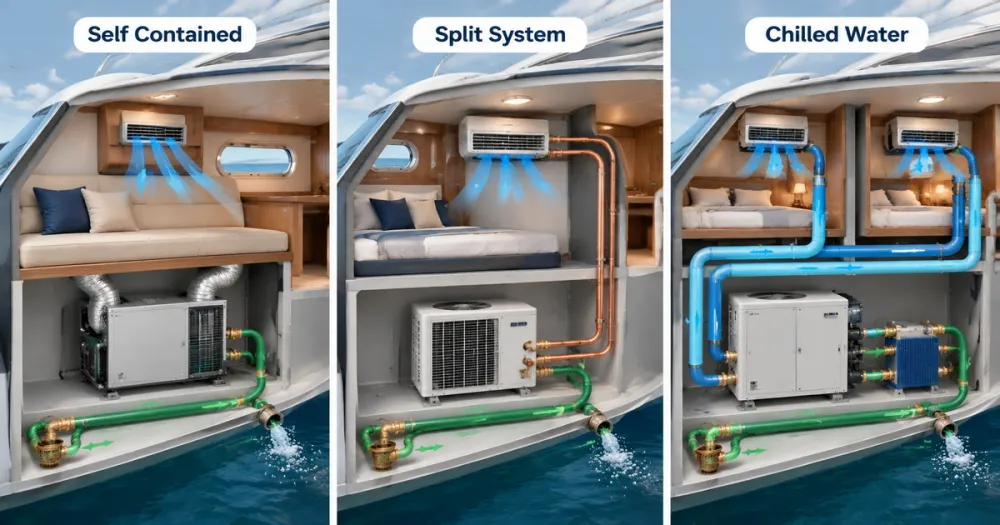
>> Distinguish the Three Main System Architectures
>> Replace “Marine Grade” With a Material Schedule
>> Compare Cooling Performance Under Identical Conditions
>> Separate Management Certification From Product Compliance
● Procurement Pitfalls and How to Avoid Them
>> Pitfall 1: A General-Purpose Unit Is Presented as a Marine Product
>> Pitfall 2: The Approved Sample and Production Units Use Different Components
>> Pitfall 3: The Quote Omits Essential Installation Components
>> Pitfall 4: Advertised Capacity Is Confused With Deliverable Capacity
● An Overlooked Insider Check: Test the Water Circuit, Not Just the AC Unit
● A Practical Factory, Sample, and Logistics Workflow
>> Step 1: Qualify the Legal and Manufacturing Entities
>> Step 2: Approve the Engineering Package
>> Step 3: Evaluate a Representative Sample
>> Step 4: Confirm Shipping Requirements Before Booking
>> Step 5: Contract for Support Before Shipment
● FAQ
>> 1. How can I verify whether a manufacturer’s ISO certificate has expired or been suspended?
>> 2. Can a supplier’s existing CE documentation cover my private-label boat air conditioner?
>> 3. How should I compare two 16,000 BTU/h units when one is substantially cheaper?
>> 4. Should I require titanium or copper-nickel for every seawater-contact component?
>> 5. Why can a factory-tested unit work at the dock but trip after the vessel gets underway?
Choosing a manufacturer of air conditioners for boats requires more than comparing cooling capacity and factory prices. Professional buyers need to establish whether a supplier understands seawater corrosion, onboard electrical limitations, restricted installation spaces, and the documentation required for the destination market.
China offers a substantial sourcing base, but its suppliers serve different applications. A factory producing customized packaged cooling equipment is not automatically interchangeable with a specialist engineering chilled-water systems for commercial vessels. Likewise, experience supplying shipyards does not necessarily mean a manufacturer accepts small private-label orders.
Why Source Air Conditioners for Boats From China?
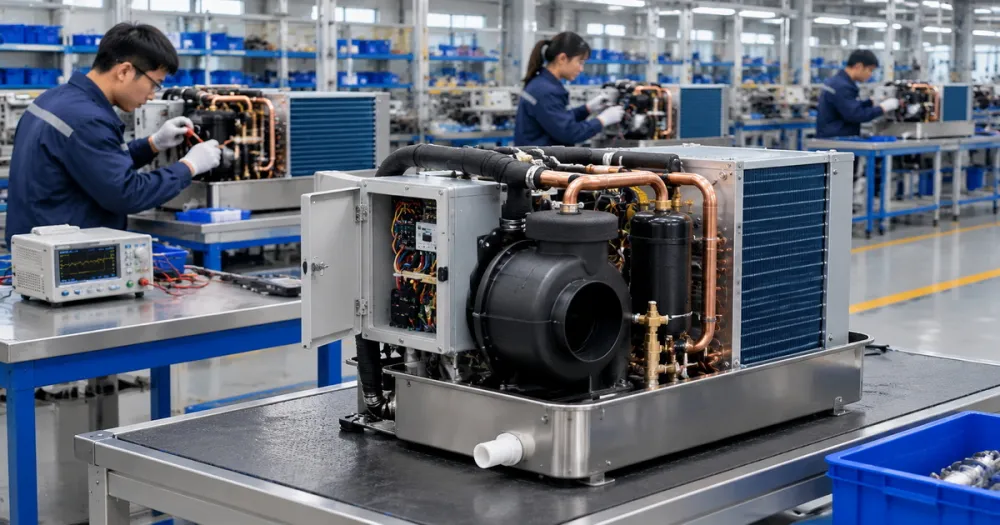
China’s broader air-conditioning industry provides a significant manufacturing foundation. In its September 2026 industry review, the China Household Electrical Appliances Association reported ChinaIoL figures showing residential air-conditioner production of approximately 187 million units during the 2026 cooling year, covering August 2025 through July 2026. Exports reached 89.41 million units. These figures describe residential equipment—not the marine air-conditioning market—but illustrate the scale of the supporting manufacturing ecosystem.
Government-published customs reporting provides another indicator of export capability: China’s air-conditioner exports to the European Union reached $3.76 billion in the first half of 2025, increasing 43.2% year over year. Again, this is a broad air-conditioner category rather than a marine-specific measure.
For boat-air-conditioner procurement, two regional concentrations are particularly relevant:
– Southern Guangdong: Guangzhou and Foshan provide access to specialized HVAC manufacturing. DREZ operates in Guangzhou’s Panyu District, while Shenling is headquartered in Shunde, Foshan.
– Jiangsu and the lower Yangtze region: Taixing, Taizhou, and Changshu host manufacturers serving shipboard and offshore environmental-control applications, including Josun, Hujiang, and Heinen & Hopman’s China operations.
The purchasing opportunity is therefore not simply a lower unit price. It is the ability to match a specific vessel application with an appropriate manufacturing and engineering partner.
Selection Criteria: How This Shortlist Was Built
A credible supplier assessment separates public information from evidence that must be obtained during qualification.
The following criteria guide this selection and should also shape a buyer’s factory audit.
| Evaluation area | Evidence buyers should request | Purchasing significance |
|---|---|---|
| Manufacturing identity | Business license, registered address, factory address, contracting entity | Establishes who manufactures the equipment and who carries contractual responsibility |
| Product relevance | Marine model drawings, technical specifications, installation manuals, vessel references | Distinguishes marine products from general-purpose equipment |
| Engineering capability | Heat-load calculations, electrical drawings, control logic, revision records | Shows whether customization extends beyond branding |
| Quality control | Incoming inspection records, pressure-test procedures, electrical tests, final inspection reports | Demonstrates repeatability rather than sample-only quality |
| Compliance | Current management-system certificates and model-specific conformity documentation | Helps prevent reliance on unrelated or outdated certificates |
| Delivery reliability | Production schedule, purchased-component lead times, inspection milestones | Makes promised delivery dates more verifiable |
| OEM/ODM support | Written customization scope, development fees, drawing ownership, change-control terms | Clarifies commercial flexibility and intellectual-property responsibilities |
| Lifecycle support | Spare-parts list, service instructions, warranty exclusions, troubleshooting procedures | Reduces downstream distributor and shipyard exposure |
A factory’s total annual output should not be treated as available marine production capacity. Similarly, “customization available” does not establish a low MOQ, exclusive tooling rights, or permission to sell a branded manufacturer’s equipment under another name.
Quick Comparison: Capacity, MOQ, and Certification Evidence
| Manufacturer | Primary sourcing relevance | Public production-capacity information reviewed | MOQ | Certification or approval position |
|---|---|---|---|---|
| DREZ | Customized climate-control projects; conditional candidate for boat applications | Company reports more than 10,000 units annually across its overall portfolio—not verified marine output | Request separate standard-product and development MOQs | Website lists ISO 9001, CE, and SASO; marine model applicability requires verification |
| Jiangsu Josun | Dedicated shipboard environmental-control equipment | Marine annual output not publicly confirmed | Project quotation required | Request current factory certificates and approvals for the exact equipment |
| Guangdong Shenling | Engineered marine air-conditioning units | Marine annual output not publicly confirmed | Project quotation required | Obtain model-specific conformity and any required classification documentation |
| Taizhou Hujiang | Marine packaged systems, fan coils, air handling, ventilation | Marine annual output not publicly confirmed | Project quotation required | Confirm equipment-specific certificates and project acceptance requirements |
| Heinen & Hopman China | Integrated marine and offshore HVAC | New Changshu facility opened in 2025; unit capacity not disclosed in reviewed announcement | Engineered-project quotation required | Agree vessel-specific classification and documentation scope |
| Bingshan Group | Larger refrigeration and central-system projects | Group scale is not a verified marine AC production figure | Project quotation required | Identify the manufacturing subsidiary and its relevant approvals |
| Jiangsu Zeniya | Marine packaged equipment and refrigeration | Not publicly confirmed | Confirm directly | Third-party profile reports ISO 9001 and class credentials; independently verify |
| Yongshen Air Conditioner | Marine HVAC and system engineering | Not publicly confirmed | Confirm directly | Current certificate scope not independently established |
| Hefei Tiane | Specialized marine refrigeration and air conditioning | Not publicly confirmed | Confirm directly | Third-party profile reports ISO 9001; verify validity and scope |
| Shanghai Yileng Carrier | Potential branded equipment or project-supply route | Marine-specific capacity not publicly confirmed | Confirm authorized supply arrangement | Verify current marine range, manufacturer identity, and applicable documentation |
The Top 10 Manufacturer Shortlist
1. DREZ (Guangzhou) Intelligent Technology Co., Ltd.
DREZ is a Guangzhou-based climate-control supplier integrating research, development, design, manufacturing, sales, and tailored solutions. Its published company profile identifies applications in commercial, industrial, emergency-response, military-support, event, and temporary-building environments.
Company background and market focus:
– Establishment history: The company states that DREZ Group was established in 2001. Its About Us page does not separately establish the incorporation year of the current DREZ Intelligent Technology entity.
– Manufacturing base: More than 6,000 square meters, with stated annual production exceeding 10,000 units across the product portfolio.
– Engineering indicators: The company reports more than 20 patents and national high-tech enterprise recognition in 2020.
– Markets: Documented service experience includes mainland China, Hong Kong, and Macao; the company states that overseas expansion began in 2015. Country-by-country export shares are not disclosed.
DREZ’s role in this shortlist is as a potential value-oriented development partner for brands seeking customized climate-control solutions. Its integrated structure provides a basis for discussing product adaptation directly with a manufacturer rather than purchasing only through a reseller.
For smaller and mid-sized brands, the qualification discussion should focus on practical flexibility: access to an application engineer, response times for drawing revisions, pilot-order terms, and the depth of OEM support. These are useful purchasing requirements, not independently measured service-performance claims.
Potential OEM/ODM discussions can cover enclosure layout, electrical configuration, controls, branding, packaging, and project-specific installation interfaces. The agreed scope should be documented before development starts.
An important qualification boundary applies: the reviewed About Us page does not establish a seawater-cooled marine product range, marine classification approval, or verified onboard installation history. Buyers considering DREZ for air conditioners for boats should therefore request the exact proposed model, condenser specification, corrosion evidence, electrical documentation, and application references before treating it as marine-qualified.
2. Jiangsu Josun Air Conditioner Co., Ltd.
Josun is a dedicated environmental-control manufacturer associated with shipboard and offshore applications. Its company information identifies Taixing, Jiangsu, as its base and dates its operating history to 1985.
Company background and market focus:
– Establishment history: 1985 according to the company’s published history.
– Core strength: Marine air conditioning, refrigeration, ventilation, and related environmental-control equipment.
– Markets: Shipbuilding, offshore, and specialized vessel applications; geographic revenue distribution was not established.
– Customization relevance: Engineered equipment and system integration are more clearly relevant than assuming a standard private-label catalog.
Josun is a logical candidate when the procurement package includes more than cabin cooling—for example, refrigeration, ventilation accessories, and coordinated system engineering.
Buyers should distinguish an operating-history date from the incorporation date of the contracting entity. Third-party sources present different dates, making the business license the appropriate basis for contract due diligence.
3. Guangdong Shenling Environmental Systems Co., Ltd.
Founded in 2000 and headquartered in Shunde, Foshan, Shenling integrates research, design, manufacturing, engineering installation, and service. It serves international environmental-control applications across several industries.
Company background and market focus:
– Established: 2000.
– Core strength: Specialized environmental-control engineering supported by a broader industrial HVAC portfolio.
– Markets: Industrial and public-building applications internationally, with a published marine product range.
– Customization relevance: Its marine product page explicitly offers personalization involving refrigerant selection and return-air arrangements.
Shenling describes its marine units as designed for salt mist, moisture, mold exposure, inclination, and vibration. These are relevant design considerations, but buyers should still obtain test conditions and acceptance criteria rather than relying on descriptive statements alone.
For procurement teams seeking engineered marine air conditioners rather than extensive private labeling, Shenling merits technical evaluation.
4. Taizhou Hujiang Special Equipment Co., Ltd.
Hujiang’s own website dates its history to 1993 and identifies its location in Taizhou, Jiangsu. Its published range includes marine packaged air-conditioning units, indirect air-handling equipment, fan coils, cabinet units, and marine mobile air conditioners.
Company background and market focus:
– Establishment history: 1993 according to the manufacturer.
– Core strength: A coordinated marine air-conditioning and ventilation portfolio.
– Markets: Ships and offshore platforms; leading export destinations are not disclosed in the reviewed source.
– Customization relevance: Its website describes customized ship air-conditioning and fire-damper supply.
Hujiang is particularly relevant when a buyer needs equipment compatibility across several parts of the onboard system.
However, buyers should not assume every product is suitable for hazardous locations. Hujiang specifically describes its marine mobile air conditioner as intended for non-explosion-proof areas.
5. Heinen & Hopman’s China Manufacturing Operations
Heinen & Hopman is an international marine HVAC specialist with manufacturing operations in China. It entered the Chinese market in 1999 and opened a new Changshu manufacturing facility on October 21, 2025.
Company background and market focus:
– Group history: Marine climate-control experience dating to 1965.
– China presence: Since 1999; this is not the incorporation date of every local entity.
– Core strength: Integrated, custom-built marine and offshore HVAC.
– Markets: Merchant shipping, offshore, naval, and yacht applications internationally.
– Customization relevance: Vessel-specific system engineering; private-label manufacturing should not be assumed.
This supplier is particularly relevant to shipyards and owners purchasing a coordinated system rather than individual boat AC units. Its published marine scope includes packaged units, cabin units, direct-expansion systems, and air-handling equipment.
Small importers should establish minimum project value, commissioning responsibility, and service arrangements early in the discussion.
6. Bingshan Group
Bingshan is a Dalian-based refrigeration and heating group with roots dating to 1930. Its core listed company describes capabilities spanning industrial refrigeration, environmental control, engineering, and lifecycle services.
Company background and market focus:
– Historical roots: 1930.
– Core strength: Refrigeration-system engineering and a broad manufacturing ecosystem.
– Markets: Domestic and overseas industrial customers; published marine refrigeration work includes fishing-vessel applications in Southeast Asia.
– Customization relevance: Engineered refrigeration packages and project supply rather than an assumed small-boat private-label program.
Bingshan deserves consideration for larger vessels or projects combining accommodation cooling with other refrigeration requirements.
The qualification boundary matters: a marine fish-preservation refrigeration reference does not independently prove performance of a compact cabin air conditioner. Buyers should identify the exact subsidiary, proposed equipment, and comparable application references.
7. Jiangsu Zeniya Refrigeration & Air Conditioning Equipment Co., Ltd.
Zeniya is identified in specialist supplier information as a Jiangsu-based manufacturer of marine packaged air conditioners, water chillers, condensing units, and related refrigeration equipment.
Company background and market focus:
– Establishment year: Unresolved in reviewed sources; published third-party information gives both 2004 and 2007.
– Core strength: Marine refrigeration and packaged cooling equipment.
– Markets: Marine and offshore applications; principal export destinations require confirmation.
– Customization relevance: Equipment configuration and system adaptation are relevant inquiry topics, but branding rights and ODM ownership need direct agreement.
Zeniya remains a reasonable qualification candidate, but conflicting background information should be resolved before supplier onboarding.
Its reported certification credentials also require independent validation. Ask for certificate numbers, issuing bodies, covered models, and the manufacturing address rather than accepting a directory badge.
8. Yongshen Air Conditioner Co., Ltd.
A specialist marine-equipment directory identifies Yongshen as a Taizhou manufacturer involved in marine HVAC, chilled-water equipment, fan coils, heat exchangers, and system engineering. The directory reports a founding date of April 27, 2005.
Company background and market focus:
– Reported establishment: 2005, subject to business-license confirmation.
– Core strength: Marine HVAC equipment and related system engineering.
– Markets: Marine applications; reliable geographic sales information was not established.
– Customization relevance: Discuss capacity configuration, controls, installation interfaces, and engineering scope directly. Public evidence does not establish a standardized private-label program.
Name matching is especially important here. English-language listings contain similar “Yongshen” and “Yongsheng” names. Buyers should match the Chinese legal name, registration identifier, factory address, and bank beneficiary before signing a contract.
9. Hefei Tiane Refrigeration Technological Co., Ltd.
Hefei Tiane appears in specialist supplier information as a manufacturer of marine air conditioners, refrigeration equipment, fans, and ventilation accessories. A directory reports establishment in 2004.
Company background and market focus:
– Reported establishment: 2004; verify against the current legal entity.
– Core strength: Specialized refrigeration and environmental-control equipment.
– Markets: Marine and other specialized cooling applications; export-market breakdown is not publicly established.
– Customization relevance: Its reported scope includes technical services and control-system integration, making it a candidate for engineered inquiries rather than assumed catalog-only purchasing.
Buyers should request current marine models, sample drawings, comparable installations, and evidence connecting any ISO certificate to the actual production site.
This is a qualification-stage candidate because the reviewed evidence is predominantly third-party information.
10. Shanghai Yileng Carrier Air-Conditioning Equipment Co., Ltd.
Shanghai Yileng Carrier was incorporated in 1995, according to corporate-profile information. A marine-equipment directory also includes the company among Chinese marine HVAC sourcing candidates.
Company background and market focus:
– Established: 1995.
– Core strength: Air-conditioning, refrigeration, ventilation equipment, and associated technical support.
– Markets: Broad HVAC applications; the current marine-specific market focus requires direct confirmation.
– OEM/ODM relevance: Do not assume private-label availability. Confirm the authorized commercial channel and whether the proposed product can legally be rebranded.
This candidate is more appropriate for buyers investigating branded equipment or project supply than for those requiring unrestricted ODM ownership.
Before shortlisting it for boat air conditioners, obtain confirmation of the current marine range, manufacturing entity, spare-parts support, and applicable product documentation.
Technical Buyer’s Guide: Specify the System Before Comparing Prices
Distinguish the Three Main System Architectures
Marine air-conditioning procurement starts with system architecture, not a preferred supplier name.
| Architecture | What the buyer is purchasing | Principal qualification question |
|---|---|---|
| Self-contained direct expansion | Refrigeration components packaged in one unit serving a local area | Will it fit with adequate airflow, plumbing access, and service clearance? |
| Split direct expansion | Separated condensing and evaporating components | Who designs, installs, evacuates, and commissions the refrigerant circuit? |
| Chilled water | A central chiller supplying a freshwater loop to air handlers | Who owns the hydraulic design, controls, balancing, and commissioning? |
Replace “Marine Grade” With a Material Schedule
“Marine grade” is not a sufficiently precise purchase specification.
Require suppliers to identify:
– Seawater-contact materials and their exact grades.
– Condenser construction and cleaning provisions.
– Drain-pan and fastener materials.
– Coating systems and inspection criteria.
– Dissimilar-metal isolation arrangements.
– Pump-head material and electrical protection.
– Replacement intervals and service access.
For example, Dometic specifies seawater-grade pump construction using glass-filled polypropylene or bronze pump heads on a published marine pump model. The useful lesson is the level of material specificity—not that every boat requires that particular pump.
Do not prescribe one alloy as universally appropriate for every component. Require the supplier to explain material selection for the actual seawater conditions, operating temperature, maintenance regime, and equipment design.
Compare Cooling Performance Under Identical Conditions
Two units carrying the same nominal capacity are not necessarily equivalent purchasing options.
Request a shared test schedule covering:
1. Entering air temperature and humidity.
2. Seawater inlet temperature.
3. Actual seawater flow.
4. Supply voltage and frequency.
5. Airflow and external static pressure.
6. Cooling capacity, electrical input, and current.
7. Noise measurement method.
8. Alarm behavior under restricted-flow conditions.
Boat layout also matters. Dometic’s selection guidance distinguishes below-deck, mid-deck, and above-deck spaces because glazing, solar exposure, and installation position affect cooling requirements.
Separate Management Certification From Product Compliance
An ISO management-system certificate does not establish that every product is suitable for every vessel or export destination.
For EU-bound products, determine which legislation applies to the exact equipment. CE marking indicates the manufacturer’s declaration of compliance with applicable EU requirements; it is not a universal third-party approval or an EU-issued quality award.
Request a product-specific declaration of conformity and supporting technical documentation. Where RoHS applies, verify the relevant substance-compliance evidence. Do not assume its applicability without checking the equipment’s scope and intended use.
Similarly, classification-society documentation, CE requirements, and the EU Marine Equipment Directive are separate matters. Applicability must be checked for the equipment and vessel rather than inferred from a collection of logos.
Procurement Pitfalls and How to Avoid Them
Pitfall 1: A General-Purpose Unit Is Presented as a Marine Product
A compact enclosure or corrosion-resistant paint does not establish marine suitability.
Ask for the complete installation manual, seawater-system design, material schedule, operating limits, and comparable vessel references. For a custom-developed product, define the qualification program before paying for production tooling.
Pitfall 2: The Approved Sample and Production Units Use Different Components
Use a controlled bill of materials covering the compressor, condenser, fan motor, controls, sensors, and critical electrical protection components.
Require written approval before substitutions. Where a substitution affects conformity evidence, the documentation must also be reviewed; EU guidance explicitly identifies component and material changes as relevant to technical documentation and conformity maintenance.
Pitfall 3: The Quote Omits Essential Installation Components
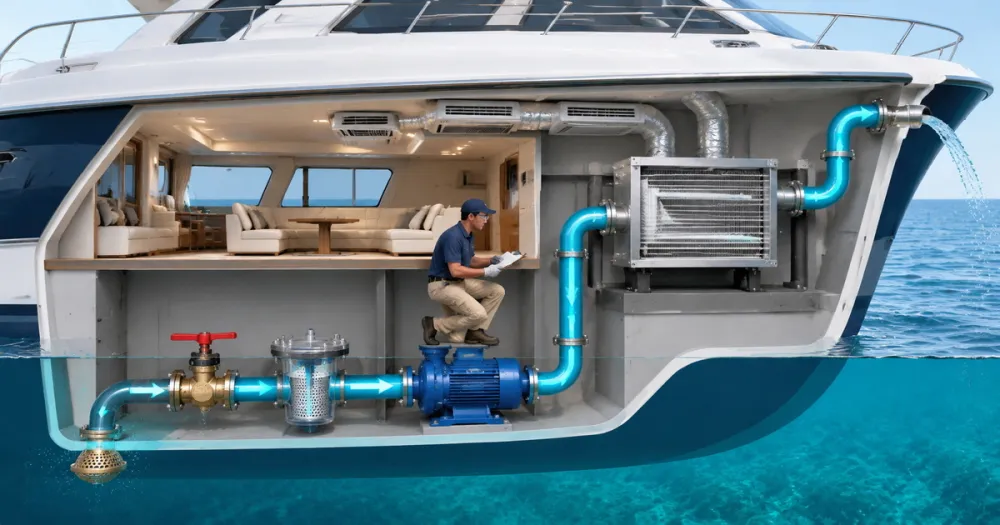
A low unit price can exclude the seawater pump, strainer, seacock, hoses, controls, ducts, grilles, and commissioning work.
Request a scope-of-supply matrix identifying who supplies, installs, and warrants every component. A complete marine AC installation involves more than the cooling unit itself.
Pitfall 4: Advertised Capacity Is Confused With Deliverable Capacity
Ask the manufacturer for a production plan tied to your model, not only a corporate capacity statement.
Recommended contract milestones include drawing approval, component procurement, assembly completion, witnessed testing, corrective-action closure, and shipment release. Treat these as negotiated deliverables rather than relying on a general promise of “fast delivery.”
An Overlooked Insider Check: Test the Water Circuit, Not Just the AC Unit
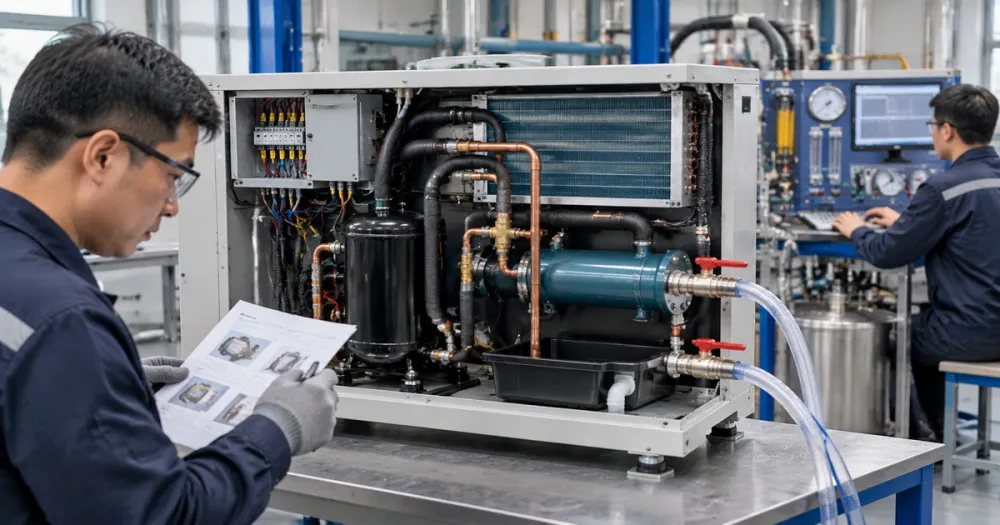
One of the most useful procurement checks is to witness the air conditioner operating against the proposed water-circuit resistance.
A unit may cool correctly on a factory bench with short hoses and easy water flow, yet perform poorly after installation with a strainer, fittings, elevation changes, and multiple branches.
Dometic’s installation documentation identifies restricted ducting and poorly arranged seawater plumbing as common installation problems. It also warns that centrifugal pumps require appropriate placement below the waterline and that trapped air can interrupt flow.
Before approving a sample, require:
– A pump selection based on the proposed system resistance.
– Flow measurements through each relevant branch.
– A restart demonstration following a power interruption.
– A defined response to reduced seawater flow.
– Agreement on installation responsibility and warranty boundaries.
The key commercial lesson is simple: approve a cooling system under representative conditions, not merely a machine operating under favorable factory conditions.
A Practical Factory, Sample, and Logistics Workflow
Step 1: Qualify the Legal and Manufacturing Entities
Request the business license, registered Chinese company name, factory address, and proposed contracting entity.
Where the seller and factory differ, document the relationship and identify who is responsible for quality, warranty claims, technical records, and spare parts.
Step 2: Approve the Engineering Package
Before ordering a sample, agree on:
– Vessel type and operating region.
– Cooling-load assumptions.
– Electrical supply and available starting power.
– Installation dimensions and service clearances.
– Seawater-system interfaces.
– Applicable conformity requirements.
– Acceptance-test methods.
– Required manuals and drawings.
For EU-bound products, the technical file should identify the facilities involved in design and manufacture, critical components, relevant requirements, and the evidence used to demonstrate compliance.
Step 3: Evaluate a Representative Sample
Use the intended production configuration rather than an unusually well-equipped demonstration unit.
Record model identifiers, component revisions, test conditions, and results. After acceptance, retain an agreed reference configuration and prohibit unapproved deviations.
Step 4: Confirm Shipping Requirements Before Booking
Ask the freight forwarder to confirm the treatment of the exact refrigerant, charge quantity, transport mode, packaging, and destination.
Include instructions for orientation, moisture protection, lifting, and handling in the shipping specification. Do not assume that previous shipments of another model establish the requirements for the current order.
Step 5: Contract for Support Before Shipment
Agree on spare-parts availability, diagnostic information, warranty response procedures, labor responsibility, and remedies for repeated failures.
For distributors, the most important question is often not whether a spare part exists, but whether a technician can identify and replace it without returning the whole unit internationally.
Conclusion
DREZ provides a different starting point: an integrated Guangzhou climate-control manufacturer for buyers exploring customized development and OEM collaboration. Its suitability for a particular boat application should be established through model-specific engineering and compliance evidence, not inferred from its broader HVAC credentials.
For a project-specific discussion with DREZ, prepare a technical brief containing the vessel type, cabin layout, operating region, electrical supply, installation dimensions, target order volume, and destination-market requirements. Request a written feasibility review, development scope, sample plan, and documentation checklist before committing to production.
FAQ
1. How can I verify whether a manufacturer’s ISO certificate has expired or been suspended?
Request the complete certificate, including its number, legal entity, site address, scope, issuing body, issue date, and expiry date.
Then verify its current status directly through the issuing certification body using independently obtained contact information. Check that the certified location is the actual production facility and that the scope covers the relevant manufacturing activity.
A visible future expiry date should not be your only check. Ask the issuer to confirm current validity and investigate any mismatch between the certificate holder, seller, and factory.
2. Can a supplier’s existing CE documentation cover my private-label boat air conditioner?
Not automatically.
EU guidance states that a business having a product manufactured and selling it under its own name or brand may be considered the manufacturer. The associated compliance responsibilities cannot simply be transferred by copying the original supplier’s declaration.
Confirm that the final configuration, brand, model identification, responsible entity, applicable legislation, and technical evidence are correctly addressed before placing the product on the market.
3. How should I compare two 16,000 BTU/h units when one is substantially cheaper?
Ask both suppliers to quote the same operating conditions and scope of supply.
Compare measured capacity, electrical input, airflow, seawater flow, pump requirements, materials, controls, installation accessories, and warranty exclusions. Also confirm whether the quotation includes a complete installation package or only the cooling unit. Marine system performance depends on the surrounding water and air-distribution arrangements, not just the nominal capacity label.
4. Should I require titanium or copper-nickel for every seawater-contact component?
No single material specification should be applied indiscriminately.
Instead, ask the supplier to justify each wetted material and its compatibility with the complete system. Require exact grades, traceability where needed, cleaning instructions, and the basis for the proposed service life.
A component-by-component schedule is more useful than an unsupported “marine-grade” claim. Published marine equipment specifications illustrate this approach by identifying pump-head materials and other construction details explicitly.
5. Why can a factory-tested unit work at the dock but trip after the vessel gets underway?
Investigate seawater availability, air ingestion, pump priming, changes in through-hull submergence, and installation geometry before concluding that the compressor is defective.
Marine installation guidance specifically warns about air locking, pump placement, and changes in inlet position relative to the waterline as the vessel moves.
The corrective process should include flow and temperature measurements under the conditions that trigger the fault. Testing only at a stationary dock may not reproduce the problem.
Reference Notes
1.European Maritime Safety Agency guidance on the Marine Equipment Directive; Dometic marine engineering and installation guidance; manufacturer publications; and supplementary supplier-directory information. Broad residential air-conditioning statistics are used only as manufacturing context, not as estimates of marine-market size. [en.cheaa]
Hot Tags: Marine Air Conditioner Manufacturers, Boat Air Conditioner Suppliers, Air Conditioners For Boats, Marine Air Conditioning Systems, China Marine Air Conditioner Manufacturers, OEM Marine Air Conditioners, Wholesale Boat Air Conditioners, Self Contained Marine Air Conditioners, Marine Chilled Water Systems, Custom Marine Air Conditioning Solutions