Content Menu
● Why Source Building Air Conditioning From China?
● Selection Criteria: How to Evaluate These Manufacturers
>> 1. DREZ (Guangzhou) Intelligent Technology Co., Ltd.
>> 2. Midea Building Technologies
>> 3. Gree Electric Appliances, Inc. of Zhuhai
>> 6. TICA
>> 8. TCL Commercial Air Conditioner
>> 9. Chigo
● Manufacturer Comparison: Capacity, MOQ, and Certification Evidence
● Technical Buying Guide: Specify Performance Before Price
>> Define the Building and System Boundary
>> Specify Materials as Measurable Requirements
>> Separate Management Certification From Product Compliance
● The Overlooked Procurement Trap: An Approved Sample Without Configuration Control
● From Factory Audit to Delivery: A Practical Procurement Process
>> 1. Verify the Contracting and Manufacturing Entities
>> 2. Use a Structured Sample-Approval Process
>> 3. Test Delivery Commitments
>> 4. Resolve Shipping and Service Details Early
● FAQ
>> 1. How can I verify whether a supplier’s ISO certificate has expired or been suspended?
>> 2. Can a supplier’s CE certificate cover equipment sold under our own brand?
>> 3. How do we compare two suppliers offering the same nominal cooling capacity?
>> 4. Does a factory’s large annual capacity guarantee a small MOQ or fast delivery?
>> 5. What should we do if the supplier changes a major component after sample approval?
Introduction
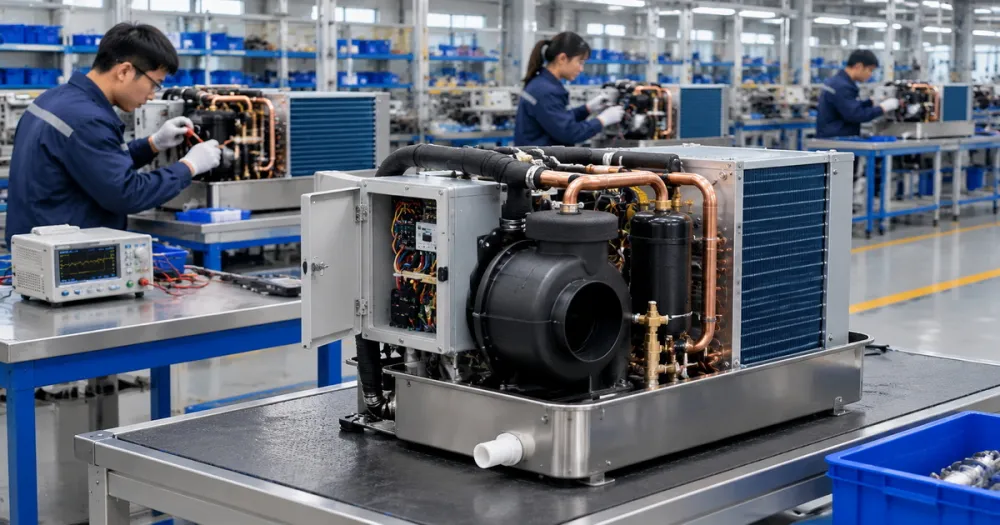
The right supplier of air conditioning for buildings must do more than offer a competitive quotation. Professional buyers need a partner that can demonstrate engineering competence, consistent quality control, realistic production scheduling, and compliance with destination-market requirements.
China offers a broad supplier base covering packaged air conditioners, rooftop units, variable refrigerant flow systems, chillers, and air-handling equipment. Its export activity also demonstrates the scale of its manufacturing ecosystem. According to a July 2026 report from the China Household Electrical Appliances Association, citing customs data, China exported 8.8729 million household air conditioners to the EU and UK between January and May 2026, up 11.35% year on year. These figures concern household equipment, not the entire commercial building HVAC market, but they provide useful evidence of export depth.
Why Source Building Air Conditioning From China?
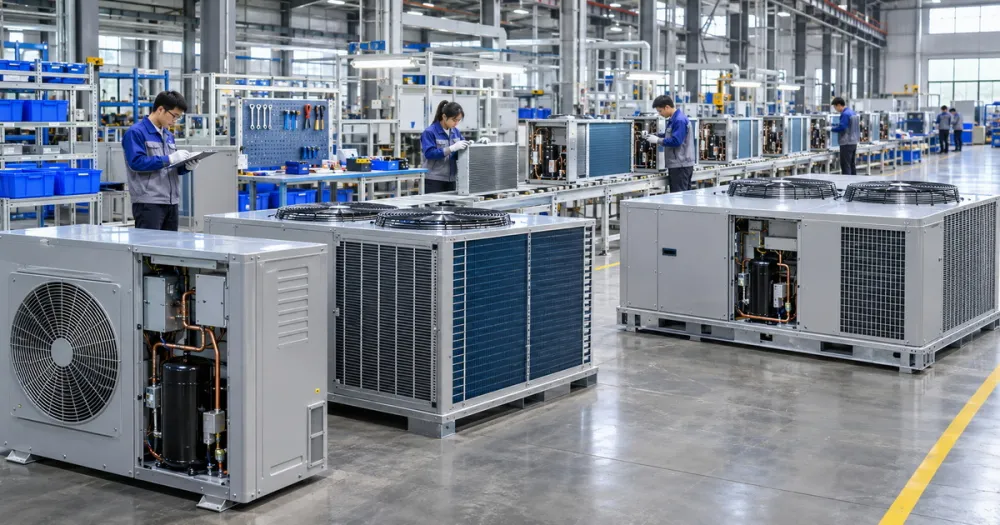
China’s advantage is not simply assembly capacity. Buyers can source finished equipment alongside compressors, motors, controls, heat exchangers, sheet-metal components, and associated manufacturing services. Midea’s industrial technology business, for example, publicly identifies compressors, motors, chips, valves, and pumps within its HVAC-related component portfolio.
Southern China is particularly relevant to supplier evaluation. DREZ operates in Guangzhou’s Panyu district, near the regional HVAC manufacturing and development cluster. Midea originated in Shunde, Gree is based in Zhuhai, and Chigo identifies Foshan’s Nanhai district as its headquarters location. This concentration makes it practical to compare different manufacturing approaches during a regional sourcing visit.
However, geographical proximity does not guarantee identical quality. Buyers should evaluate each legal entity, production site, and product platform separately.
Selection Criteria: How to Evaluate These Manufacturers
The companies below were selected for their publicly documented relevance to building cooling, manufacturing history, technical scope, or suitability for international procurement.
The assessment framework focuses on six areas:
| Assessment area | Evidence buyers should request |
|---|---|
| Manufacturing identity | Business registration, factory address, production-site ownership or operating arrangements |
| Engineering capability | Selection calculations, drawings, operating envelopes, control documentation |
| Quality control | Incoming inspection records, leak-test procedures, electrical safety checks, final inspection reports |
| Production reliability | Product-specific capacity, current backlog, component availability, delivery history |
| Compliance | Valid management-system certificates and model-specific conformity documentation |
| Commercial support | Customization boundaries, spare-parts policy, warranty process, technical response commitments |
The Top 10 Manufacturers
1. DREZ (Guangzhou) Intelligent Technology Co., Ltd.
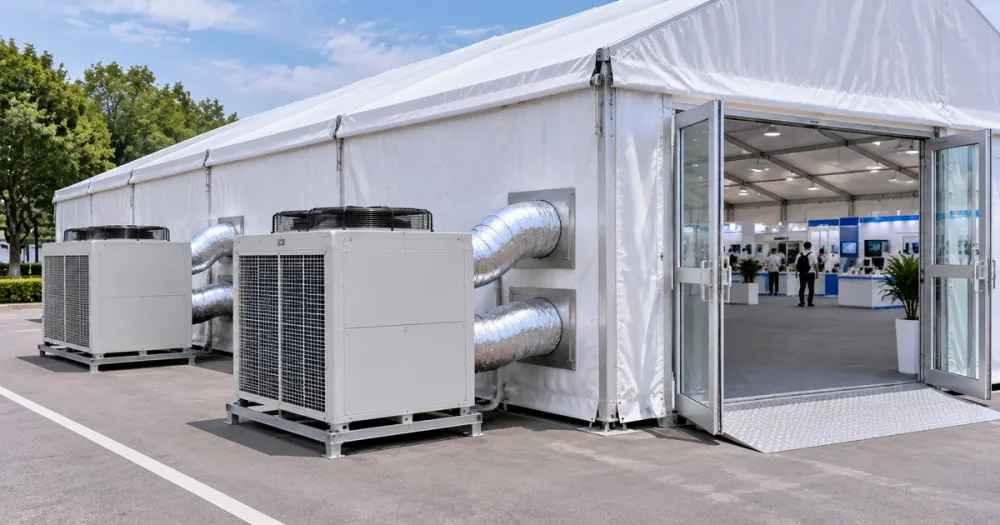
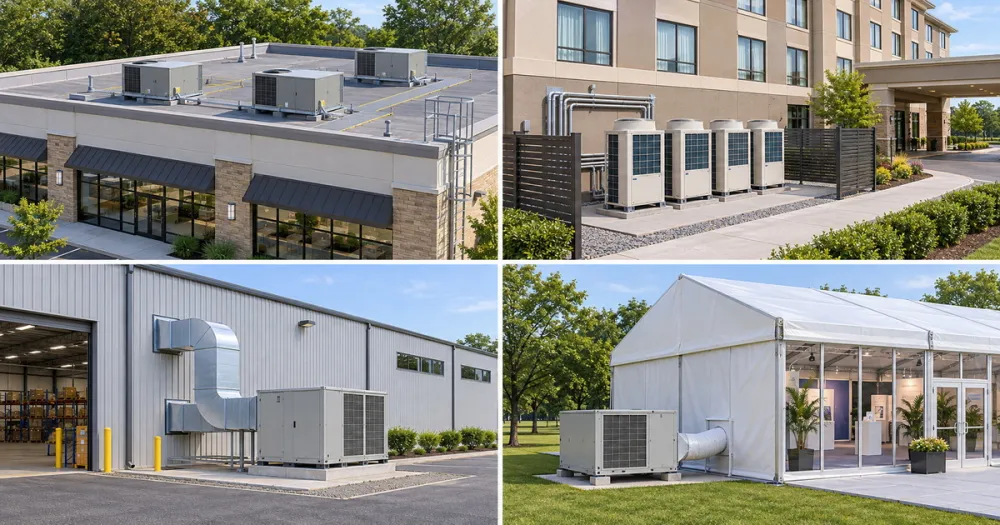
DREZ is a specialist climate-control supplier integrating research and development, design, manufacturing, sales, and tailored solutions. Its published product scope includes packaged tent air conditioners, rooftop units, trailer-mounted systems, and fresh-air ventilation units. Applications include commercial and industrial facilities, steel structures, exhibitions, emergency support, and temporary buildings.
– Establishment background: DREZ identifies its parent group as established in 2001. The current company’s incorporation date should be verified separately.
– Manufacturing footprint: The company reports a factory exceeding 6,000 square meters and annual capacity above 10,000 units.
– Documented market background: Mainland China, Hong Kong, and Macao; overseas expansion began in 2015.
– Technical credentials: Its website lists ISO 9001, CE, and SASO credentials and reports more than 20 patents. Buyers should request current supporting documents.
For smaller overseas brands, DREZ is worth evaluating as a potential value-oriented alternative to high-volume appliance groups. Its specialist product range makes it particularly relevant where duct arrangements, mobility, installation access, or unconventional building layouts influence equipment selection.
For OEM and ODM discussions, buyers should define requirements for branding, casing configuration, electrical supply, controls, interfaces, documentation, and packaging. DREZ’s claimed tailored-solution capability provides a starting point, but the scope and validation requirements of each modification should be agreed in writing.
Its proposed advantages—flexibility, direct engineering communication, and deeper customization support—should be tested through a structured enquiry. Ask for one consolidated technical response, a drawing revision schedule, and an itemized customization quotation. These provide a more useful measure of communication efficiency than promotional claims.
2. Midea Building Technologies
Midea offers a broad platform for buyers seeking multiple building HVAC categories from a large manufacturing organization. Midea Group was founded in 1968, while Midea Building Technologies dates its establishment to 1999. Its published portfolio includes VRF systems, unitary split and packaged equipment, air-to-water heat pumps, and modular chillers.
– Core strength: Breadth of building services and HVAC technologies.
– Market orientation: International building projects and distribution networks; Midea reports a group presence in more than 200 countries and regions.
– OEM/ODM discussion: Standardized product platforms, market-specific configurations, and eligible private-label programs.
– Procurement limitation: Group-wide manufacturing scale does not establish the MOQ or availability of a particular commercial model.
Midea is a logical candidate for buyers seeking portfolio consistency across residential, light-commercial, and larger building applications. Its corporate materials acknowledge residential inverter air-conditioner production that includes OEM brands, but commercial private-label availability must be confirmed separately.
3. Gree Electric Appliances, Inc. of Zhuhai
Founded in 1991, Gree developed from household air-conditioner assembly into a diversified manufacturing group. Its official corporate profile describes production bases in China and overseas and exports to more than 160 countries and regions.
– Core strength: Extensive air-conditioning manufacturing experience and engineering resources.
– Market orientation: Domestic and international equipment distribution.
– OEM/ODM discussion: Approved product platforms, regional configurations, controls, and branding arrangements where available.
– Procurement limitation: Do not assume access to unrestricted private-label manufacturing simply because the supplier has substantial production capacity.
Gree is worth evaluating when product-platform maturity and manufacturing depth matter more than highly individualized small-batch development. Confirm the contracting entity, permitted sales territories, and whether technical support comes directly from the factory or through an intermediary.
4. Haier HVAC
Haier Group was founded in Qingdao in 1984. Its European HVAC operation describes a range spanning residential and light-commercial products, large-commercial equipment, and heating solutions. The same source reports total air-conditioning production capacity exceeding 27 million sets annually across 16 factories, including eight overseas factories. This is global capacity, not China-only commercial-building output.
– Core strength: Broad product coverage supported by international market operations.
– Documented markets: Europe, including the UK, France, Germany, Italy, Spain, and other regional markets.
– OEM/ODM discussion: Region-specific product development, controls, interfaces, and eligible manufacturing cooperation.
– Procurement limitation: Branded distribution availability does not automatically establish private-label eligibility.
Haier deserves consideration when local market support, product documentation, and regional application experience are important. Buyers should identify the exact factory responsible for the selected model rather than relying on group-level credentials.
5. Hisense HVAC
Hisense’s published history identifies the establishment of Qingdao Hisense Hitachi Air-conditioning Systems in 2003. Its current HVAC business covers research, production, global sales, and after-sales services, with a portfolio including VRF, chillers, heat pumps, and other building air-conditioning products.
– Core strength: Inverter-driven building climate systems and integrated product development.
– Documented markets: International operations with regional contacts covering the Americas and other territories.
– OEM/ODM discussion: Project-specific configurations, controls integration, and authorized cooperation arrangements.
– Procurement limitation: Verify the legal manufacturer and current contracting structure instead of treating historical joint-venture descriptions as current ownership evidence.
Hisense also illustrates why certification must be checked at model level. A published DIN CERTCO document identifies specific Hi-Therma heat-pump models and applicable test standards; it does not certify every product sold under the wider brand.
6. TICA
Founded in 1991, TICA focuses on clean-air, cooling, heating, and energy-related systems. Its current corporate profile reports a global research network of more than 1,100 engineers, over 200 laboratories, and 17 manufacturing facilities. These are corporate network figures rather than annual unit-production capacity.
– Core strength: Engineered air-side systems and technically demanding building environments.
– Market orientation: Domestic and international clean-environment and climate-system projects.
– OEM/ODM discussion: Application engineering, equipment configuration, air-treatment requirements, and system interfaces.
– Procurement limitation: A customized engineered system is not necessarily a conventional private-label product.
TICA’s published product categories include chillers, air-side units, commercial equipment, VRF, and data-center products. It is therefore particularly relevant when the enquiry requires coordinated system design rather than a simple equipment replacement.
7. AUX Air Conditioning
AUX Group was established in 1986 and entered the air-conditioning industry in 1994. Its air-conditioning business reports international activity across North America, Europe, South America, Southeast Asia, and the Middle East.
– Core strength: Standardized air-conditioning platforms and international manufacturing experience.
– Market orientation: Broad residential distribution, with commercial air-conditioning activity dating to 2003.
– OEM/ODM discussion: Eligible split-system and light-commercial platforms, regional specifications, packaging, and branding.
– Procurement limitation: Household product scale should not be treated as evidence of capability across every commercial system category.
AUX is most relevant when buyers can work from an established platform. Before requesting extensive changes, establish which modifications remain within the validated design and which require additional development or testing.
8. TCL Commercial Air Conditioner
TCL’s commercial air-conditioning business operates within a group founded in 1981. Its official introduction describes manufacturing and research operations worldwide and products and services reaching more than 160 countries.
– Core strength: Commercial air-conditioning participation backed by a large technology group.
– Market orientation: International commercial and home-comfort channels.
– OEM/ODM discussion: Available equipment platforms, controller requirements, regional electrical configurations, and authorized branding options.
– Procurement limitation: Group founding history and global reach do not establish the capacity or certification status of a specific commercial-air-conditioning factory.
TCL is worth including in a competitive tender where buyers want to compare established platforms and export support. Request a current commercial product catalogue and factory-specific documentation before narrowing the shortlist.
9. Chigo
Chigo was founded in 1994 and is headquartered in Nanhai, Foshan. Its published product scope includes residential and commercial air conditioners, air-source heat pumps, and refrigeration equipment. The company reports business coverage exceeding 180 countries and regions and annual capacity above six million sets across its southern and eastern China bases.
– Core strength: Broad air-conditioning manufacturing scope within Guangdong’s supplier ecosystem.
– Market orientation: Domestic and overseas distribution.
– OEM/ODM discussion: Available residential and commercial platforms, regional specifications, branding, and packaging.
– Procurement limitation: Its disclosed capacity is not a statement of available commercial-equipment production slots.
Chigo’s profile also identifies a manufacturing base opened in Sihui, Zhaoqing, in January 2022. Buyers should confirm which site will manufacture their order and ensure that the submitted certificates and inspection arrangements refer to that site.
10. Dunham-Bush China
Dunham-Bush was founded in the United States in 1894 and established manufacturing in Yantai, China, in 1995. It belongs in this guide as a manufacturer operating in China, not as a Chinese-origin brand. Its Chinese operation describes products including compressors, large chillers, heat pumps, air-side equipment, and smaller commercial units.
– Core strength: Applied HVAC equipment and engineered commercial cooling.
– Market orientation: China and international commercial, institutional, and industrial applications.
– OEM/ODM discussion: Project engineering, equipment configuration, controls, and system integration.
– Procurement limitation: Buyers seeking basic private-label room air conditioners should verify whether its cooperation model fits their requirements.
Dunham-Bush is particularly relevant when technical selection, commissioning support, and long-term system operation carry greater weight than the lowest initial unit price.
Manufacturer Comparison: Capacity, MOQ, and Certification Evidence
| Manufacturer | Published capacity or scale indicator | MOQ position | Certification or conformity evidence to examine |
|---|---|---|---|
| DREZ | Company reports over 10,000 units/year | Not publicly verified; request standard and customized quantities separately | Website lists ISO 9001, CE, SASO; request current scope and model documents |
| Midea | Broad global manufacturing and component network | Platform- and program-specific | Factory management certificates and exact-model technical documentation |
| Gree | Multiple domestic and overseas production bases | Confirm with authorized manufacturing entity | Site-specific certificates and selected-model reports |
| Haier | Over 27 million AC sets/year globally; not China-only commercial output | Product- and region-specific | Relevant factory certificate and destination-market product documentation |
| Hisense HVAC | Global research and manufacturing operations | Confirm by product family | Model-specific evidence; published KEYMARK documentation covers identified heat pumps |
| TICA | 17 manufacturing facilities worldwide; not unit capacity | Engineered-project or platform-specific | Factory scope plus application-specific performance evidence |
| AUX | Multiple manufacturing bases; selected commercial capacity not established here | Confirm by platform and customization scope | Exact manufacturing-site and product-model documents |
| TCL CAC | Worldwide manufacturing and research operations | Confirm directly | Commercial-factory credentials and exact-model conformity file |
| Chigo | Reports over six million sets/year across identified bases | Confirm standard versus modified models | Factory-specific certificates; do not rely on general certification claims |
| Dunham-Bush China | Yantai manufacturing established in 1995 | Project-specific | Selected equipment’s technical, conformity, and performance documentation |
Technical Buying Guide: Specify Performance Before Price
Define the Building and System Boundary
“Air conditioning for buildings” covers equipment with very different responsibilities. Midea, TICA, and Hisense, for example, publish portfolios spanning multiple system categories rather than one interchangeable product type.
A useful quotation brief should therefore state:
– Building use, location, occupancy, and operating hours.
– Design indoor and outdoor conditions.
– Cooling and heating requirements.
– Ventilation and filtration expectations.
– Electrical supply and installation constraints.
– Required control interfaces.
– Maintenance access and local service arrangements.
For temporary buildings and steel structures, explain how air will enter and return from the occupied space. For permanent installations, identify whether the supplier is quoting equipment only or accepting responsibility for system selection.
Specify Materials as Measurable Requirements
Avoid purchasing descriptions such as “premium coil” or “heavy-duty cabinet.” Instead, ask suppliers to declare the proposed construction and acceptance criteria:
| Component | Information to include in the specification |
|---|---|
| Heat exchanger | Tube and fin materials, construction, coating, inspection method |
| Cabinet | Material grade, thickness, coating system, corrosion-test evidence where required |
| Insulation | Material, thickness, fire-performance requirements, attachment method |
| Refrigerant circuit | Compressor model, principal valves, pressure-rating evidence, leak-test procedure |
| Electrical assembly | Component list, wiring diagrams, protective devices, terminal identification |
| Controls | Firmware identification, operating logic, alarms, communication protocol |
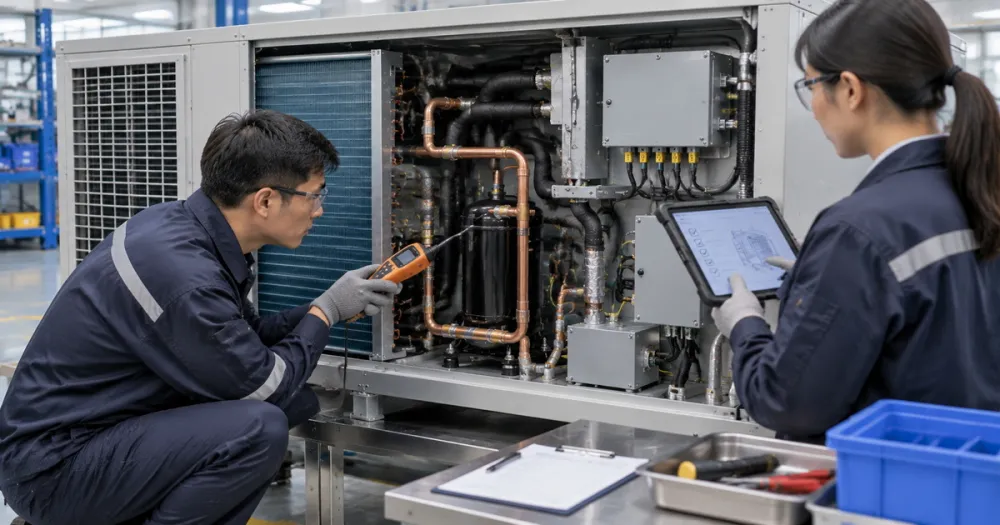
These are recommended procurement controls, not claims that every listed manufacturer offers identical construction. Incorporate the agreed requirements into the purchase specification and final inspection checklist.
Separate Management Certification From Product Compliance
An ISO 9001 certificate concerns a management system and its stated scope. Product conformity requires separate evidence. IAF CertSearch provides certificate status, scope, certified locations, and issuing-body information that can support management-system verification.
For EU-bound products, CE marking is a manufacturer’s declaration that applicable requirements have been met. The European Commission explicitly states that no central EU body grants permission or a universal certificate to use the mark. Buyers should examine the EU Declaration of Conformity and supporting technical documentation rather than accept an attractive certificate cover page.
For private-label buyers, this distinction is especially important: the Commission states that a business having products made and selling them under its own name or brand is considered the manufacturer for these purposes.
Ask a competent compliance specialist to establish the applicable electrical, electromagnetic compatibility, substance-restriction, refrigerant, energy-performance, and pressure-equipment requirements for the exact configuration and destination.
The Overlooked Procurement Trap: An Approved Sample Without Configuration Control
A less visible sourcing risk is approving a sample while leaving the production configuration insufficiently defined.
A sample report demonstrates evidence about the tested configuration. It does not, by itself, establish that every later unit uses the same components, firmware, or construction. Model-specific certification documents illustrate this limitation: the Hisense heat-pump certificate identifies particular model combinations rather than an entire unrestricted product range.
The practical safeguard is to create a configuration baseline before production:
1. Record the approved model and drawing revision.
2. Freeze the critical bill of materials.
3. Identify compressor, motor, controller, and firmware versions.
4. Define which substitutions require written approval.
5. Link inspection records to production serial numbers.
6. Specify when a change requires technical reassessment or retesting.
Do not prohibit every substitution automatically. Instead, require documented review of its effect on safety, performance, serviceability, and existing conformity evidence. The Commission likewise emphasizes that product changes can require the conformity documentation to be reviewed and updated.
This approach addresses both deliberate material downgrading and well-intentioned substitutions made during component shortages.
From Factory Audit to Delivery: A Practical Procurement Process
1. Verify the Contracting and Manufacturing Entities
Match the quotation, business registration, bank beneficiary, factory address, and certificate holder. Where entities differ, request a written explanation of their roles.
Check certification status through the issuing body or IAF CertSearch, including scope and certified location. A valid certificate belonging to another group company is not sufficient evidence for the proposed factory.
2. Use a Structured Sample-Approval Process
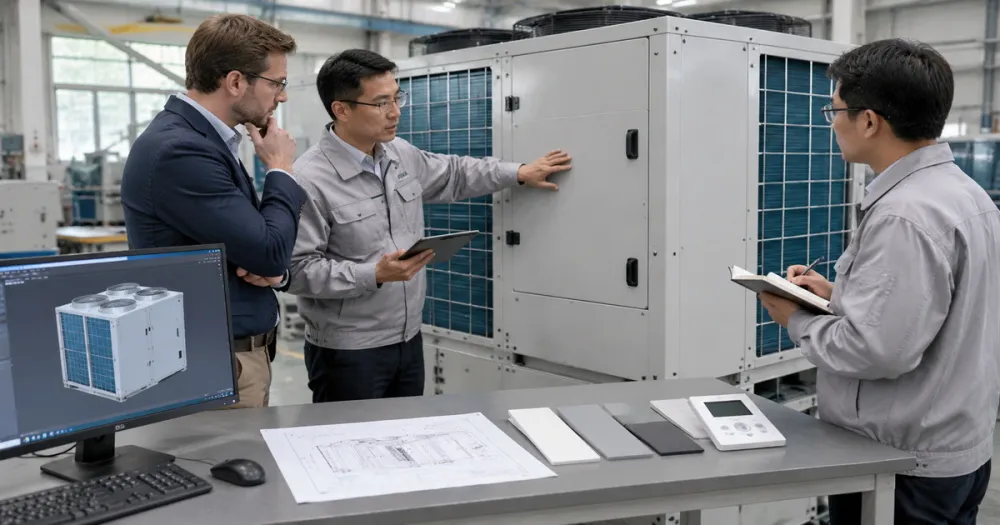
Agree on the sample specification before payment. Define the test conditions, documentation package, inspection method, and acceptance thresholds.
For customized equipment, require an approved drawing and a list of deviations from the standard platform. Resolve those deviations before production rather than after the first container arrives.
3. Test Delivery Commitments
Request a milestone schedule covering:
– Engineering approval.
– Component procurement.
– Pilot production.
– Inspection and testing.
– Packaging.
– Shipment readiness.
Ask the supplier to identify which milestones depend on buyer approval. This makes delivery discussions more useful than an unsupported promise of a short lead time.
4. Resolve Shipping and Service Details Early
Before booking freight, confirm packed dimensions, gross weight, lifting points, handling restrictions, packaging design, and the responsibilities under the agreed trade term.
Provide the forwarder with the actual refrigerant and shipment information and obtain its classification and handling requirements. Do not assume that all air-conditioning shipments follow identical procedures.
Finally, negotiate spare-parts availability, warranty evidence requirements, response times, and responsibility for replacement freight before placing a repeat order.
Conclusion
There is no single manufacturer suited to every building-cooling purchase. The shortlisted companies span specialist packaged systems, broad commercial platforms, clean-environment equipment, and applied HVAC engineering. Their published portfolios demonstrate why buyers should compare equivalent system categories rather than brand names alone.
For buyers considering DREZ, the most useful next step is a defined technical enquiry covering building conditions, target market, quantity, electrical supply, installation constraints, and OEM requirements. Ask for a model recommendation, customization matrix, supporting documents, and itemized quotation. Its published specialist product range makes that a more meaningful starting point than a price-only request.
A reliable long-term partnership begins when both parties can explain exactly what will be built, how it will be verified, and who will support it after delivery.
FAQ
1. How can I verify whether a supplier’s ISO certificate has expired or been suspended?
Search using the certificate number or legal company name in IAF CertSearch, then examine the status, standard, scope, certified location, certification body, and accreditation information. The platform distinguishes active, suspended, withdrawn, and expired certificates. If records are unclear or inconsistent, contact the issuing certification body directly rather than relying on a scanned PDF.
2. Can a supplier’s CE certificate cover equipment sold under our own brand?
Do not assume so. Under the European Commission’s guidance, a business that has equipment made and sells it under its own brand is considered the manufacturer. Establish who signs the Declaration of Conformity, who maintains the technical documentation, and whether the evidence covers your exact model and configuration. A voluntary certificate is not a substitute for the required conformity assessment.
3. How do we compare two suppliers offering the same nominal cooling capacity?
Require both suppliers to quote against one specification, including test conditions, equipment configuration, electrical input, airflow requirements, and intended installation. Ask them to identify every deviation.
Where certification or independent performance evidence is offered, check the exact model combinations and test standards. Published model-specific documentation shows why a shared capacity label alone is insufficient for verification.
4. Does a factory’s large annual capacity guarantee a small MOQ or fast delivery?
No such conclusion can be drawn from the disclosed capacity figures. Haier’s published figure covers global air-conditioning production, while Chigo’s figure spans identified manufacturing bases; neither establishes available slots for your selected customized model. Request a written MOQ, customization charge, material-availability assessment, and production schedule for the actual order.
5. What should we do if the supplier changes a major component after sample approval?
Require a documented change request identifying affected models and serial numbers, the reason for substitution, and the proposed verification work. Do not approve solely because the replacement has a similar headline rating.
For EU-bound equipment, assess whether the change affects the supporting technical evidence or Declaration of Conformity. The Commission states that product changes require the documentation to be reviewed and updated accordingly.
Hot Tags: Commercial Air Conditioning Manufacturers, Air Conditioning For Buildings, HVAC Manufacturers In China, Commercial Air Conditioner Suppliers, OEM Air Conditioner Manufacturers, ODM Air Conditioning Manufacturers, Rooftop Air Conditioner Manufacturers, Packaged Air Conditioning Units, Industrial Air Conditioning Systems, Commercial HVAC Equipment Suppliers