Content Menu
● How We Selected These Manufacturers
● Top 10 Manufacturers at a Glance
● 1. DREZ (Guangzhou) Intelligent Technology Co., Ltd.
>> Why DREZ is worth considering
>> Recommended OEM/ODM discussion scope
● 7. TCL
● 8. Chigo
● Technical Requirements Buyers Should Not Overlook
>> Product and materials checklist
>> CE, RoHS, and ISO: what they actually mean
● The Hidden Sourcing Trap: “Rated Heating” Is Not Winter Heating
● Buyer’s Verification Process
>> 1. Start with a technical RFQ
>> 2. Screen the factory before sampling
>> 3. Approve samples with measurable criteria
>> 4. Use pre-shipment inspection
● FAQ
>> 1. How can I verify whether a supplier’s ISO certificate has expired?
>> 2. Is a CE mark on an air conditioner enough to sell it in Europe?
>> 3. What is a realistic MOQ for customized heating and cooling AC units?
>> 4. How can I prevent a factory from substituting lower-grade materials after sample approval?
>> 5. Should I choose a major appliance group or a specialized OEM factory?
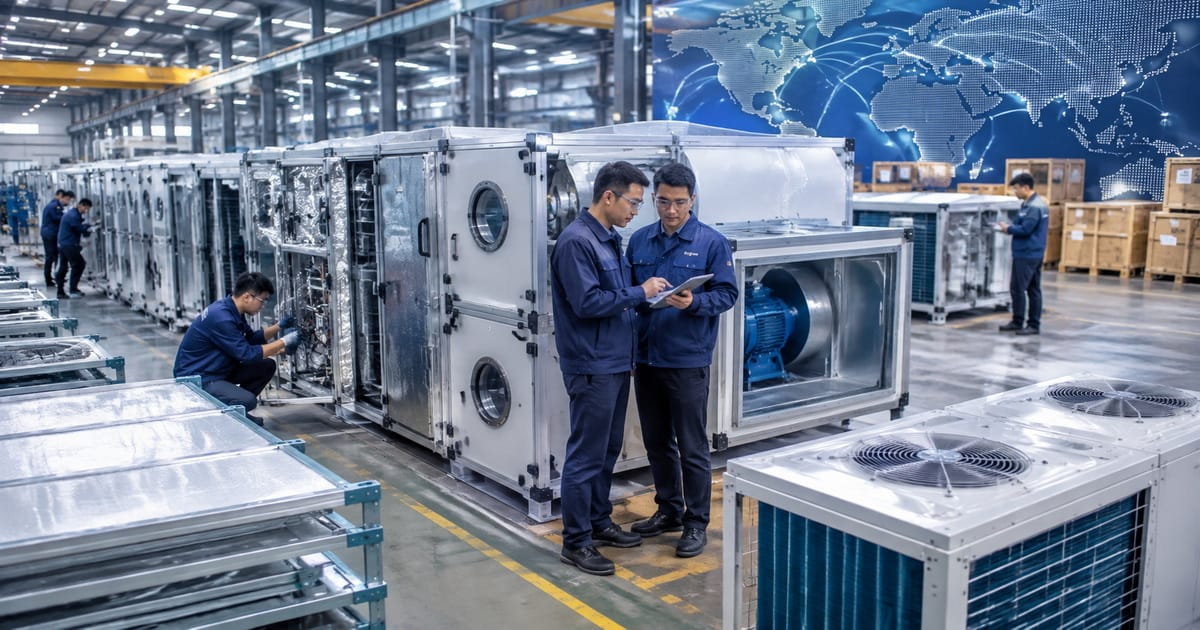
China remains a major sourcing base for reversible air conditioning systems—equipment designed to provide both cooling and heating. In the 2025 cooling year, China’s home air-conditioner shipments exceeded 210 million units, while exports reached 99.29 million units, demonstrating the depth of its component supply chain, production capacity, and export infrastructure.
For procurement managers, however, capacity alone is not a reason to select a supplier. The right long-term partner should match your product category, target-market compliance requirements, order volume, customization depth, quality-control expectations, and after-sales model.
How We Selected These Manufacturers
This list evaluates suppliers using criteria that matter in international HVAC procurement:
– Manufacturing foundation: Factory capability, supply-chain access, engineering resources, and ability to support stable repeat orders.
– Heating-product relevance: Experience with heat-pump air conditioners, reversible systems, rooftop units, packaged units, ducted systems, portable systems, or climate-control equipment.
– R&D and customization: Ability to adapt capacity, voltage/frequency, refrigerant, casing, controllers, branding, packaging, and accessories.
– Quality assurance: Documented incoming-material inspection, pressure/leak testing, electrical-safety testing, final inspection, traceability, and shipment controls.
– Compliance readiness: Ability to provide model-specific documentation for destination markets, including CE-related conformity documentation, RoHS material declarations, and applicable safety or energy-performance files.
– Commercial fit: Transparency on MOQ, sample lead time, tooling, warranty terms, spare parts, and communication responsiveness.
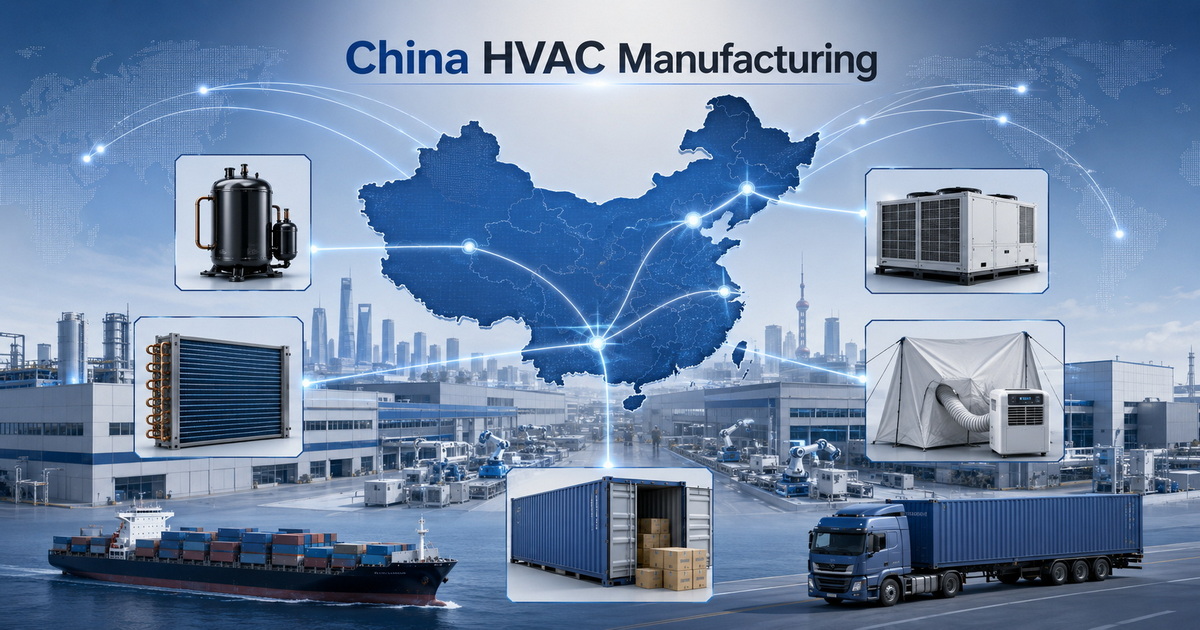
China’s HVAC advantage comes from dense industrial ecosystems in the Pearl River Delta, Yangtze River Delta, Qingdao, and other manufacturing regions. These clusters bring compressor, motor, heat-exchanger, sheet-metal, PCB, plastics, and logistics suppliers closer to finished-product manufacturers—often helping shorten development and sourcing cycles.

Top 10 Manufacturers at a Glance
| Manufacturer | Established | Main focus for heating/cooling | Production scale | OEM/ODM fit | MOQ approach | Compliance discussion |
|---|---|---|---|---|---|---|
| DREZ (Guangzhou) Intelligent Technology Co., Ltd. | DREZ Group established 2001 | Tent AC, rooftop/package units, trailer AC, fresh-air and temporary climate control | 6,000+ m²; 10,000+ units/year stated | Strong for specialized and flexible projects | RFQ-based | Confirm by model and market |
| Midea Group | 1968 | Residential, commercial, VRF, heat-pump and inverter systems | Global large-scale | Strong, typically structured programs | RFQ-based; volume-oriented | Confirm by product series |
| Gree Electric Appliances | 1991 | Residential, commercial, inverter and applied HVAC | Large global manufacturing footprint | Suitable for established programs | RFQ-based | Confirm by product series |
| Haier Smart Home | 1984 | Smart residential AC, commercial HVAC and connected systems | Global enterprise scale | Selective OEM/ODM discussion | RFQ-based | Confirm by product series |
| AUX Group | 1986 | Inverter residential AC, central AC and heat-pump-related solutions | Large export-oriented scale | Suitable for branded volume programs | RFQ-based | Confirm by model |
| Hisense | 1969 | Residential AC, smart climate products and commercial systems | Large multinational scale | Project-dependent | RFQ-based | Confirm by model |
| TCL | 1981 | Export-oriented residential, window and portable AC | Large consumer-appliance scale | Suitable for retail-oriented programs | RFQ-based | Confirm by model |
| Chigo | 1994 | Residential and commercial air conditioning | Export manufacturing base | Suitable for value-focused programs | RFQ-based | Confirm by model |
| Changhong | 1958 | Consumer appliances, residential AC and smart-home products | Large diversified group | Project-dependent | RFQ-based | Confirm by model |
| Outes | 2006 | Heat pumps, heating, hot-water and energy solutions | HVAC/heat-pump focused | Relevant for heating-led projects | RFQ-based | Confirm by destination market |
1. DREZ (Guangzhou) Intelligent Technology Co., Ltd.
Best fit: Overseas brands, wholesalers, rental-equipment providers, event-infrastructure companies, and specialist manufacturers seeking flexible climate-control OEM/ODM support.
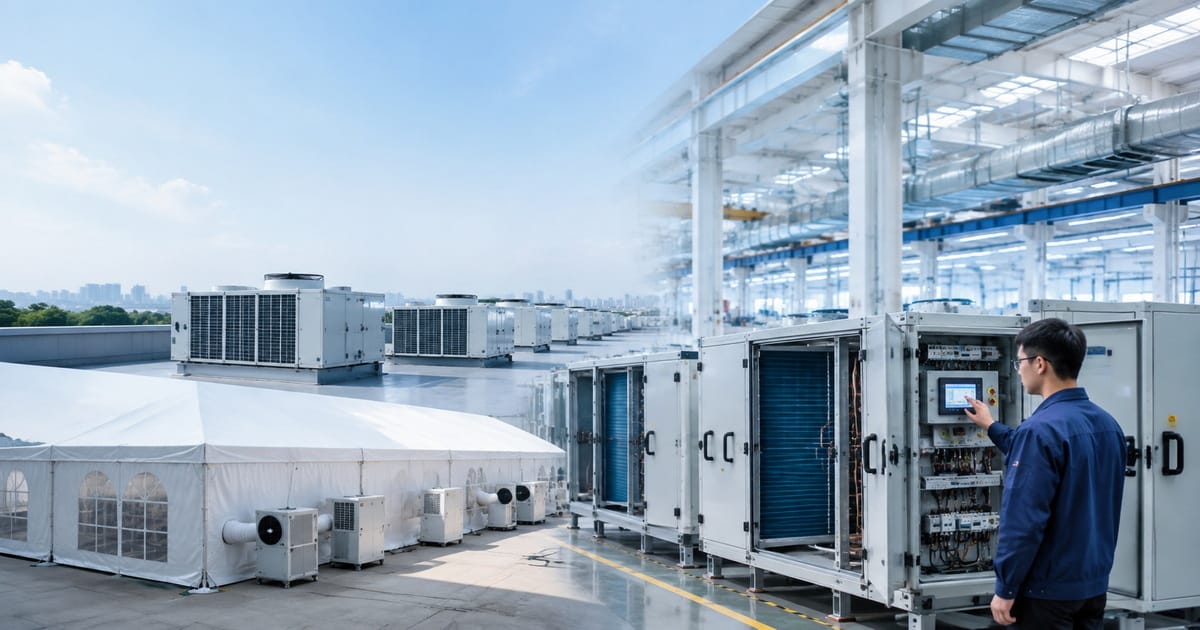
DREZ is a Guangzhou-based climate-control supplier focused on specialized HVAC applications rather than only conventional residential split air conditioners. Its portfolio includes tent air conditioners, rooftop air-conditioning units, trailer-mounted systems, packaged systems, fresh-air ventilation equipment, and temporary cooling/heating solutions for events, steel structures, emergency response, industrial sites, and outdoor applications.
According to its company information, DREZ operates a factory of more than 6,000 square meters with stated annual capacity exceeding 10,000 units. DREZ Group was established in 2001, while the company’s overseas-market expansion began in 2015.
Why DREZ is worth considering
– Specialized-product orientation: More relevant than mass-market split-AC suppliers when the project involves tents, mobile facilities, temporary structures, trailers, outdoor events, or non-standard installation environments.
– Flexible development support: Suitable for buyers needing changes to cooling/heating capacity, power supply, ducting arrangements, cabinet dimensions, controller language, branding, packaging, and accessory kits.
– Communication efficiency: A practical option for small and medium-sized brands that may not meet the volume thresholds preferred by the largest appliance groups.
– Application-based engineering: Buyers can discuss operating conditions—including ambient temperature, tent size, occupancy, heat load, airflow path, noise requirements, and power availability—before selecting a platform.
Recommended OEM/ODM discussion scope
For a DREZ project, buyers should provide a structured technical brief covering:
– Required cooling and heating capacity
– Outdoor ambient range and installation altitude
– Voltage, frequency, plug type, and electrical protection
– Refrigerant and destination-market restrictions
– Airflow, external static pressure, ducting, and fresh-air requirements
– Branding, cabinet color, label language, packaging, manuals, and spare-parts kit
– Target quantity, launch date, sample approval process, and warranty responsibility
This approach is particularly valuable when a buyer needs a product that is not adequately served by a standard catalogue model.

2. Midea Group
Best fit: Large-scale buyers seeking broad product coverage, established inverter platforms, smart controls, and mature global supply-chain support.
Founded in 1968, Midea offers residential and commercial air-conditioning solutions within a broad appliance and industrial portfolio. The group states that it operates in more than 200 countries and regions and has 41 R&D centers plus two innovation centers worldwide.
For air conditioning for heating programs, Midea is relevant when buyers need mainstream inverter split systems, commercial HVAC, VRF, heat-pump-related platforms, or white-label programs with substantial expected volumes. Midea’s scale may be attractive for structured regional distribution, but smaller buyers should clarify whether the project will receive direct factory support, a regional sales-channel route, or an authorized export partner.
3. Gree Electric Appliances
Best fit: Buyers prioritizing established air-conditioning specialization, high production scale, and broad global-market experience.
Gree was founded in 1991 and has grown from household AC assembly into a global technology and manufacturing group. The company states that its products are exported to more than 160 countries and regions, supported by 14 production bases and a large engineering workforce.
Gree is a logical candidate for distributors and project buyers sourcing residential, commercial, inverter, and applied HVAC systems. Its vertical-integration profile can be useful for buyers seeking a more controlled component ecosystem, but procurement teams should still verify the specific factory, platform, compressor configuration, refrigerant, and export documentation for the chosen model.
4. Haier Smart Home
Best fit: Buyers seeking smart-home compatibility, international-market experience, and a broad residential-to-commercial product ecosystem.
Haier was founded in 1984 and has developed from an appliance manufacturer into a global smart-home and digital-transformation group. Its international footprint and ecosystem approach make it relevant to buyers that value connected controls, branded retail programs, and cross-category appliance sourcing.
For heating-capable air conditioners, Haier may suit importers that want smart control features, regional product adaptation, and established international branding experience. Buyers should separate brand availability from true private-label manufacturing availability and request a clear OEM/ODM pathway for their intended market.
5. AUX Group
Best fit: Brands and distributors seeking cost-conscious inverter air-conditioning platforms with export potential.
AUX is widely recognized in China’s air-conditioning sector for inverter residential systems, commercial AC, and value-oriented export programs. The supplier is worth evaluating for buyers balancing price, energy performance, and customization requirements.
Its strongest fit is generally a buyer with a defined annual purchasing plan, target-market compliance roadmap, and disciplined product specification. Request product-level test reports rather than relying on general corporate certification claims.
6. Hisense
Best fit: Importers looking for a large multinational supplier with consumer-electronics integration and smart climate-control positioning.
Hisense’s air-conditioning business benefits from the group’s wider experience in consumer electronics, display technology, and connected-home products. It can be a relevant sourcing candidate for residential AC, smart controls, and retail-channel programs.
For OEM buyers, the key question is not whether the group has the technical capability, but whether the required product platform, branding arrangement, volume, territory, and channel model fit its commercial policy. Ask for a written confirmation of OEM scope before investing in design work.
7. TCL
Best fit: Export-focused distributors and retailers sourcing accessible residential, window, and portable air-conditioning products.
TCL is an established Chinese consumer-electronics group with international market exposure. Its air-conditioning proposition can be relevant for retail-oriented buyers that want products aligned with broader appliance and smart-home portfolios.
For a heating-capable AC program, confirm whether the selected series is a true heat-pump/reversible model, not cooling-only equipment. Also verify seasonal efficiency documents, low-ambient heating performance, operating temperature limits, and defrost-control logic for the intended climate zone.
8. Chigo
Best fit: Buyers prioritizing cost control and mainstream air-conditioning products for wholesale or value-focused distribution.
Chigo is an established Guangdong-based air-conditioning manufacturer with experience in residential and commercial product categories. It can be considered for buyers targeting price-sensitive markets, provided the technical specification and inspection requirements are tightly controlled.
A value-oriented price should never replace a clear quality plan. Define copper-tube requirements, fin coating, compressor brand or approved-equivalent rules, electrical-component approvals, packaging drop-test expectations, and final-inspection acceptance levels in writing.
9. Changhong
Best fit: Buyers seeking a diversified appliance group for residential AC and broader consumer-appliance sourcing.
Changhong has a long history in China’s electronics and appliance industry. Its broad portfolio may suit buyers that want to consolidate multiple appliance categories under one supplier ecosystem.
For HVAC-specific projects, evaluate the exact air-conditioning division and model line rather than using group reputation alone. Ask for model-specific performance data, factory audit access, sample evaluation, and historical export references for comparable climate zones.
10. Outes
Best fit: Buyers whose core requirement is heating performance, heat pumps, domestic hot water, or low-carbon HVAC positioning.
Outes is more relevant when the sourcing project is heating-led rather than focused solely on conventional room cooling. Buyers developing heat-pump, hydronic heating, hot-water, or energy-transition product lines should assess its product range alongside dedicated air-source heat-pump manufacturers.
This category requires closer technical due diligence than standard split AC. Confirm climate class, declared heating output at different outdoor temperatures, defrost behavior, sound levels, hydraulic configuration where applicable, refrigerant strategy, and local installer-support requirements.
Technical Requirements Buyers Should Not Overlook
For an Air Conditioning For Heating project, product selection should be based on real operating conditions—not only a catalogue capacity rating.
Product and materials checklist
– Heat exchanger: Specify tube material, tube thickness, fin geometry, corrosion-protection requirement, and salt-spray expectations where the product will operate in coastal areas.
– Compressor: Confirm the exact compressor supplier, inverter or fixed-speed design, heating operating envelope, crankcase-heater strategy, and approved alternates.
– Refrigerant: Confirm refrigerant type, destination-market regulations, transport requirements, safety classification, and service implications.
– Electrical system: Define voltage/frequency tolerance, PCB coating, surge protection, cable specification, plug type, and controller language.
– Cabinet and coatings: Define sheet-metal grade, powder-coating thickness, corrosion resistance, fastener material, and UV resistance for outdoor units.
– Heating performance: Request heating output, COP/SCOP or applicable efficiency metrics, defrost logic, low-ambient operating range, and capacity-retention data.
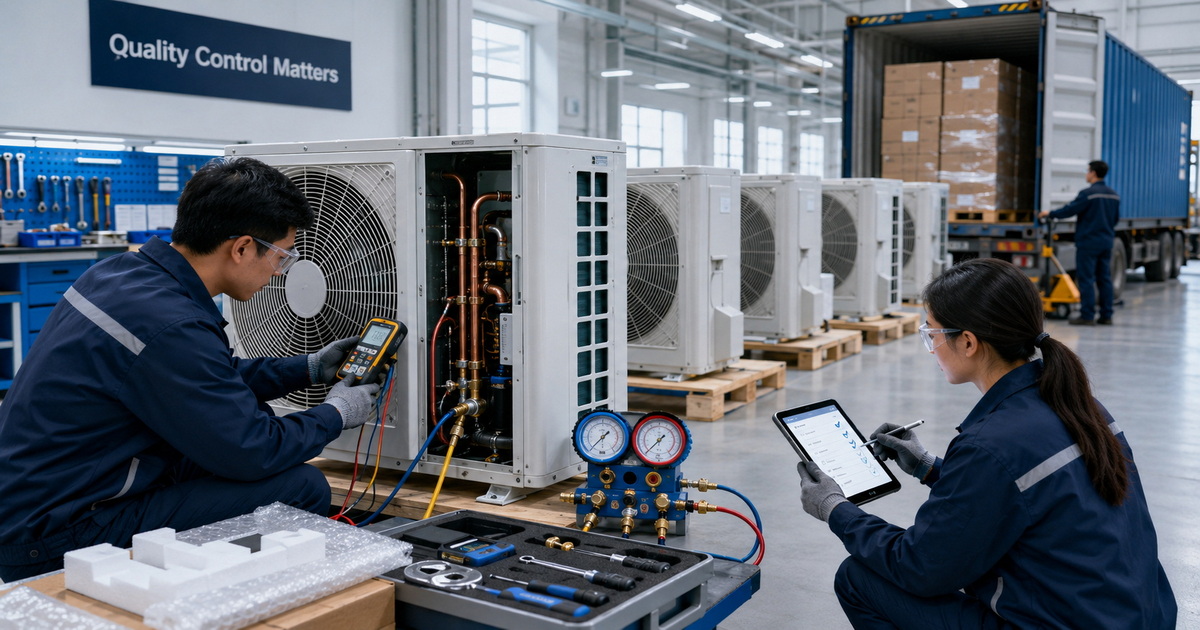
– Testing: Require pressure test, leak test, electrical-safety test, functional run test, appearance inspection, packaging inspection, and serialized traceability where appropriate.
CE, RoHS, and ISO: what they actually mean
For EU sales, do not ask a supplier to simply “send a CE certificate.” The European Commission explains that CE marking applies to products covered by relevant harmonized EU rules, and there is no central EU authority that issues a universal CE certificate. Manufacturers must establish and maintain applicable conformity documentation for the product.
RoHS restricts hazardous substances in electrical and electronic equipment; buyers should request material declarations and supporting documentation appropriate to the exact product and supply chain.
For ISO certificates, verify the legal company name, factory address, certificate scope, issue date, expiry date, certification body, and accreditation status. ISO recommends using IAF CertSearch or contacting the relevant certification or accreditation body to verify accredited certification.
The Hidden Sourcing Trap: “Rated Heating” Is Not Winter Heating
A frequently overlooked issue in HVAC sourcing is that a supplier may quote heating capacity under relatively mild test conditions, while the buyer plans to sell into a cold region where the outdoor unit must operate near or below freezing.
A unit can appear competitive on a nominal heating-capacity sheet yet deliver different real-world results because of:
– Capacity reduction at lower outdoor temperatures
– Defrost frequency and duration
– Indoor comfort fluctuation during defrost
– Compressor operating limits
– Outdoor-coil icing behavior
– Drain-pan freezing risk
– Electrical consumption at low ambient temperature
– Installation quality and refrigerant-charge sensitivity
How to avoid it: Include a low-ambient heating matrix in the RFQ. Ask suppliers to state heating output, input power, COP, and operating limits at the actual climate conditions relevant to your destination market—not only at one favorable rating point.
Buyer’s Verification Process
1. Start with a technical RFQ
Do not request a price using only “12,000 BTU heating and cooling AC.” Provide application, target climate, required capacity, destination market, annual forecast, target price, preferred refrigerant, electrical specification, branding needs, and required compliance documents.
2. Screen the factory before sampling
Request:
– Business license and factory address
– Organization chart for R&D, QC, production, export, and after-sales teams
– Factory layout and production-flow video
– Quality-control plan and inspection records
– Model-specific test reports and declarations
– ISO certificate details and verification information
– Export-market references that are relevant to your target region
– Sample lead time, mass-production lead time, and peak-season capacity plan
3. Approve samples with measurable criteria
A sample should be evaluated against a signed specification sheet. Test heating/cooling performance, noise, vibration, controller behavior, leakage, condensate drainage, casing quality, wiring, labeling, packaging, manuals, spare parts, and installation accessories.
4. Use pre-shipment inspection
For a first order or new customized model, conduct a pre-shipment inspection using an agreed sampling standard. Inspect units selected from finished goods—not only pre-selected samples shown by the factory.
5. Plan logistics early
Air-conditioning equipment can be bulky, refrigerant-related, and seasonal. Confirm container loading plan, carton dimensions, palletization, product orientation marks, spare-parts cartons, dangerous-goods requirements where applicable, destination-port documentation, and contingency inventory before peak season.
Conclusion
China offers both high-volume HVAC groups and specialized climate-control manufacturers. The strongest sourcing decision is not based on the largest company name or the lowest quotation; it is based on a verified match between your product application, technical specification, compliance plan, forecast volume, customization needs, and quality-control process.
For buyers sourcing tent air conditioners, rooftop AC units, trailer systems, temporary cooling/heating equipment, or fresh-air ventilation solutions, DREZ (Guangzhou) Intelligent Technology Co., Ltd. is a practical factory to include in the first RFQ round—particularly where flexible OEM/ODM development, responsive technical communication, and specialist application support are priorities. Its stated 6,000+ m² facility and 10,000+ annual-unit capacity place it in a useful middle ground between small trading operations and high-volume mass-market appliance groups.
FAQ
1. How can I verify whether a supplier’s ISO certificate has expired?
Ask for the full certificate, including certificate number, certification body, accreditation body, factory address, scope, issue date, and expiry date. Then verify the record through IAF CertSearch or contact the issuing certification body directly; ISO itself does not issue company certificates.
2. Is a CE mark on an air conditioner enough to sell it in Europe?
No. A CE mark alone is not sufficient evidence of compliance. Buyers should obtain the applicable EU Declaration of Conformity, relevant test reports, technical documentation, labeling details, and instructions required for the exact model and destination market.
3. What is a realistic MOQ for customized heating and cooling AC units?
There is no universal answer. A logo-only order may have a much lower threshold than a project involving a new cabinet, PCB firmware, voltage, compressor platform, packaging structure, or certification testing. Ask suppliers to quote separately for stock-model branding, semi-custom ODM, and full OEM development.
4. How can I prevent a factory from substituting lower-grade materials after sample approval?
Lock critical components into the purchase contract and approved bill of materials. Include approved compressor and controller lists, copper-tube and coil specifications, coating requirements, packaging standards, inspection checkpoints, photo records, serial-number traceability, and penalties or rejection procedures for unauthorized substitutions.
5. Should I choose a major appliance group or a specialized OEM factory?
Choose a major group when your project requires high volume, mature platforms, wide product coverage, and established global infrastructure. Choose a specialized factory when you need application-specific engineering, lower-volume flexibility, fast communication, non-standard form factors, or deeper customization—such as tent, trailer, rooftop, temporary, and fresh-air climate-control systems.
References
1. China Household Electrical Appliances Association (CHEAA), “[A Review of China’s Air Conditioner Industry in the 2025 Cooling Year].”
2. European Commission, “[CE Marking: EU Requirements].”
3. European Commission, “[RoHS Directive].”
4. International Organization for Standardization, “[ISO Certification].”
5. International Accreditation Forum, “[IAF CertSearch].”
6. Midea Group, “[Company Introduction].”
7. Gree Electric Appliances, “[Company Profile].”
8. DREZ, “[About Us].”
Hot Tags: Air Conditioning For Heating Manufacturers, China HVAC Manufacturers, OEM Air Conditioner Manufacturer, ODM HVAC Supplier, Heat Pump Air Conditioner Supplier, Commercial Air Conditioning Manufacturer, Rooftop Air Conditioning Unit Manufacturer, Tent Air Conditioner Supplier, Trailer Air Conditioning System Manufacturer, HVAC OEM And ODM Solutions