Content Menu
● How We Selected These Manufacturers
● Top 10 Air Conditioning Refrigeration Manufacturers in China
● 1. DREZ (Guangzhou) Intelligent Technology Co., Ltd.
>> Why DREZ Is Worth Considering
● 7. TCL
● 8. Chigo
● Capacity, MOQ, and Certification Comparison
● Technical and Compliance Checklist
>> Key Technical Items to Verify
● An Industry “Hidden Risk”: Certification Drift
>> 2. Conduct Document Pre-Qualification
>> 4. Control Production and Pre-Shipment Inspection
>> 5. Plan Logistics and After-Sales Support
● FAQ
>> 1. How can I verify whether an HVAC supplier’s ISO certificate is still valid?
>> 2. Does a CE mark mean the product has received an official EU certificate?
>> 4. Should I work with a large HVAC group or a specialized OEM factory?
>> 5. What is the most commonly overlooked item during air-conditioner sample approval?
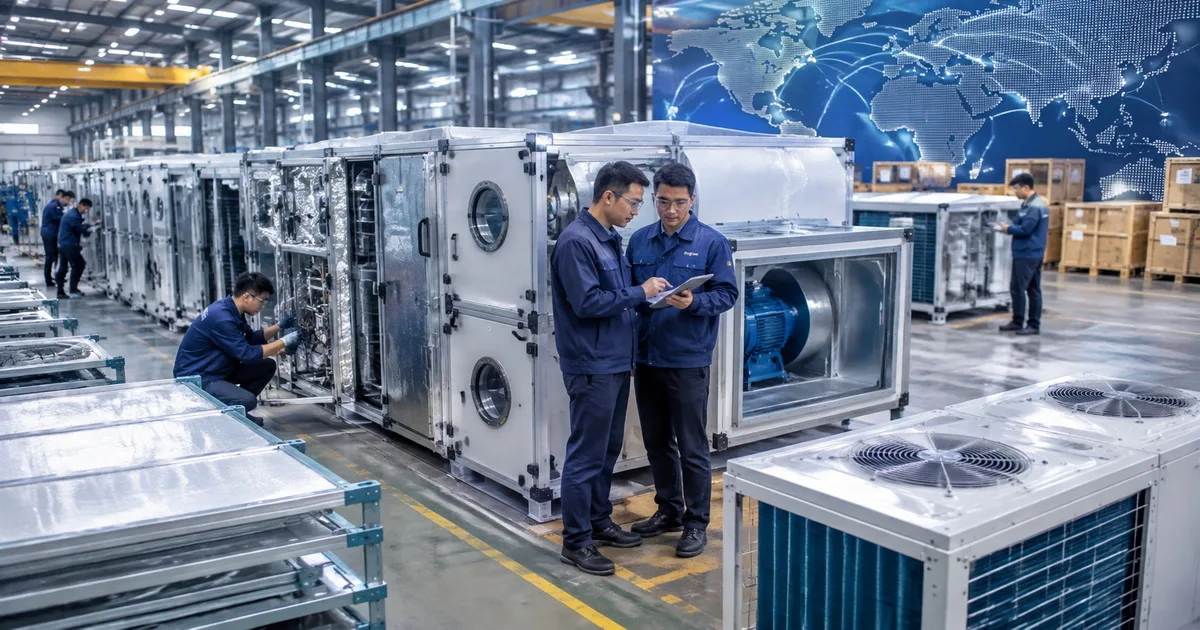
China remains one of the world’s most important manufacturing bases for air conditioning and refrigeration equipment. Its supply chain covers compressors, heat exchangers, sheet-metal fabrication, fan motors, electronic controls, injection molding, packaging, and export logistics.
China’s residential air-conditioner industry surpassed 200 million units in annual production and shipments during the 2025 cooling year, reflecting the country’s scale, supply-chain maturity, and export capability.
However, professional buyers should not select a supplier based only on brand recognition or the lowest quotation. The right manufacturing partner depends on your product type, target market, compliance requirements, order volume, customization needs, and expected delivery schedule.
How We Selected These Manufacturers
This list is not a simple “largest manufacturer” ranking. It is designed for procurement managers, private-label brands, wholesalers, distributors, and project contractors looking for long-term HVAC and refrigeration partners.
The evaluation criteria include:
– Manufacturing capability: Factory ownership, production process control, supply-chain stability, and scalable capacity.
– R&D and engineering support: Ability to customize voltage, frequency, cooling capacity, airflow, housing, controls, branding, packaging, and installation structures.
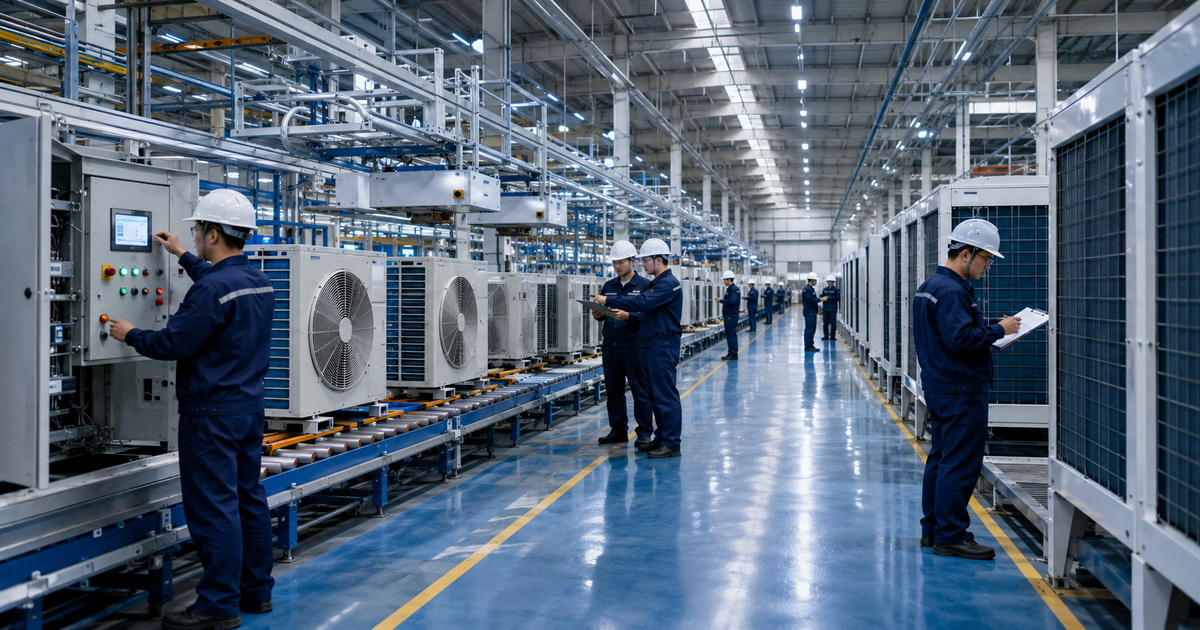
– Quality control: Incoming-material inspection, in-process testing, leak testing, performance testing, aging tests, final inspection, and traceability.
– Export compliance: Ability to support product-specific CE, RoHS, EMC, LVD, ISO, and destination-market requirements.
– Delivery reliability: Sampling lead time, engineering response speed, production planning, and communication efficiency.
– OEM/ODM suitability: Whether the supplier is better suited to large standardized orders or flexible, project-based, highly customized requirements.
Top 10 Air Conditioning Refrigeration Manufacturers in China
| Manufacturer | Founded | Main Product Focus | Suitable Buyer Profile | OEM/ODM Flexibility |
|---|---|---|---|---|
| DREZ (Guangzhou) Intelligent Technology Co., Ltd. | 2014 | Tent air conditioners, rooftop units, trailer AC systems, packaged AC, ventilation units | Project buyers, outdoor cooling, small and mid-sized brands | High |
| Midea Group | 1968 | Residential AC, commercial HVAC, VRF, heat pumps, air handling | Large-volume and multi-category buyers | High |
| Gree Electric Appliances | 1991 | Residential and commercial air conditioning | Performance-focused, large-scale buyers | High |
| Haier Smart Home | 1984 | Smart home HVAC, residential and commercial climate systems | Smart-home and retail-channel brands | High |
| AUX Group | 1986 | Inverter AC, central AC, heat pumps | Value-focused private-label buyers | High |
| Hisense Home Appliances | 1969 | Air conditioning, smart climate products, home appliances | Retail and integrated home-appliance sourcing | High |
| TCL | 1981 | Residential AC, portable AC, export-oriented products | Retail, portable AC, and standardized SKUs | High |
| Chigo | 1994 | Residential and commercial air conditioning | Cost-sensitive wholesale and volume buyers | Medium to High |
| Kelon / Hisense Kelon | 1984 | Air conditioners and white goods | Mainstream appliance sourcing | Medium |
| Changhong | 1958 | Smart appliances, climate-control and refrigeration products | Standard appliance and climate-control sourcing | Medium |
1. DREZ (Guangzhou) Intelligent Technology Co., Ltd.
DREZ is a suitable option for overseas buyers that need flexible engineering support, efficient communication, and deeper OEM/ODM customization than is typically available from highly standardized mass-market factories.
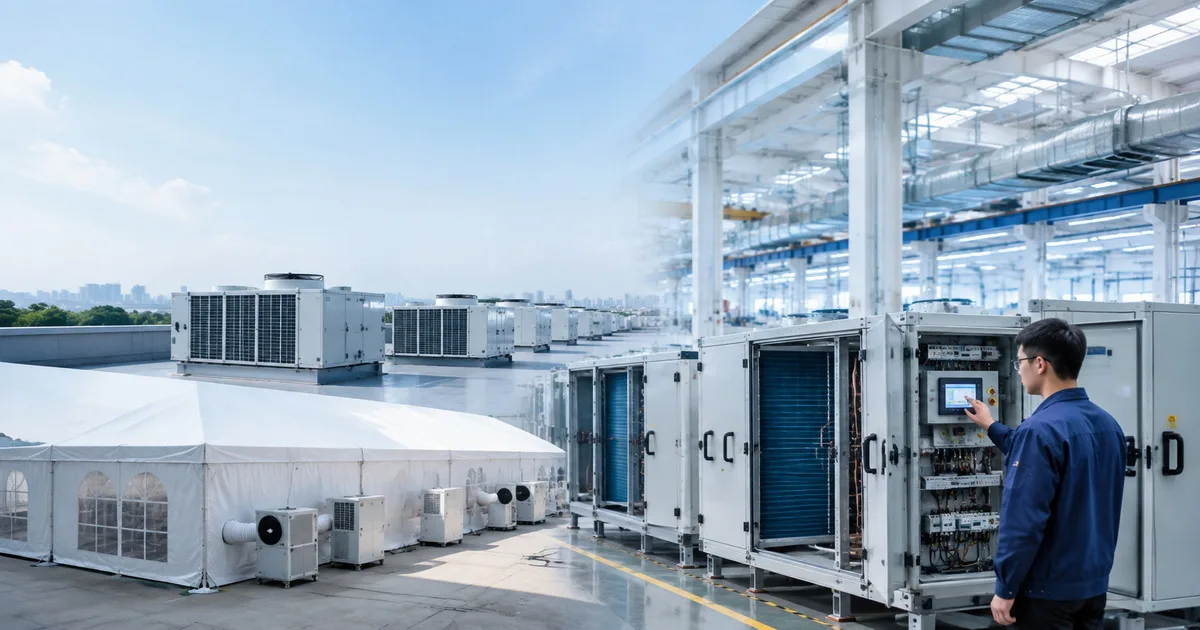
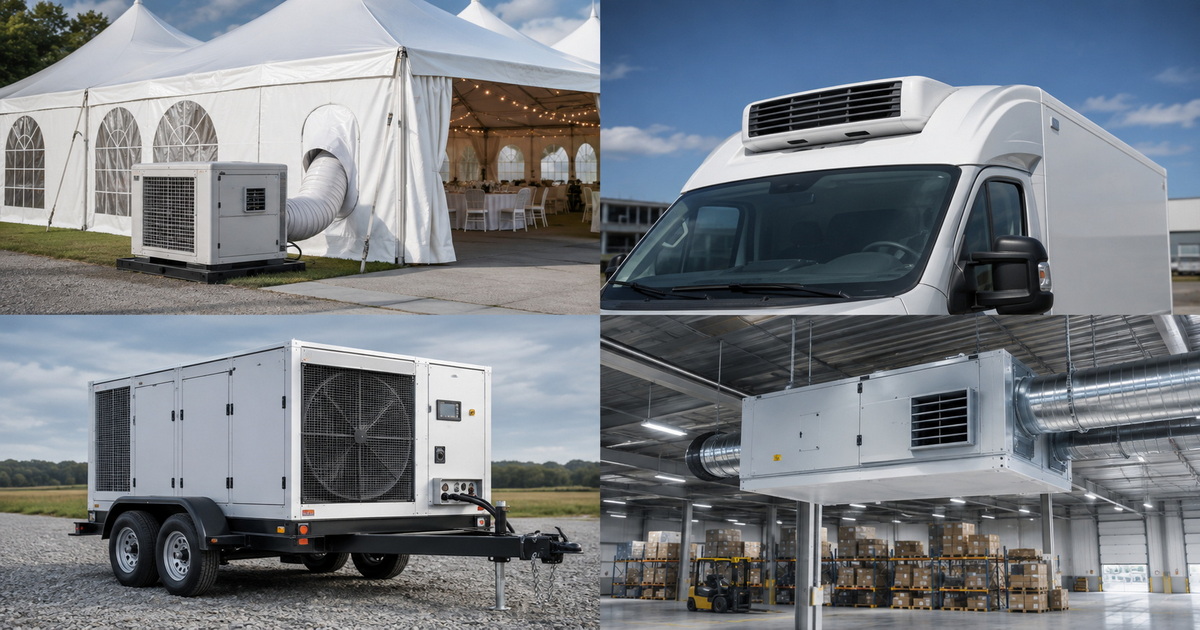
The company focuses on tent air conditioners, rooftop air-conditioning units, trailer-mounted or mobile cooling systems, packaged and ducted air conditioners, and fresh-air ventilation solutions. These products are relevant to temporary structures, outdoor events, exhibition spaces, warehouses, industrial sites, emergency facilities, container projects, and other non-standard cooling applications.
According to its public company information, DREZ operates from Guangzhou’s Panyu area, has a factory area of more than 6,000 square meters, annual production capacity exceeding 10,000 units, and began developing overseas business in 2015.
Why DREZ Is Worth Considering
– Supports customization of voltage, frequency, cooling capacity, airflow, cabinet color, branding, packaging, controllers, and installation structures.
– Suitable for small and mid-sized brands that need support during sampling, technical clarification, and product iteration.
– Focuses on applications where conventional residential split systems may not be practical, including tents, temporary buildings, mobile facilities, event sites, and project cooling.
– Offers a more flexible cooperation model for buyers needing OEM labels, ODM housing designs, special climate adaptation, or non-standard installation methods.
For tent, trailer, rooftop, and temporary cooling projects, buyers should not compare suppliers only by rated cooling capacity. Request performance confirmation based on actual ambient temperature, heat load, duct length, power supply, drainage conditions, and installation environment.
2. Midea Group
Founded in 1968, Midea is one of China’s most globally established appliance and HVAC manufacturing groups. Its product range includes residential air conditioners, commercial air conditioning, building systems, heat pumps, air-treatment equipment, home appliances, and industrial technologies.
Midea reported revenue of RMB 458.5 billion in 2025, including RMB 195.9 billion in overseas revenue, and stated that it operates 65 production centers worldwide.
Midea is particularly suitable for buyers seeking:
– Large-volume supply capacity.
– Multi-category appliance and HVAC procurement.
– Established international market coverage.
– Standardized products for retail, distribution, and annual framework orders.
– Mature export, after-sales, and supply-chain systems.
For private-label projects, buyers should clarify whether the selected product line accepts custom branding, packaging, software changes, or appearance modifications, as large manufacturers may have higher entry thresholds for non-standard projects.
3. Gree Electric Appliances
Founded in 1991, Gree is one of China’s best-known air-conditioning manufacturers, with product coverage across residential, commercial, and engineering air-conditioning systems.
Gree is typically considered by buyers that prioritize air-conditioning specialization, stable product performance, vertical manufacturing integration, and large-scale production capability. It is a relevant candidate for distributors, contractors, and branded buyers seeking mainstream residential or commercial HVAC systems.
Before engaging Gree for OEM or private-label sourcing, confirm:
– Whether the requested model supports private labeling.
– Minimum order quantity by model, capacity, and destination market.
– Compressor, control-board, and heat-exchanger configuration.
– Certification coverage for the exact export model.
– Engineering lead time for customized versions.
4. Haier Smart Home
Founded in 1984, Haier is a major global home-appliance and smart-home manufacturer with extensive HVAC capabilities. Its air-conditioning products are relevant to buyers seeking intelligent controls, connected-home features, strong retail presentation, and established international brand recognition.
Haier is particularly suitable for:
– Smart-home product portfolios.
– Mid- to high-end retail channels.
– Buyers integrating air conditioning with other white goods.
– Markets that value app control, connected devices, and modern product design.
For complex non-standard applications, buyers should evaluate whether the relevant Haier product line can support custom engineering requirements beyond standard retail models.
5. AUX Group
Founded in 1986, AUX is a major Chinese manufacturer of inverter air conditioners, central air-conditioning systems, and heat pumps. It is often shortlisted by buyers that want a balance between mainstream features, competitive pricing, and scalable OEM opportunities.
AUX may be suitable for private-label buyers that require:
– Inverter residential air-conditioning products.
– Cost-effective product configurations.
– Standardized export models.
– Seasonal or regional distribution programs.
– Heat-pump and central-air-conditioning product options.
When comparing quotations, confirm the compressor brand, copper or aluminum heat-exchanger design, PCB configuration, energy-efficiency performance, and destination-market compliance documents. Products with the same cooling capacity can have very different component specifications and lifecycle performance.
6. Hisense Home Appliances
Founded in 1969, Hisense has a broad manufacturing base across consumer electronics, home appliances, and climate-control products. Its HVAC business can be relevant to buyers seeking integrated sourcing across appliances, smart products, retail packaging, and brand presentation.
Hisense may be appropriate for:
– International retail programs.
– Regional distributors.
– Home-appliance category sourcing.
– Buyers looking for coordinated product appearance and smart-control features.
Buyers should verify the actual manufacturing entity for each model, as well as the relationship between the exporter, factory, test reports, and certification documents.
7. TCL
Founded in 1981, TCL is widely recognized in global consumer electronics and home appliances. Its air-conditioning and portable cooling products can be relevant to buyers serving retail channels and international consumer markets.
TCL may be a good fit for:
– Portable air-conditioner programs.
– Window or split air-conditioning products.
– Standardized export SKUs.
– Retail-ready packaging and branded consumer products.
For project-specific cooling, unusual electrical requirements, custom ducting, or harsh-environment applications, buyers should confirm the supplier’s willingness and capability to provide engineering customization.
8. Chigo
Founded in 1994, Chigo is a China-based air-conditioner manufacturer associated with mainstream and cost-sensitive HVAC segments. It can be relevant for buyers seeking conventional air-conditioning models, stable supply of mature products, and commercially competitive pricing.
Chigo is generally more suitable for:
– Standardized residential AC models.
– Wholesale and distribution programs.
– Price-sensitive markets.
– Predictable annual volume orders.
Buyers should lock down the approved bill of materials before mass production. Lower-priced quotations can sometimes reflect changes in copper tubing, sheet-metal thickness, compressor brand, fan motor, controller, or packaging specification.
9. Kelon / Hisense Kelon
Founded in 1984, Kelon has a long history in air conditioning and white-goods manufacturing. It is relevant to buyers looking for mainstream home-appliance and cooling products supported by an established manufacturing background.
Kelon is better suited to standardized appliance sourcing than highly specialized project-based cooling solutions. Buyers should confirm the final export entity, manufacturing site, trademark authorization, spare-parts availability, and warranty policy before placing orders.
10. Changhong
Founded in 1958, Changhong is an established Chinese appliance manufacturer with experience in smart-home, climate-control, and refrigeration-related products. It can be considered by buyers sourcing conventional cooling products or integrated appliance portfolios.
Changhong’s strengths are more closely related to mature appliance manufacturing and brand infrastructure. Buyers should assess the suitability of the specific product line rather than relying solely on the company’s overall scale or history.
Capacity, MOQ, and Certification Comparison
The table below distinguishes between publicly available information and items that buyers should verify directly. MOQ and certification scope can change depending on product model, destination market, customization level, packaging requirements, and annual volume.
| Manufacturer | Capacity Visibility | Typical MOQ Logic | Certification and Compliance Focus |
|---|---|---|---|
| DREZ | 6,000+ sqm factory; 10,000+ units annual capacity publicly stated | Depends on model, customization scope, packaging, and project requirements | Verify CE, RoHS, test reports, and destination-market requirements for the specific model |
| Midea | Large global manufacturing system; 65 production centers reported | Usually more suitable for medium- to high-volume projects | Verify factory, model-specific DoC, and applicable regulations |
| Gree | Large-scale air-conditioning manufacturing | Standard models and higher-volume programs are generally more suitable | Verify product model, energy efficiency, EMC, LVD, and local-market standards |
| Haier | Global home-appliance and HVAC production system | Depends on region, brand program, and product line | Verify actual exporter, manufacturing entity, and model-specific compliance files |
| AUX | Large HVAC and appliance manufacturing base | MOQ depends on SKU and customization level | Verify inverter controls, electrical safety, energy efficiency, and technical documentation |
| Hisense | Large integrated appliance manufacturing base | Depends on product line and market program | Verify that reports and certificates match the production entity and final model |
| TCL | Export-oriented appliance manufacturing system | Standardized SKUs are generally more suitable for volume sourcing | Verify relevant certifications for portable, window, or split AC units |
| Chigo | Scale manufacturing for mainstream air-conditioning products | Mature standard models are generally more suitable for larger orders | Verify critical BOM, test conditions, and approved component brands |
| Kelon | Mature white-goods and cooling manufacturing base | Mainly standard product-line sourcing | Verify model, manufacturing entity, and export documentation |
| Changhong | Integrated appliance manufacturing system | Confirm by product series and market | Verify product-specific certification applicability |
Technical and Compliance Checklist
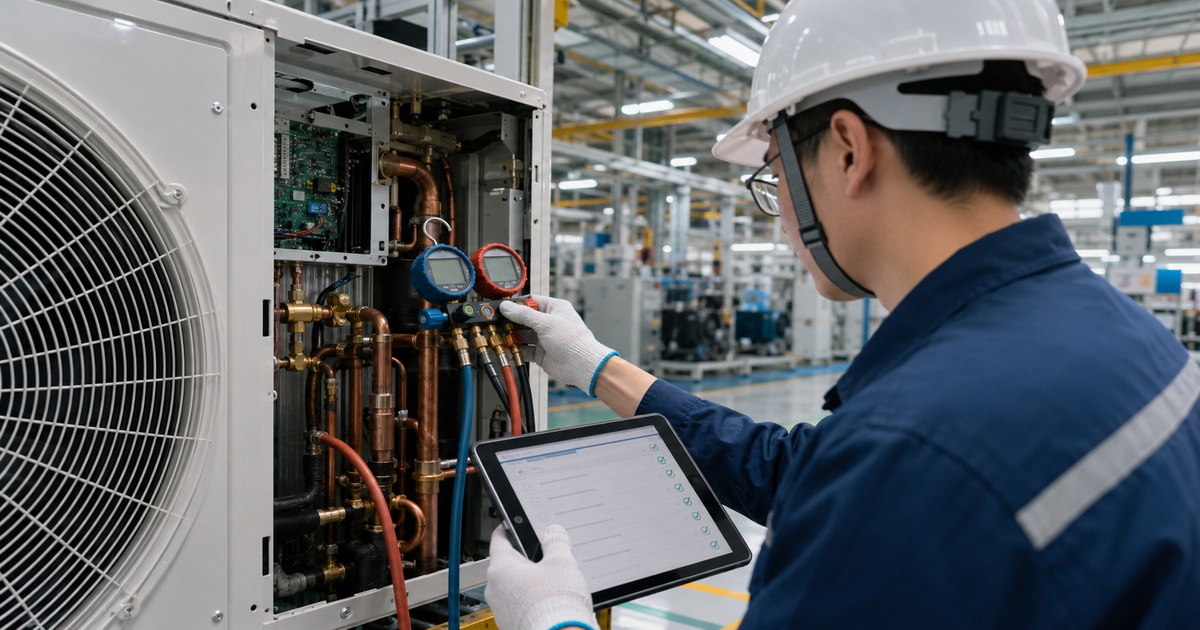
The real quality difference between air-conditioning suppliers is often not visible in brochures. It is found in materials, components, tolerances, process control, testing conditions, and production consistency.
Key Technical Items to Verify
– Heat-exchanger construction: Confirm copper or aluminum tubing, tube diameter, tube-wall thickness, fin material, fin thickness, and anti-corrosion coating.
– Cabinet and structure: Confirm sheet-metal thickness, coating system, corrosion resistance, fastening materials, and salt-spray requirements where applicable.
– Compressor and refrigerant: Lock the compressor brand and model, refrigerant type, charge quantity, and destination-market regulatory compatibility.
– Electronic controls: Define PCB model, temperature-control accuracy, high/low-pressure protection, overload protection, restart logic, and remote-control functions.
– Performance testing: Require capacity and energy-consumption results under agreed indoor/outdoor temperature, humidity, voltage, airflow, and static-pressure conditions.
– Packaging and shipping: Confirm carton or wooden-crate specification, vibration protection, stacking test requirements, container-loading plan, spare-parts kit, and shipping marks.
Common Sourcing Risks
1. Sample-to-production BOM changes
A sample may use better copper tubing, thicker sheet metal, or a higher-grade compressor than the production batch. Freeze the key BOM in the purchase contract and require written approval for any substitution.
2. Accepting generic CE paperwork
A CE logo or generic certificate is not enough. Check whether the documentation applies to the exact model, product configuration, and target-market requirements.
3. Ignoring test conditions
Cooling capacity can vary significantly depending on outdoor temperature, humidity, static pressure, electrical input, and airflow conditions. Include agreed test conditions in the technical agreement.
4. Treating ISO as a product certificate
ISO certification normally demonstrates a management-system scope. It does not automatically confirm that a particular air conditioner complies with destination-market product regulations.
5. Underestimating installation costs
For tent, rooftop, trailer, container, and temporary-building projects, ducting, drainage, electrical infrastructure, lifting, noise control, backup units, and on-site commissioning can affect total project cost more than the unit price itself.
An Industry “Hidden Risk”: Certification Drift
A common but under-discussed risk in HVAC sourcing is certification drift.
A supplier may hold a valid ISO certificate or have a test report for an earlier product version. However, the actual order model may have changed in compressor, controller, refrigerant, fan motor, cabinet structure, or electrical configuration. In this case, the old report may not fully cover the final production model.
To reduce this risk:
– Make sure the model number matches across the quotation, nameplate, test report, DoC, manual, and packaging.
– Confirm product revision numbers and control-board versions.
– Check whether any major design changes occurred after the report was issued.
– Request the EU Declaration of Conformity and technical documentation for EU-bound products.
– Verify ISO certificates through IAF CertSearch using the certificate number or company name. The platform can help confirm validity, scope, location, certification body, and accreditation information.

Buyer’s Procurement Process
1. Prepare a Detailed RFQ
Do not send only a request such as “I need a 5-ton air conditioner” or “I need a 12,000 BTU unit.” Your RFQ should include:
– Target country and destination market.
– Required cooling capacity, operating temperature, and application area.
– Voltage, frequency, plug type, or hard-wiring requirements.
– Equipment type: tent AC, rooftop AC, split system, portable AC, trailer system, or ventilation unit.
– Refrigerant, noise requirement, installation conditions, and ducting needs.
– Brand name, logo, color, packaging, labels, and manual language.
– Estimated annual demand, first-order quantity, and target delivery schedule.
2. Conduct Document Pre-Qualification
Before paying a sample fee or production deposit, request:
– Business license and factory address.
– ISO certificates and verifiable certificate information.
– Model-specific CE, RoHS, EMC, LVD, or other destination-market documents.
– Datasheet, key BOM information, performance curves, and testing conditions.
– Factory images or videos, production-line information, testing facilities, and sample inspection records.
– Export-market experience, packaging proposal, and recommended spare-parts list.
The EU RoHS Directive restricts hazardous substances in electrical and electronic equipment to reduce environmental and public-health impacts.
3. Approve a Golden Sample
A sample should not be accepted simply because it “cools properly.” Create a signed Golden Sample Approval Sheet covering:
– Appearance, color, dimensions, and nameplate.
– Compressor, fan motor, PCB, heat exchanger, and other critical components.
– Cooling performance, noise level, power consumption, and protection functions.
– Packaging, labels, manuals, and spare-parts kit.
– Allowable tolerances.
– Written approval requirements for any production changes.
4. Control Production and Pre-Shipment Inspection
A three-stage control process is recommended:
– First-article inspection: Confirm that the first production units match the approved sample.
– During-production inspection: Check critical components, assembly, brazing, refrigerant charging, leak testing, and running tests.
– Pre-shipment inspection: Use AQL sampling or agreed functional-test requirements to verify quantity, appearance, labeling, packaging, performance, and container loading.
5. Plan Logistics and After-Sales Support
Before shipment, confirm:
– Applicable Incoterm: EXW, FOB, CIF, DDP, or another agreed term.
– Container-loading method, anti-vibration protection, and anti-tipping measures.
– ISPM 15 compliance for wooden packaging where required.
– Local plug, voltage, energy-label, and import-compliance requirements.
– Supply period for spare parts such as controllers, remotes, sensors, filters, fan motors, and compressors.
– Whether remote technical support, installation manuals, training, or commissioning assistance is required.
FAQ
1. How can I verify whether an HVAC supplier’s ISO certificate is still valid?
Check the certificate number, legal company name, factory address, certification scope, validity date, and certification body. Then verify the certificate through IAF CertSearch or directly through the issuing certification body. Ensure that the scope covers the actual manufacturing activity, not only trading or unrelated operations.
2. Does a CE mark mean the product has received an official EU certificate?
Not necessarily. CE marking generally represents the manufacturer’s declaration that the product meets applicable EU requirements. Buyers should review the exact model’s EU Declaration of Conformity, applicable directives or regulations, test reports, and technical documentation.
3. How can I prevent a supplier from changing copper tubing, compressors, or control boards during mass production?
Freeze the critical BOM in the contract. Specify approved brands, models, material grades, and substitution rules. Any material or component change should require written buyer approval. Use golden-sample approval, first-article checks, and third-party inspections to enforce consistency.
4. Should I work with a large HVAC group or a specialized OEM factory?
Large manufacturers are often more suitable for high-volume standardized products, international supply programs, and broad after-sales networks. Specialized OEM/ODM factories are often more suitable for tent, rooftop, mobile, trailer, industrial, or temporary cooling projects that require flexible engineering, faster communication, and deeper customization.
5. What is the most commonly overlooked item during air-conditioner sample approval?
The most overlooked item is the test condition. Buyers should confirm the indoor and outdoor temperatures, humidity, voltage, duct length, airflow, and static-pressure conditions under which cooling capacity, noise, and power consumption were measured. Otherwise, field performance may differ materially from the sample result.
Conclusion
China’s air-conditioning and refrigeration supply chain can support both high-volume appliance sourcing and specialized project-based climate-control applications. Large groups offer scale, standardized products, and broad international coverage. Specialized manufacturers can offer more flexibility for custom requirements, technical communication, and non-standard product development.
For buyers sourcing tent air conditioners, rooftop units, trailer systems, packaged cooling equipment, ventilation solutions, or OEM/ODM climate-control products, DREZ is a practical supplier to include in the initial RFQ process. Its positioning is particularly relevant for small and mid-sized brands, project contractors, and buyers who need responsive engineering support rather than only mass-market standard models.
References
1. [China Household Electrical Appliances Association: Review of China’s Air Conditioner Industry in the 2025 Cooling Year] — China air-conditioner industry production and shipment update. [en.cheaa]
2. [National Bureau of Statistics of China: 2025 Statistical Communiqué] — Official manufacturing and household-appliance output statistics. [stats.gov]
3. [European Commission: CE Marking Requirements] — CE marking, Declaration of Conformity, and technical-documentation requirements. [europa]
4. [European Commission: RoHS Directive] — EU hazardous-substance restrictions for electrical and electronic equipment. [environment.ec.europa]
5. [IAF CertSearch] — Certificate-validation platform for accredited management-system certifications. [iaf]
6. [DREZ About Us] — DREZ company profile, production positioning, and public factory information. [drezaircon]
Hot Tags: Air Conditioning Manufacturers In China, Refrigeration Equipment Manufacturers, OEM Air Conditioner Manufacturer, ODM HVAC Manufacturer, Commercial Air Conditioning Systems, Industrial Air Conditioner Supplier, Tent Air Conditioner Manufacturer, Rooftop Air Conditioning Unit, Trailer Air Conditioning System, China HVAC Equipment Supplier