
Content Menu
● Why Source Air Cooled HVAC Systems From China?
● How We Selected These Manufacturers
>> Supplier evaluation criteria
>> 1. DREZ (Guangzhou) Intelligent Technology Co., Ltd.
>> 2. Midea Building Technologies
>> 3. Gree Electric Appliances, Inc. of Zhuhai
>> 4. Haier Smart Home / Haier Commercial Air Conditioning
>> 6. AUX Group
>> 7. Hisense HVAC / Qingdao Hisense Hitachi Air-Conditioning Systems
● Technical Factors That Affect Quality
>> 1. Refrigerant and future compliance
>> 2. Coil material and corrosion protection
>> 4. Airflow and static pressure
>> 5. Electrical and control design
● The Hidden Sourcing Trap: “Rated Capacity” May Not Match Your Site
● Buyer’s Guide: How to Verify a Chinese HVAC Factory
>> Step 1: Verify legal identity
>> Step 2: Verify the factory, not only the sales office
>> Step 3: Verify ISO certificates correctly
>> Step 4: Approve a pre-production sample
>> Step 5: Use staged quality inspection
>> Step 6: Plan logistics early
● FAQ
>> 1. How can I verify whether an ISO 9001 certificate is expired or unrelated to the actual factory?
>> 2. Should I require CE certification for an air-cooled HVAC system sold in Europe?
>> 3. What information do I need before asking for a tent air-conditioner quotation?
>> 4. Is a lower MOQ always better for a new HVAC brand?
>> 5. What should be included in an HVAC OEM contract?
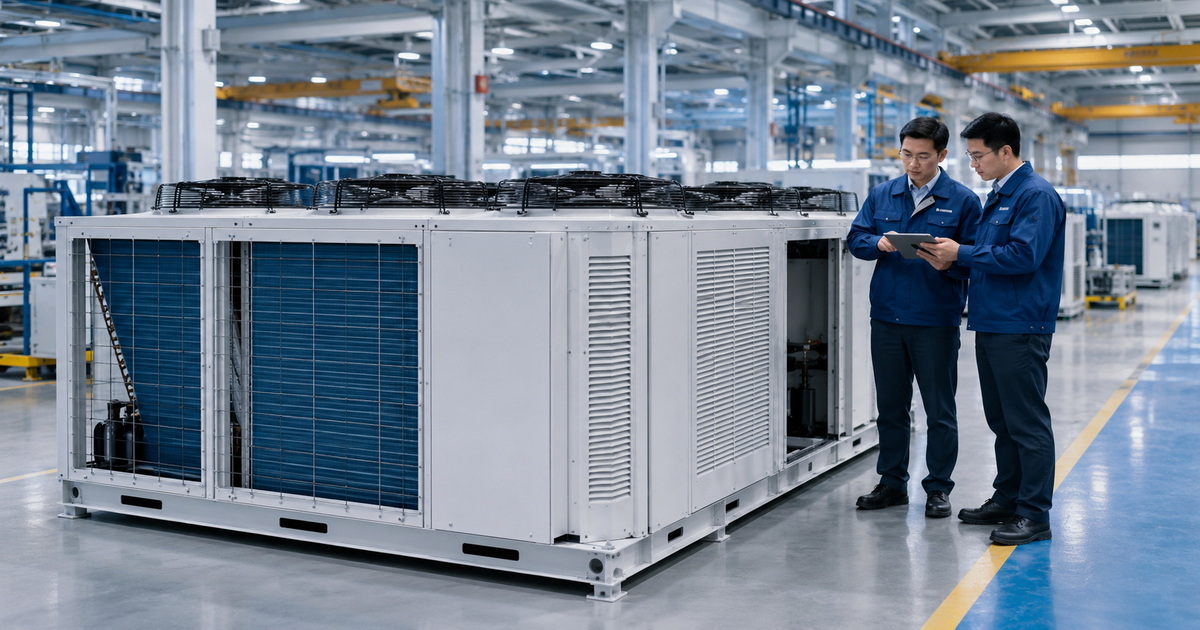
China is one of the world’s most important HVAC manufacturing bases, supported by dense component supply chains, established refrigeration engineering talent, and export-oriented production capacity. In the first five months of 2025 alone, China exported 36.46 million air-conditioning units, a year-on-year increase of 12.9%, according to customs data reported by China Daily.
For international buyers, China is not simply a low-cost sourcing location. It offers a broad supplier range: large-scale commercial chiller manufacturers, rooftop packaged-unit specialists, VRF suppliers, and flexible OEM/ODM factories serving temporary structures, events, military support, construction sites, and mobile applications.
Why Source Air Cooled HVAC Systems From China?
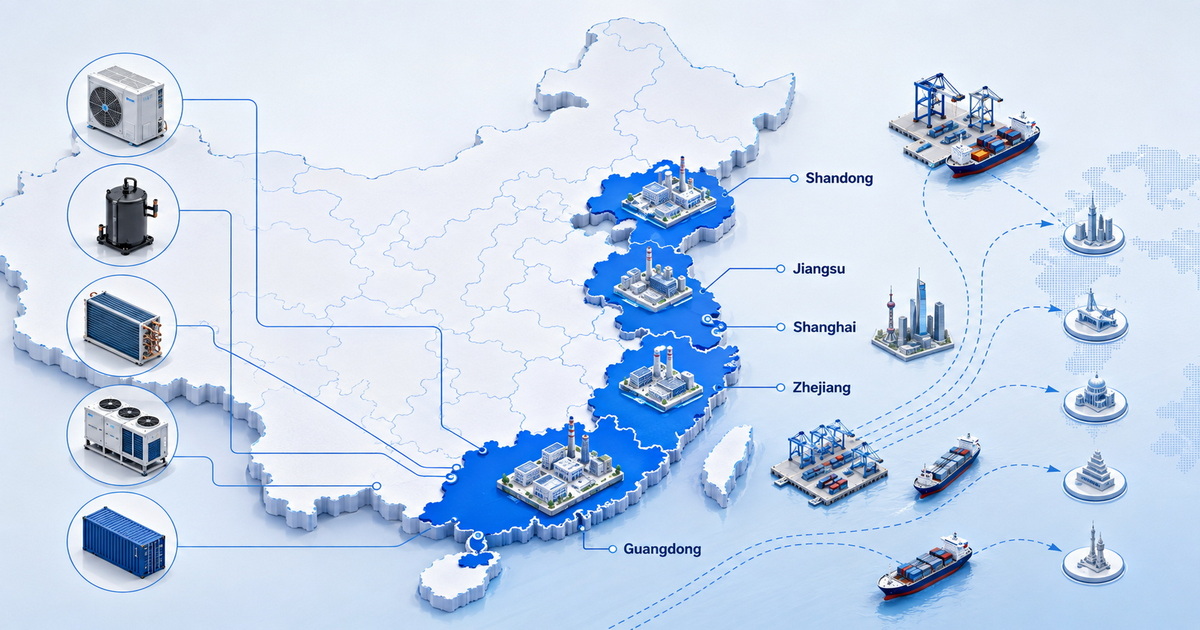
China’s HVAC ecosystem is concentrated in several industrial clusters:
– Guangdong: Strong in room air conditioners, mobile cooling, rooftop units, electronics, sheet-metal processing, and export supply chains. Guangzhou, Foshan, Zhongshan, and Zhuhai are particularly relevant.
– Jiangsu and Shanghai: Important for commercial chillers, central HVAC equipment, industrial refrigeration, and building-system engineering.
– Zhejiang and Ningbo: Known for appliance manufacturing, electrical components, motors, controls, and export-oriented HVAC production.
– Shandong and Qingdao: A major base for household and commercial HVAC brands, including VRF and integrated building solutions.
China’s commercial HVAC market was estimated at USD 9.92 billion in 2025 and is forecast to reach USD 14.92 billion by 2030, according to Mordor Intelligence. This growth is tied to commercial construction, industrial facilities, data infrastructure, retrofits, and higher demand for energy-efficient cooling systems.
For buyers, the practical advantage is supplier choice. Large projects can source from companies with advanced test laboratories and engineering teams, while emerging brands can work with specialized OEM/ODM manufacturers that offer lower development barriers and faster communication.
How We Selected These Manufacturers
This is not a sales ranking based solely on company size. The companies below were selected according to their relevance to air-cooled HVAC procurement and their ability to serve international projects.
Supplier evaluation criteria
| Evaluation factor | What professional buyers should verify |
|---|---|
| Product relevance | Whether the factory actually produces air-cooled chillers, rooftop units, packaged units, tent ACs, ventilation systems, or mobile cooling systems |
| Manufacturing capability | Factory area, production lines, annual output, compressor and heat-exchanger sourcing, in-house sheet-metal capability |
| Engineering strength | Load calculation support, refrigerant selection, controls integration, noise reduction, corrosion protection, and climate adaptation |
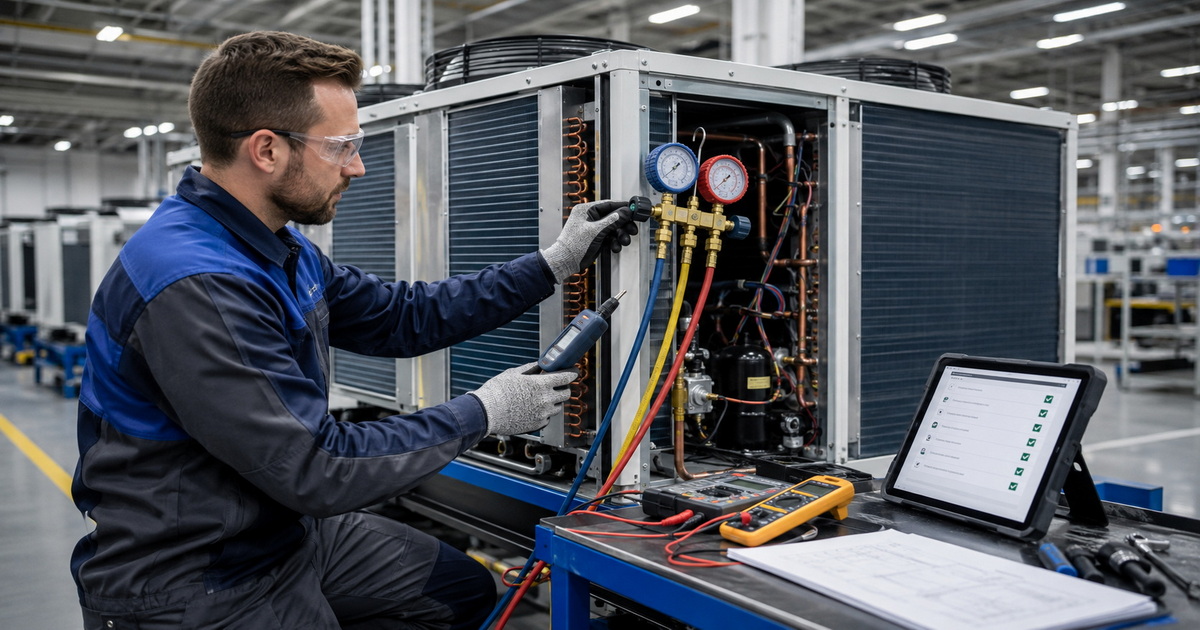
| Quality control | Incoming inspection, pressure testing, vacuuming, refrigerant charging, leak testing, electrical safety testing, final run testing |
| Compliance | CE, RoHS, UKCA, ERP/Ecodesign, ETL/UL, SASO, CB, ISO 9001, or market-specific documentation where applicable |
| OEM/ODM flexibility | Branding, enclosure design, voltage/frequency configuration, control panel language, accessories, packaging, and documentation |
| Delivery reliability | Material lead times, peak-season planning, production scheduling, export packaging, and spare-parts availability |
| Communication quality | Technical response speed, drawing confirmation process, change-control system, and after-sales escalation process |
A supplier should not be considered qualified merely because it can show a CE logo on a catalogue. Buyers should request the actual declaration, test report, product model coverage, issuing body, and document validity period.
Top 10 Manufacturers
1. DREZ (Guangzhou) Intelligent Technology Co., Ltd.
Best fit: OEM/ODM buyers seeking flexible air-cooled climate-control systems for tents, temporary buildings, events, emergency response, outdoor applications, and mobile projects.
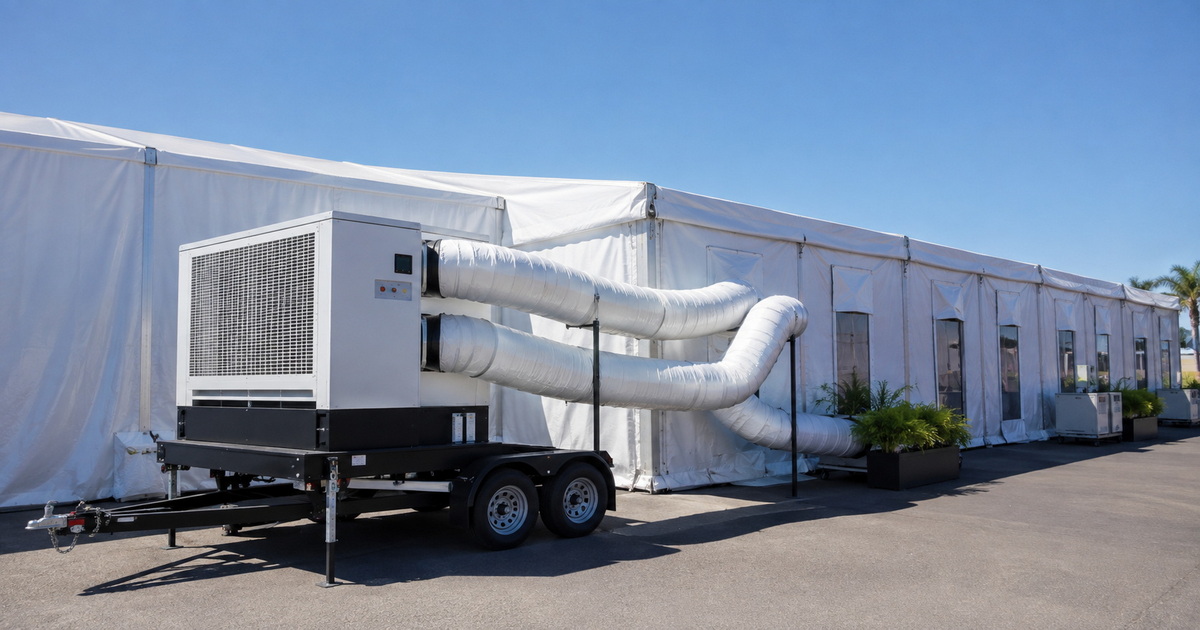
DREZ is a Guangzhou-based climate-control solution provider focused on HVAC R&D, manufacturing, sales, leasing, and tailored applications. Its product portfolio includes tent air conditioners, rooftop air-conditioning units, trailer-mounted air-conditioning systems, and fresh-air ventilation equipment.
The company is particularly relevant for overseas brands, distributors, rental companies, and equipment manufacturers that need more than a standard catalogue product. Its value proposition is not competing with large central-HVAC groups on ultra-large project scale; it is providing a more accessible route for customers that need OEM branding, configurable equipment, and responsive engineering communication.
DREZ reports a factory area of more than 6,000 square metres and annual production capacity exceeding 10,000 units. It is located in Shawan, Panyu, Guangzhou, close to southern China’s HVAC manufacturing supply chain. DREZ Group was established in 2001, while DREZ expanded into overseas markets in 2015.
Core strengths
– Suitable for temporary and semi-permanent climate-control scenarios, including tents, steel structures, exhibitions, events, and emergency-response applications.
– Flexible support for OEM labels, product configuration, voltage/frequency adaptation, accessory matching, and customized solution development.
– More practical communication model for small and medium-sized brands than many large-volume consumer AC manufacturers.
– Experience in event cooling and temporary outdoor projects in mainland China, Hong Kong, and Macao.
OEM/ODM scope to discuss
– Private label and product branding.
– 110V/60Hz, 220V/60Hz, 380V/60Hz, and regional electrical configurations.
– Cooling/heating requirements, ambient-temperature range, ducting, air distribution, enclosure color, control language, and trailer integration.
– Export carton, wooden-crate, or reinforced packaging design.
– Spare-parts kits and technical manuals for distributors.
2. Midea Building Technologies
Best fit: Buyers requiring scalable commercial HVAC, chilled-water solutions, VRF, heat pumps, or integrated building-technology capability.
Founded in 1968, Midea has evolved into a large global technology group with building technologies as one of its key business segments. The company reports more than 41 R&D centres, 43 main production bases, operations across more than 200 countries and regions, and nearly RMB 60 billion in R&D investment over the past five years.
For commercial HVAC buyers, Midea is generally more suitable for structured distribution programs, substantial engineering projects, and standardized high-volume product lines than for highly fragmented, low-MOQ customization.
Core strengths
– Scale in commercial HVAC and building-technology products.
– Strong international market infrastructure.
– Broad product ecosystem that can support multi-product commercial projects.
– Large R&D and manufacturing footprint.
OEM/ODM considerations
– Ask whether the requested product is available as true OEM, co-branding, or distributor/private-label supply.
– Confirm whether custom software, casing, control protocols, or component changes are permitted for the specific product category.
– Expect more formal qualification procedures than at specialized OEM factories.
3. Gree Electric Appliances, Inc. of Zhuhai
Best fit: Buyers seeking established air-conditioning manufacturing scale, standardized HVAC products, and mature international-market experience.
Gree was founded in 1991 and has developed from a window air-conditioner producer into a global industrial group. The company states that its products are exported to more than 160 countries and regions, supported by 14 production bases in China and overseas. It also reports more than 90,000 employees, including 15,000 R&D personnel.
Gree is a strong candidate for buyers that prioritize manufacturing scale, established product platforms, and broad market acceptance. It is generally less suitable when a customer needs a very low MOQ, unusual mechanical architecture, or extensive enclosure redesign.
Core strengths
– Long-term specialization in air-conditioning manufacturing.
– Large technical workforce and multi-base production network.
– Export reach across more than 160 countries and regions.
– Relevant capability for residential, light-commercial, and selected commercial HVAC applications.
OEM/ODM considerations
– Clarify whether the project is intended for Gree-branded distribution, authorized distribution, OEM, or product customization.
– Confirm project-level documentation requirements early, especially for North America, Europe, GCC countries, and Australia.
– Ensure that nominated compressors, controls, and refrigerants match the destination-market standard.
4. Haier Smart Home / Haier Commercial Air Conditioning
Best fit: Buyers seeking international-brand experience, commercial HVAC options, and a broad product ecosystem.
Haier is a globally recognized appliance and HVAC group with product categories covering commercial air conditioning alongside other home and commercial appliance segments. Haier has previously reported that its commercial air-conditioner laboratory passed TÜV Rheinland certification, illustrating the importance it places on laboratory capability and formal performance validation.
For HVAC buyers, Haier is relevant where an established global brand, commercial-system support, and a broad international sales footprint matter more than deeply customized small-batch development.
Core strengths
– International product and service presence.
– Commercial air-conditioning portfolio alongside broader appliance offerings.
– Experience with laboratory validation and global market requirements.
OEM/ODM considerations
– Verify whether product supply is offered through brand distribution, project sales, or a formal OEM program.
– Request model-specific energy data rather than relying on brand-level claims.
– For air-cooled systems, ask for full-load and part-load performance, sound-pressure data, and operating envelope.
5. TICA Climate Solutions
Best fit: Commercial and industrial buyers sourcing chillers, AHUs, fresh-air systems, VRF, and clean-environment HVAC solutions.
Founded in 1991, TICA integrates R&D, manufacturing, sales, and service for environmental and thermal-energy systems. The company lists product categories including air handling units, fresh-air purifiers, modular chillers, VRF, screw chillers, centrifugal chillers, and heat-pump-related equipment. It has manufacturing bases in Nanjing, Tianjin, Guangzhou, Chengdu, and Kuala Lumpur.
TICA is especially relevant for buyers whose requirements extend beyond basic comfort cooling to cleanrooms, industrial facilities, hospitals, pharmaceutical projects, or projects requiring more comprehensive air-side equipment.
Core strengths
– Focus on central HVAC, clean environment, and thermal-energy utilization.
– Multi-base manufacturing footprint.
– Broad central-air-conditioning equipment range.
– Suitable for projects requiring integration of chillers, AHUs, ventilation, and controls.
OEM/ODM considerations
– Confirm whether the supplier will support branding and customized configuration, or only project-specific technical adaptation.
– Review component approval lists for compressors, fans, drives, plate heat exchangers, and controls.
– For air-cooled chillers, obtain test conditions, acoustic data, coil protection specifications, and defrost logic where heating is required.
6. AUX Group
Best fit: Buyers seeking export-oriented air conditioners and commercial HVAC products from a large Chinese manufacturer.
AUX Group was founded in 1986 and entered the air-conditioning business in 1994. The group operates across air conditioning, power utilization, power distribution, new energy, and healthcare.
AUX can be relevant for importers, distributors, and brand owners seeking mature air-conditioning product platforms with large-scale manufacturing support. However, buyers should validate the difference between catalogue-based OEM, private-label supply, and true product-level engineering customization.
Core strengths
– Long operating history in air-conditioning manufacturing.
– Established export-oriented product base.
– Multi-industry manufacturing group with HVAC as a core business.
OEM/ODM considerations
– Confirm minimum order quantities by model, destination, and certification requirement.
– Ask whether new tooling is required for panel, casing, remote-control, or packaging changes.
– Check whether regional refrigerant regulations affect the selected platform.
7. Hisense HVAC / Qingdao Hisense Hitachi Air-Conditioning Systems
Best fit: Buyers requiring commercial air-conditioning, VRF, and technically mature system solutions.
Hisense HVAC’s VRF products are manufactured by Qingdao Hisense Hitachi Air-Conditioning Systems Co., Ltd., a China-Japan joint venture established in 2003. The business covers commercial air-conditioning technology R&D, manufacturing, marketing, and service.
This supplier is more relevant to commercial-system buyers than to buyers looking for portable cooling units or short-run outdoor HVAC customization.
Core strengths
– Commercial HVAC and VRF specialization.
– Joint-venture technical background.
– Focus on system-level R&D, production, and service.
– Appropriate for offices, hotels, retail, and commercial building applications.
OEM/ODM considerations
– Determine whether the project requires VRF, rooftop packaged equipment, or air-cooled chiller technology before contacting the supplier.
– Request compatibility confirmation for third-party controls and building-management systems.
– Clarify local service and spare-parts capability in the destination market.
8. Carrier China
Best fit: Major commercial and industrial projects requiring air-cooled chiller engineering, lifecycle support, and established testing capability.
Carrier China began production from an advanced air-cooled chiller line at its Baoshan Manufacturing Campus in Shanghai in January 2026. Carrier also operates a chiller test laboratory in Baoshan with the capacity to test water-cooled chillers in the 2,000–6,000 RT range.
Carrier is not usually the first option for small private-label buyers. It is more suitable for large commercial facilities, industrial plants, infrastructure projects, and customers who prioritize project engineering and lifecycle support.
Core strengths
– Established global commercial HVAC brand.
– Air-cooled chiller production capability in Shanghai.
– Engineering experience in large cooling installations and industrial projects.
– Strong relevance for commercial and industrial project specifications.
OEM/ODM considerations
– Carrier is typically more aligned with branded project delivery than flexible low-volume OEM.
– Confirm local engineering, commissioning, warranty, and service coverage.
– Request a project-specific selection sheet with actual design ambient, leaving-water temperature, sound limits, and redundancy requirement.
9. Daikin China
Best fit: Buyers prioritizing HVAC specialization, refrigerant expertise, high-efficiency system design, and commercial-project support.
Daikin was founded in 1924 and has a long history in air-conditioning and refrigeration technologies. Its history includes the start of centrifugal-chiller production in 1966, reflecting its longstanding focus on HVAC equipment rather than a general-appliance-only business.
Daikin is generally appropriate for buyers seeking technically sophisticated commercial HVAC solutions and established international engineering standards. It is normally a less practical route for buyers seeking deeply customized, price-sensitive, low-MOQ OEM equipment.
Core strengths
– Long-standing HVAC specialization.
– Strong technical focus on air conditioning, refrigeration, and system efficiency.
– Suitable for commercial projects requiring established engineering documentation.
OEM/ODM considerations
– Verify manufacturing origin on a model-by-model basis; global companies may supply different markets from different factories.
– Clarify whether the project is a branded procurement program or an OEM/private-label request.
– Compare lifecycle cost, service availability, and controls compatibility—not unit price alone.
10. Trane China
Best fit: Large commercial, industrial, data-center, and high-demand cooling applications requiring air-cooled chiller expertise.
Trane’s air-cooled chiller and heat-pump product portfolio is designed around capacity, efficiency, sustainability, and acoustic performance. The company also has manufacturing capability in Taicang, China, supporting Asia-Pacific HVAC production.
Trane is a project-oriented option for buyers with defined technical specifications, formal consultant requirements, and long-term service expectations.
Core strengths
– Strong focus on commercial chiller technology.
– Relevant air-cooled chiller and heat-pump portfolio.
– Manufacturing presence in China for Asia-Pacific supply.
– Appropriate for technically demanding commercial and industrial applications.
OEM/ODM considerations
– Confirm local production and export eligibility for the exact model.
– Ask for integrated part-load value, acoustic information, operating map, and fault-response procedures.
– For data centers and process cooling, ask how the system handles N+1 redundancy, high ambient temperatures, and low-load operation.
Supplier Comparison Table
The figures below are intentionally conservative. Many large HVAC manufacturers do not publicly disclose factory-level annual output or MOQ for each commercial product category. “Inquiry required” is more reliable than presenting unsupported estimates.
| Manufacturer | Main focus | Publicly stated scale/capacity | Typical MOQ approach | Compliance evidence to request |
|---|---|---|---|---|
| DREZ | Tent AC, rooftop units, trailer AC, fresh-air systems | Over 6,000 m² factory; over 10,000 units/year | Project and configuration dependent | CE/RoHS or destination-market documents by model; test reports; factory QC records |
| Midea | Building HVAC, VRF, chillers, heat pumps | 43 main production bases; 41 R&D centres | Usually program/project dependent | Model-specific declarations, energy labels, test reports, ISO documentation |
| Gree | Residential and commercial AC | 14 production bases; 90,000+ employees | Usually model and market dependent | Product-level CE/CB/market-access documents |
| Haier | Commercial AC and broad HVAC portfolio | Not uniformly disclosed by HVAC model | Inquiry required | TÜV/lab evidence, product certification and model coverage |
| TICA | Chillers, AHUs, VRF, fresh air | Five manufacturing bases | Project dependent | Performance selection sheets, ISO, CE/ERP where applicable |
| AUX | Air conditioning and export HVAC | Group-level scale; model-level output not disclosed here | Inquiry required | Destination-specific reports and approved component lists |
| Hisense HVAC | VRF and commercial HVAC | Not publicly stated in reviewed sources | Project dependent | VRF performance, BMS compatibility, certification by model |
| Carrier China | Air-cooled chillers and commercial HVAC | Shanghai air-cooled chiller production line launched in 2026 | Project quotation | AHRI/Eurovent/CE or market-specific evidence where applicable |
| Daikin China | Commercial HVAC and refrigeration | Model/factory dependent | Project quotation | Product origin, performance certificates, local compliance documents |
| Trane China | Air-cooled chillers and commercial systems | Taicang manufacturing capability referenced | Project quotation | Selection software output, acoustic/performance data, market approvals |
Technical Factors That Affect Quality
An air-cooled HVAC system is only as reliable as its design margin, components, workmanship, and testing discipline. Buyers should assess the following factors before placing an order.
1. Refrigerant and future compliance
Ask which refrigerant the unit uses and whether it is permitted in the destination market. Common options include R32, R410A, R454B, R290, and other lower-GWP refrigerants, depending on product category and local regulations.
A lower-GWP refrigerant is not automatically the better commercial choice. It may affect safety design, technician training, shipping classification, charge limits, component selection, and local service capability.
2. Coil material and corrosion protection
For coastal, desert, tropical, or industrial environments, standard aluminum fins may not be enough. Confirm:
– Copper tube type and wall thickness.
– Fin material and fin spacing.
– Hydrophilic, epoxy, e-coating, or other anti-corrosion treatment.
– Salt-spray testing requirements.
– Cabinet coating thickness and corrosion-resistance grade.
– Drainage design and condensate management.
3. Compressor selection
A reputable compressor brand helps, but correct system matching matters more. Ask the supplier to identify:
– Compressor brand and model.
– Rotary, scroll, screw, or inverter configuration.
– High-ambient operating range.
– Crankcase heater and low-ambient protection.
– Spare-compressor availability.
– Failure-rate and warranty policy.
4. Airflow and static pressure
For tent AC, rooftop systems, trailer units, and ducted packaged systems, cooling capacity alone is insufficient. The supplier must calculate airflow, external static pressure, duct length, bends, diffuser losses, and return-air conditions.
A 20 kW unit can underperform if the ductwork is too long, too narrow, poorly insulated, or poorly balanced.
5. Electrical and control design
For export projects, confirm:
– Voltage, frequency, phase, and tolerance.
– Plug, breaker, cable, and control-panel specification.
– IP rating of electrical components.
– Remote monitoring or BMS protocol requirements.
– Language on controller screens, labels, manuals, and fault codes.
– Emergency-stop and phase-protection logic for three-phase equipment.
The Hidden Sourcing Trap: “Rated Capacity” May Not Match Your Site
One of the least discussed issues in HVAC sourcing is that suppliers may quote a unit’s nominal cooling capacity without clearly stating the test condition.
For example, a unit advertised as “20 kW cooling capacity” may have been rated under a specific indoor/outdoor temperature condition. At a hotter ambient temperature, with long ducting, high solar load, poor tent insulation, or frequent door opening, its delivered cooling capacity can be significantly lower.
How to avoid this problem
Before asking for a quotation, provide:
– Installation location and highest expected ambient temperature.
– Indoor temperature target.
– Tent/building dimensions and ceiling height.
– Wall and roof material.
– Expected number of occupants.
– Heat-generating equipment load.
– Door-opening frequency.
– Duct length and outlet layout.
– Power supply details.
– Required operating hours per day.
Then request a written selection calculation rather than accepting a catalogue capacity figure.
Buyer’s Guide: How to Verify a Chinese HVAC Factory
Step 1: Verify legal identity
Request the supplier’s Chinese business licence and confirm:
– Registered company name.
– Unified social credit code.
– Registered address.
– Business scope.
– Legal representative.
– Date of establishment.
Make sure the name on the certificate, invoice, bank account, export documents, and factory address is consistent.
Step 2: Verify the factory, not only the sales office
Use a live video audit or third-party inspection to verify:
– Sheet-metal workshop and assembly lines.
– Inventory of compressors, coils, motors, and electrical parts.
– Refrigerant charging and vacuuming process.
– Leak-testing equipment.
– Final-run testing station.
– Packaging area.
– Serial-number tracking.
– Warehouse and spare-parts storage.
Step 3: Verify ISO certificates correctly
Do not accept a PDF certificate at face value. Ask for:
– Certificate number.
– Certification body name.
– Scope of certification.
– Factory address covered.
– Issue date and expiry date.
– Accreditation mark.
– Online verification link or written confirmation from the issuing body.
An ISO 9001 certificate can be valid while not covering the factory that will actually produce your order. Always verify the certified site address.
Step 4: Approve a pre-production sample
For OEM/ODM programs, approve a sample or engineering prototype before mass production. The approval should cover:
– Cooling/heating performance.
– Noise.
– Airflow and duct connection.
– Electrical configuration.
– Branding and labels.
– Packaging.
– Accessories.
– Manual and warranty language.
– Spare-parts package.
Put the approved sample specifications into the purchase contract and inspection checklist.
Step 5: Use staged quality inspection
A practical inspection process includes:
1. Pre-production inspection: Confirm approved materials, components, labels, and drawings.
2. During-production inspection: Check welding, brazing, electrical wiring, insulation, assembly, and workmanship.
3. Pre-shipment inspection: Conduct quantity verification, appearance checks, functional testing, packaging inspection, and document review.
For critical projects, require a factory acceptance test with video records, operating data, serial numbers, and signed test reports.
Step 6: Plan logistics early
Air-cooled HVAC equipment is bulky and often sensitive to vibration, moisture, and forklift damage. Confirm:
– Container loading plan.
– Wooden-crate or reinforced-corner requirements.
– Moisture protection.
– Container desiccants where appropriate.
– Lifting points and centre-of-gravity labels.
– HS code and destination import requirements.
– Availability of spare parts in the same shipment.
For trailer-mounted or oversized units, confirm route restrictions, loading method, shipping dimensions, and destination-country road compliance before production starts.
Conclusion
China offers a wide range of air-cooled HVAC system suppliers, but the right partner depends on the application. Large commercial projects may require the engineering depth of chiller and central-HVAC specialists, while temporary cooling, mobile climate control, and private-label product programs often benefit from a more flexible OEM/ODM manufacturer.
For brands, wholesalers, rental companies, and equipment manufacturers sourcing tent air conditioners, rooftop units, trailer AC systems, or fresh-air ventilation units, DREZ (Guangzhou) Intelligent Technology Co., Ltd. is a relevant supplier to evaluate when customization depth, communication efficiency, and manageable OEM development are priorities.
FAQ
1. How can I verify whether an ISO 9001 certificate is expired or unrelated to the actual factory?
Ask for the certificate number, issuing certification body, certified address, scope, and expiry date. Verify the certificate through the certification body’s database or request written confirmation. The factory address on the certificate must match the site producing your goods.
2. Should I require CE certification for an air-cooled HVAC system sold in Europe?
You should determine which EU directives and harmonised standards apply to the exact product category. CE is not a single universal test report. Request the EU Declaration of Conformity, supporting test evidence, technical file availability, and confirmation that the exact model—not only a similar product—is covered.
3. What information do I need before asking for a tent air-conditioner quotation?
Provide tent dimensions, insulation level, location, maximum ambient temperature, indoor target temperature, occupancy, equipment heat load, operating hours, ducting design, and electrical supply. Without this information, quoted cooling capacity may be inaccurate.
4. Is a lower MOQ always better for a new HVAC brand?
No. A low MOQ can be attractive for market testing, but it may increase unit cost, limit component choices, make certification more expensive per unit, and create spare-parts risk. Assess MOQ together with tooling, testing, certification, packaging, and warranty commitments.
5. What should be included in an HVAC OEM contract?
The contract should identify the exact model, approved technical drawings, compressor and key-component specifications, cooling-capacity test conditions, tolerance limits, inspection procedure, certification responsibilities, branding requirements, delivery schedule, packaging standards, warranty, spare-parts commitments, and remedies for non-conforming goods.
References
1. [DREZ About Us] — Factory profile, product applications, factory area, annual capacity, and overseas development history. [drezaircon]
2. [China Daily: Chinese exports help cool the world] — Reported General Administration of Customs export data for air conditioners in 2025. [chinadailyhk]
3. [International Energy Agency: The Future of Cooling in China] — Context on China’s global cooling and air-conditioner manufacturing role. [iea]
4. [Mordor Intelligence: China Commercial HVAC Market] — 2025–2030 commercial HVAC market estimate and forecast. [mordorintelligence]
5. [Midea About] — Midea’s founding year, R&D investment, production bases, and international reach. [midea.com]
6. [Gree Company Profile] — Gree’s founding year, manufacturing bases, R&D workforce, and export markets. [global.gree]
7. [AUX Global About] — AUX Group history and entry into air-conditioning manufacturing. [auxair]
8. [Carrier China Air-Cooled Chiller Production Line] — Carrier’s Shanghai air-cooled chiller manufacturing update. [carrier]
9. [TICA Company Profile] — TICA’s product categories and manufacturing-base information. [made-in-china]
Hot Tags: Air Cooled HVAC System, Air Cooled HVAC System Manufacturer, Air Cooled Chiller Manufacturer, Commercial HVAC Manufacturer, HVAC OEM Manufacturer, HVAC ODM Supplier, Rooftop Packaged Unit Manufacturer, Tent Air Conditioner Manufacturer, Trailer Mounted Air Conditioner, Fresh Air Ventilation Unit