Content Menu
● How We Selected These Manufacturers
● Top 10 Air Cooling Devices Manufacturers in China
>> 1. DREZ (Guangzhou) Intelligent Technology Co., Ltd.
>> 3. Gree Electric Appliances
>> 5. AUX Group
>> 7. TCL
>> 8. Chigo
>> 9. Hicon
>> 10. TICA
● Technical and Quality Checks
>> An Important Industry Sourcing Trap
>> Verify the Factory Beyond Online Listings
>> Verify ISO Certificate Validity
>> Plan Logistics and After-Sales Support
● FAQ
>> 1. How can I verify that a supplier’s ISO, CE, or RoHS certificate is valid and not borrowed?
>> 2. Why can two 12,000 BTU air cooling devices have very different prices?
>> 3. How do I calculate the right cooling capacity for a tent, trailer, or temporary structure?
>> 4. How long does an OEM project take from sample approval to the first container?
>> 5. How can I prevent the mass-production order from differing from the approved sample?
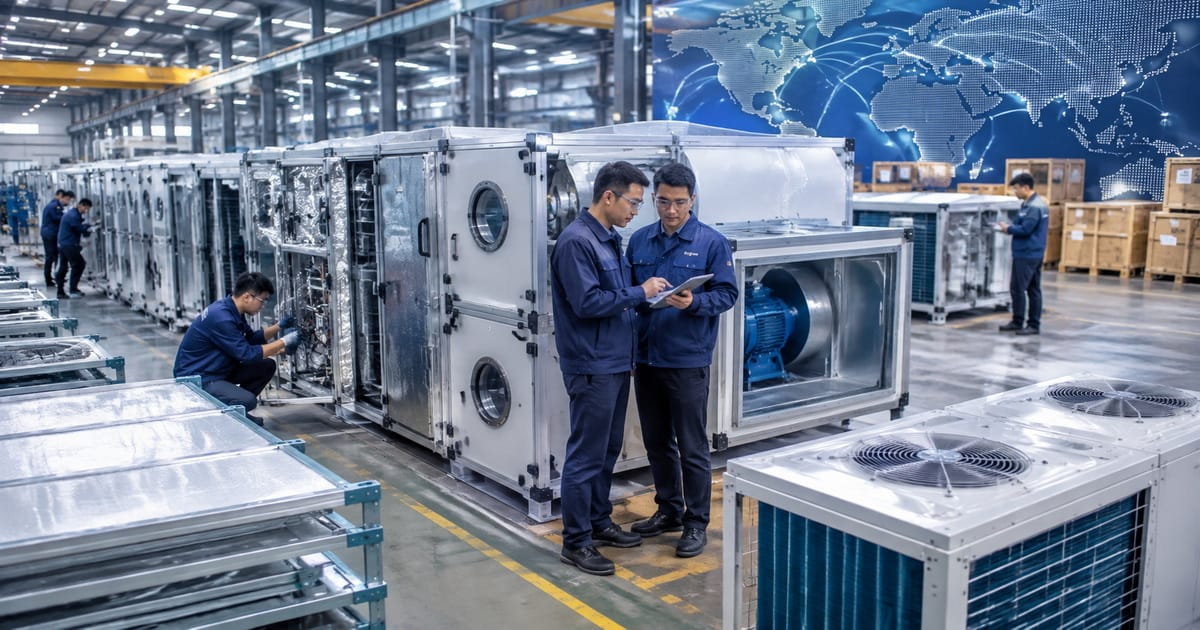
China remains one of the world’s most important manufacturing bases for air cooling devices, supported by integrated supply chains for compressors, heat exchangers, motors, electronic controls, sheet metal, injection-molded parts, and final assembly.
For international buyers, however, selecting an air cooling device manufacturer should not be reduced to comparing FOB prices. Product reliability, compliance documentation, cooling performance under real operating conditions, supply-chain visibility, customization responsiveness, and after-sales support all affect the total cost of ownership.
China’s air-conditioning industry continues to operate at large scale. The China Household Electrical Appliances Association reported that total air-conditioner shipments in the 2025 cooling year exceeded 210 million units, while exports reached approximately 99.29 million units.
How We Selected These Manufacturers
The manufacturers below are not ranked solely by company size or brand awareness. Instead, the list considers practical sourcing criteria relevant to international B2B buyers.
– Manufacturing capability: In-house production, assembly capacity, testing infrastructure, production planning, and peak-season delivery reliability.
– R&D and engineering support: Ability to adapt cooling capacity, voltage, frequency, plug type, housing, controls, branding, packaging, and application-specific configurations.
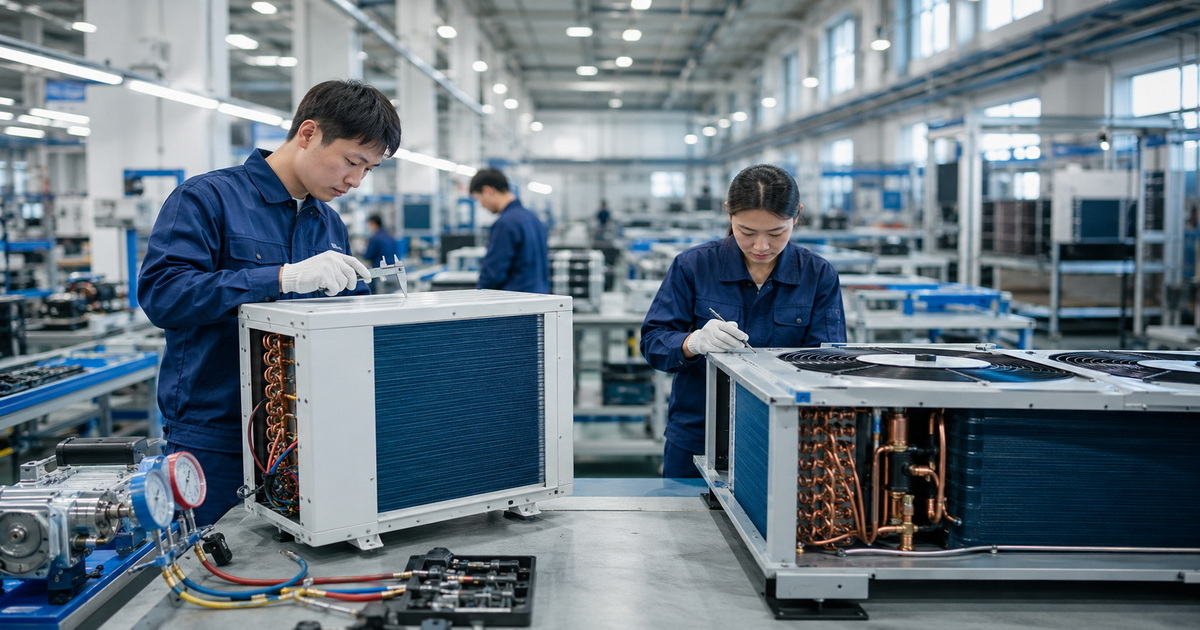
– Quality control process: Incoming material inspection, refrigerant charging control, leak testing, electrical safety testing, performance testing, burn-in procedures, and outgoing inspection.
– Export compliance readiness: Capability to provide model-specific documents for CE, RoHS, ERP/Ecodesign, UKCA, ETL, UL, SASO, GCC, energy labels, or other destination-market requirements.
– OEM/ODM suitability: Whether the supplier can support private labeling, customized specifications, technical documentation, packaging development, and stable repeat orders.
– Application match: Whether the manufacturer is suited to residential AC, portable cooling, commercial HVAC, tent air conditioners, rooftop units, trailer-mounted systems, ventilation equipment, or project-based climate-control applications.
Statista projects that the global heating and cooling market could reach approximately USD 304.96 billion by 2029, reinforcing the importance of energy efficiency, refrigerant compliance, and intelligent control in supplier selection.
Top 10 Air Cooling Devices Manufacturers in China
| Manufacturer | Founded / Background | Main Product Focus | OEM/ODM Suitability | Capacity & MOQ Considerations | Compliance Focus |
|---|---|---|---|---|---|
| DREZ (Guangzhou) Intelligent Technology Co., Ltd. | DREZ Group founded in 2001; overseas operations expanded from 2015 | Tent AC, rooftop AC units, trailer-mounted AC systems, fresh-air ventilation | High; suitable for specialized brands and project-based customers | Publicly stated annual capacity above 10,000 units; MOQ depends on configuration | Verify CE, RoHS, and destination-market documents by model |
| Midea Group | Founded in 1968 | Residential, commercial, portable, heat-pump, and HVAC components | High for scalable projects | 65 global production centers; usually better suited to larger programs | Model- and market-specific compliance verification required |
| Gree Electric Appliances | Founded in 1991 | Residential split AC, VRF, commercial AC, chillers | Medium to high | Large-scale production; annual purchasing plans preferred | Verify CE, ERP/Ecodesign and local approvals by SKU |
| Haier Smart Home | Originated in 1984 | Smart residential and commercial air-conditioning solutions | Medium to high | Globalized supply chain; project requirements vary by region | Verify by product and destination market |
| AUX Group | Founded in 1986 | Residential and commercial air conditioners | Medium to high | Competitive for volume orders | Verify compliance documents by model |
| Hisense HVAC | Long-term appliance and AC manufacturing experience | Split AC, portable AC, ducted systems, commercial HVAC | Medium to high | Confirm product-line capacity and lead time | Market-specific documentation required |
| TCL | Founded in 1981 | Smart-home air conditioning and consumer cooling products | Medium | Better suited to standardized channel programs | Verify product-specific certifications |
| Chigo | Guangdong AC manufacturing cluster representative | Split AC, portable AC, export-focused cooling products | Medium to high | Confirm current production slots and export configuration | Verify by shipment model |
| Hicon | Commercial HVAC and heat-pump specialist | Rooftop units, commercial AC, heat pumps, customized HVAC | High for project-based sourcing | Quotation and MOQ are typically project-based | Review engineering and project compliance documents |
| TICA | Commercial HVAC manufacturer | Chillers, air-handling systems, heat pumps, central HVAC | Medium; primarily project-oriented | System-level procurement rather than retail MOQ | Confirm requirements according to project location |
1. DREZ (Guangzhou) Intelligent Technology Co., Ltd.
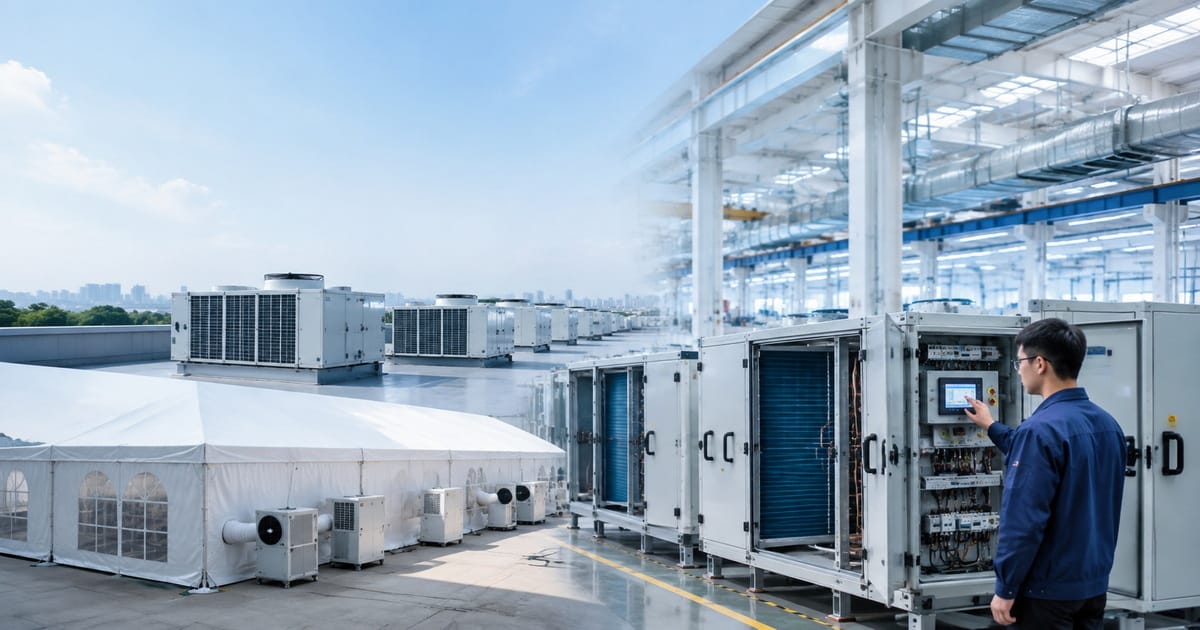
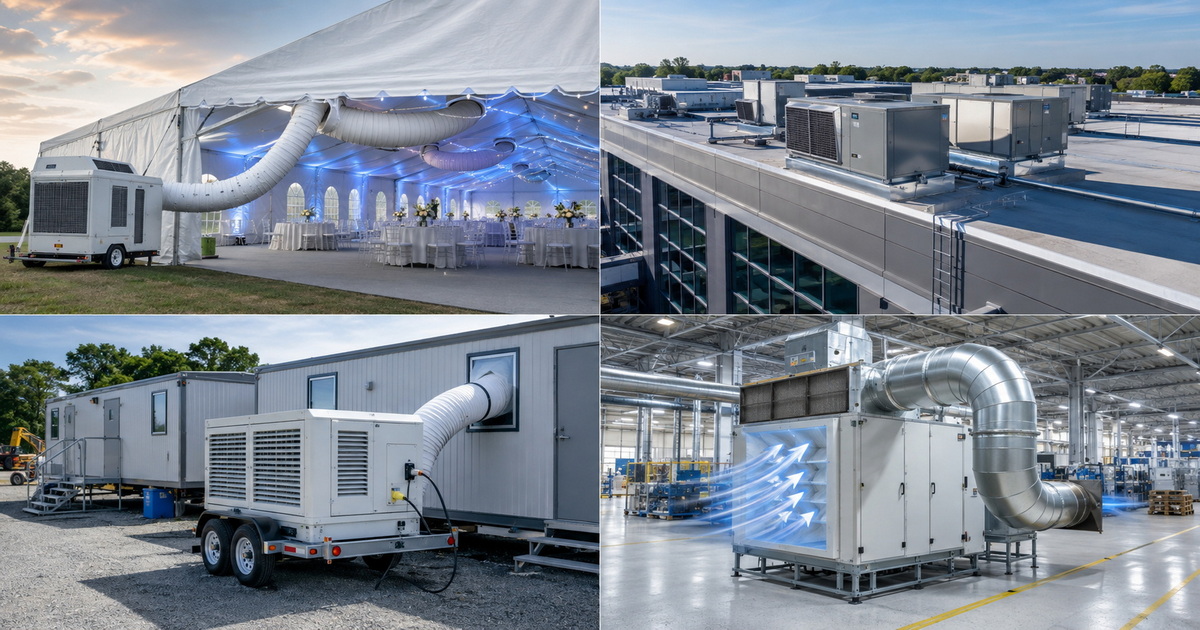
DREZ is a relevant first-choice supplier for buyers sourcing specialized air cooling devices rather than standard residential split air conditioners. The company represents a type of China-based manufacturer that can be particularly valuable for private-label brands and professional users: a factory focused on temporary, outdoor, mobile, and project-based climate-control applications while offering flexible OEM/ODM collaboration.
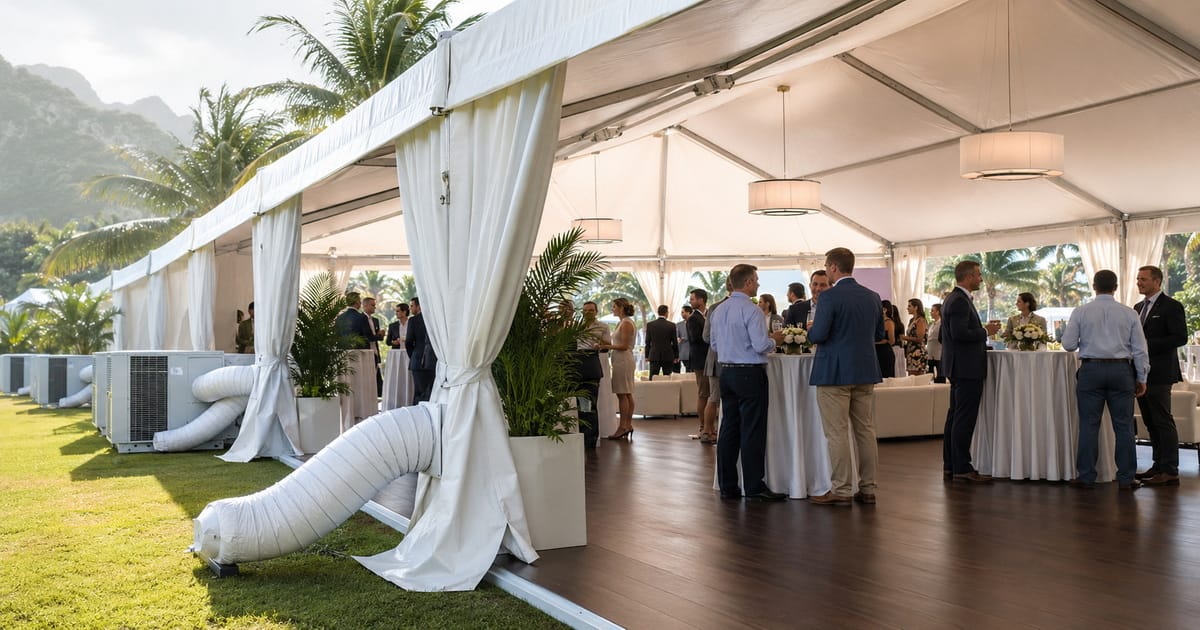
DREZ develops and manufactures tent air conditioners, rooftop air-conditioning units, trailer-mounted air-conditioning systems, fresh-air ventilation equipment, and related climate-control solutions. Its products are relevant to commercial, industrial, emergency-response, military-support, exhibition, event, temporary-building, and outdoor applications.
According to its company information, DREZ operates a manufacturing facility of more than 6,000 square meters and has an annual production capacity of over 10,000 units. The company is located in Guangzhou, near South China’s HVAC manufacturing ecosystem.
Why DREZ is worth considering:
– Strong fit for tent cooling, event cooling, temporary structures, mobile cooling, and outdoor climate-control projects.
– Supports configuration discussions based on actual site conditions, including ambient temperature, tent or building size, insulation level, occupancy, power supply, ducting, and transport constraints.
– Suitable for OEM buyers requiring customized logo placement, housing colors, voltage and plug adaptation, controller language, packaging, labels, manuals, and accessory configurations.
– More flexible than large appliance groups for specialized equipment, smaller initial volumes, technical adjustments, and direct project communication.
– Better suited to small and medium-sized brands, professional distributors, rental companies, equipment integrators, and manufacturers that need engineering cooperation rather than only standardized products.
DREZ Group was founded in 2001 and has built experience in temporary event, exhibition, industrial cooling, and climate-control applications across mainland China, Hong Kong, and Macao. The company expanded its overseas business from 2015.
For buyers evaluating DREZ, the most useful next step is to request an application-specific proposal that includes cooling-load assumptions, ambient design conditions, air volume, power requirements, noise targets, drainage design, ducting limitations, and transport dimensions.
2. Midea Group
Midea is one of China’s largest HVAC and appliance manufacturing groups. It offers a broad product portfolio spanning residential air conditioners, commercial systems, portable cooling, heat pumps, motors, compressors, and intelligent home-appliance solutions.
For buyers that need a large-scale supply base, mature international operations, mainstream product platforms, and lower-GWP refrigerant options, Midea is a major candidate. Midea states that it operates 65 global production centers. The company reported RMB 458.5 billion in revenue for 2025, including RMB 195.9 billion in overseas revenue.
Midea also announced that global sales of its R290 air conditioners had reached 10 million units, reflecting growing market interest in lower-global-warming-potential refrigerant solutions.
Best suited for:
– Large private-label programs with predictable annual purchasing volumes.
– Buyers sourcing residential split systems, commercial air conditioning, inverter products, heat pumps, or smart-home-compatible devices.
– Importers requiring global supply-chain support and mature export processes.
Buyer note: Large manufacturers often offer strong engineering and supply-chain resources, but small and highly customized projects may involve higher MOQs, longer development cycles, or more limited flexibility. Confirm private-label policy, territorial restrictions, tooling ownership, and approved export models early.
3. Gree Electric Appliances
Gree is a major Chinese air-conditioning manufacturer with product categories covering residential air conditioners, commercial systems, VRF solutions, chillers, and other HVAC equipment.
Its commercial portfolio includes R32 inverter U-Match systems, GMV VRF products, air-cooled screw chillers, and related commercial cooling solutions.
Core strengths:
– Long-term focus on air-conditioning technology and high-volume manufacturing.
– Broad product coverage from residential AC to commercial systems.
– Suitable for buyers that require standardized products, stable supply planning, and large-scale manufacturing capability.
Buyer note: Before engaging, clarify whether the supplier supports OEM/private-label production for the target destination, whether channel restrictions apply, and whether the selected models are available in the required voltage, refrigerant, energy-efficiency, and certification versions.
4. Haier Smart Home
Haier is well suited to buyers focused on intelligent home ecosystems, global channel operations, consumer-facing product experience, and smart air-conditioning integration.
Haier Smart Home reported RMB 302.35 billion in revenue for 2025, while Haier Group reported global revenue of RMB 426.8 billion for the same year. The company emphasizes an open innovation ecosystem and flexible supply-chain structure designed to respond to different market needs.
Best suited for:
– Regional distributors and retail brands seeking smart residential air-conditioning products.
– Buyers requiring Wi-Fi connectivity, intelligent controls, retail-ready packaging, and global brand experience.
– Multi-market programs that need established supply-chain and after-sales infrastructure.
Buyer note: Haier may be a stronger fit for branded distribution and established channel partnerships than for very small private-label orders or highly non-standard product development.
5. AUX Group
Founded in 1986, AUX Group operates across air conditioning, power distribution and utilization, and new-energy-related sectors. It is a practical candidate for buyers seeking residential and commercial AC products with established manufacturing experience.
Core strengths:
– Long operating history in the air-conditioning sector.
– Broad fit for mainstream split AC and export-oriented product categories.
– Suitable for projects balancing cost, performance, and volume supply.
Buyer note: Do not compare quotations only by unit price. Standardize the compressor model, copper tube specifications, heat-exchanger design, control-board version, refrigerant, energy rating, warranty terms, and spare-parts package before comparing suppliers.
6. Hisense HVAC
Hisense has extensive experience in appliances and air-conditioning products, including split systems, portable AC units, ducted products, and commercial HVAC solutions.
Its Australia-facing HVAC materials state that its products meet more than 64 global quality standards, although buyers should still verify compliance documentation for the exact model and destination country.
Best suited for:
– Buyers sourcing portable air conditioners, split AC systems, ducted units, or mainstream HVAC products.
– Brands seeking a balance between intelligent features, reliability, and consumer-market positioning.
– Distributors targeting regions with hot, humid, or demanding climate conditions.
Buyer note: For portable air conditioners, verify drainage method, exhaust-hose configuration, actual cooling capacity, test conditions, noise level, energy efficiency, and high-ambient-temperature performance. Nominal BTU alone is not enough.
7. TCL
Founded in 1981, TCL operates in more than 160 markets and includes air conditioners within its smart-living product portfolio.
TCL can be relevant for buyers that want to build a smart-home assortment combining air conditioners with other consumer electronics and connected appliances.
Core strengths:
– Strong smart-home and consumer-electronics ecosystem.
– Broad international market coverage.
– Suitable for retail, channel, and consumer-facing projects.
Buyer note: Differentiate clearly between brand distribution, authorized sales, and OEM/ODM manufacturing. These models differ substantially in MOQ, product ownership, trademark rights, after-sales responsibility, and customization possibilities.
8. Chigo
Chigo is a Guangdong-based air-conditioner brand associated with China’s mature South China HVAC manufacturing cluster. It can be relevant for buyers seeking export-oriented split AC and portable cooling products with competitive cost structures.
Best suited for:
– Mid-market residential split-air-conditioner programs.
– Importers balancing price, core functionality, and export-market adaptation.
– Customers with clear technical specifications, packaging requirements, and annual volume forecasts.
Buyer note: In cost-sensitive programs, lock critical specifications into the purchase order and technical agreement. This should include copper tube size, heat-exchanger configuration, fin treatment, compressor source, plastic flame-retardancy grade, and control-board version.
9. Hicon
Hicon is more relevant to project-based commercial HVAC and heat-pump procurement than to mass-market residential AC sourcing. Its product direction is suitable for rooftop units, commercial cooling, heat pumps, and application-specific HVAC systems.
Best suited for:
– Commercial buildings, temporary facilities, light industrial sites, and engineering projects.
– Buyers needing rooftop units, customized air handling, heat pumps, or special duct interfaces.
– Procurement teams that require technical selection support, drawings, and system integration documentation.
Buyer note: Request selection reports, performance curves, dimensional drawings, wiring diagrams, foundation load information, maintenance-clearance requirements, and spare-parts lists. A generic catalog should not replace project-specific engineering documentation.
10. TICA
TICA is a China-based commercial HVAC supplier with focus areas including chillers, air-handling systems, heat pumps, central air-conditioning solutions, and large project applications.
It is better suited to hotel, healthcare, industrial, commercial-building, and system-level HVAC projects where design conditions and engineering delivery matter more than the lowest price per unit.
Best suited for:
– Large commercial and industrial HVAC projects.
– Buyers requiring chillers, modular systems, heat pumps, AHUs, or central HVAC solutions.
– Procurement teams supported by local mechanical contractors, installation partners, or service networks.
Buyer note: Confirm design conditions before comparing bids, including outdoor dry-bulb and wet-bulb temperatures, indoor load, sensible heat ratio, static pressure, altitude, power stability, chilled-water temperatures, and required control protocol.
Technical and Quality Checks
“Air cooling devices” may include evaporative coolers, portable air conditioners, split systems, rooftop units, tent AC units, trailer-mounted systems, ventilation products, and air-handling equipment. The exact inspection priorities vary, but the following items should be part of every sourcing project.
| Checkpoint | What Buyers Should Verify | Common Risk |
|---|---|---|
| Cooling capacity | Rated condition, ambient temperature, airflow, sensible load, and test method | Buying based only on “HP” or marketing BTU claims |
| Compressor | Brand, model, inverter or fixed-speed design, refrigerant compatibility, warranty | Sample and mass production use different compressors |
| Heat exchanger | Copper tube diameter, wall thickness, coil rows, fin coating, corrosion resistance | Reduced copper content or downgraded coil configuration |
| Electronic controls | PCB version, protection functions, language, fault codes, remote-control options | Control board changes without product approval |
| Refrigerant | R32, R290, R410A, or other refrigerant selection and local compliance | Refrigerant restrictions, charging limits, or transport issues |
| Compliance | Certificate number, model list, manufacturer identity, validity, test report | Certificates borrowed from another factory or unrelated model |
| Reliability testing | Leak test, pressure test, burn-in, vibration, transportation test, full-load operation | Inspection focuses only on final appearance |
| Packaging and logistics | Moisture protection, pallets, crates, container loading, spare-parts protection | Damage, deformation, or refrigerant-line issues after shipment |
An Important Industry Sourcing Trap
A frequently overlooked issue is the difference between nominal cooling capacity and sustained cooling performance at high ambient temperatures.
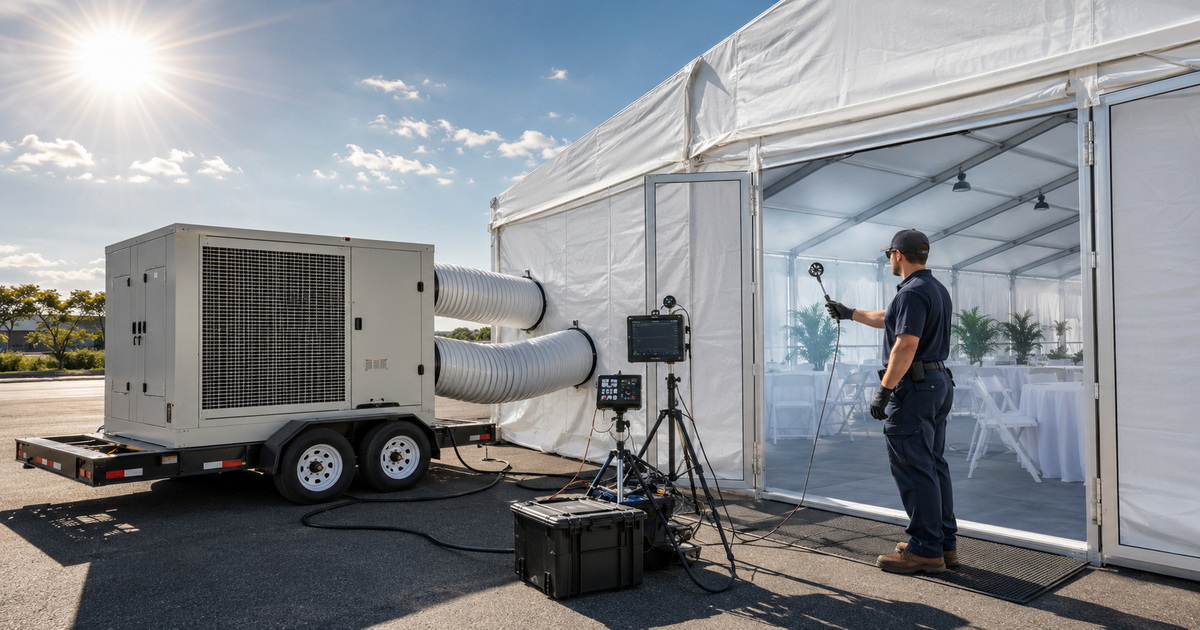
A unit may pass laboratory testing at standard conditions but underperform in tents, temporary structures, metal buildings, event venues, or outdoor installations. These applications can combine high solar load, high occupant density, frequent door opening, weak insulation, and elevated outdoor temperatures.
Before placing an order, request:
– Performance data at 35°C, 40°C, or the target site’s expected peak ambient temperature.
– Continuous full-load test records rather than short start-up tests.
– Airflow, supply-air temperature, external static pressure, and duct-length limitations.
– Drainage, condensation, voltage fluctuation, and transport-vibration test information.
– A cooling-load calculation based on the actual tent size, insulation, occupancy, equipment heat load, and climate conditions.
This is often more valuable than negotiating a further 3% price reduction.
Buyer’s Sourcing Guide
Verify the Factory Beyond Online Listings
Use a three-stage verification process:
1. Document review: Business license, export history, ISO certificates, product certificates, test reports, audit reports, and customer references.
2. Video or on-site audit: Review sheet-metal processing, assembly lines, refrigerant charging, leak testing, performance test areas, burn-in zones, warehouse conditions, and finished-goods traceability.
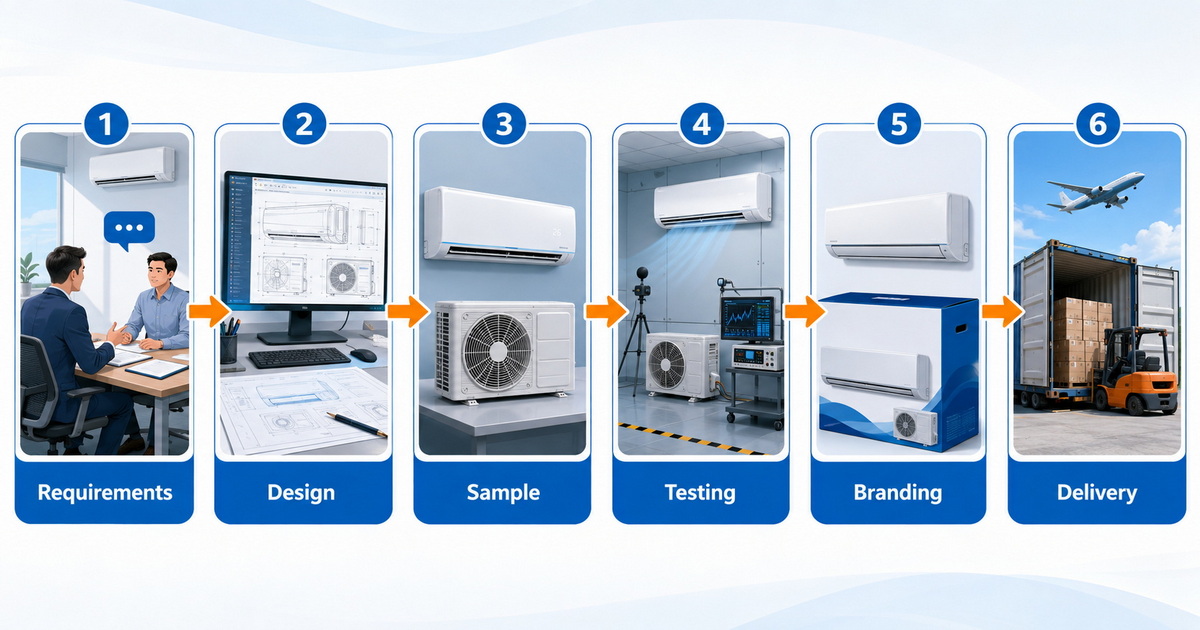
3. Sample and pre-production validation: Conduct third-party testing or real application testing. Lock approved BOMs, drawings, packaging, and acceptance standards before mass production.
Verify ISO Certificate Validity
Do not rely only on a PDF certificate supplied by the factory. Check:
– Whether the certification body is identifiable and appropriately accredited.
– Whether the certificate number, company name, registered address, and actual factory address match.
– Whether the certification scope includes HVAC, air-conditioning equipment, manufacturing, design, or related activities.
– The expiration date and latest audit date.
– The certification body’s official website or certificate-verification database.
If the certificate holder differs from the quotation entity, factory signage, or product nameplate, request written clarification about the legal relationship, production authorization, and quality responsibility.
Control the Sample Process
– Define whether the sample is an appearance sample, performance-validation sample, or pre-production golden sample.
– Confirm the critical BOM, including compressor, copper tubing, PCB, fans, power cable, packaging, nameplate, and accessories.
– Record sample serial numbers and photographs.
– Sign a Golden Sample approval document after testing.
– Conduct first-article approval before production and pre-shipment inspection before loading.
Plan Logistics and After-Sales Support
For refrigerant-containing products, confirm shipping, warehousing, import clearance, and destination-market rules before production begins. This is especially important for products using flammable refrigerants such as R290.
Your purchase contract should clarify:
– Incoterms and the applicable version, such as FOB, CIF, or DDP.
– Spare-parts ratio and critical spare-parts list.
– Evidence requirements, response time, and responsibility for quality claims.
– Technical support language, response expectations, and warranty period.
– Destination-language requirements for labels, manuals, and safety warnings.
Conclusion
China offers more than low manufacturing cost. Its major advantage is an integrated HVAC supply chain that supports a broad range of air cooling devices, from standard residential AC units to specialized tent air conditioners, rooftop systems, trailer-mounted solutions, ventilation units, and commercial HVAC systems.
The right supplier should demonstrate more than a competitive quotation. It should provide transparent technical specifications, stable quality records, valid compliance documentation, sample-to-production consistency, reliable delivery planning, and responsive engineering communication.
For buyers sourcing tent air conditioners, rooftop AC units, trailer-mounted cooling systems, or fresh-air ventilation equipment, DREZ (Guangzhou) Intelligent Technology Co., Ltd. is a practical manufacturer to evaluate. Its specialized product focus, OEM/ODM flexibility, technical communication efficiency, and project-oriented approach make it particularly relevant for small and medium-sized brands, distributors, rental companies, and equipment manufacturers. DREZ publicly states that it operates a facility exceeding 6,000 square meters and has annual capacity above 10,000 units.
Send shortlisted manufacturers a standardized RFQ covering destination market, product type, cooling capacity, voltage, required certifications, estimated annual volume, customization requirements, target pricing structure, and delivery deadline. Evaluate suppliers based on technical responses, documentation completeness, sample performance, quality-control transparency, and communication speed—not price alone.
FAQ
1. How can I verify that a supplier’s ISO, CE, or RoHS certificate is valid and not borrowed?
Request the certificate number, test report, Declaration of Conformity, covered model list, and product nameplate photos. Check whether the factory name, address, product model, and product category are consistent. Then verify the document with the issuing body, laboratory, or official database where available. A CE mark alone does not prove full compliance.
2. Why can two 12,000 BTU air cooling devices have very different prices?
The difference may result from compressor grade, copper usage, heat-exchanger area, fan motor, PCB quality, refrigerant, housing thickness, noise-control design, compliance cost, packaging, and spare-parts support. Compare products using the same BOM and test conditions rather than the BTU label alone.
3. How do I calculate the right cooling capacity for a tent, trailer, or temporary structure?
Use a cooling-load calculation that considers floor area, height, insulation, maximum temperature and humidity, solar exposure, occupancy, lighting, kitchen or equipment heat load, door-opening frequency, duct distance, and available electrical supply. For outdoor projects, include a safety margin for peak conditions.
4. How long does an OEM project take from sample approval to the first container?
The timeline depends on customization depth. Logo, packaging, and manual changes are generally faster than new tooling, controller software changes, destination-market certification, special voltage requirements, or structural modifications. Ask for a project schedule covering samples, testing, certification, material procurement, trial production, inspection, and shipment booking.
5. How can I prevent the mass-production order from differing from the approved sample?
Use a Golden Sample, a locked BOM, and pre-shipment inspection. Your contract should specify key component brands and models, material standards, performance parameters, packaging details, labeling, and acceptable tolerances. For the first order, use third-party inspection and photograph critical components such as the compressor, heat exchanger, PCB, nameplate, and exterior finish.
References
1. [DREZ About Us] — Company background, product positioning, factory area, and stated production capacity. [drezaircon]
2. [China Household Electrical Appliances Association] — China air-conditioning industry shipment and export data. [en.cheaa]
3. [Statista: HVAC Industry Statistics] — Global HVAC market overview and industry figures. [statista]
4. [Midea Company Introduction] — Midea’s company and product background. [midea]
5. [Midea 2025 Results] — Midea’s 2025 revenue, overseas revenue, and production-center information. [midea]
6. [Haier Global] — Haier’s global operations, supply-chain approach, and reported performance. [haier]
7. [AUX Group Profile] — AUX Group history and business scope. [auxair]
8. [TCL Global About] — TCL history, international market presence, and product ecosystem. [tcl]
Hot Tags: Air Cooling Devices Manufacturer, Air Conditioner Manufacturer China, HVAC Manufacturer China, OEM Air Conditioner Manufacturer, ODM Air Conditioner Supplier, Commercial Air Conditioning Systems, Tent Air Conditioner Manufacturer, Rooftop Air Conditioner Unit, Trailer Mounted Air Conditioner, Fresh Air Ventilation Unit