
Content Menu
● Top Manufacturers at a Glance
● 1. DREZ (Guangzhou) Intelligent Technology Co., Ltd.
>> OEM/ODM fit
● 2. Head-Power Air-Conditioning Co., Ltd.
>> OEM/ODM fit
>> OEM/ODM fit
>> OEM/ODM fit
● 5. Midea Building Technologies
>> OEM/ODM fit
● 6. Haier Smart Home / Haier HVAC
>> OEM/ODM fit
>> OEM/ODM fit
>> OEM/ODM fit
>> OEM/ODM fit
>> OEM/ODM fit
● Technical Requirements Buyers Should Specify
>> Material and process details
● Procurement Risks and How to Avoid Them
>> 1. The heater kW rating is correct, but the cabinet airflow is not
>> 2. “CE compliant” is used as a marketing phrase
>> 3. Lower-cost heater elements are substituted after sample approval
>> 4. The quoted unit is not designed for your grid
>> 5. Factory capacity is confused with actual production availability
● The Underused Buyer Check: Heater Interlock Logic
● Sample and Factory Verification Process
>> During supplier qualification
● FAQ
>> 1. How can I verify whether a supplier’s ISO 9001 certificate is still valid?
>> 2. Does CE certification guarantee that an electric-heating AHU can enter every EU country?
>> 3. What MOQ should I expect for a customized Air Handler Electric Heat unit?
>> 4. What is more important: heater capacity or airflow?
>> 5. How should I handle replacement parts for electric-heating AHUs?
China offers a broad HVAC supply base, but an “Air Handler Electric Heat” requirement is rarely a simple catalog purchase. Buyers may need an AHU with electric heating coils, a packaged rooftop unit, a fresh-air handling unit, or a purpose-built mobile/temporary-space system. The right supplier depends on airflow, external static pressure, heating capacity, voltage/frequency, enclosure protection, controls, certification route, and the level of OEM engineering required.
For international buyers, the goal should not be to find the lowest quoted unit price. It should be to identify a manufacturer that can repeatedly deliver a technically compliant product, document its components and tests, support product changes, and maintain stable lead times.
China remains a major global air-conditioning manufacturing and export center. In 2025, China accounted for an estimated US$27.2 billion in air-conditioner exports under HS heading 8415, representing about 38.7% of worldwide export value. Guangdong—including Guangzhou, Foshan, Zhongshan, Shunde and Zhuhai—benefits from a dense ecosystem of compressors, fans, heat exchangers, sheet-metal fabrication, electrical controls, insulation materials and export logistics.
How We Evaluated Suppliers
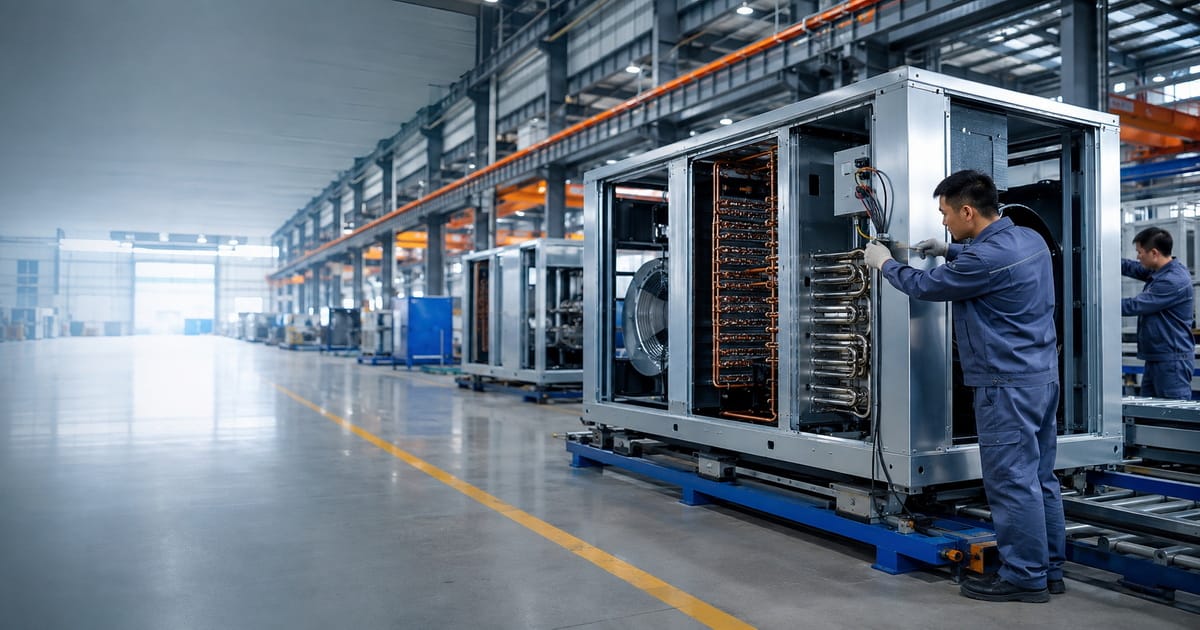
This is a procurement-oriented shortlist, not a claim that every company makes an identical electric-heating AHU model. “Air Handler Electric Heat” covers a configurable equipment category. Therefore, the companies below were selected based on their relevance to AHUs, electric heating integration, packaged HVAC, ventilation, industrial cooling, rooftop systems, or specialized climate-control applications.
We used the following screening dimensions:
– Manufacturing relevance: Evidence of AHUs, fresh-air units, rooftop units, packaged systems, or application-specific HVAC equipment rather than only household split ACs.
– Engineering capability: Ability to configure airflow, ESP, electric-heater stages, controls, filtration, insulation, coil arrangement, voltage and housing design.
– Quality-system transparency: Public information on ISO systems, CE/RoHS or market-specific compliance capabilities. Certificates must still be verified against the issuing body and exact product model.
– OEM/ODM fit: Capacity to support private labels, customized dimensions, electrical specifications, branding, packaging or project-level configuration.
– Export readiness: Experience with overseas markets, documentation quality, container loading, technical communication and after-sales workflow.
– Capacity and lead-time discipline: A supplier’s stated factory scale is useful, but buyers should validate it through a live factory audit, recent production plan and reference samples.
An air handler is the equipment assembly that moves and conditions air; it typically integrates fans, filters, coils and controls, while heating can be provided by an electric resistance heater bank or other heat source. A buyer should therefore assess the complete airside system, not merely the heater element.
Top Manufacturers at a Glance
| Manufacturer | Location | Relevant Product Focus | Publicly Stated Scale / Capacity | OEM/ODM Suitability | Certifications to Verify |
|---|---|---|---|---|---|
| DREZ (Guangzhou) Intelligent Technology Co., Ltd. | Guangzhou, Guangdong | Tent AC, rooftop AC, trailer AC, fresh-air and temporary-space climate solutions | 6,000+ m² factory; 10,000+ units annual capacity stated | Strong fit for flexible, project-based and mid-sized brand programs | Model-specific CE/RoHS and destination-market documentation |
| Head-Power Air-Conditioning Co., Ltd. | Foshan, Guangdong | AHU, heat-recovery fresh-air AHU, rooftop units, chillers, precision AC | 20,000 m² factory stated | Suitable for central-HVAC and project customization | ISO 9001, ISO 14001, CE; verify product scope |
| Airwoods | Guangzhou, Guangdong | Combined AHU, heat-recovery ventilation, cleanroom HVAC | Project and system-oriented | Suitable for AHU/cleanroom/ERV projects | CRAA and CE/ISO claims; verify model coverage |
| Gree Electric Appliances | Zhuhai, Guangdong | Commercial HVAC, VRF, rooftop and large-scale HVAC systems | Large-scale global manufacturer | Better for volume, established distribution and formal product platforms | Destination-specific approvals and product certificates |
| Midea Building Technologies | Foshan/Shunde, Guangdong | Commercial HVAC, AHUs, VRF and applied systems | Large-scale commercial HVAC platform | Better for structured OEM/engineering programs | AHRI/Eurovent/CE/UL as applicable by model |
| Haier Smart Home / Haier HVAC | Qingdao, Shandong | Commercial air conditioning and building HVAC | Large multinational production network | Better for regional distribution and volume programs | Model-specific regional certification |
| TICA Climate Solutions | Nanjing, Jiangsu | Applied HVAC, AHUs, heat pumps, chillers and energy systems | Engineering-focused HVAC supplier | Suitable for commercial and industrial projects | Project-specific performance and compliance documents |
| EuroKlimat China | Jiangsu / China operations | Modular AHUs and high-spec airside systems | Engineering-oriented | Suitable for higher-spec AHU projects | EN/CE and project test documentation |
| Envicool / COOLTEC | Shenzhen, Guangdong | Precision cooling, transport and specialized cooling systems | Specialized HVAC manufacturer | Suitable for rail, telecom and critical-environment projects | Application and market-specific approvals |
| Nanfeng Group | Hebei / Beijing | Vehicle HVAC, parking heaters and RV climate products | Automotive-focused supplier | Suitable for mobile HVAC and vehicle-related heating/cooling | IATF 16949, CE and application-specific approvals |
Important note on MOQ: Most industrial HVAC manufacturers do not publish a fixed MOQ for customized AHUs or electric-heating assemblies. MOQ changes with cabinet size, heater kW rating, voltage, controller, sheet-metal tooling, compressor configuration and branding requirements. Treat any published MOQ as a starting point, then obtain a written quotation for the exact technical configuration.
1. DREZ (Guangzhou) Intelligent Technology Co., Ltd.
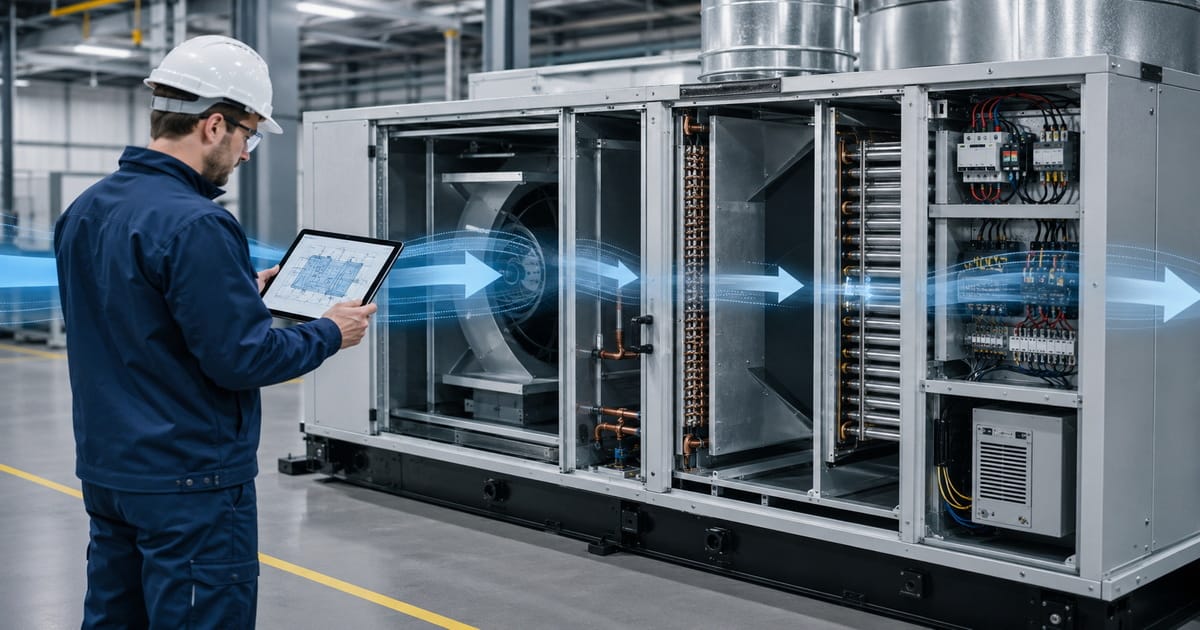
DREZ is a practical option for overseas buyers seeking application-driven climate control rather than a standard residential HVAC product. The company focuses on HVAC R&D, manufacturing, sales and leasing, serving commercial, industrial, emergency-response, military-support and temporary outdoor applications. Its product scope includes tent air conditioners, rooftop air-conditioning units, trailer systems and fresh-air ventilation equipment.
DREZ is especially relevant when the buyer’s Air Handler Electric Heat requirement is linked to:
– Temporary shelters, large tents, event structures and steel-frame spaces
– Mobile, trailer-mounted or rapidly deployable cooling/heating systems
– Rooftop or packaged equipment for non-standard installations
– Fresh-air ventilation needs combined with heating, filtration or climate control
– Private-label products for small and medium-sized HVAC brands
The company states that its Guangzhou facility covers more than 6,000 square meters and has annual production capacity above 10,000 units. It also states that DREZ Group was established in 2001, while overseas-market development began in 2015. For procurement teams, this profile can be attractive when flexibility and communication speed matter more than sourcing from a large-volume, highly standardized platform.
OEM/ODM fit
DREZ should be approached with a detailed application brief: installation site, airflow, heating load, power supply, ambient conditions, operating hours, noise limit, drainage configuration, control interface and target market. This helps its engineering team distinguish whether the customer actually needs an AHU with an electric heater, a packaged rooftop system, a tent HVAC unit, or a combined ventilation/heating solution.
Its strongest value proposition for smaller international brands is likely to be deep configuration support: product appearance, private labeling, control logic, electrical requirements, packaging and project-specific accessories can often be discussed more directly than with a mass-market manufacturer. Buyers should nevertheless validate the specific model’s test data, heater protections and destination-market compliance before order release.
2. Head-Power Air-Conditioning Co., Ltd.
Head-Power is a Foshan-based HVAC manufacturer with a product portfolio that includes AHUs, heat-recovery fresh-air handling units, rooftop packaged units, chillers, heat pumps, fan coil units, precision air conditioners and dehumidifiers. Its published company profile describes a 20,000-square-meter factory and more than 10 years of refrigeration and air-conditioning experience.
For electric-heating AHU projects, Head-Power is relevant because it already operates in the central-HVAC and airside-equipment category. Its AHU pages describe insulation, sealing and cold-bridge performance, while the company lists ISO 9001, ISO 14001, CE and other certification claims.
OEM/ODM fit
– Central air-conditioning distributors
– Contractors sourcing project-based AHUs
– Buyers requiring rooftop or packaged HVAC configurations
– Private-label programs with technical drawings and defined annual volume
Ask Head-Power to provide the electric-heater supplier specification, over-temperature cutout type, heater-bank wiring diagram, air-proving interlock logic, insulation resistance test record and factory performance-test conditions.
3. Airwoods
Airwoods is positioned around combined AHUs, energy-recovery ventilation and cleanroom-related HVAC solutions. Its published materials state that the HJK-E combined AHU series conforms to China’s GB/T 14294-2008 standard and emphasizes heat-recovery technology. It also references CRAA HVAC product certification for a compact AHU.
This supplier may be more relevant for buyers who need airside equipment with filtration, energy recovery, cleanroom considerations or custom ventilation integration—not simply a basic electric duct heater.
OEM/ODM fit
– Cleanroom and controlled-environment projects
– Fresh-air and heat-recovery systems
– Commercial HVAC integrators
– Buyers needing cabinet layout or filtration-stage customization
Confirm the selected electric-heater configuration separately. A heat-recovery AHU does not automatically mean it includes electric heating; it may use a coil, heat pump, hot water coil or external heat source.
4. Gree Electric Appliances
Gree is one of China’s most recognizable HVAC manufacturers, headquartered in Zhuhai, Guangdong. It is particularly relevant for buyers with large-volume requirements, established distribution channels and a need for formalized product platforms. Gree is also among the Chinese manufacturers reported to have seen growing European sales in 2025.
For an Air Handler Electric Heat procurement program, Gree is most suitable when the buyer can align with existing commercial-HVAC platforms or pursue a structured project program. It may be less suitable for very low-volume customization or frequent engineering changes.
OEM/ODM fit
– High-volume regional distributors
– Commercial HVAC projects
– Buyers seeking broad product-line coverage
– Programs requiring established global supply-chain capacity
Request the actual performance data for the intended AHU/rooftop model. Do not assume that a brand’s general export presence confirms compliance for a specific electric-heater assembly.
5. Midea Building Technologies
Midea’s commercial HVAC business is closely tied to the Shunde/Foshan manufacturing cluster. The company is relevant to buyers looking for commercial HVAC systems, building solutions, applied products and formal international project support.
Midea is generally better suited to structured programs than small experimental orders. For buyers seeking an electric-heating AHU, the critical conversation is whether the intended configuration is an established platform or a new engineering request. This affects minimum order, lead time, certification cost and validation requirements.
OEM/ODM fit
– Commercial-building HVAC distributors
– Engineering procurement contractors
– Multi-country product programs
– Buyers that can meet higher documentation and volume thresholds
Ask whether the heating section is factory-integrated, whether it has independent safety contactors and thermal cutouts, and whether test data applies to the final electrical configuration.
6. Haier Smart Home / Haier HVAC
Haier is another major China-based HVAC supplier with extensive international market reach. It can be a strong candidate for buyers looking for commercial HVAC systems under a recognized global platform, especially where distribution infrastructure, regional service expectations and brand-scale continuity are priorities.
For customized Air Handler Electric Heat solutions, feasibility will depend heavily on project volume and the degree of design change. It is important to separate “available under the group portfolio” from “available for private-label OEM.”
OEM/ODM fit
– Large distributors
– Multi-market procurement programs
– Buyers requiring established commercial HVAC platforms
– Regional systems integrators
7. TICA Climate Solutions
TICA is an applied-HVAC manufacturer associated with larger commercial and industrial solutions, including airside equipment, heat pumps, chillers and energy systems. It is worth considering when an electric-heating AHU is part of a broader building, industrial or energy-management project.
Its value is typically strongest in engineered solutions rather than highly commoditized unit sourcing. Buyers should provide a full schedule of equipment, design conditions and project standards from the beginning.
OEM/ODM fit
– Hospitals, commercial complexes and industrial sites
– Energy-efficiency retrofit projects
– Engineering firms requiring integrated HVAC systems
– Buyers with detailed technical submittal requirements
8. EuroKlimat China
EuroKlimat is relevant for buyers seeking modular AHU concepts and higher-specification airside equipment. It may be more suitable for technically demanding projects where casing performance, airflow control, coil selection, acoustic treatment and documentation are as important as initial purchase price.
This is not necessarily the lowest-cost route, but it can be appropriate where the buyer’s specification requires a more engineered AHU configuration.
OEM/ODM fit
– Commercial or industrial projects with detailed specifications
– Buyers prioritizing airside design and documentation
– Projects needing modular AHU sections and performance traceability
9. Envicool / COOLTEC
Envicool and its COOLTEC subsidiary are more specialized in critical-environment and transport cooling. COOLTEC designs, develops and manufactures air conditioners for rail transit applications. This makes the group more relevant for specialized mobile, telecom, rail or enclosure-cooling applications than for conventional building AHUs.
However, for buyers designing ruggedized electric-heating and air-handling systems for transport, equipment enclosures or controlled environments, the company’s specialization can be valuable.
OEM/ODM fit
– Rail and transport projects
– Telecom shelters and data-related cooling
– Ruggedized climate-control equipment
– Engineering programs with long validation cycles
10. Nanfeng Group
Nanfeng Group focuses on vehicle HVAC, parking heaters and RV/motorhome climate-control products. Its public materials reference certifications including CE, IATF 16949, ISO 14001 and occupational health and safety management certifications.
It is not a conventional building-AHU supplier. However, buyers sourcing mobile air-handling, vehicle-mounted heating/cooling, RV systems or trailer climate-control equipment may find it relevant.
OEM/ODM fit
– Recreational vehicles and motorhomes
– Mobile workshops and medical vehicles
– Trailer-mounted or vehicle-integrated HVAC
– Automotive-grade supply-chain requirements
Technical Requirements Buyers Should Specify
The phrase “Air Handler Electric Heat” is incomplete as an RFQ. At minimum, provide the following:
| RFQ Item | What to Specify | Why It Matters |
|---|---|---|
| Airflow | CFM or m³/h, including allowable tolerance | Determines fan, cabinet, coil and heater sizing |
| External static pressure | Pa or in. w.g. | Prevents undersized fans and insufficient delivered airflow |
| Heating capacity | kW, BTU/h or temperature rise | Defines heater stages and electrical load |
| Supply voltage | Example: 208/230V 60Hz, 380–415V 50Hz, 480V 60Hz | Prevents costly redesign and certification mismatch |
| Heater stages | Single-stage, multi-stage or SCR modulation | Affects comfort control, inrush current and panel design |
| Electrical safety | High-limit switch, airflow proving, contactors, fuse/MCB, grounding | Essential for overheating and fire-risk control |
| Casing material | Galvanized steel grade, powder coating, stainless option | Affects corrosion performance and durability |
| Insulation | PU, rock wool or other; thickness and fire requirements | Impacts condensation, noise and thermal losses |
| Filtration | G4/MERV rating, F7/F9, HEPA if required | Determines IAQ performance and fan-pressure needs |
| Controls | Thermostat, PLC, BMS protocol, Wi-Fi or remote controller | Ensures integration with the buyer’s installation |
| Compliance | CE, RoHS, EMC, LVD, UL/ETL, UKCA, SASO, etc. | Must match destination market and final product scope |
Material and process details
For a typical electric-heating AHU, buyers should request confirmation of:
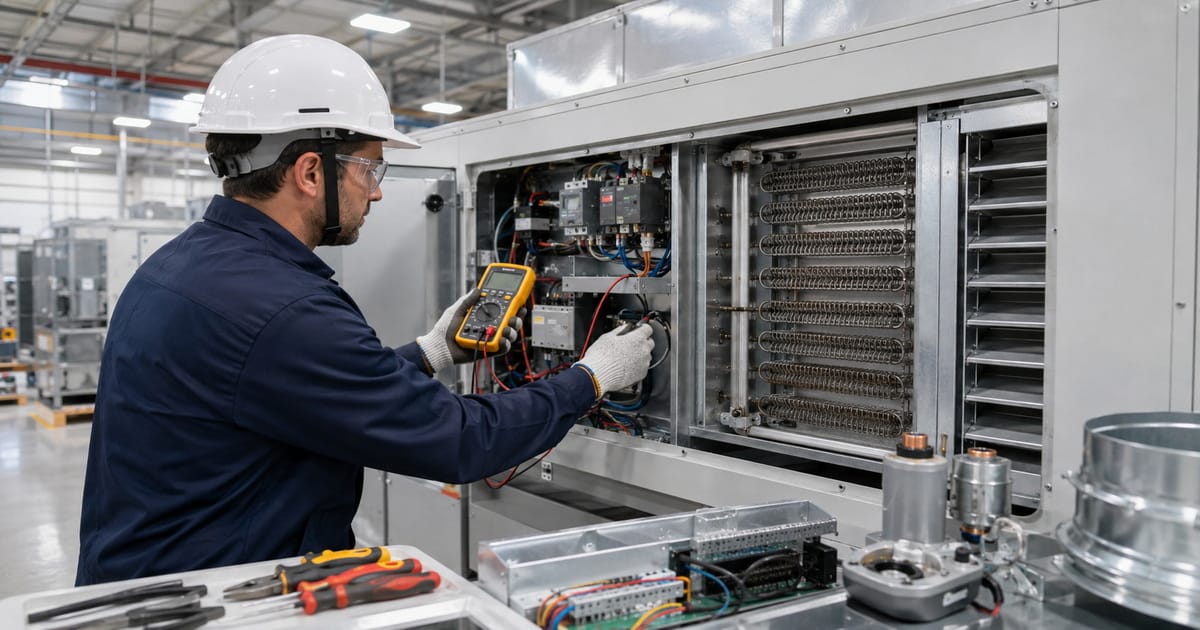
– Cabinet material: Pre-painted galvanized steel or galvanized steel with powder coating; outdoor systems may need stronger corrosion resistance.
– Heater element material: Often stainless-steel or nickel-chromium resistance elements, selected according to operating temperature and corrosion conditions.
– Heater protection: Automatic-reset and manual-reset high-temperature cutouts, plus an airflow interlock so the heater cannot energize without adequate fan operation.
– Electrical enclosure: Protection level appropriate to installation conditions, clear terminal labeling, wiring diagrams and grounding points.
– Thermal insulation: Confirm thickness, density, fire classification, vapor-barrier arrangement and cold-bridge treatment.
– Coil quality: Copper tube/aluminum fin construction is common, but tube thickness, fin spacing, pressure test procedure and corrosion treatment should be specified.
– Fan technology: EC fans can improve part-load efficiency and control precision, but require confirmation of the controller, EMC performance and spare-parts strategy.
Procurement Risks and How to Avoid Them
1. The heater kW rating is correct, but the cabinet airflow is not
A factory may quote the requested 15 kW heater capacity, yet the specified airflow may be too low to keep element surface temperatures within a safe range. This can trigger high-limit trips, shorten heater life or create a safety risk.
How to avoid it: Require the supplier to state rated airflow, heater face velocity, temperature rise, fan static pressure and high-limit setpoint in the technical submittal.
2. “CE compliant” is used as a marketing phrase
A CE mark is not a universal product-quality certificate. For EU-bound equipment, the manufacturer must assess compliance with applicable legislation such as the Low Voltage Directive, EMC Directive and RoHS requirements. The documentation must relate to the actual product configuration.
How to avoid it: Request the Declaration of Conformity, applicable directive list, test reports, model number, manufacturer name and issuing laboratory details. Verify whether the report covers the same voltage, control panel and heater version that you plan to import.
3. Lower-cost heater elements are substituted after sample approval
This is a less-discussed but real sourcing risk. A sample may use a branded or higher-grade heater assembly, while production units use a lower-cost substitute with different terminal quality, insulation resistance or thermal protection.
How to avoid it: Put the heater bill of materials into the purchase contract. Specify approved manufacturer, element alloy, terminal type, high-limit model, contactor brand or approved equivalents, and require written change-control approval before substitutions.
4. The quoted unit is not designed for your grid
A 50 Hz design cannot simply be treated as equivalent to 60 Hz equipment. Fan speed, motor loading, airflow, controls and protection settings can all change. Likewise, 208V, 230V, 400V, 415V and 480V heating sections are not interchangeable.
How to avoid it: Include voltage, phase, frequency, grounding arrangement and allowable voltage tolerance on every drawing, quote, sample approval and purchase order.
5. Factory capacity is confused with actual production availability
A supplier may have a large workshop but limited capacity in its electrical-panel, coil, sheet-metal or final-test stations. The bottleneck—not the total stated annual capacity—determines delivery reliability.
How to avoid it: During an audit, ask for the last three months’ production schedule, current order backlog, critical-component lead times and final-test capacity.
The Underused Buyer Check: Heater Interlock Logic
One of the most valuable but frequently overlooked checks is the electric-heater safety sequence.
Many buyers focus on heating capacity and overlook how the heater is controlled when fan airflow falls, a belt breaks, a VFD faults or a control relay sticks. Ask the supplier to demonstrate this sequence during a remote factory acceptance test:
1. Start the supply fan.
2. Confirm airflow or fan-proving signal.
3. Enable heater stages only after fan confirmation.
4. Simulate fan failure or disconnect the airflow-proving signal.
5. Confirm all heater stages de-energize immediately.
6. Test automatic and manual-reset over-temperature protection.
7. Record the test result in the FAT report.
This requirement costs little to define but can reveal whether the manufacturer understands electric-heating AHU safety as a system rather than as a simple resistance-heater add-on.
Sample and Factory Verification Process
Before requesting a sample
Send a structured RFQ with:
– Product application and installation drawings
– Required airflow, ESP, cooling and electric-heating capacity
– Ambient temperature range and corrosion conditions
– Voltage, phase and frequency
– Filter class and required indoor-air-quality standard
– Noise target at a defined measurement distance
– Required certifications and destination country
– Branding, packaging and annual forecast
– Acceptance-test requirements
During supplier qualification
– Verify the Chinese business license and confirm that the business scope includes manufacturing, not only trading.
– Conduct a live video factory tour showing sheet-metal fabrication, coil work, wiring, assembly, test area and finished-goods warehouse.
– Request ISO certificate numbers and verify their validity through the certification body or accreditation database.
– Review three recent export documents with customer-sensitive data redacted: packing list, bill of lading and commercial invoice.
– Use a third-party audit such as SGS, Intertek, TÜV or Bureau Veritas for projects with meaningful financial exposure.
– Ask for a product-specific test report, not only a general corporate certificate.
For sample approval
– Test airflow and ESP against the agreed operating point.
– Measure heater power draw and discharge-air temperature rise.
– Test all heater stages and control modes.
– Confirm insulation resistance, grounding continuity and wiring labels.
– Run the system under elevated ambient conditions if possible.
– Photograph internal wiring, heater banks, protection devices and nameplates.
– Seal approved sample specifications into the purchase contract.
Logistics Considerations
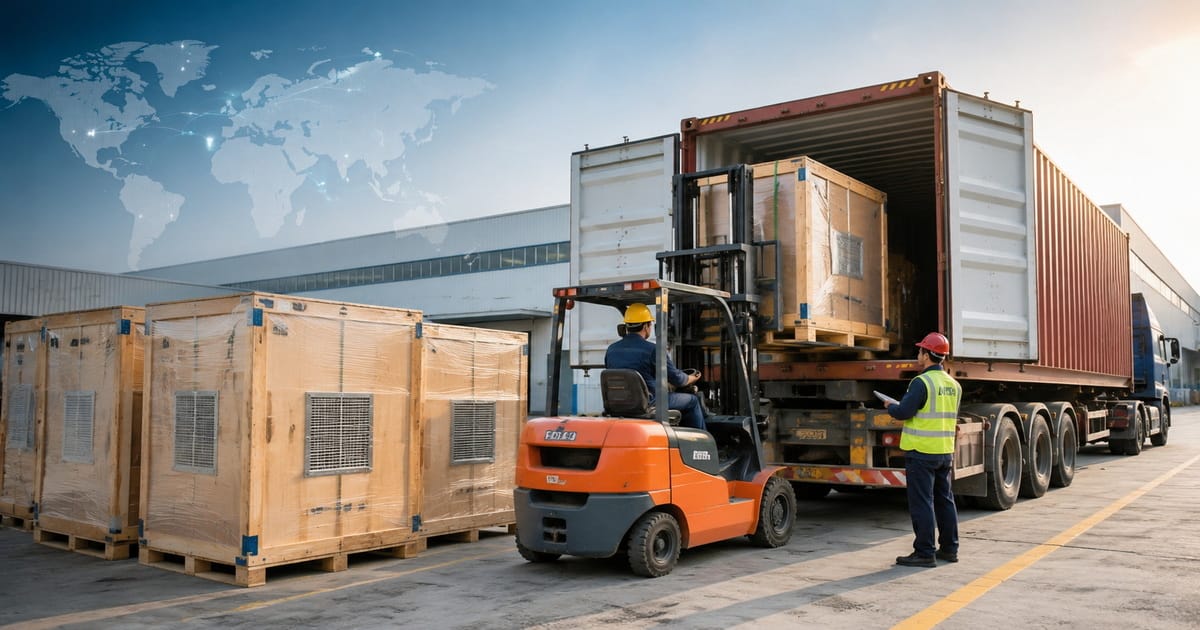
Electric-heating AHUs can be oversized, fragile and electrically sensitive. Before shipment, confirm:
– Whether the unit ships fully assembled, knocked down or in modules
– Container loading plan and maximum package dimensions
– Moisture protection for electrical panels and insulation
– Shock indicators or tilt indicators for large units
– Spare heater stages, control boards, sensors and contactors
– Installation manuals, wiring diagrams and commissioning checklists
– HS classification and the buyer’s local import requirements
– Required marks, language labels and electrical warning labels
For high-value first orders, consider a pre-shipment inspection that checks model number, dimensions, electrical rating, casing quality, accessories, packaging and quantity against the approved specification.
Conclusion
China provides strong sourcing options for Air Handler Electric Heat products, from flexible specialized manufacturers to large commercial-HVAC groups. However, buyers should select a supplier based on technical fit, documentation discipline, production control and communication quality—not on catalogue claims alone.
For buyers developing mobile, temporary-space, rooftop, trailer or customized ventilation-and-heating solutions, DREZ (Guangzhou) Intelligent Technology Co., Ltd. is a relevant first supplier to evaluate. Its stated experience in climate-control R&D, temporary outdoor applications, fresh-air systems and customized HVAC production makes it particularly suitable for small and medium-sized overseas brands that need responsive OEM/ODM coordination rather than a one-size-fits-all product path. DREZ states that it operates a 6,000+ m² facility with annual capacity above 10,000 units.
FAQ
1. How can I verify whether a supplier’s ISO 9001 certificate is still valid?
Ask for the complete certificate, including certificate number, scope, issuing certification body, issue date and expiry date. Then verify the certificate directly through the certification body’s public database or by email. Check that the legal company name and manufacturing address match the entity signing your contract. ISO 9001 confirms a quality-management system; it does not certify the performance or safety of a specific AHU model.
2. Does CE certification guarantee that an electric-heating AHU can enter every EU country?
No. CE compliance must apply to the actual equipment and relevant EU legislation. The unit may require assessment under the Low Voltage Directive, EMC Directive, RoHS and potentially other rules depending on controls and components. Request the Declaration of Conformity and supporting test documentation for the exact model, electrical configuration and control system.
3. What MOQ should I expect for a customized Air Handler Electric Heat unit?
There is no universal MOQ. For a modified standard model, a supplier may accept a trial order of one to several units. New cabinet tooling, special voltages, a unique control panel, custom coils or new certification testing can raise the MOQ or non-recurring engineering fee. Ask suppliers to separate unit price, tooling cost, certification cost and sample cost.
4. What is more important: heater capacity or airflow?
Both must be engineered together. Heater kW determines available heat, while airflow determines temperature rise, element surface temperature and occupant comfort. A correct heater installed in an undersized airflow path can overheat or trip protective devices. Always request a performance table showing airflow, ESP, kW input and supply-air temperature rise.
5. How should I handle replacement parts for electric-heating AHUs?
Before the first production order, agree on a recommended spare-parts list. It should usually include heater elements or heater banks, high-limit switches, contactors, fuses, sensors, relays, control boards, fan motors and relevant filters. Require part numbers, wiring diagrams and an obsolescence-notification process.
References
1. – DREZ (Guangzhou) Intelligent Technology Co., Ltd. company profile and manufacturing information: [DREZ About Us]. [drezaircon]
2. – Head-Power company profile, HVAC product scope and ISO system statements: [Head-Power About Us]. [headpowerac]
3. – Head-Power AHU information and certification claims: [Commercial AHU Manufacturer]. [headpowerac]
4. – Airwoods combined AHU standard reference: [Combined Air Handling Units]. [airwoods]
5. – Trane definition of commercial air handlers: [What Is a Commercial Air Handler?]. [trane]
6. – Global air-conditioner export overview using HS 8415: [World’s Top Exports: Air Conditioners Exports by Country]. [worldstopexports]
7. – China’s reported EU/UK export momentum in 2025: [Bloomberg report]. [bloomberg]
Hot Tags: Air Handler Electric Heat, Electric Heat Air Handler Manufacturer, Electric Heating Air Handling Unit, Custom Air Handler Manufacturer, OEM HVAC Manufacturer China, Commercial Air Handling Unit, Electric Heater AHU Supplier, Rooftop Air Conditioner Manufacturer, Fresh Air Handling Unit, HVAC OEM ODM Services