Content Menu
● How We Selected These Suppliers
● China’s HVAC Manufacturing Clusters
>> 1. DREZ (Guangzhou) Intelligent Technology Co., Ltd.
>> 2. Holtop
>> 3. TICA
>> 4. Gree Electric Appliances
>> 5. Midea Building Technologies
>> 10. TENT and Jiangsu Standard AHU Suppliers
● Technical Requirements for Air Handlers
>> Do Not Compare Copper Weight Alone
>> Sample Quality May Not Equal Mass Production
>> Use Samples to Verify Engineering Capability
>> Plan Logistics and After-Sales Support
● FAQ
>> 1. How can I verify that an ISO 9001 certificate is genuine and not expired?
>> 2. Does a CE certificate mean an air handler can automatically be sold in the EU?
>> 3. Why can two suppliers quote the same cooling capacity at very different prices?
>> 4. How should I negotiate MOQ for a private-label air handler program?
>> 5. Should I use a third-party inspection company in China?
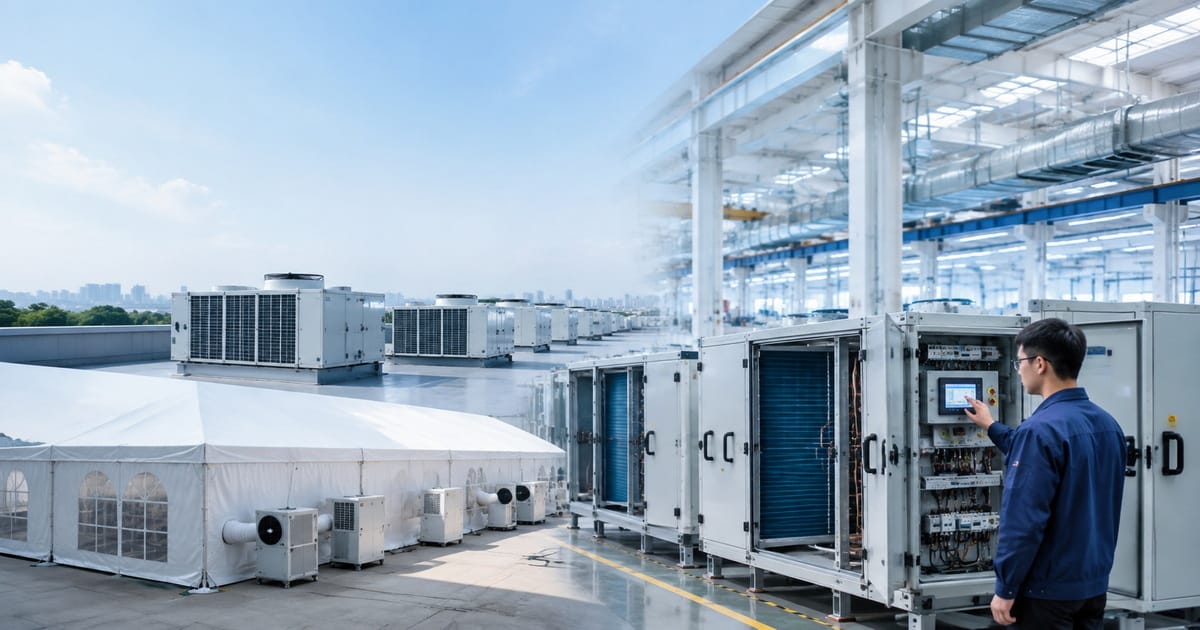
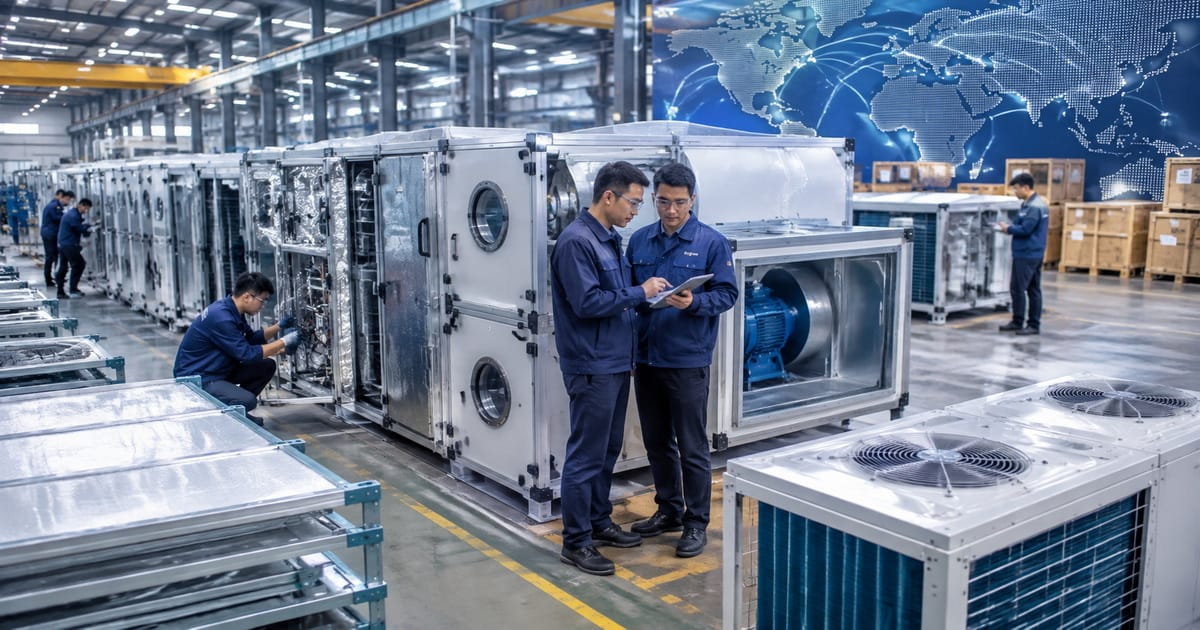
China is one of the world’s most important HVAC manufacturing bases. For buyers sourcing an air handler for AC unit, China offers more than price competitiveness: it provides an integrated supply chain for heat exchangers, EC fans, sheet-metal fabrication, controls, filters, insulation panels, compressors, and export-ready final assembly.
China’s air-conditioner industry recorded total production and sales of more than 210 million units during the 2025 cooling year, while exports reached approximately 99.29 million units, up 16.7% year on year. Although these figures do not represent AHU output alone, they demonstrate the scale, export readiness, and component ecosystem available to HVAC buyers. Meanwhile, the global air handling unit market was valued at approximately USD 14.9 billion in 2025.
How We Selected These Suppliers
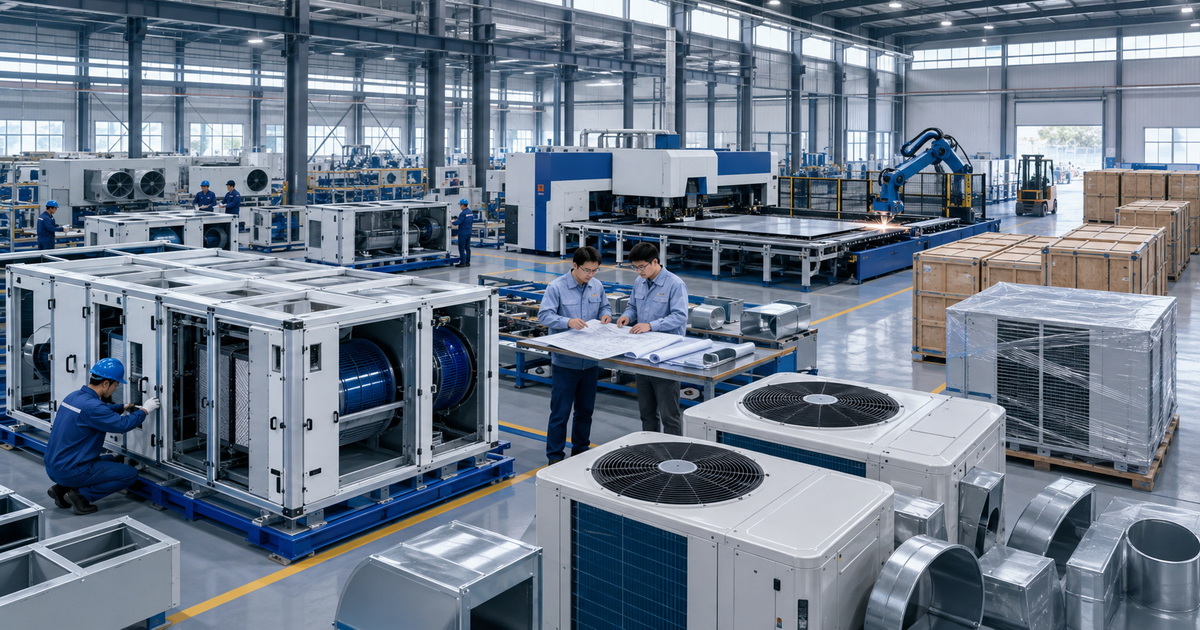
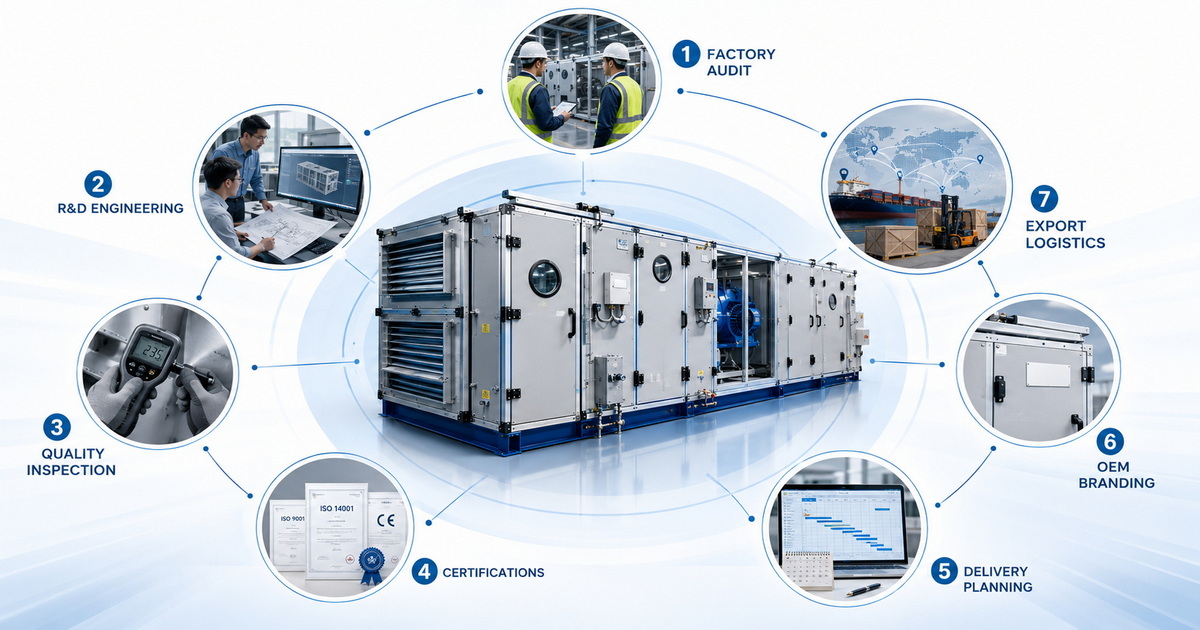
A professional buyer should not select an air handler manufacturer based on a quotation alone. In HVAC sourcing, a lower unit price can reflect compromises in fan selection, coil design, insulation, casing thickness, controls, or factory testing.
We considered the following criteria:
| Evaluation Area | What Buyers Should Verify | Why It Matters |
|---|---|---|
| Factory capability | Legal entity, factory location, production lines, supplier control, quality system | Indicates manufacturing consistency and supply continuity |
| R&D and engineering | Airflow design, static pressure selection, coil calculation, controls, non-standard drawings | Determines whether the unit actually suits the application |
| Core materials | Fan brand, coil specifications, casing material, insulation, controls | Affects efficiency, noise, service life, and warranty claims |
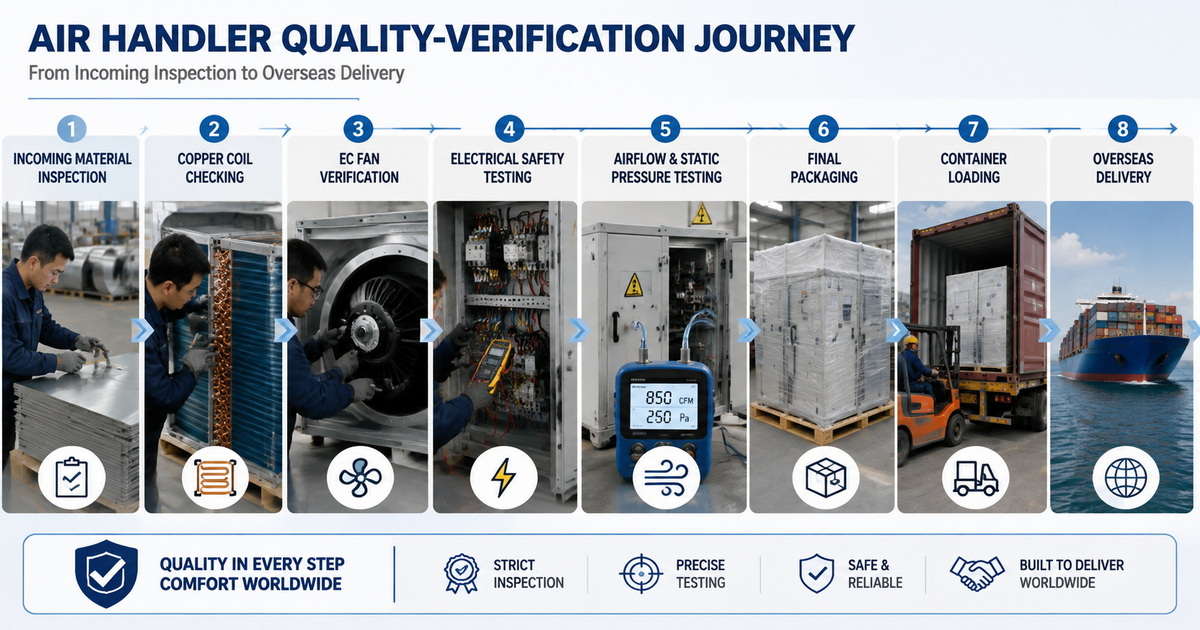
| Quality control | Incoming inspection, pressure testing, electrical safety checks, run testing, final inspection | Reduces batch-to-batch quality variation |
| Compliance support | CE, RoHS, UKCA, ERP/Ecodesign, UL, or destination-specific documents | Helps prevent market-access and customs issues |
| Delivery stability | Component availability, production schedule, sample lead time, peak-season capacity | Protects project deadlines and inventory planning |
| OEM/ODM support | Branding, nameplates, packaging, appearance, controls, documentation, spare parts | Essential for private-label and long-term product programs |
A critical point for international buyers: ISO 9001 certification confirms a quality-management system; it does not automatically prove that a specific air handler model meets CE, RoHS, energy-efficiency, or destination-market requirements.
China’s HVAC Manufacturing Clusters
China’s HVAC industry is supported by regional manufacturing clusters, each with different strengths:
– Guangdong: Guangzhou, Foshan, Zhongshan, Zhuhai — Strong in commercial air conditioning, export manufacturing, sheet metal, electrical controls, and flexible OEM/ODM development.
– Jiangsu: Nanjing, Suzhou, Wuxi, Taizhou — Stronger concentration of central air conditioning, chillers, modular systems, industrial temperature control, and large project equipment.
– Shandong: Dezhou, Jinan and surrounding cities — Mature supply base for central HVAC systems, air handling units, cleanroom equipment, fan coil units, and engineering-oriented products.
– Beijing and North China — Notable for heat recovery ventilation, fresh-air systems, air purification, and building ventilation solutions.
For buyers, this means supplier selection should follow product requirements. Guangdong can be a strong option for flexible private-label projects and mobile climate-control equipment, while Jiangsu and Shandong are often better aligned with larger central HVAC and project-based AHU requirements.
Top 10 Manufacturers
| Manufacturer | Background | Product Focus | OEM/ODM Fit | Public Scale Information | Certification / Compliance Review |
|---|---|---|---|---|---|
| DREZ (Guangzhou) Intelligent Technology Co., Ltd. | DREZ Group established in 2001 | Tent ACs, rooftop units, trailer AC systems, fresh-air ventilation | High; suitable for small and mid-sized brands | 6,000+ m² factory; 10,000+ units annual capacity | Confirm by model and destination market |
| Holtop | Founded in 2002 | Heat-recovery ventilation, AHUs, purification AHUs | Medium to high | 70,000+ m² related manufacturing footprint cited publicly | ISO systems and project-specific documents |
| TICA | Commercial HVAC group | Central HVAC, thermal-energy utilization, commercial systems | Medium; more project-oriented | Group-scale R&D, manufacturing, and service network | Verify by equipment category |
| Gree Electric Appliances | Founded in 1991 | Commercial AC, VRF, rooftop units, air-side equipment | Medium; often standardized programs | Large-scale global manufacturing network | CE, RoHS, and destination requirements |
| Midea Building Technologies | Commercial HVAC division with long operating history | VRF, chillers, rooftop units, commercial AC | Medium; suitable for structured projects | Large group supply chain and overseas network | Confirm by product and market |
| Guangdong Head-Power | Industrial HVAC supplier in Guangdong | Cleanroom AC, explosion-proof AC, rooftop units, custom AHUs | High for special applications | Project-oriented manufacturing | ISO, project documents, application-specific approvals |
| Amrta Air Conditioning | Shandong commercial HVAC exporter | AHUs, heat pumps, chillers, rooftop units | Medium to high | Commercial HVAC export focus | ISO, CE, and market-specific documentation |
| Euroklimat China | European technical heritage | AHUs, chillers, precision cooling, project HVAC | Medium; higher-specification projects | European engineering background | Verify project specifications and test reports |
| Hicon Industry | Ningbo industrial cooling supplier | Industrial AC, process cooling, custom temperature control | Medium to high | Industrial cooling and export focus | ISO, CE, electrical safety documentation |
| TENT / Jiangsu AHU suppliers | Jiangsu air-side equipment cluster | Standard AHUs, ventilation and fresh-air units | Medium to high | Standardized AHU product orientation | Model-level CE and performance documentation |
1. DREZ (Guangzhou) Intelligent Technology Co., Ltd.
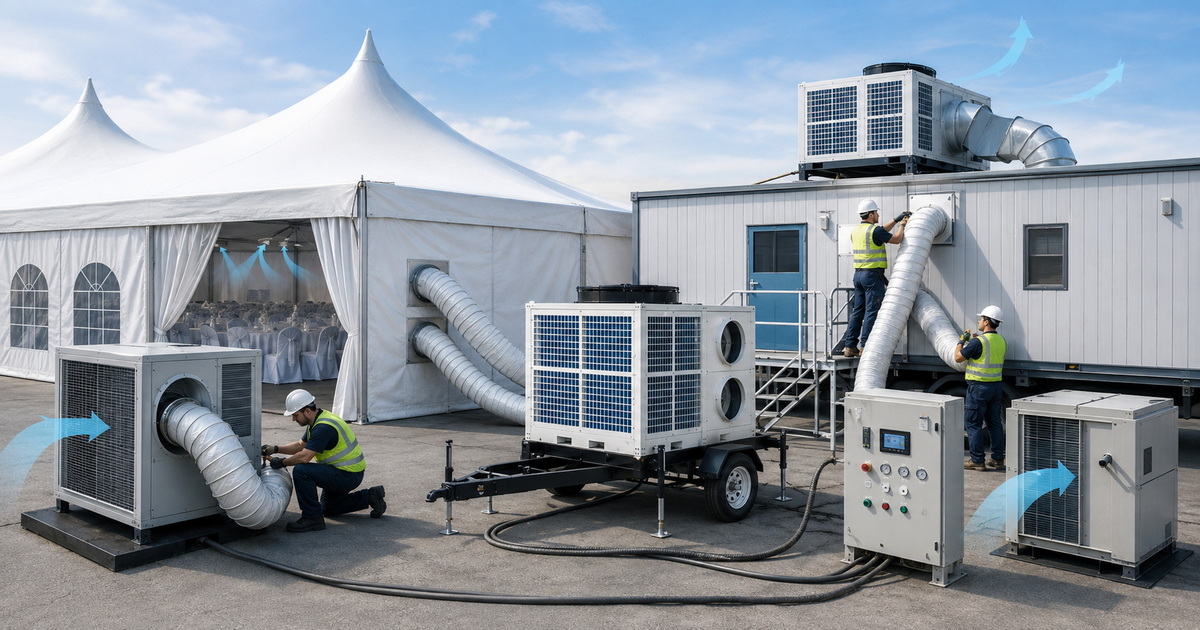
DREZ is a suitable candidate for buyers seeking a responsive, flexible, and customization-oriented climate-control supplier, particularly for mobile, temporary, outdoor, and application-specific cooling projects.
The company integrates HVAC R&D, manufacturing, sales, rental, and customized solution development. Its solutions cover commercial, industrial, emergency-response, military-support, large-tent, steel-structure temporary building, exhibition, festival, and outdoor-event applications. DREZ Group was established in 2001 and expanded into overseas markets in 2015. Its public company information states that it operates from Guangzhou’s Panyu District, with a factory area of more than 6,000 square meters and annual output exceeding 10,000 units.
Key sourcing strengths include:
– Product coverage including tent air conditioners, rooftop AC units, trailer-mounted AC systems, and fresh-air ventilation equipment.
– A practical fit for OEM and ODM projects involving capacity, voltage/frequency, refrigerant selection, control options, appearance, branding, labels, packaging, and application-specific requirements.
– Access to Guangdong’s established HVAC supply chain for sheet metal, controls, components, and export logistics.
– A technical workforce structure in which more than 60% of employees reportedly hold a bachelor’s degree or above, supporting engineering communication and product iteration for overseas customers.
DREZ is not necessarily the best fit for every large-scale central AHU project. However, it is a relevant supplier for tent cooling, temporary structures, outdoor events, emergency cooling, mobile AC, trailer AC, and private-label climate-control programs where flexibility, communication speed, and customized engineering support matter.
For effective quotations, buyers should specify the intended environment, outdoor design temperature, coverage area, occupancy, power supply, ducting plan, installation conditions, branding requirements, and expected annual order volume.
2. Holtop
Founded in 2002, Holtop specializes in air-to-air heat-recovery equipment, energy recovery ventilators, and air handling units. Its product direction is especially relevant for commercial buildings, schools, hospitals, offices, and ventilation projects that prioritize fresh-air delivery, filtration, and energy recovery.
Public product information for selected heat-recovery AHUs describes 25 mm sandwich panels, galvanized steel internal panels, high-density flame-retardant PU insulation, and double-embedded sealing structures. Its product materials also list airflow, external static pressure, cooling capacity, heat-recovery efficiency, and filtration specifications for selected units.
Buyers should:
– Request selection based on actual outdoor conditions, airflow, ESP, coil requirements, and filtration grade.
– Review sensible and total heat-recovery efficiency separately.
– Verify cross-contamination control, bypass functionality, frost protection, and condensate management.
– For hospital, cleanroom, or high-humidity applications, verify casing leakage, filter sealing, drain-pan material, access space, and control logic.
3. TICA
TICA is a professional company that integrates R&D, manufacturing, sales, and service in environmental and thermal-energy utilization. Its business scope includes commercial HVAC, energy applications, and system-level solutions.
TICA can be more suitable for:
– Medium and large commercial buildings, hotels, transportation hubs, data centers, and industrial projects.
– Buyers sourcing chillers, terminal units, controls, and broader HVAC solutions together.
– Projects with formal technical specifications, engineering documentation, and delivery milestones.
Before starting an OEM or distribution relationship, buyers should confirm whether private labeling, controller localization, spare-parts kits, regional distribution rights, and engineering-change procedures are available for the intended product category.
4. Gree Electric Appliances
Gree is one of China’s most recognized air-conditioning manufacturers, with broad coverage across residential and commercial air conditioning, VRF systems, rooftop units, and related HVAC products.
It can be a relevant option for buyers that prioritize standardized commercial equipment, supply-chain scale, or experience in international markets. However, large product catalogs do not automatically mean that every category is available for open OEM/ODM cooperation.
For any air handler for AC unit program, buyers should confirm:
– Whether the quoted unit is manufactured directly by the group, supplied through an authorized channel, or sourced from an affiliated factory.
– Model-specific performance data and electrical compatibility.
– Availability of private labeling or customer-specific modifications.
– Warranty responsibilities, spare-parts availability, and territorial distribution restrictions.
5. Midea Building Technologies
Midea Building Technologies is a key commercial HVAC division of Midea Group. Its commercial HVAC business was established in 1999 and was among the early VRF manufacturers in China.
Midea can be well suited to:
– Buyers seeking standardized commercial HVAC products supported by a large supply chain.
– Projects involving VRF systems, air-cooled modular chillers, chillers, rooftop units, or larger commercial installations.
– Regional distributors that already have installation, commissioning, and after-sales capability.
When sourcing air handlers or customized air-side products, do not rely only on group-level brand recognition. Request detailed model-level documentation, including fan curves, coil performance, casing construction, control manuals, optional sections, and relevant test conditions.
6. Guangdong Head-Power
Guangdong Head-Power focuses on industrial air conditioning, cleanroom systems, explosion-proof air conditioners, rooftop units, and customized HVAC equipment.
This type of supplier can be relevant for chemical processing, pharmaceutical production, electronics manufacturing, laboratories, cleanrooms, and high-temperature or high-humidity industrial environments.
Buyers should verify:
– Whether explosion-proof classifications match the site’s hazardous-area classification.
– Whether cleanroom AHUs include defined filter sections, sealing details, pressure control, airflow balancing, and access-door performance.
– Whether electrical panels, sensors, motors, and control components are covered by a consistent compliance strategy.
– Whether the supplier can provide a factory acceptance test plan for critical projects.
7. Amrta Air Conditioning
Amrta is a China-based commercial HVAC manufacturer and exporter with products including air handling units, heat pumps, chillers, and rooftop units.
It may be suitable for distributors and project buyers that need multiple commercial HVAC categories from one source. Buyers should request:
– Project-specific selection documents instead of catalog capacity figures alone.
– A complete major-component list covering compressor, fan, controller, heat exchanger, valves, insulation, and electrical components.
– Warranty terms, spare-parts recommendations, fault-response procedures, and remote technical support.
– Proof of previous export experience in the destination country, especially for voltage, frequency, climate conditions, and local approval requirements.
8. Euroklimat China
Euroklimat was founded in Milan, Italy, in 1963 and focuses on cooling, air conditioning, and temperature-control solutions.
For buyers considering China-based sourcing under European engineering principles, Euroklimat-related solutions may be relevant for higher-specification projects where selection accuracy, energy efficiency, controls, documentation, and long-term operating performance are important.
Buyers should clarify:
– Whether the product is manufactured in Europe, manufactured in China, or produced in China under European technical specifications.
– Whether the quotation includes EC fans, controls, heat recovery, filtration, access sections, transport base frames, and installation accessories.
– Which exact standards support claims such as “European standard” or “European quality.”
– Whether performance and compliance reports correspond to the exact model being purchased.
9. Hicon Industry
Hicon, based in Ningbo, focuses on industrial refrigeration, process cooling, and industrial temperature-control applications. It can be relevant for equipment-room cooling, industrial production environments, telecom facilities, process equipment, and applications with high sensible heat loads.
For industrial air handler or AC projects, buyers should define:
– Sensible heat load, latent load, operating hours, and allowable downtime.
– Ambient temperature limits and high-temperature derating performance.
– Corrosion-resistance requirements, especially for coastal or chemical environments.
– Fan, compressor, and control-component specifications.
– Full-load testing requirements, alarm logic, and shipment packaging for sea freight.
10. TENT and Jiangsu Standard AHU Suppliers
Jiangsu remains an important sourcing region for standard AHUs, ventilation systems, fresh-air units, and central HVAC air-side equipment. Suppliers in this group are often suitable for distributors building a standardized product line for offices, hotels, retail spaces, schools, and general commercial projects.
The advantage is modularity and relatively standardized airflow ranges. The risk is that “standard AHU” can mean very different configurations among suppliers.
The technical agreement should define:
– Rated airflow and acceptable tolerance.
– External static pressure and design margin.
– Casing leakage requirements.
– Panel thickness, internal and external sheet materials, insulation-core type, and insulation density.
– Coil rows, tube diameter, tube-wall thickness, fin material, and coating.
– Fan make, motor efficiency, speed control, and IP rating.
– Filter class, initial pressure drop, final pressure drop, and dirty-filter alarm.
– Controls, alarms, electrical requirements, and BMS communication protocol.
Technical Requirements for Air Handlers
An air handler for AC unit is not one fixed product. It may refer to a packaged indoor air handler, modular AHU, DX air handling unit, chilled-water AHU, rooftop-unit air-side section, or fresh-air and heat-recovery module.
Before requesting quotations, define the system boundary and required performance.
| Technical Item | What to Specify in an RFQ | Common Buyer Mistake |
|---|---|---|
| Airflow | m³/h or CFM, design point, permitted tolerance | Specifying only “coverage area” |
| Static pressure | ESP, duct resistance, final filter pressure allowance | Good airflow on paper but insufficient airflow after duct connection |
| Coil design | DX or chilled-water coil, rows, face velocity, entering/leaving conditions | Comparing nominal cooling capacity under different conditions |
| Fan | AC or EC, brand, efficiency, speed control, motor protection | Treating rated airflow as actual system airflow |
| Casing | Panel material, insulation, thermal-break design, access doors, leakage | Focusing only on appearance or panel thickness |
| Filtration | G4, M5, F7, HEPA, pressure-drop requirements | Ignoring filter resistance during fan selection |
| Controls | Temperature, humidity, inverter control, BMS protocol, alarms | Not confirming Modbus, BACnet, or local electrical standards |
| Refrigerant | R32, R410A, R454B, or another approved option | Ignoring regulations, transport considerations, and flammability class |
Hidden Sourcing Risks
Do Not Compare Copper Weight Alone
A less-discussed risk in AHU sourcing is that suppliers can present similar nominal cooling capacities while using different coil face areas, fin spacing, airflow rates, test conditions, or effective heat-transfer surfaces.
A unit may look well-built and still underperform under the buyer’s actual operating conditions.
Request the following before making a technical comparison:
– Coil rows, tube diameter, tube wall thickness, and circuit configuration.
– Fin material, fin spacing, and hydrophilic coating details.
– Coil face area and face velocity.
– Entering-air dry-bulb and wet-bulb conditions.
– Chilled-water entering/leaving temperatures and flow rate, or DX evaporating/condensing conditions.
– Airflow and ESP at the declared performance point.
– Performance reports, factory test records, or third-party test documentation where available.
If a supplier cannot clearly explain the test condition behind its rated capacity, treat the quotation carefully.
Sample Quality May Not Equal Mass Production
A common issue in OEM HVAC sourcing is unauthorized component substitution after sample approval. The sample may use a branded EC fan, thicker sheet metal, or premium controller, while mass production uses a lower-cost “equivalent” component.
Avoid this by locking the following into the PI and technical agreement:
– Approved brands and part numbers for critical components.
– Casing material and thickness tolerance.
– Coil, insulation, and control specifications.
– Inspection procedures, sample size, test requirements, and acceptance criteria.
– A list of non-substitutable parts that cannot be changed without written approval.
Buyer’s Sourcing Guide
Prepare a Complete RFQ
Avoid sending only: “Please quote a 10,000 CFM AHU.”
A professional RFQ should include:
– Destination country, application, and estimated annual volume.
– Required airflow and external static pressure.
– Indoor and outdoor design conditions.
– Cooling source: DX, chilled water, heat pump, or another system.
– Power requirement, such as 380–415V/3Ph/50Hz or 460V/3Ph/60Hz.
– Filtration, sound, casing, and control requirements.
– Certification and documentation requirements.
– Target lead time, sample schedule, packaging, and branding needs.
Use Samples to Verify Engineering Capability
A sample should validate more than appearance. During sample approval, evaluate:
– Drawing approval and dimensional accuracy.
– Performance-point verification.
– Full-load running test.
– Drainage, condensate, and leakage checks.
– Electrical safety and protective functions.
– Noise and vibration levels.
– Controller functions, alarms, and communication.
– Packaging suitability for sea freight.
For suppliers such as DREZ, buyers should describe the actual use case in detail. For example: tent size, peak outdoor temperature, number of occupants, tent-door opening frequency, available electrical supply, transport method, and required setup speed.
Verify ISO Certificates
To verify whether an ISO 9001 certificate is valid and relevant:
1. Request the full certificate, not a cropped image or sales brochure.
2. Check the legal entity name, factory address, scope, certificate number, issue date, and expiry date.
3. Search the certificate number through the issuing certification body’s official database.
4. Confirm that the certification body holds appropriate accreditation.
5. Match the certified address with the actual production site.
6. Use video audits, third-party factory audits, or pre-shipment inspections for important orders.
The certificate holder, exporter, and actual manufacturer may be different entities. If so, clarify the responsibility structure in the supply contract.
Plan Logistics and After-Sales Support
Key logistics risks for AHUs and air-conditioning equipment include dimensional weight, refrigerant transport rules, wood-packaging compliance, sea-freight corrosion, and destination-country service expectations.
Confirm:
– Whether the unit is pre-charged with refrigerant and whether special transport documentation is required.
– Whether wood packaging complies with ISPM 15 requirements.
– Container loading plans, center-of-gravity information, stacking restrictions, and forklift access.
– Moisture protection, desiccants, corrosion protection, and seaworthy packaging.
– Correct HS classification. Air-conditioning equipment commonly falls under HS heading 8415, but the exact subheading depends on the equipment design and configuration.
– Whether shipment documents include packing lists, commercial invoices, certificates of origin, manuals, wiring diagrams, test reports, spare-parts lists, and warranty terms.
Conclusion
The right China air handler for AC unit manufacturer is not simply the supplier with the lowest quotation. It is the supplier that can clearly demonstrate design capability, component transparency, quality-control discipline, compliance support, delivery reliability, and after-sales responsibility.
For buyers developing tent ACs, trailer-mounted AC units, rooftop systems, fresh-air ventilation equipment, or other mobile climate-control products, DREZ is worth adding to a qualified supplier list. Its product focus, flexible OEM/ODM support, Guangzhou-based supply-chain access, and application-oriented engineering make it particularly relevant for small and medium-sized brands requiring responsive cooperation. Public company information indicates a 6,000+ m² factory and annual output exceeding 10,000 units.
FAQ
1. How can I verify that an ISO 9001 certificate is genuine and not expired?
Request the full certificate and verify the legal entity, factory address, certification scope, certificate number, expiry date, and issuing body. Search the number through the certification body’s official database. The factory address on the certificate should match the actual production site.
2. Does a CE certificate mean an air handler can automatically be sold in the EU?
No. CE is not a universal product passport. It involves manufacturer declarations and technical documentation for the applicable legal requirements. Buyers should review the exact model’s Declaration of Conformity, applicable standards, test evidence, nameplate information, and relevant EU-market obligations.
3. Why can two suppliers quote the same cooling capacity at very different prices?
The stated cooling capacity may be based on different test conditions. Price also changes with EC versus AC fans, coil construction, casing insulation, sheet thickness, controls, compressor brand, static-pressure allowance, certification work, factory testing, and warranty support. Compare the complete specification and operating conditions—not only kW or BTU figures.
4. How should I negotiate MOQ for a private-label air handler program?
MOQ tends to be lower for standard products and higher when you request custom sheet metal, private-label controls, exclusive colors, special voltage, unique packaging, or certification work. A practical strategy is to start with samples or a pilot order, provide an annual forecast, and negotiate tiered pricing as volume grows.
5. Should I use a third-party inspection company in China?
For a first order, non-standard AHU, project-based equipment, or OEM program, third-party inspection is strongly recommended. The inspection should include model verification, major BOM checks, dimensions, electrical safety, operation testing, condensate drainage, packaging, documents, and loading supervision where appropriate.
References
1. – [DREZ About Us] — Company background, factory scale, annual production capacity, overseas-market development, and application areas. [drezaircon]
2. – [China Household Electrical Appliances Association] — China air-conditioner industry production, sales, and export data. [en.cheaa]
3. – [Holtop Official Website] — Holtop company background and heat-recovery/AHU specialization. [holtop]
4. – [Holtop AHU Product Information] — Example AHU construction and performance parameters. [holtop]
5. – [TICA Official Website] — TICA’s integrated R&D, manufacturing, sales, and service profile. [ticachina]
6. – [Future Market Insights: Air Handling Unit Market] — Global AHU market estimate for 2025. [futuremarketinsights]
7. – [U.S. Census: HS Classification Reference] — HS heading reference for air-conditioning-related products. [census]
Hot Tags: Air Handler For AC Unit, Air Handling Unit Manufacturers, China HVAC Manufacturers, OEM Air Conditioning Manufacturer, Commercial Air Handling Unit, Custom HVAC Solutions, AHU Manufacturer China, Rooftop Air Conditioning Unit, Fresh Air Ventilation System, Industrial Air Conditioning Systems