Content Menu
● How We Selected These Manufacturers
● Why Source AHU Systems From China?
● 1. DREZ (Guangzhou) Intelligent Technology Co., Ltd.
● 2. Head-Power Air-Conditioning
● 5. Midea Building Technologies
● Technical Specifications Buyers Should Define
>> 1. Unapproved “Equivalent” Component Substitution
>> 2. Treating CE as a Complete Compliance Solution
>> 3. Approving a Sample That Does Not Match Mass Production
>> 4. Starting Lead-Time Counting Too Early
>> 5. Ignoring Packaging and Container-Loading Requirements
● Recommended Factory Verification Process
● FAQ
>> 1. How can I verify whether an HVAC supplier’s ISO 9001 certificate is still valid?
>> 2. Why do AHU quotations vary so much between Chinese factories?
>> 3. How do I know whether a CE or RoHS document applies to my order?
>> 4. How should I negotiate MOQ for an OEM HVAC project?
>> 5. How can I verify a supplier’s real production capacity?
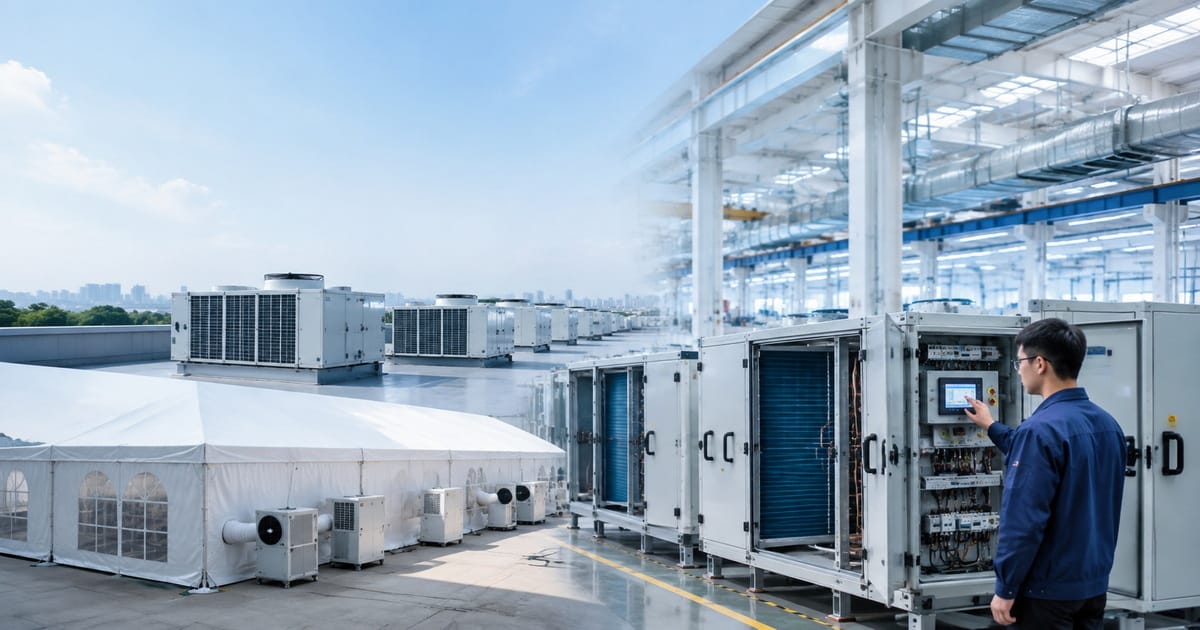
China remains one of the world’s most important HVAC manufacturing hubs, offering an integrated supply chain for sheet-metal fabrication, coils, EC fans, compressors, electrical controls, insulation panels, and final equipment assembly.
For professional buyers, however, sourcing an Air Handler HVAC System is not simply a matter of comparing unit prices. Airflow, external static pressure, coil design, fan selection, casing insulation, filtration, controls, refrigerant compliance, and delivery reliability can materially affect project performance and lifetime cost.
How We Selected These Manufacturers
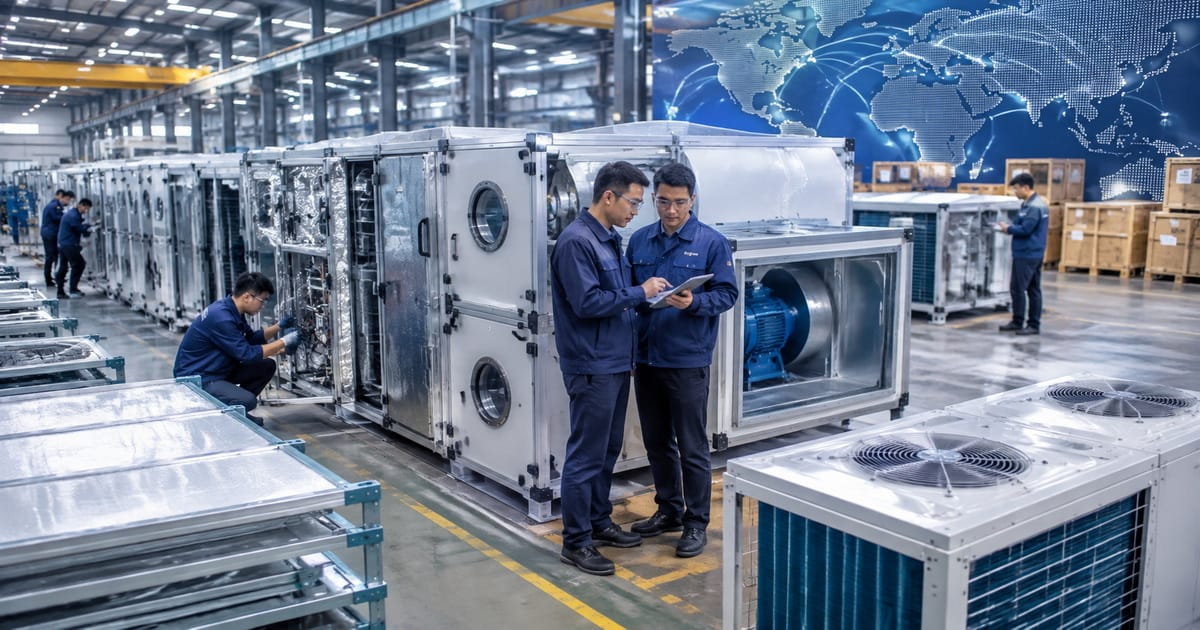
This list is not a simple brand-ranking exercise. Different manufacturers suit different sourcing situations: some are better for high-volume standardized commercial HVAC programs, while others are more suitable for project-based, outdoor, mobile, or deeply customized OEM requirements.
We assessed suppliers using the following criteria:
1. Manufacturing capability
Can the supplier control core processes such as sheet-metal fabrication, casing assembly, coil installation, electrical assembly, functional testing, and export packaging?
2. Engineering and R&D capability
Can the supplier provide selection data based on airflow, external static pressure, cooling/heating load, filtration class, coil configuration, noise limits, and installation constraints?
3. Quality-control process
Does the manufacturer provide incoming-material inspection, pressure or leak testing, electrical safety checks, functional test records, serial-number traceability, and final inspection procedures?
4. Certification transparency
Are ISO, CE, RoHS, CB, UL, AHRI, Eurovent, or other documents valid, traceable, product-specific, and relevant to the target market?
5. OEM/ODM flexibility
Can the factory support branding, electrical adaptation, housing changes, controller customization, packaging, technical documentation, and controlled component substitutions?
6. Delivery reliability
Can the supplier demonstrate stable procurement, production scheduling, key-component availability, and export packing capability?
The global air handling unit market was estimated at approximately USD 16.95 billion in 2026, according to Mordor Intelligence. The China commercial HVAC market was estimated at USD 9.92 billion in 2025 and is projected to grow at a CAGR of 8.51% through 2030.
Why Source AHU Systems From China?
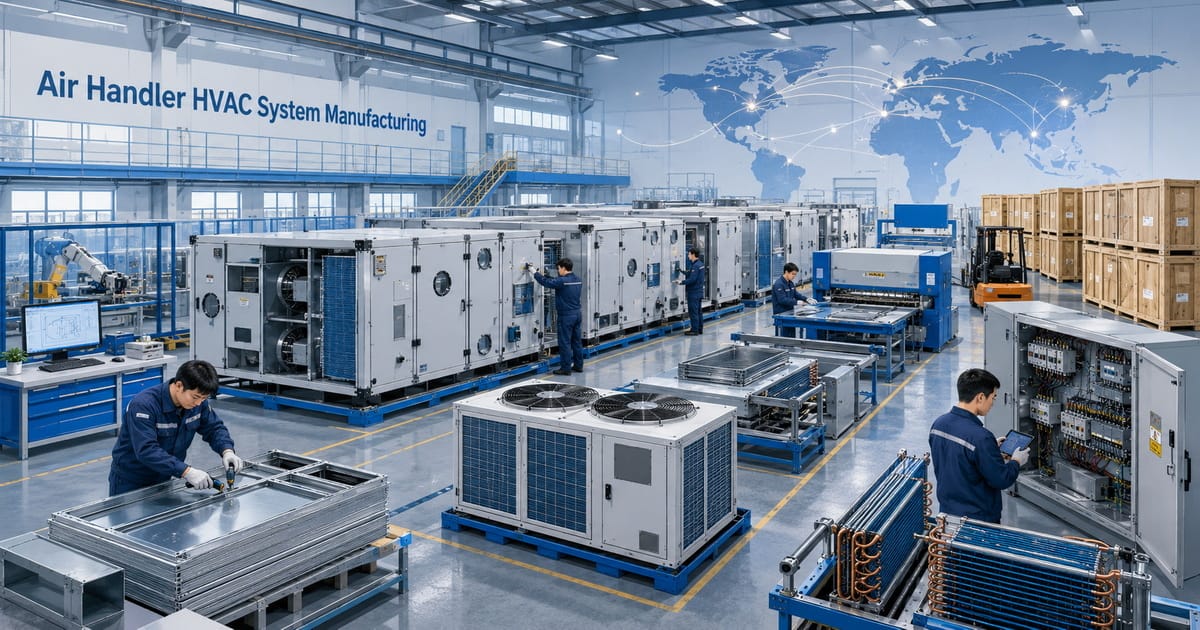
China offers a highly integrated HVAC supply base. Guangdong, Jiangsu, Shandong, Beijing, and surrounding industrial regions provide access to equipment manufacturers as well as upstream suppliers of coils, fans, compressors, electronics, insulation materials, filters, and precision sheet-metal components.
Key advantages include:
– Strong component availability and shorter sourcing cycles.
– Broad product coverage, from standard rooftop units to modular AHUs and mobile cooling systems.
– Competitive OEM/ODM opportunities for overseas brands.
– Flexible production options for both engineered projects and repeatable product platforms.
– Growing experience with CE, RoHS, UL, AHRI, and other export-market compliance requirements.
Buyers should still conduct product-level due diligence. A company-level certification or large factory footprint does not automatically prove that a specific AHU configuration meets your airflow, efficiency, safety, or regulatory requirements.
China Customs publishes official national import and export statistics that can help buyers understand broad trade flows, although AHU-specific analysis should be conducted using the correct HS code and destination-market classification.
Manufacturer Comparison
| Manufacturer | Location | Main Strengths | Suitable Buyer Profile | MOQ / Capacity Approach | Certification Checks |
|---|---|---|---|---|---|
| DREZ (Guangzhou) Intelligent Technology Co., Ltd. | Guangzhou, Guangdong | Tent ACs, rooftop units, trailer AC systems, fresh-air ventilation, mobile climate-control solutions | Small-to-medium brands, rental companies, outdoor and project-based OEM/ODM buyers | Published capacity: over 10,000 units annually; MOQ depends on configuration | Confirm CE/RoHS and model-specific documentation |
| Head-Power Air-Conditioning | Foshan, Guangdong | AHUs, rooftop units, heat-recovery ventilation, chillers, precision cooling | Commercial HVAC and custom engineering projects | Project-based quotation | Verify ISO 9001, ISO 14001, and product scope |
| Airwoods | Guangzhou, Guangdong | Modular AHUs, cleanroom HVAC, heat-recovery ventilation | Cleanroom, healthcare, electronics, and ventilation projects | Selection-based project orders | Confirm CE/ISO and model-level performance files |
| Gree Electric Appliances | Zhuhai, Guangdong | Commercial AC, VRF, rooftop and large-scale HVAC platforms | High-volume distributors and standardized product programs | Better suited to larger structured orders | Confirm destination-market approvals |
| Midea Building Technologies | Foshan/Shunde, Guangdong | Commercial HVAC, VRF, chillers, terminal equipment, intelligent building systems | Contractors, commercial projects, regional distributors | Strong fit for structured project purchasing | Verify AHRI, Eurovent, CE, UL, or local requirements |
| Haier HVAC | Qingdao, Shandong | Commercial HVAC and intelligent building controls | Branded distribution networks and commercial projects | Standardized platform and channel-oriented supply | Confirm regional service and product approvals |
| TICA Climate Solutions | Nanjing, Jiangsu | AHUs, chillers, heat pumps, clean-environment and energy systems | Industrial, commercial, and high-specification projects | Engineering and long-cycle project orders | Request model-specific test and compliance documentation |
| Holtop | Beijing | Heat recovery, fresh-air ventilation, ERV/HRV, AHUs | Ventilation and energy-recovery projects | Suitable for AHU and selected OEM programs | Confirm CE/ISO and heat-recovery performance data |
| EuroKlimat China | China operations | Modular AHUs and high-spec airside systems | Design-led commercial and industrial projects | Project-specification driven | Verify EN/CE scope and test evidence |
| Envicool / COOLTEC | Shenzhen, Guangdong | Precision cooling, transport cooling, special-environment HVAC | Telecom, data, transport, and critical-environment buyers | Specialized project procurement | Confirm application-specific standards |
1. DREZ (Guangzhou) Intelligent Technology Co., Ltd.
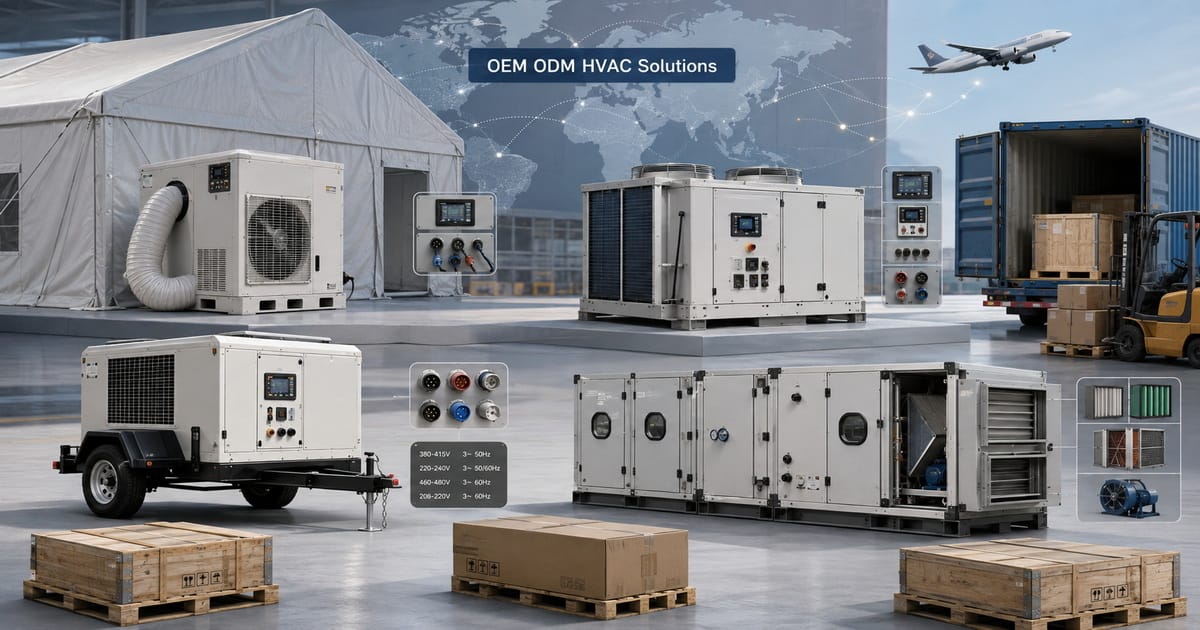
DREZ is a climate-control solutions provider focused on R&D, design, production, sales, and customized HVAC solutions. Its product range includes tent air conditioners, rooftop air-conditioning units, trailer-mounted AC systems, and fresh-air ventilation equipment.
The company is particularly relevant to overseas buyers serving temporary buildings, large tents, exhibitions, events, warehouses, emergency-response projects, industrial temporary spaces, and mobile climate-control applications.
DREZ’s public company profile states that the group was established in 2001, while its intelligent technology business is located in Shawan, Panyu District, Guangzhou. The company reports a factory area of more than 6,000 square meters and annual capacity exceeding 10,000 units. It also states that it began expanding into overseas markets in 2015.
For small and medium-sized international brands, DREZ can be a practical option because it combines climate-control product development with relatively flexible project communication.
Its potential strengths include:
– Product coverage across tent cooling, rooftop systems, trailer-mounted AC units, and fresh-air ventilation.
– Suitability for outdoor, temporary, mobile, and non-standard installation environments.
– OEM/ODM support for branding, voltage and frequency adaptation, controller requirements, appearance, packaging, and application-specific configurations.
– Faster communication and greater customization potential than some large, highly standardized HVAC platforms.
– A useful sourcing option for rental companies, event-equipment suppliers, temporary structure providers, and emerging HVAC brands.
Buyers should still request model-specific documentation, including electrical specifications, refrigerant information, noise data, cooling-capacity test conditions, key-component BOM, packing method, and applicable CE/RoHS documentation before placing production orders.
2. Head-Power Air-Conditioning
Head-Power is based in Foshan, Guangdong, a major HVAC and appliance manufacturing region. Its product portfolio includes air handling units, heat-recovery ventilation equipment, rooftop units, chillers, precision air conditioning, and selected specialized HVAC systems.
The company can be a suitable candidate for commercial HVAC buyers seeking customized AHU configurations or project-based solutions. Industry listings associate the company with AHU, rooftop, and specialized air-conditioning products, along with ISO 9001 and ISO 14001-related claims. Buyers should independently confirm certification validity, registered address, scope, and coverage before relying on those documents.
When evaluating Head-Power, request:
– Fan selection curves at the required operating point.
– Coil specifications, including tube diameter, fin type, rows, and test pressure.
– Casing material and insulation details.
– Static-pressure capability and noise data.
– Production and inspection records for comparable export models.
3. Airwoods
Airwoods is a Guangzhou-based HVAC supplier associated with modular AHUs, heat-recovery ventilation, cleanroom HVAC, and engineering-oriented air treatment systems.
It is more relevant for buyers working in controlled-environment applications such as cleanrooms, laboratories, healthcare facilities, food-processing areas, electronics factories, and specialized ventilation projects.
For these projects, buyers should avoid requesting only a unit price. Instead, the RFQ should define:
– Required airflow and external static pressure.
– Indoor and outdoor design conditions.
– Filter stages and target cleanliness level.
– Casing insulation and thermal-bridge requirements.
– Coil and drainage design.
– BMS communication protocol.
– Pressure-control and alarm requirements.
4. Gree Electric Appliances
Gree Electric Appliances was founded in 1991 and operates as a major Chinese HVAC manufacturer with an extensive global production and export footprint. Its public corporate materials state that its products are sold in more than 160 countries and regions, and that it operates 14 domestic and overseas production bases with more than 90,000 employees and approximately 15,000 R&D personnel.
Gree is generally more suitable for buyers seeking scale, standardized product platforms, recognized brand manufacturing capability, and stable distribution support.
For OEM discussions, buyers should clarify early:
– Whether private-label manufacturing is available for the requested product category.
– The minimum annual purchase volume.
– Product-platform flexibility.
– Destination-market certification availability.
– Technical support and spare-parts arrangements.
– Lead-time conditions for customized electrical or control configurations.
5. Midea Building Technologies
Midea Building Technologies, commonly known as MBT, is part of Midea Group and focuses on intelligent-building products, services, and HVAC solutions. MBT states that it was established in 1999 and has developed from an HVAC supplier into a provider of broader building-technology solutions.
Its product ecosystem includes commercial HVAC systems, VRF, chillers, heating solutions, terminal products, and intelligent-building technologies.
MBT is a strong candidate for:
– Commercial building projects.
– Hotels, offices, retail complexes, and mixed-use developments.
– Regional distributors requiring established product platforms.
– Contractors sourcing integrated HVAC systems.
For AHU sourcing, do not assume that a group-level certification or product family automatically applies to every configuration. Confirm the selected product series, technical performance, compatible outdoor equipment, controls, target-market certifications, and after-sales support model.
6. Haier HVAC
Haier HVAC is supported by Haier’s Qingdao-based manufacturing and global appliance ecosystem. It is relevant to commercial HVAC projects, branded distribution programs, intelligent controls, and building-equipment solutions.
This supplier type is usually most appropriate for buyers that prioritize standardized products, established brand recognition, regional channel support, and longer-term commercial cooperation.
Before selecting Haier HVAC for an AHU-related project, verify:
– Compatibility between the AHU and the proposed outdoor or chilled-water system.
– Available control interfaces and BMS integration.
– Local distributor and service coverage.
– Spare-part lead times.
– Certification status for the exact destination market.
7. TICA Climate Solutions
TICA was established in 1991 and operates in clean-environment and thermal-energy-utilization systems. Its corporate profile states that it integrates R&D, manufacturing, sales, and service, and reports more than 1,100 engineers, more than 200 laboratories, over 700 international patents and copyrights, and 17 manufacturing bases.
TICA can be considered for industrial facilities, commercial buildings, clean-environment applications, heat-pump systems, and complex HVAC projects.
It is especially relevant where buyers require more than a basic AHU box. For example, a project may need coordinated chillers, heat pumps, airside equipment, controls, energy optimization, and detailed technical submittals.
Buyers should request:
– Selection software output or engineering calculation sheets.
– Fan and coil performance data.
– Factory test procedures.
– Project references with comparable climates or industries.
– Detailed commissioning and warranty terms.
8. Holtop
Holtop was founded in 2002 and specializes in air-to-air heat-recovery equipment. Its public materials describe a product range including energy-recovery ventilation systems and AHUs for office and industrial applications, and it also references OEM capability for certain AHU products.
Holtop is especially relevant for projects where fresh air, heat recovery, energy efficiency, and ventilation quality are central requirements.
For heat-recovery AHUs, buyers should clarify:
– Heat-recovery technology and expected efficiency under stated conditions.
– Frost-protection strategy.
– Bypass and defrost control logic.
– Filter arrangement and replacement access.
– Fan energy consumption.
– Condensate-management design.
– Winter shutdown procedures.
Holtop’s maintenance guidance notes that water should be drained from coils during winter shutdown to reduce freezing risk. This reinforces the importance of including installation, drainage, freeze protection, and maintenance requirements in the procurement specification.
9. EuroKlimat China
EuroKlimat China is more relevant for modular air handling solutions and higher-specification airside systems. It may be suitable for design-led commercial, industrial, and building projects with detailed requirements for casing performance, energy efficiency, air leakage, acoustics, and technical documentation.
For this category of supplier, buyers should request evidence beyond a brochure:
– Airflow and pressure curves.
– Fan operating-point calculations.
– Casing thermal-transmittance information.
– Air-leakage performance data.
– Coil pressure-drop calculations.
– Noise measurements.
– Project-specific compliance documents.
10. Envicool / COOLTEC
Envicool / COOLTEC focuses on precision cooling, transportation cooling, and special-environment thermal-management systems. It is not always the first choice for conventional comfort AHU procurement, but it can be highly relevant for critical environments.
Potential applications include:
– Telecom shelters.
– Data-related equipment spaces.
– Rail and transportation systems.
– Outdoor cabinets.
– Energy storage.
– High-reliability industrial environments.
For these applications, buyers should prioritize environmental protection, vibration resistance, electrical stability, redundancy, operating-temperature range, alarms, remote monitoring, and serviceability over conventional comfort-cooling specifications.
Technical Specifications Buyers Should Define
| Technical Item | What to Specify | Common Procurement Risk |
|---|---|---|
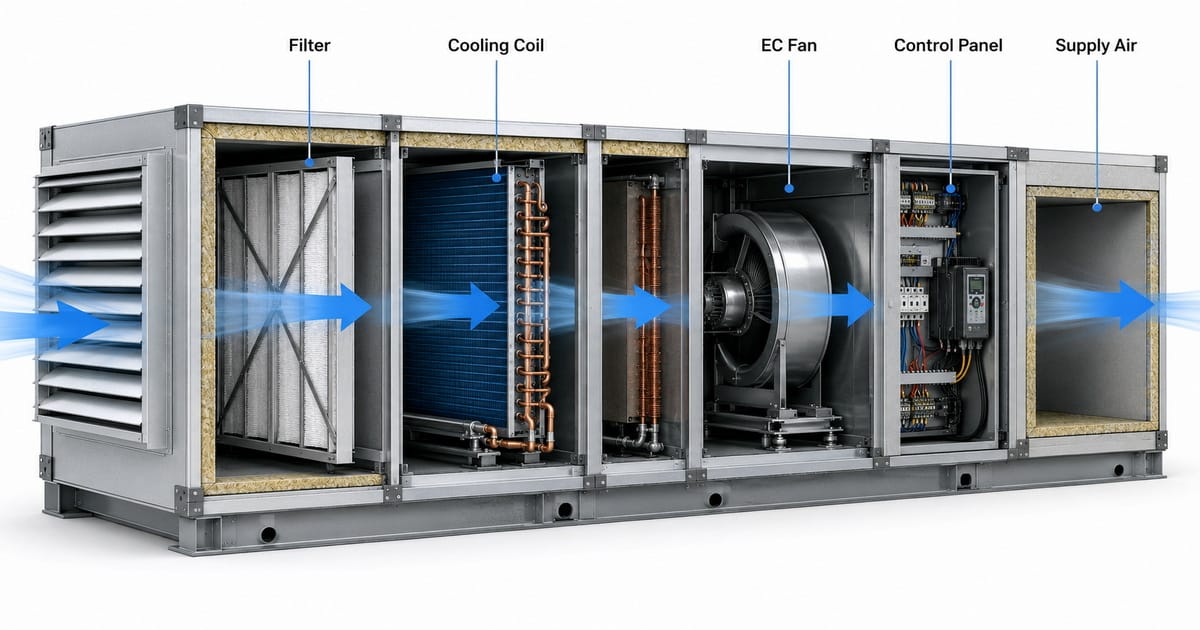
| Airflow and static pressure | Design airflow, maximum airflow, external static pressure, total system resistance | Supplier quotes airflow without proving usable static pressure |
| Casing structure | Panel thickness, steel grade, galvanization, insulation material, frame design | Thin panels, low-density insulation, thermal bridging |
| Coil design | Copper tube size, fin type, rows, operating pressure, pressure-test requirement | Reduced tube wall thickness or lower-grade fin material |
| Fan system | EC or AC fan, brand, efficiency, ESP, noise level, vibration control | Undersized fan creates noise, poor pressure margin, high energy use |
| Filtration | Filter grade, dimensions, pressure-drop limit, alarm function | Filter labels do not match required standards |
| Controls | PLC/controller, BMS protocol, alarms, remote access, interlocks | Control logic remains undefined until commissioning |
| Refrigerant and electrical system | Refrigerant type, voltage, frequency, plugs, breakers, protection class | Equipment does not match local regulations or power conditions |
Common Sourcing Risks
1. Unapproved “Equivalent” Component Substitution
One of the most common but under-discussed issues in HVAC sourcing is component substitution after the quotation stage.
A supplier may quote a named EC fan, compressor, controller, copper-tube thickness, or insulation specification, then replace it during production with an “equivalent” component. The substituted item may appear acceptable, but can change efficiency, reliability, noise, certification status, or spare-part availability.
How to avoid it:
– Add a key-component BOM to the purchase contract.
– Define which components cannot be substituted without written approval.
– Specify approved brands, performance limits, and equivalent-substitution procedures.
– Inspect labels, serial numbers, and component brands during first-article inspection and pre-shipment inspection.
– Require written engineering approval for any design or component change.
2. Treating CE as a Complete Compliance Solution
CE marking alone does not prove that every product can be legally placed on every European market. Compliance depends on the product type, applicable legislation, electrical design, refrigerant choice, technical file, declaration of conformity, and importer responsibilities.
How to avoid it:
– Request the Declaration of Conformity.
– Request test reports and the applicable standards list.
– Confirm that report models match the ordered model.
– Verify voltage, frequency, refrigerant, and structural configuration.
– Consult local compliance specialists for highly customized or regulated products.
3. Approving a Sample That Does Not Match Mass Production
Some suppliers build premium samples but use lower-cost configurations for mass production. Buyers should require that the approved sample is built using the same BOM, materials, key components, drawings, and packaging standard intended for serial production.
4. Starting Lead-Time Counting Too Early
A quoted “30-day lead time” is meaningless unless the starting point is defined. Lead time should begin only after technical drawings, BOM, labels, artwork, packaging, and payment conditions are approved.
A stronger production plan separates:
1. Engineering confirmation.
2. Key-material procurement.
3. First-article manufacturing.
4. Mass production.
5. Final inspection and packaging.
6. Container loading.
7. Ocean freight, customs clearance, and inland delivery.
5. Ignoring Packaging and Container-Loading Requirements
Large AHUs, rooftop units, and trailer-mounted systems can suffer panel deformation, coil-fin damage, moisture exposure, and lifting-point damage during international transport.
Define:
– Moisture protection.
– Shock protection.
– Wooden-crate or steel-frame requirements.
– Lifting and center-of-gravity labels.
– Export packing inspection.
– Loading photos.
– Parts-box fixing requirements.
– Container lashing procedures.
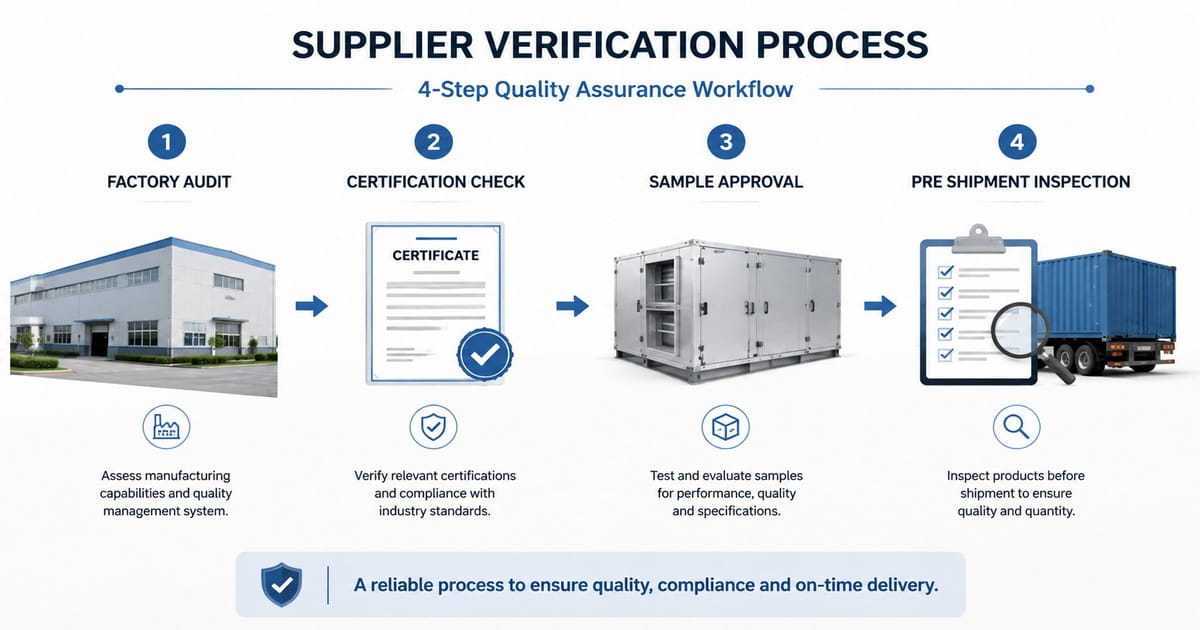
Recommended Factory Verification Process
1. Submit a detailed RFQ
Include airflow, static pressure, temperature and humidity conditions, installation environment, electrical supply, target country, certification needs, annual purchase volume, and branding requirements.
2. Conduct a technical clarification meeting
Ask for selection sheets, dimensional drawings, wiring diagrams, system schematics, BOM, performance data, control descriptions, and quotation validity.
3. Verify legal and technical documents
Review the company registration, factory address, ISO certificates, product compliance documents, third-party reports, export references, and customer-project examples.
4. Conduct a video or on-site factory audit
Inspect sheet-metal work, coil assembly, electrical assembly, test areas, packaging, warehouse control, incoming inspection, and production records—not just the showroom.
5. Approve a production-representative sample
Confirm the sample BOM, test items, acceptance criteria, corrective-action deadlines, and mass-production consistency.
6. Control the first order in stages
Arrange inspections before production, after first-article completion, during mass assembly, and before shipment. For high-value orders, consider third-party pre-shipment inspection and container-loading supervision.
Conclusion
Selecting an Air Handler HVAC System manufacturer in China requires more than identifying the lowest quotation. The most reliable supplier is one that can repeatedly deliver verified performance, controlled components, compliant documentation, stable quality, and predictable lead times.
For buyers seeking tent air conditioners, rooftop units, trailer-mounted cooling systems, fresh-air ventilation equipment, or mobile climate-control solutions, DREZ (Guangzhou) Intelligent Technology Co., Ltd. is a relevant supplier to include in an OEM/ODM RFQ process. Its Guangzhou manufacturing base, project-oriented product portfolio, and flexible approach to customization make it particularly suitable for overseas small-to-medium brands, rental businesses, and application-specific HVAC programs.
FAQ
1. How can I verify whether an HVAC supplier’s ISO 9001 certificate is still valid?
Request the complete certificate, including the certificate number, certification body, validity date, factory address, and scope of certification. Verify it through the certification body’s database or by written inquiry. Make sure the certified address matches the real manufacturing location and that the scope covers HVAC equipment manufacturing rather than only trading or sales activities.
2. Why do AHU quotations vary so much between Chinese factories?
The difference often comes from fan selection, static-pressure capability, coil rows, copper-tube thickness, fin material, casing thickness, insulation density, filter configuration, controller quality, test scope, packing, certification, and warranty terms. Compare technical BOMs and operating conditions—not only unit prices.
3. How do I know whether a CE or RoHS document applies to my order?
Ask for the Declaration of Conformity, applicable standards, test reports, and exact covered models. Check that the model number, voltage, frequency, refrigerant, manufacturer name, and product configuration match the equipment you are ordering. Non-standard products may require additional assessment or documentation.
4. How should I negotiate MOQ for an OEM HVAC project?
Break MOQ into separate categories: complete-unit MOQ, customized housing MOQ, private-mold MOQ, customized controller MOQ, customized packaging MOQ, and spare-parts MOQ. Smaller brands can begin with a standard platform plus logo labels, packaging, and limited configuration changes, then move toward deeper customization after demand is proven.
5. How can I verify a supplier’s real production capacity?
Ask for production schedules from the past 6–12 months, equipment lists, key-workstation counts, staff shifts, work-in-progress orders, warehouse turnover, monthly shipment records, and key-component stock levels. Factory size alone does not equal capacity. Common bottlenecks include coils, sheet-metal processing, electrical assembly, testing, outsourced coating, and export packaging.
References
1. – [DREZ About Us] — Company positioning, product scope, factory information, and overseas-market development. [drezaircon]
2. – [China Customs Statistics] — Official China import and export statistics portal. [english.customs.gov]
3. – [Mordor Intelligence: Air Handling Units Market] — Global AHU market estimate and industry definition. [mordorintelligence]
4. – [Mordor Intelligence: China Commercial HVAC Market] — China commercial HVAC market outlook. [mordorintelligence]
5. – [Gree Corporate Profile] — Gree’s founding date, manufacturing footprint, workforce, and R&D information. [global.gree]
6. – [Midea Building Technologies] — MBT business background and HVAC solution scope. [hvac.midea]
7. – [TICA Corporate Profile] — TICA’s corporate, engineering, and manufacturing information. [global.tica]
8. – [Holtop AHU Products] — Holtop’s background and AHU product focus. [holtop]
Hot Tags: Air Handler HVAC System, Air Handling Unit Manufacturer China, Commercial Air Handling Unit, HVAC OEM Manufacturer, HVAC ODM Manufacturer, Custom Air Handling Unit, Industrial Air Handling Unit, Rooftop Air Conditioning Unit, Fresh Air Ventilation System, China HVAC Supplier