Content Menu
● Why Source Air Handling Unit Systems from China?
● How We Selected These Manufacturers
● Top 10 Air Handling Unit System Manufacturers in China
>> 1. DREZ (Guangzhou) Intelligent Technology Co., Ltd.
>> 2. Guangdong Head-Power Air-Conditioning Co., Ltd.
>> 3. Airwoods
>> 4. Midea Building Technologies
>> 6. Gree Electric Appliances, Inc. of Zhuhai
>> 7. Haier HVAC / Haier Smart Home
>> 9. Shenzhen Envicool Technology Co., Ltd.
● Technical Due Diligence Checklist
>> Do Not Check Steel Thickness Alone
>> Internal Sourcing Tip: Inspect the Hidden Components
>> Define Coil Requirements in the Purchase Order
>> Select Fans by Operating Point
>> CE Is Not a Universal Compliance Certificate
● Buyer’s Guide: How to Source an AHU System Safely
>> 1. Prepare a Detailed Technical RFQ
>> 2. Verify Certificates Properly
>> 3. Use a Sample-to-Mass-Production Process
>> 4. Plan Logistics Before Production
● FAQ
>> 1. How can I verify whether an AHU manufacturer’s ISO 9001 certificate has expired?
>> 2. Which AHU components are most likely to be downgraded in a low-price quotation?
>> 3. How should I compare airflow and energy-consumption data from two suppliers?
>> 4. What order quantity is needed for private labeling and ODM development?
>> 5. Should I hire a third-party inspection company for AHU orders?
China is one of the world’s most important HVAC manufacturing bases, with strong supply networks for fans, coils, filters, sheet-metal enclosures, insulation panels, controls, compressors, and heat-recovery components.
For international buyers, sourcing an Air Handling Unit System from China can provide more than a competitive purchase price. The real advantage is access to a flexible manufacturing ecosystem: suppliers can adapt air volume, external static pressure, cooling source, filtration level, electrical standard, casing structure, control logic, branding, and packaging to specific market requirements.
However, AHU procurement should never be based on airflow and price alone. A low-cost unit may hide compromises in panel construction, coil material, fan selection, drainage design, filter area, electrical components, or final testing. Those shortcuts can create costly field failures after installation.
The global AHU market was valued at approximately USD 14.9 billion in 2025 and is projected to continue growing in 2026, driven by commercial construction, industrial ventilation, data centers, healthcare, cleanrooms, and energy-efficiency requirements.
Why Source Air Handling Unit Systems from China?
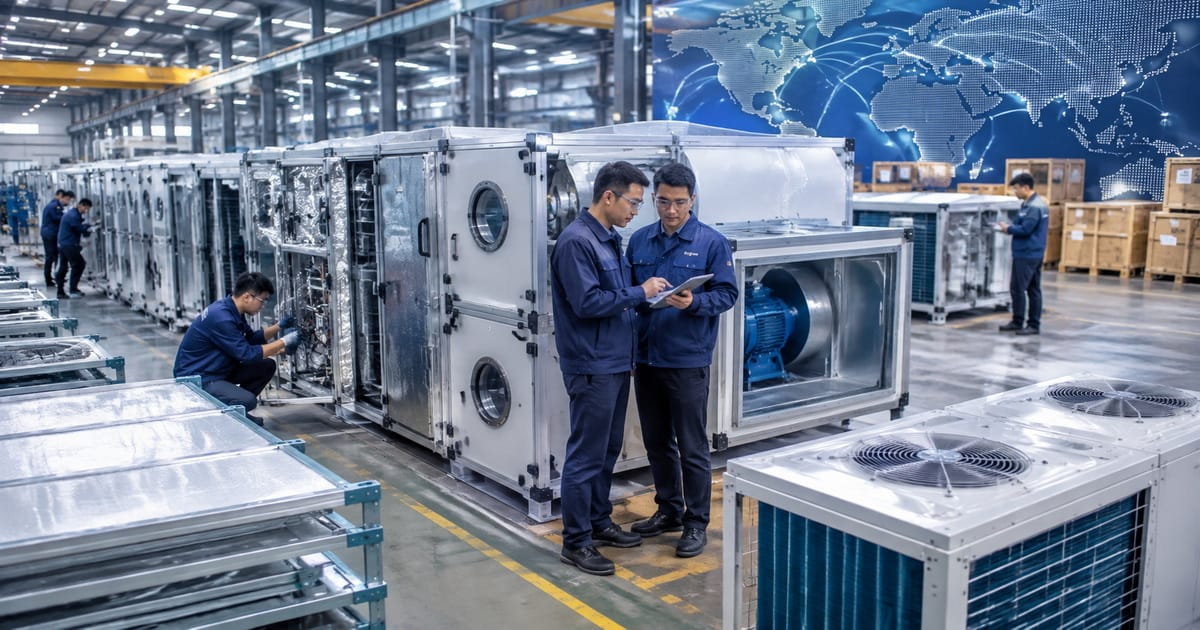
China’s HVAC manufacturing capacity is concentrated in several industrial clusters:
– Guangdong Province: Guangzhou, Foshan, Zhuhai, and Shenzhen provide strong capabilities in commercial air conditioning, sheet-metal fabrication, electronic controls, export logistics, and OEM/ODM services.
– Jiangsu Province: Nanjing, Suzhou, and Wuxi are important locations for central air-conditioning systems, industrial cooling, and engineering-grade HVAC equipment.
– Shandong Province: Qingdao has a well-developed home appliance and commercial HVAC ecosystem, supported by large international manufacturers.
– Beijing-Hebei Region: This area supports industrial ventilation, mobile climate-control systems, vehicle HVAC, and engineering equipment supply chains.
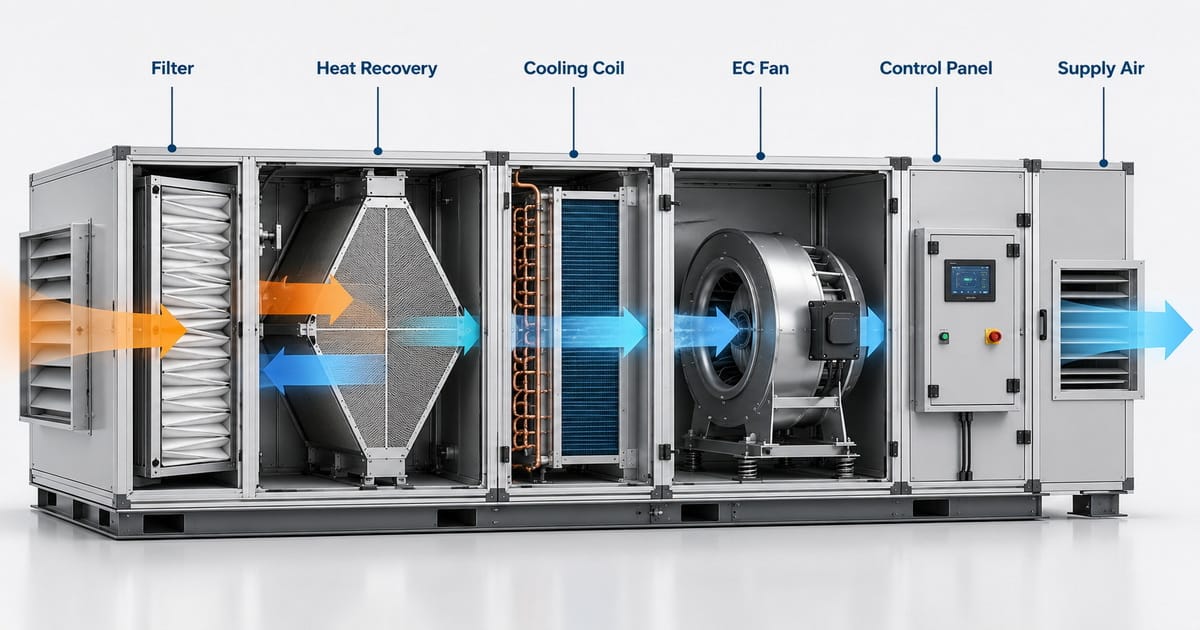
For overseas buyers, these clusters make it easier to source a complete system rather than a single machine. AHU manufacturers can often integrate EC fans, chilled-water or DX coils, filters, heat-recovery cores, dampers, electrical controls, and BMS communication interfaces within one project.
Still, supplier capability varies greatly. A factory that can assemble a basic ventilation unit may not be able to engineer a reliable AHU for high humidity, cleanroom pressure control, corrosive environments, or demanding export compliance.
How We Selected These Manufacturers
| Selection Criterion | What Buyers Should Check | Why It Matters |
|---|---|---|
| Product relevance | Whether the supplier genuinely manufactures AHUs, ventilation units, air-side systems, or related HVAC equipment | Prevents sourcing from factories with limited AHU engineering experience |
| R&D and engineering | Fan selection, coil design, casing structure, filtration, controls, and system matching | Determines whether the unit performs under real operating conditions |
| Quality control | Incoming material inspection, pressure testing, electrical testing, air leakage inspection, and final inspection records | Reduces field failures and warranty exposure |
| Export compliance | CE, RoHS, UKCA, UL, AHRI, SASO, or destination-market requirements | Ensures the product can legally enter and operate in the target market |
| OEM/ODM flexibility | Private label, casing customization, branding, controls, manuals, packaging, and spare parts | Important for distributors and brand owners |
| Delivery stability | Production planning, key-component inventory, BOM control, and lead-time visibility | Reduces project delays caused by component shortages |
| Transparency | Factory address, manufacturing capability, test procedures, project references, and documentation | A practical indicator of supplier reliability |
Top 10 Air Handling Unit System Manufacturers in China
1. DREZ (Guangzhou) Intelligent Technology Co., Ltd.
Location: Guangzhou, Guangdong, China
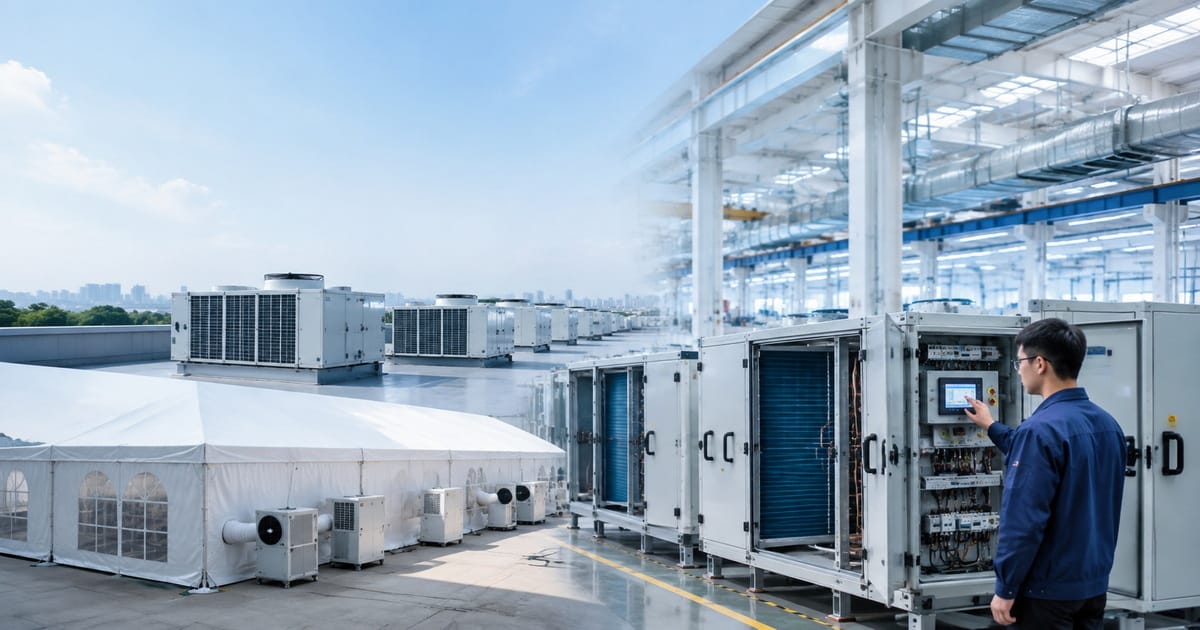
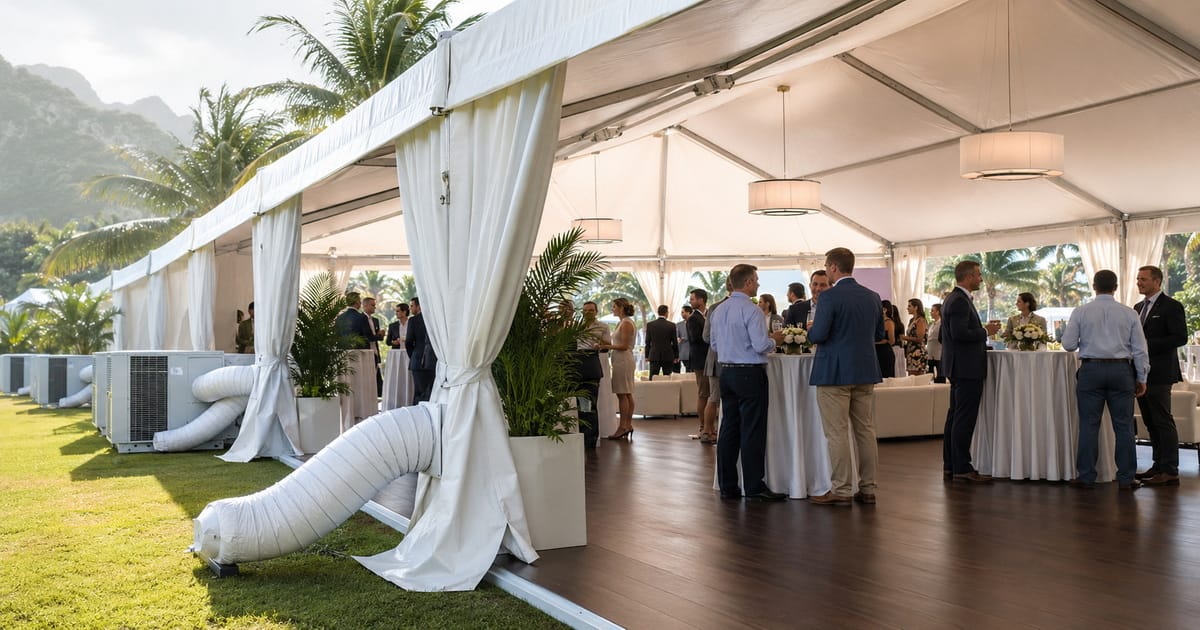
Core Products: Tent air conditioners, rooftop air-conditioning units, trailer-mounted air-conditioning systems, ventilation units, and mobile climate-control solutions.
Best For: Small and mid-sized brands, rental equipment companies, temporary structures, tents, outdoor events, emergency applications, and customized OEM/ODM projects.
DREZ is a climate-control solution provider focused on product development, design, manufacturing, sales, and customized project support. Its product portfolio includes tent air conditioners, rooftop units, trailer air-conditioning systems, and fresh-air ventilation products designed for temporary, mobile, industrial, and outdoor environments.
According to its public company information, DREZ has more than 6,000 square meters of manufacturing space and annual production capacity exceeding 10,000 units. The company also reports experience serving domestic event and industrial projects, with overseas market development beginning in 2015.
Rather than competing directly with major central-air-conditioning groups on mass-market volume, DREZ is particularly relevant for buyers seeking flexibility, communication efficiency, and practical customization.
Key strengths include:
– Suitable for temporary buildings, event tents, warehouses, steel structures, mobile facilities, and outdoor operations.
– Supports OEM and ODM cooperation for overseas brands and equipment distributors.
– Can discuss customized configurations based on installation space, voltage, frequency, ambient temperature, cooling load, and target market.
– Offers a more flexible option for project-based orders and mid-volume private-label programs.
– Stronger relevance for customers that need responsive engineering communication rather than a fixed catalog-only product range.
For example, a tent-rental brand in Europe may require a private-label cooling unit with 50 Hz power, a specific plug type, branded packaging, corrosion resistance for outdoor use, and fast-install duct connections. This type of project often requires closer coordination than a standard catalog purchase, making DREZ a practical candidate for evaluation.
Before placing an order for fixed-building AHUs, cleanroom systems, or projects with strict local regulations, buyers should submit a detailed technical RFQ. It should define airflow, external static pressure, filtration level, cooling source, control protocol, noise limit, installation method, and mandatory certifications.
2. Guangdong Head-Power Air-Conditioning Co., Ltd.
Location: Foshan, Guangdong, China
Core Products: Air handling units, heat-recovery ventilation systems, rooftop package units, chillers, precision air conditioners, and central HVAC systems.
Best For: Commercial HVAC contractors, regional distributors, hotels, schools, factories, and project-based buyers.
Head-Power is a relevant supplier for buyers seeking traditional commercial and industrial air-side HVAC equipment. Its public materials indicate product coverage across AHUs, heat-recovery units, ventilation systems, rooftop units, and related central-air-conditioning products.
Public supplier information references a factory area of approximately 20,000 square meters and lists ISO 9001, ISO 14001, and CE certification claims. Buyers should verify the validity, scope, and model applicability of those documents before issuing a purchase order.
Key sourcing advantages include:
– A product range aligned with conventional AHU and ventilation-system procurement.
– Capability to discuss chilled-water coil, DX coil, heat-recovery, and modular AHU configurations.
– Location in Foshan, where sheet-metal, fan, control, insulation, and logistics resources are well developed.
– Potential fit for engineering specifications and commercial project requirements.
3. Airwoods
Location: Guangzhou, Guangdong, China
Founded: 2007
Core Products: Cleanroom AHUs, heat-recovery ventilation, HVAC systems, VOC treatment, and indoor-air-quality solutions.
Best For: Pharmaceutical, healthcare, food processing, electronics, laboratory, cleanroom, and industrial air-quality projects.
Airwoods was established in 2007 and publicly states that it supplies HVAC, cleanroom, and building-air-quality solutions to customers in more than 50 countries.
Its main advantage is its system-oriented approach. Rather than treating an AHU as a stand-alone product, Airwoods often combines air handling, filtration, cooling, humidity control, pressure management, and cleanroom requirements into an integrated engineering solution.
For example, its published project information includes a customized DX AHU with 16,000 m³/h airflow and 90 kW cooling capacity for a pharmaceutical cleanroom application.
Buyers may consider Airwoods when they need:
– AHUs for cleanrooms, laboratories, medical facilities, food factories, or electronics production.
– Multi-stage filtration and pressure-control systems.
– Heat recovery, dehumidification, cooling, heating, and ventilation integration.
– Engineering support for regulated indoor environments.
4. Midea Building Technologies
Location: Foshan/Shunde, Guangdong, China
Core Products: Commercial HVAC, VRF systems, chillers, AHUs, heat-exchange units, building automation, and energy-management solutions.
Best For: Large commercial projects, mature distributors, regional HVAC networks, and standardized building-system procurement.
Midea Building Technologies, commonly known as MBT, is the business division of Midea Group focused on commercial buildings, HVAC, energy management, and intelligent building technologies. Midea renamed its Commercial Air Conditioner Division as Midea Building Technologies in 2020.
MBT has disclosed its participation in major public projects, including HVAC support for facilities related to the 2023 Asian Games. Its solutions included modular AHUs, heat-exchange units, centrifugal chillers, and integrated HVAC systems.
Key strengths include:
– A broad commercial HVAC product portfolio.
– Large-scale manufacturing and supply-chain capability.
– Ability to integrate AHUs with chillers, VRF systems, heat pumps, and building controls.
– Suitable for buyers with defined project specifications, forecast volume, and professional procurement processes.
However, small private-label buyers should confirm minimum order requirements and the actual depth of available OEM/ODM customization before proceeding.
5. TICA Climate Solutions
Location: Nanjing, Jiangsu, China
Founded: 1991
Core Products: Modular AHUs, standard AHUs, clean-environment systems, chillers, heat pumps, and energy solutions.
Best For: Industrial facilities, hospitals, electronics plants, pharmaceutical projects, transportation hubs, exhibition centers, and high-specification commercial buildings.
TICA was established in 1991 and specializes in the R&D, manufacturing, sales, and service of central air-conditioning, clean-environment, and thermal-energy-utilization products. It publicly states that it operates five manufacturing facilities.
TICA’s modular AHU range is positioned for demanding applications including electronics, hospitals, pharmaceuticals, food, tobacco, automotive painting, precision optical manufacturing, textile plants, airports, subways, exhibition centers, offices, hotels, and shopping centers.
Buyers should pay close attention to:
– Panel construction, insulation material, frame design, and thermal-bridge control.
– Fan type, EC or VFD control options, and performance at the specified operating point.
– Coil configuration, fin treatment, corrosion resistance, and condensate-drainage design.
– Documentation for testing, commissioning, and destination-market compliance.
6. Gree Electric Appliances, Inc. of Zhuhai
Location: Zhuhai, Guangdong, China
Core Products: Commercial air conditioning, VRF systems, chillers, rooftop units, air-side equipment, and integrated HVAC systems.
Best For: Large distributors, commercial construction projects, government procurement, and standardized HVAC programs.
Gree is one of China’s largest air-conditioning manufacturers, with strong capabilities in commercial HVAC, compressors, electronic controls, and mass production. Its scale and supply-chain integration make it relevant for buyers looking for established commercial HVAC platforms and stable supply capacity.
Gree is generally a stronger fit for projects with defined specifications, standardized configurations, mature sales channels, or larger order volume. Buyers seeking low-MOQ private-label products, frequent structural changes, or highly customized control systems should confirm those capabilities early in the sourcing process.
7. Haier HVAC / Haier Smart Home
Location: Qingdao, Shandong, China
Core Products: Commercial air conditioning, VRF systems, central HVAC, smart-building solutions, and connected climate-control systems.
Best For: Regional distribution networks, commercial-building projects, smart-building applications, and buyers seeking established international product platforms.
Haier’s strengths include global brand reach, commercial HVAC product development, and connected building solutions. It can be considered by buyers seeking mature product platforms and larger-scale commercial HVAC support.
For AHU-related procurement, buyers should verify:
– Whether the specific air-side equipment is manufactured by the proposed production entity.
– Which control protocols are available for BMS integration.
– Whether spare parts and service support are available in the target market.
– Whether the required AHU configuration is standard, project-engineered, or available for private-label cooperation.
8. EuroKlimat China
Location: China-based manufacturing and operations, with a strong presence in the Yangtze River Delta HVAC ecosystem.
Core Products: Modular AHUs, engineered air-side systems, commercial HVAC solutions, and project-based equipment.
Best For: Buyers requiring engineering documentation, modular construction, maintainability, and higher-specification air-side systems.
EuroKlimat China is relevant for purchasers that value modular AHU design, engineered air-side configurations, project documentation, and structured equipment selection.
For projects involving complex filtration, heat recovery, access sections, high external static pressure, or special maintenance requirements, buyers should request:
– Air-selection sheets with full design conditions.
– Fan curves and actual operating points.
– Casing air-leakage and thermal-bridge data.
– Filter dimensions, initial resistance, final resistance, and replacement access.
– Factory acceptance testing procedures and packing plans.
9. Shenzhen Envicool Technology Co., Ltd.
Location: Shenzhen, Guangdong, China
Core Products: Precision cooling, data-center cooling, thermal management, temperature and humidity control, and intelligent monitoring solutions.
Best For: Data centers, telecom sites, battery-energy-storage systems, power electronics, laboratories, medical applications, and critical cooling environments.
Envicool is not primarily a conventional comfort-AHU manufacturer. Instead, it is a strong candidate for critical-environment cooling and precision temperature-and-humidity-control projects.
Its public information indicates that it provides temperature and humidity control and monitoring solutions for sectors including telecommunications, IT, power, healthcare, new energy, electronics, laboratories, HVAC, and cold-chain applications.
Buyers should consider Envicool when the project emphasizes:
– High heat density and continuous operation.
– Precision temperature or humidity control.
– N+1 redundancy and fault alarms.
– Remote monitoring and BMS communication.
– Long-term spare-parts planning and service response.
10. Nanfeng Group
Location: Northern China, with operations linked to the Beijing-Hebei industrial region.
Core Products: Vehicle air conditioning, parking air conditioners, heating systems, RV air conditioning, and mobile climate-control equipment.
Best For: RV brands, special vehicles, construction machinery, mobile medical units, field operations, and transport-related HVAC applications.
Nanfeng Group is more closely associated with mobile and vehicle climate-control systems than conventional building AHUs. It is included because some “air handling” projects are actually intended for trailers, mobile shelters, vehicles, field stations, or temporary equipment rooms.
For mobile HVAC systems, buyers should focus on factors that are different from fixed-building AHUs:
– Vibration resistance and transportation durability.
– DC or vehicle-power compatibility.
– Weight and installation-space limitations.
– Weather resistance, dust protection, and corrosion resistance.
– Field-service accessibility and rapid maintenance.
Supplier Comparison Table
The following table is intended for early-stage supplier screening. Actual production capacity, MOQ, certification scope, and lead time must be confirmed for the exact product model and order quantity.
| Manufacturer | Main Focus | Capacity / Capability Indicator | Typical MOQ Approach | Certification and Compliance Focus | OEM/ODM Suitability |
|---|---|---|---|---|---|
| DREZ | Tent AC, rooftop AC, trailer AC, ventilation, mobile climate control | 6,000+ m² factory; 10,000+ units/year | Flexible; suitable for projects and mid-sized brands | Verify CE, RoHS, and destination-market documents by model | High |
| Head-Power | AHUs, heat recovery, ventilation, rooftop units | Public references to approximately 20,000 m² | Usually negotiated by configuration and project volume | Verify ISO 9001, ISO 14001, and CE scope | High |
| Airwoods | Cleanroom AHUs, heat recovery, IAQ systems | Publicly states service in 50+ countries | Often project-based | Cleanroom, filtration, and project documentation | High |
| Midea Building Technologies | Commercial HVAC, AHUs, VRF, chillers | Large group manufacturing platform | Better suited to larger programs and projects | Model-specific CE, UL, AHRI, Eurovent, or local approvals | Medium |
| TICA | Modular AHUs, clean environments, heat pumps | Publicly states five manufacturing facilities | Typically project and configuration dependent | Air-side performance, engineering standards, export requirements | Medium-High |
| Gree | Commercial HVAC, VRF, chillers | Large-scale manufacturing | Often suited to established channels and larger orders | Product-model certification and territory policy | Medium |
| Haier HVAC | Commercial AC, connected building systems | Large global manufacturing network | Often channel or project dependent | Model selection, service coverage, BMS compatibility | Medium |
| EuroKlimat China | Engineering-grade modular AHUs | Project-oriented air-side capability | Usually project-specific | CE/EN requirements, performance documentation | Medium-High |
| Envicool | Precision cooling and thermal management | Technology-focused cooling and monitoring solutions | Depends on system complexity | Reliability, controls, data-center or industry-specific compliance | Medium-High |
| Nanfeng Group | Vehicle and mobile HVAC | Mobile climate-control specialization | Vehicle platform or project dependent | Vehicle-use and destination-market regulations | Medium-High |
Technical Due Diligence Checklist
Do Not Check Steel Thickness Alone
A common sourcing mistake is to ask only for “0.5 mm galvanized steel” or “0.6 mm galvanized steel.” A reliable AHU specification should also define:
– Outer and inner panel material grades.
– Double-skin panel construction.
– Insulation material: PU, PIR, rock wool, or EPS.
– Frame structure and thermal-bridge prevention.
– Drain-pan material and corrosion resistance.
– Door seals, access-panel design, and service-door rigidity.
– Internal sheet-metal protection in high-humidity areas.
Internal Sourcing Tip: Inspect the Hidden Components
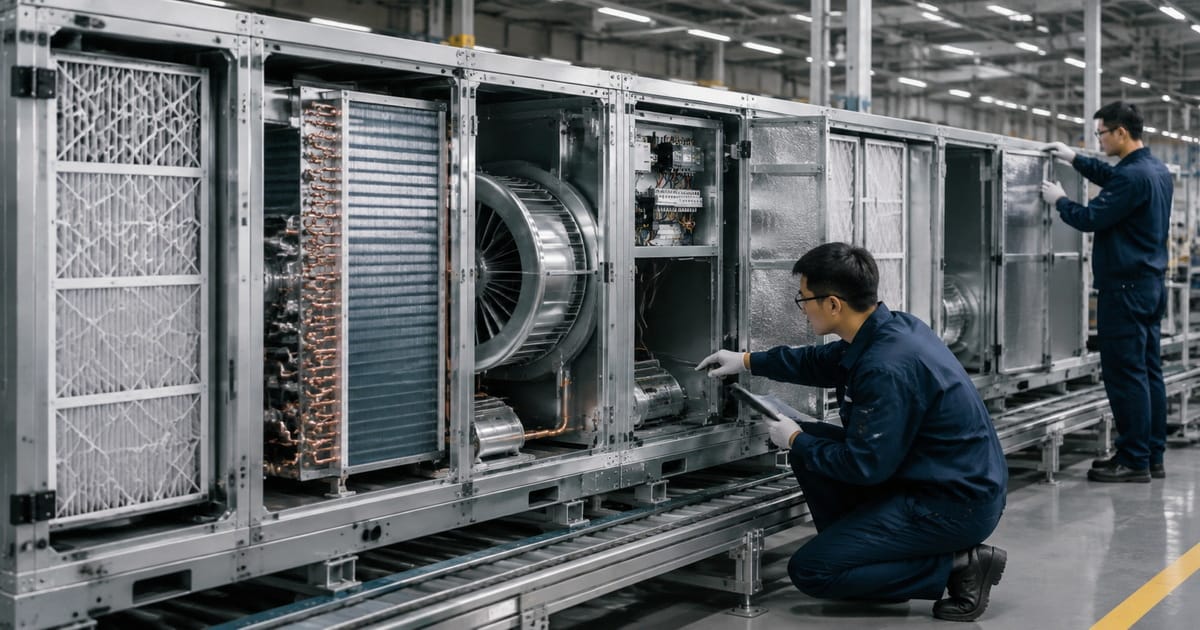
Many buyers inspect only the external casing and product appearance. The highest-risk areas are often hidden:
– Condensate drain pans.
– Internal casing joints.
– Coil-frame connections.
– Door edges and gasket contact points.
– Fan-section vibration mounts.
– Internal sheet-metal surfaces exposed to condensation.
A unit may look professional at the factory but develop corrosion, water leakage, loose seals, or drainage problems after 12 to 24 months in a humid or coastal environment.
Ask the supplier for detailed internal photos, material declarations, drain-pan drawings, door-sealing structure, and corrosion-protection information before approving the sample.
Define Coil Requirements in the Purchase Order
Do not accept a generic statement such as “copper tube and aluminum fin coil.” The purchase order should specify:
– Copper-tube diameter, wall thickness, and number of rows.
– Fin material, thickness, fin spacing, and coating type.
– Chilled-water or refrigerant design conditions.
– Face velocity and permitted air-side pressure drop.
– Pressure-test method and test pressure.
– Drain-pan slope, drainage outlet size, and overflow prevention.
– Corrosion-protection requirements for coastal or industrial environments.
Select Fans by Operating Point
AHU fan selection should be based on the actual system operating point, not nominal airflow alone. Request:
– Required airflow and total external static pressure.
– Fan curve and actual duty point.
– Fan efficiency, input power, and sound level.
– EC fan or VFD control configuration.
– Airflow performance at both clean-filter and dirty-filter conditions.
– Redundancy requirements, such as dual fans or N+1 arrangements.
A common hidden issue occurs when a supplier selects a fan only for clean-filter conditions. After several months of operation, filter resistance rises, airflow drops, and the building may fail to maintain pressure, ventilation rate, or temperature uniformity.
CE Is Not a Universal Compliance Certificate
A CE mark is not a universal approval for every product configuration or market. Buyers should verify:
– Whether the Declaration of Conformity lists the exact product model.
– Which harmonized standards were used.
– Whether motors, drives, electrical panels, and controls are included in the compliance scope.
– Whether RoHS, EMC, Low Voltage, machinery safety, and eco-design requirements apply.
– Whether the destination market requires UKCA, UL, ETL, SASO, G-Mark, or other approvals.
Buyer’s Guide: How to Source an AHU System Safely
1. Prepare a Detailed Technical RFQ
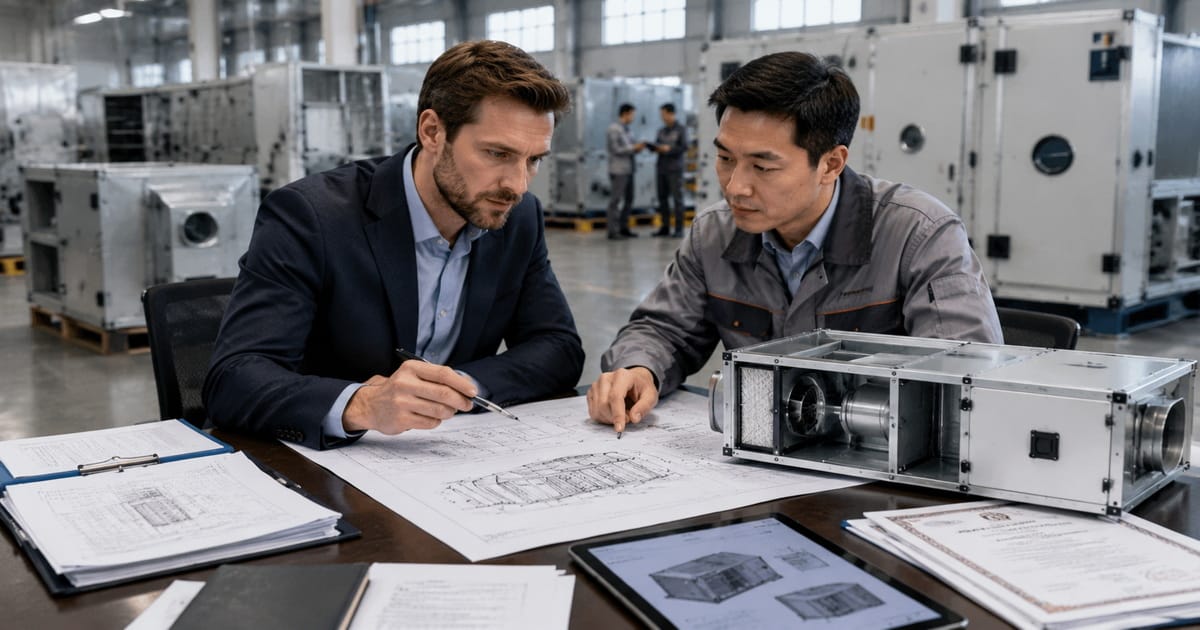
Avoid sending a simple request such as: “Please quote one 10,000 CMH AHU.”
A professional AHU RFQ should include:
– Application: commercial comfort cooling, cleanroom, food plant, warehouse, tent, industrial facility, or temporary building.
– Design airflow and external static pressure.
– Outdoor and indoor temperature/humidity design conditions.
– Cooling and heating source: chilled water, DX, heat pump, electric heater, steam, or heat recovery.
– Required filtration class.
– Unit dimensions, access direction, and installation restrictions.
– Voltage, frequency, plug, and electrical standard.
– Control requirements: local controller, 0–10 V, Modbus, BACnet, or BMS integration.
– Destination country and mandatory compliance requirements.
– Expected annual volume, initial order quantity, and requested delivery date.
2. Verify Certificates Properly
To check whether an ISO 9001 certificate is still valid:
1. Request the full certificate, certificate number, certification body, validity period, and scope.
2. Search the certificate through the certification body’s official database where available.
3. Confirm that the certified company name and registered address match the actual manufacturing entity.
4. Verify that the certification scope covers HVAC manufacturing or relevant production activities.
5. For CE, UL, or other product approvals, check the exact model, test date, and key components.
3. Use a Sample-to-Mass-Production Process
For OEM and ODM projects, use a staged approval process:
1. Technical approval sample: Confirm design, branding, control logic, materials, and major components.
2. Engineering sample: Test airflow, static pressure, cooling/heating, noise, dehumidification, drainage, and protection functions.
3. First Article Inspection: Confirm the production BOM, label, packaging, and inspection standard before mass production.
4. In-process inspection: Review casing, coils, electrical components, fans, leakage prevention, and assembly quality.
5. Pre-shipment inspection: Check finished products, performance, packaging, documentation, and loading condition.
For complex systems, include a Factory Acceptance Test in the contract. Define the test conditions, tolerances, test equipment, acceptance criteria, and witness requirements.
4. Plan Logistics Before Production
AHUs can create significant logistics risk because of their size and configuration. Before confirming the order, verify:
– Whether the complete unit fits in a 20GP, 40GP, or 40HQ container.
– Whether the unit must be shipped in sections for on-site assembly.
– Whether coils, fan sections, electrical panels, and corners have dedicated transport protection.
– Whether wood packaging complies with ISPM 15 requirements.
– Whether the supplier provides container-loading photos and packing lists.
– Whether the installation site has lifting, assembly, sealing, and commissioning capability.
A low initial equipment price can become expensive if it excludes sectional packing, installation guidance, spare parts, commissioning documents, or proper export packaging.
Conclusion
The right Air Handling Unit System manufacturer is not necessarily the supplier with the lowest quotation. The best long-term partner is the one that can translate your application requirements into a controlled BOM, documented production process, reliable performance data, and consistent after-sales support.
Large commercial HVAC platforms such as Midea Building Technologies, TICA, Gree, and Haier may be suitable for standardized commercial projects and larger purchasing programs. Airwoods, Head-Power, and EuroKlimat China are more relevant for cleanroom, industrial air-quality, or engineering-focused air-side applications. For tent cooling, rooftop systems, trailer air conditioning, temporary structures, and flexible OEM/ODM programs for small and mid-sized brands, DREZ is a practical supplier to include in your sourcing shortlist. DREZ reports more than 6,000 square meters of factory space, annual capacity above 10,000 units, and experience in temporary-space and project-based climate control.
FAQ
1. How can I verify whether an AHU manufacturer’s ISO 9001 certificate has expired?
Request the complete certificate, including the certificate number, issuing body, validity dates, and certification scope. Then verify the certificate through the certification body’s official database, if available. Confirm that the certified legal entity and factory address match the actual production site.
2. Which AHU components are most likely to be downgraded in a low-price quotation?
Common substitutions include thinner galvanized steel, lower-grade insulation, thinner copper tubes, lower-cost aluminum fins, standard AC fans instead of EC fans, smaller filter areas, lower-grade controllers, simplified drainage systems, and reduced access doors. The best protection is an approved BOM that lists material grades, part numbers, brands, and replacement rules.
3. How should I compare airflow and energy-consumption data from two suppliers?
Ask both suppliers to submit selections under exactly the same design conditions: airflow, external static pressure, temperature, humidity, filtration resistance, fan model, fan speed, input power, efficiency, and noise level. Do not compare maximum airflow or nominal motor power alone.
4. What order quantity is needed for private labeling and ODM development?
There is no universal MOQ. Private labels, manuals, packaging, and color changes can often begin at relatively low quantities. New tooling, casing redesign, control-software development, product recertification, or exclusive structural designs usually require a higher annual volume commitment. A practical approach is to begin with branded versions of an existing platform, then move to deeper ODM after market validation.
5. Should I hire a third-party inspection company for AHU orders?
For first orders, customized products, high-humidity applications, cleanroom projects, or high-value orders, third-party inspection or a customer-witnessed FAT is strongly recommended. The inspection should cover materials, dimensions, electrical safety, fan operation, coil pressure testing, drainage, controls, product appearance, packaging, and documents—not only finished-product photos.
References
1. [DREZ About Us] — Company background, factory information, manufacturing capability, product range, and overseas-market profile. [drezaircon]
2. [TICA Air-Side Units] — Modular AHU application sectors and air-side product positioning. [global.tica]
3. [TICA Corporate Profile] — Company history and business scope. [global.tica]
4. [Midea Building Technologies] — Modular AHU and major-project HVAC application information. [mbt.midea]
5. [Airwoods HVAC & Cleanroom Solutions] — Company history, international market coverage, and HVAC/cleanroom positioning. [airwoods]
6. [Mordor Intelligence AHU Market Analysis] — Global AHU market context and market-size reference. [mordorintelligence]
Hot Tags: Air Handling Unit System, Air Handling Unit Manufacturer, Commercial HVAC System, Modular Air Handling Unit, OEM HVAC Manufacturer, Custom Air Handling Unit, Heat Recovery Ventilation System, Industrial Air Handling Unit, AHU Supplier China, HVAC OEM ODM Services