Content Menu
● Why Source Air HVAC Systems From China?
● How We Selected These Manufacturers
● Top 10 Air HVAC Systems Manufacturers in China
>> 1. DREZ (Guangzhou) Intelligent Technology Co., Ltd.
>> 3. Gree Electric Appliances, Inc. of Zhuhai
>> 5. Hisense
>> 6. AUX Group
>> 7. TCL
● Manufacturer Comparison Table
>> 1. The Rated Cooling Capacity Is Not Tested Under Your Conditions
>> 2. Similar Appearance Does Not Mean Similar Materials
>> 3. Certificates May Not Cover the Actual Export Model
>> 4. Approved Samples Can Differ From Mass Production
>> 5. Packaging and Logistics Are Often Underestimated
● Buyer’s Guide: How to Verify a Chinese HVAC Factory
>> Test Their Engineering Response
>> Use a Structured Sample Process
● FAQ
>> 1. How can I verify whether a Chinese HVAC manufacturer’s ISO 9001 certificate is still valid?
>> 2. Does a CE mark mean an HVAC product can automatically be sold in Europe?
>> 3. How long does an HVAC OEM project usually take?
>> 5. How should I size a tent AC, rooftop AC, or trailer-mounted AC system?
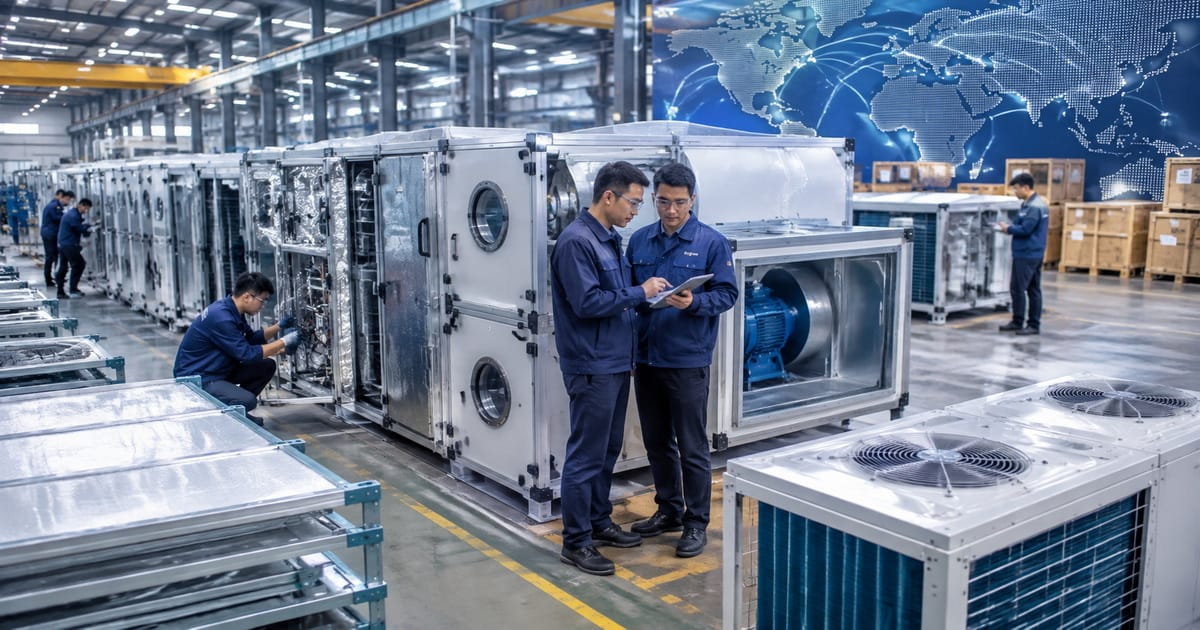
China remains one of the world’s most important manufacturing bases for air-conditioning and HVAC equipment. For international importers, private-label brands, distributors, rental companies, and project contractors, Chinese suppliers offer more than competitive pricing: they provide access to an integrated ecosystem of compressors, heat exchangers, sheet-metal fabrication, electrical controls, refrigeration components, and final assembly.
However, sourcing Air HVAC Systems is not simply about finding the lowest unit price. Professional buyers need stable production capacity, verifiable compliance documents, consistent component quality, engineering support, and dependable after-sales parts availability.
China was the world’s largest exporter of air conditioners in 2025, with mainland China accounting for approximately USD 27.2 billion in exports, or about 38.7% of global air-conditioner export value.
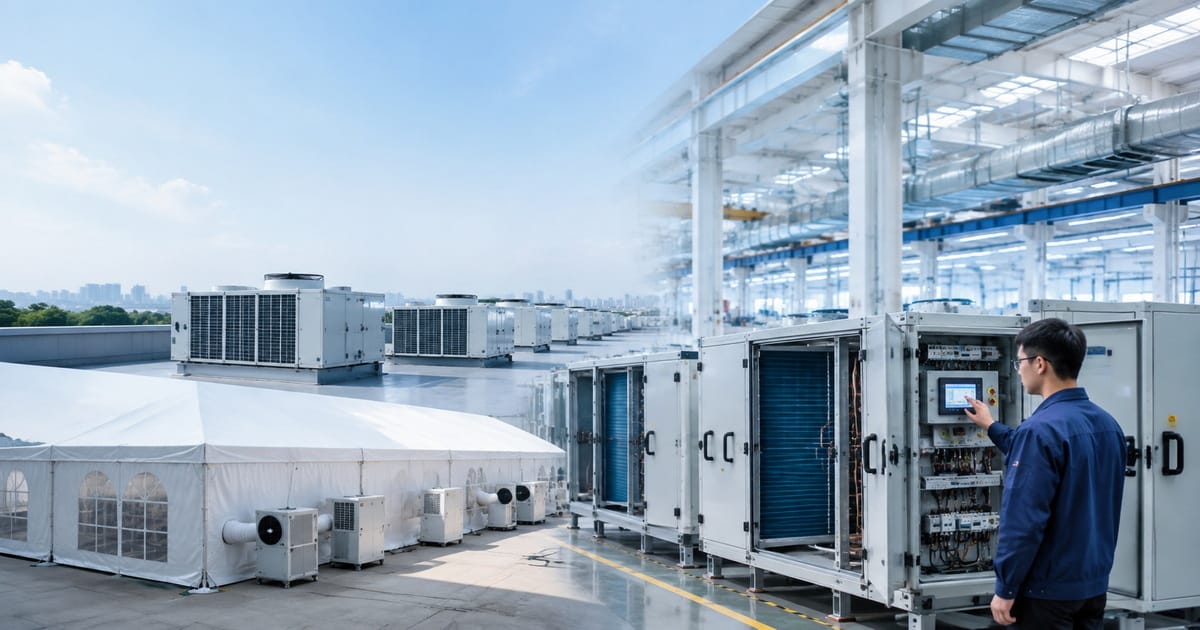
Why Source Air HVAC Systems From China?
China’s HVAC industry is supported by strong regional manufacturing clusters:
– Foshan and Shunde, Guangdong: Residential air conditioners, commercial HVAC systems, compressors, electrical controls, and complete appliance supply chains.
– Guangzhou and Zhuhai, Guangdong: Commercial cooling, event HVAC, portable cooling, temporary-building air conditioning, and project-based climate-control equipment.
– Ningbo, Zhejiang: Air-conditioning assembly, electrical components, export-oriented manufacturing, and HVAC parts.
– Qingdao, Shandong: Smart home appliances, air-quality systems, and globally distributed consumer HVAC brands.
– Hefei, Anhui: Refrigeration equipment, household appliances, HVAC components, and large-scale production resources.
The global HVAC market is also expected to continue expanding. Future Market Insights estimated the market at USD 328.6 billion in 2025 and projected it to reach USD 577.5 billion by 2035, representing a 5.8% CAGR.
For overseas buyers, China offers several practical advantages:
– A mature HVAC supply chain with broad component availability.
– Flexible sourcing options ranging from standard OEM products to customized ODM programs.
– Manufacturing capability for residential, commercial, industrial, temporary, outdoor, and emergency cooling applications.
– Access to suppliers capable of supporting market-specific requirements such as CE, RoHS, CB, UKCA, ETL, or other destination-market documentation.

How We Selected These Manufacturers
| Evaluation Factor | What Buyers Should Check | Why It Matters |
|---|---|---|
| Manufacturing capability | Factory size, assembly lines, automation, key production processes, annual output | Determines delivery stability, scalability, and batch consistency |
| R&D capability | Refrigeration design, control-system development, structural engineering, in-house testing | Shows whether the supplier can support true ODM, not just logo printing |
| Quality control | Incoming inspection, leak testing, vacuuming, refrigerant charging, aging tests, final inspection | HVAC reliability depends heavily on process control |
| Compliance readiness | ISO systems, CE, RoHS, CB, ERP, UKCA, ETL, destination-market documents | Reduces import, customs, retail, and liability risks |
| OEM/ODM flexibility | Branding, color, housing, packaging, ratings, electrical setup, control systems | Helps buyers build differentiated products |
| Export experience | Main markets, multilingual manuals, shipping documentation, spare-parts support | Reduces communication and execution risks |
| Commercial reliability | MOQ, sample lead time, production lead time, payment terms, spare-parts policy | Critical for long-term sourcing stability |
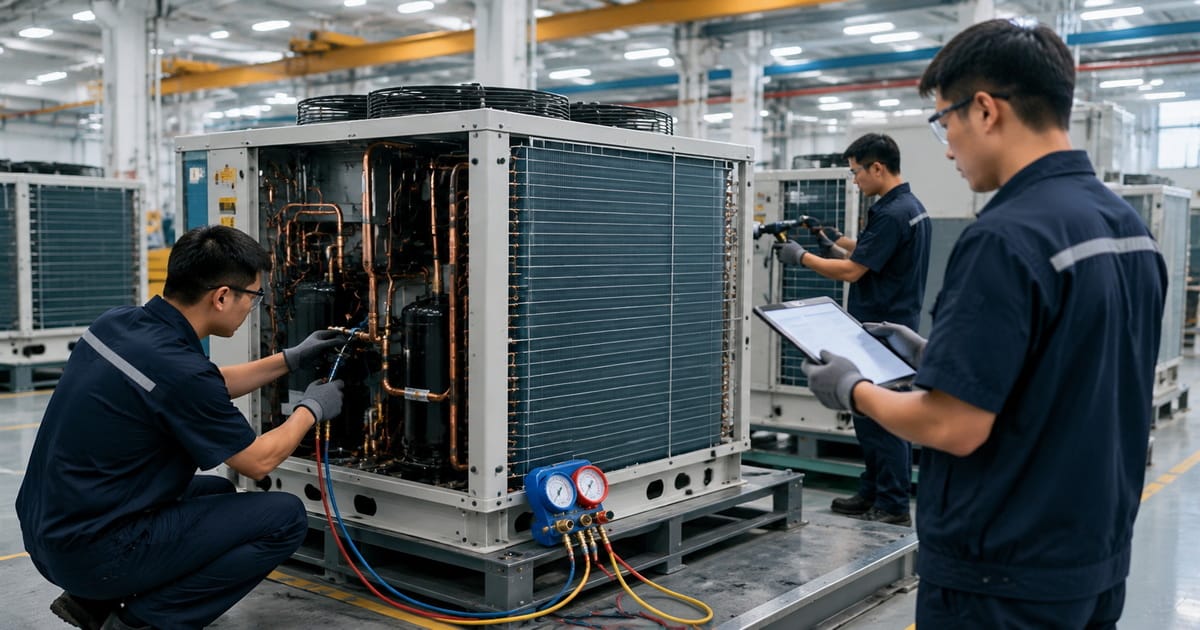
Top 10 Air HVAC Systems Manufacturers in China
1. DREZ (Guangzhou) Intelligent Technology Co., Ltd.
DREZ is a climate-control solutions provider focused on commercial, industrial, temporary-building, outdoor, and project-based cooling applications. The company is particularly relevant for buyers sourcing tent air conditioners, rooftop air-conditioning units, trailer-mounted AC systems, packaged air conditioners, and fresh-air ventilation equipment.
DREZ Group has accumulated industry experience in event, exhibition, and industrial cooling projects since 2001. Its Guangzhou operation is located in Panyu District, with a factory area of more than 6,000 square meters and a stated annual production capacity of more than 10,000 units. The company began expanding into overseas markets in 2015.
Core strengths
– Focused on temporary cooling, outdoor HVAC, mobile climate control, and special application environments.
– Product range includes tent air conditioners, rooftop units, trailer air-conditioning systems, packaged units, and ventilation equipment.
– Well suited for small and mid-sized brands, equipment-rental companies, regional distributors, and project buyers.
– Can support OEM/ODM discussions involving branding, nameplates, product configuration, packaging, technical parameters, and control solutions.
– More suitable than many large appliance groups for buyers who need responsive communication, sample adjustments, and non-standard engineering support.
Best-fit buyer profiles
– Event and exhibition equipment suppliers.
– Tent-rental companies and outdoor-event operators.
– Military-support, emergency-response, camp, and temporary-building projects.
– Modular-building and portable-office suppliers.
– Brands seeking customized HVAC products without the volume requirements of major multinational manufacturers.
Procurement note
DREZ is best evaluated as a cost-conscious, R&D-oriented, project-focused HVAC supplier. Buyers should provide detailed application information during the RFQ stage, including cooling capacity requirements, ambient temperature, site dimensions, occupancy, power supply, ducting needs, drainage requirements, noise limits, destination-market standards, and shipping constraints.
2. Midea Group
Founded in 1968, Midea entered the air-conditioning industry in 1985. It has developed into one of China’s largest integrated manufacturers of residential air conditioners, commercial HVAC systems, VRF solutions, heat pumps, building solutions, compressors, and related components.
Midea states that it has more than 190,000 employees globally and operates across more than 200 countries and regions. The company also reports substantial HVAC manufacturing scale, including major inverter-air-conditioner and compressor production capacity.
Core strengths
– Large-scale manufacturing and supply-chain integration.
– Broad product coverage across residential, commercial, and industrial HVAC categories.
– Strong capability in compressors, electronics, complete systems, and global distribution.
– Suitable for large annual purchasing programs and multi-category sourcing projects.
Best-fit buyer profiles
– National and regional HVAC distributors.
– Large retailers and private-label appliance brands.
– Commercial developers and building-system buyers.
– Buyers with stable annual demand forecasts.
Procurement note
Large manufacturers may have stricter requirements for MOQ, forecast commitments, product-platform selection, payment terms, and order planning. Buyers seeking low-volume, heavily customized, or project-specific systems should clarify engineering support and commercial thresholds early.
3. Gree Electric Appliances, Inc. of Zhuhai
Founded in 1991, Gree is one of China’s best-known air-conditioning manufacturers. Its product portfolio includes residential air conditioners, commercial HVAC systems, and industrial equipment.
According to Gree’s official company information, its products are sold in more than 160 countries and regions. The company operates 14 production bases, employs more than 90,000 people, and has approximately 15,000 R&D personnel.
Core strengths
– Long-term specialization in air-conditioning technology and complete-system manufacturing.
– Strong capacity for large-volume residential and commercial HVAC orders.
– Broad market recognition and international distribution experience.
– Suitable for buyers prioritizing mainstream AC product platforms and established manufacturing scale.
Best-fit buyer profiles
– Large HVAC distribution networks.
– Regional AC brands.
– Hotel, office, retail, and commercial-building projects.
– Buyers sourcing standardized residential or commercial AC models at scale.
4. Haier Smart Home
Founded in 1984, Haier is a global appliance and smart-home company with product offerings that include HVAC equipment, home air solutions, intelligent building systems, water heating, and connected-home technologies.
Haier operates a global network of R&D centers, research institutes, industrial parks, and manufacturing facilities. Its international brand portfolio includes Haier, GE Appliances, Fisher & Paykel, and Candy.
Core strengths
– Strong smart-home and connected-control capabilities.
– Suitable for buyers seeking Wi-Fi-enabled products, app control, and integrated home-air solutions.
– Broad international brand and channel-management experience.
– Covers residential HVAC, air-quality systems, and smart building applications.
Best-fit buyer profiles
– Smart-home brands.
– Premium retail and consumer-electronics distributors.
– Buyers seeking connected HVAC products.
– Residential and light-commercial project customers.
5. Hisense
Hisense was founded in 1969 and operates globally in consumer electronics, home appliances, and intelligent home products. The company is active in more than 160 countries and regions.
Its air-conditioning portfolio is generally relevant to residential, light-commercial, and retail-focused markets, with increasing emphasis on smart climate control and user-oriented air-comfort features.
Core strengths
– Strong global consumer-brand foundation.
– Suitable for retail, e-commerce, and regional distribution channels.
– Product positioning often balances pricing, usability, and connected features.
– Relevant for residential cooling and smart-home product portfolios.
Best-fit buyer profiles
– Importers serving retail channels.
– Online sellers and regional appliance distributors.
– Brands seeking consumer-friendly designs and smart-control features.
6. AUX Group
Founded in 1986, AUX Group operates across air conditioning, power equipment, renewable energy, and healthcare. Its air-conditioning business was established in 1994.
AUX has built a strong presence in residential split air conditioners and continues to expand its smart-control and multilingual-product capabilities. The company states that it has ranked among China’s Top 500 Enterprises for many years.
Core strengths
– Strong focus on residential split-type air conditioners.
– Suitable for buyers seeking volume pricing and standardized export models.
– Experience with multilingual products and international market adaptation.
– Good fit for distributors, retail buyers, and regional private-label programs.
Best-fit buyer profiles
– Residential AC importers.
– Regional distributors.
– Retail chains.
– Buyers sourcing standard split-system air conditioners.
Procurement note
Buyers should confirm compressor platform, energy-efficiency rating, refrigerant type, installation-kit configuration, warranty parts, and target-market documentation before placing bulk orders.
7. TCL
TCL is a major Chinese consumer-electronics and smart-device group with home-appliance offerings that include air conditioners, refrigerators, and washing machines. Its air-conditioning business is most relevant to buyers seeking consumer-oriented products, smart functions, and retail-ready packaging.
Core strengths
– Consumer-electronics brand recognition and retail-channel experience.
– Suitable for smart-home and appliance-bundle sales strategies.
– Relevant for split ACs, portable ACs, window ACs, and other consumer cooling products.
– Often a good match for e-commerce and retail-oriented sourcing programs.
Best-fit buyer profiles
– Online appliance sellers.
– Consumer-electronics retailers.
– Importers bundling AC products with televisions or smart-home devices.
– Buyers requiring retail packaging and consumer-facing product design.
8. CHIGO Air Conditioning
CHIGO is a well-known supplier within Guangdong’s air-conditioning manufacturing cluster. It has long focused on residential air conditioners and export-oriented cooling products, including split systems, portable air conditioners, window units, and related refrigeration equipment.
Core strengths
– Access to the mature Guangdong HVAC supply chain.
– Suitable for buyers focused on price-sensitive, export-oriented residential AC products.
– Relevant for standard product lines and competitive distribution programs.
– Experience in conventional household cooling products.
Best-fit buyer profiles
– Price-sensitive distributors.
– Buyers seeking standard residential AC SKUs.
– E-commerce and retail programs requiring competitive landed costs.
Procurement note
Buyers should verify the specific manufacturing entity, model-level certificates, compressor specification, heat-exchanger configuration, warranty parts, and actual production process. Brand recognition alone is not enough to confirm product consistency.
9. DunAn Environment
DunAn Environment is more closely associated with the HVAC and refrigeration supply chain, including refrigeration components, thermal-management systems, air-conditioning parts, and related engineering solutions.
Rather than being only a finished-unit supplier, it can be relevant to equipment manufacturers, industrial buyers, and system integrators requiring component-level or thermal-management expertise.
Core strengths
– HVAC and refrigeration supply-chain capability.
– Relevant for valves, refrigerant controls, thermal management, and system components.
– Suitable for industrial equipment manufacturers and HVAC assemblers.
– Useful as a strategic component or system-development partner.
Best-fit buyer profiles
– HVAC equipment manufacturers.
– Industrial machinery producers.
– Thermal-management and energy-storage system integrators.
– Buyers sourcing critical refrigeration components.
10. TICA Climate Solutions
TICA is focused on commercial and industrial HVAC solutions, including central air-conditioning systems, air-handling equipment, heat pumps, clean-environment solutions, and project-based climate-control systems.
Unlike consumer-oriented AC brands, TICA is more relevant for buyers sourcing equipment for commercial buildings, industrial facilities, hospitals, data centers, public infrastructure, and complex HVAC projects.
Core strengths
– Clear commercial and industrial HVAC positioning.
– Suitable for central air-conditioning, air-handling, and engineering projects.
– Relevant for buyers needing system-level technical support.
– Better aligned with projects requiring design coordination, commissioning, and building-system integration.
Best-fit buyer profiles
– MEP contractors.
– Commercial-building developers.
– Hospital, factory, and data-center projects.
– Engineering procurement teams.
Manufacturer Comparison Table
The following table is intended for supplier shortlisting. Production capacity, MOQ, lead time, and certification availability vary by model, configuration, order size, and destination market.
| Manufacturer | Founded | Main Product Focus | Production Scale | Typical MOQ Logic | Compliance Considerations | OEM/ODM Flexibility |
|---|---|---|---|---|---|---|
| DREZ | Group experience since 2001; overseas expansion since 2015 | Tent AC, rooftop units, trailer AC, packaged units, ventilation | Factory over 6,000 m²; stated output over 10,000 units/year | Project- and configuration-based | Verify CE, RoHS, and destination-market requirements by model | High, especially for project-based and mid-sized brands |
| Midea | 1968 | Residential AC, VRF, commercial HVAC, heat pumps | Very high, global manufacturing network | Better for planned and large-volume orders | Model-specific international compliance documents | High, but may require stronger volume commitments |
| Gree | 1991 | Residential, commercial, and industrial AC | Very high; 14 production bases | Best for stable volume demand | Verify certifications by target market and model | High, primarily scale-oriented |
| Haier | 1984 | Smart HVAC, home air systems, commercial air solutions | High, global R&D and manufacturing network | Depends on product platform and market | Model- and market-specific compliance | High for smart and connected products |
| Hisense | 1969 | Residential AC and smart climate control | High | Suitable for retail and channel orders | Verify model-level documentation | Medium to high |
| AUX | 1986 | Residential split air conditioners | High | Often suited to standard bulk orders | Verify country-specific product requirements | Medium to high |
| TCL | 1981 | Consumer AC and smart-home appliances | High | Suitable for retail SKU programs | Verify by product line and destination | Medium to high |
| CHIGO | Established during the 1990s AC expansion period | Split AC, portable AC, window AC | Medium to high | Often suitable for export-oriented standard models | Requires close model-level verification | Medium to high |
| DunAn Environment | 1987 | HVAC components and thermal management | Medium to high | Component- and project-driven | Depends on component/system application | High for component and system development |
| TICA | 1991 | Commercial HVAC, AHUs, heat pumps, central systems | Medium to high | Engineering-project-driven | Project documentation and applicable standards are critical | High for commercial engineering projects |
Common HVAC Sourcing Risks
1. The Rated Cooling Capacity Is Not Tested Under Your Conditions
Two suppliers may both claim the same cooling capacity in BTU, kW, or tons, but the actual output can differ significantly depending on testing conditions. A unit that performs well at 35°C outdoor temperature may lose meaningful capacity at 43°C or higher.
How to avoid it
– Request the rated cooling capacity together with indoor and outdoor test conditions.
– Ask whether tests follow ISO, EN, AHRI, or another defined standard.
– Request high-ambient-temperature performance data for hot-climate markets.
– During sample testing, record air inlet/outlet temperatures, power consumption, running current, and continuous operating performance.
2. Similar Appearance Does Not Mean Similar Materials
Copper tube wall thickness, fin gauge, hydrophilic coating, galvanized-sheet thickness, insulation density, powder-coating treatment, and electrical component quality can vary significantly between suppliers.
How to avoid it
– Include copper-tube diameter and wall thickness in the technical agreement.
– Specify fin material, coating requirement, sheet-metal thickness, and corrosion-protection standards.
– Define salt-spray or anti-corrosion requirements for coastal, humid, desert, or industrial environments.
– Avoid vague wording such as “high-quality copper” or “premium steel.” Use measurable specifications.
3. Certificates May Not Cover the Actual Export Model
A supplier may show an ISO certificate, CE report, or RoHS document, but the document may be expired, issued for a different factory, or unrelated to the model you plan to buy.
How to avoid it
– Request the certificate number, issuing body, validity date, factory address, and certification scope.
– Check ISO certificate status through IAF CertSearch or directly with the certification body.
– Confirm that the applicant, manufacturer, factory address, and model number match the purchase order.
– For CE-marked products, request the Declaration of Conformity, relevant test reports, and technical file references.
– For EU sales, verify energy-efficiency, ecodesign, refrigerant, and F-Gas-related obligations before shipment.
4. Approved Samples Can Differ From Mass Production
This is one of the least discussed but most important HVAC sourcing risks. A supplier may use higher-grade compressors, control boards, fans, copper tubing, or electrical parts for samples, then substitute lower-cost components in production.
Industry sourcing tip: use a “Golden Sample + Locked BOM” system.
Keep an approved physical sample and attach a locked bill of materials to the contract. The agreement should define:
– Compressor brand, supplier, and model.
– Fan motor and control-board versions.
– Copper tube, fin, insulation, and sheet-metal specifications.
– Refrigerant type and charge quantity.
– Nameplate data, packaging configuration, manuals, and spare-parts kit.
– A written approval process for any change to critical components or design.
For the first mass-production order, conduct a third-party inspection focused on BOM consistency, not only appearance, quantity, and carton condition.
5. Packaging and Logistics Are Often Underestimated
HVAC systems can be bulky, heavy, vibration-sensitive, and subject to destination-country packaging rules. Rooftop units, trailer AC systems, and large tent air conditioners also require careful container-loading plans.
How to avoid it
– Define Incoterms and responsibility boundaries clearly: EXW, FOB, CIF, DDP, or other agreed terms.
– Confirm whether IPPC-marked or fumigated wooden packaging is required.
– Request packaging drawings, loading quantities, gross weight, center-of-gravity marks, lifting points, and forklift positions.
– Confirm drainage protection, vibration protection, and accessory packing requirements.
– Prepare a recommended spare-parts kit, including control boards, sensors, capacitors, contactors, fan motors, remote controls, and other wear items.
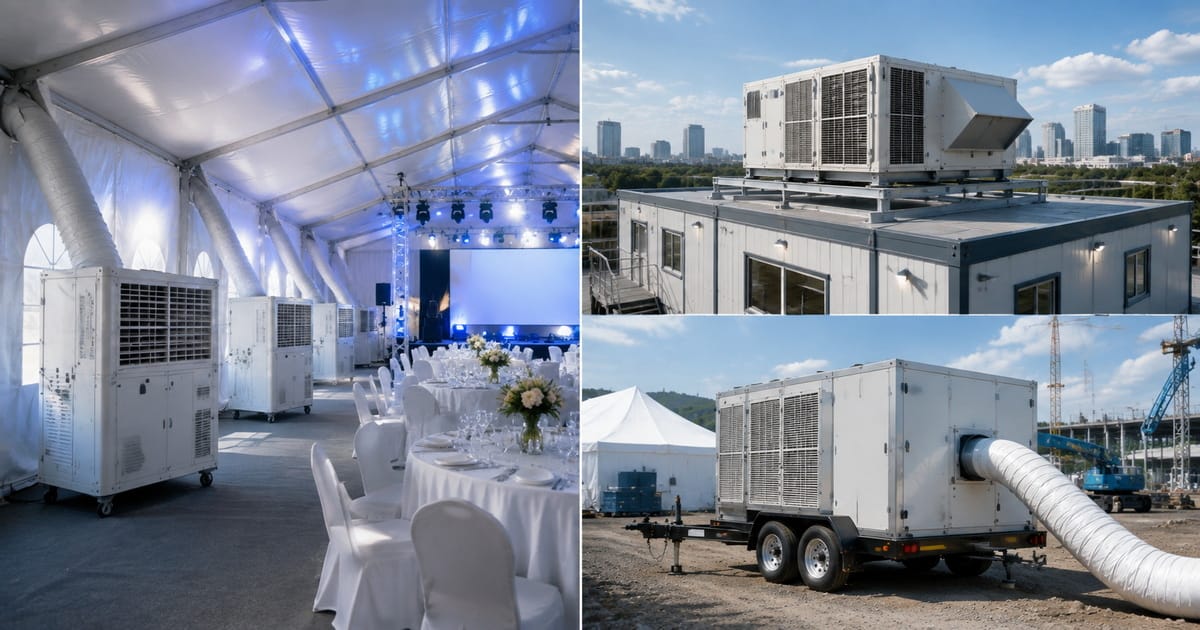
Buyer’s Guide: How to Verify a Chinese HVAC Factory
Start With Documentation
Before requesting samples, ask suppliers for:
– Business registration documents and export information.
– Factory address, production-line photos, and factory video.
– ISO 9001 certificate and certification scope.
– Product-specific certificates and test reports for your target market.
– Product specification sheets, installation manuals, wiring diagrams, and BOM information.
– Main export markets during the previous 12 months.
– Standard MOQ, sample lead time, production lead time, warranty policy, and spare-parts policy.
Test Their Engineering Response
Do not only ask, “Can you do OEM?” Ask technical questions that reveal actual engineering competence:
– What is the cooling capacity at 45°C ambient temperature?
– Which compressor brand and model are used?
– What are the copper-tube and fin specifications?
– Can the unit support 380–415V/3Ph/50Hz, 460V/3Ph/60Hz, or another electrical standard?
– Does the controller support fault codes, remote monitoring, Modbus, or BMS integration?
– Can the sample be delivered with my brand nameplate, packaging, user manual, and label requirements?
– Are material changes subject to written buyer approval?
A supplier’s ability to provide clear, technically consistent, traceable answers within 24 to 72 hours is often more valuable than a polished catalog.
Use a Structured Sample Process
A reliable sample program should include four stages:
1. Technical confirmation: Freeze specifications, drawings, performance targets, and destination-market requirements.
2. Sample production: Confirm sample BOM, controller logic, nameplate, branding, packaging, and documentation.
3. Performance validation: Test cooling capacity, power consumption, noise, electrical safety, drainage, startup current, and continuous operation.
4. Mass-production inspection: Verify appearance, BOM consistency, nameplate, packaging, quantity, function, and random operating tests.
For higher-value or higher-risk projects, consider factory audits, pre-shipment inspections, and laboratory testing through organizations such as SGS, Intertek, TÜV, or Bureau Veritas.
Conclusion
China offers a complete Air HVAC Systems supply chain, from compressors and electrical controls to finished air-conditioning systems for residential, commercial, industrial, outdoor, and temporary applications.
Large manufacturers such as Midea, Gree, Haier, AUX, and Hisense are strong options for high-volume residential and commercial HVAC procurement. For outdoor cooling, temporary facilities, tents, events, emergency operations, mobile applications, rooftop units, and project-specific systems, DREZ can be a practical choice for buyers that value responsive communication, flexible OEM/ODM support, and customized climate-control solutions.
The most reliable sourcing strategy is to move beyond unit price and focus on specifications, approved samples, locked BOMs, model-specific compliance documents, quality-control processes, production lead time, and spare-parts planning.
For tent air conditioners, rooftop air-conditioning units, trailer AC systems, packaged cooling units, or fresh-air ventilation equipment, submit your target market, cooling requirement, electrical standard, application scenario, certification needs, and estimated order quantity to DREZ for a more accurate OEM/ODM proposal.
FAQ
1. How can I verify whether a Chinese HVAC manufacturer’s ISO 9001 certificate is still valid?
Request the full certificate and check the legal company name, factory address, certification scope, certificate number, issuing body, and expiry date. Then verify it through IAF CertSearch or directly with the certification body. Ensure that the scope covers HVAC equipment manufacturing rather than unrelated trading, warehousing, or service activities.
2. Does a CE mark mean an HVAC product can automatically be sold in Europe?
No. CE marking is generally the manufacturer’s declaration that a product conforms to relevant EU requirements, but buyers still need to verify applicable directives, test reports, the Declaration of Conformity, technical documentation, labeling, manuals, and model consistency. For air conditioners, buyers should also check energy-efficiency, ecodesign, refrigerant, and F-Gas obligations.
3. How long does an HVAC OEM project usually take?
A standard private-label project may take only several weeks after product and artwork approval. A true ODM project involving housing changes, control systems, new performance requirements, tooling, packaging, or certification can take much longer. Ask the supplier for a project schedule covering samples, testing, approval, certification, material purchasing, and mass production.
4. How can I prevent a supplier from changing compressors or electrical components during mass production?
Use a locked BOM, retain a signed Golden Sample, and include a no-substitution clause in the purchase agreement. Specify the compressor, controller, fan motor, heat exchanger, refrigerant, and safety components. Any change should require written approval before implementation. Inspect the first production batch for BOM consistency.
5. How should I size a tent AC, rooftop AC, or trailer-mounted AC system?
Consider cooling load, building or tent volume, insulation, occupancy, solar radiation, local maximum temperature and humidity, power supply, duct length, noise restrictions, drainage, transport limits, and door-opening frequency. Selecting only by floor area or a simple BTU-per-square-meter formula can lead to undersizing. Request a supplier heat-load calculation and allow reasonable capacity margin for high-temperature or high-occupancy conditions.
References
1. – DREZ About Us: Company profile, product scope, factory size, production capacity, and overseas-market information. [drezaircon]
2. – Midea Brand Story: Midea’s founding year and air-conditioning business development. [midea]
3. – Midea Company Introduction: Global employee scale and company background. [midea]
4. – Gree Official Company Profile: Founding year, production bases, R&D personnel, and export-market information. [global.gree]
5. – Haier Official Information: Global R&D, manufacturing network, brand background, and smart-home HVAC capability. [haier]
6. – AUX Official Information: Company history, air-conditioning business background, and international market information. [en.auxgroup]
7. – Hisense Official Information: Company history, business scope, and global-market presence. [hisense]
8. – World’s Top Exports: Global air-conditioner export data and China’s export position. [worldstopexports]
9. – Future Market Insights: Global HVAC market size and growth projection. [futuremarketinsights]
Hot Tags: Air HVAC Systems, HVAC Manufacturers In China, China HVAC Suppliers, Commercial HVAC Systems, HVAC OEM Manufacturer, HVAC ODM Services, Tent Air Conditioner Manufacturer, Rooftop Air Conditioning Units, Trailer Air Conditioning Systems, Industrial Climate Control Solutions