Content Menu
● Why Trailer Air Conditioning Matters on Construction Sites
● Trailer Air Conditioning vs. Basic Portable Cooling
>> Why Evaporative Cooling Has Limits
>> Why Integrated Cooling Wins
● When Mobile Cooling Becomes Essential
>> 1. High-Heat and High-Humidity Jobsites
>> 2. Remote or Temporary Construction Projects
>> 3. Large Crews and Multiple Shifts
>> 4. Heat-Sensitive Equipment and Documents
>> 5. Regulatory and Client Requirements
● How to Size a Trailer Air Conditioning System
>> What Buyers Should Request From Suppliers
● A Heat-Ready Trailer Setup for Construction Sites
>> Example: A Roadwork Project in Humid Summer Conditions
● Choosing an OEM or ODM Trailer AC Partner
● Build a More Resilient Mobile Worksite
>> 1. What is trailer air conditioning?
>> 2. Why do construction sites need air-conditioned trailers?
>> 3. Is a fan enough for a construction site trailer?
>> 4. How do I choose the right cooling capacity for a trailer?
>> 5. Can trailer air conditioners operate from a generator?
>> 6. What maintenance does a trailer HVAC system require?
>> 7. Can an OEM supplier customize trailer air conditioners?
Construction projects do not pause when temperatures rise. Crews still pour concrete, install roofing, operate machinery, and complete deadlines under direct sun. That is why trailer air conditioning is becoming a practical jobsite requirement rather than a seasonal convenience. A properly specified mobile cooling solution gives workers a dependable place to recover, rehydrate, hold meetings, and protect heat-sensitive equipment.
For contractors, trailer manufacturers, rental fleets, and site-office builders, the key decision is not simply whether to install air conditioning. It is whether a cooling system can perform reliably in a mobile, dusty, high-heat construction environment. DREZ (Guangzhou) Intelligent Technology Co., Ltd. develops OEM and ODM trailer air conditioning solutions designed for brands, wholesalers, and equipment manufacturers that need this balance of cooling performance, durability, installation flexibility, and customization.
Why Trailer Air Conditioning Matters on Construction Sites
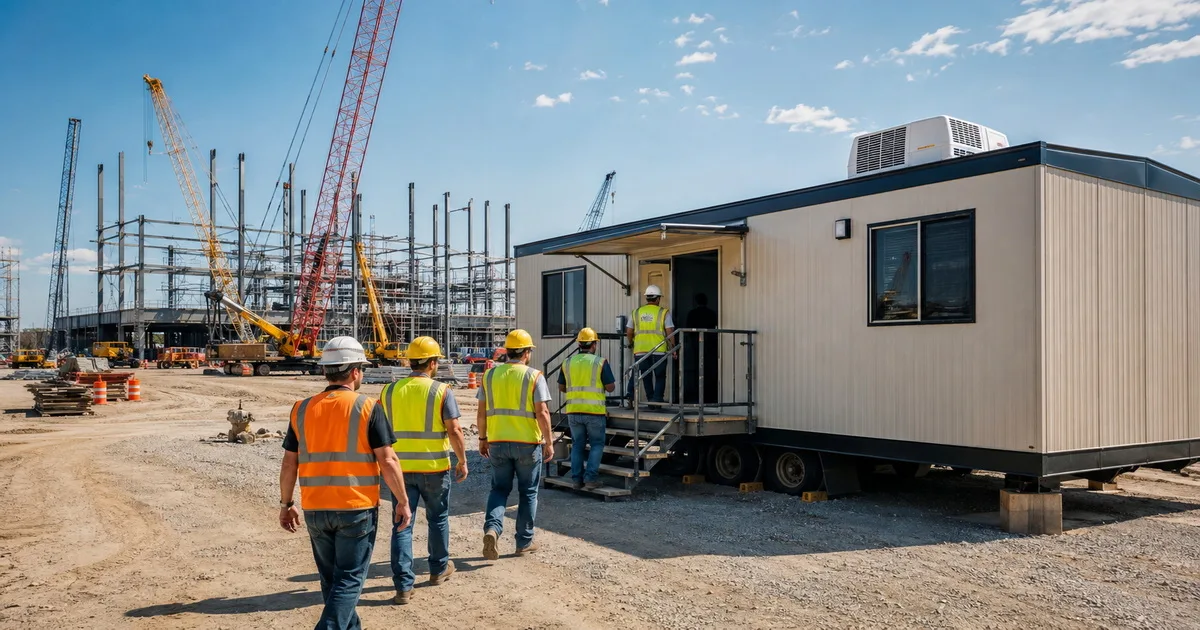
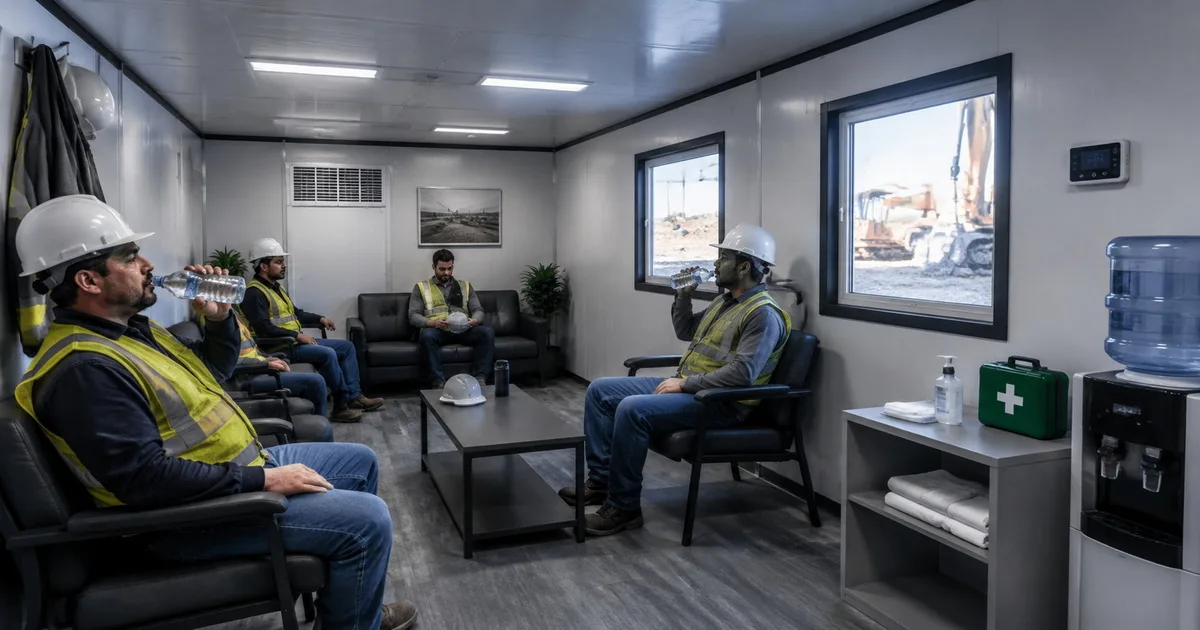
A construction trailer often performs several jobs at once. It may serve as a site office, meeting room, first-aid point, dispatch center, security station, changing room, or employee break area. In hot weather, it also becomes a recovery space.
This is where construction site trailer air conditioning creates measurable operational value.
Construction workers face a disproportionately high heat burden. Research covering U.S. occupational heat-related deaths between 1992 and 2016 found that construction represented 6% of the workforce but accounted for 36% of occupational heat-related deaths. Heat affects more than comfort. It can reduce attention, slow reaction time, increase fatigue, and raise the likelihood of mistakes around vehicles, elevated work, tools, and electrical systems.
An air-conditioned trailer supports a broader heat-control plan by providing:
– A cool recovery area for scheduled and preventive rest breaks.
– A safer response point when a worker shows heat-stress symptoms.
– A more productive office environment for supervisors, planners, and coordinators.
– Protection for electronics, documents, network equipment, and stored supplies.
– A cleaner indoor refuge when jobsite dust, fumes, or noise become excessive.
– A usable welfare facility where workers can rest in privacy and comfort.
OSHA identifies air conditioning, cooled air, and increased airflow as engineering controls that can make work safer in hot environments. It also promotes water, rest, and shade as key components of heat-illness prevention.
Trailer Air Conditioning vs. Basic Portable Cooling
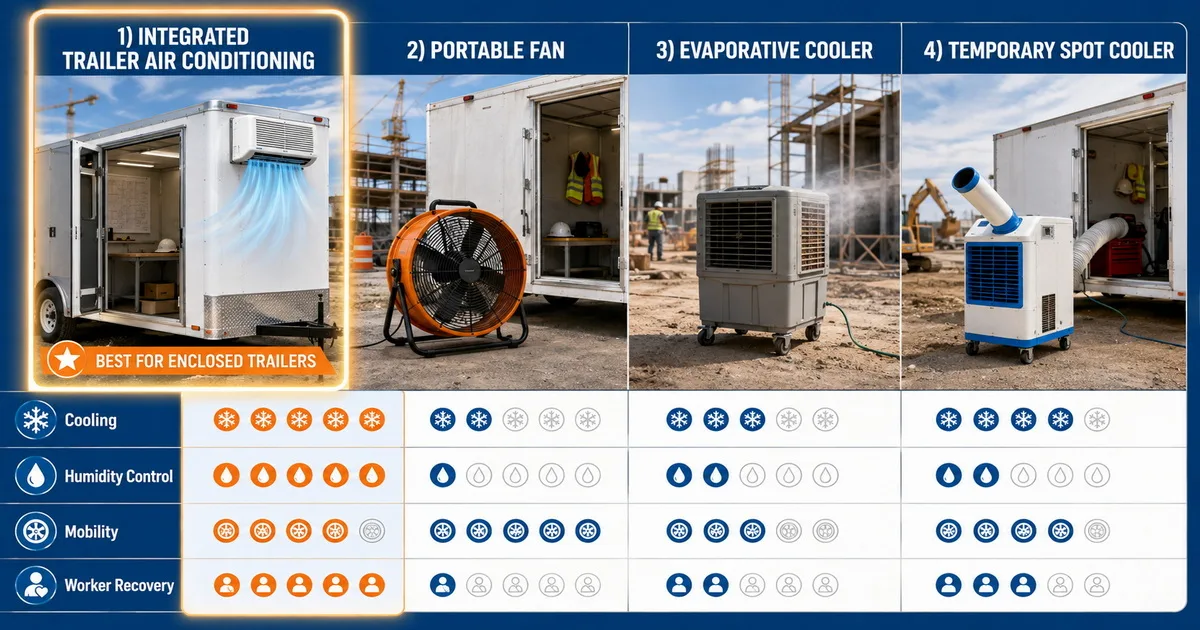
Not all cooling options are equal. A portable fan, evaporative cooler, or temporary spot cooler may help in limited conditions. However, a construction site needs an option that remains effective when heat, humidity, dust, vibration, and repeated relocation are part of daily operations.
| Feature | Trailer Air Conditioning | Portable Fan | Evaporative Cooler | Temporary Spot Cooler |
|---|---|---|---|---|
| Controls indoor temperature | Yes | No | Limited | Partial |
| Performs in humid climates | Yes | Limited | Often reduced | Usually |
| Removes indoor humidity | Yes | No | No | Sometimes |
| Suitable for enclosed trailers | Highly suitable | Limited | Depends on ventilation | Suitable for zones |
| Protects electronics and documents | Yes | No | Limited | Partial |
| Supports cooled recovery space | Yes | No | Limited | Depends on layout |
| Integrated into trailer design | Yes | No | No | Usually external |
| Suitable for OEM/ODM specification | Yes | No | Limited | Limited |
Why Fans Are Not Enough
Fans move air. They do not lower air temperature. In high-heat conditions, especially in enclosed site offices, a fan may circulate warm air without providing meaningful physical recovery.
Fans can still support comfort when combined with air conditioning. They may improve air distribution inside a larger trailer. But they are not a replacement for a dedicated trailer HVAC system.
Why Evaporative Cooling Has Limits
Evaporative coolers can be effective in hot, dry climates because they use water evaporation to reduce air temperature. Their performance declines in humid conditions, where the air already contains significant moisture.
Construction sites in coastal, tropical, monsoon, or humid subtropical regions often need mechanical cooling and dehumidification. A packaged trailer air conditioner can provide both functions. That matters when wet workwear, frequent door openings, and human occupancy increase indoor moisture.
Why Integrated Cooling Wins
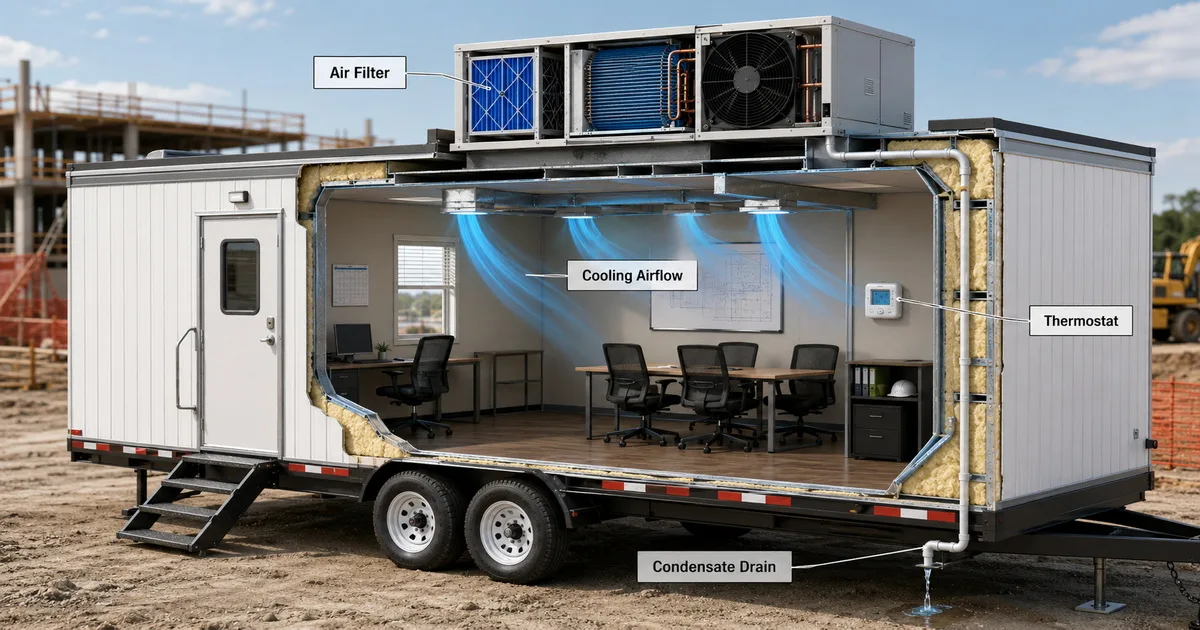
An integrated mobile trailer air conditioner is designed around the trailer’s dimensions, insulation level, electrical system, roof structure, wall openings, and intended occupancy.
This reduces improvised installation risks. It also helps manufacturers create a repeatable product configuration for fleet customers, distributors, and end users.
When Mobile Cooling Becomes Essential
Trailer air conditioning becomes essential when heat creates a safety, operational, or commercial risk. The need is strongest when a trailer is not just an office but an active welfare and control space.
1. High-Heat and High-Humidity Jobsites
Temperature alone does not tell the full story. Humidity, direct sunlight, air movement, physical workload, protective clothing, and acclimatization all affect heat strain.
NIOSH recommends modifying work and rest schedules as temperature, humidity, sunlight, workload, and protective clothing increase. It also states that breaks in air conditioning do not interfere with workers’ acclimatization.
A mobile cooled trailer is particularly valuable when the site has:
– Long periods above local heat-risk thresholds.
– High humidity that makes sweat evaporation less effective.
– Little natural shade.
– Concrete, steel, roofing, or asphalt surfaces that radiate heat.
– Workers wearing PPE, reflective clothing, helmets, or respirators.
– Crews performing physically demanding tasks.
2. Remote or Temporary Construction Projects
Remote projects may lack permanent buildings, utility infrastructure, and nearby public shelter. Examples include roadworks, renewable-energy installations, pipelines, temporary camps, telecommunications projects, mining support areas, and disaster-recovery zones.
In these cases, a portable air conditioning trailer solution creates controlled indoor conditions without waiting for permanent facilities.
The trailer can be moved with the project. This mobility is critical for contractors managing phased construction or projects that relocate every few weeks.
3. Large Crews and Multiple Shifts
A small trailer may be adequate for a supervisor and two coordinators. It is not sufficient for a large crew taking staggered rest breaks.
Site managers should calculate cooling capacity based on:
– Trailer length, width, and ceiling height.
– Number of people expected during peak break periods.
– Door-opening frequency.
– Window area and solar exposure.
– Insulation thickness and air leakage.
– Internal heat from computers, refrigerators, lighting, and equipment.
– Outdoor temperature and humidity.
– Local power availability.
The most common specification mistake is selecting capacity based only on trailer floor area. On a hot construction site, occupancy, solar gain, and door traffic can be equally important. A unit that works in a warehouse may be undersized on an exposed jobsite.
4. Heat-Sensitive Equipment and Documents
Construction trailers increasingly contain more than desks. They house routers, surveillance monitors, battery chargers, server cabinets, drawing printers, control panels, radios, medical supplies, and tablets.
High temperature and humidity can shorten equipment life, affect battery performance, and create discomfort for staff who must monitor operations for extended periods. Trailer cooling helps maintain a stable operating environment.
5. Regulatory and Client Requirements
Heat-protection expectations are expanding. OSHA published a proposed rule in 2024 for heat injury and illness prevention across outdoor and indoor work, including construction. The proposed rule would require employers to develop plans to evaluate and control workplace heat hazards.
State-level requirements can be more specific. In California, employers must provide shade when outdoor temperatures exceed 80°F, and the shaded area must accommodate workers taking recovery or rest periods.
An air-conditioned trailer does not replace every legal obligation. However, it can be an important part of a compliant, documented, and worker-focused heat-prevention strategy.
How to Size a Trailer Air Conditioning System
Correct sizing protects both comfort and equipment reliability. Oversizing can increase energy cycling and cost. Undersizing can leave workers with a warm, humid trailer exactly when cooling is most needed.
Practical Sizing Workflow
1. Define the trailer use.
Is it a site office, worker break room, medical trailer, command center, equipment room, or multi-purpose unit?
2. Measure the occupied space.
Record length, width, ceiling height, insulation type, window area, and interior layout.
3. Estimate peak occupancy.
Design for the busiest realistic period, not the average number of occupants.
4. Assess external heat load.
Consider sun exposure, roof color, building materials, local climate, and nearby radiant surfaces.
5. Identify internal heat sources.
Count computers, screens, printers, refrigeration units, lighting, chargers, and other equipment.
6. Review power conditions.
Confirm voltage, frequency, generator compatibility, startup current, and power stability.
7. Specify installation constraints.
Consider rooftop, wall-mounted, split, or under-bench configuration; roof load; drainage; service access; and transport vibration.
What Buyers Should Request From Suppliers
For an OEM or ODM trailer air conditioning project, do not compare only nominal cooling capacity. Request a full technical discussion covering:
– Cooling capacity under realistic ambient conditions.
– Heating function for cold-weather deployments, if required.
– Dehumidification capability for humid climates.
– Power input and electrical compatibility.
– Refrigerant type and regional compliance needs.
– Compressor design and vibration resistance.
– Airflow volume and supply-air distribution.
– Noise level for offices, clinics, and rest spaces.
– Corrosion protection for coastal or chemically exposed sites.
– Filter access for dusty construction environments.
– Condensate drainage design.
– Controller options, including digital thermostats and remote monitoring.
– Branding, housing, color, and interface customization for private-label programs.
A Heat-Ready Trailer Setup for Construction Sites
Trailer air conditioning works best when it supports, rather than replaces, a complete heat-management process.
Recommended Site Setup
– Position the trailer close enough for practical access, but away from idling equipment, dust sources, and exhaust.
– Use exterior shading or an awning where possible to reduce solar heat gain.
– Keep doors closed when the space is cooling, while maintaining appropriate occupancy and emergency access.
– Provide clearly marked drinking-water stations nearby.
– Establish staggered break times for large crews.
– Train supervisors to recognize early signs of heat illness.
– Maintain a simple emergency response procedure.
– Inspect filters, drains, wiring, and fasteners on a regular schedule.
NIOSH recommends gradual acclimatization over 7 to 14 days. For new workers, it advises starting at no more than 20% of the usual heat-exposure duration on the first day and increasing by no more than 20% each subsequent day.
Example: A Roadwork Project in Humid Summer Conditions
Imagine a road-maintenance contractor operating a mobile site trailer for a 25-person crew. The trailer is used as a dispatch office in the morning and a rotating rest space from late morning through afternoon.
The challenge is not just high temperature. It includes direct sun, reflective asphalt, physical work, PPE, engine noise, dust, and frequent dehydration risk.
A well-designed trailer cooling strategy could include:
– A high-capacity, vibration-resistant rooftop air conditioner.
– Insulated trailer walls and reflective roof treatment.
– A shaded entry zone to reduce hot-air infiltration.
– Washable or replaceable filtration for dust control.
– Cooled seating for rotating breaks.
– A digital thermostat with a lockable control range.
– Easy-access service panels for fleet maintenance teams.
The result is not merely a cooler office. It is a dependable recovery point that helps the contractor sustain work quality and crew welfare during difficult conditions.
Choosing an OEM or ODM Trailer AC Partner
For brands and manufacturers, the right supplier should understand both HVAC engineering and mobile-equipment realities. A stationary air conditioner is not automatically suitable for transportable trailers.
A capable OEM and ODM partner should help you align product design with your target market, installation method, customer profile, and after-sales model.
Evaluation Checklist
| Selection Area | Questions to Ask |
|---|---|
| Product engineering | Is the unit designed for vibration, transport, and outdoor exposure? |
| Customization | Can the supplier adapt capacity, housing, control panel, color, logo, and installation layout? |
| Climate suitability | Can the system be configured for high heat, high humidity, dust, salt air, or cold weather? |
| Quality process | Are incoming materials, assembly, performance, and electrical safety inspected? |
| Documentation | Are manuals, wiring diagrams, specification sheets, and installation guidance available? |
| Serviceability | Can technicians access filters, controls, drainage, and key components easily? |
| Supply stability | Can the supplier support forecast-based production and consistent spare-parts supply? |
| Market readiness | Can the product be adapted for voltage, frequency, labeling, and regional certification needs? |
DREZ can support customers that need more than an off-the-shelf product. For trailer brands, equipment makers, and wholesalers, a tailored trailer air conditioning system can strengthen product differentiation, support private-label strategies, and improve end-user satisfaction.
Build a More Resilient Mobile Worksite
Construction heat is a planning issue, a workforce issue, and a product-design issue. When a trailer functions as a genuine recovery area, it needs dependable cooling—not just airflow.
Trailer air conditioning becomes essential when crews work through sustained heat, humidity, remote conditions, large break rotations, or equipment-sensitive operations. The right system should be sized for real site loads, built for mobility, easy to service, and adaptable to the customer’s brand and market requirements.
If you are developing a construction trailer, mobile office, welfare unit, command vehicle, or rental fleet, contact DREZ (Guangzhou) Intelligent Technology Co., Ltd. to discuss OEM or ODM trailer air conditioning options matched to your trailer layout, climate conditions, electrical system, and target market.
Frequently Asked Questions
1. What is trailer air conditioning?
Trailer air conditioning is a cooling system designed for mobile or transportable enclosed spaces, including construction site offices, welfare trailers, mobile clinics, command units, and equipment trailers. It may be rooftop-mounted, wall-mounted, split-type, or integrated into the vehicle structure.
2. Why do construction sites need air-conditioned trailers?
They provide a cooler place for recovery breaks, coordination work, first aid, meetings, and storage of heat-sensitive equipment. They can also support a wider heat-illness prevention plan that includes water, rest, shade, training, and supervision.
3. Is a fan enough for a construction site trailer?
Usually, no. A fan moves air but does not reduce indoor air temperature or remove humidity. In hot and humid conditions, an air conditioner provides more reliable cooling and dehumidification for enclosed spaces.
4. How do I choose the right cooling capacity for a trailer?
Evaluate the trailer dimensions, insulation, windows, sun exposure, local climate, occupant count, door-opening frequency, and internal equipment load. Work with a qualified supplier to calculate the actual heat load rather than relying only on floor area.
5. Can trailer air conditioners operate from a generator?
Many units can be configured for generator-powered applications, but the generator must be sized for running load and compressor startup demand. Confirm voltage, frequency, phase, and power quality before selecting the system.
6. What maintenance does a trailer HVAC system require?
Typical maintenance includes cleaning or replacing filters, checking condensate drainage, inspecting wiring and mounting hardware, cleaning coils, verifying refrigerant-system performance, and testing controls. Dusty worksites may require more frequent filter inspections.
7. Can an OEM supplier customize trailer air conditioners?
Yes. OEM and ODM programs can include cooling capacity, heating options, housing dimensions, appearance, brand labeling, controllers, voltage, mounting configuration, filtration, corrosion protection, and documentation.
References
1. Centers for Disease Control and Prevention, National Institute for Occupational Safety and Health. [Heat Stress in Construction].
2. Dong, X. S., et al. [Heat-Related Deaths Among Construction Workers in the United States]. *American Journal of Industrial Medicine*.
3. Occupational Safety and Health Administration. [Overview: Working in Outdoor and Indoor Heat Environments].
4. Occupational Safety and Health Administration. [Heat Injury and Illness Prevention in Outdoor and Indoor Work Settings Rulemaking].
5. Centers for Disease Control and Prevention, NIOSH. [Workplace Recommendations for Heat Stress].
6. California Department of Industrial Relations. [Heat Illness Prevention: Shade and Other Cooling Measures].
7. California Department of Industrial Relations. [Cal/OSHA Heat Illness Prevention Guidance].
8. American Society of Heating, Refrigerating and Air-Conditioning Engineers. [ANSI/ASHRAE Standard 55: Thermal Environmental Conditions for Human Occupancy].
Hot Tags: Trailer Air Conditioning, Construction Site Air Conditioning, Mobile Cooling Solutions, Trailer HVAC Systems, Construction Site Cooling Solutions, Mobile Office Trailer Air Conditioner, Rooftop Air Conditioner For Trailers, OEM Trailer Air Conditioning, ODM HVAC Solutions, Portable Site Office Air Conditioning