
Content Menu
● What Separates These Two Cooling Applications?
● Trailer Air Conditioning Comparison Table
● Military Trailer Air Conditioning: Built for Field Resilience
>> Key Requirements for Military Field Operations
>> Military Application Example
● Industrial Temporary Cooling: Fast, Flexible, and Site-Specific
>> Common Industrial Temporary Cooling Scenarios
>> What Industrial Buyers Should Prioritize
● Cooling Capacity Is Not the Same as Cooling Outcome
>> A Practical Sizing Checklist
● Power, Efficiency, and Generator Planning
>> Field and Temporary Power Checklist
● How OEM and ODM Buyers Can Specify the Right Unit
>> Useful OEM and ODM Specification Points
● Choose a Trailer AC System Around Risk
● FAQ
>> 1.What is trailer air conditioning?
>> 2.Can one trailer AC unit serve both military and industrial uses?
>> 3.How do I determine the required trailer air conditioner capacity?
>> 4.Why is humidity control important in temporary cooling?
>> 5.Can trailer air conditioning operate from a generator?
>> 6.What information should I provide for an OEM trailer air conditioning project?
>> 7.What is the main risk of undersizing a temporary cooling unit?
Trailer air conditioning supports two very different operating realities: mission-critical military field operations and fast-moving industrial temporary cooling. While both applications require reliable portable climate control, their priorities, design logic, installation methods, and risk tolerance are not the same.
For buyers, the correct choice is not simply the unit with the highest cooling capacity. It is the system that matches the shelter type, ambient conditions, available power, duty cycle, mobility needs, air-quality requirements, and service plan. As a climate-control supplier supporting OEM and ODM projects, DREZ approaches trailer-mounted air conditioning as a complete application-engineering challenge—not a one-size-fits-all product decision.
What Separates These Two Cooling Applications?
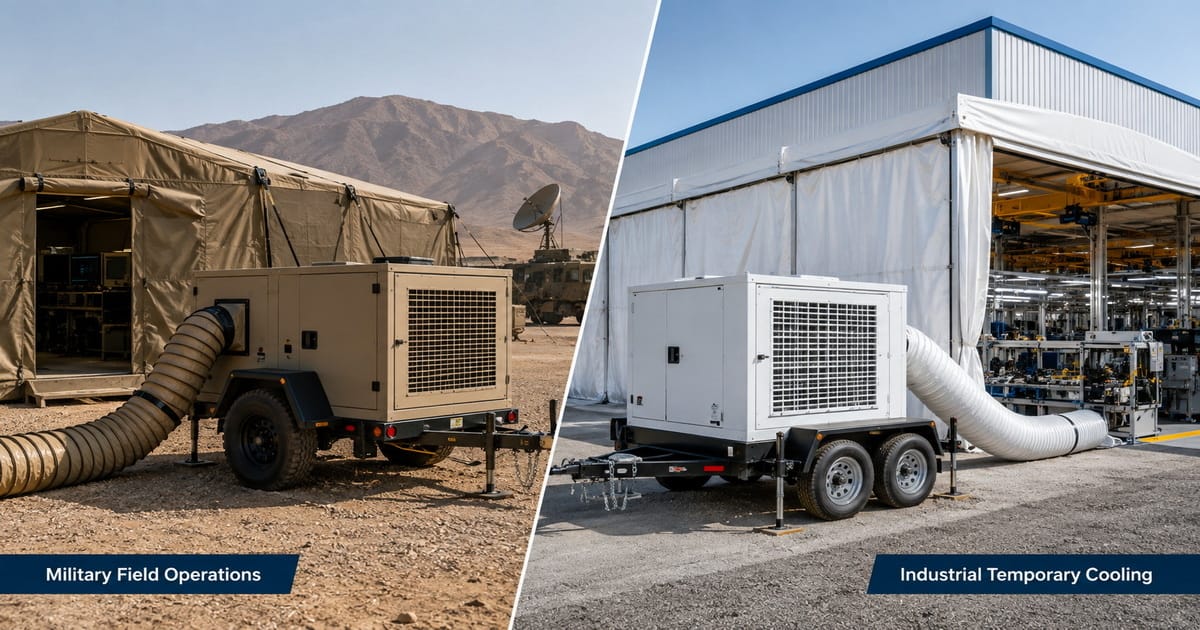
Military field operations and industrial temporary cooling both need rapid deployment. Both may operate outdoors. Both may need trailer-mounted HVAC equipment with flexible duct connections.
However, the operating consequences of failure are very different.
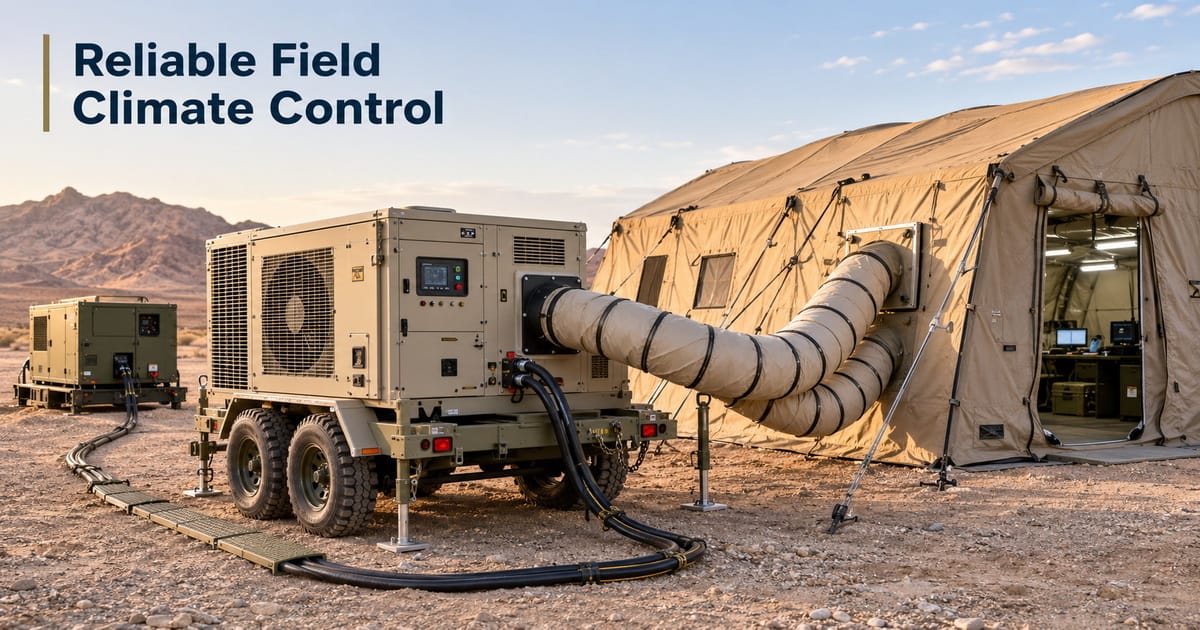
A military environmental control solution may support command shelters, communications equipment, medical tents, mobile workshops, or protected equipment enclosures. The unit often needs to operate under poor road conditions, unstable power supply, dust exposure, long daily runtime, and demanding transport conditions.
Industrial temporary cooling usually serves planned or unplanned commercial needs. Typical uses include factory shutdowns, warehouse heat relief, construction projects, outdoor events, temporary production areas, data-room backup, and equipment cooling during permanent HVAC repairs.
The central difference is clear:
– Military trailer air conditioning prioritizes operational continuity and environmental resilience.
– Industrial temporary cooling prioritizes speed, flexibility, cost control, and practical cooling delivery.
Military-grade environmental control units are designed to regulate temperature, humidity, and air quality in shelters, vehicles, temporary buildings, and critical equipment spaces. Trailer-mounted systems can also offer large-capacity cooling and heating configurations for sizeable mobile facilities.
Trailer Air Conditioning Comparison Table
| Decision Factor | Military Field Operations | Industrial Temporary Cooling |
|---|---|---|
| Primary objective | Protect personnel, communications, medical activity, and mission equipment | Restore comfort, protect production, reduce heat exposure, or maintain temporary processes |
| Typical location | Remote camps, command posts, field shelters, vehicle support zones | Factories, warehouses, construction sites, event locations, maintenance areas |
| Operating environment | Dust, sand, rain, vibration, uneven terrain, extreme temperatures | Mixed indoor/outdoor conditions, often with easier site access |
| Reliability expectation | Very high; failure can interrupt critical operations | High, but redundancy may be adjusted based on process and budget risk |
| Mobility requirement | Frequent transport and fast redeployment | Short-term placement, rental deployment, or seasonal relocation |
| Power conditions | Generator-based, limited grid access, variable field power | Grid power, temporary generator power, or hybrid arrangements |
| Cooling priorities | Temperature, humidity, filtration, equipment protection, uptime | Temperature reduction, air circulation, worker comfort, targeted spot cooling |
| Enclosure type | Military tents, rigid shelters, containers, mobile command spaces | Warehouses, temporary partitions, process rooms, marquees, maintenance tents |
| Customization need | Rugged construction, specific voltage, duct interfaces, transport integration | Capacity selection, ducting length, trailer layout, controls, branding |
| Procurement focus | Compliance, lifecycle support, deployment readiness, durability | Lead time, installation speed, operating cost, rental or purchase economics |
Military Trailer Air Conditioning: Built for Field Resilience
In a field environment, cooling is rarely only about comfort. It can support equipment stability, reduce heat stress, maintain workable interior conditions, and help protect sensitive electronics from excessive temperature and humidity.
A military trailer air conditioning unit must be evaluated as part of a wider field-support system. The trailer, generator, cables, ducts, shelter envelope, fuel plan, maintenance access, and spare-parts strategy all affect real performance.
Key Requirements for Military Field Operations
Rugged transportability is essential. The equipment may travel over rough roads, be repositioned repeatedly, or remain deployed for extended periods. Trailer frames, mounting points, panel construction, refrigerant piping, fasteners, and electrical cabinets should be designed with transport vibration in mind.
Environmental protection matters as much as nominal cooling capacity. Dust, sand, moisture, solar exposure, and wind-driven debris can reduce heat-exchanger performance and increase maintenance needs. Effective filtration and accessible service panels are practical advantages in remote locations.
Power compatibility should be confirmed before deployment. Field systems often depend on generators. The cooling unit’s starting behavior, running demand, voltage range, phase, frequency, cable length, and generator reserve capacity should be reviewed together.
Humidity management is often overlooked. A shelter may feel cooler while still having excessive moisture. Condensation can affect electronics, documents, medical supplies, communications racks, and occupied comfort. In humid climates, latent-load performance is as important as sensible cooling capacity.
Serviceability should be designed into the project. Field personnel need clear controls, replaceable filters, readable fault indicators, safe access to components, and realistic preventive-maintenance instructions.
The U.S. Army’s 60k IECU program emphasized standardized installation, operation, and maintenance using the tools and training available to soldiers. It also highlighted reduced unit weight and avoidance of startup power surges as practical design benefits for field deployment.
Military Application Example
Imagine a 60-person command shelter operating in a hot, dusty location. Inside are people, lighting, communications racks, laptop workstations, and power-distribution equipment.
A buyer should not select capacity from floor area alone. The cooling load also includes:
– Solar gain through the shelter fabric or panels.
– Heat from occupants.
– Electronics and communications equipment.
– Outdoor-air infiltration through doors and cable openings.
– Heat introduced by ventilation requirements.
– Humidity entering from outside air.
– Reduced performance caused by dirty filters or high ambient temperature.
A robust system design may include one primary trailer AC unit, a contingency unit or backup plan, insulated ducting, sealed transitions, generator capacity margin, and scheduled filter inspections.
Industrial Temporary Cooling: Fast, Flexible, and Site-Specific
Industrial temporary cooling has a broader range of commercial use cases. A unit may operate for one week during a plant shutdown or for several months while a permanent HVAC system is replaced.
The buyer’s objective is usually to deliver measurable cooling where it is needed without disrupting production, access routes, safety procedures, or site logistics.
Common Industrial Temporary Cooling Scenarios
– Factory maintenance shutdowns when permanent chillers, rooftop units, or air handlers are unavailable.
– Warehouse hot spots near loading doors, upper mezzanines, or heat-producing machinery.
– Temporary production expansions using modular enclosures or leased workspaces.
– Construction and fit-out projects that need worker cooling before permanent HVAC commissioning.
– Equipment protection for temporary server rooms, electrical rooms, test stations, or control spaces.
– Heat-risk mitigation in facilities with elevated indoor temperatures.
In some jurisdictions, indoor heat requirements create a stronger need for documented cooling plans. California’s indoor heat-illness prevention standard applies to many workplaces when indoor temperatures reach 82°F and requires access to designated cool-down areas maintained below that threshold.
What Industrial Buyers Should Prioritize
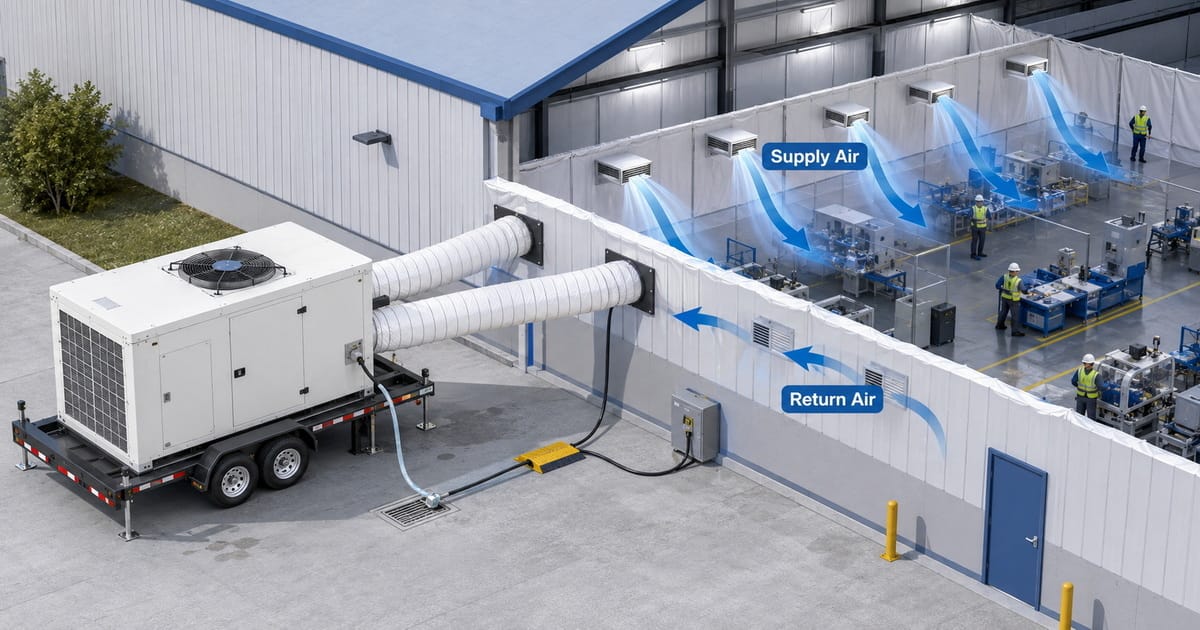
Deployment speed is usually a major procurement factor. The trailer must arrive ready for positioning, duct connection, power connection, and commissioning.
Air distribution determines whether the cooling investment works. A powerful unit can still underperform if cold air is discharged too far from the load, ducts are poorly routed, return air is blocked, or the area has major uncontrolled openings.
Targeted capacity reduces waste. Cooling an entire warehouse may be impractical when only a packaging line, inspection zone, control room, or break area needs temperature relief.
Noise management can influence location planning. The trailer, generator, discharge air path, and return-air placement should not interfere with workers, customers, neighbors, or event operations.
Drainage planning is necessary in humid locations. Condensate may be significant during long operating hours. Buyers should define drainage routing before equipment arrives.
Cooling Capacity Is Not the Same as Cooling Outcome
A common buying mistake is comparing trailer air conditioning units only by BTU/h or tonnage. Capacity is important, but delivered performance depends on the total load and the actual installation.
Cooling-load analysis should account for external weather, humidity, solar exposure, enclosure construction, occupancy, lighting, machinery, ventilation, infiltration, and operating schedule. The ASHRAE Heat Balance approach recognizes that instantaneous heat gain does not always equal the cooling load at the same moment, which is why simple rules of thumb can create selection errors.
A Practical Sizing Checklist
Before requesting a quotation, prepare the following information:
1. Application type: Military shelter, container, temporary workshop, warehouse zone, tent, or event structure.
2. Dimensions: Length, width, height, and usable enclosed volume.
3. Location: Country, city, expected outdoor design temperature, humidity, and solar exposure.
4. Operating schedule: Required daily runtime, seasonal use, and continuous-duty expectations.
5. Heat sources: Number of people, equipment wattage, lighting, machines, and process heat.
6. Power supply: Voltage, phase, frequency, generator size, cable distance, and outlet type.
7. Air-distribution plan: Duct diameter, duct length, supply location, return path, and enclosure openings.
8. Special conditions: Dust, corrosion, rain, noise restrictions, filtration needs, heating requirement, or transport limitations.
A capacity reserve can be useful, but excessive oversizing is not automatically safer. It can create short cycling, weaker dehumidification, unnecessary generator demand, and higher operating cost. The best design balances sensible load, latent load, duty cycle, and controllability.
Power, Efficiency, and Generator Planning
For mobile applications, electrical planning is a core part of climate-control engineering. A trailer air conditioner must operate within the available electrical infrastructure while leaving adequate capacity for other connected loads.
EER measures cooling output divided by electrical power input and is expressed in Btu per watt-hour. It is useful for comparing efficiency at defined operating conditions, although buyers should also review real-world ambient conditions, part-load behavior, and generator fuel consumption.
Field and Temporary Power Checklist
– Confirm voltage, phase, frequency, and permitted voltage tolerance.
– Include startup current and running current in generator planning.
– Avoid placing the generator exhaust near HVAC return-air openings.
– Use correctly rated cables, connectors, grounding, and weather protection.
– Confirm whether the unit needs soft-start, staged compressors, or load-shedding controls.
– Plan safe cable routing to protect workers and avoid vehicle damage.
– Keep maintenance access clear around the unit and generator.
Temporary electrical systems should be designed around actual connected load demand, grounded properly, maintained in code-compliant condition, and equipped with appropriate GFCI protection for relevant receptacle outlets.
How OEM and ODM Buyers Can Specify the Right Unit
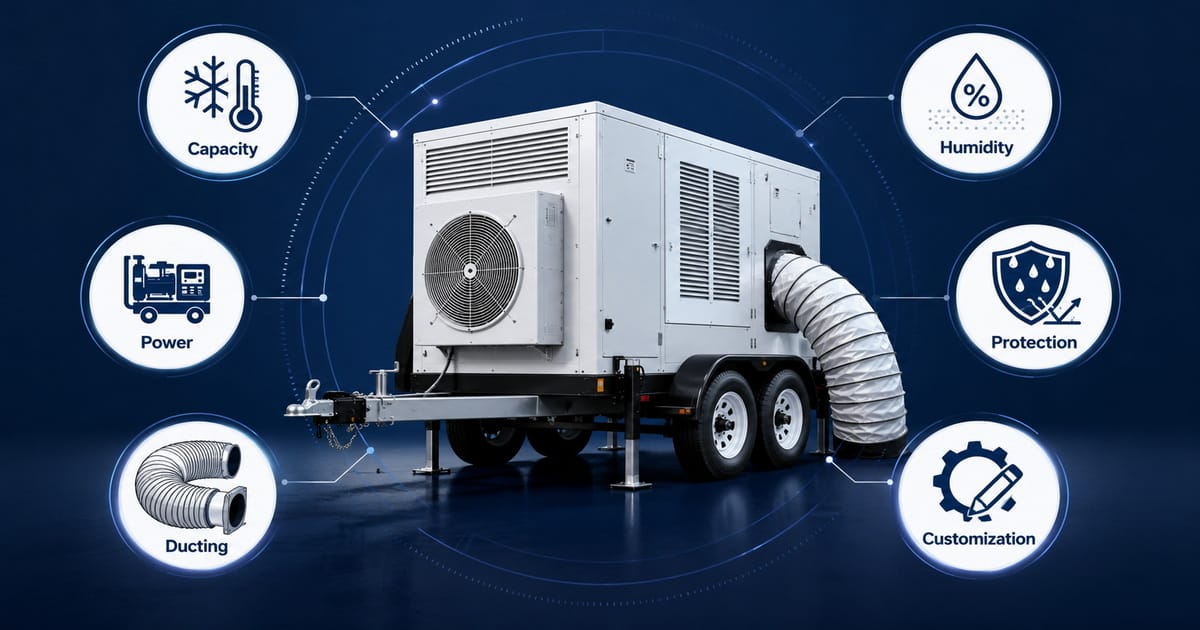
For overseas brands, wholesalers, and equipment manufacturers, an OEM or ODM project should start with a clear product-definition document rather than a generic capacity request.
At DREZ, the project discussion should connect product configuration with the commercial model. A distributor may need a standard platform with private labeling. A manufacturer may require a custom trailer layout, interface dimensions, control logic, electrical specification, or enclosure design for integration into its own solution.
Useful OEM and ODM Specification Points
– Required cooling and heating capacity.
– Trailer dimensions, axle layout, towing interface, and mobility conditions.
– Electrical system requirements for target markets.
– Generator integration or external generator compatibility.
– Control-panel language, branding, and user interface.
– Duct connection size, location, and quantity.
– Filter grade and service-access arrangement.
– Coil treatment for humid or corrosive environments.
– Color, casing material, logo placement, and packaging requirements.
– Spare-parts package, technical documents, and after-sales support expectations.
A strong supplier partnership begins with application data. The more complete the operating profile, the more accurately a trailer air conditioning system can be designed for performance, reliability, and commercial fit.
Choose a Trailer AC System Around Risk
Military field operations require resilience, protection, and continuity. Industrial temporary cooling requires rapid deployment, controllable cost, and effective air delivery. The right system may look similar from the outside, but its engineering priorities should reflect the consequences of failure.
If you are developing a private-label trailer air conditioner, sourcing cooling units for distribution, or integrating mobile HVAC into a larger project, share your site conditions and technical requirements with DREZ. Our team can help evaluate capacity, power compatibility, trailer configuration, ducting interfaces, and OEM or ODM customization options for your target market.
FAQ
1.What is trailer air conditioning?
Trailer air conditioning is a mobile HVAC system installed on a towable chassis. It can provide cooling, heating, ventilation, and in some cases humidity management for temporary shelters, industrial spaces, containers, events, field facilities, and emergency applications.
2.Can one trailer AC unit serve both military and industrial uses?
Potentially, yes. However, the unit should be configured for its primary duty. Military field use may require more rugged construction, specialized filtration, transport resilience, and field-power compatibility. Industrial use may place more emphasis on fast deployment, duct flexibility, noise level, and operating cost.
3.How do I determine the required trailer air conditioner capacity?
Start with a cooling-load assessment. Include the space size, local weather, insulation, solar gain, people, equipment heat, humidity, ventilation, infiltration, and operating hours. Do not rely only on floor area or a general BTU-per-square-foot rule.
4.Why is humidity control important in temporary cooling?
Humidity affects comfort, condensation risk, and equipment protection. In command shelters, containers, temporary rooms, and humid industrial sites, poor dehumidification can create damp surfaces and affect sensitive electronics even when the air temperature appears acceptable.
5.Can trailer air conditioning operate from a generator?
Yes, many mobile systems are designed for generator-powered operation. Confirm the unit’s voltage, phase, frequency, startup demand, running demand, and any soft-start requirements before selecting the generator.
6.What information should I provide for an OEM trailer air conditioning project?
Provide the target application, capacity range, voltage and frequency, trailer size, destination market, annual quantity, branding needs, ducting interfaces, environmental conditions, heating requirements, desired controls, and any compliance or documentation requirements.
7.What is the main risk of undersizing a temporary cooling unit?
An undersized unit may run continuously without reaching the required indoor condition. This can lead to worker discomfort, equipment overheating, reduced productivity, poor dehumidification, higher energy use, and avoidable emergency replacement costs.
References
1. U.S. Army. “[New environmental control units keep systems, Soldiers on target].”
2. HDT Global. “[Environmental Control Units].”
3. Defense Advancement. “[Military Environmental Control Unit].”
4. California Department of Industrial Relations. “[Cal/OSHA Heat Illness Prevention Guidance and Resources].”
5. U.S. Department of Energy Federal Energy Management Program. “[Minimum Efficiency Requirements Tables for Heating and Cooling Product Categories].”
6. IESVE. “[ASHRAE Heating & Cooling Load Calculations].”
7. Electrical Safety Foundation International. “[Temporary Power Safety].”
Hot Tags:Trailer Air Conditioning, Military Environmental Control Units, Industrial Temporary Cooling, Mobile HVAC Systems, Trailer Mounted Air Conditioners, Temporary Cooling Solutions, Military Field HVAC, Portable Industrial Air Conditioning, OEM Trailer Air Conditioners, Mobile Climate Control Solutions