Content Menu
● Why the Rental vs Ownership Decision Matters
● Trailer Air Conditioning Rental: Best for Flexibility
>> Advantages of Renting Trailer Air Conditioning Equipment
>> When Trailer Air Conditioning Rental Makes Sense
● Owned Trailer Air Conditioning Equipment: Best for Predictable Use
>> Benefits of Owning Trailer Air Conditioning Units
>> The Hidden Costs of Ownership
● Rental vs Owned Trailer Air Conditioning: Side-by-Side Comparison
● Calculate the Real Break-Even Point
>> Step 1: Estimate Annual Rental Cost
>> Step 2: Estimate Annual Ownership Cost
>> Step 3: Compare Productive-Day Cost
● A Practical Contractor Decision Framework
>> 1. How Many Days Will the Unit Be Used?
>> 2. Is the Equipment Core or Specialized?
>> 3. Can Your Team Maintain It?
>> 4. What Happens if the Unit Fails?
>> 5. Can the Equipment Be Reused Across Projects?
● Expert Insight: Use a Hybrid Fleet Model
● Equipment Specification Matters as Much as Acquisition Method
● Choose a Scalable Climate-Control Partner
● FAQ
>> 1.Is trailer air conditioning rental cheaper than buying?
>> 2.How do contractors calculate trailer air conditioning ownership cost?
>> 3.When should a contractor buy trailer air conditioning equipment?
>> 4.What is a hybrid trailer air conditioning fleet strategy?
>> 5.What should be included in a trailer air conditioning rental agreement?
>> 6.Why is preventive maintenance important for owned trailer air conditioning units?
>> 7.Can trailer air conditioning systems be customized for OEM and ODM projects?
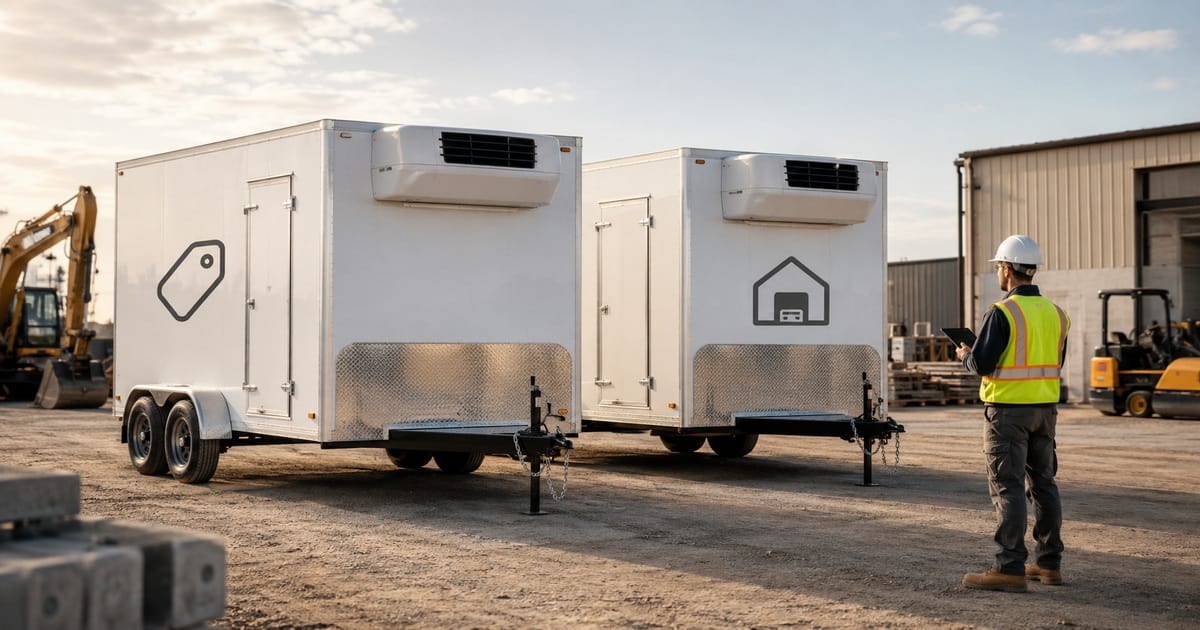
For contractors managing temperature-controlled trailers, the trailer air conditioning rental vs owned equipment decision affects more than the monthly budget. It influences fleet availability, job-site flexibility, maintenance exposure, cargo protection, and the capital available for business growth.
From my experience evaluating mobile climate-control requirements for contractors and fleet operators, the best choice is rarely “always rent” or “always buy.” A stronger strategy is to own the equipment used consistently and rent capacity for seasonal, project-specific, or specialized demand. This approach protects cash flow while keeping temperature-sensitive operations reliable.
Why the Rental vs Ownership Decision Matters
A trailer air conditioning system is a working business asset. Whether it supports equipment crews, mobile workspaces, temporary storage, events, healthcare projects, or temperature-sensitive freight, failure can create expensive disruption.
The wrong acquisition model can lead to:
– Idle equipment costs during slow months
– Limited capacity during high-demand projects
– Unexpected repair expenses
– Temperature-control failures that interrupt operations
– Capital tied up in equipment that is not generating revenue
– Rental availability risk during peak seasons
A contractor should therefore compare more than the purchase price and rental rate. The real question is:
Which strategy delivers the lowest total cost per productive operating day while maintaining dependable climate control?
Government equipment-procurement guidance similarly notes that ownership includes maintenance, repairs, transport, insurance, warranties, storage, staffing, and training costs. It also indicates that consistent utilization is necessary before a purchase becomes economical.
Trailer Air Conditioning Rental: Best for Flexibility
Trailer air conditioning rental is often the right choice when demand is uncertain, project durations are short, or equipment specifications change from job to job.
Instead of committing capital to a permanent asset, contractors pay for equipment when a contract, season, or emergency requires it.
Advantages of Renting Trailer Air Conditioning Equipment
Low upfront investment is the most obvious benefit. A rental agreement usually requires far less cash than buying a new trailer air conditioning unit or a complete temperature-controlled trailer.
Rental can also provide:
– Fast deployment for urgent projects
– Flexible contract lengths for daily, weekly, monthly, or seasonal work
– Access to newer equipment without purchasing every upgrade
– Reduced repair responsibility, depending on the agreement
– Scalable capacity during busy periods
– Equipment testing opportunities before committing to a model or supplier
– Less storage burden when equipment is not in use
For contractors handling irregular projects, renting changes equipment from a fixed asset into a variable operating cost.
When Trailer Air Conditioning Rental Makes Sense
Rental is usually the stronger option when the equipment will be used for:
– A one-time construction project
– Emergency cooling after equipment failure
– Seasonal demand peaks
– Temporary site offices or mobile workforce facilities
– Short-term event infrastructure
– A specialized temperature range or trailer configuration
– Pilot projects in a new service market
– A contract with uncertain renewal potential
For example, a contractor with a 12-week summer infrastructure project may need air-conditioned crew trailers only during the hottest months. Purchasing multiple units for a single seasonal contract can create unnecessary year-round carrying costs. Renting allows the contractor to match equipment capacity to the revenue-producing period.
The Risks of Renting
Rental is flexible, but it is not automatically the cheapest solution.
Common drawbacks include:
– Higher long-term cost when use is frequent
– Limited equipment availability in peak summer or emergency periods
– Delivery and pickup charges
– Potential damage, cleaning, or excess-use fees
– Less customization control
– Variable equipment condition between rental providers
– Rental rate increases over time
A rental contract should clearly define the maintenance scope, emergency service response time, delivery obligations, insurance, fuel or energy responsibility, operating-hour limits, and damage procedures.
> Suggested visual placement: After this section.
> AI image prompt: “Professional temperature-controlled trailer rental handover, contractor reviewing checklist with HVAC technician beside modern trailer-mounted air conditioning equipment, industrial project location, realistic documentary photography, high detail, clean composition.”
Owned Trailer Air Conditioning Equipment: Best for Predictable Use
Owning trailer air conditioning equipment gives contractors direct control over availability, configuration, service schedules, branding, and long-term fleet planning.
It is usually the better solution when the equipment supports regular operations and can remain productive through most of the year.
Benefits of Owning Trailer Air Conditioning Units
An owned unit can create meaningful operational advantages:
– Guaranteed availability for recurring projects
– Lower cost per operating day at high utilization
– Custom specifications for trailer layout, cooling capacity, power source, and controls
– Brand consistency for customer-facing mobile units
– Better operational familiarity for drivers and technicians
– Potential resale value at the end of the ownership period
– Asset value that may support financing or business valuation
For companies with recurring contracts, owning can reduce dependency on rental inventory and avoid delays when the market is busy.
The Hidden Costs of Ownership
The purchase price is only the beginning. A practical cost strategy must include the full lifecycle expense.
| Ownership Cost Category | What Contractors Need to Include |
|---|---|
| Acquisition | Purchase price, import cost, delivery, installation, commissioning |
| Financing | Loan interest, leasing fees, opportunity cost of capital |
| Depreciation | Decline in equipment value over time |
| Preventive maintenance | Filters, belts, electrical inspections, refrigerant-system service |
| Repairs | Compressors, fans, controllers, wiring, seals, batteries, generators |
| Insurance | Equipment coverage, theft, liability requirements |
| Storage | Yard space, protection, security, winterization |
| Compliance | Inspections, refrigerant handling, local transport and safety obligations |
| Downtime | Lost revenue, substitute rentals, customer disruption |
| Resale | Expected sale value at the end of the useful life |
A useful equipment-cost framework is:
Total Cost of Ownership=Acquisition Cost+Operating Costs+Financing Costs−Resale Value
The most overlooked factor is often downtime risk. A contractor may own a trailer air conditioning system, but that asset does not create value if it is unavailable during a contract-critical period.
Industry guidance for equipment decisions recommends including depreciation, maintenance, storage, insurance, and capital opportunity cost rather than comparing only a purchase price with a rental quote.
Rental vs Owned Trailer Air Conditioning: Side-by-Side Comparison
| Decision Factor | Trailer Air Conditioning Rental | Owned Trailer Air Conditioning Equipment |
|---|---|---|
| Upfront cash requirement | Low | High |
| Best use case | Short-term, seasonal, emergency, specialized projects | Frequent, predictable, long-term operations |
| Maintenance responsibility | Often handled by rental provider, subject to contract | Contractor responsibility |
| Equipment availability | Dependent on rental market and reservation timing | Available whenever the unit is operational |
| Customization | Limited to rental fleet options | High flexibility for capacity, controls, power, and branding |
| Storage requirement | Usually none after return | Required during idle periods |
| Repair risk | Lower direct exposure, but response time matters | Full responsibility and planning required |
| Long-term unit cost | Can become expensive with continuous use | Often improves at high utilization |
| Technology updates | Easier to access newer models | May require upgrades or replacement investment |
| Resale value | None | Potential recovery of capital at disposal |
| Scalability | Excellent for peak demand | Limited by owned fleet size |
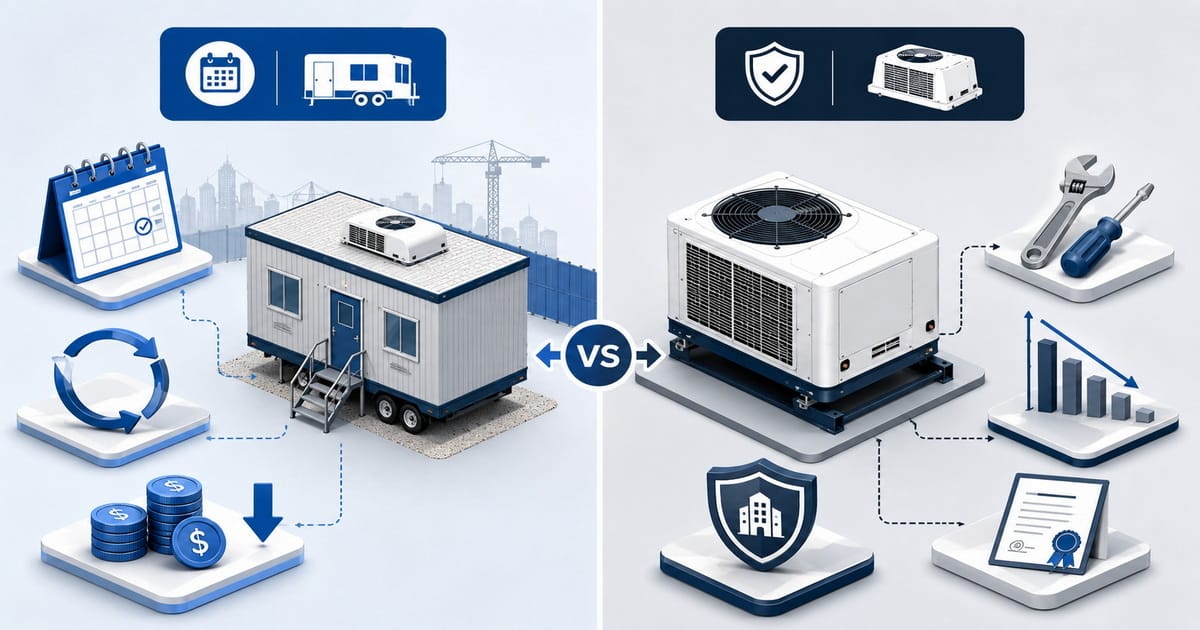
Rental supports agility. Ownership supports control. The right answer depends on utilization, contract visibility, available capital, and service capacity.
Calculate the Real Break-Even Point
A reliable decision should be based on operating data, not instinct.
Start by calculating the annual cost of each option.
Step 1: Estimate Annual Rental Cost
Annual Rental Cost=(Rental Rate per Day×Expected Rental Days)+Delivery Fees+Pickup Fees+Contract Extras
Include all likely extras, such as emergency delivery, after-hours support, site transfers, cleaning, and damage-waiver fees.
Step 2: Estimate Annual Ownership Cost
Annual Ownership Cost=Annual Depreciation+Financing+Maintenance+Repairs+Insurance+Storage+Downtime Allowance
Then calculate:
Ownership Cost per Operating Day=Annual Ownership Cost/Annual Productive Days
Step 3: Compare Productive-Day Cost
Do not use calendar days. Use only the days when the trailer air conditioning equipment is actively supporting a job, customer, or revenue-generating function.
A practical rule is:
– Rent if demand is temporary, seasonal, uncertain, or below the equipment’s economic utilization level.
– Buy if usage is consistent, contracts are predictable, and the owned cost per productive day is clearly lower.
– Use a hybrid strategy if the business has a steady baseline demand plus seasonal surges.
The U.S. General Services Administration states that equipment ownership generally needs consistent utilization—often cited as more than 900 operating hours annually—to become cost-effective, although the exact threshold must be calculated for the specific equipment type, local market, maintenance plan, and financing structure.
A Practical Contractor Decision Framework
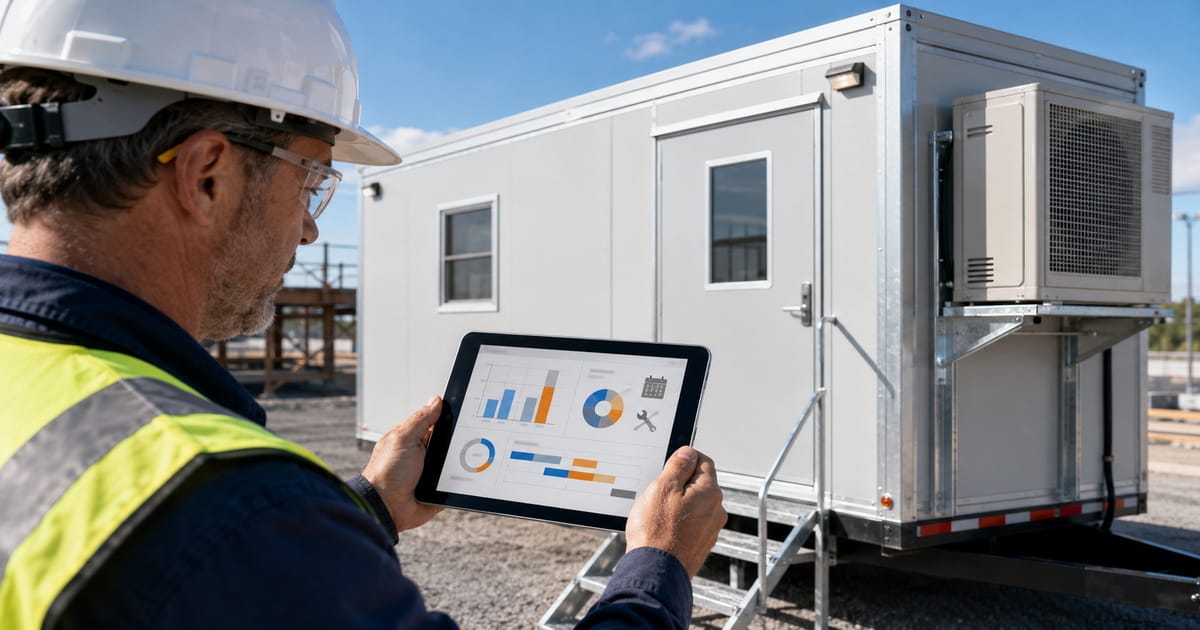
Use the following five questions before purchasing or renting trailer air conditioning equipment.
1. How Many Days Will the Unit Be Used?
Track historical job data. Do not estimate based only on optimism.
Ask:
– How many productive days did the unit operate last year?
– Will future projects create similar demand?
– Is the work seasonal?
– Does the equipment support one customer or several recurring customers?
High and dependable use supports ownership. Sporadic use supports rental.
2. Is the Equipment Core or Specialized?
A standard air-conditioned trailer used on many projects may be a core fleet asset.
A highly specialized unit—such as a multi-zone climate-controlled trailer, extreme-temperature unit, or customized mobile workspace—may be better rented until demand becomes proven.
3. Can Your Team Maintain It?
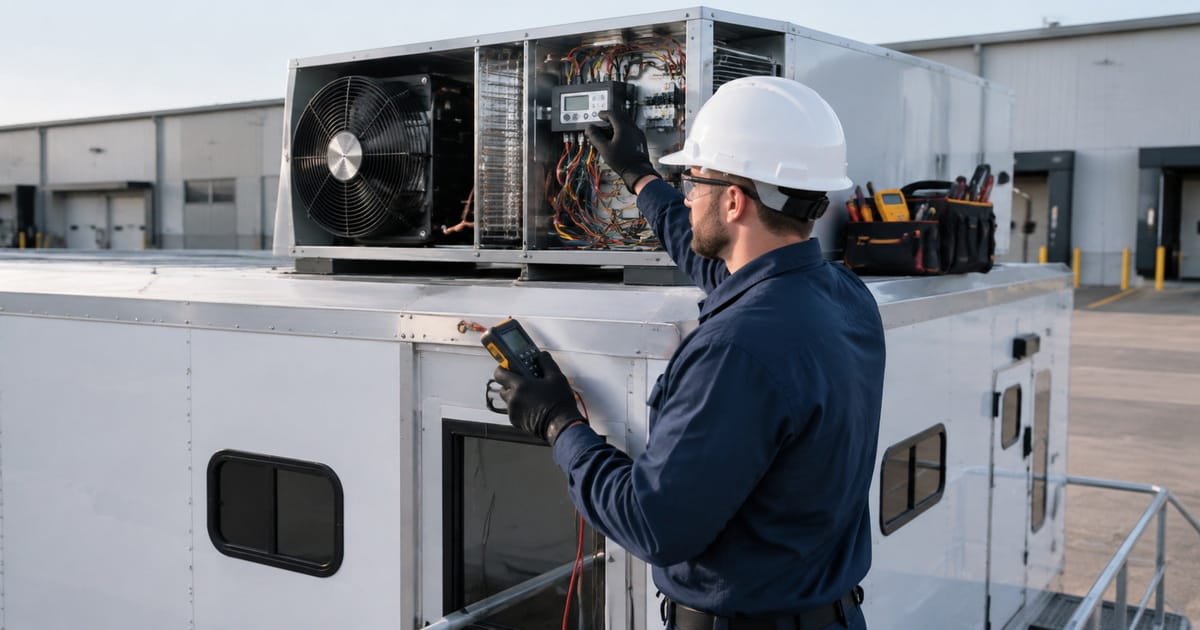
Ownership requires more than a technician on call. Contractors need a preventive maintenance schedule, spare-part planning, service records, and a backup strategy.
For temperature-controlled transport, refrigeration performance depends on the equipment’s cooling capacity, insulation quality, cargo or space heat load, outside conditions, airflow, and operating practices.
If the business does not have the maintenance capability, a service-backed rental agreement or an OEM support package may reduce risk.
4. What Happens if the Unit Fails?
This is the operational question many procurement teams miss.
If a trailer air conditioning failure causes missed work, customer penalties, product damage, crew discomfort, or contractual disputes, the cost of downtime can exceed the apparent equipment savings.
Every contractor should define:
– Maximum acceptable downtime
– Emergency rental supplier
– Local service coverage
– Backup unit availability
– Parts availability
– Escalation contacts for critical failures
5. Can the Equipment Be Reused Across Projects?
A trailer with flexible cooling capacity, modular controls, dependable power options, and adaptable interior layout can serve more contracts.
Versatility improves utilization. Higher utilization improves the case for ownership.
Expert Insight: Use a Hybrid Fleet Model
For most contractors, the strongest cost strategy is not choosing one model exclusively.
Own the baseline. Rent the peak.
A hybrid fleet strategy may look like this:
– Own the trailer air conditioning units needed for recurring contracts.
– Rent extra units during summer demand spikes.
– Rent specialty configurations before adding them to the permanent fleet.
– Maintain a rental agreement for emergency replacement capacity.
– Review fleet utilization every quarter, not only at year-end.
This model reduces the risk of buying too much equipment during a strong season and carrying idle assets when demand slows.
It also gives contractors a practical way to test new configurations. For instance, a business can rent a multi-zone trailer air conditioning system for several projects, collect feedback from operators and customers, and then specify the right capacity, control options, and power arrangement for an eventual OEM or ODM purchase.
Equipment Specification Matters as Much as Acquisition Method
Rental versus ownership is only one part of the decision. A poorly specified unit can increase fuel consumption, service requirements, and performance complaints regardless of who owns it.
When selecting trailer air conditioning equipment, evaluate:
– Cooling capacity for the actual heat load
– Ambient temperature performance
– Trailer insulation quality
– Air distribution and return-air path
– Power source and energy consumption
– Noise requirements
– Controller accuracy and remote monitoring
– Maintenance access
– Spare-part availability
– Corrosion resistance and operating environment
– Multi-zone capability, where required
– OEM or ODM customization options
For temperature-controlled trailers, airflow is particularly important. Conditioned air must move through the intended space without being blocked by cargo, partitions, equipment, or poor interior layout. Proper pre-trip checks and pre-cooling procedures also support stable performance.
Choose a Scalable Climate-Control Partner
Contractors should look beyond the initial equipment quote. The right supplier should help evaluate operating conditions, recommend suitable capacity, support custom requirements, and provide a clear service pathway.
DREZ (Guangzhou) Intelligent Technology Co., Ltd. supports brand owners, wholesalers, and manufacturers with OEM and ODM trailer air conditioning solutions. For contractors and fleet solution providers, a tailored system can help align cooling performance, trailer dimensions, control requirements, energy source, and product positioning with the actual operating environment.
Need a more cost-effective trailer air conditioning strategy? Contact DREZ to discuss your expected utilization, trailer configuration, target market, and customization requirements. Our team can help you evaluate whether a rental-oriented, ownership-oriented, or hybrid equipment strategy fits your commercial plan.
FAQ
1.Is trailer air conditioning rental cheaper than buying?
Rental is usually cheaper for short-term, seasonal, emergency, or uncertain demand. Buying can become more economical when the equipment is used frequently and predictably over several years.
2.How do contractors calculate trailer air conditioning ownership cost?
Include purchase cost, financing, depreciation, preventive maintenance, repairs, insurance, storage, compliance, downtime risk, and expected resale value. Divide the annual ownership cost by productive operating days to determine cost per day.
3.When should a contractor buy trailer air conditioning equipment?
Buying is usually appropriate when the unit supports recurring projects, utilization is consistently high, the company has maintenance support, and the expected ownership cost per productive day is lower than the effective rental rate.
4.What is a hybrid trailer air conditioning fleet strategy?
A hybrid model means owning the equipment needed for stable baseline demand and renting additional or specialized units for project peaks, emergencies, seasonal surges, or testing new applications.
5.What should be included in a trailer air conditioning rental agreement?
The agreement should define rental term, rate, delivery and collection, maintenance responsibility, emergency repair response, insurance, operating-hour limits, energy or fuel responsibility, damage procedures, and equipment condition at handover.
6.Why is preventive maintenance important for owned trailer air conditioning units?
Preventive maintenance helps protect cooling capacity, airflow, electrical reliability, component life, energy efficiency, and equipment availability. It also reduces the risk of costly failures during active projects.
7.Can trailer air conditioning systems be customized for OEM and ODM projects?
Yes. OEM and ODM solutions can be customized around cooling capacity, trailer dimensions, control systems, power supply, climate conditions, noise limits, installation method, branding, and specific operational requirements.
References
1. U.S. General Services Administration. [Rental of Industrial Equipment]
2. University of Florida Institute of Food and Agricultural Sciences. [Protecting Perishable Foods During Transport by Truck or Rail]
3. Cleveland Brothers. [Renting vs. Buying Construction Equipment in 2026]
4. ASHRAE. [Standards and Guidelines]
5. EquipmentWatch. [Rental Rate Blue Book and Cost Recovery]
Hot Tags:Trailer Air Conditioning, Trailer Air Conditioning Rental, Trailer Air Conditioning Units, Refrigerated Trailer Rental, Trailer HVAC Systems, Mobile Climate Control, Temperature Controlled Trailers, OEM Trailer Air Conditioning, Commercial Trailer Cooling, Trailer Air Conditioner Manufacturer