Content Menu
● Why Cooling Matters in Emergency Relief Camps
● What Are Trailer Air Conditioning Systems?
>> Core Features of Trailer-Mounted HVAC Units
>> Best Applications for Trailer Air Conditioning Systems
● What Are Temporary Shelter Cooling Solutions?
>> A System-Level Approach to Shelter Cooling
● Trailer AC Systems vs Temporary Shelter Cooling Solutions
● Cooling Capacity Is Not the Only Selection Metric
● Deployment Speed and Operational Resilience
>> Recommended Emergency Cooling Deployment Process
● OEM and ODM Considerations for Global Brands
>> Questions to Ask an OEM/ODM Supplier
● Which Option Should You Choose?
● Request a Customized Emergency Cooling Solution
● FAQs
>> 1. What is the main advantage of a trailer air conditioning system for emergency relief camps?
>> 2. Can trailer-mounted air conditioners cool more than one tent?
>> 3. Are temporary shelter cooling solutions suitable for off-grid areas?
>> 4. Why is dehumidification important in emergency shelters?
>> 5. What information should I provide when requesting an OEM trailer AC quotation?
>> 6. Can one system provide heating as well as cooling?
>> 7. How can shelter operators improve cooling efficiency?
When a disaster response team needs reliable cooling fast, the decision is rarely as simple as “buy an air conditioner.” Trailer air conditioning systems for emergency relief camps and temporary shelter cooling solutions solve overlapping problems, but they are designed for different deployment models, capacities, power conditions, and operational priorities.
For procurement teams, relief organizations, shelter manufacturers, and OEM brands, the right choice depends on whether cooling must move with the operation, serve multiple structures, operate off-grid, manage humidity, or maintain a safer environment for vulnerable occupants. This guide compares both approaches from an HVAC manufacturing and emergency-deployment perspective.
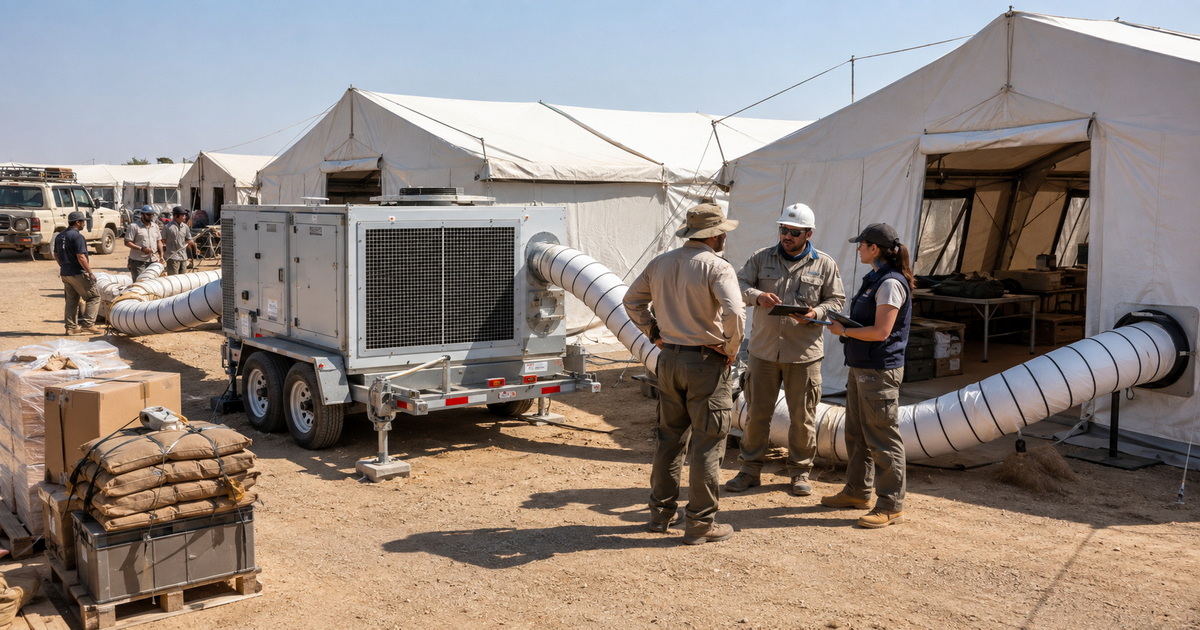
Why Cooling Matters in Emergency Relief Camps
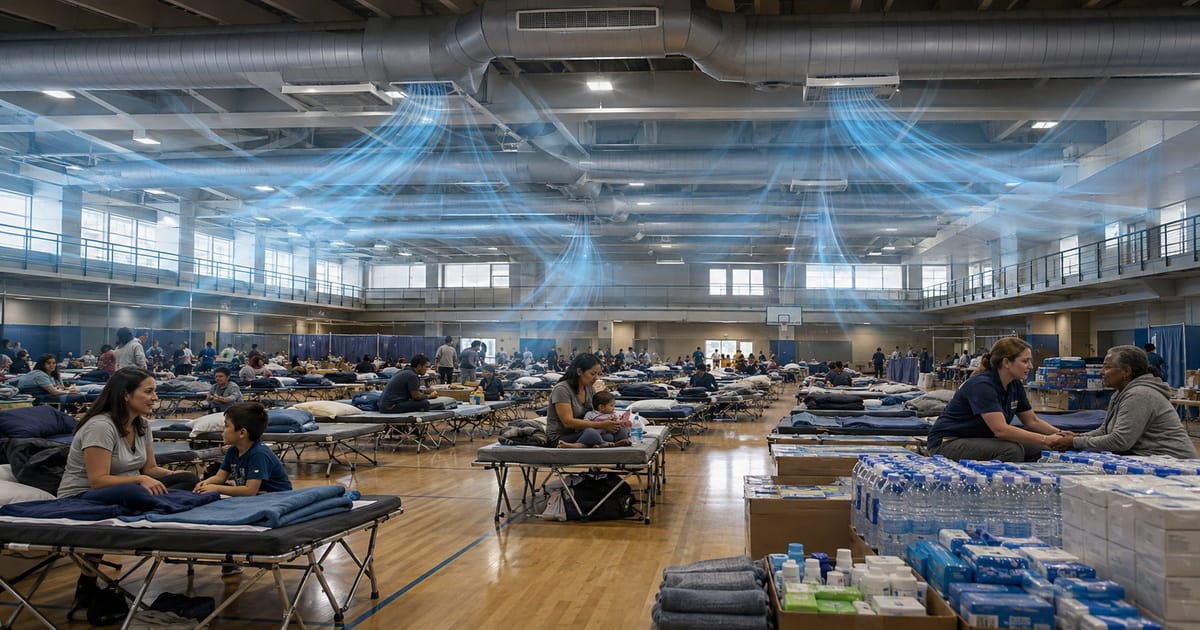
Emergency camps are often established after floods, earthquakes, wildfires, conflicts, and extreme-heat events. In these conditions, indoor heat is not merely a comfort concern; it can affect health, rest, medical care, communications equipment, food storage, and responder performance.
The U.S. Centers for Disease Control and Prevention advises people to seek air-conditioned spaces during extreme heat. It also notes that fans may increase body temperature when indoor temperatures exceed 90°F (32°C), making mechanical cooling especially important in severe heat conditions.
For emergency shelter operators, cooling systems should support:
– Stable indoor temperatures for evacuees, children, older adults, and medical patients
– Humidity control in hot and humid climates
– Fresh-air ventilation and filtration
– Rapid installation with limited local infrastructure
– Generator, grid, battery, or hybrid-power compatibility
– Reliable serviceability during continuous operation
What Are Trailer Air Conditioning Systems?
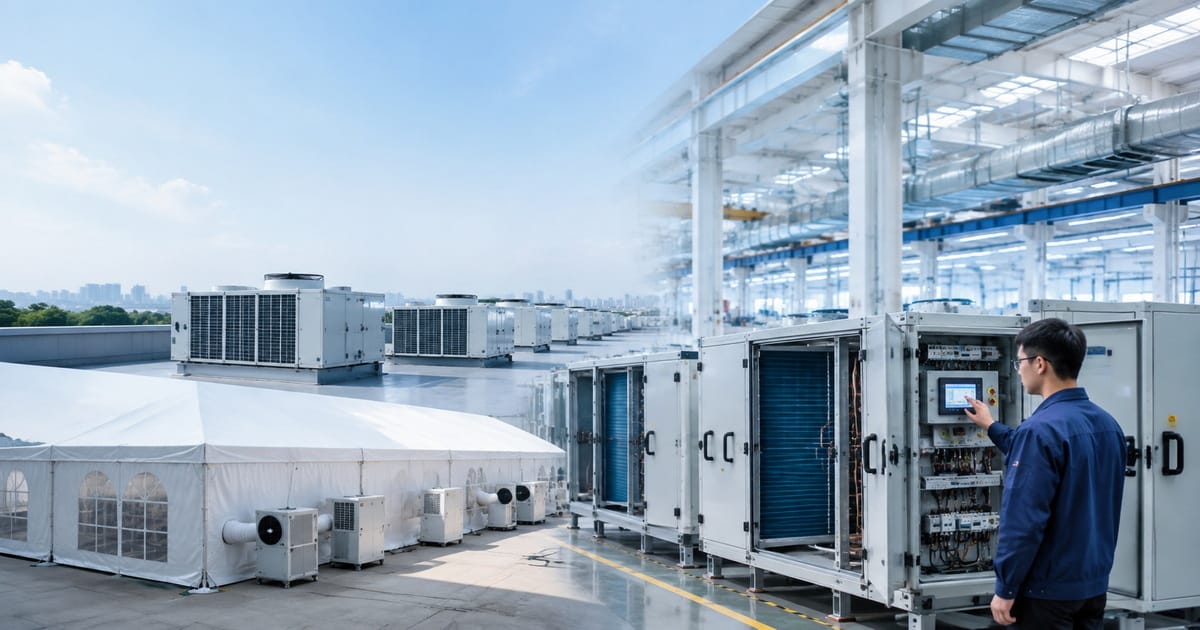
Trailer air conditioning systems are self-contained HVAC units installed on a road-legal or towable trailer chassis. They are typically designed for rapid transportation, outdoor installation, and ducted cooling delivery to tents, temporary buildings, command centers, medical facilities, or large accommodation zones.
A trailer-mounted system usually combines the refrigeration circuit, blower, electrical controls, structural enclosure, towing frame, and service access points in one mobile package. Instead of placing noisy and heat-producing equipment inside a shelter, the cooling unit remains outdoors and sends conditioned air through supply and return ducts.
Core Features of Trailer-Mounted HVAC Units
A well-designed trailer air conditioning system for emergency relief camps may include:
– High-capacity cooling and optional heating capability
– Duct connections for one or multiple temporary structures
– Heavy-duty chassis, towing hitch, wheels, and stabilizer legs
– Weather-resistant outdoor enclosure
– Generator-ready electrical configuration
– Variable-speed fans or staged compressors
– Integrated thermostat, controller, alarms, and remote monitoring options
– Air filtration and optional enhanced filtration configurations
– Service panels for fast maintenance in the field
Trailer HVAC systems are particularly suitable for response operations where the cooling capacity must travel from site to site. Field-deployable HVAC equipment is commonly used for tented and containerized shelters, and rugged systems may be engineered to operate across very wide ambient temperature ranges.
Best Applications for Trailer Air Conditioning Systems
Trailer-mounted cooling is often the strongest option for:
– Large emergency relief camps
– Mobile field hospitals and triage tents
– Disaster command centers
– Military-style base camps
– Temporary worker accommodation
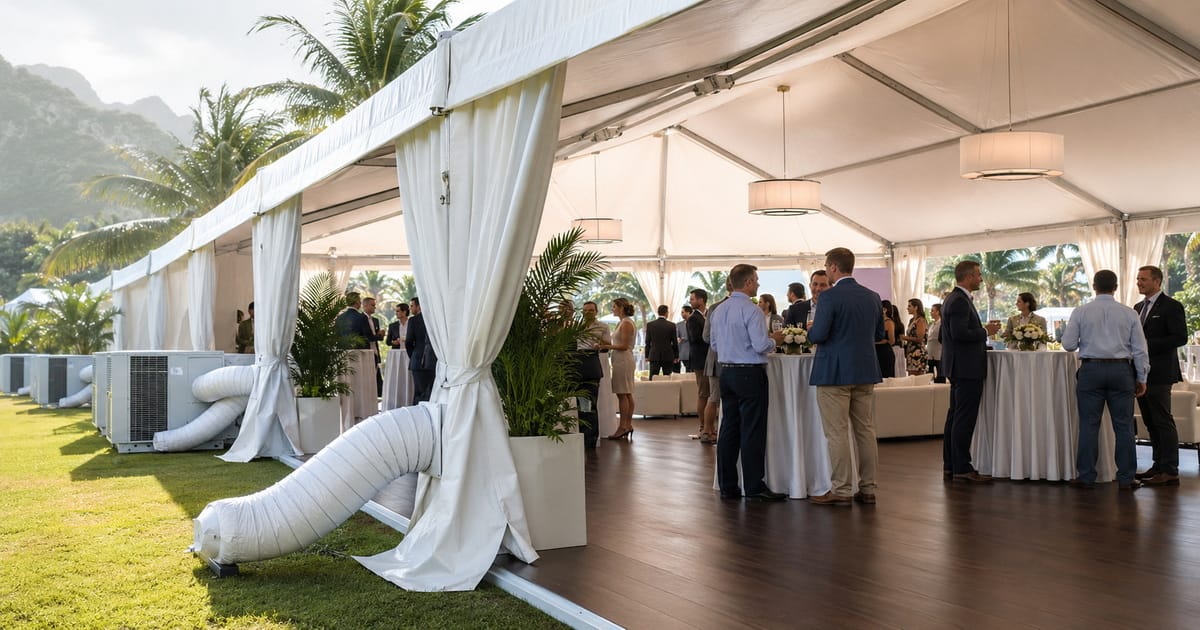
– Event or logistics tents requiring temporary HVAC
– Multi-room modular shelters
– Remote locations with access for towing vehicles
The main value is mobility at scale. One transportable unit can be positioned outside the occupied space, connected to ductwork, powered, and commissioned without permanently modifying the shelter structure.
What Are Temporary Shelter Cooling Solutions?
Temporary shelter cooling solutions are broader than any single product. They describe the complete combination of equipment and design measures used to maintain safe, usable indoor conditions in tents, prefabricated buildings, container shelters, temporary clinics, warehouses, and community cooling areas.
A complete solution may use a trailer-mounted HVAC unit, but it can also use portable spot coolers, packaged air conditioners, evaporative equipment where climate conditions allow, ventilation fans, ducting, insulated liners, shade structures, backup generators, battery storage, and airflow controls.
A System-Level Approach to Shelter Cooling
The performance of a temporary shelter cooling solution depends on more than rated cooling capacity. The most effective designs evaluate:
1. Outdoor temperature, solar exposure, humidity, dust, and rainfall
2. Shelter size, ceiling height, insulation level, and air leakage
3. Number of occupants and heat from lighting or equipment
4. Required indoor temperature and humidity targets
5. Available grid, generator, solar, or battery power
6. Ventilation, filtration, pressure, and indoor-air-quality needs
7. Installation time, operator skills, maintenance access, and relocation frequency
This is why a “temporary shelter cooling solution” should be specified as an engineered package rather than an AC unit selected by floor area alone.
Research on off-grid HVAC for temporary shelters has found that mobile modular energy systems combining photovoltaic power, storage, and heat recovery can support simultaneous electricity, heating, and cooling functions. This is particularly relevant when relief camps operate far from stable grid power.
Trailer AC Systems vs Temporary Shelter Cooling Solutions
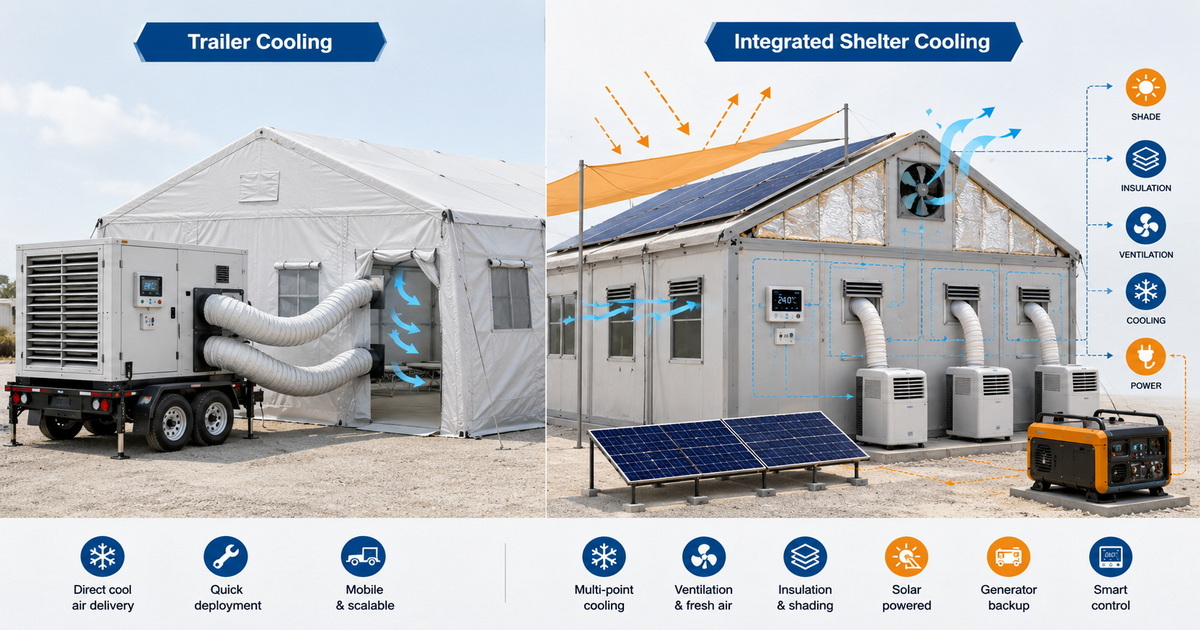
| Comparison Factor | Trailer Air Conditioning Systems | Temporary Shelter Cooling Solutions |
|---|---|---|
| Primary definition | A towable, self-contained HVAC product | A complete cooling and indoor-climate strategy |
| Mobility | Excellent; built for road transport and rapid relocation | Varies by equipment mix and shelter layout |
| Typical capacity | Medium to high capacity, often for large tents or multiple zones | Can range from small spot cooling to camp-wide HVAC |
| Installation | Outdoor placement plus duct and power connection | May require HVAC, insulation, shade, power, ducting, and ventilation coordination |
| Best use case | Mobile camps, field hospitals, command posts, multi-tent sites | Any temporary facility requiring a tailored comfort and resilience plan |
| Power configuration | Commonly generator or grid powered; hybrid options possible | Can combine grid, generator, solar, batteries, and load-management measures |
| Scalability | Add trailers or multiple duct branches | Add capacity, zones, insulation, ventilation, and energy assets as needed |
| Procurement model | Product-focused purchase, rental, OEM, or fleet deployment | Project-focused package, often requiring engineering consultation |
| Key limitation | Requires towing access and suitable external placement | Requires stronger planning and coordination across multiple components |
The practical conclusion is straightforward: choose a trailer unit when the operation needs a robust, movable HVAC asset; choose a shelter cooling solution when the project requires coordinated performance across the entire temporary environment.
Cooling Capacity Is Not the Only Selection Metric
Many buyers start with cooling capacity, usually expressed in kW, BTU/h, or tons. Capacity is important, but it should never be the only selection criterion. A unit that appears correctly sized on paper can still underperform if the tent has large air leaks, poor insulation, high solar gain, inadequate return airflow, or insufficient generator capacity.
The Cooling Load Checklist
Before requesting a quotation from an OEM or ODM manufacturer, prepare these project details:
– Shelter type, dimensions, ceiling height, and layout
– Number of connected tents or rooms
– Site location and peak outdoor temperature
– Relative humidity and rainy-season conditions
– Occupancy levels and operating hours
– Internal heat sources, including lighting, medical devices, IT equipment, and catering equipment
– Required indoor temperature range
– Available voltage, phase, frequency, and generator size
– Ducting distance, duct diameter, and required air outlets
– Air filtration, fresh-air, or pressure-control requirements
– Transport restrictions, towing rules, and site access conditions
In hot-humid disaster zones, dehumidification is often as important as air temperature reduction. A shelter can feel uncomfortable and may develop condensation risks even when the thermostat indicates an acceptable temperature.
For emergency or healthcare-related spaces, ventilation must also be considered alongside cooling. ASHRAE notes that unconditioned spaces can cause potentially life-threatening thermal stress, while ventilation and filtration can reduce airborne contaminant concentrations.
Deployment Speed and Operational Resilience
Trailer air conditioning systems are generally faster to relocate because the refrigeration, controls, and structure move as one integrated asset. Once positioned, operators typically level the trailer, connect electrical power, attach ducts, establish condensate management, verify airflow, and start the system.
However, a broader temporary shelter cooling solution can deliver better resilience when the camp faces power interruptions, changing occupancy, or extreme weather. For example, a solution may combine an HVAC trailer with insulated tent liners, external shading, a backup generator, spare flexible ducts, remote temperature sensors, and a defined maintenance procedure.
Industry facilities guidance recommends determining both average and peak cooling loads, ensuring proper ventilation and airflow, using alarms where appropriate, and establishing standard operating procedures for installation, operation, monitoring, and disconnection.
Recommended Emergency Cooling Deployment Process
1. Survey the site: Check access roads, towing clearance, drainage, prevailing wind, flood risk, and power location.
2. Calculate the load: Include solar gain, occupancy, equipment heat, infiltration, and humidity.
3. Select the architecture: Choose trailer HVAC, portable units, ducted packaged equipment, or a hybrid system.
4. Plan air distribution: Keep ducts as short and straight as practical; separate supply and return air paths.
5. Prepare backup power: Verify generator sizing, fuel logistics, cable protection, grounding, and automatic transfer requirements.
6. Commission before occupancy: Test temperature pull-down, airflow, condensate drainage, alarms, and emergency shutdown procedures.
7. Monitor continuously: Record indoor temperature, humidity, power consumption, and fault notifications.
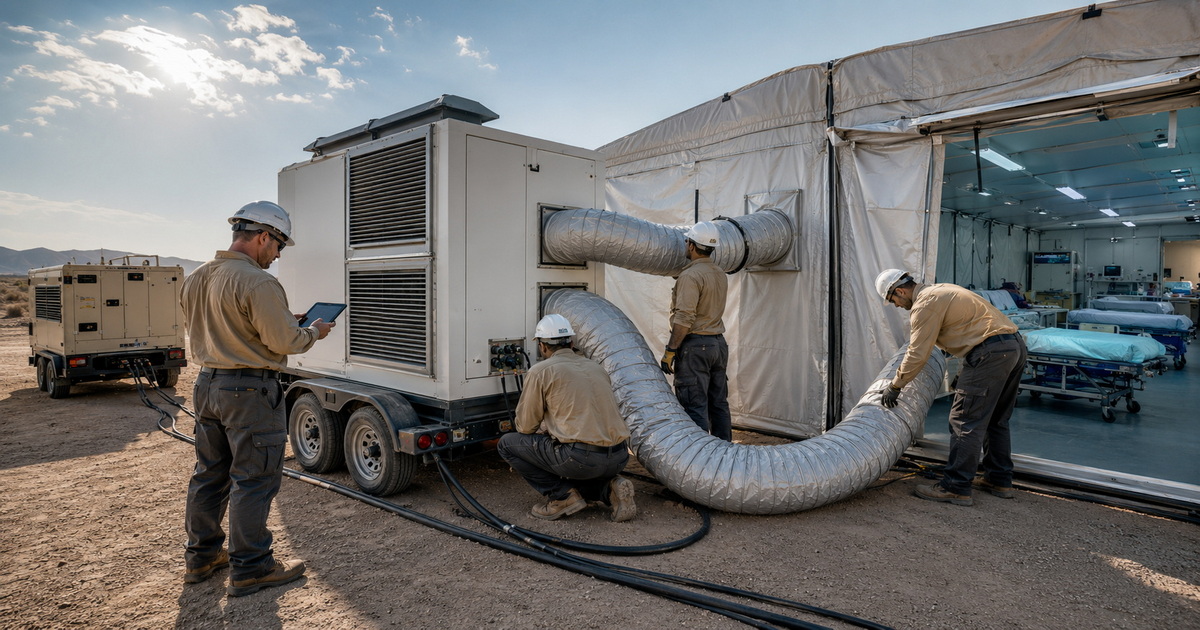
OEM and ODM Considerations for Global Brands
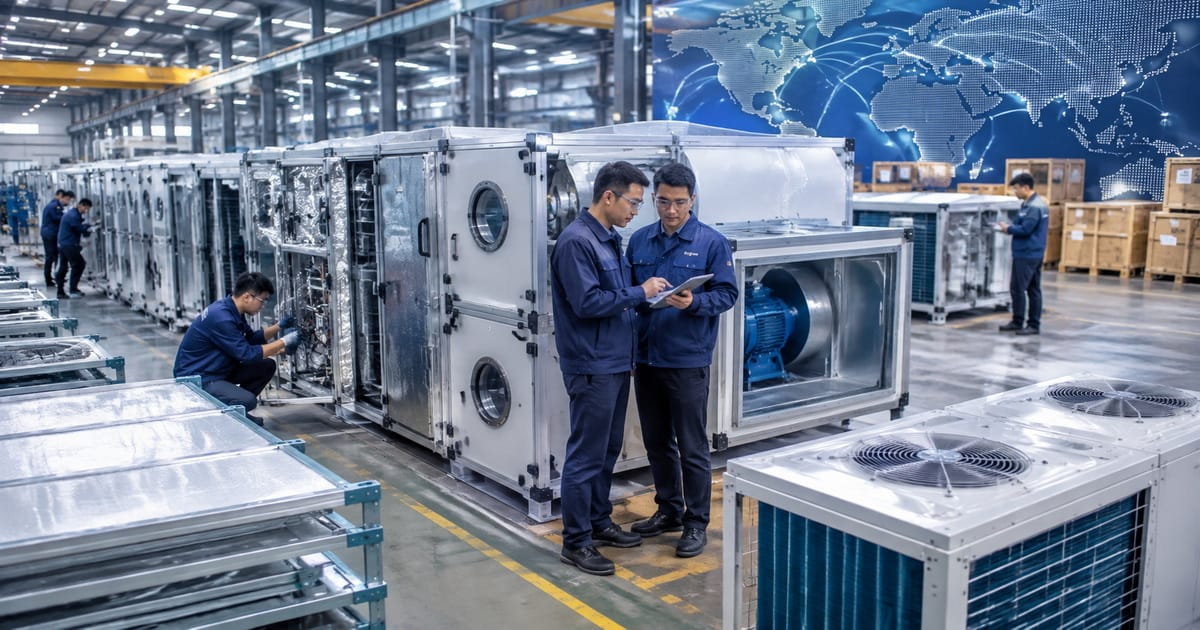
For overseas brands, wholesalers, and temporary-shelter manufacturers, the decision is not limited to selecting a standard model. An OEM or ODM partner should help align the equipment with local markets, electrical standards, trailer regulations, installation practices, and the end user’s operating environment.
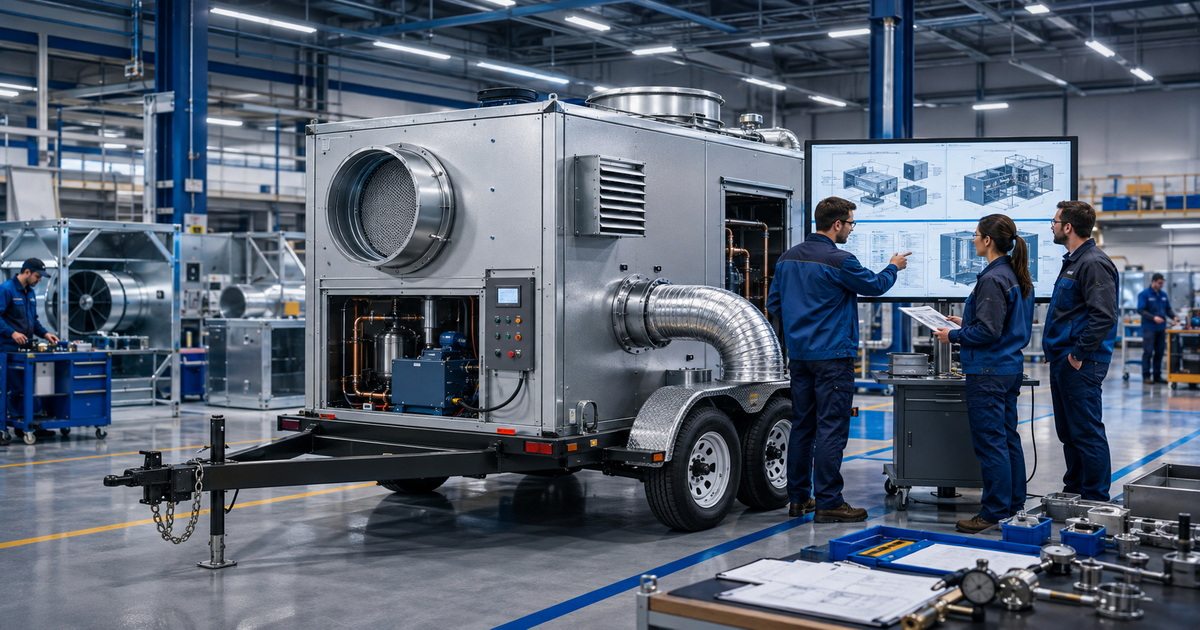
DREZ (Guangzhou) Intelligent Technology Co., Ltd. can position its trailer air conditioning systems and climate-control products around configurable, project-led manufacturing rather than generic equipment supply. For example, buyers may require different cooling capacities, power inputs, exterior materials, trailer arrangements, duct interfaces, controller languages, branding panels, filtration levels, or packaging specifications.
Questions to Ask an OEM/ODM Supplier
– Can the system be configured for local voltage, frequency, and plug standards?
– Is the trailer chassis suitable for the target market’s towing and road requirements?
– Can the air conditioner provide cooling, heating, ventilation, and dehumidification where needed?
– What is included in the ducting, control, and installation package?
– How are spare parts, technical documents, and remote support handled?
– Can the supplier provide private-label branding and customized product appearance?
– What quality-control checks are completed before shipment?
– Can the design be adapted for hospitals, tents, containers, or modular buildings?
A durable climate-control product is valuable, but a deployable solution creates more value for distributors and end users because it reduces integration uncertainty.
Which Option Should You Choose?
Choose a trailer air conditioning system if your customer needs transportable, higher-capacity HVAC for rapidly changing locations, large tents, or multi-zone emergency camps.
Choose a temporary shelter cooling solution if the project needs a complete engineered package that integrates HVAC equipment with shelter design, ducting, insulation, power, ventilation, controls, and backup planning.
For many international disaster-relief, military, medical, and modular-shelter projects, the optimal answer is both: a trailer-mounted AC unit as the central cooling asset, integrated into a complete temporary shelter cooling solution.
Request a Customized Emergency Cooling Solution
Need a trailer-mounted air conditioning system for emergency relief camps, field hospitals, modular shelters, or remote temporary facilities?
Contact DREZ to discuss an OEM or ODM climate-control solution tailored to your target capacity, local power standard, shelter layout, deployment conditions, and private-label requirements. A properly configured system can help your brand deliver faster deployment, more reliable cooling, and stronger value for end users.
FAQs
1. What is the main advantage of a trailer air conditioning system for emergency relief camps?
Its main advantage is mobility. The complete HVAC system can be transported by road, positioned outside a shelter, and connected through ducts to deliver cooling without occupying valuable indoor space.
2. Can trailer-mounted air conditioners cool more than one tent?
Yes. A suitably sized trailer HVAC system can serve multiple tents or zones through a planned duct network, provided the airflow, duct lengths, return air, and cooling load are properly engineered.
3. Are temporary shelter cooling solutions suitable for off-grid areas?
Yes. They can be designed around generators, solar power, battery storage, or hybrid power systems. The selected configuration should account for cooling load, runtime, fuel logistics, and weather conditions.
4. Why is dehumidification important in emergency shelters?
High humidity reduces perceived comfort, increases condensation risk, and can make a cooled space feel damp. In tropical, coastal, or rainy climates, cooling equipment should be evaluated for latent-load and dehumidification performance, not only sensible cooling capacity.
5. What information should I provide when requesting an OEM trailer AC quotation?
Provide shelter dimensions, climate conditions, occupancy, cooling target, power supply, ducting requirements, operating hours, transport requirements, and any branding or certification needs.
6. Can one system provide heating as well as cooling?
Yes. Some temporary HVAC systems are designed for year-round use with cooling, heating, and dehumidification functions. This can reduce the need to procure separate seasonal equipment.
7. How can shelter operators improve cooling efficiency?
Use insulated shelter materials, exterior shading, controlled entrances, sealed duct connections, short duct runs, proper return-air paths, and temperature monitoring. These measures reduce unwanted heat gain and lower the burden on the HVAC system.
References
1. [CDC — About Heat and Your Health] — Guidance on using air conditioning during extreme heat and limits of fan use above 90°F. [cdc]
2. [ASHRAE — Healthcare Resources] — Information on thermal stress, ventilation, filtration, and emergency surge-space considerations. [ashrae]
3. [Sciendo — Application Possibilities of Off-Grid HVAC Systems for Temporary Shelters] — Research on modular energy systems supporting HVAC in temporary shelters. [sciendo]
4. [FacilitiesNet — Backup Plan for Portable Cooling HVAC Units] — Guidance on load assessment, ventilation, alarms, and operating procedures for portable cooling. [facilitiesnet]
5. [Western Shelter — HVAC and ECU Systems] — Examples of portable shelter HVAC functions, including cooling, heating, and dehumidification. [westernshelter]
6. [Defense Advancement — Dantherm Climate Control Systems for Deployed Forces] — Field-deployable climate-control considerations for tented and containerized environments. [defenseadvancement]
Hot Tags: Trailer Mounted HVAC Systems, Temporary Shelter Cooling Solutions, Emergency Relief Camp Air Conditioning, Mobile HVAC Units, Portable Air Conditioning Systems, Tent HVAC Systems, Disaster Relief Climate Control, Field Hospital HVAC Systems, OEM Air Conditioning Manufacturer, Custom HVAC Solutions