
Content Menu
● What Are Trailer Air Conditioning Units?
● What Are Modular HVAC Systems?
● Trailer AC vs Modular HVAC: Deployment Speed at a Glance
● Why Trailer Air Conditioning Units Deploy Faster
>> 1. The system arrives as a mobile cooling asset
>> 2. Fewer building dependencies
>> 3. Cooling can be zoned around the actual need
● Why Modular HVAC Systems Are Faster Than Traditional HVAC
>> Key schedule advantages of modular HVAC
● Deployment Timeline: A Realistic Comparison
● The Hidden Schedule Risks Buyers Should Evaluate
● How to Choose the Right System
>> A practical hybrid approach
● OEM and ODM Considerations for Global Buyers
● Request a Deployment-Focused Solution
>> 1. Are trailer air conditioning units faster to install than modular HVAC systems?
>> 2. Can trailer-mounted AC units cool large industrial spaces?
>> 3. Is modular HVAC suitable for temporary projects?
>> 4. What information should I provide when requesting a trailer AC quotation?
>> 5. Can a trailer air conditioning unit be customized for my brand?
>> 6. What can delay trailer air conditioner deployment?
When uptime is critical, deployment speed can matter more than nominal cooling capacity. Trailer air conditioning units are built for rapid, mobile, self-contained cooling, while modular HVAC systems are designed to accelerate permanent or semi-permanent projects through off-site fabrication and standardized on-site assembly.
In climate-control procurement, “fast installation” and “fast deployment” are not identical. A modular HVAC system may reduce a conventional construction schedule substantially, but a trailer-mounted air conditioning unit can often be transported, positioned, connected, and commissioned with far less site work.
What Are Trailer Air Conditioning Units?
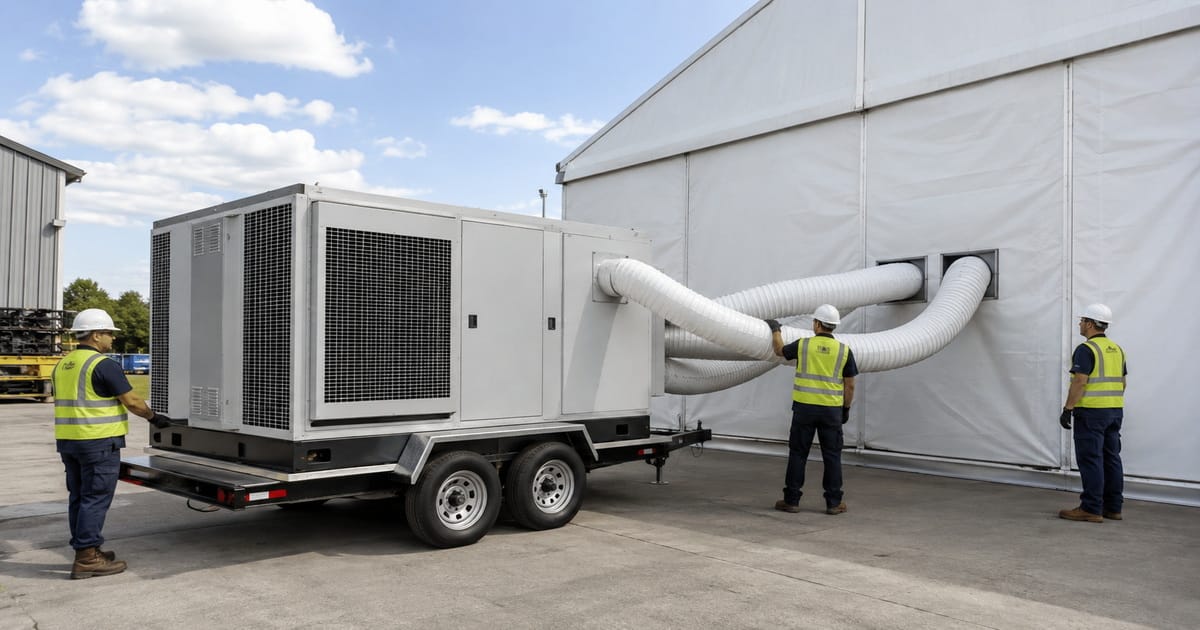
A trailer air conditioning unit is a mobile climate-control system installed on a road-ready trailer platform. It typically integrates major cooling components into one transportable package, allowing the system to be delivered directly to a site and connected to power, ducts, controls, and the target cooling zone.
Unlike fixed central HVAC systems, trailer-mounted AC units are designed around mobility, rapid setup, and temporary or flexible deployment. They are commonly used where permanent HVAC infrastructure is unavailable, under construction, undersized, damaged, or impractical.
Typical applications include:
– Temporary warehouses and logistics areas
– Outdoor events and exhibition structures
– Construction-site offices and workforce facilities
– Emergency cooling and disaster-relief operations
– Industrial maintenance shutdowns
– Data-center contingency cooling
– Military, mining, oil-and-gas, and remote-site projects
– Seasonal production expansion
A well-designed trailer AC system can reduce installation complexity because the refrigeration circuit, fans, controls, chassis, and core mechanical components are pre-integrated before shipment. The field team mainly focuses on site positioning, power connection, duct routing, airflow balancing, and commissioning.
What Are Modular HVAC Systems?
Modular HVAC systems refer to HVAC equipment or system sections manufactured, assembled, and often tested off-site before delivery. Depending on the project, they can include packaged rooftop units, modular air handlers, prefabricated pipe racks, mechanical skids, controls assemblies, duct modules, or complete mechanical-room sections.
The central idea is to shift work from an unpredictable jobsite to a controlled factory environment. This can reduce on-site labor requirements, improve repeatability, and allow mechanical fabrication to run in parallel with building construction.
However, modular HVAC does not eliminate the need for site integration. The system may still require:
– Crane lifting and positioning
– Structural coordination
– Electrical and controls integration
– Refrigerant, water, or hydronic piping connections
– Ductwork tie-ins
– Building automation system (BAS) commissioning
– Air balancing and compliance testing
For permanent facilities, these steps are valuable and appropriate. But they influence the true deployment timeline.
Trailer AC vs Modular HVAC: Deployment Speed at a Glance
| Deployment factor | Trailer Air Conditioning Units | Modular HVAC Systems |
|---|---|---|
| Primary use case | Temporary, mobile, emergency, flexible cooling | Long-term or semi-permanent building HVAC |
| Typical site preparation | Stable parking area, access, power, duct route | Structural, mechanical, electrical, and lifting coordination |
| Factory integration | Complete mobile unit or highly integrated package | Equipment/modules fabricated and pre-assembled off-site |
| On-site installation | Usually limited to positioning, power, ducts, and startup | Requires module placement plus system tie-ins and commissioning |
| Mobility after deployment | High; can be relocated to another site | Low; normally installed as part of a building system |
| Speed for urgent cooling | Usually faster | Faster than traditional field-built HVAC, but not always immediate |
| Scalability | Add or relocate independent units | Add modules, capacity sections, or future mechanical zones |
| Best procurement model | Rental fleet, emergency response, temporary projects, mobile operations | Construction projects, permanent facilities, repeatable building programs |
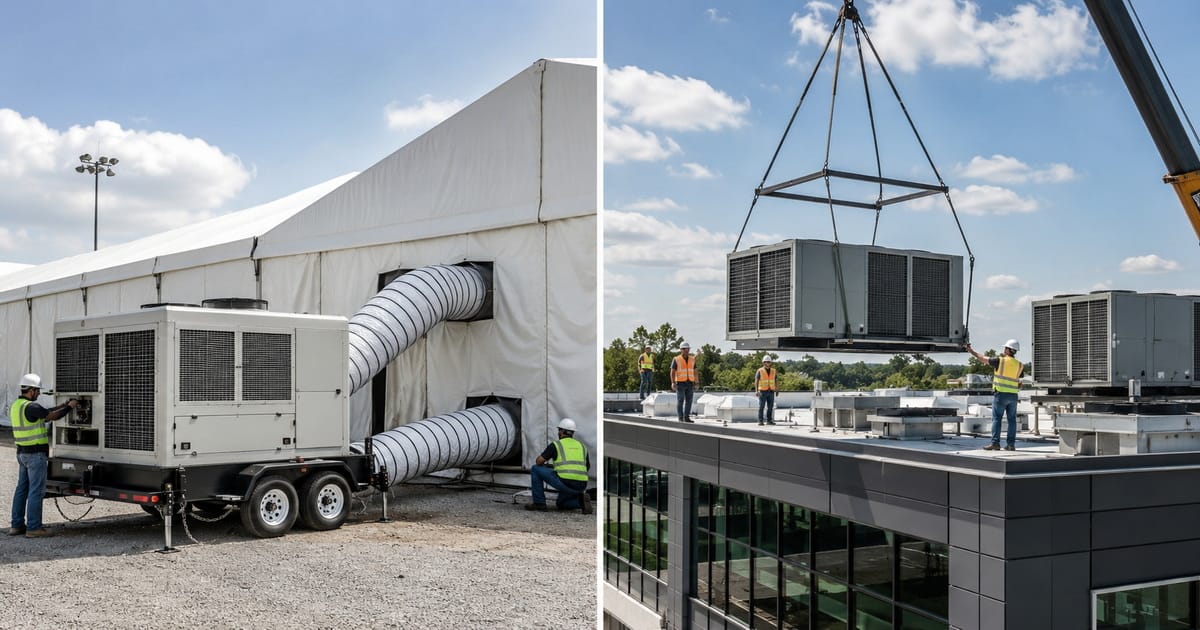
Trailer air conditioning units generally win when the project needs cooling with minimal permanent infrastructure. Modular HVAC systems win when a project needs a standardized, scalable, long-term system with reduced on-site construction work.
Why Trailer Air Conditioning Units Deploy Faster
1. The system arrives as a mobile cooling asset
A trailer-mounted AC unit is delivered on its own transport platform. There is usually no need to build a permanent equipment pad, install a rooftop curb, or complete a mechanical room before the cooling equipment arrives.
This is especially important for temporary infrastructure. Instead of waiting for extensive building services, the operator can position the unit close to the load area and route supply and return ducts to the target zone.
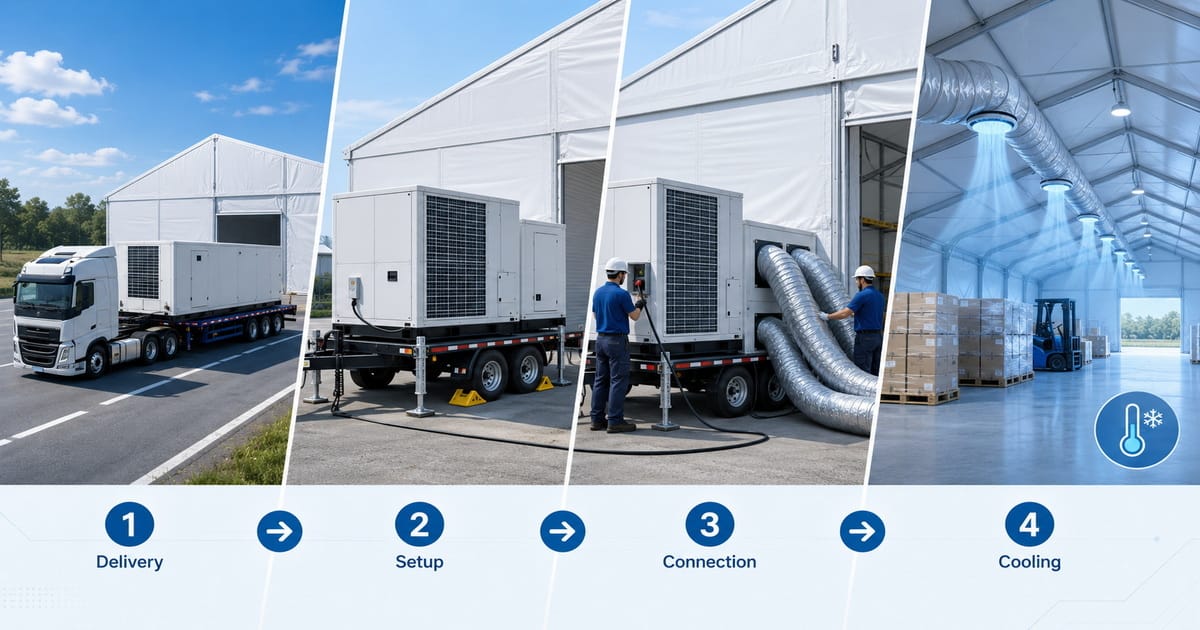
A typical deployment sequence may include:
1. Deliver the trailer AC unit to the site
2. Park and level it on stable ground
3. Secure the unit according to local safety requirements
4. Connect approved electrical power or generator supply
5. Install supply and return air ducts
6. Configure temperature, airflow, and control settings
7. Perform startup checks and begin cooling
This simplified sequence is why trailer air conditioning is widely suited to fast-response cooling scenarios.
2. Fewer building dependencies
In practical project planning, HVAC deployment is often delayed by dependencies outside the HVAC supplier’s control. These can include delayed roofing, unfinished electrical rooms, restricted crane access, incomplete walls, or late-stage architectural changes.
Trailer air conditioning units can reduce exposure to these dependencies. They can operate beside a building, tent, warehouse bay, containerized facility, or temporary enclosure without becoming part of the permanent structure.
For procurement teams, this means lower schedule risk.
3. Cooling can be zoned around the actual need
A permanent HVAC project often treats the whole building as the cooling target. In contrast, mobile trailer AC can focus capacity on the area that needs immediate temperature control.
For example, a manufacturer may only need to protect a production line, a temporary clean workspace, a server room, or a loading zone. Instead of waiting for a site-wide HVAC installation, a trailer unit can cool the high-priority area first.
This targeted strategy can improve operational continuity and reduce disruption.
Why Modular HVAC Systems Are Faster Than Traditional HVAC
Modular HVAC should not be viewed as “slow.” Compared with conventional, fully field-built systems, it can materially compress the project schedule.
Off-site manufacturing allows components to be fabricated while site work continues. Factory assembly can also improve quality control because equipment is built with standardized tooling, defined workflows, and documented testing procedures.
Key schedule advantages of modular HVAC
– Parallel workstreams: Equipment fabrication can proceed while foundations, structural work, or building envelopes are completed.
– Reduced field labor: More assembly occurs in a controlled factory rather than at a congested project site.
– Less weather exposure: Off-site production is less vulnerable to rain, heat, wind, and other jobsite interruptions.
– Standardized installation: Repeatable module designs can simplify installation across multi-site projects.
– Pre-testing opportunities: Manufacturers can test parts of the system before delivery, reducing field troubleshooting.
A commercial HVAC project may benefit significantly when modules are pre-assembled and pre-tested before on-site installation. However, final tie-ins, controls integration, air balancing, and commissioning still determine when the system can truly serve occupants or processes.
Deployment Timeline: A Realistic Comparison
The table below reflects a planning framework, not a universal installation guarantee. Actual timing depends on cooling capacity, electrical availability, duct complexity, site access, permitting, lifting requirements, climate conditions, and local codes.
| Project phase | Trailer Air Conditioning Unit | Modular HVAC System |
|---|---|---|
| Engineering and selection | Select capacity, power type, duct interface, control options | Design modules, coordinate building interfaces, confirm load calculations |
| Manufacturing approach | Unit can be held as fleet inventory or produced as a customized mobile package | Modules are usually fabricated to project specifications |
| Delivery | Road transport directly to the deployment area | Delivery often coordinated with crane, staging area, and construction schedule |
| Site setup | Positioning, power, ducting, basic safety checks | Lifting, placement, structural attachment, duct/piping/electrical tie-ins |
| Startup | Can be rapid when utilities and ducts are ready | Requires more comprehensive integrated commissioning |
| Relocation | Designed for re-deployment | Usually impractical after permanent integration |
The fastest equipment is not automatically the fastest project solution. If a trailer AC unit arrives without sufficient electrical supply, duct access, or airflow planning, it can still underperform. Likewise, a modular HVAC system that is designed early and integrated into the construction plan can outperform a poorly coordinated temporary cooling approach.
The Hidden Schedule Risks Buyers Should Evaluate
Electrical readiness
Both solutions require a reliable power strategy. Buyers should confirm voltage, frequency, phase, cable sizing, breaker protection, generator compatibility, and startup current requirements before delivery.
For international OEM and ODM projects, electrical configurations may vary by market. A climate-control supplier should be able to align the trailer air conditioning unit or modular HVAC design with destination-country electrical standards and customer branding requirements.
Air-distribution planning
Cooling capacity alone does not guarantee comfort. Poorly sized ducts, long duct runs, restrictive bends, inadequate return air, or leakage can reduce delivered airflow and create hot spots.
Before deployment, confirm:
– Required supply-air volume
– Duct diameter and material
– Maximum duct length
– Return-air pathway
– Static-pressure limits
– Location of conditioned zones
– Outdoor temperature and humidity conditions
– Need for dehumidification or filtration
Transportation and access
Trailer units need a safe road route, turning clearance, parking area, and stable ground. Modular equipment may require even more planning, including lifting plans, crane capacity, delivery windows, and staging space.
For remote sites, logistics engineering is part of HVAC engineering.
How to Choose the Right System
Choose a trailer air conditioning unit when:
– You need cooling quickly
– The project is temporary, seasonal, mobile, or emergency-based
– The site lacks permanent HVAC infrastructure
– You need to move cooling capacity between locations
– You want independent cooling zones
– You are building a rental or service fleet
– You need an OEM/ODM-branded mobile climate-control solution
Choose a modular HVAC system when:
– The building will operate long term
– You are developing a new facility or major renovation
– The project benefits from off-site fabrication
– You need integrated building controls and permanent distribution
– You can coordinate mechanical work early in the construction schedule
– You want standardized HVAC packages across multiple sites
A practical hybrid approach
Many industrial customers should not treat this as an either/or decision.
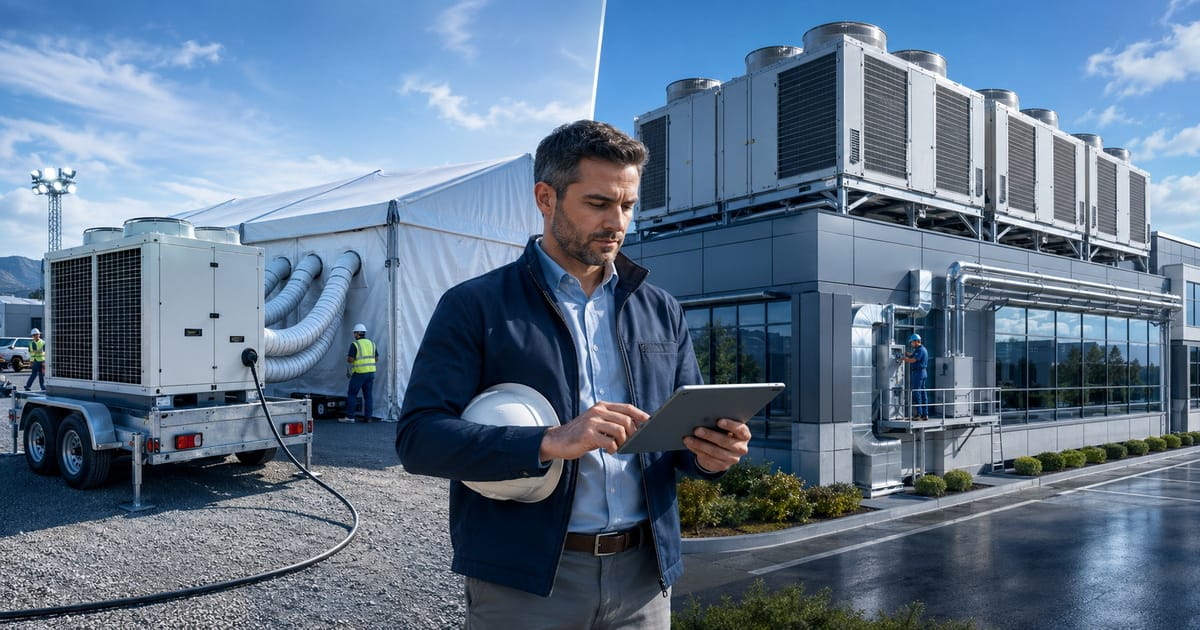
A practical strategy is to use trailer air conditioning units for temporary cooling during construction, maintenance, seasonal peaks, or emergency backup, while installing modular HVAC systems for the facility’s long-term base load.
This approach protects production continuity and prevents construction or maintenance activities from creating unacceptable heat risk.
OEM and ODM Considerations for Global Buyers
For brand owners, distributors, fleet operators, and equipment manufacturers, deployment speed starts during product development—not only at the installation site.
An experienced OEM/ODM climate-control partner can help specify a product around real deployment conditions, including:
– Cooling capacity matched to the target environment
– Voltage and frequency for destination markets
– Trailer chassis and towing configuration
– Duct connection size and airflow direction
– Generator compatibility
– Control panel language and user interface
– Remote monitoring and fault alarms
– Brand colors, logo placement, and enclosure design
– Corrosion resistance for coastal, mining, or humid environments
– Service access for faster maintenance
At DREZ (Guangzhou) Intelligent Technology Co., Ltd., the objective is not simply to supply equipment. It is to help customers develop climate-control solutions that are easier to transport, deploy, operate, maintain, and market under their own brand.
Request a Deployment-Focused Solution
Need a cooling solution that can be delivered and operational without waiting for a permanent HVAC build-out?
Contact DREZ (Guangzhou) Intelligent Technology Co., Ltd. to discuss OEM or ODM trailer air conditioning units, mobile climate-control systems, and customized deployment requirements. Share your target application, required cooling capacity, power standard, delivery market, and branding needs—and our team can help define a practical product configuration for your business.
Frequently Asked Questions
1. Are trailer air conditioning units faster to install than modular HVAC systems?
Usually, yes. Trailer air conditioning units are designed for mobility and can typically be positioned, connected to power, ducted, and commissioned with fewer site integration steps. Modular HVAC is faster than traditional field-built HVAC but still needs installation coordination and system tie-ins.
2. Can trailer-mounted AC units cool large industrial spaces?
Yes, depending on system capacity, ambient conditions, insulation, internal heat load, duct design, and airflow distribution. Large spaces may require multiple trailer AC units or a zoned deployment plan.
3. Is modular HVAC suitable for temporary projects?
It can be, but it is usually more appropriate for semi-permanent or permanent facilities. If frequent relocation, urgent commissioning, or minimal site work is the priority, trailer air conditioning units are generally more suitable.
4. What information should I provide when requesting a trailer AC quotation?
Provide the target cooling area, indoor and outdoor temperatures, heat load, required power supply, voltage/frequency, ducting distance, application type, transportation conditions, destination market, and OEM/ODM branding requirements.
5. Can a trailer air conditioning unit be customized for my brand?
Yes. OEM and ODM customization may include cooling capacity, enclosure design, color, logo, electrical configuration, controls, duct interfaces, trailer design, remote monitoring, and special environmental protection requirements.
6. What can delay trailer air conditioner deployment?
The most common delays are inadequate site power, poor ground conditions, insufficient access for the trailer, missing ductwork, unclear airflow planning, local permitting requirements, and unavailable operators or technicians.
References
1. DREZ Aircon. “[Trailer Air Conditioning vs Central Chiller System for Temporary Infrastructure Projects].” Accessed August 17, 2026.
2. Daikin. “[Prefabricated HVAC Systems: 2025 Guide].” Accessed August 17, 2026.
3. U.S. Department of Housing and Urban Development. “[Analyzing Cost and Energy Use Impact of Integrated Hot Water Systems in Modular Construction].” Accessed August 17, 2026.
4. Donnelly Mechanical. “[Understanding Modular Construction and Prefabrication].” July 4, 2024.
5. FacilitiesNet. “[Data Center Meets Aggressive Schedule With Modular Strategies].” August 16, 2017.
6. BOXX Modular. “[Choosing the Right Modular Building HVAC System].” September 25, 2022.
Hot Tags: Trailer Air Conditioning Units, Modular HVAC Systems, Mobile Air Conditioning Units, Temporary Cooling Solutions, Industrial Trailer Air Conditioners, Commercial HVAC Systems, OEM HVAC Manufacturer, ODM Climate Control Solutions, Portable Industrial Air Conditioning, Emergency Cooling Equipment