Content Menu
● What Is Trailer Air Conditioning?
>> Why Trailer Air Conditioning Fits Fast-Moving Projects
● What Is a Temporary Central Chiller System?
● Trailer Air Conditioning vs Central Chiller System: Core Differences
● When Trailer Air Conditioning Is the Better Choice
>> 1. The project requires rapid deployment
>> 2. The cooling zones are separated
>> 3. The site layout will change
>> 4. The project is short or uncertain
>> 5. The site has limited mechanical infrastructure
● When a Central Chiller System Is the Better Choice
>> 1. The project has multiple large connected buildings
>> 2. The cooling load is high and stable
>> 3. The project requires precise environmental control
>> 4. The project duration justifies installation work
>> 5. The client needs central redundancy planning
● Capacity Planning: Do Not Size by Floor Area Alone
>> A Practical Temporary Cooling Sizing Workflow
● Total Cost: Look Beyond Equipment Price
● Energy Performance and Operating Efficiency
● Reliability, Maintenance, and Site Safety
>> Trailer AC Reliability Considerations
>> Central Chiller Reliability Considerations
● Expert Recommendation for OEM and Project Buyers
● Need a Temporary Cooling Solution Built for Your Project?
>> 1. Is trailer air conditioning suitable for large temporary facilities?
>> 2. How quickly can a trailer air conditioning system be installed?
>> 3. Does a central chiller system provide better cooling than trailer AC?
>> 4. Can trailer air conditioning control humidity?
>> 5. What information should I give an OEM trailer AC supplier?
>> 6. Is an air-cooled chiller suitable for temporary infrastructure?
>> 7. Should temporary cooling equipment include backup capacity?
For temporary infrastructure projects, choosing between trailer air conditioning and a central chiller system is not simply a question of cooling capacity. It is a decision about deployment speed, site utilities, operating duration, zoning needs, reliability, and total project risk.
As a climate-control supplier working with OEMs, wholesalers, and equipment manufacturers, we often see projects lose time and budget because the cooling method is selected too late. A trailer-mounted air conditioning system can provide fast, self-contained cooling where installation flexibility matters most. A temporary central chiller system is usually better when a large site needs stable, distributed, high-capacity cooling through a water-based network.
What Is Trailer Air Conditioning?
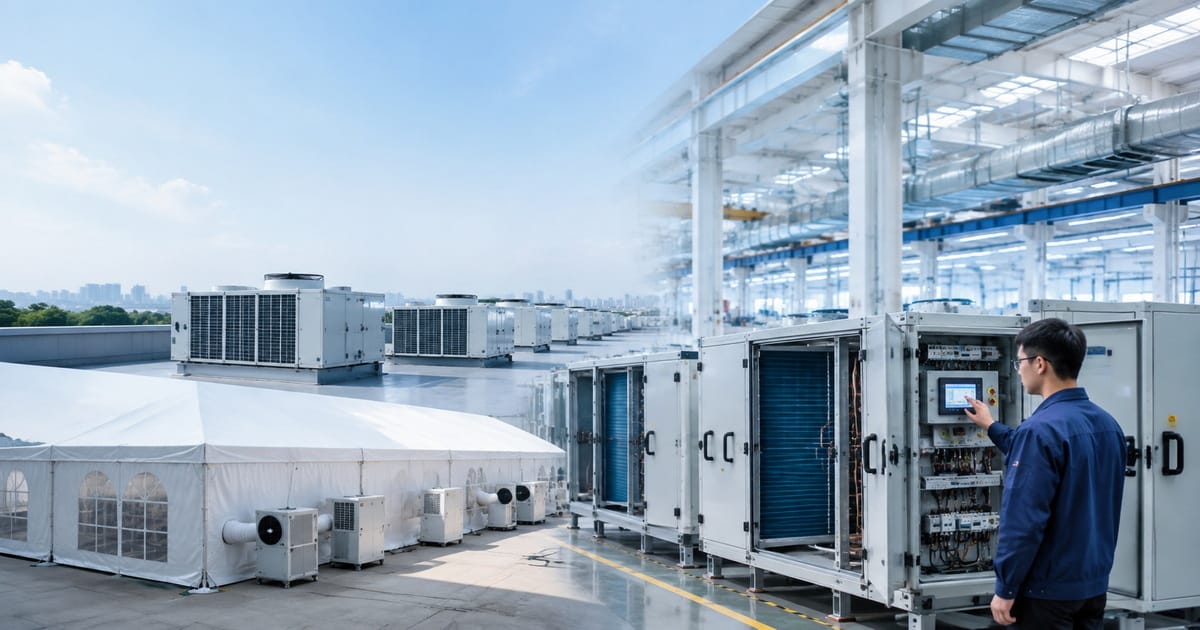
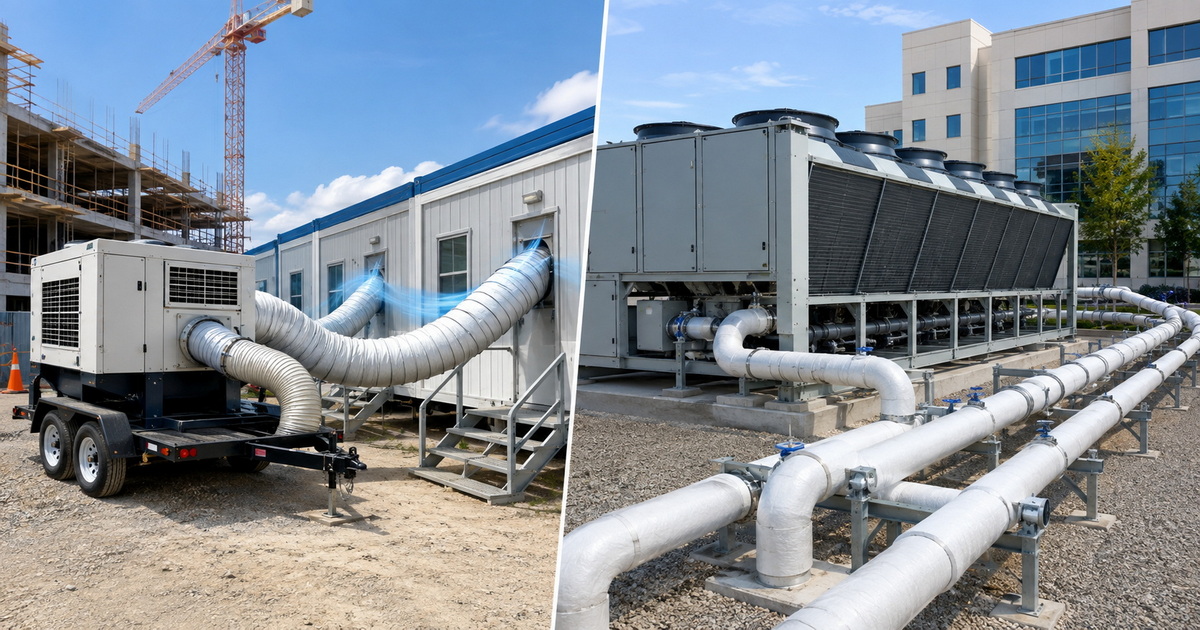
A trailer air conditioning system is a mobile cooling unit mounted on a road-ready trailer or skid platform. It is normally designed for rapid transportation, positioning, electrical connection, duct connection, and commissioning.
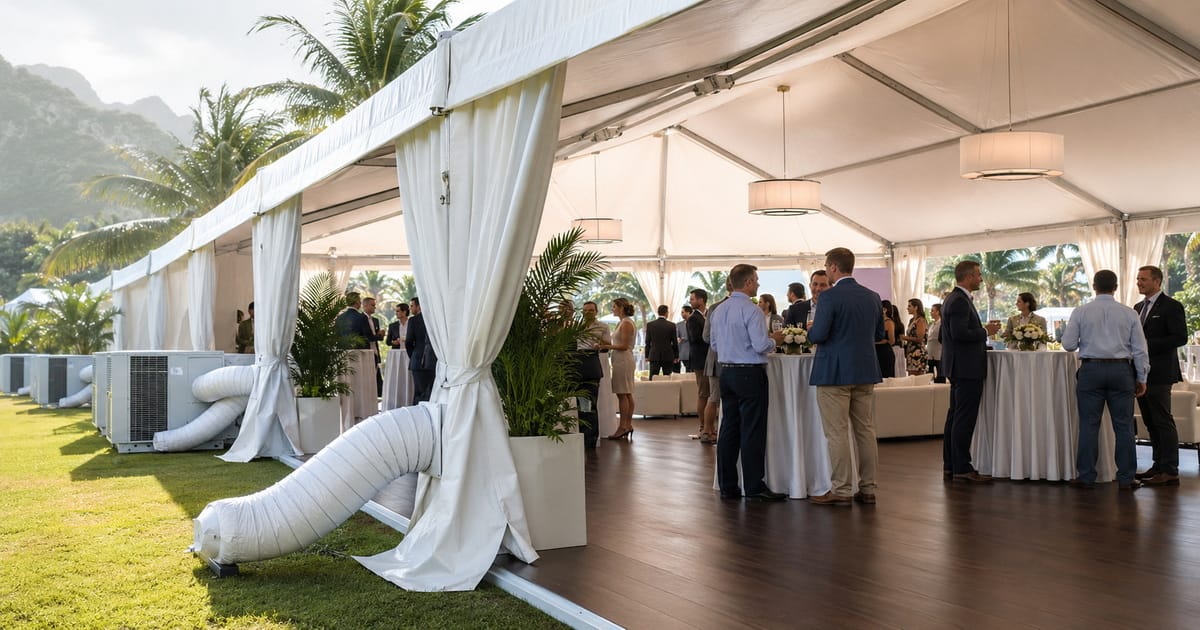
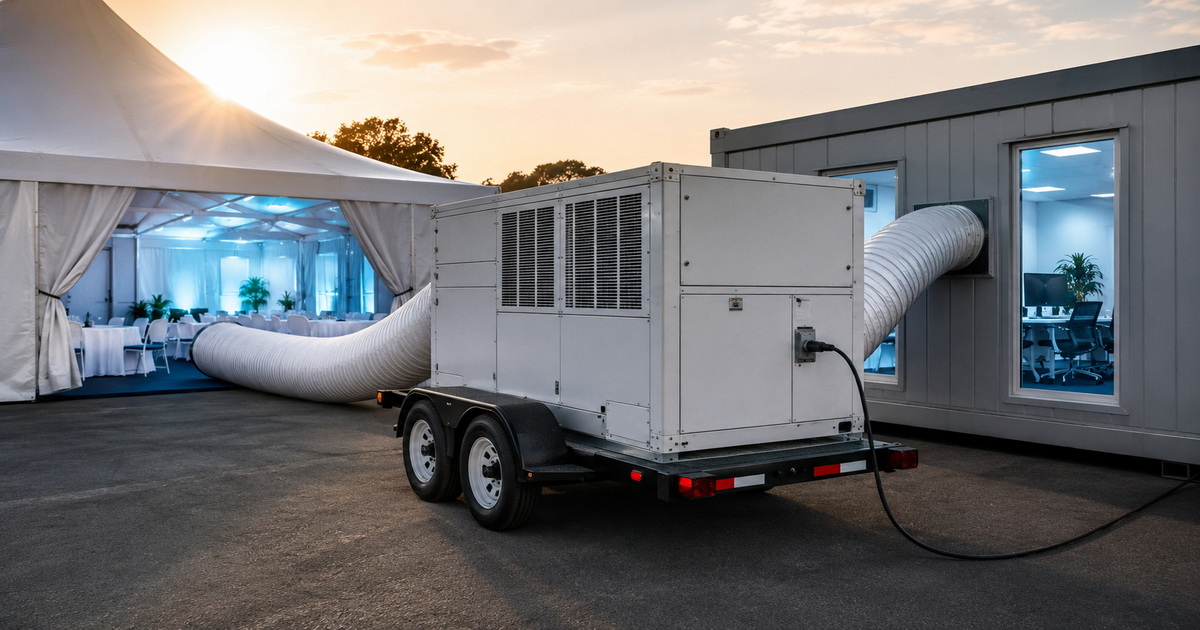
Unlike a permanent HVAC installation, trailer AC equipment is intended to be moved between projects or repositioned as site needs change. Depending on the configuration, it may supply cooled air directly into tents, temporary structures, workshops, containerized rooms, or modular facilities through flexible ductwork.
For temporary projects, the biggest advantage is simple: the cooling system can arrive as one functional package.
Typical trailer-mounted air conditioning applications include:
– Temporary offices and construction camps
– Outdoor event tents and exhibition halls
– Film sets and mobile production spaces
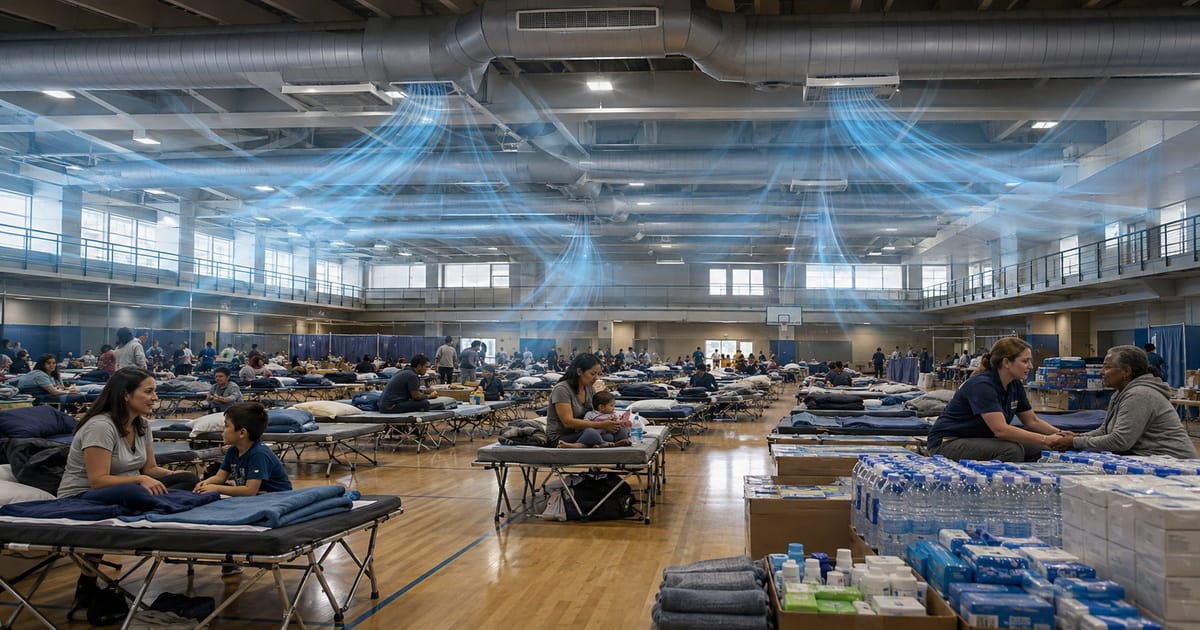
– Emergency response shelters
– Telecommunications and equipment enclosures
– Temporary warehouses
– Industrial maintenance areas
– Military and field operations
– Modular classrooms and medical units
A well-designed trailer air conditioning unit may integrate major components into a compact system, including the compressor, condenser, evaporator, supply fan, control panel, electrical protection, and transport frame.
Why Trailer Air Conditioning Fits Fast-Moving Projects
Temporary infrastructure usually has changing boundaries, uncertain handover dates, and incomplete utilities. In these conditions, a trailer AC system can reduce coordination work.
The operating model is direct:
1. Deliver the unit to the site.
2. Park it on stable ground.
3. Connect approved electrical power or a generator.
4. Install supply and return air ducts.
5. Set temperature and airflow parameters.
6. Start cooling the target zone.
This does not mean site planning is unnecessary. However, it avoids the large chilled-water distribution network, pump package, air-handling equipment, and insulation scope typically required by a central chiller system.
What Is a Temporary Central Chiller System?
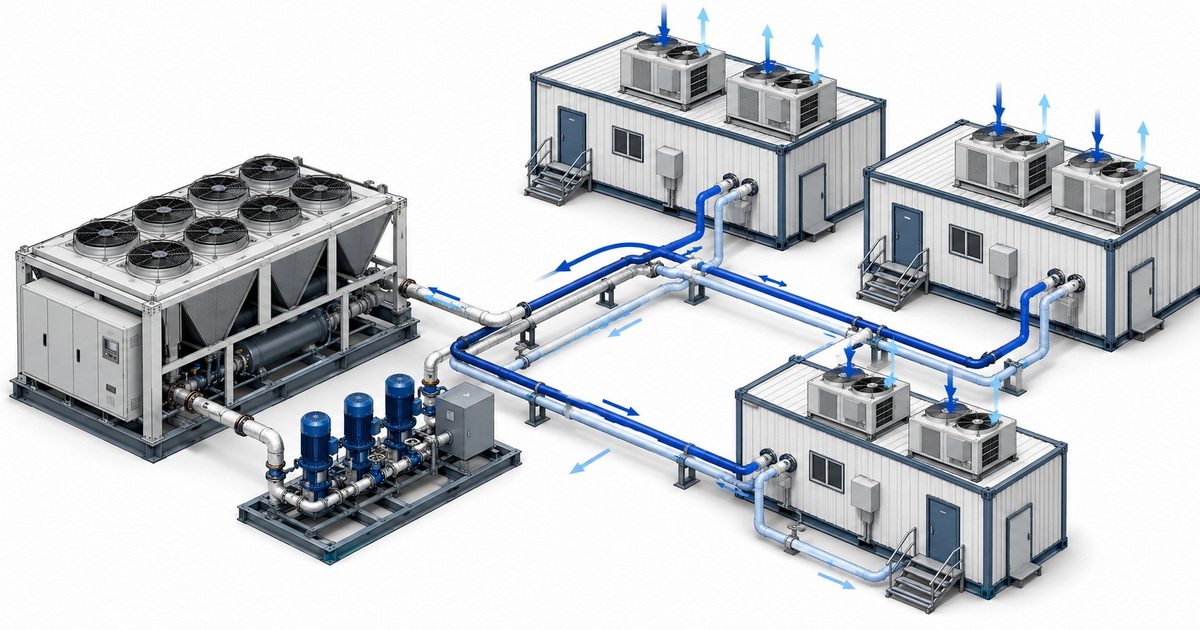
A central chiller system removes heat from water or a water-glycol solution. The chilled fluid then circulates through pipes to air-handling units, fan coil units, process equipment, or temporary cooling coils.
For temporary infrastructure projects, the chiller may be air-cooled or water-cooled. Air-cooled chillers are generally easier to deploy where cooling towers or dependable water supplies are unavailable. Water-cooled systems may be suitable for high-capacity, long-duration installations when water treatment, cooling towers, and engineering support are practical.
A temporary central chiller system usually includes:
– Chiller unit or multiple chillers
– Chilled-water pumps
– Buffer tank, where required
– Headers and valves
– Insulated supply and return piping
– Air-handling units or fan coil units
– Controls and monitoring equipment
– Electrical distribution equipment
– Backup or redundancy equipment for critical sites
The key characteristic is centralized cooling generation with distributed delivery. One plant can serve several buildings, rooms, or processes at different locations.
Trailer Air Conditioning vs Central Chiller System: Core Differences
Both systems can support temporary cooling. Their economics and operational performance become very different as project scale and duration increase.
| Decision Factor | Trailer Air Conditioning | Central Chiller System |
|---|---|---|
| Cooling delivery | Direct supply air through ducts | Chilled water distributed to air handlers or coils |
| Deployment speed | Usually very fast | Moderate to slow due to piping and distribution work |
| Best project scale | Small to medium zones | Medium to very large multi-zone sites |
| Initial installation scope | Lower | Higher |
| Site flexibility | High; unit can be relocated | Lower after piping is installed |
| Zoning | Good for independent spaces | Excellent for many connected zones |
| Cooling capacity expansion | Add more trailer units | Add chillers, pumps, or terminal units |
| Duct or pipe requirement | Flexible ducting | Insulated chilled-water piping |
| Maintenance complexity | Relatively simple per unit | Higher system-level coordination |
| Best duration | Short-term to medium-term | Medium-term to long-term |
| Typical risk | Capacity can become fragmented across zones | Installation and hydraulic design can become complex |
| Suitable for critical loads | Yes, with redundant units | Yes, with engineered redundancy and controls |
The right answer depends less on whether one system is “better” and more on whether the project needs speed and mobility or centralized scale and long-term distribution.
When Trailer Air Conditioning Is the Better Choice
Trailer air conditioning is often the stronger option when cooling must be operational quickly, the conditioned area is compact, or the site layout may change.
1. The project requires rapid deployment
A temporary event, emergency shelter, or shutdown operation may not have time for extensive piping work. A trailer AC system can be positioned close to the load and connected with ducting.
This can reduce the number of trade interfaces during installation.
2. The cooling zones are separated
Temporary projects may include tents, container offices, field clinics, security points, and modular rooms located far apart. Instead of building a long chilled-water loop, separate trailer AC units can cool individual zones.
This creates operational independence. If one unit requires servicing, other zones can continue operating.
3. The site layout will change
Construction projects evolve. A trailer system can be moved from one work area to another as teams, materials, and temporary buildings relocate.
For example, a contractor may cool a temporary electrical control room during one construction phase, then move the same unit to a commissioning tent later.
4. The project is short or uncertain
If the project duration is only weeks or a few months, a large central plant may create unnecessary installation cost and decommissioning work.
In this case, trailer air conditioning can offer a more proportional solution.
5. The site has limited mechanical infrastructure
Central chiller systems need space for pipe routes, pumping equipment, air handlers, drainage planning, and installation access. Trailer-mounted air conditioning needs a suitable parking area, power, duct routing, and safe airflow clearance.
That simpler infrastructure requirement is valuable for remote sites and rapid-response operations.
When a Central Chiller System Is the Better Choice
A temporary central chiller system becomes more attractive when cooling demand is large, continuous, distributed, or operationally critical.
1. The project has multiple large connected buildings
A temporary hospital complex, large modular accommodation camp, exhibition center, or industrial facility may contain many zones with different occupancy patterns.
A central chiller plant can feed multiple air-handling units across the site. This makes it easier to manage cooling at a system level.
2. The cooling load is high and stable
Chiller systems are engineered for large cooling loads. They can be especially effective where cooling is needed around the clock and multiple zones operate simultaneously.
Temporary chilled-water rental equipment is widely used for supplemental cooling, emergency response, industrial applications, and planned shutdowns. Available capacities can range from relatively small units to several hundred tons, depending on the supplier and project design.
3. The project requires precise environmental control
Some temporary applications need more than comfort cooling. Examples include:
– Pharmaceutical or laboratory support areas
– Data and communications spaces
– Food-processing support areas
– Industrial process cooling
– Equipment commissioning zones
– High-occupancy temporary facilities
With suitable terminal equipment and controls, a chilled-water system can offer more consistent temperature control across many locations.
4. The project duration justifies installation work
For a project lasting many months or longer, the higher initial installation effort can be offset by more organized distribution, better zoning, centralized monitoring, and easier capacity management.
5. The client needs central redundancy planning
Critical facilities may require an N+1 redundancy strategy, meaning the site can continue operating if one cooling unit is unavailable. Central plants can be designed around this requirement, although the same resilience can also be achieved by using multiple independent trailer AC units.
Capacity Planning: Do Not Size by Floor Area Alone
One of the most common mistakes in temporary cooling is selecting equipment from square footage alone. Area matters, but it is not the cooling load.
Actual demand depends on:
– Outdoor temperature and solar exposure
– Building insulation and air leakage
– Ceiling height
– Number of occupants
– Lighting load
– Computers, servers, and electrical equipment
– Industrial process heat
– Ventilation and fresh-air requirements
– Door opening frequency
– Humidity control requirements
– Future load changes during the project
For quick early-stage planning, rental-industry guidance often uses rules of thumb such as approximately one ton of cooling per 400 square feet for some basic conditioned spaces. Tents with sides may require around one ton per 125 square feet, while occupancy and equipment loads can change the result significantly. These figures are planning references only, not final engineering calculations.
A Practical Temporary Cooling Sizing Workflow
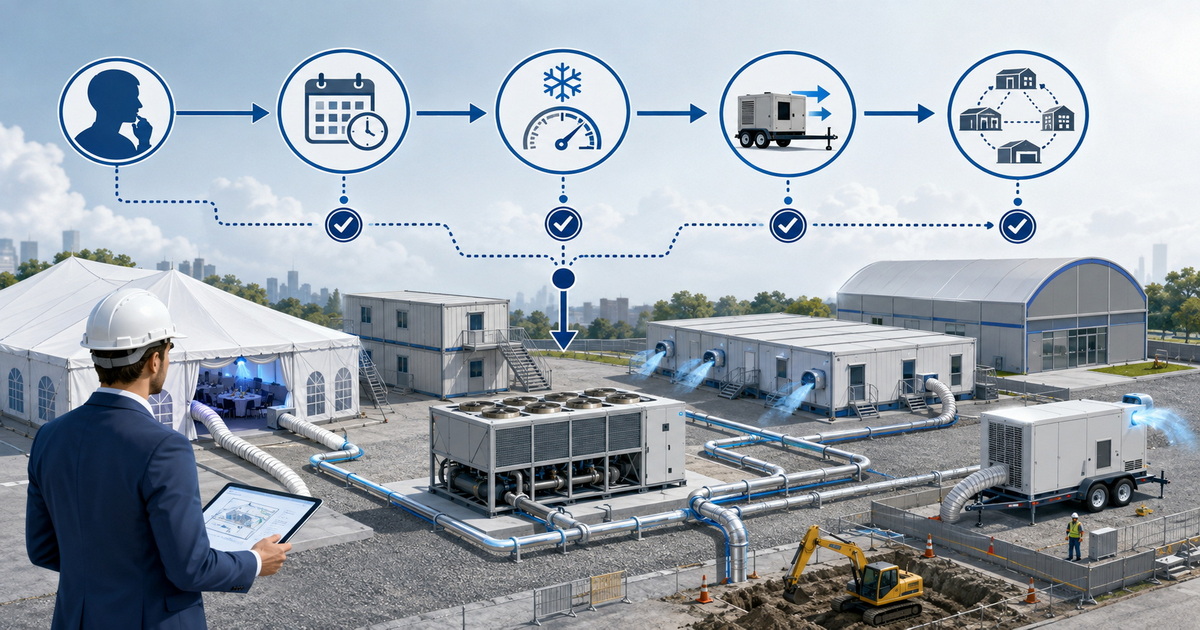
Before selecting trailer AC units or a central chiller system, use this process:
1. Define the objective.
Is the project seeking comfort cooling, process cooling, humidity control, equipment protection, or all four?
2. Map every conditioned zone.
Identify floor area, height, construction type, occupancy, operating hours, and internal heat sources.
3. Calculate sensible and latent loads.
Sensible heat changes air temperature. Latent heat is associated with moisture removal. Both matter in humid climates.
4. Review diversity.
Not every zone reaches peak load at the same moment. However, critical spaces may require full guaranteed capacity.
5. Allow for contingency.
Temporary sites are dynamic. A reasonable reserve protects the project from added equipment, hotter weather, or occupancy changes.
6. Validate power availability.
Cooling capacity is useless if the electrical system or generator cannot support startup current and operating demand.
7. Plan redundancy.
Identify what happens if one unit stops. Can another trailer unit be moved? Is there standby chiller capacity?
Total Cost: Look Beyond Equipment Price
A lower equipment rental or purchase price does not always mean the lower total project cost.
For trailer air conditioning, cost categories often include:
– Equipment transport
– Site positioning
– Electrical connection
– Ducting
– Fuel or electricity
– Routine maintenance
– Operator support, if required
For temporary central chiller systems, additional costs may include:
– Piping materials and insulation
– Pump skids and water connections
– Air handlers or cooling coils
– Temporary structural supports
– Installation labor
– Water treatment for water-cooled arrangements
– Controls integration
– Flushing, testing, and decommissioning
The best procurement method is to compare the installed cost per usable cooling zone, not only the unit price or nominal cooling capacity.
A 100-ton chiller may look efficient on paper. But if the project requires long pipe runs, multiple pumps, electrical upgrades, and complex terminal installation, the total cost can exceed a modular trailer AC approach for a short-duration project.
By contrast, buying several small trailer units without a coordinated airflow plan can create noise, power, duct-routing, and maintenance problems. The lowest-cost approach is usually the one that matches the actual site operating model.
Energy Performance and Operating Efficiency
Efficiency should be evaluated at the operating condition, not only from a brochure rating.
EER measures cooling output relative to electrical input at a defined full-load condition. SEER or SEER2 evaluates seasonal performance for smaller comfort-cooling equipment under standardized test procedures. For temporary industrial projects, actual site performance may differ because of ambient temperature, duct losses, part-load operation, generator loading, and maintenance condition.
When comparing options, ask suppliers for:
– Rated cooling capacity at the project design ambient temperature
– Power input at full and part load
– Airflow and external static pressure capability
– Chilled-water flow and pump head requirements
– Noise data at the property boundary
– Recommended duct or pipe length limits
– Required power supply and startup characteristics
– Temperature and humidity control range
– Maintenance intervals
– Remote monitoring options
For trailer air conditioning, duct design is often the hidden efficiency factor. Long, undersized, poorly sealed ducts increase pressure drop and reduce delivered airflow.
For central chiller systems, pipe routing and hydraulic balancing are equally important. Poor balancing can leave distant zones warm while closer zones receive excessive flow.
Reliability, Maintenance, and Site Safety
Temporary does not mean low-risk. Cooling failure can interrupt production, damage sensitive equipment, reduce worker comfort, create safety issues, or delay event operations.
Trailer AC Reliability Considerations
– Select weather-resistant enclosures for outdoor placement.
– Maintain clear condenser airflow.
– Protect ducts from crushing, sharp bends, and vehicle traffic.
– Use properly rated power cables and grounding.
– Keep backup capacity for mission-critical areas.
– Inspect filters, condensate drainage, and fan performance.
Central Chiller Reliability Considerations
– Verify pump redundancy and standby capacity.
– Insulate piping to prevent condensation and energy loss.
– Test water flow, pressure, and valve operation.
– Ensure air handlers have adequate condensate drainage.
– Use proper freeze protection where climate conditions require it.
– Commission controls before occupancy begins.
For both solutions, create a simple site document showing equipment location, electrical source, airflow or water route, emergency contacts, maintenance schedule, and backup plan.
Expert Recommendation for OEM and Project Buyers
Choose trailer air conditioning when your priority is fast deployment, direct cooling, mobility, independent zones, and minimal mechanical installation.
Choose a central chiller system when your priority is large-scale capacity, multiple connected zones, stable long-duration operation, centralized control, and engineered redundancy.
For many large temporary infrastructure projects, the most resilient answer is a hybrid cooling strategy:
– Use a central chiller system for core buildings and permanent-like modular facilities.
– Use trailer AC units for remote zones, surge demand, temporary work fronts, or emergency backup.
This approach prevents one system from carrying every operational risk.
Need a Temporary Cooling Solution Built for Your Project?
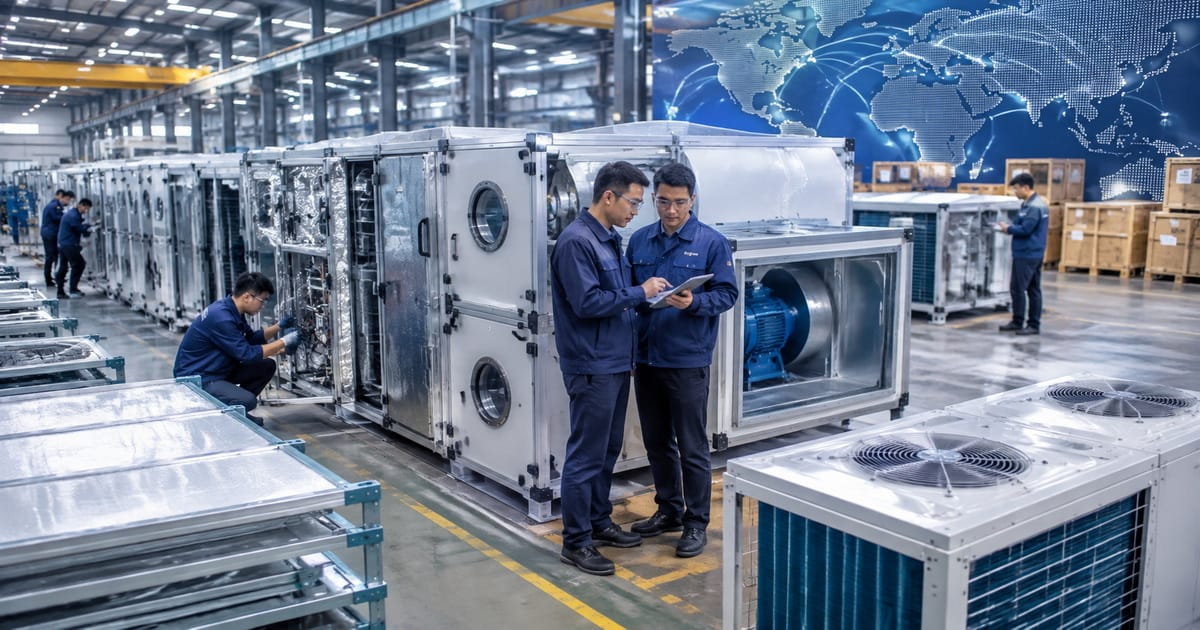
DREZ (Guangzhou) Intelligent Technology Co., Ltd. supports global brands, wholesalers, and equipment manufacturers with OEM and ODM trailer air conditioning solutions for temporary and mobile climate-control applications.
Share your project location, target temperature, conditioned area, occupancy, heat sources, available power, operating duration, and installation constraints. Our technical team can help you evaluate whether a trailer-mounted air conditioning solution, a central chilled-water approach, or a hybrid design is the most practical option for your market and application.
Frequently Asked Questions
1. Is trailer air conditioning suitable for large temporary facilities?
Yes. Multiple trailer AC units can cool large facilities by dividing the site into independent zones. This approach is often practical for temporary camps, event areas, modular buildings, and separated workspaces. For a large connected complex with continuous high load, a central chiller system may be more efficient to manage.
2. How quickly can a trailer air conditioning system be installed?
Installation time depends on site access, power availability, duct length, and commissioning requirements. Compared with a chilled-water plant requiring pipe installation, pumps, and terminal units, a trailer AC system generally offers a much faster route to operational cooling.
3. Does a central chiller system provide better cooling than trailer AC?
Not automatically. A central chiller system is better suited to large, distributed, and long-term applications. Trailer air conditioning is often better for rapid deployment and flexible zone-by-zone cooling. The correct option depends on the site load profile and project constraints.
4. Can trailer air conditioning control humidity?
Yes, many trailer AC systems can remove moisture while cooling. However, required humidity performance depends on entering air conditions, coil design, airflow, temperature setpoint, and outside-air volume. Projects with strict humidity requirements should provide design conditions before equipment selection.
5. What information should I give an OEM trailer AC supplier?
Provide the cooling area, building type, ceiling height, local weather conditions, indoor temperature target, humidity target, number of occupants, heat-generating equipment, operating hours, available electrical supply, transport requirements, duct connections, and any required certifications.
6. Is an air-cooled chiller suitable for temporary infrastructure?
Often, yes. Air-cooled chillers are widely used for temporary chilled-water applications because they avoid the additional cooling-tower and condenser-water infrastructure associated with water-cooled systems. Suitability still depends on ambient temperature, capacity, installation space, noise limits, and electrical availability.
7. Should temporary cooling equipment include backup capacity?
For critical areas, yes. A backup plan can include an additional trailer AC unit, spare rental chiller capacity, standby generators, dual power paths, or multiple smaller units instead of one large single point of failure.
References
1. AHRI. “[2023 Energy Efficiency Standards].” Explains the transition to SEER2, EER2, and updated HVAC efficiency test procedures. [ahrinet]
2. AAON. “[What Do the Different Efficiency Ratings Mean?].” Defines EER and SEER and describes their use in assessing cooling efficiency. [aaon]
3. Carrier Rental Systems. “[Air-Cooled Chillers].” Covers temporary air-cooled chiller applications and available rental capacity ranges. [carrier]
4. Carrier Rental Systems. “[Chiller Rentals].” Describes planned shutdown, supplemental cooling, emergency response, process cooling, and temporary chiller applications. [carrier]
5. Carrier Rental Systems. “[Air-Cooled Chiller Rentals].” Describes temporary chilled-water solutions for emergency, industrial, and food-processing applications. [carrier]
6. Sunbelt Rentals. “[Finding the Best Temporary HVAC for Job Sites].” Provides preliminary job-site sizing examples, heat-load factors, and planning cautions. [sunbeltrentals]
7. IES. “[ASHRAE Heating and Cooling Load Calculations].” Reviews key principles in cooling-load calculations and the limitations of rules-of-thumb. [iesve]