Content Menu
● What Is the Difference Between Trailer Air Conditioning and Container HVAC Units?
● Trailer AC vs Container HVAC at a Glance
● Mobility: Why Trailer Air Conditioning Usually Wins
>> Where Trailer Air Conditioning Performs Best
>> Trailer AC Design Priorities for OEM Buyers
● Cooling Capacity: Why Container HVAC Often Offers More Headroom
>> Cooling Capacity Is Not the Same as Cooling Performance
>> When Container HVAC Is the Better Fit
● A Practical Cooling-Load Workflow for Buyers
>> Step 1: Define the Thermal Envelope
>> Step 2: Identify Peak Operating Conditions
>> Step 3: List Internal Heat Sources
>> Step 4: Select Air Distribution and Controls
>> Step 5: Validate the Prototype
● Energy Efficiency, Power Supply, and Operating Cost
>> Design for the Hottest Hour, Not the Average Day
● OEM and ODM Considerations for Climate-Control Brands
● Which System Should You Choose?
● Request a Custom Climate-Control Solution
● FAQ
>> 1. Is a trailer air conditioner suitable for continuous operation?
>> 2. How many BTUs does a 20-foot container need?
>> 3. Can a container HVAC unit be transported with the container?
>> 4. What is more energy-efficient: trailer AC or container HVAC?
>> 5. Should I select HVAC capacity based only on container size?
>> 6. What information should I provide to an OEM trailer AC manufacturer?
Choosing between trailer air conditioning and container HVAC units is not simply a question of BTU rating. For OEM brands, distributors, fleet operators, and modular-space manufacturers, the right answer depends on where the unit operates, how often it moves, the available power supply, the enclosure’s insulation, and the required temperature stability.
From an HVAC product-development perspective, trailer-mounted systems usually deliver better operational mobility, while container HVAC units often provide more scalable, application-specific cooling for fixed or semi-permanent spaces. The best option is the system that matches the real heat load—not the largest unit on a specification sheet.
DREZ (Guangzhou) Intelligent Technology Co., Ltd. supports overseas brands, wholesalers, and manufacturers with OEM and ODM climate-control solutions. This comparison is designed to help procurement teams define the right product architecture before requesting a custom trailer AC or container HVAC solution.
What Is the Difference Between Trailer Air Conditioning and Container HVAC Units?
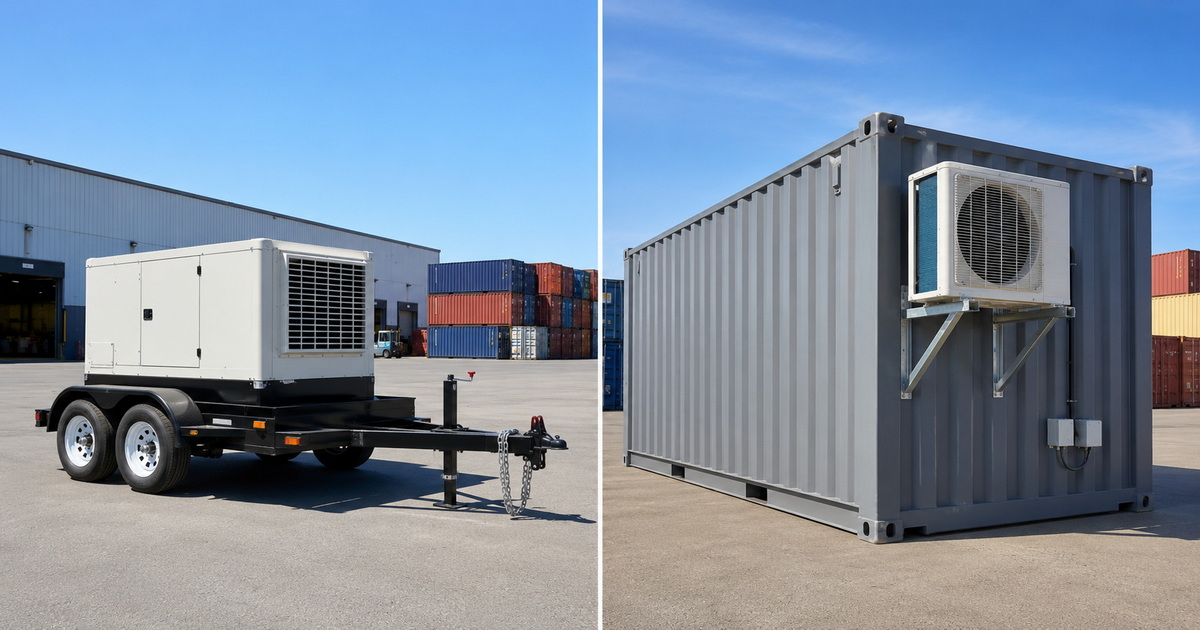
A trailer air conditioning system is engineered to cool a moving or frequently relocated trailer, mobile cabin, service vehicle, temporary field unit, or specialty mobile equipment. Its design must account for vibration, road shock, compact mounting space, weather exposure, electrical limitations, and practical maintenance access.
A container HVAC unit provides heating, ventilation, and air conditioning for a shipping container or containerized structure. Typical applications include mobile offices, telecom shelters, battery-energy-storage enclosures, workshops, equipment rooms, temporary clinics, security stations, and modular accommodation.
Cooling capacity refers to the rate at which an HVAC system removes heat. It is commonly expressed in BTU/h, kW, or refrigeration tons; 1 ton of cooling equals 12,000 BTU/h. However, capacity alone does not determine real-world comfort. Poor insulation, direct solar exposure, air leakage, high humidity, people, lighting, and operating equipment can each increase the cooling load significantly.
Trailer AC vs Container HVAC at a Glance
| Comparison factor | Trailer air conditioning | Container HVAC units | Better choice |
|---|---|---|---|
| Mobility | Designed for frequent movement and transport | Usually installed for stationary or semi-stationary use | Trailer AC |
| Mounting flexibility | Rooftop, wall-mounted, under-bench, split or packaged configurations | Wall-mounted, rooftop, split, ducted, packaged, or through-wall configurations | Depends on enclosure design |
| Cooling capacity scalability | Limited by trailer size, power, weight, and mounting area | Easier to scale with larger, multi-zone, or ducted configurations | Container HVAC |
| Road vibration resistance | A core design requirement | May require extra reinforcement for transport | Trailer AC |
| Interior air distribution | Best for compact, single-zone spaces | Better suited to long containers and divided spaces | Container HVAC |
| Installation speed | Fast when integrated into a trailer production line | Fast for pre-engineered container projects, but may need cut-outs and insulation work | Depends on project maturity |
| Typical operating pattern | Mobile, intermittent, route-based, field service | Longer duty cycles, stationary deployment, controlled enclosure | Depends on application |
| OEM/ODM customization | Strong potential for vehicle platform integration | Strong potential for enclosure layout and climate-control specifications | Both |
Mobility: Why Trailer Air Conditioning Usually Wins
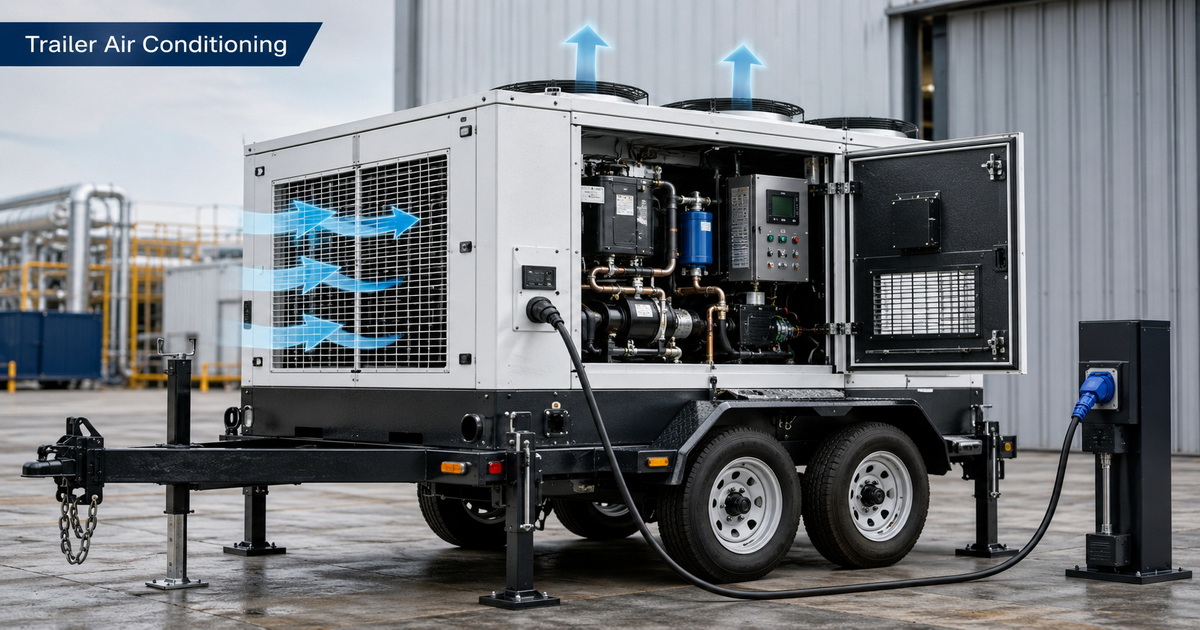
For mobility, a purpose-built trailer AC system is normally the stronger option. It is designed around the realities of transport: vibration, acceleration, road debris, weather variation, limited mounting surfaces, and constrained onboard electrical power.
An industrial portable or mobile cooling system should be selected around the application’s cooling load, airflow, humidity, available electrical service, and physical operating environment—not just floor area. In mobile equipment, undersizing can force continuous operation, increasing compressor stress and reducing performance under high ambient temperatures.
Where Trailer Air Conditioning Performs Best
Trailer air conditioning is especially suitable for:
– Mobile service trailers and roadside support units
– Event trailers and temporary ticketing cabins
– Field laboratories and mobile testing units
– Command centers and emergency-response trailers
– Recreational, hospitality, or demonstration trailers
– Specialty vehicle cabins and mobile workspaces
– Portable clinics, inspection units, and equipment trailers
For product managers, mobility includes more than wheels. A truly mobile HVAC design should consider weight distribution, center of gravity, electrical demand, drainage, mounting strength, service access, and transport vibration.
Trailer AC Design Priorities for OEM Buyers
When developing an OEM trailer air conditioner, I recommend documenting these requirements before selecting a platform:
1. Define the trailer’s internal volume, insulation level, window area, and peak occupancy.
2. Identify whether cooling is required while driving, while parked, or in both conditions.
3. Confirm the power source: grid connection, generator, battery bank, solar-assisted battery, or hybrid power.
4. Specify the maximum ambient temperature and humidity in the target sales markets.
5. Set noise, corrosion-resistance, ingress-protection, refrigerant, control-interface, and branding requirements.
6. Confirm mounting style: rooftop, side-wall, rear-wall, concealed split system, or custom integrated housing.
A trailer AC unit that is easy to install but difficult to maintain will create warranty pressure for the brand owner. For this reason, removable panels, accessible filters, clear diagnostic codes, and replaceable service components should be considered early in the OEM design process.
Cooling Capacity: Why Container HVAC Often Offers More Headroom
A container HVAC unit often has an advantage when the project needs higher capacity, more even airflow, multiple rooms, or longer daily operating hours. A standard 20-foot container has roughly 150 square feet of interior floor area, while a 40-foot container has around 300 square feet.
However, the same container can require dramatically different HVAC capacity depending on insulation and climate. One industry sizing guide suggests that an insulated 20-foot container in a moderate climate may need roughly 9,000–12,000 BTU/h, whereas an uninsulated unit under extreme heat may need 18,000–24,000 BTU/h. These figures are planning references—not substitutes for an engineering load calculation.
Cooling Capacity Is Not the Same as Cooling Performance
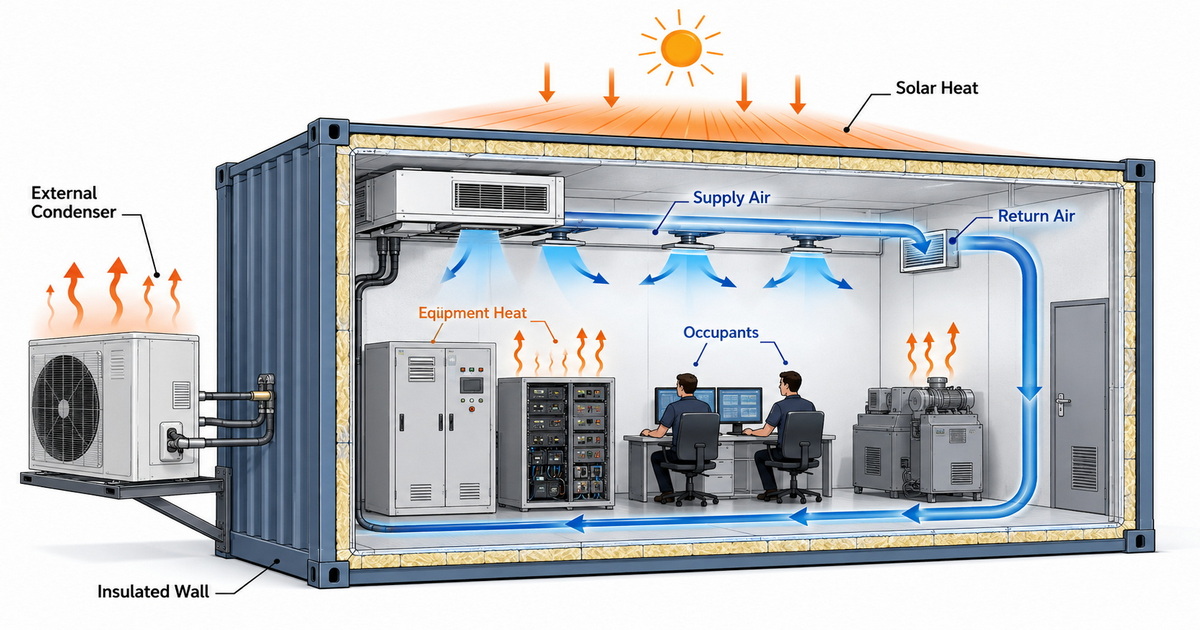
A high-capacity container AC can still underperform when airflow is blocked, ducting is poorly designed, doors remain open, or the metal shell receives intense solar radiation. In practice, the system must remove heat from several sources:
– Heat transfer through the roof, walls, floor, and doors
– Solar gain, especially on unshaded steel roofs and sidewalls
– Air infiltration from door openings and gaps
– Occupants, lighting, computers, chargers, machinery, or telecom equipment
– Outdoor ventilation air and humidity
– Heat generated by the HVAC system’s own electrical components
Cooling-load methodologies account for geometry, insulation, orientation, solar conditions, internal equipment, occupancy, and outdoor design conditions. This is why a “one-size-fits-all” BTU recommendation can lead to poor comfort, excess energy use, and avoidable warranty claims.
When Container HVAC Is the Better Fit
Container HVAC units are usually the better solution for:
– Shipping container offices and guard rooms
– Containerized data, telecom, or network equipment shelters
– Battery or power-electronics enclosures
– Modular classrooms and accommodation
– Mining, construction, and remote-site facilities
– Container workshops and tool rooms
– Laboratory, medical, or controlled-environment containers
For a 40-foot container divided into office and equipment zones, a single small wall AC may create hot and cold areas. A better approach may be a ducted or multi-zone design with correctly placed supply and return air paths.
A Practical Cooling-Load Workflow for Buyers
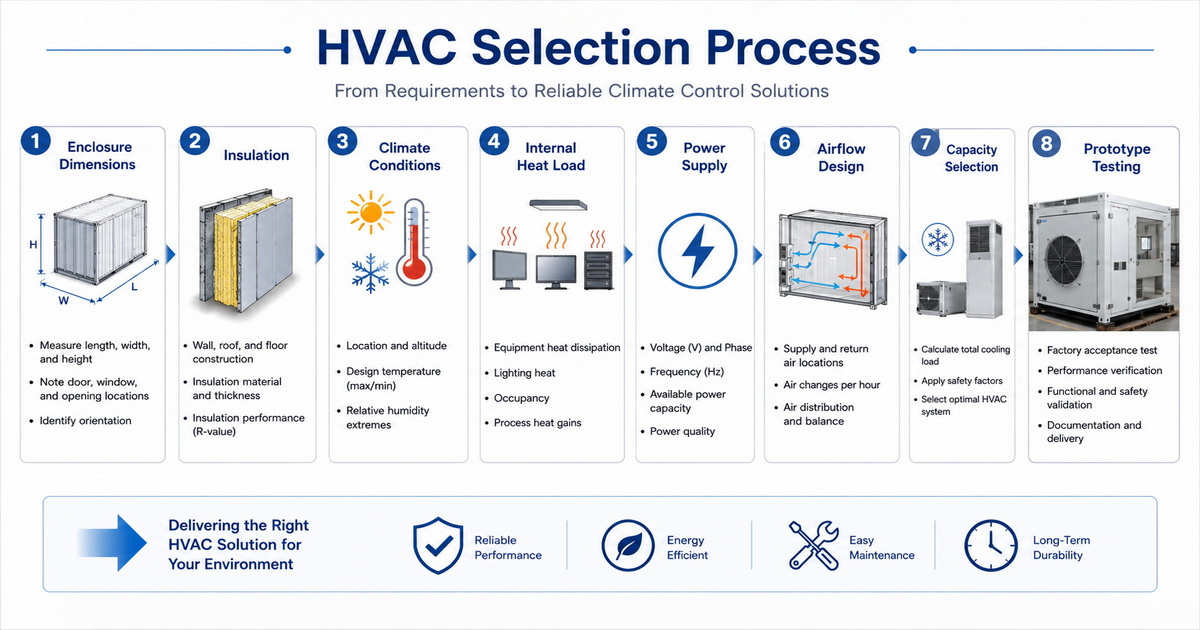
The best procurement decision starts with an application brief. Before comparing trailer AC suppliers or container HVAC manufacturers, use the following workflow.
Step 1: Define the Thermal Envelope
Record the enclosure type, dimensions, wall construction, insulation thickness, roof color, window area, door-opening frequency, and airtightness. Insulation should be addressed before final HVAC sizing, because it directly changes the heat entering the conditioned space.
Step 2: Identify Peak Operating Conditions
Use the hottest expected local weather conditions rather than average annual weather. Also record humidity, direct sunlight, elevation, and whether the unit will operate on asphalt, in a yard, under a canopy, or inside a building.
Step 3: List Internal Heat Sources
Count people, lighting, computers, chargers, battery systems, appliances, process equipment, and any equipment that runs continuously. A container used as a telecom shelter has a very different cooling profile from a container used as a daytime office.
Step 4: Select Air Distribution and Controls
Decide where cooled air enters, where warm return air is collected, and whether separate zones need separate setpoints. For temperature-sensitive equipment, consider remote monitoring, alarms, staged compressors, variable-speed control, and automatic restart after a power interruption.
Step 5: Validate the Prototype
Test the first unit during a realistic high-load condition. Measure indoor temperature, humidity, supply-air temperature, compressor cycling, noise, power consumption, and temperature recovery after doors open. This provides evidence for final product optimization and strengthens the OEM brand’s technical documentation.
Energy Efficiency, Power Supply, and Operating Cost
Energy efficiency should be evaluated as a system-level issue. An efficient compressor cannot compensate for an uninsulated container, leaking doors, undersized wiring, poor return-air design, or a generator that cannot support compressor starting current.
For trailers, the key question is often: Can the available onboard power run the AC reliably without compromising other equipment? A compact DC, inverter-driven, or hybrid-power design may be valuable where idle-free operation, battery runtime, or generator fuel use matters.
For containers, efficiency gains often come from better insulation, reflective exterior coatings, roof shading, sealed penetrations, sensible thermostat settings, and a properly sized system. Oversized air conditioners can cycle too quickly and may control humidity less effectively, while undersized systems can run continuously and wear prematurely.
Design for the Hottest Hour, Not the Average Day
In climate-control projects, the largest performance complaints often occur during the hottest afternoon period, not at noon on a mild day. Steel containers can absorb significant solar heat, particularly on the roof. A technically sound proposal should therefore state the assumed outdoor design temperature, solar exposure, target indoor condition, and occupancy/equipment load.
This transparency improves trust between the manufacturer, OEM customer, installer, and end user. It also protects the brand from unrealistic performance expectations.
OEM and ODM Considerations for Climate-Control Brands
For overseas brands and distributors, choosing between trailer air conditioning and container HVAC should include product strategy—not only technical capacity.
DREZ can support OEM and ODM projects by aligning the HVAC configuration with the customer’s enclosure, target climate, installation process, and market positioning. A high-quality custom program should define more than a capacity range.
Key OEM/ODM specification areas include:
– Cooling and heating capacity at stated ambient conditions
– Voltage, frequency, battery compatibility, and generator requirements
– Refrigerant platform and compliance requirements for the destination market
– Rooftop, wall, split, ducted, or packaged-system configuration
– Corrosion protection for coastal, humid, dusty, or high-salinity locations
– Noise targets for residential, hospitality, medical, or field applications
– Controller language, user interface, remote monitoring, and fault diagnostics
– Brand color, logo placement, carton design, manuals, and spare-parts strategy
– Pilot-run testing, inspection criteria, and after-sales documentation
A successful custom HVAC project begins with a detailed application questionnaire. It does not begin with the question, “What is your lowest price for a 12,000 BTU unit?”
Which System Should You Choose?
Choose a trailer air conditioning system if your priority is frequent movement, road-ready construction, compact installation, and mobile operation. It is the natural choice for trailers, mobile service platforms, temporary field units, and specialty vehicles.
Choose a container HVAC unit if your priority is stable long-term cooling, greater capacity flexibility, ducted or multi-zone airflow, and climate control inside a containerized structure. It is usually the stronger solution for container offices, technical shelters, modular facilities, and equipment enclosures.
For applications that combine transport and long stationary operation, a hybrid approach may work best: a ruggedized container HVAC platform with reinforced mounting, transport locks, flexible electrical input, and remote monitoring.
Request a Custom Climate-Control Solution
Need a trailer AC system or container HVAC unit designed around your market and enclosure? Share your dimensions, insulation specification, target climate, power supply, indoor temperature target, and expected operating hours with DREZ.
Our engineering and OEM/ODM teams can help evaluate the cooling load, recommend the right configuration, and develop a climate-control solution that supports your product brand—not just your initial purchase order.
FAQ
1. Is a trailer air conditioner suitable for continuous operation?
It can be, provided the system is correctly sized for the trailer’s heat load and has a reliable power source. Continuous operation also requires proper airflow, maintenance access, filtration, and compressor protection.
2. How many BTUs does a 20-foot container need?
There is no universal answer. As a planning reference, an insulated 20-foot container in moderate conditions may need about 9,000–12,000 BTU/h, while an uninsulated container in severe heat can require 18,000–24,000 BTU/h or more.
3. Can a container HVAC unit be transported with the container?
Yes, but the mounting structure, refrigerant lines, electrical connections, condensate drainage, and vibration protection must be engineered for transport. A standard stationary installation may not withstand repeated road movement.
4. What is more energy-efficient: trailer AC or container HVAC?
Neither category is inherently more efficient. Actual efficiency depends on system sizing, compressor technology, insulation, solar exposure, enclosure sealing, power supply, controls, and operating conditions.
5. Should I select HVAC capacity based only on container size?
No. Container size is only a starting point. The cooling-load assessment should also include climate, insulation, sun exposure, ventilation, people, door openings, and heat-producing equipment.
6. What information should I provide to an OEM trailer AC manufacturer?
Provide enclosure drawings, internal dimensions, insulation details, target countries, maximum ambient temperature, humidity, power source, required run time, installation location, noise target, and branding or certification requirements.
References
1. Trane Commercial. “[What Is Cooling Capacity?]” Defines cooling capacity and common units of measurement. [trane]
2. Global Industrial. “[Industrial Portable Air Conditioner Guide: How to Choose the Right Cooling Solution]” Covers industrial cooling selection factors, capacity units, and application variables. [globalindustrial]
3. Mobile Modular. “[Shipping Container Heating and Cooling: BTU Sizing]” Provides reference container cooling ranges based on insulation and climate conditions. [mobilemodularcontainers]
4. U.S. Department of Energy / Building America. “[Energy Impacts of Oversized Residential Air Conditioners]” Discusses the impacts of HVAC oversizing. [www1.eere.energy]
5. Pacific Northwest National Laboratory. “[Air Conditioning]” Explains the importance of load calculation and correct equipment sizing. [basc.pnnl]
6. Container One. “[Shipping Container Dimensions]” Provides typical internal and external dimensions for standard shipping containers. [containerone]
7. IES Virtual Environment. “[ASHRAE Heating & Cooling Load Calculations]” Summarizes cooling-load factors such as geometry, solar gain, occupancy, and equipment loads. [iesve]
Hot Tags: Trailer Air Conditioning Systems, Container HVAC Units, Mobile HVAC Solutions, Trailer Air Conditioner Manufacturer, Container Air Conditioning System, OEM HVAC Manufacturer, ODM Climate Control Solutions, Mobile Cooling Equipment, Industrial Container Cooling, Custom Trailer HVAC Systems