Content Menu
● What Is the Difference Between Trailer Air Conditioning and Ducted Portable Systems?
● Why High Heat Loads Challenge Mobile Cooling Systems
>> The Five Heat Sources Buyers Often Underestimate
● Which System Performs Better in Extreme Heat?
>> 1. Effective Capacity Matters More Than Nameplate BTU
>> 2. Air Distribution Decides Whether Occupants Feel Cool
>> 3. Trailer AC Usually Wins on Continuous Duty
● High-Heat Performance Comparison
● A Practical Load-Assessment Method Before You Buy
● When a Ducted Portable System Is the Smarter Choice
● OEM and ODM Considerations for Trailer Brands
● FAQ
>> 1. Is trailer air conditioning better than a portable AC for hot climates?
>> 2. Can a ducted portable air conditioner cool an enclosed trailer?
>> 3. How many BTUs do I need for trailer air conditioning?
>> 4. Why does my trailer AC struggle at midday?
>> 5. What is the biggest installation mistake with ducted portable AC systems?
>> 6. Should OEM trailer manufacturers choose rooftop or ducted trailer air conditioning?
When heat gain becomes severe, trailer air conditioning generally handles high heat loads better than a ducted portable system—provided the unit is properly sized, installed, and matched to the trailer’s insulation, occupancy, equipment load, and climate. Ducted portable systems remain valuable where mobility, temporary deployment, or zero-permanent-installation requirements outweigh peak cooling performance.
For OEMs, trailer builders, equipment brands, and fleet operators, the decision is not simply “fixed AC vs portable AC.” It is a question of usable cooling capacity under real operating conditions. In high ambient temperatures, direct solar exposure, frequent door openings, dense occupancy, and equipment-generated heat can quickly push a cooling system beyond its rated performance.
What Is the Difference Between Trailer Air Conditioning and Ducted Portable Systems?
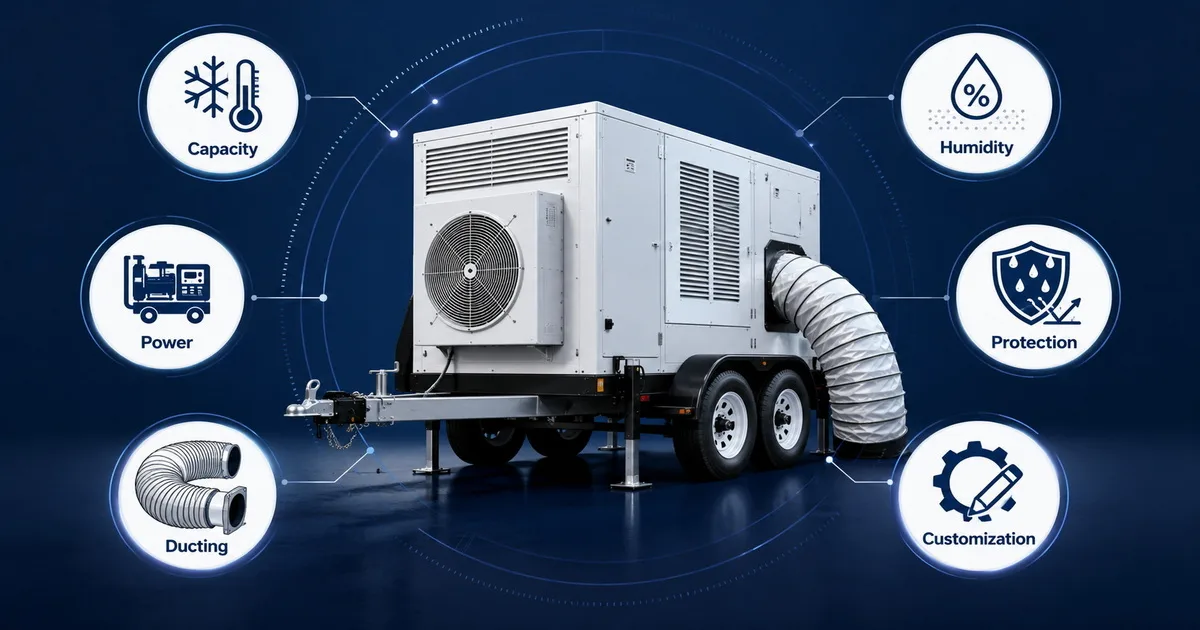
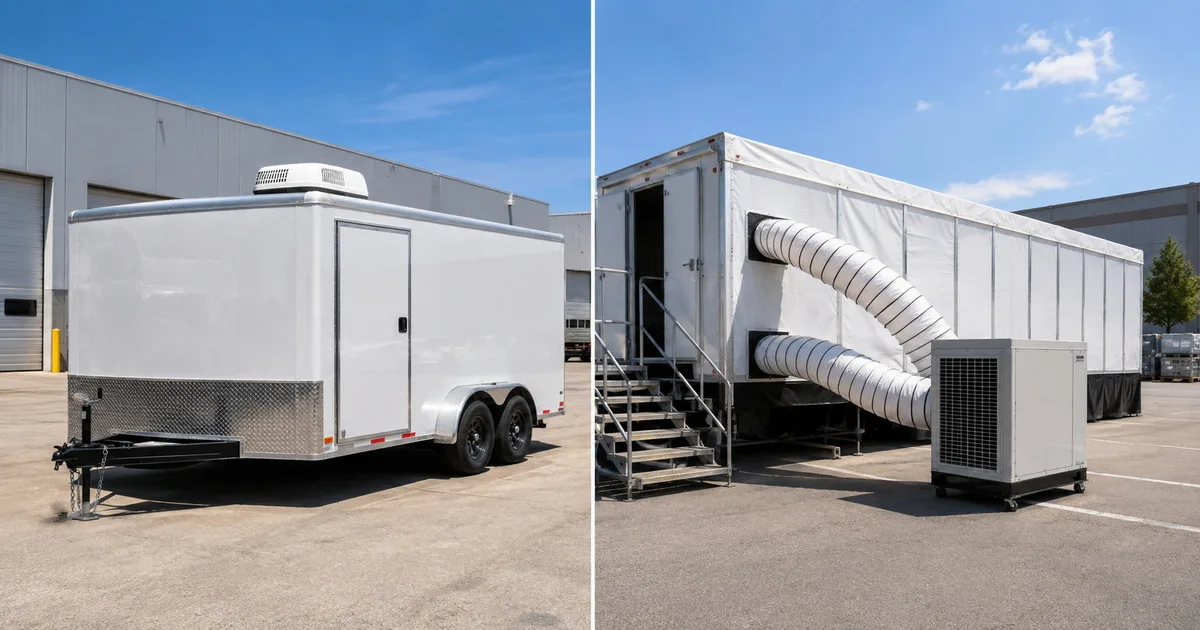
A trailer air conditioning system is designed as an integrated cooling solution for a mobile enclosure. Depending on the application, it may be roof-mounted, wall-mounted, under-bench, split-type, or externally mounted with purpose-designed supply and return ducting. The system is normally selected around the trailer layout, electrical architecture, vibration environment, and expected duty cycle.
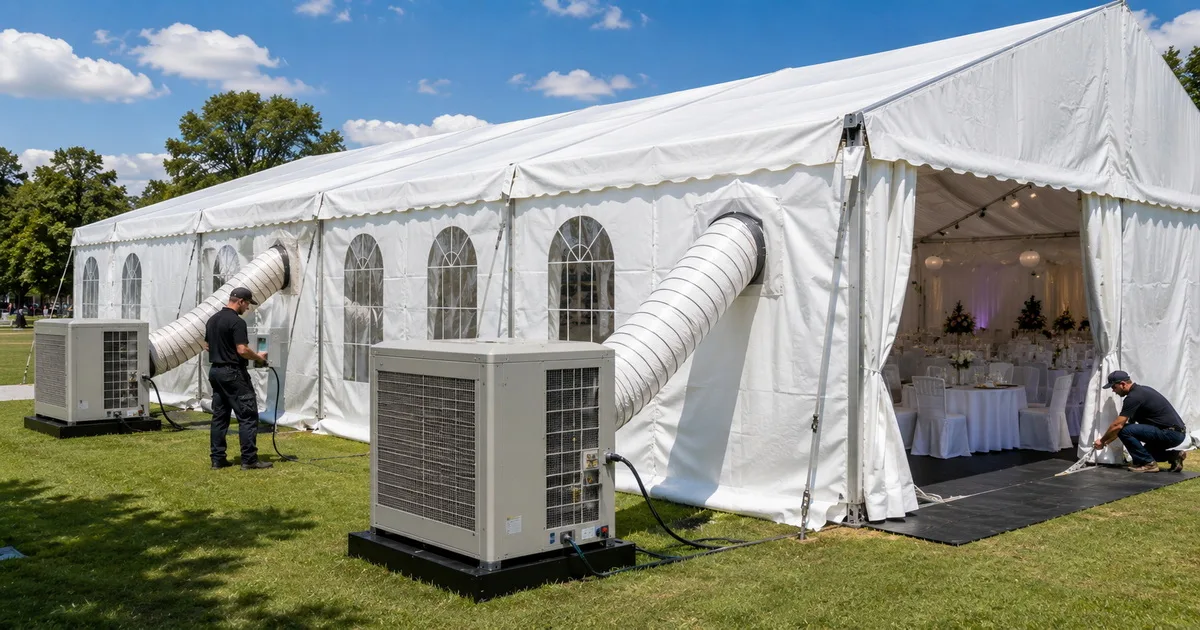
A ducted portable air conditioning system is a movable packaged unit that supplies cooled air through flexible ducts. The main unit typically remains outside the occupied trailer, tent, temporary shelter, workshop, or modular space. This arrangement can reduce indoor noise and preserve interior floor space, but duct routing and installation quality strongly affect real-world results.
| Factor | Trailer Air Conditioning | Ducted Portable System |
|---|---|---|
| Installation | Permanent or semi-permanent integration | Temporary, movable deployment |
| High-heat-load capability | Usually stronger when correctly engineered | Can be effective, but more sensitive to duct losses |
| Space inside trailer | Often preserves usable floor area | Main unit can stay outside, though ducts need routing |
| Airflow distribution | Can use designed supply and return paths | Depends heavily on duct length, bends, and placement |
| Mobility | Installed with the trailer | Easy to redeploy across sites |
| Best fit | OEM trailers, service vehicles, mobile workspaces, branded fleets | Events, rental fleets, temporary facilities, emergency cooling |
| Customization potential | High for OEM/ODM programs | Moderate; often built around standard unit configurations |
The central difference is system integration. Trailer AC is built into the application. A ducted portable unit is added around the application.
Why High Heat Loads Challenge Mobile Cooling Systems
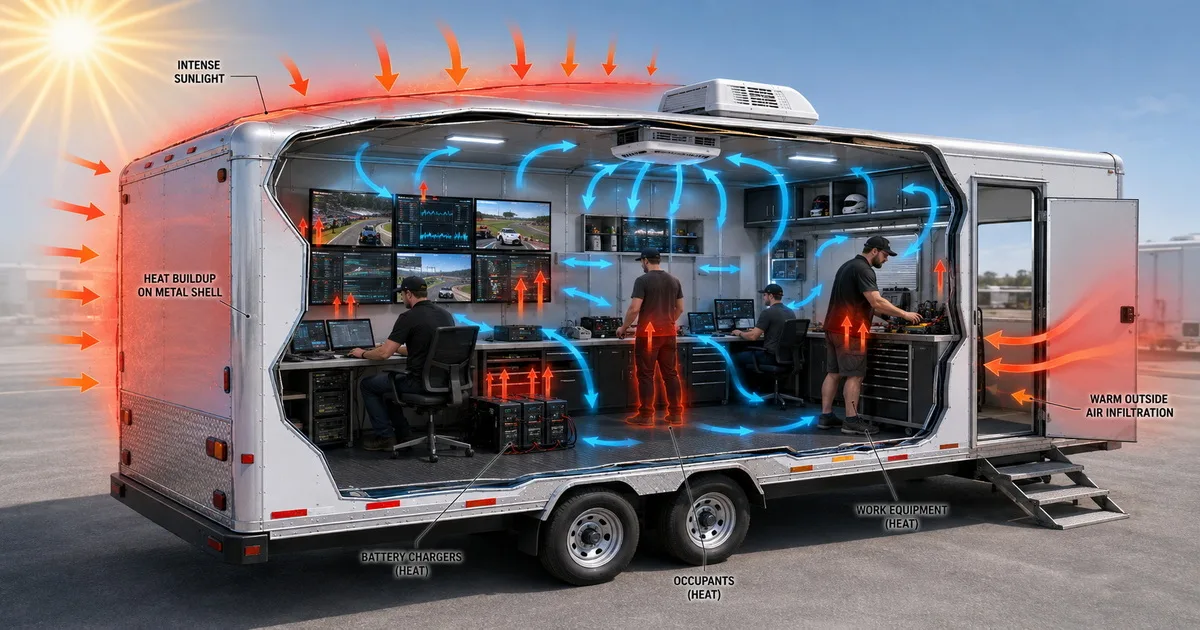
A high heat load means heat is entering or being generated inside the trailer faster than the cooling system can remove it. In a mobile enclosure, this is common because trailers often have thin metal skins, limited insulation, large exposed roof surfaces, frequent door activity, and compact interiors.
ASHRAE cooling-load guidance identifies solar gain, conduction through the envelope, infiltration, people, lighting, appliances, and equipment as important contributors to cooling demand. It also emphasizes that instantaneous heat gain and the actual cooling load are not always identical, because heat can be absorbed and released over time by interior surfaces and materials.
The Five Heat Sources Buyers Often Underestimate
– Solar radiation through the roof, sidewalls, windows, and open doors
– Envelope conduction through uninsulated or lightly insulated metal panels
– Air infiltration when doors are opened, seals leak, or exhaust fans create negative pressure
– Internal equipment heat from batteries, chargers, servers, lighting, cooking equipment, electronics, or production tools
– Occupant heat and humidity, especially in crowded mobile workspaces or event trailers
For example, a demonstration trailer operating in direct summer sun may contain several staff members, LED displays, network equipment, lighting, and frequently opened doors. Even if the trailer’s floor area appears small, its peak cooling demand may be much higher than a simple square-footage estimate suggests.
Which System Performs Better in Extreme Heat?
For sustained high heat loads, a correctly specified trailer air conditioning system usually has the performance advantage. This is especially true when the system uses a purpose-designed installation location, adequate condenser ventilation, sealed supply and return airflow, and controls selected for the trailer’s operating environment.
However, the word correctly matters. A poorly installed rooftop unit, an undersized condenser, or a system with inadequate power supply can still perform poorly. Conversely, a well-sized ducted portable system with short, insulated ducts and an effective return-air strategy can be a practical cooling solution for temporary applications.
1. Effective Capacity Matters More Than Nameplate BTU
Buyers should not compare systems solely by their advertised BTU/h figure. The useful question is: how much cooling capacity remains available at the actual outdoor temperature, humidity, airflow condition, and duct configuration?
The U.S. Department of Energy uses Seasonal Adjusted Cooling Capacity, or SACC, for portable air conditioners. SACC is calculated from measured cooling capacity under 95°F and 83°F test conditions, giving buyers a more realistic performance reference than a single nominal capacity number.
For trailer applications, manufacturers and procurement teams should request:
– Rated cooling capacity at the intended ambient temperature
– Power input and current draw at full load
– Supply airflow and external static-pressure capability
– Condenser operating limits
– Refrigerant and compressor specifications
– Sound data at the operator or passenger position
– Test conditions used for published performance figures
A high-quality OEM supplier should be able to explain not just what the system is rated to deliver, but under which conditions that rating applies.
2. Air Distribution Decides Whether Occupants Feel Cool
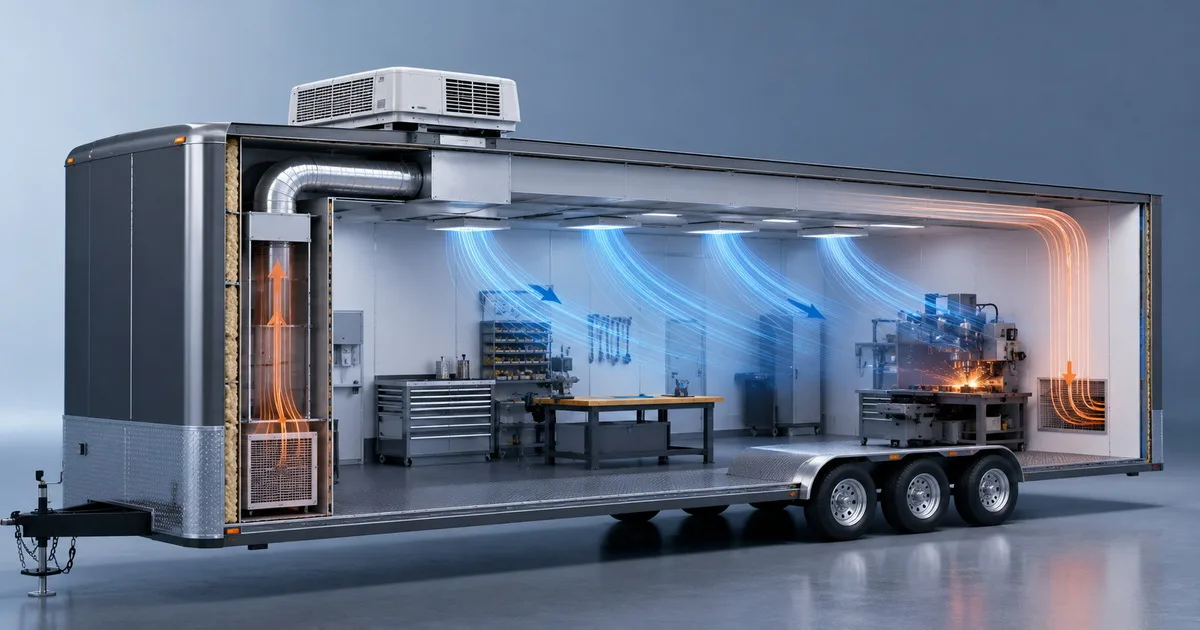
A trailer AC system can distribute air through ceiling ducts, directional vents, or separate zones. This is a major advantage in long trailers, mobile clinics, command vehicles, production trailers, and branded demonstration units where occupants are spread across the enclosure.
Ducted portable systems can also distribute cool air, but flexible ducts introduce pressure losses. Long runs, sharp bends, crushed duct sections, undersized ducts, and leaking connections can reduce delivered airflow. Poor return-air placement can also cause short-circuiting, where cooled supply air returns to the machine before it cools the occupied zone.
A practical airflow rule: place supply air toward the hottest or most occupied area, and locate the return path away from the supply outlet. This encourages air to sweep through the usable space instead of circulating around the unit.
3. Trailer AC Usually Wins on Continuous Duty
In mobile commercial applications, cooling equipment may need to operate for long hours in high ambient temperatures. Trailer air conditioning is generally better suited to this duty because the system can be engineered with appropriate mounting, drainage, wiring, controls, vibration resistance, and enclosure-specific airflow.
Portable units are excellent for flexibility. Yet they often require more site discipline: external placement, weather protection, duct routing, condensate management, power planning, and secure positioning. These tasks are manageable, but they create more operational variables.
High-Heat Performance Comparison
| Performance Area | Integrated Trailer Air Conditioning | Ducted Portable Air Conditioning |
|---|---|---|
| Peak-load resilience | Strong when sized for the enclosure and ambient design condition | Moderate to strong, depending on unit capacity and duct setup |
| Solar-exposed trailer roof | Better when roof insulation and system capacity are engineered together | Can help, but does not solve envelope heat gain |
| Long, narrow interiors | Better airflow control through designed vents or ducting | Duct placement requires careful planning |
| Frequent relocation | Less flexible after installation | Strong advantage |
| Temporary event cooling | Suitable for purpose-built trailers | Often ideal for short-duration deployment |
| Maintenance access | Can be integrated into fleet service plans | Easier to swap or reposition on site |
| Indoor noise | Often lower with exterior or rooftop configurations | Low indoors if main unit remains outside |
| Risk of setup errors | Lower after professional installation | Higher due to duct, power, drainage, and placement variables |
A Practical Load-Assessment Method Before You Buy
Do not select a trailer cooling system by trailer length alone. Length is a useful starting point, but not a complete engineering method. Industry sizing guides commonly place many travel-trailer applications in the roughly 13,500–18,000 BTU/h range, while larger units may require 18,000 BTU/h or multiple systems. Actual needs vary substantially with floor area, insulation, climate, and use case.
Use this five-step process before specifying an OEM or ODM system:
1. Measure the enclosure
Record length, width, ceiling height, roof construction, insulation thickness, window area, and door locations.
2. Define the design condition
Use the hottest expected ambient temperature, not average weather. Consider solar exposure, humidity, dust, and whether the trailer will be parked on hot pavement.
3. List internal loads
Include occupants, lighting, computers, battery chargers, displays, refrigeration equipment, cooking appliances, machinery, and any process heat.
4. Map airflow and access points
Identify supply vent locations, return-air paths, door-opening patterns, and zones with high heat concentration.
5. Validate power and redundancy
Check shore power, generator output, battery/inverter capability, startup current, cable sizing, and whether critical applications need backup cooling.
This method is particularly important for OEM buyers. A standard model may work for a basic cargo trailer but fail in a medical, telecom, mobile laboratory, food-service, or high-value demonstration application.
When a Ducted Portable System Is the Smarter Choice
Ducted portable cooling is not a “lower-grade” category. It is the more suitable option when the project values flexibility over permanent integration.
Choose a ducted portable air conditioning system when:
– The cooling requirement is seasonal, short-term, or event-based
– The unit must serve multiple trailers, tents, or temporary zones
– Permanent roof or wall modifications are not permitted
– The main cooling equipment should remain outside the occupied area
– Rental deployment, disaster response, or temporary operations are involved
– The buyer needs rapid replacement or redistribution of equipment
DREZ’s outdoor-festival guidance highlights a practical workflow for temporary cooling: define the enclosure, map heat sources, evaluate weather risks, design supply and return airflow, and confirm power plus redundancy before deployment. That same approach applies to temporary trailer cooling projects.
OEM and ODM Considerations for Trailer Brands
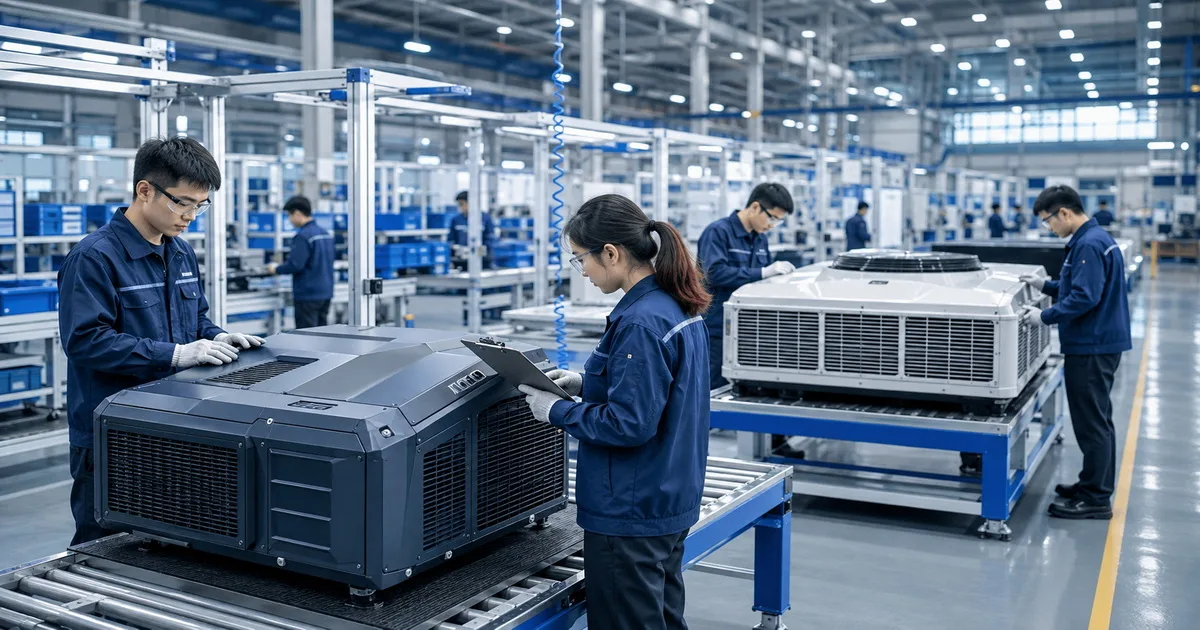
For international trailer brands, wholesalers, and manufacturers, the best cooling product is often the one that fits the production process—not simply the unit with the highest catalog capacity.
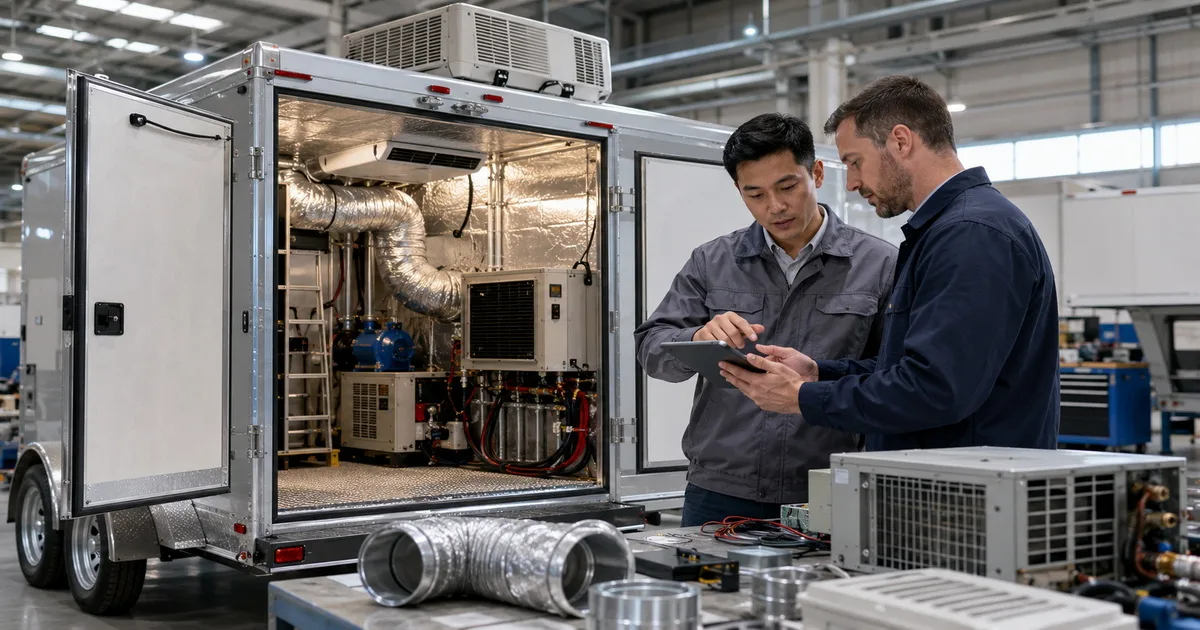
An OEM/ODM trailer air conditioning partner should be able to support:
– Cooling-capacity selection for your target markets and climates
– Rooftop, wall-mounted, split, or ducted configuration development
– Branding, color, panel, controller, and packaging customization
– Electrical compatibility for regional voltage and frequency requirements
– Installation interfaces that simplify trailer assembly
– Documentation for operation, installation, maintenance, and after-sales support
– Reliability-oriented design for vibration, transport, dust, rain, and high ambient temperatures
For a brand launching a trailer line across hot regions, specifying an integrated high-ambient solution at the design stage can reduce warranty risk, improve user comfort, and create a more differentiated product position.
The Bottom Line
If the trailer must operate reliably during sustained solar exposure, high occupancy, equipment heat, or hot-climate service, choose a properly engineered trailer air conditioning system. It offers stronger long-term control over capacity, airflow, integration, and user comfort.
Choose ducted portable systems when mobility and short-term deployment are the priority. They can cool effectively, but success depends more heavily on on-site duct layout, power availability, condensate handling, and disciplined setup.
DREZ (Guangzhou) Intelligent Technology Co., Ltd. supports trailer brands, wholesalers, and manufacturers with OEM and ODM climate-control solutions. Contact DREZ to discuss your trailer dimensions, ambient conditions, power platform, internal heat sources, and target cooling performance before selecting a configuration.
FAQ
1. Is trailer air conditioning better than a portable AC for hot climates?
Usually, yes. An integrated trailer AC system is generally more suitable for sustained hot-climate operation because it can be designed around the trailer’s airflow, power, structure, and operating environment. The final result still depends on capacity selection and installation quality.
2. Can a ducted portable air conditioner cool an enclosed trailer?
Yes. A ducted portable unit can cool an enclosed trailer, especially for temporary or mobile use. Keep duct runs short, avoid sharp bends, seal connections, plan return airflow, and verify that the electrical supply can support the unit.
3. How many BTUs do I need for trailer air conditioning?
There is no universal answer. Trailer floor area is only one variable. You must also consider roof and wall insulation, outside temperature, direct sun, windows, door openings, people, equipment, and humidity. Many standard travel-trailer systems fall within 13,500–18,000 BTU/h, but high-load applications may need larger or multiple systems.
4. Why does my trailer AC struggle at midday?
Midday performance often declines because solar radiation raises roof and wall temperatures, outdoor condenser conditions worsen, door openings introduce hot air, and internal equipment may be operating at full load. Inadequate insulation and insufficient airflow can compound the problem.
5. What is the biggest installation mistake with ducted portable AC systems?
Poor duct and return-air design is one of the most common errors. Excessively long or kinked ducts, unsealed connections, and supply air directed too close to the return side can waste cooling capacity.
6. Should OEM trailer manufacturers choose rooftop or ducted trailer air conditioning?
The best format depends on trailer height restrictions, roof strength, interior layout, noise expectations, service access, target climate, and assembly process. A supplier should evaluate the entire vehicle or enclosure before recommending a configuration.
References
1. ASHRAE. “[Fundamentals of Heating and Cooling Loads].” Covers cooling loads from windows, solar gain, internal loads, lighting, appliances, people, and system effects. [ashrae]
2. ASHRAE. “[Load Calculation Applications Manual].” Provides calculation methods and resources for cooling loads, including solar irradiation and conduction effects. [ashrae]
3. U.S. Department of Energy. “[Portable Air Conditioner Test Procedure Final Rule].” Defines Seasonal Adjusted Cooling Capacity (SACC) for portable air conditioners. [energy]
4. ENERGY STAR. “[Room Air Conditioners].” Provides capacity-selection guidance by area to be cooled. [energystar]
5. Furrion. “[What Size AC Do I Need for My RV? A Complete Guide for RV Owners].” Provides market-facing BTU ranges and selection factors for RV and travel-trailer air conditioning. [furrion]
6. DREZ Aircon. “[Trailer Air Conditioning for Outdoor Festivals: Advantages Over Portable Air Conditioners].” Discusses enclosure definition, heat-source mapping, airflow planning, weather assessment, and power redundancy for temporary cooling applications. [drezaircon]
Hot Tags: Trailer Air Conditioning, Ducted Portable Air Conditioning, OEM Trailer Air Conditioner, ODM Climate Control Solutions, Commercial Trailer HVAC, Mobile Trailer Cooling Systems, High Ambient Air Conditioning, Industrial Portable Air Conditioner, Trailer Air Conditioner Manufacturer, Custom HVAC Solutions