Content Menu
● What Is Trailer Air Conditioning for Events?
● What Is a Mobile Air Conditioning Unit?
● Trailer AC vs Mobile AC at a Glance
● Why Trailer Air Conditioning Performs Better at Large Events
>> 1. Higher Capacity for Large Occupancy Loads
>> 2. Better Airflow Distribution
>> 3. Stronger Humidity Control
>> 4. Better Guest Experience and Lower Indoor Noise
● When Mobile Air Conditioning Units Are the Better Option
>> Choose Mobile AC When You Need Fast, Local Cooling
>> Understand the Limitation of Spot Cooling
● Event Cooling Capacity: A Better Selection Method
>> Start With Zones, Not Equipment
● Installation and Operations Checklist
● Ventilation Is Not the Same as Cooling
● OEM and ODM Considerations for Event HVAC Brands
>> Features Worth Prioritising
● Final Verdict: Which System Is Better?
● FAQs
>> 1. Is trailer air conditioning suitable for outdoor events?
>> 2. Can mobile air conditioning units cool a large tent?
>> 3. How do I choose the right event air conditioner capacity?
>> 4. Why is humidity control important for event cooling?
>> 5. Can trailer AC and mobile AC be used together?
>> 6. What should an event-rental company consider when sourcing OEM AC equipment?
For large-scale events, trailer air conditioning is usually the stronger primary solution when organisers need high cooling capacity, extended operating hours, and dependable climate control across large tents, halls, or temporary structures. A mobile air conditioning unit is generally the better choice for targeted cooling, rapid deployment, and flexible supplementary coverage.
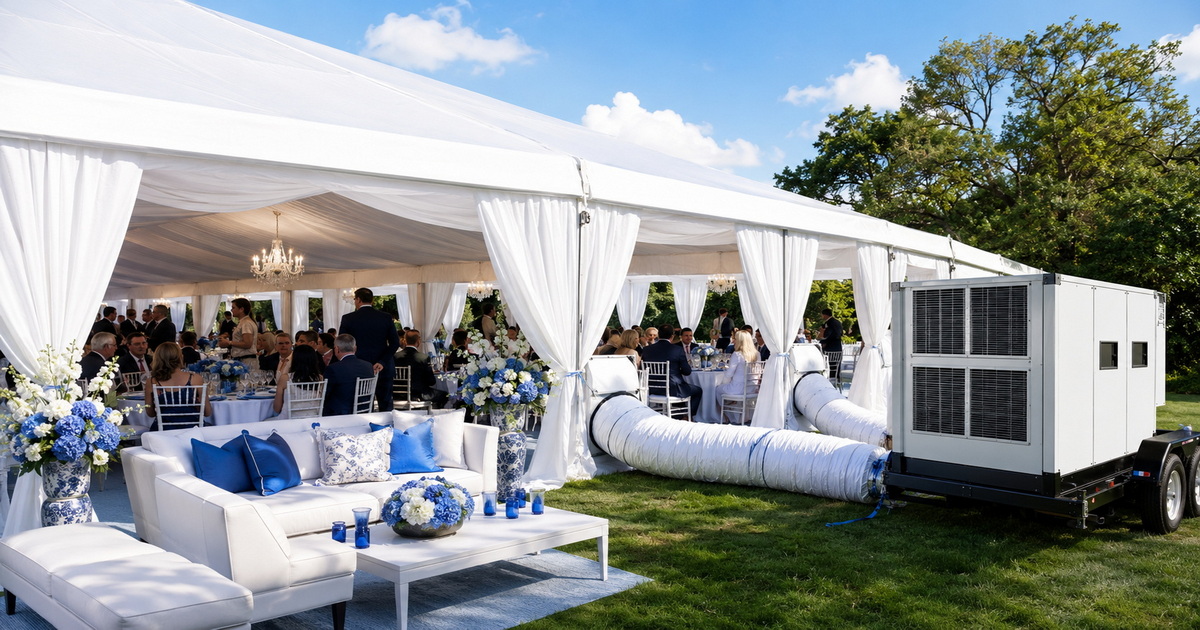
This comparison refers to trailer-mounted industrial air conditioning systems—equipment transported on a trailer and connected to the venue through ducting—not air conditioners installed inside recreational trailers. For event-rental companies, distributors, and event-equipment brands, selecting the right configuration affects guest comfort, installation efficiency, operating cost, and brand reputation.
What Is Trailer Air Conditioning for Events?
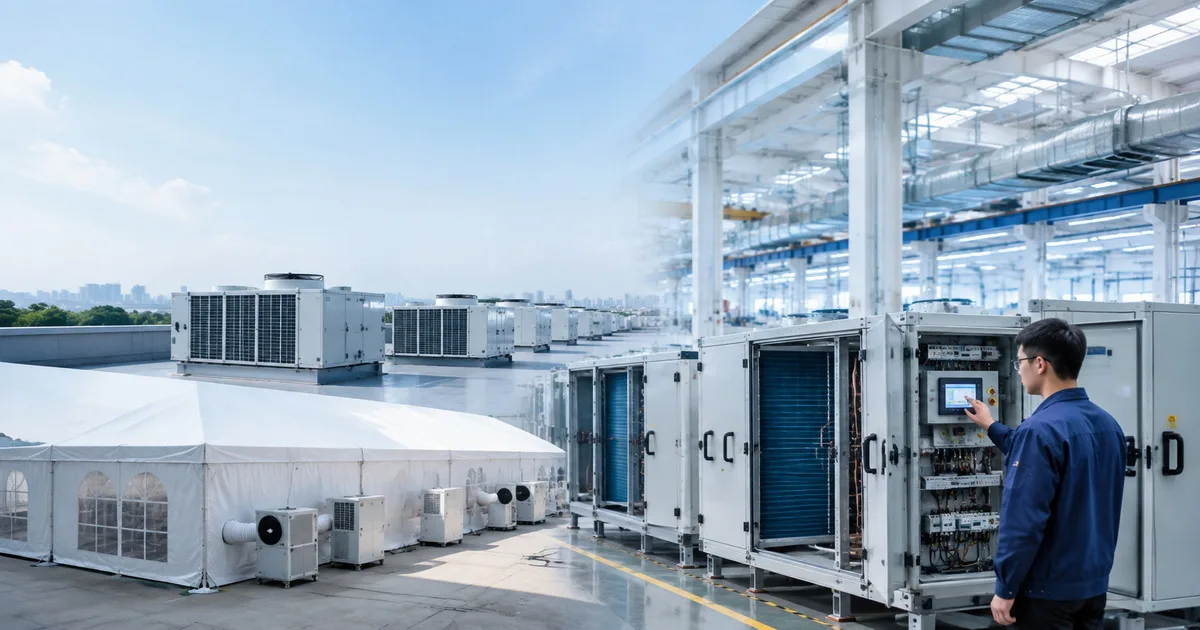
Trailer air conditioning is a high-capacity, transportable HVAC solution built into a trailer chassis. It is typically delivered to the event site, positioned outside the occupied area, and connected through flexible ducts, supply plenums, or temporary air-distribution systems.
A trailer AC system is designed for applications where a small portable unit would be insufficient, such as:
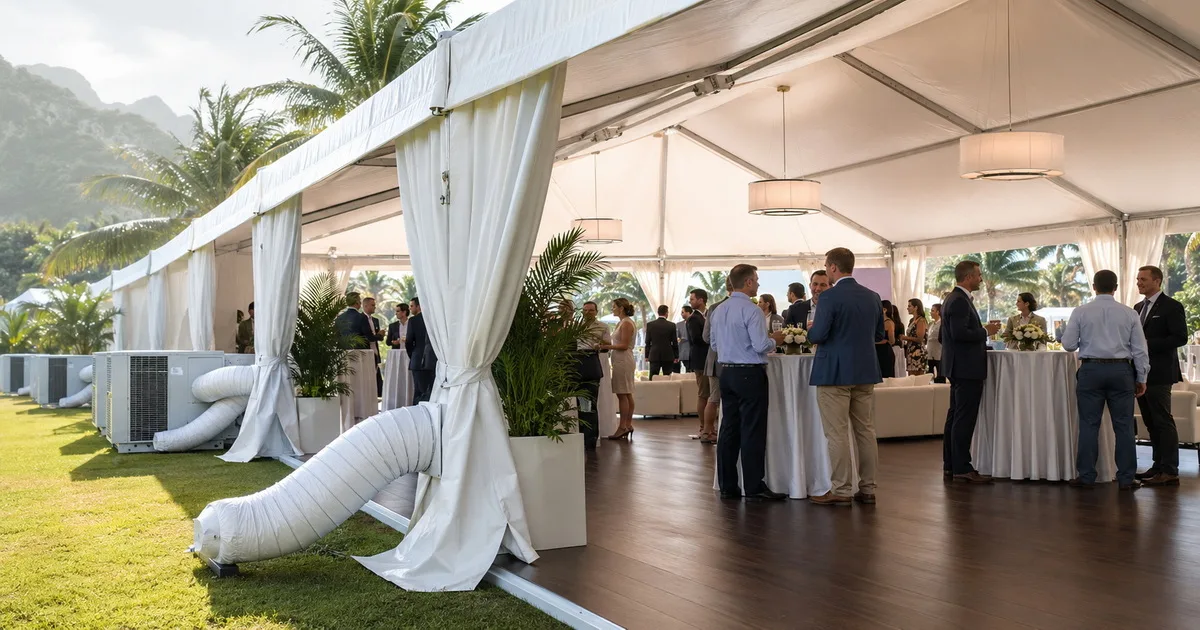
– Large wedding tents and marquees
– Trade shows and product launches
– Outdoor concerts and VIP lounges
– Film-production sets
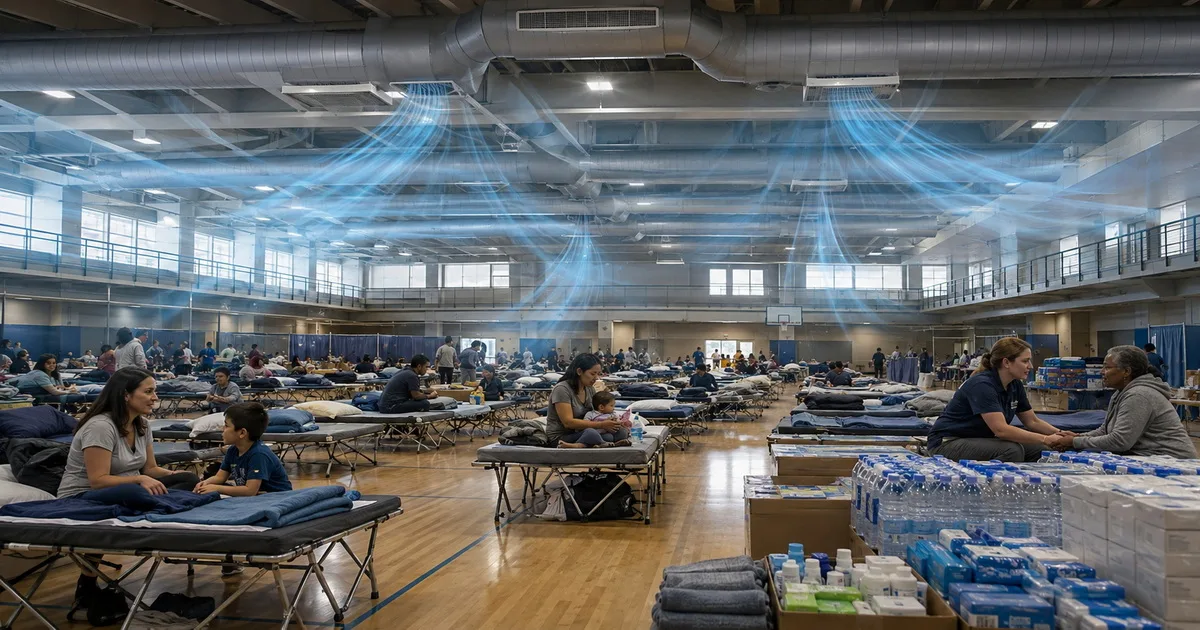
– Disaster-relief shelters
– Temporary warehouses or industrial workspaces
– Sports events and hospitality pavilions
Because the main mechanical components stay outside the event structure, trailer units can help reduce indoor equipment footprint and move compressor noise away from guests. Temporary event cooling providers commonly use industrial AC and remote equipment configurations to condition large tented or outdoor-adjacent spaces.
What Is a Mobile Air Conditioning Unit?
A mobile air conditioning unit is a self-contained, movable AC system. Depending on the product category, it may be wheeled into position, rolled between zones, or placed near a local heat source.
For commercial event use, mobile AC units commonly serve:
– Registration desks
– Backstage areas
– Control rooms
– Catering tents
– First-aid stations
– Pop-up retail booths
– VIP rooms
– Equipment rooms and temporary offices
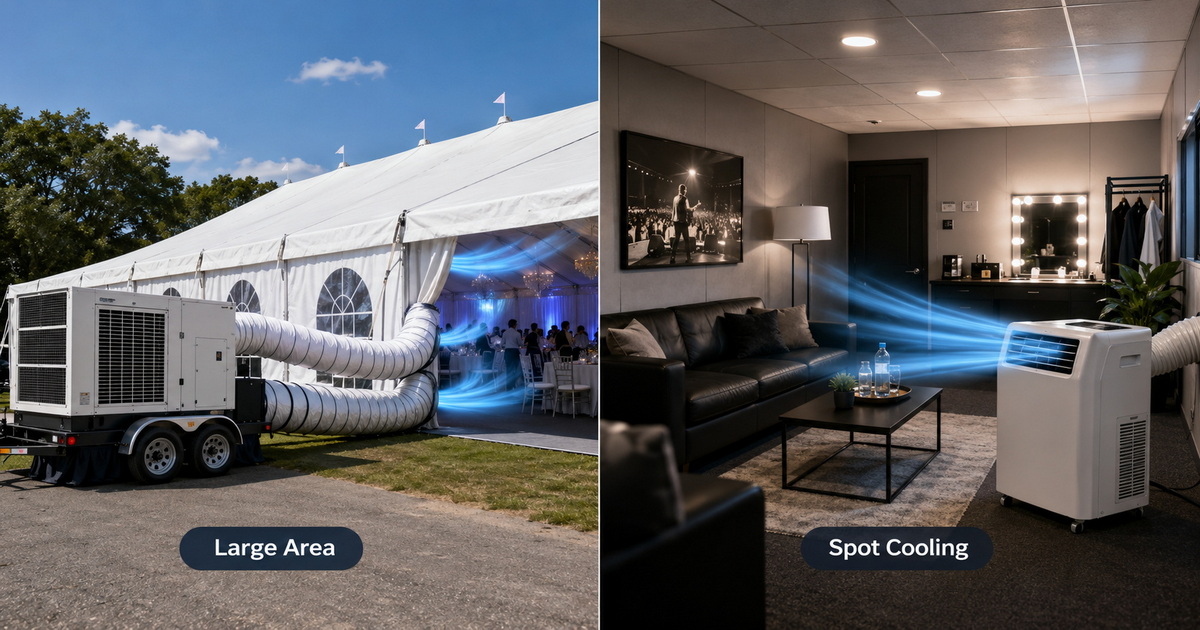
Their central value is flexibility. A mobile unit can be moved where people feel heat stress, where electronics need protection, or where a specific zone has unexpectedly high occupancy.
However, “portable” does not automatically mean “suitable for a crowd.” Small portable AC units are often intended for personal or small-zone cooling, while a true event-grade mobile AC must have adequate airflow, condensate handling, electrical compatibility, and ducting options.
Trailer AC vs Mobile AC at a Glance
| Decision Factor | Trailer Air Conditioning | Mobile Air Conditioning Unit |
|---|---|---|
| Best application | Large tents, halls, long-duration events | Targeted zones, smaller spaces, supplementary cooling |
| Cooling capacity | Usually high and scalable | Low to medium, depending on model |
| Air distribution | Ducted distribution across a wide area | Localised or spot cooling |
| Setup speed | Requires transport planning and duct installation | Fast placement and connection |
| Footprint inside venue | Low, because equipment remains outdoors | Higher, because units occupy indoor floor space |
| Noise management | Better potential, especially with remote placement | Can be more noticeable near guests |
| Power demand | Often requires planned generator or site electrical capacity | May use standard or commercial power, model-dependent |
| Humidity control | Usually stronger for large enclosed environments | Varies widely by unit and operating conditions |
| Scalability | High, with multiple trailers and duct runs | Moderate, through multiple individual units |
| Typical buyer | Rental fleets, event contractors, OEM brands | Distributors, rental firms, facility managers |
Trailer-mounted systems cool the event environment. Mobile units cool the problem area.
Why Trailer Air Conditioning Performs Better at Large Events
1. Higher Capacity for Large Occupancy Loads
Crowds generate significant sensible heat and moisture. Lighting, audiovisual equipment, catering appliances, solar exposure, open tent entrances, and frequent door traffic add further heat gain.
A trailer AC system can be engineered around the event’s actual cooling load rather than chosen solely by floor area. This matters because an enclosed 1,000 m² exhibition tent with dense occupancy needs a fundamentally different solution from a lightly occupied canopy.
A professional cooling-load assessment should consider:
– Event floor area and ceiling height
– Expected guest count at peak time
– Tent fabric, insulation, and sidewall configuration
– Outdoor temperature and solar exposure
– Lighting and AV heat loads
– Kitchen or catering equipment
– Door openings and service access
– Required indoor temperature and humidity level
The U.S. Department of Energy notes that air-conditioning capacity is used for both sensible cooling and moisture removal; in many conditions, a meaningful share of system capacity is needed for dehumidification rather than temperature reduction alone.
2. Better Airflow Distribution
A large event rarely fails because the AC has no cooling capacity. It fails because the conditioned air does not reach the people who need it.
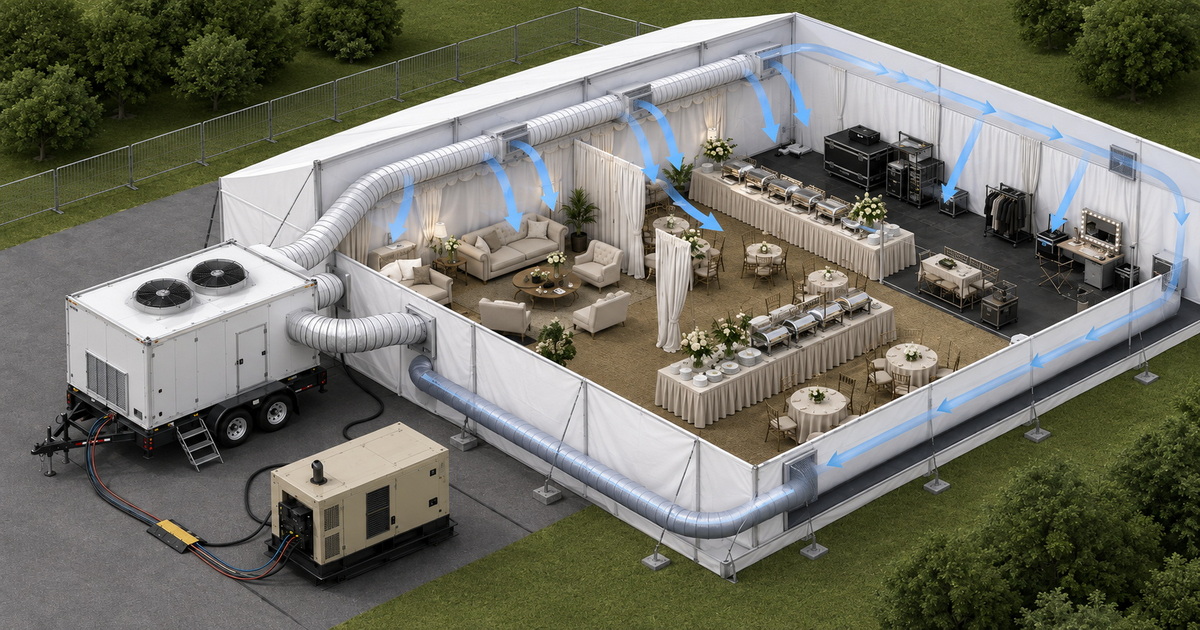
With trailer air conditioning, supply ducts can be positioned along tent perimeters, under flooring, above truss systems, or in dedicated zones. This enables a more controlled airflow path than placing several small units around the edge of a venue.
Practical example: For a premium wedding tent, place conditioned supply air at two or more locations, then position return-air paths away from entrances and catering heat sources. This reduces the chance that cold air is immediately lost through open doors or short-circuits back to the return side.
3. Stronger Humidity Control
In humid climates, lower air temperature alone may not make guests comfortable. A system must also remove moisture effectively.
For enclosed event spaces, a relative humidity level above 60% can feel sticky, reduce perceived comfort, and create condensation risks. Building-science guidance recommends designing air-conditioning and dehumidification systems to maintain indoor relative humidity below 60%.
Trailer AC units are normally more appropriate than basic mobile units where humidity control is a critical requirement, especially for:
– Summer tent events
– Coastal venues
– Tropical climates
– Temporary exhibition structures
– Events with dense crowds
– Product displays sensitive to moisture
4. Better Guest Experience and Lower Indoor Noise
A trailer-based unit can keep the loudest mechanical elements outside the guest area. With correct duct selection and system placement, the occupied venue can feel quieter, more premium, and less cluttered.
This is especially valuable for speeches, ceremonies, luxury activations, broadcast events, and corporate conferences. Industrial event-cooling suppliers also identify remote compressor placement as a way to reduce equipment noise in the conditioned space.
When Mobile Air Conditioning Units Are the Better Option
Trailer air conditioning is not always necessary. Mobile air conditioning units can be the smarter commercial choice when the venue is smaller, the event schedule is short, or cooling demand is concentrated in a few zones.
Choose Mobile AC When You Need Fast, Local Cooling
A mobile unit is often preferable when:
– The venue already has partial HVAC coverage
– Only one room or booth is overheating
– Cooling is needed for a few hours
– Access is too limited for a trailer
– The event layout changes frequently
– The buyer needs a compact, lower-investment rental product
– A backup unit is needed for critical zones
For example, a mobile AC unit can protect a live-streaming control room, an LED-wall processor rack, or a backstage dressing room without requiring ducting throughout the entire venue.
Understand the Limitation of Spot Cooling
Mobile units work best when the target cooling zone is defined. In a large, open tent with multiple entrances, several small units may create uneven results: one corner becomes cold while the centre remains warm.
This is why an experienced event HVAC planner avoids treating mobile AC units as a simple “multiply by quantity” substitute for a central, ducted trailer system.
Event Cooling Capacity: A Better Selection Method
Start With Zones, Not Equipment
Instead of asking, “How many units do we need?”, ask:
1. Which spaces need comfort cooling? Guest tent, stage, kitchen, VIP lounge, control room, or medical area.
2. Which zones have the highest heat load? Areas with people, lighting, cooking, or direct sunlight.
3. Which zones are mission-critical? Server racks, broadcast equipment, food storage, or medical facilities.
4. What is the event duration? A four-hour reception differs from a three-day exhibition.
5. What backup is required? High-profile events should not depend on a single point of failure.
This zone-first method helps rental companies create more accurate quotations and allows OEM/ODM suppliers to configure equipment portfolios around real customer use cases.
Use a Hybrid Cooling Plan
For many large events, the best answer is not “trailer AC or mobile AC.” It is a hybrid configuration:
– Use trailer air conditioning as the main cooling source for the primary tent or hall.
– Use mobile AC units in high-load zones, such as kitchens, AV rooms, backstage spaces, and VIP suites.
– Keep one mobile unit available as rapid backup for unexpected hot spots.
This structure improves operational resilience while preventing the unnecessary cost of oversizing the central system.
Installation and Operations Checklist
A well-designed product can still underperform if the installation is weak. Before equipment arrives on site, event operators should confirm the following.
Before Delivery
– Verify trailer access, turning space, ground stability, and parking location.
– Confirm electrical supply, generator capacity, cable routes, and backup power.
– Map duct routes before furniture, staging, and décor are installed.
– Identify drainage or condensate-management requirements.
– Check local noise restrictions and operating-hour limitations.
– Keep air intakes away from vehicle exhaust, generators, kitchens, and other contamination sources.
ASHRAE guidance emphasises that outdoor-air intakes should be protected from external contamination sources.
During Operation
– Monitor indoor temperature and relative humidity at several locations.
– Check doors, tent sidewalls, and service openings for excessive air loss.
– Inspect filters, condensate drains, hoses, and duct connections.
– Assign one trained operator or technician to respond to alarms.
– Maintain clear access around the equipment for servicing and safe airflow.
After the Event
– Record runtime, weather conditions, occupancy, and customer feedback.
– Inspect coils, filters, ducting, electrical connectors, and chassis components.
– Review whether capacity was oversized, undersized, or poorly distributed.
– Use the findings to improve future fleet specifications and OEM product development.
Ventilation Is Not the Same as Cooling
Cooling and ventilation should be designed together. A space can feel cold but still have poor air quality if outdoor-air ventilation is inadequate.
The U.S. Environmental Protection Agency explains that carbon dioxide monitoring can help indicate when outdoor-air ventilation may be insufficient in occupied indoor spaces. For event operators, CO₂ monitoring should be treated as an operational indicator—not as a replacement for a qualified ventilation design.
Important: Do not close every opening simply to retain cooled air. The correct balance depends on venue design, occupancy, outdoor conditions, local regulations, and the equipment’s ventilation strategy.
OEM and ODM Considerations for Event HVAC Brands
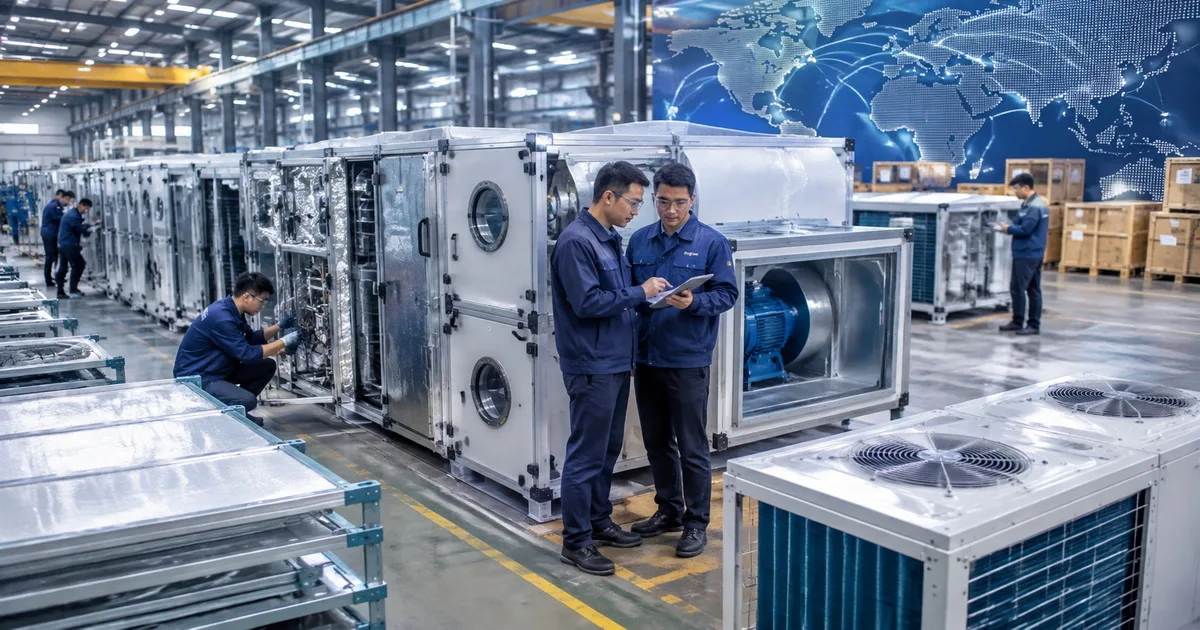
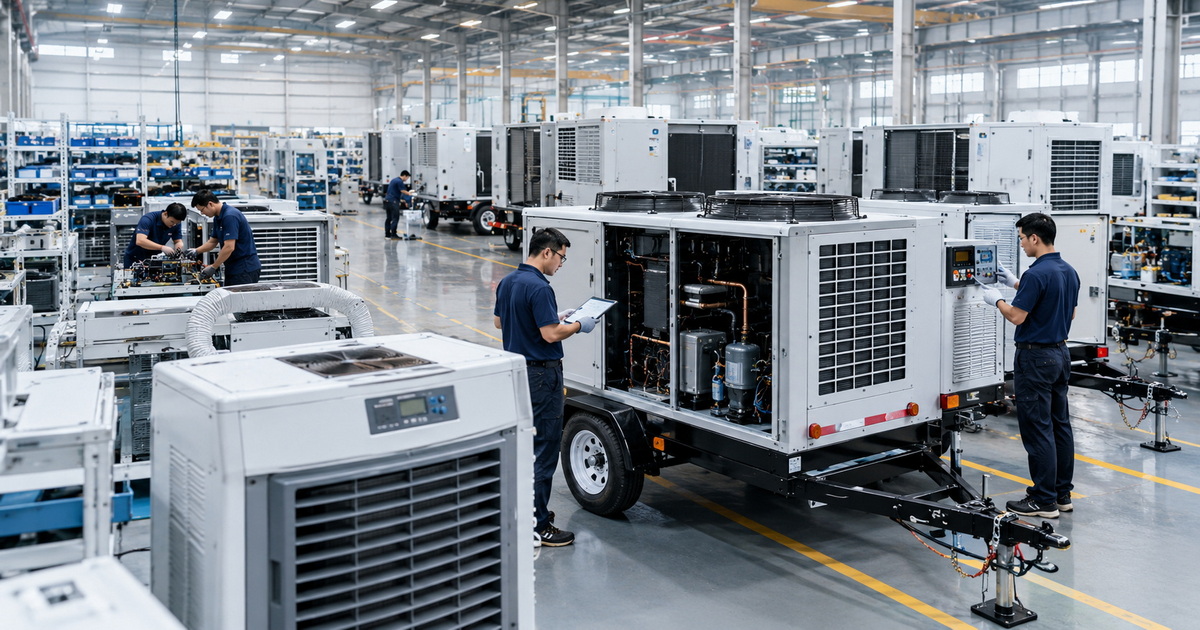
For brands, distributors, and rental fleets, the product decision goes beyond cooling output. The right OEM/ODM partner should help transform field requirements into a repeatable, maintainable product platform.
Features Worth Prioritising
– Modular capacity: Product ranges that can serve small tents through major event structures.
– Ducting compatibility: Supply and return-air connections sized for common event applications.
– Smart controls: Temperature, humidity, fault alerts, runtime monitoring, and remote diagnostics.
– Rugged mobility: Trailer chassis, corrosion protection, secure tie-down points, and all-weather enclosures.
– Serviceability: Accessible filters, electrical panels, compressors, drainage points, and spare parts.
– Brand customisation: Housing colour, logo placement, control-panel language, manuals, and packaging.
– Regional compliance: Electrical specifications, refrigerant requirements, safety certifications, and destination-market documentation.
For an OEM or ODM project, a manufacturer should evaluate the entire operating journey: delivery, connection, operation, maintenance, fault recovery, and return transport. That perspective is more valuable than selecting equipment based on capacity alone.
Final Verdict: Which System Is Better?
For large-scale events, trailer air conditioning is usually the better core investment. It delivers higher capacity, more consistent airflow distribution, better humidity-control potential, and a cleaner guest-facing environment.
Mobile air conditioning units remain essential. They are the practical solution for small venues, temporary hot spots, equipment areas, and backup cooling. The strongest event-climate-control offerings combine both formats into a flexible, scalable product range.
Looking for an OEM or ODM climate-control partner? DREZ can help brands, wholesalers, and equipment manufacturers develop trailer air conditioning systems and mobile air conditioning units tailored to their target markets, operating conditions, and brand specifications. Contact our team to discuss capacity planning, product customisation, and scalable event-cooling solutions.
FAQs
1. Is trailer air conditioning suitable for outdoor events?
Yes. Trailer air conditioning is commonly used to cool enclosed or semi-enclosed temporary structures, such as tents, marquees, pavilions, exhibition halls, and hospitality spaces. Performance depends on insulation, tent sealing, duct layout, outdoor conditions, and correct capacity selection.
2. Can mobile air conditioning units cool a large tent?
They can provide local or supplementary cooling, but they are usually not the best standalone solution for a large, densely occupied tent. For large spaces, a trailer-mounted ducted system generally offers more even cooling and better scalability.
3. How do I choose the right event air conditioner capacity?
Assess floor area, ceiling height, occupancy, climate, solar load, tent construction, lighting, equipment, doors, and humidity requirements. A professional load calculation is more reliable than choosing a unit based on area alone.
4. Why is humidity control important for event cooling?
High humidity makes guests feel warmer, even when air temperature is reduced. It can also create condensation, affect décor and electronics, and reduce overall event comfort. Systems should be selected for both cooling and moisture removal.
5. Can trailer AC and mobile AC be used together?
Yes. A hybrid solution is often ideal: trailer AC cools the main venue, while mobile AC units support high-load or critical zones such as kitchens, backstage rooms, AV areas, and medical stations.
6. What should an event-rental company consider when sourcing OEM AC equipment?
Key considerations include cooling capacity, airflow design, mobility, power configuration, duct compatibility, noise level, climate durability, maintenance access, spare-parts availability, control functions, and regional compliance requirements.
References
1. U.S. Department of Energy, [Variable Capacity Comfort Systems and Smart Ventilation].
2. U.S. Environmental Protection Agency, [Reference Guide for Indoor Air Quality in Schools].
3. U.S. Department of Energy, [Supplemental Humidity Control].
4. ASHRAE, [Risk Management Guidance for Health, Safety, and Environmental Quality].
5. TCRS, [Using Climate Control Solutions in Outdoor Events].
6. Americool Heating & Cooling, [Climate Control Your Next Tent Event].
7. U.S. Department of Energy, [Supplemental Dehumidification in Warm-Humid Climates].
Hot Tags: Trailer Air Conditioning, Mobile Air Conditioning Unit, Temporary Event Cooling, Industrial Air Conditioning Systems, Event HVAC Solutions, Trailer Mounted Air Conditioner, Commercial Portable Air Conditioner, Temporary Climate Control, Outdoor Event Air Conditioning, OEM HVAC Manufacturer