Commercial Air Conditioner Market is evolving rapidly as businesses across industries increasingly rely on efficient, reliable, and scalable cooling solutions. From large-scale warehouses to temporary event tents and exhibition halls, the demand for industrial and portable air conditioning systems is growing steadily.
Factors such as the rise of global trade shows, large corporate events, and the expansion of industrial infrastructure are driving the adoption of advanced HVAC technologies. Modern commercial AC units are no longer limited to basic cooling they integrate energy-efficient compressors, smart temperature control, modular designs, and remote monitoring capabilities, enabling organizations to optimize both performance and operational costs.
The market is also witnessing significant innovation in temporary and portable AC systems, which are particularly essential for outdoor events and tent-based applications where traditional fixed HVAC solutions are impractical.
Businesses are increasingly prioritizing flexible cooling solutions that can be deployed quickly, cover large spaces efficiently, and maintain consistent environmental conditions, even in challenging outdoor or high-density settings. Additionally, sustainability concerns and energy regulations are pushing manufacturers to develop low-power, eco-friendly commercial AC solutions that reduce carbon footprints while maintaining high efficiency.
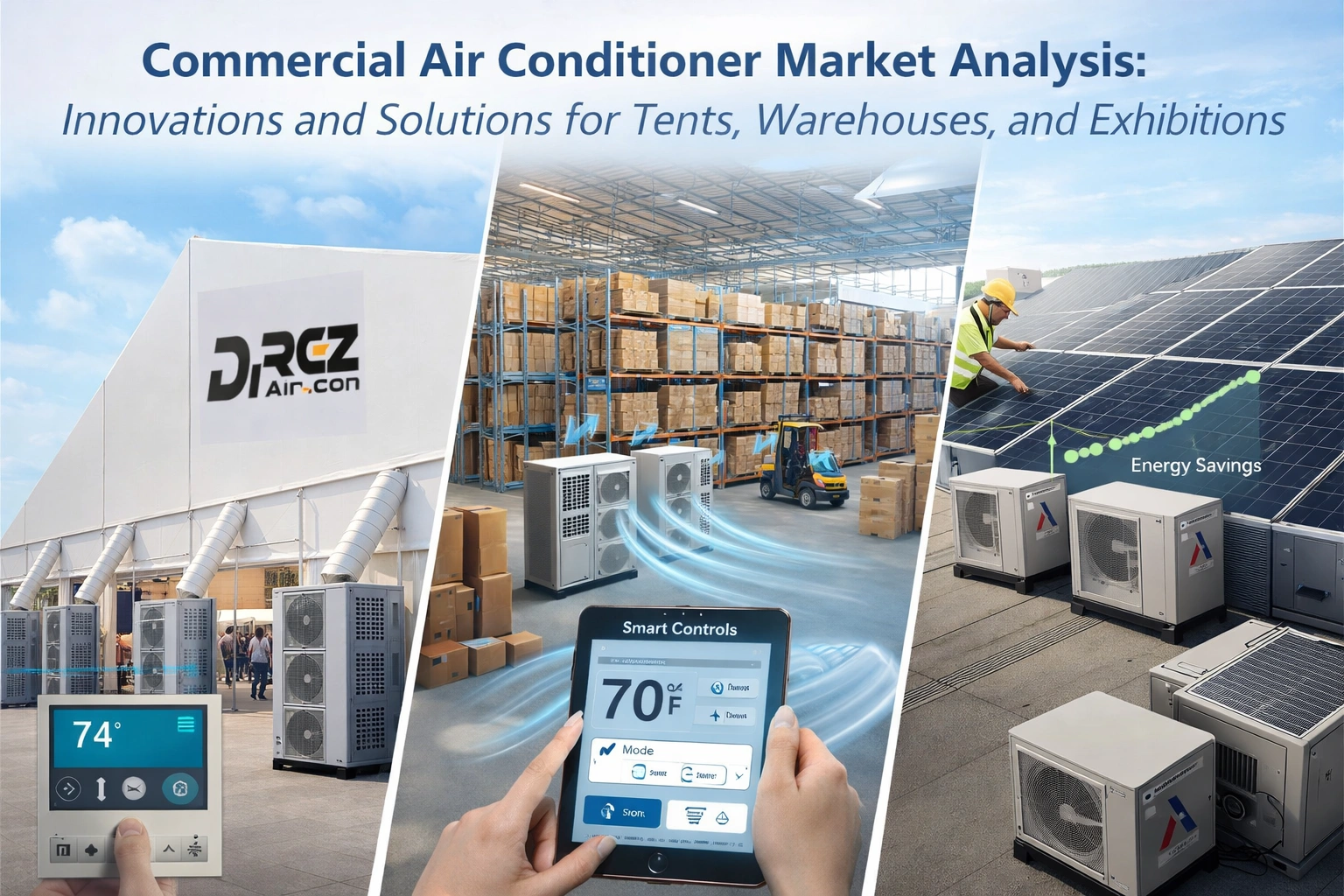
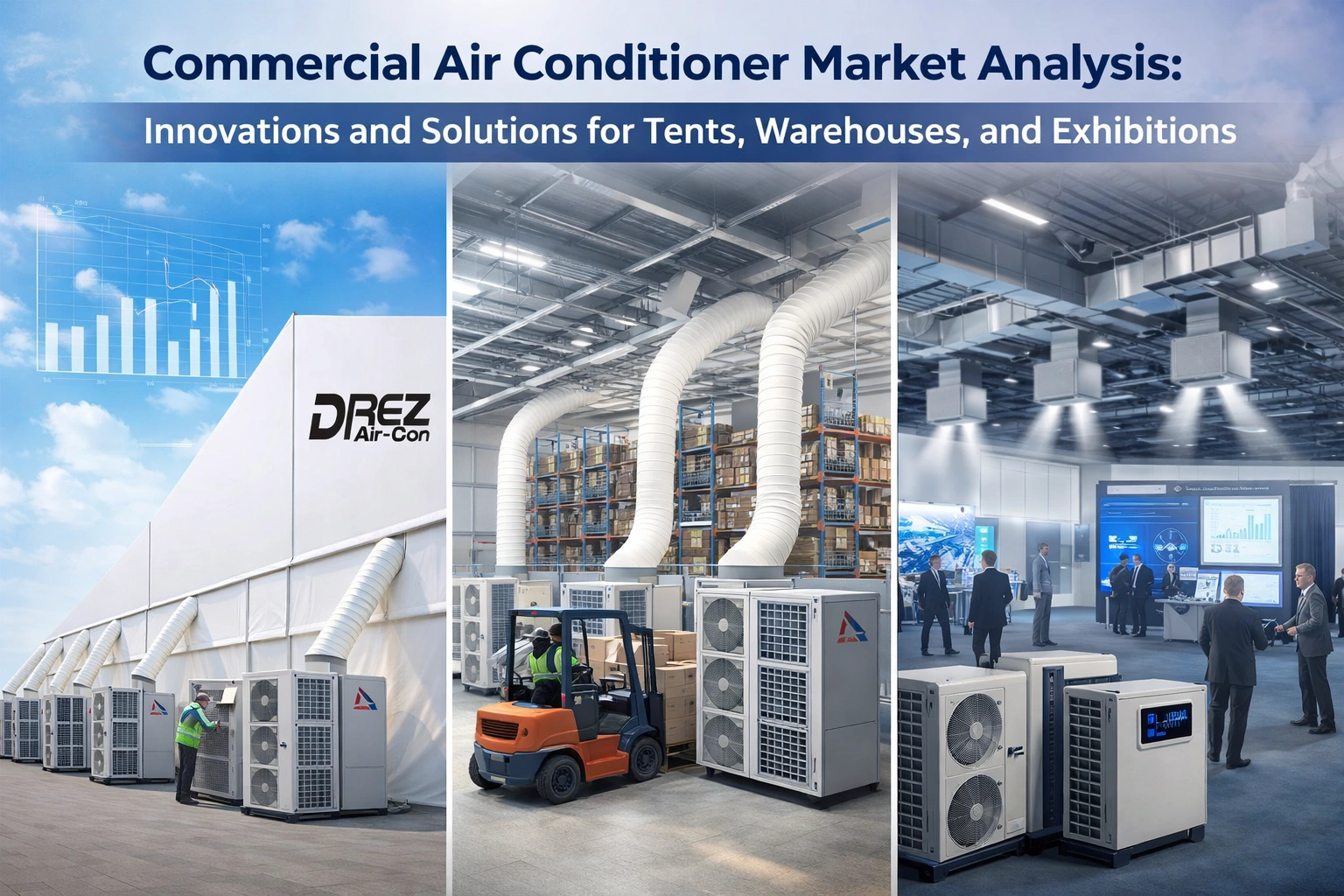
Commercial Air Conditioner Market Analysis: Innovations and Solutions for Tents, Warehouses, and Exhibitions
In this guide, we will explain how the commercial air conditioner market is shaping solutions for tents, warehouses, and exhibitions, highlighting trends, innovations, and key considerations for businesses seeking optimal HVAC systems.
1. Introduction to the Commercial Air Conditioner Market
The commercial air conditioner market is witnessing robust growth due to the increasing demand for reliable HVAC solutions across industries. Businesses are adopting advanced industrial and portable AC solutions to meet the cooling requirements of tents, warehouses, and exhibition halls.
Market reports indicate that global commercial HVAC demand is expanding at a compound annual growth rate (CAGR) of 6–7%, driven by the growth of event management, logistics, and industrial facilities. Temporary and portable tent air conditioning systems are becoming increasingly relevant for outdoor events, trade shows, and emergency shelters, while industrial AC units remain crucial for warehouses and manufacturing plants.
Understanding the dynamics of the commercial air conditioner market is vital for businesses seeking to implement energy-efficient, scalable, and high-performance cooling solutions.
2. Key Market Trends in Commercial Air Conditioning
2.1 Growth of Industrial and Portable AC Solutions
With the rise of industrial facilities and large-scale events, businesses require commercial air conditioners that are both reliable and portable. Portable AC units for tents and exhibitions allow for quick deployment and temporary climate control, which is critical for large outdoor events or temporary warehouse setups.
2.2 Demand for Energy-Efficient Commercial AC Units
Energy efficiency has become a central factor in AC adoption. Modern commercial air conditioner systems incorporate variable speed compressors, inverter technology, and optimized airflow designs to reduce operational costs while maintaining performance in large spaces.
2.3 Technological Innovations in Temporary Cooling Systems
Innovations include:
- Modular portable AC systems for tent and exhibition applications
- Smart temperature control and remote monitoring
- Compact industrial AC units with low maintenance requirements
These trends are shaping the commercial air conditioner market, influencing product development and procurement decisions globally.
3. Commercial AC Solutions for Event Tents
Temporary event structures such as trade shows, wedding tents, and outdoor exhibitions require flexible and high-capacity cooling systems.
3.1 Features and Benefits
Tent air conditioning systems are designed to:
- Maintain uniform temperature across large tents
- Offer easy installation and portability
- Adapt to different tent sizes with modular units
3.2 Case Studies: Exhibitions, Festivals, and Outdoor Events
For example, a large trade show in Dubai required a cooling solution for tents covering over 5,000 square meters. Deploying modular portable commercial AC units ensured a consistent indoor environment despite high external temperatures, while energy-efficient designs reduced operational costs by 15–20% compared to traditional systems.
3.3 Portable and Temporary AC Solutions
Modern portable AC units feature compact design, remote control operation, and quick setup, making them ideal for event planners and temporary warehouse operations. These systems represent a growing segment of the commercial air conditioner market.
4. Warehouse and Industrial Cooling Systems
4.1 Importance of HVAC for Warehouses and Factories
Warehouses, cold storage facilities, and factories require industrial air conditioner solutions that can maintain consistent temperatures over large spaces. Poor climate control can compromise inventory, employee comfort, and equipment efficiency.
4.2 Industrial AC Solutions for Large-Scale Spaces
Commercial AC solutions for warehouses include:
- High-capacity ducted systems
- Variable refrigerant flow (VRF) systems
- Industrial-grade portable units
These systems are designed to cover large floor areas efficiently, maintain stable temperatures, and minimize energy consumption.
4.3 Energy Efficiency and Durability
Incorporating energy-efficient components such as inverter compressors, high-efficiency fans, and insulated ducting ensures lower operational costs and longer equipment life, aligning with global sustainability trends in the commercial air conditioner market.
5. Exhibition Hall and Large Venue HVAC Solutions
5.1 Cooling Requirements for Exhibitions and Trade Shows
Exhibition halls require custom HVAC solutions to accommodate high visitor density, equipment heat loads, and open hall designs. Maintaining a comfortable environment ensures better attendee experience and equipment safety.
5.2 Innovations in Commercial AC Units for Large Venues
Key solutions include:
- Ductless split AC systems for flexibility in large spaces
- Modular AC units for scalable cooling
- Smart thermostats and automated controls
5.3 Tailored Solutions for Event Organizers
Businesses increasingly rely on providers that can design solutions tailored to venue size, layout, and event duration, ensuring optimal temperature and energy efficiency.
6. Market Analysis and Growth Forecast
6.1 Market Size and Regional Trends
The global commercial air conditioner market is projected to reach $36 billion by 2030, driven by:
- Expansion of industrial parks and warehouses
- Growth in large-scale events and exhibitions
- Adoption of energy-efficient HVAC systems in commercial buildings
Regionally, Asia-Pacific leads the market due to rapid industrialization and event-driven economies, while Europe and North America are adopting sustainable AC solutions to reduce operational costs.
6.2 Emerging Opportunities
- Growth in temporary and portable AC units for events
- Smart commercial AC systems with IoT integration
- Expanding B2B partnerships in industrial and event cooling sectors
6.3 Future Innovations
The next generation of commercial AC systems focuses on:
- AI-controlled HVAC for predictive climate management
- Enhanced energy efficiency and reduced carbon footprint
- Modular, easy-to-deploy solutions for temporary applications
7. Choosing the Right Commercial Air Conditioner
7.1 Selection Factors for Tents, Warehouses, and Exhibitions
Key considerations when choosing a commercial AC unit include:
- Cooling capacity and airflow coverage
- Energy efficiency ratings
- Installation flexibility (permanent vs temporary)
- Maintenance and operational cost
7.2 Comparing Portable vs Fixed Industrial AC Solutions
- Portable units: Quick deployment, ideal for tents, events, and temporary warehouses
- Fixed industrial systems: Optimized for long-term use in warehouses and factories
7.3 Energy Efficiency and Maintenance Considerations
Choosing units with high EER/SEER ratings and low-maintenance components reduces cost of ownership and improves sustainability.
8. Why Partner with Drez Aircon
Drez Aircon specializes in industrial, tent, and exhibition air conditioning solutions. Their offerings include:
- Modular tent AC units for temporary event structures
- High-capacity warehouse cooling systems
- Energy-efficient and scalable HVAC solutions
Case studies demonstrate Drez Aircon’s ability to deliver large-scale projects efficiently, meeting both energy and performance requirements. Partnering with an experienced manufacturer ensures tailored solutions, reliable equipment, and expert support.
10 FAQs – Commercial Air Conditioner Market
Q1: What is the commercial air conditioner market size?
The global commercial air conditioner market is projected to reach $36 billion by 2030, driven by growth in industrial, event, and commercial applications, including tents, warehouses, and exhibition halls.
Q2: Which commercial AC solutions are best for large tents?
Portable modular AC units with high airflow coverage and quick deployment are ideal for temporary tent structures, trade shows, and outdoor events.
Q3: How to choose energy-efficient industrial AC systems?
Select systems with inverter technology, high EER/SEER ratings, and low-maintenance components to reduce operational costs and improve energy efficiency.
Q4: What innovations are driving the commercial HVAC market?
Technological advancements include AI-controlled systems, modular portable units, energy-efficient industrial ACs, and smart monitoring for predictive climate management.
Q5: What are the main types of commercial air conditioners for warehouses?
Key types include ducted industrial AC systems, VRF (Variable Refrigerant Flow) units, and high-capacity portable ACs, designed to cover large spaces efficiently.
Q6: How do commercial AC systems differ for exhibitions and events?
Exhibition and event AC units prioritize mobility, modularity, and temporary installation, while maintaining consistent temperature control for high visitor density.
Q7: Can tent air conditioning systems be energy-efficient?
Yes, modern tent AC solutions integrate energy-saving compressors, optimized airflow, and modular units, reducing power consumption without compromising cooling performance.
Q8: What factors should businesses consider when selecting a commercial AC?
Consider space size, cooling capacity, energy efficiency, installation type (fixed vs portable), maintenance, and event duration to choose the most suitable system.
Q9: Are portable commercial AC units suitable for industrial applications?
Portable units are ideal for temporary warehouse setups, outdoor events, or emergency cooling, whereas fixed industrial systems are better for long-term, large-scale operations.
Q10: How is the commercial air conditioner market evolving globally?
The market is shifting toward energy-efficient, modular, and AI-enabled HVAC solutions, with growth in Asia-Pacific, Europe, and North America driven by industrial expansion and event-driven demand.
Summary
The commercial air conditioner market is expanding rapidly, driven by industrial growth, large-scale events, and sustainability demands. Businesses are increasingly adopting portable, modular, and energy-efficient AC solutions to optimize comfort and efficiency in tents, warehouses, and exhibitions.
By understanding market trends, technological innovations, and regional demand, businesses can select the right commercial air conditioner solutions to meet their operational and energy efficiency goals.