When designing a large-scale cooling system, choosing the correct industrial air conditioner capacity is one of the most important engineering decisions you’ll make. The cooling load of a facility directly affects system efficiency, energy consumption, equipment reliability, and overall production quality. Incorrect sizing can lead to energy wastage, temperature fluctuations, and premature system failure all of which can be avoided through proper calculation and planning.
Industrial Air Conditioner Capacity Sizing
Industrial facilities generate significant internal heat loads due to machinery, lighting, human activity, and production processes. An undersized system will struggle to maintain temperature and humidity control, leading to overheated equipment or compromised materials. Conversely, an oversized unit may result in short cycling, uneven airflow, and high operating costs.
At Drezaircon, we specialize in precision-engineered cooling solutions for factories, warehouses, data centers, and industrial plants across China and beyond. This guide provides a professional overview of how to size industrial air conditioner units accurately and efficiently ensuring long-term performance and energy optimization.
In this guide, we’ll explain how to calculate capacity requirements, understand key influencing factors, and make data-driven choices for industrial HVAC design.
Understanding Cooling Capacity and Its Importance
What Cooling Capacity Means in Industrial Applications?
Cooling capacity refers to the total amount of heat an air conditioner can remove from a space per unit of time. It is typically measured in BTU (British Thermal Units), kilowatts (kW), or tons of refrigeration (TR). In industrial HVAC systems, this value determines how effectively the system can maintain temperature stability under varying heat loads.
Difference Between BTU, TR, and kW
- 1 Ton of Refrigeration (TR) = 12,000 BTU/hour
- 1 kW = 3,412 BTU/hour
Understanding these conversions allows engineers to translate calculated loads into practical equipment capacity during system design.
Industrial Cooling Load Calculation: Core Concepts
Industrial cooling load combines multiple sources of heat:
- Internal loads: Generated by machinery, lighting, people, and production.
- External loads: Resulting from ambient temperature, solar radiation, and ventilation.
- Process heat: Specific to industrial equipment operation.
Accurate assessment of these loads ensures your system performs reliably under full operational conditions.
Factors Affecting Industrial Air Conditioner Sizing
Building Layout and Volume Considerations: Large open spaces, high ceilings, and complex layouts require special airflow management strategies to distribute cooling evenly.
Production Process and Machinery Heat Output: Every machine or motor adds to the total cooling load. Estimating their heat generation accurately is key to correct capacity sizing.
Temperature and Humidity Control in Industries: Maintaining precise environmental conditions is vital for production quality:
- Electronics manufacturing: Sensitive to humidity and static.
- Food processing: Requires stable temperatures to prevent spoilage.
- Pharmaceutical facilities: Must comply with cleanroom temperature and humidity standards.
Insulation, Ventilation, and Air Exchange Rates: Poor insulation or excessive ventilation can increase the cooling requirement significantly. The HVAC design must balance airflow efficiency with heat loss control.
Environmental Conditions and Seasonal Variations: In China’s diverse climate, from humid coastal regions to dry inland zones, local ambient temperature affects system capacity needs.
Step-by-Step Industrial Cooling Load Calculation Process
Step 1 – Data Collection and Space Assessment: Begin by measuring dimensions, occupancy levels, heat-emitting sources, and operating schedules.
Step 2 – Determining Heat Sources and Thermal Gains: Identify all sources contributing to internal and external heat load, including lighting, motors, and solar exposure.
Step 3 – Applying Heat Load Estimation Methods: Use industry standards such as ASHRAE methods or simulation software for accurate modeling.
Step 4 – Using the Air Conditioner Capacity Calculation Formula
BTU Calculation for Factory Cooling
A simplified formula:
Total BTU/hr = Volume × ΔT × Air Exchange × Heat Load Factor
Where ΔT is the temperature difference between indoor and outdoor air.
Step 5 – Verifying Results and Adjusting for Efficiency: Cross-check results with real operational data and allow a 10–15% safety margin for variable loads.
How to Perform Tonnage Calculation for Industrial AC?
Understanding “Tons of Refrigeration” (TR)
One ton equals the cooling power required to melt one ton of ice in 24 hours equivalent to 12,000 BTU/hr.
Tonnage Conversion Based on Cooling Load
Divide the total BTU/hr requirement by 12,000 to determine the necessary tonnage.
Common Mistakes in Tonnage Selection
- Ignoring process-generated heat.
- Using residential formulas for industrial settings.
- Overlooking insulation and airflow efficiency.
Recommended Safety Margins
A slight buffer in tonnage ensures stable performance under peak load conditions without oversizing.
Industrial Air Conditioner Selection Criteria
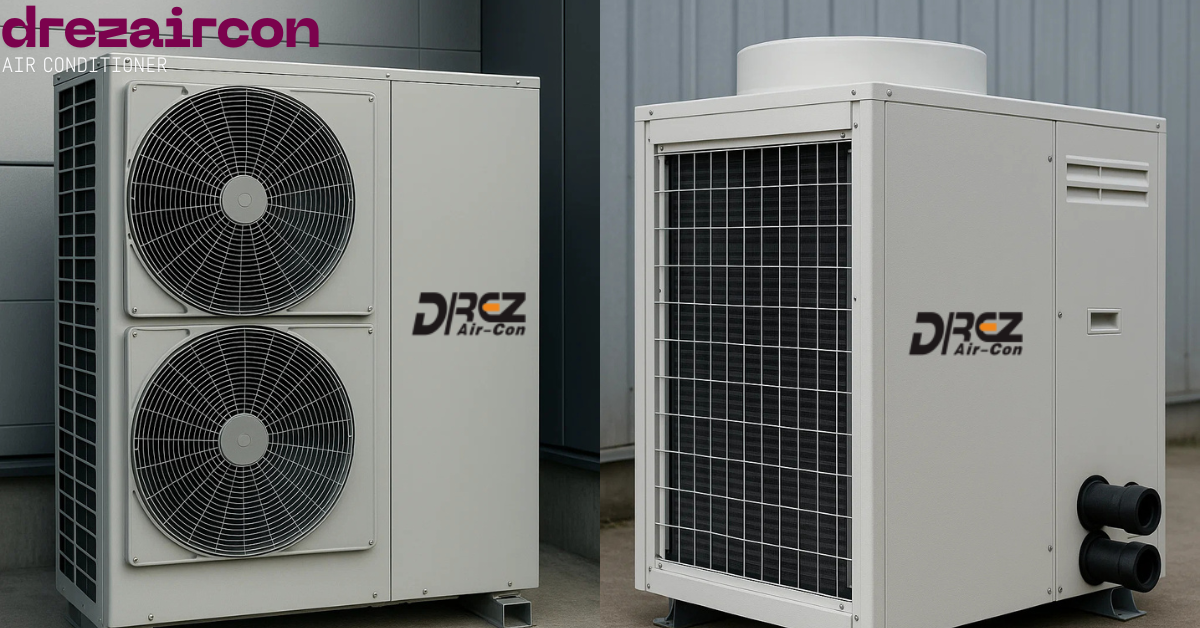
Matching Capacity with Application Type: Choose the unit type (air-cooled or water-cooled) based on available space, water supply, and environmental conditions.
Compatibility with Air Handling Units (AHUs): Ensure balanced airflow and consistent temperature control between AHUs and main chillers.
Load Balancing Between Chillers: Utilise modular systems to distribute the load and enhance redundancy.
Role of Industrial Chiller and Air Handling Units (AHUs)
Chillers in Cooling Load Distribution
Chillers remove heat from process water, which circulates through coils in AHUs.
Air Handling Units for Circulation
AHUs distribute conditioned air efficiently throughout the facility.
Smart Controls and Automation
Variable-speed drives and IoT sensors dynamically optimise cooling output.
Energy-Efficient Industrial Air Conditioning Strategies
Why Energy Efficiency Matters
Industrial air conditioning represents a major operational expense. Improving efficiency lowers costs and emissions.
Drezaircon’s Energy-Saving Technologies
- High-efficiency compressors
- Advanced refrigerants (low GWP)
- Smart temperature control systems
Sustainability and Compliance
Energy-efficient systems help companies meet global green building standards and reduce lifecycle costs.
Advanced Heat Load Estimation Methods
Computational Tools
Software like TRACE™, Carrier HAP, and EnergyPlus enables simulation-based cooling load predictions.
Real-Time Monitoring
AI-driven systems monitor fluctuations and adjust cooling in real-time, optimizing performance.
Air Conditioner Capacity Calculation Formula Explained
Basic Formula
Q = ρ × Cp × V × ΔT
Where:
ρ = air density, Cp = specific heat, V = air volume flow, ΔT = temperature difference.
Example Calculation
For a 1,000 m³ space with ΔT of 10°C and airflow of 5,000 m³/h, calculate required BTUs and convert to TR.
Comparing Industrial Air Conditioner Systems
Air-Cooled vs Water-Cooled
Air-cooled systems are easier to install; water-cooled units offer higher efficiency in large-scale facilities.
Lifecycle Cost Comparison
Water-cooled systems may cost more upfront but save significantly on operational expenses.
Regional Considerations for Industrial Cooling in China
Climate Variations: Coastal areas like Guangzhou require dehumidification; northern zones need more temperature control.
Energy Efficiency Regulations: Complying with China’s GB21454 energy standard ensures better market competitiveness.
Local Support from Drezaircon: Our after-sales network provides fast installation, maintenance, and performance auditing across China.
Maintenance and Optimization After Installation
Schedule regular inspections to prevent performance drop.
Identify refrigerant leaks, airflow blockages, or compressor faults early to avoid downtime.
A manufacturing plant in Shenzhen required a 600TR system to stabilize internal temperatures at 24°C.
After accurate load calculation, Drezaircon installed a modular chiller setup achieving 15% energy savings and consistent humidity control.
Common Pitfalls in Capacity Sizing
- Ignoring equipment heat output
- Relying on residential formulas
- Neglecting air filtration losses
Each mistake can significantly reduce cooling efficiency and increase costs.
Professional Consultation and Support
Drezaircon offers end-to-end HVAC consulting, from load analysis and capacity sizing to equipment installation and lifecycle optimization.
Our engineering team brings years of field experience and deep knowledge of industrial processes, ensuring every project achieves peak performance
Final Calculation and Verification
Always verify your capacity sizing results through real data and field testing before commissioning the system. Fine-tune system controls for stable and efficient operation.
Conclusion
Selecting the correct industrial air conditioner unit capacity is not just about cooling, it’s about optimizing performance, safety, and long-term savings.
Accurate capacity sizing ensures balanced comfort, minimal energy use, and greater equipment longevity.
Drezaircon continues to lead the way in industrial HVAC system design, offering advanced, energy-efficient solutions across China.