Industrial Factory Air Conditioner Solutions are essential for modern manufacturing facilities where stable temperature control directly affects production efficiency, equipment lifespan, employee comfort, and overall operating costs. In factories, excessive heat generated by machinery, production lines, motors, lighting systems, and enclosed workspaces can quickly reduce workforce productivity and increase the risk of machine failure. A properly designed industrial cooling system helps maintain consistent indoor conditions, supports sensitive manufacturing processes, and reduces unplanned downtime caused by overheating.
For industries such as electronics, automotive, textiles, food processing, and steel fabrication, reliable factory cooling solutions are no longer just a facility upgrade they are a core part of operational performance. Advanced industrial HVAC systems now offer high-capacity cooling, modular expansion, smart zoning, ventilation control, and energy-efficient inverter technology to meet the changing demands of large production spaces. By investing in the right commercial air conditioning for factories, businesses can lower energy consumption, improve workplace safety, and create a more productive manufacturing environment.
Industrial Factory Air Conditioner Solutions: Maximize Efficiency and Productivity
In this guide, we will explain how industrial factory air conditioner solutions improve efficiency, reduce energy costs, solve common cooling challenges, and help factories maximize long-term productivity.
In modern manufacturing, temperature control is directly tied to output quality, worker safety, machine reliability, and energy cost control. When production floors, warehouses, and workshops face continuous heat loads from equipment, furnaces, motors, lighting, and high occupancy, ordinary cooling systems are no longer enough. This is where Industrial Factory Air Conditioner Solutions become a critical part of operational strategy.
For factory owners, plant engineers, and facility managers, the right industrial HVAC systems do more than cool air. They stabilize process conditions, reduce equipment failure risks, improve employee comfort, and support long-term cost efficiency. In many industrial sites, cooling can account for 30–60% of total facility energy use, which makes optimization a major profitability lever.
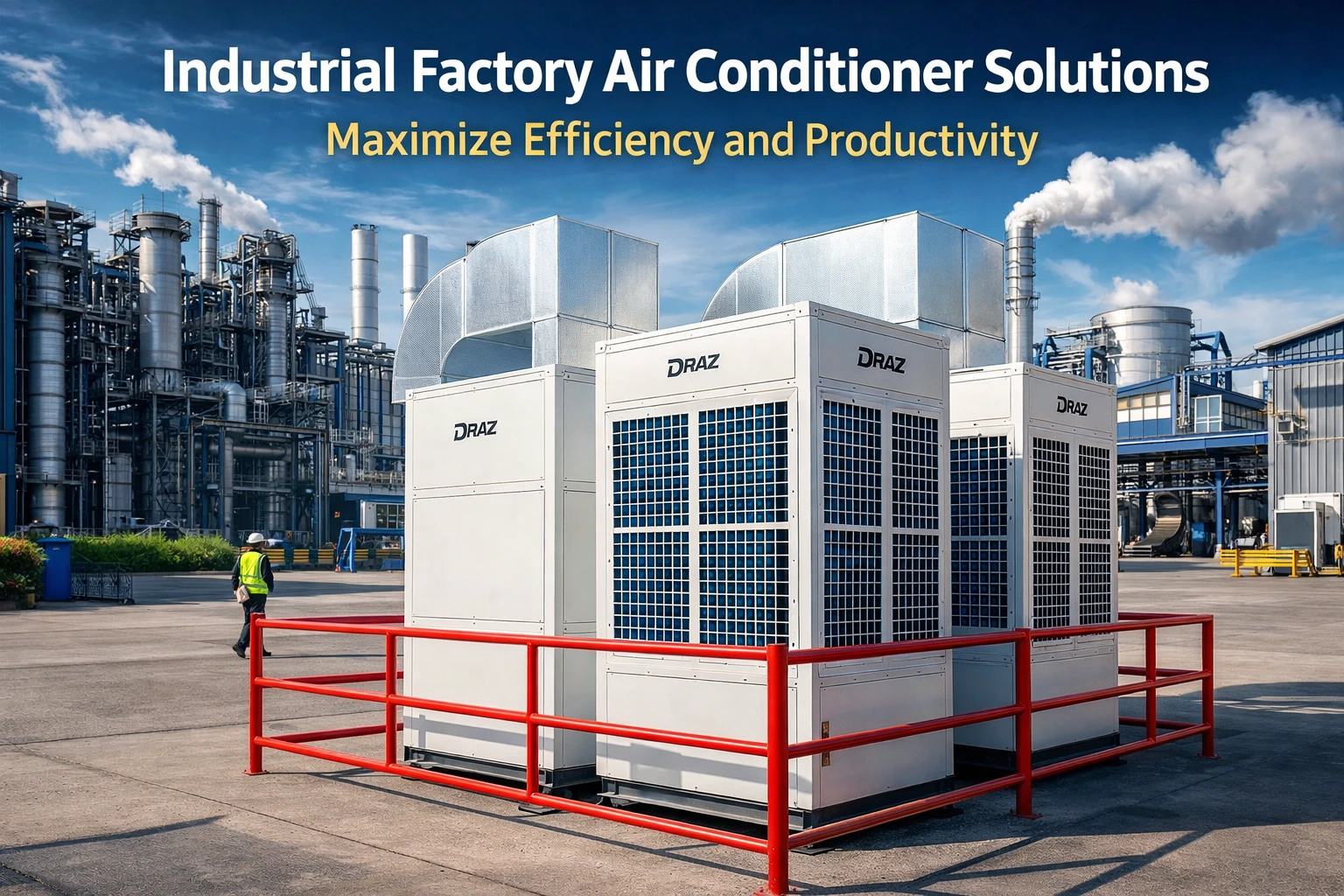
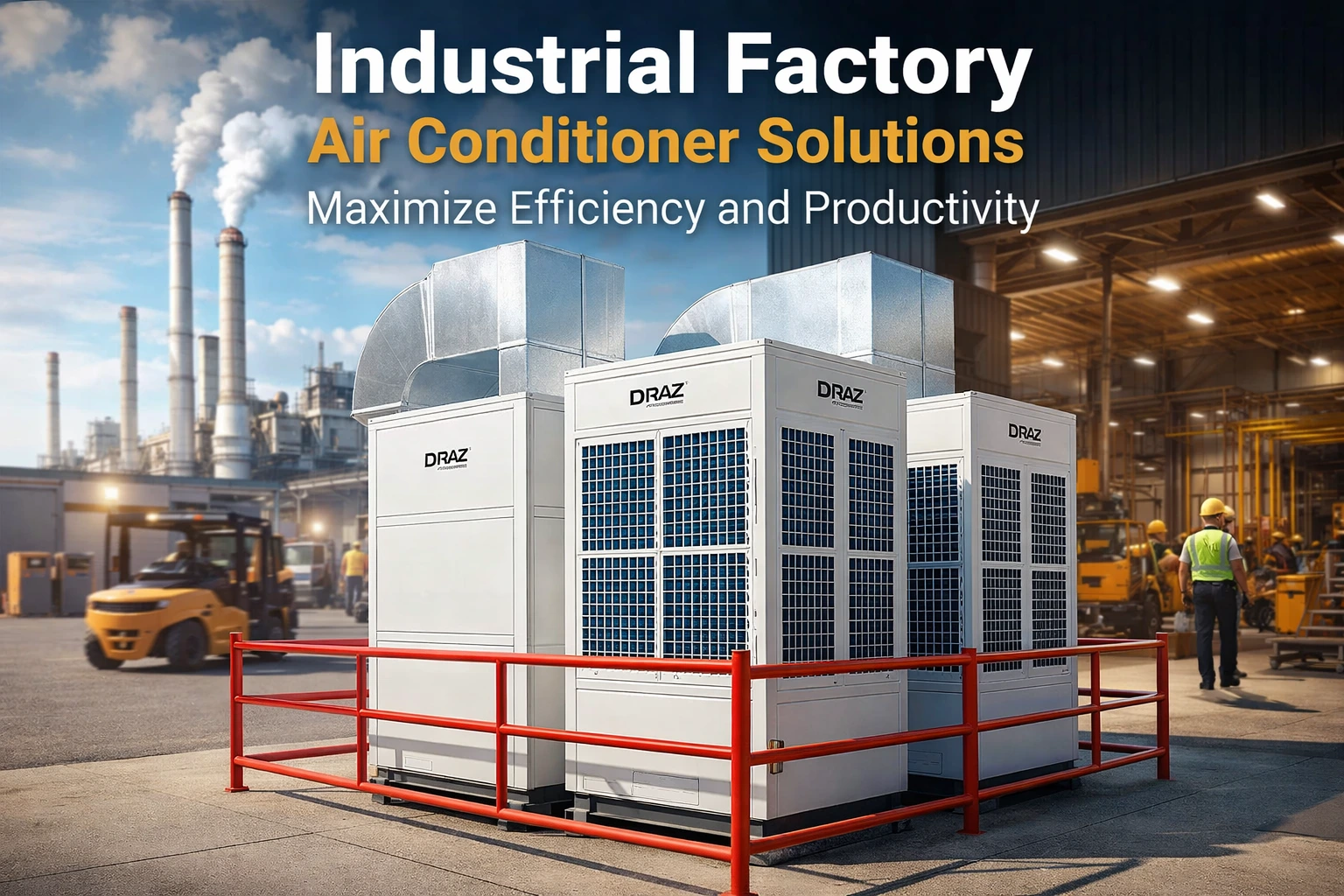
Drezaircon supports this demand with scalable cooling systems for factory buildings, steel structures, production workshops, temporary industrial facilities, and large commercial spaces, including roof-mounted, integrated, and portable high-capacity units designed for continuous industrial operation.
Introduction to Industrial Factory Air Conditioner Solutions
Industrial environments are fundamentally different from offices and retail spaces. Heat generation is dynamic and often uneven, with certain zones running hotter due to machinery clusters, production lines, welding areas, compressors, or packaging equipment.
A well-designed factory cooling solution solves five operational needs:
- Maintain stable indoor temperatures
- Protect temperature-sensitive machinery
- Improve workforce comfort
- Support humidity control where needed
- Reduce downtime caused by overheating
For example, in electronics, food processing, textiles, pharmaceuticals, and automotive manufacturing, even minor thermal instability can affect product consistency and reject rates.
That is why advanced commercial air conditioning for factories now uses:
- zoned cooling
- high-static airflow
- fresh air integration
- smart load balancing
- predictive maintenance controls
- modular expansion design
Benefits of Industrial Factory Air Conditioner Solutions
Improving Factory Productivity and Operational Efficiency
Employee performance and machine stability both decline in overheated environments. Excess heat can slow assembly work, increase operator fatigue, and lead to thermal shutdowns in sensitive equipment.
A stable factory climate control system helps maintain:
- faster production cycles
- fewer machine interruptions
- safer operator conditions
- reduced defect rates
- improved shift consistency
Drezaircon’s industrial systems are specifically built for large-space airflow distribution, which is essential for production workshops where temperature layering often becomes a problem.
Energy-Efficient Factory AC Units to Reduce Costs
Energy efficiency is one of the strongest business cases for upgrading factory AC infrastructure.
Modern energy-efficient factory AC systems improve cost control through:
- inverter compressor control
- VFD fan motors
- load-based cooling
- occupancy zoning
- automated schedule optimization
- weather-responsive cooling logic
Real-world factory case studies show that optimized cooling systems can reduce electricity use by 15–30% annually, depending on zoning accuracy and production variability. Drezaircon documented a large electronics manufacturing deployment where a 32-ton integrated AC system reduced energy cost by 15% over 12 months.
Reliable Climate Control for Manufacturing Facilities
Reliability matters more than raw cooling power.
A strong industrial AC unit must run continuously under:
- dust-heavy conditions
- high ambient temperatures
- vibration-prone environments
- corrosive industrial air
- multi-shift production schedules
Drezaircon’s product line includes portable, trailer, roof, and floor-standing units suitable for both permanent and semi-permanent industrial layouts.
Common Challenges in Factory Cooling
Overheating in Industrial Facilities and Its Impact
Common overheating sources include:
- CNC machinery
- molding lines
- heat treatment zones
- server cabinets
- compressed air rooms
- enclosed packaging halls
Without adequate cooling, businesses face:
- machine derating
- premature motor wear
- increased lubrication breakdown
- product spoilage
- unsafe worker heat exposure
High Energy Costs of Factory Air Conditioning
One major issue with older industrial HVAC systems is overcooling large unused zones.
This happens when:
- one thermostat controls multiple halls
- fixed-speed compressors run at full load
- duct balancing is poor
- fresh air ratios are excessive
- insulation losses are ignored
The result is unnecessary operational expenditure.
Maintenance Challenges and Installation Considerations
Poor planning during installation often creates long-term maintenance problems:
- inaccessible rooftop units
- clogged industrial filters
- poor condensate drainage
- refrigerant inefficiency
- undersized ducts
- weak static pressure
This is why custom industrial AC solutions must begin with a site-specific thermal load study.
Features of Modern Industrial Factory Air Conditioner Solutions
High-Capacity and Modular AC Units
Modern factories need systems that scale with production.
The best high-capacity air conditioners use modular architecture so facilities can:
- add new production zones
- cool warehouse extensions
- support seasonal demand
- create backup redundancy
Drezaircon’s systems span from under 10 tons to 32-ton integrated systems and larger industrial applications, making phased scaling possible.
Custom Industrial AC Solutions for Unique Facilities
Every factory layout differs.
Cooling design must adapt to:
- ceiling height
- heat-generating machinery
- process airflow
- dust exposure
- humidity targets
- temporary expansions
This is especially useful for:
- steel structures
- prefabricated workshops
- emergency production lines
- temporary project facilities
Advanced Temperature Control and Ventilation Technology
Modern industrial ventilation and cooling solutions now integrate:
- IoT sensors
- AI load prediction
- humidity compensation
- predictive maintenance alerts
- multi-zone temperature logic
AI-supported control has already shown 15–30% yearly energy savings in real factory environments by matching cooling load to production schedules.
Applications of Industrial Factory Air Conditioner Solutions
Warehouse and Storage Facility Air Conditioning
Warehouses require stable cooling for:
- inventory preservation
- packaging integrity
- electronics storage
- cold chain support
- worker comfort
Manufacturing Plant Cooling Systems
Production halls need high-volume air throw and stable airflow paths.
This is especially critical in:
- electronics
- automotive
- textiles
- pharmaceutical
- plastics
- food plants
Workshop and Temporary Industrial AC Solutions
One of Drezaircon’s strongest business-fit advantages is temporary industrial cooling deployment.
Its expertise in:
- mobile AC
- trailer AC
- integrated large-space units
- ducted temporary cooling
makes it suitable for:
- project workshops
- maintenance shutdowns
- steel fabrication tents
- overflow production zones
- seasonal expansion plants
This aligns naturally with Drezaircon’s existing strength in large tent and structure cooling.
Choosing the Right Industrial Factory Air Conditioner Solutions
Factors to Consider: Size, Capacity, and Efficiency
Selection starts with:
- hall volume
- machine heat load
- occupancy density
- door opening frequency
- ventilation requirements
- insulation quality
Selecting Energy-Efficient and Reliable Units
Look for:
- inverter systems
- corrosion-resistant coils
- washable industrial filters
- high EER/SEER values
- modular compressors
- strong after-sales support
Evaluating Installation and Maintenance Support
The best ROI comes from lifecycle support:
- installation planning
- commissioning
- airflow balancing
- preventive service
- spare parts access
- future expansion compatibility
Drezaircon’s support model around manufacture, sale, and lease gives additional flexibility for project-based factories and temporary industrial deployments.
FAQs on Industrial Factory Air Conditioner Solutions
1) What is the best cooling system for a factory?
A zoned industrial HVAC system with modular expansion, smart controls, and high static airflow is usually the best choice for factories. It allows different production zones to maintain stable temperatures based on machinery heat load and occupancy.
2) How much energy can industrial AC save?
Optimized smart cooling systems can reduce annual cooling energy use by 15–30%, depending on plant layout, insulation quality, production schedules, and control accuracy.
3) Can factory AC systems be used in temporary workshops?
Yes. Portable, trailer-mounted, and integrated ducted systems are highly effective for temporary workshops, steel structures, maintenance zones, and seasonal production expansion facilities.
4) How often should industrial AC systems be serviced?
Quarterly preventive maintenance is recommended for most industrial environments. In dust-heavy production plants, monthly filter inspections and coil cleaning help maintain efficiency and airflow quality.
5) Why is Drezaircon suitable for factory cooling?
Drezaircon specializes in large-space industrial cooling, rooftop systems, portable units, integrated high-tonnage systems, and temporary structure HVAC, making its solutions a strong fit for factory and workshop applications.
6) What size industrial air conditioner does a factory need?
The required AC size depends on floor area, ceiling height, machinery heat output, worker density, ventilation demand, and insulation levels. A professional thermal load calculation is the most accurate way to choose the right capacity.
7) What are the main benefits of industrial factory air conditioner solutions?
The main benefits include:
- better worker comfort
- reduced equipment overheating
- improved production consistency
- lower downtime risks
- better humidity and climate control
- long-term energy savings
8) Can industrial factory AC systems improve productivity?
Yes. Stable temperature control reduces employee fatigue, protects machines from thermal shutdown, and creates a more consistent manufacturing environment, which can directly improve output quality and production speed.
9) What features should I look for in a factory cooling system?
Key features include:
- inverter compressor technology
- modular design
- zoning controls
- high-capacity airflow
- washable industrial filters
- smart sensors
- predictive maintenance alerts
- durable anti-corrosion coils
10) Are industrial factory air conditioner solutions suitable for warehouses?
Absolutely. These systems are widely used for warehouse cooling, storage temperature control, packaging areas, logistics hubs, and inventory protection, especially for electronics, food, and temperature-sensitive materials.
Final thoughts:
The right Industrial Factory Air Conditioner Solutions strategy directly impacts:
- productivity
- machine lifespan
- employee retention
- utility bills
- operational uptime
- product quality
For facilities managing large heat loads, scalable and energy-optimized factory cooling solutions are no longer optional they are core infrastructure.
With Drezaircon’s experience across factories, steel structures, workshops, tents, and temporary industrial facilities, businesses can deploy cooling systems that match both immediate production needs and long-term expansion goals.