Industrial window air conditioner systems play a critical role in maintaining stable and safe working environments across factories, warehouses, workshops, and commercial facilities. Unlike residential cooling units, industrial window air conditioners are designed to operate under higher heat loads, longer daily runtimes, and demanding environmental conditions where equipment heat, electrical systems, and continuous production generate excess thermal stress.
In many industrial buildings, installing a centralized HVAC system is either impractical or cost-prohibitive. Older factory structures, segmented work zones, temporary production areas, and equipment rooms often require localized, dependable cooling rather than full-building air conditioning. This is where industrial-grade window-mounted air conditioners offer a practical solution by delivering focused cooling with minimal installation requirements.
From manufacturing plants and control rooms to maintenance workshops and storage facilities, these units help protect sensitive equipment, improve worker comfort, and support operational efficiency. Their ability to provide direct cooling, combined with robust construction and higher cooling capacity, makes them a preferred choice for facility managers and industrial buyers seeking reliable performance without complex infrastructure changes.
As industrial operations continue to demand efficiency, uptime, and cost control, understanding how industrial window air conditioners work and where they fit within broader cooling strategies becomes essential for making informed decisions.
Industrial Window Air Conditioner: A Complete Guide for Factories & Commercial Spaces
Industrial and commercial facilities operate under very different cooling conditions than residential environments. High heat loads, continuous operation, equipment-generated temperatures, and strict uptime requirements demand cooling solutions that are reliable, efficient, and easy to deploy.
Among the available options, the industrial window air conditioner remains a practical and widely used solution for factories, workshops, warehouses, and control rooms where centralized HVAC systems are not feasible or cost-effective.
This guide explains how industrial window air conditioners work, where they are used, how to select the right unit, and how they compare with other industrial cooling solutions giving facility managers and procurement teams the information they need to make informed decisions.
What Is an Industrial Window Air Conditioner?
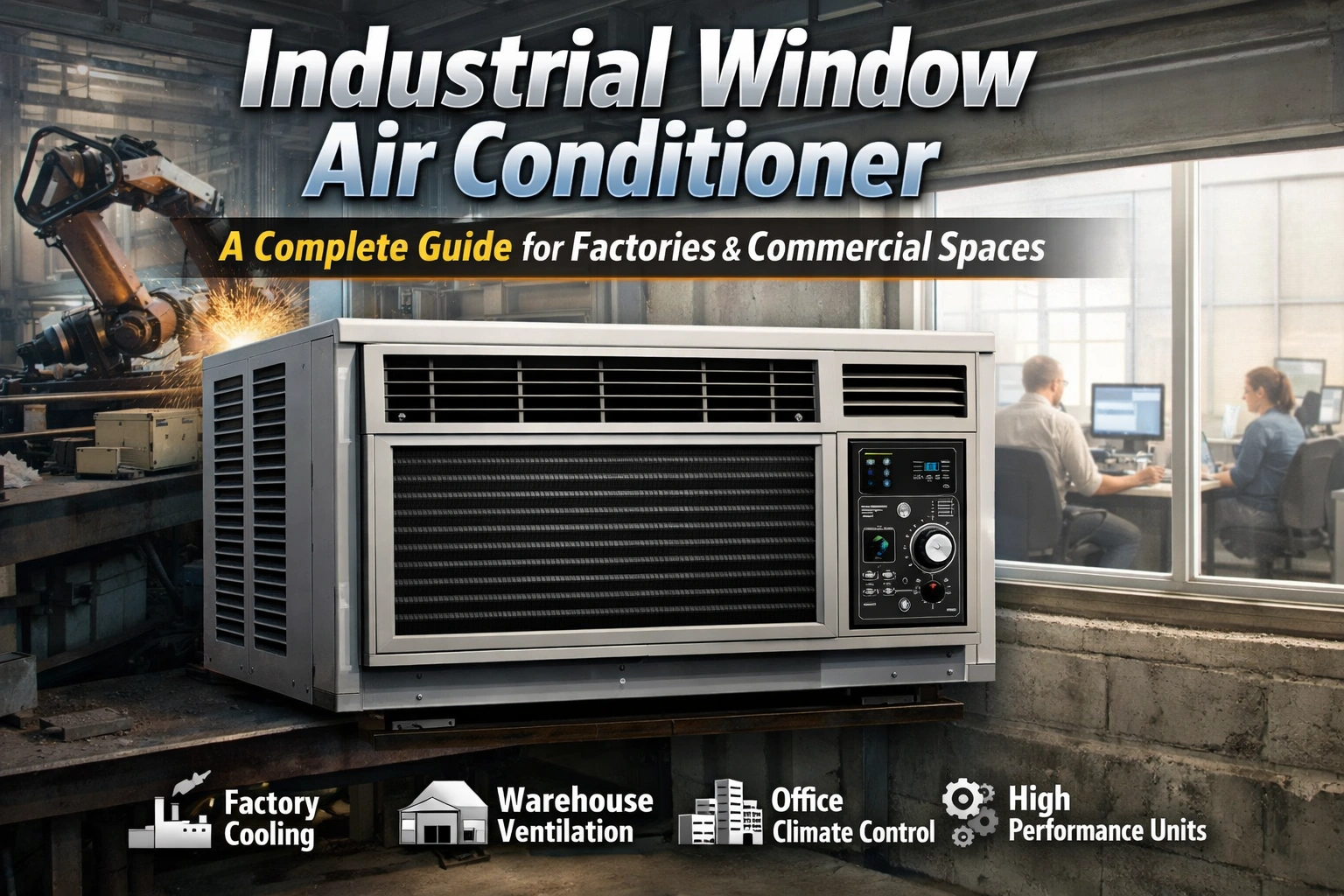
An industrial window air conditioner is a window- or wall-mounted cooling unit designed specifically for commercial and industrial applications. Unlike residential window ACs, industrial-grade units are engineered to handle higher thermal loads, longer operating hours, and harsher environments.
Difference Between Industrial and Residential Window AC Units
The key differences include:
- Cooling capacity: Industrial window AC units typically range from 18,000 BTU to 60,000+ BTU, compared to 5,000–12,000 BTU for residential units.
- Duty cycle: Designed for continuous or extended operation, often 16–24 hours per day.
- Construction: Reinforced cabinets, corrosion-resistant coils, and heavy-duty compressors.
- Electrical requirements: Many industrial units support three-phase power or higher voltage options.
- Application focus: Built for factories, workshops, equipment rooms, and industrial buildings not living spaces.
Why Industrial Window AC Units Are Used in Commercial Environments
Industrial window air conditioners are commonly selected because they:
- Do not require ductwork or centralized HVAC systems
- Can be installed quickly in existing structures
- Offer localized cooling for specific zones
- Reduce upfront installation costs
- Provide reliable cooling in remote or temporary industrial spaces
Key Applications of Industrial Window Air Conditioners
Window Air Conditioner for Factories and Manufacturing Units
Factories often generate heat from machinery, production lines, and electrical equipment. Installing a centralized HVAC system may not be practical, especially for older buildings.
Industrial window AC units are used to:
- Cool production control areas
- Maintain operator comfort
- Protect temperature-sensitive machinery
- Stabilize working conditions near heat-generating processes
Industrial Window AC for Warehouses and Workshops
Warehouses and workshops typically require spot cooling rather than full-space air conditioning. Window-mounted industrial air conditioners are often installed in:
- Supervisor offices
- Packing stations
- Equipment maintenance areas
- Tool rooms
This approach reduces energy consumption while maintaining acceptable working conditions.
Cooling Solutions for Control Rooms and Equipment Rooms
Control rooms, server rooms, and electrical rooms require consistent temperature control. Industrial window AC units are favored because:
- They operate independently of building HVAC
- They can be dedicated to critical rooms
- They offer predictable cooling capacity
- They reduce the risk of system-wide failure
Window-Mounted AC for Temporary Industrial Spaces
Temporary production areas, modular buildings, and site offices often rely on window-mounted industrial air conditioners due to:
- Fast installation
- Easy relocation
- Minimal infrastructure requirements
- Compatibility with temporary wall panels
Key Features of an Industrial Window Air Conditioner
High Cooling Capacity and Continuous Operation
Industrial window air conditioners are built to deliver stable cooling under high ambient temperatures. Many models are designed to operate effectively in environments exceeding 45°C (113°F), making them suitable for heavy industrial use.
Heavy-Duty Construction and Industrial-Grade Components
Key design elements include:
- Reinforced steel cabinets
- High-efficiency copper tube condensers
- Industrial-grade compressors
- Vibration-resistant mounting systems
These features extend service life and reduce downtime.
Efficient Airflow and Heat Dissipation Design
Industrial units use:
- High-static-pressure fans
- Optimized airflow paths
- Larger condenser surfaces
This ensures consistent cooling performance even under high heat loads.
Power Supply and Voltage Requirements
Depending on capacity, industrial window AC units may require:
- 220V single-phase power
- 380V or 415V three-phase power
- Dedicated electrical circuits
Power compatibility is a critical selection factor for industrial buyers.
Cooling Capacity and Performance Considerations
Understanding BTU and Tonnage for Industrial Window AC Units
Cooling capacity is measured in BTU (British Thermal Units) or tons of refrigeration:
- 12,000 BTU ≈ 1 ton
- 36,000 BTU ≈ 3 tons
- 60,000 BTU ≈ 5 tons
Industrial window air conditioners typically start at 1.5 tons and go upward based on application needs.
Matching Cooling Capacity to Room Size and Heat Load
Capacity selection must consider:
- Room size and ceiling height
- Heat output from machinery
- Number of occupants
- Ambient temperature
- Insulation quality
For example, a control room with multiple electrical panels may require significantly more cooling than a similarly sized office.
Temperature Control in High-Heat Industrial Environments
In factories operating heavy machinery, temperature stability—not just cooling—is critical. Industrial window AC units provide:
- Precise thermostat control
- Fast heat removal
- Localized temperature management
Installation Requirements for Industrial Window Air Conditioners
Wall and Window Mounting Options
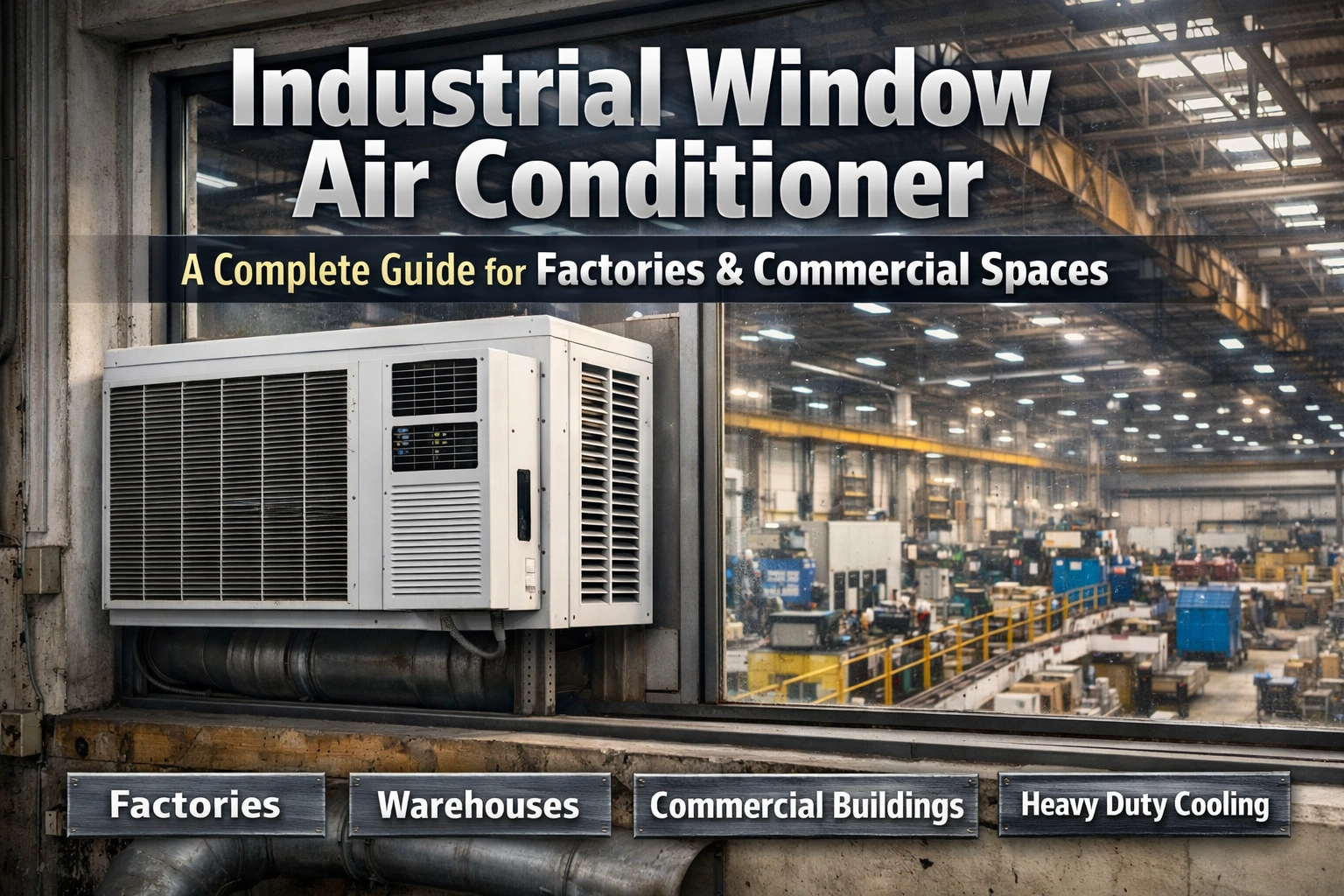
Industrial window AC units can be:
- Installed through reinforced windows
- Mounted through wall cutouts
- Integrated into sandwich panels or metal walls
Structural support is essential due to unit weight.
Electrical and Structural Requirements
Installation planning should include:
- Load-bearing wall assessment
- Electrical circuit capacity
- Proper grounding
- Drainage for condensate
Failure to address these factors can reduce unit lifespan.
Installation Best Practices for Industrial Facilities
Best practices include:
- Sealing gaps to prevent air leakage
- Ensuring unrestricted airflow
- Allowing service access
- Protecting units from direct debris exposure
Industrial Window Air Conditioner vs Other Cooling Solutions
Industrial Window AC vs Portable Air Conditioner
| Feature | Window AC | Portable AC |
|---|---|---|
| Cooling capacity | Higher | Limited |
| Installation | Fixed | Temporary |
| Stability | High | Moderate |
| Best use | Permanent zones | Short-term needs |
Window-Mounted AC vs Split Air Conditioning Systems
Split systems offer higher efficiency but require:
- Indoor and outdoor unit installation
- Refrigerant piping
- Higher installation costs
Window-mounted industrial AC units remain preferred for fast deployment and cost control.
When to Choose a Packaged or Trailer-Mounted Air Conditioner
For large tents, events, or industrial halls, packaged or trailer-mounted air conditioners like those offered by Drez Aircon are more suitable than window units due to:
- Higher airflow
- Larger coverage
- Centralized cooling distribution
Energy Efficiency and Operating Cost Factors
Energy-Efficient Industrial Window AC Technologies
Modern industrial window air conditioners may include:
- High-efficiency compressors
- Optimized heat exchangers
- Improved fan motor designs
These features reduce energy consumption per cooling unit delivered.
Power Consumption and Cost Optimization
Operating cost depends on:
- Daily runtime
- Load matching
- Ambient temperature
- Maintenance quality
Oversized units increase energy waste, while undersized units increase wear.
Reducing Energy Loss in Industrial Cooling Applications
Energy efficiency improves when:
- Units are properly sealed
- Filters are cleaned regularly
- Airflow paths remain unobstructed
- Units are sized correctly
Maintenance and Reliability in Industrial Use
Routine Maintenance for Industrial Window Air Conditioners
Recommended maintenance includes:
- Filter cleaning every 2–4 weeks
- Coil inspection quarterly
- Electrical connection checks
- Drainage inspection
Common Performance Issues and Troubleshooting
Typical issues include:
- Reduced airflow due to dirty filters
- Compressor overheating from blocked ventilation
- Electrical faults due to unstable power supply
Early detection prevents downtime.
Ensuring Long Service Life in Commercial Environments
Consistent maintenance can extend unit lifespan beyond 8–10 years in industrial settings.
How to Choose the Right Industrial Window Air Conditioner
Key Selection Criteria for Industrial Buyers
Buyers should evaluate:
- Cooling capacity
- Power compatibility
- Operating environment
- Maintenance access
- Manufacturer support
Capacity, Power, and Application Matching
Correct matching ensures:
- Stable operation
- Lower energy costs
- Reduced maintenance frequency
Custom and OEM Options for Industrial Projects
For specialized requirements, OEM manufacturers like Drez Aircon provide customized industrial cooling solutions tailored to project conditions.
Why Industrial Buyers Choose Professional HVAC Manufacturers
Importance of Manufacturer Experience and Product Quality
Industrial cooling equipment must perform reliably under stress. Experienced manufacturers understand:
- Industrial thermal challenges
- Compliance standards
- Application-specific design needs
Customization, Technical Support, and After-Sales Service
Professional HVAC manufacturers offer:
- Technical consultation
- Product customization
- Spare parts availability
- After-sales support
These factors reduce operational risk.
Industrial Window Air Conditioner Solutions for Factories & Commercial Spaces
Industrial window air conditioners remain a practical, cost-effective solution for localized cooling in factories and commercial facilities. When selected and installed correctly, they deliver reliable performance, manageable operating costs, and long service life.
For larger-scale or specialized applications such as tents, temporary industrial structures, or high-capacity cooling Drez Aircon’s packaged and industrial HVAC solutions provide scalable alternatives designed for demanding environments.