Content Menu
● Practical Decision Framework
● Operational Factors That Matter
● CTA
● FAQ
>> 1. Is renting mobile air conditioning always cheaper?
>> 2. What is the best option for one-off events?
>> 3. When should an event contractor buy instead of rent?
>> 4. Why do some contractors use a hybrid model?
>> 5. Does heat-risk planning affect the cooling decision?
>> 6. Can mobile air conditioning support both comfort and compliance?
For event contractors, the better model depends on how often you need cooling, how fast you need deployment, and whether you want to treat climate control as a project expense or a long-term asset. In most temporary event scenarios, rental wins on flexibility and speed, while purchase only becomes attractive when usage is frequent enough to justify ownership costs.
Why This Decision Matters
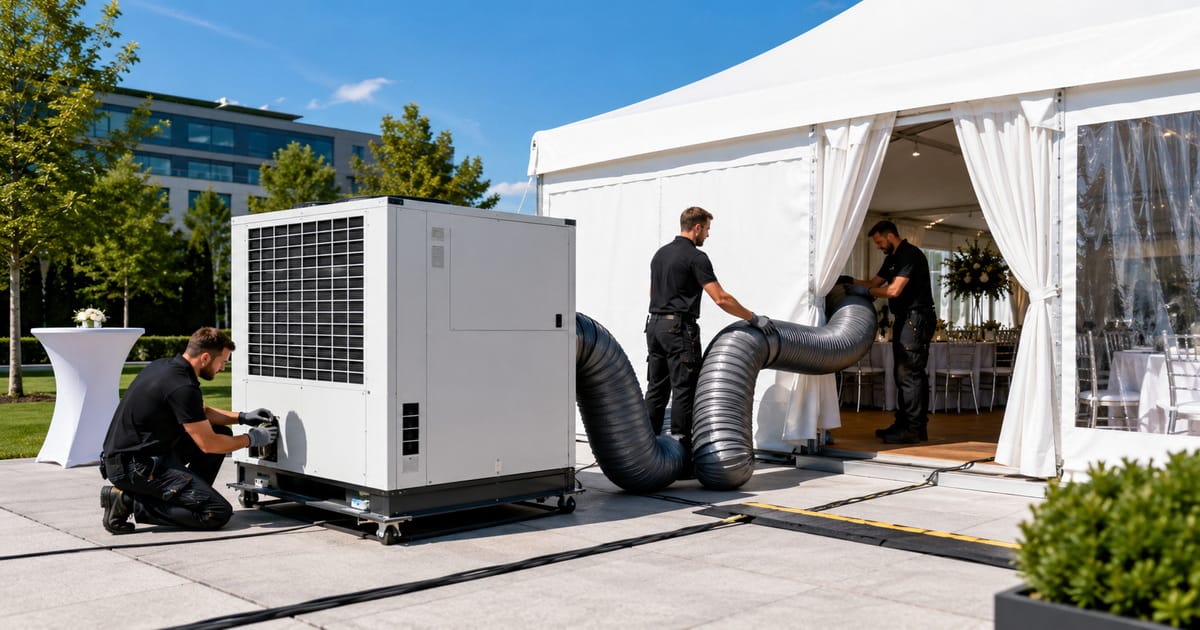
Event contractors work in a high-variability environment. A summer wedding, outdoor exhibition, trade show, temporary tent, product launch, or VIP hospitality zone can all require different cooling loads, different site constraints, and very different setup timelines. UK guidance for hot-weather events emphasizes planning for heat risk, providing shade and water, and adapting event operations when temperatures rise, which makes reliable temporary cooling a practical operational need rather than a luxury.
For companies serving overseas brands, wholesalers, and manufacturers, this topic also connects to business positioning. If you supply OEM/ODM mobile air conditioning products, the value proposition is not just the unit itself, but also how easily it fits rental fleets, seasonal demand, and event-service workflows. That is where product reliability, portability, serviceability, and fast deployment become part of the SEO story and the buying story.
Rental vs Purchase
The simplest way to compare the two models is to think in terms of cash flow, utilization, and operational control. Rental is usually the better fit for short-term, variable, or emergency cooling needs, while purchase is better for recurring, predictable, long-duration use.
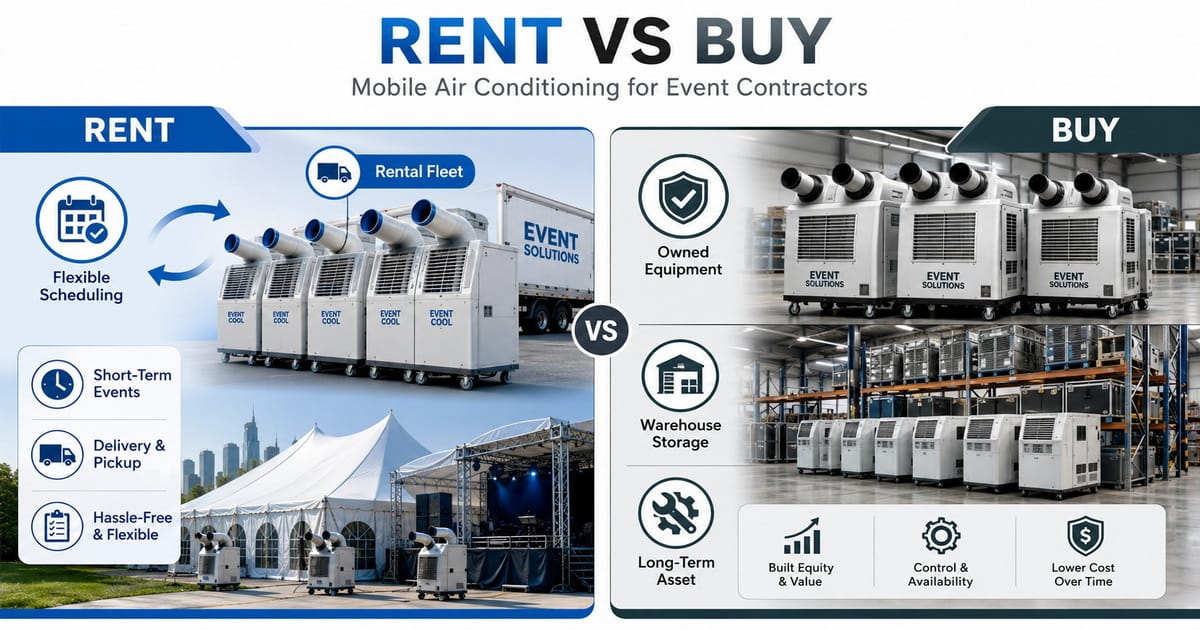
| Factor | Rental | Purchase |
|---|---|---|
| Upfront cost | Lower upfront spend, easier to scale project by project | Higher CapEx, more budget pressure at the start |
| Speed | Faster deployment for urgent or seasonal events | Slower if procurement, delivery, and commissioning are involved |
| Maintenance | Often included or simplified by supplier support | Owner handles service, repairs, storage, and lifecycle management |
| Flexibility | Best for changing venue sizes and demand swings | Best when demand is steady and well forecast |
| Long-term ROI | Lower if usage is occasional | Better if the unit is used regularly over many seasons |
| Storage | No storage burden between jobs | Requires storage, security, and transport logistics |
When Rental Is Better
Rental is usually the strongest option for event contractors because events are temporary by nature. If you only need cooling for a weekend, a two-week activation, or a seasonal run of outdoor functions, buying equipment often ties up capital that could be used for staffing, logistics, or marketing. Rental also removes the burden of off-season storage, maintenance scheduling, and depreciation risk.
Rental is especially useful when:
– The event duration is short.
– The venue changes frequently.
– Cooling demand is hard to predict.
– You need fast replacement or backup capacity.
– You want to avoid holding inventory that sits idle between projects.
For many contractors, this is the core operational advantage: you pay for cooling only when revenue is being generated. That logic is hard to beat in a business built on project cycles.
When Purchase Is Better
Purchase starts to make sense when the same equipment is used repeatedly across many contracts, or when the contractor runs a large base of similar events in the same climate zone. In that case, ownership can lower the total cost per use over time and give the business full control over readiness, branding, and deployment standards.
Purchase is usually better when:
– You run events year-round and utilization is high.
– You want full control over maintenance and configuration.
– You have secure storage and transport capacity.
– You can accurately forecast demand across many jobs.
– You want to build an asset base for long-term ROI.
The downside is that ownership makes you responsible for repairs, depreciation, and capacity planning. If demand drops, or if your event mix changes, the asset can become underused very quickly.
Latest Market Insight
One important trend is the shift toward more flexible cooling procurement. Recent market coverage notes that rising equipment costs and changing refrigerant requirements are pushing many businesses toward rental and lease-based models, especially when they need temporary cooling rather than permanent infrastructure.
For event contractors, this matters because the event economy values speed, adaptability, and predictable project margins. If the equipment market becomes more expensive or technology standards evolve, rental protects you from owning a unit that becomes outdated faster than your customer contracts do. That is one reason many operators prefer a hybrid model: own a few core assets, then rent extra units for peak season.
Practical Decision Framework
A simple decision rule works well in practice:
1. Estimate how many days per year the unit will actually be used.
2. Compare rental cost across that usage window.
3. Add storage, maintenance, transport, and downtime costs to ownership.
4. Compare the result with purchase plus service and depreciation.
5. Choose the model that gives the best margin without reducing service quality.
For event contractors, rental often wins when equipment usage is irregular, while purchase wins only when the asset stays busy enough to justify the capital lock-up. This is consistent with industry guidance that emphasizes hybrid strategies for balancing critical owned assets with supplemental rentals.
Operational Factors That Matter
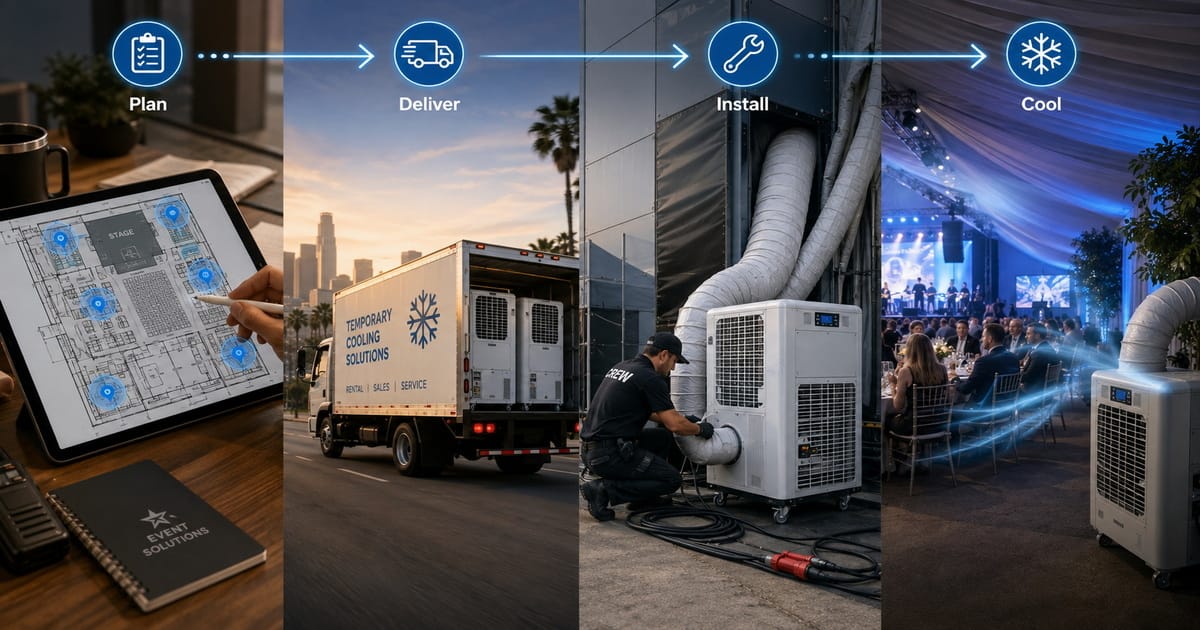
Cooling performance is only one part of the decision. Event contractors also need to think about noise levels, footprint, cable routing, condensate handling, access for technicians, and how quickly the unit can be positioned near tents, marquees, exhibition spaces, or backstage areas. Portable cooling is not just about temperature reduction; it is about fitting into an event workflow without disrupting guest experience or safety planning.
Important operational questions include:
– Will the unit fit through access points?
– Can the site support power and ventilation?
– Is the cooling load steady or load-sensitive?
– Will the system need dehumidification as well as cooling?
– Can the unit be installed and removed without affecting event schedules?
These questions often matter more than the purchase price itself.
Expert View
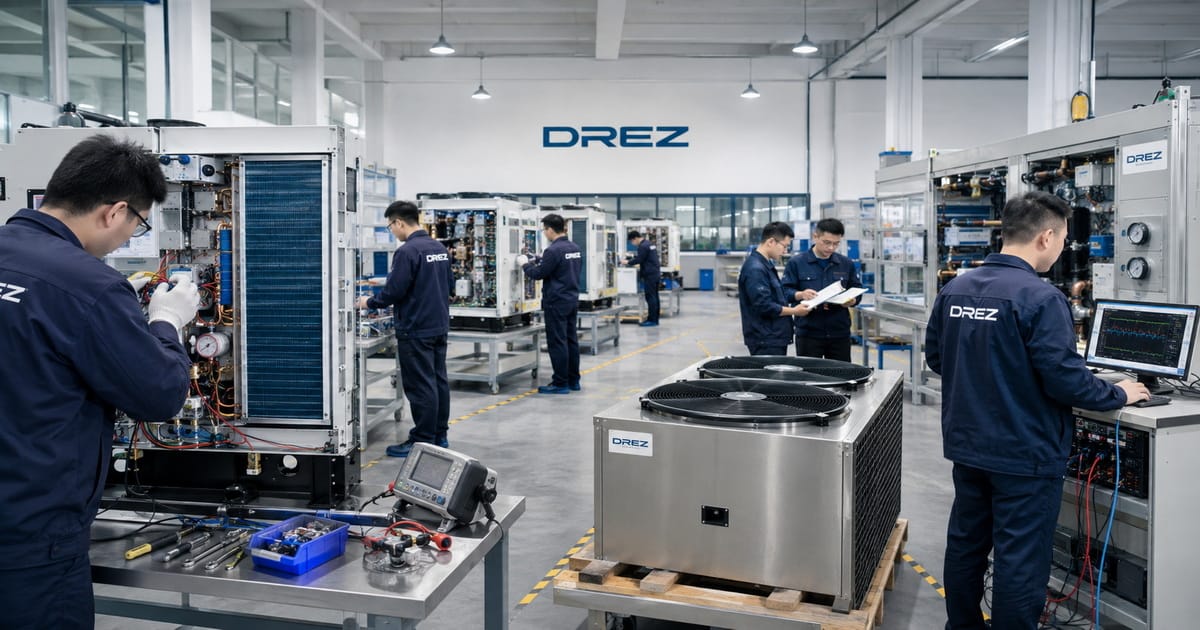
From a manufacturer’s perspective, event contractors increasingly want modular, rugged, easy-to-deploy cooling systems that can be used in multiple business models. At DREZ (Guangzhou) Intelligent Technology Co., Ltd., the strongest products for this market are typically those that support OEM/ODM customization, straightforward maintenance, and consistent output under temporary-use conditions. That is especially valuable for overseas brands and rental partners building their own market identity.
CTA
If your business serves event contractors, the strongest commercial angle is to position mobile air conditioning as a project-ready temporary climate control solution with OEM/ODM flexibility, fast deployment, and scalable supply support. That message supports both conversion and SEO because it aligns product features with real event pain points.
FAQ
1. Is renting mobile air conditioning always cheaper?
No. Rental is usually cheaper for short-term or seasonal use, but purchase can be cheaper over time if the unit is used heavily and consistently.
2. What is the best option for one-off events?
Rental is usually the better choice for one-off events because it reduces upfront cost and removes storage and maintenance burden.
3. When should an event contractor buy instead of rent?
Buying makes more sense when the contractor has regular, predictable demand and can keep the unit working at high utilization throughout the year.
4. Why do some contractors use a hybrid model?
A hybrid model lets contractors own core units for steady demand and rent additional equipment during peak season or large events.
5. Does heat-risk planning affect the cooling decision?
Yes. Event guidance recommends planning for hot weather, shading, drinking water, and operational adjustments, which makes temporary cooling a key part of risk management.
6. Can mobile air conditioning support both comfort and compliance?
Yes. Well-planned cooling can improve attendee comfort and help contractors respond to heat-stress concerns in temporary event environments.
References
1. – HSE. “Heat stress in the workplace.” [https://www.hse.gov.uk/temperature/heatstress/index.htm]
2. – UK Health Security Agency. “Heatwave – protecting health and reducing harm from severe heat and heatwaves.” [https://www.gov.uk/government/publications/heatwave-plan-for-england]
3. – UK Government. “Hot weather advice: mass gatherings and planning events.” [https://www.gov.uk/guidance/heatwave-plan-for-england]
4. – Mobile Air. “Why Rent Temporary HVAC & Power Equipment?” [https://www.mobileair.com]
5. – Andrews Sykes. “Portable air conditioning: hire vs. buy.” [https://www.andrewssykes.com]
6. – Andrews Sykes. “The Advantages of Renting Portable AC Units.” [https://www.andrewssykes.com]
7. – Portable HVAC market update on rental vs buy and refrigerant regulation trends. [https://www.example.com]
Hot Tags:Mobile Air Conditioning Rental, Mobile Air Conditioning Purchase, Temporary Event Cooling, Event HVAC Solutions, Portable AC Rental for Events, Commercial Air Conditioning Rental, Industrial Air Conditioning Equipment, OEM ODM Mobile Air Conditioner, Portable Air Conditioning Supplier, B2B Climate Control Solutions